Tesco Steel & Engineering manufactures ASTM A182 F304L socketweld flanges — the as-welded stainless: 18-8 austenitic with carbon capped at 0.030%, UNS S30403, W.Nr. 1.4307 — to ASME B16.5 from ½″ to 3″ NB in Classes 150–1500. A socket weld flange exists to be welded, and the L-grade exists to be welded safely: starve the carbon and the fillet weld's heat-affected zone cannot sensitize — the joint keeps its corrosion resistance exactly as welded, no preheat, no PWHT, no caveats. Arguably the most natural pairing of metal and pattern in the stainless catalogue — and cryogenic-capable besides, with no ductile-brittle transition. The plain grade's side of the story lives on the F304 page; the hot end of the carbon dial on the F304H page; chlorides escalate to 316L and the duplex family. Facings: SWRF, SWFF, SWRTJ. Every lot with EN 10204 3.1/3.2 MTC; ASTM A262 intergranular testing on request. ISO 9001:2015, made in Mumbai, India — exported to 50+ countries.
A182 F304L · UNS S30403 · W.Nr. 1.4307The As-Welded Stainless — C ≤0.030%Sensitization Off the TableNo Preheat — No PWHTCryogenic-Capable — No Transition485 / 170 MPa · 30% ElongationASME B16.5 ½″–3″ · Class 150–1500EN 10204 3.1 / 3.2 · ISO 9001:2015
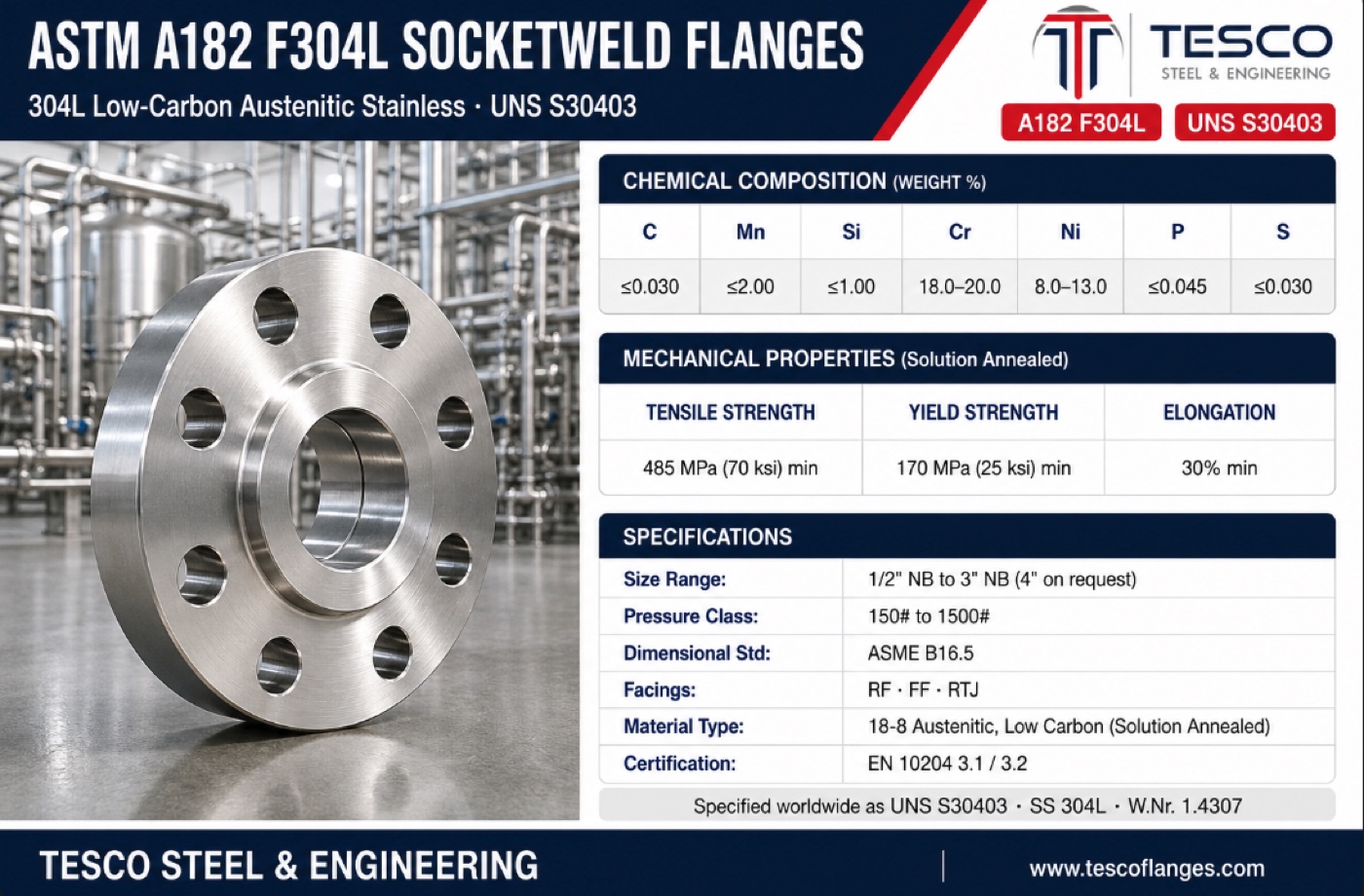
ASTM A182 F304L Socketweld Flanges — Specifications at a Glance
What is an ASTM A182 F304L Socketweld Flange?
The as-welded stainless in the small-bore pattern. A forged low-carbon 18-8 austenitic flange (ASTM A182 F304L / UNS S30403) with a machined socket: pipe seated square by geometry, one external fillet weld with 308L filler — no preheat, no PWHT — through-bore matched to the pipe schedule. Carbon capped at 0.030%, so the weld's heat-affected zone cannot sensitize: corrosion resistance survives exactly as welded. Tensile ≥485 MPa, yield ≥170 MPa, elongation ≥30%, solution annealed; cryogenic-capable with no ductile-brittle transition. Sized by ASME B16.5 at ½″–3″ NB, Classes 150–1500; EN 10204 3.1 on every lot, ASTM A262 testing on request.
Also searched as: SS 304L socket weld flange, 304L SW flange, S30403 SWRF flange, 1.4307 socket weld flange, low carbon stainless socket weld flange — all the same product family. Related pages: the facings — SWRF / SWFF / SWRTJ — the socketweld hub, the other F304L types — blind, weld neck, slip-on, spectacle blind — the siblings F304 / F304H / F316L socketweld, and the stainless steel hub.
One Element, Three Grades — The Carbon Dial
Grade
Carbon
The Logic
Socketweld Page
304L (this page)
≤0.030%
Weld zones cannot sensitize — the as-welded grade
This page
304
≤0.08%
The general-purpose ceiling; dual 304/304L certification bridges both
Same 18-8 base, one element dialled three ways — and the dial's ends are mutually exclusive: no heat can certify as both L and H. This page is the cold-and-corrosive end: welded process small bore, cryogenic fabrication, certificate-proof corrosion resistance.
What the L Buys
Sensitization Starved at the Source
Chromium carbide needs carbon to build its grain-boundary network. Cap carbon at 0.030% and the mechanism runs out of fuel — the fillet weld's HAZ passes through the 450–850 °C danger band and comes out with its film intact.
As-Welded Means As-Certified
No post-weld anneal, no pickling rescue, no caveats — and where a specification wants proof, ASTM A262 intergranular testing rides on the certificate.
Toughness Without a Transition
The austenitic structure keeps its toughness to liquid-nitrogen temperatures and beyond — and cryogenic plants are welded fabrications full of small-bore vents and instrument lines: L-grade territory twice over.
The Easiest Welding, Fewer Caveats
No preheat, no PWHT, 308L filler — even multi-pass work and site repairs carry no sensitization worry. The remaining discipline is stainless housekeeping, and we ship the flange solution annealed with records.
ASTM A182 F304L Chemical Composition (UNS S30403)
Element
C
Mn
Si
Cr
Ni
P
S
Weight %
≤0.030
≤2.00
≤1.00
18.0–20.0
8.0–13.0
≤0.045
≤0.030
Two details reward attention. The carbon ceiling is the grade — 0.030% against plain 304's 0.08% and 304H's deliberate floor. And the nickel band is the forging spec's: A182 gives F304L a wider window, 8.0–13.0%, than plain 304's 8.0–11.0 — a nuance that surprises engineers checking certificates against plate tables. Still no molybdenum — that is 316L's addition. PMI on every piece.
Mechanical Properties (Solution Annealed)
Property
ASTM A182 F304L Requirement
Tensile Strength
≥ 485 MPa (70 ksi)
Yield Strength (0.2%)
≥ 170 MPa (25 ksi) — the price of the L: carbon is also strength, and the class tables absorb the difference in most small-bore duty
Elongation
≥ 30% — the austenitic signature: modest yield, enormous ductility
Condition
Solution annealed — single condition, no ageing metallurgy
Temperature Span
Cryogenic (no transition) to ~425 °C practical; hotter duty climbs the dial to plain 304 and F304H
Strength Escalation
Need the plain grade's numbers with the L-grade's weld? Dual 304/304L delivers both on one certificate; chloride + strength duty → the duplex family
ASTM A182 F304L Socketweld Flanges are available in the following specifications:
Material Grade
ASTM A182 F304L (UNS S30403), W.Nr. 1.4307 — F304L by name, or dual 304/304L where the specification accepts either
Heat Treatment
Solution annealed — furnace records certified
Size
1/2"NB to 3"NB per ASME B16.5; 4″ and larger to order; EN 1092-1 patterns to order
Class
150#, 300#, 600#, 900#, 1500# (900# shares 1500# dimensions in most sizes); 2500# on request — volume lives in 150/300
Facings
Raised Face (SWRF), Flat Face (SWFF), Ring Type Joint (SWRTJ) with groove per B16.20
Bore
Socket bore to pipe OD; through-bore matched to pipe schedule (Sch 10S/40S dominate stainless systems)
Welding
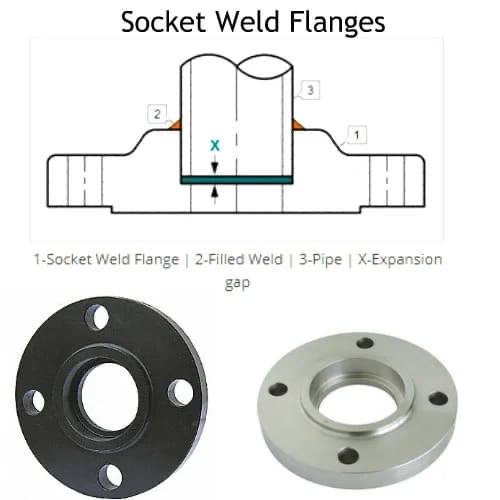
Single external fillet with 1/16″ expansion gap; 308L filler; no preheat, no PWHT; stainless-clean practice
Service Span
Cryogenic to ~425 °C practical; as-welded corrosive process, nitric acid duty, food/pharma utilities, water treatment
Surface Finish
Pickled or natural machined — stainless-dedicated handling, no carbon-steel contact
Testing
Tension & chemistry per heat; PMI on every piece; ASTM A262 intergranular testing on request; socket depth and bore gauged
Certification
EN 10204 3.1 with solution-anneal records (standard) / 3.2 witnessed
Specification Notes — Getting 304L Sockets Right
Four honest notes.The L has a price: 485/170 MPa against plain 304's 515/205 — where a piping spec needs the plain grade's allowable stresses and the L-grade's weld, dual 304/304L delivers both numbers on one certificate. The L is not a hot grade: lower carbon means lower allowable stresses as temperature climbs — sustained duty above ~425 °C climbs the dial toward plain 304 and F304H, and no L or dual-certified heat can ever satisfy an H-grade line. Crevice is not sensitization: the socket gap remains a geometric crevice whatever the carbon — chloride duty escalates to 316L and the duplex family, or to a butt-welded pattern. And the hygienic rule survives: food, dairy and pharma product lines exclude socket welds — 304L sockets belong on those plants' utility side.
How Our A182 F304L Socketweld Flanges Are Manufactured
1
Forging — cut billet of the spectro-verified low-carbon S30403 heat is hot-forged into the flange blank with full heat traceability and segregated stainless handling.
2
Solution annealing — the anneal-and-quench that dissolves any carbides and sets the clean austenitic structure; furnace charts retained against the heat number.
3
Machining — faces, OD and drilling to ASME B16.5 on stainless-dedicated stations — work-hardening respected with sharp tooling and positive feeds; socket counterbore and depth gauged piece by piece, through-bore matched to the ordered schedule.
4
Facing — RF serrations, flat face or RTJ groove per B16.20.
5
Testing & marking — tension and chemistry per heat; PMI on every piece; ASTM A262 intergranular testing where ordered; laser-marked with grade, size, class, schedule and heat number.
6
Certification & packing — EN 10204 3.1 MTC with solution-anneal records (3.2 witnessed on request); packed sea-worthy with no carbon-steel contact.
Where ASTM A182 F304L Socketweld Flanges Are Used
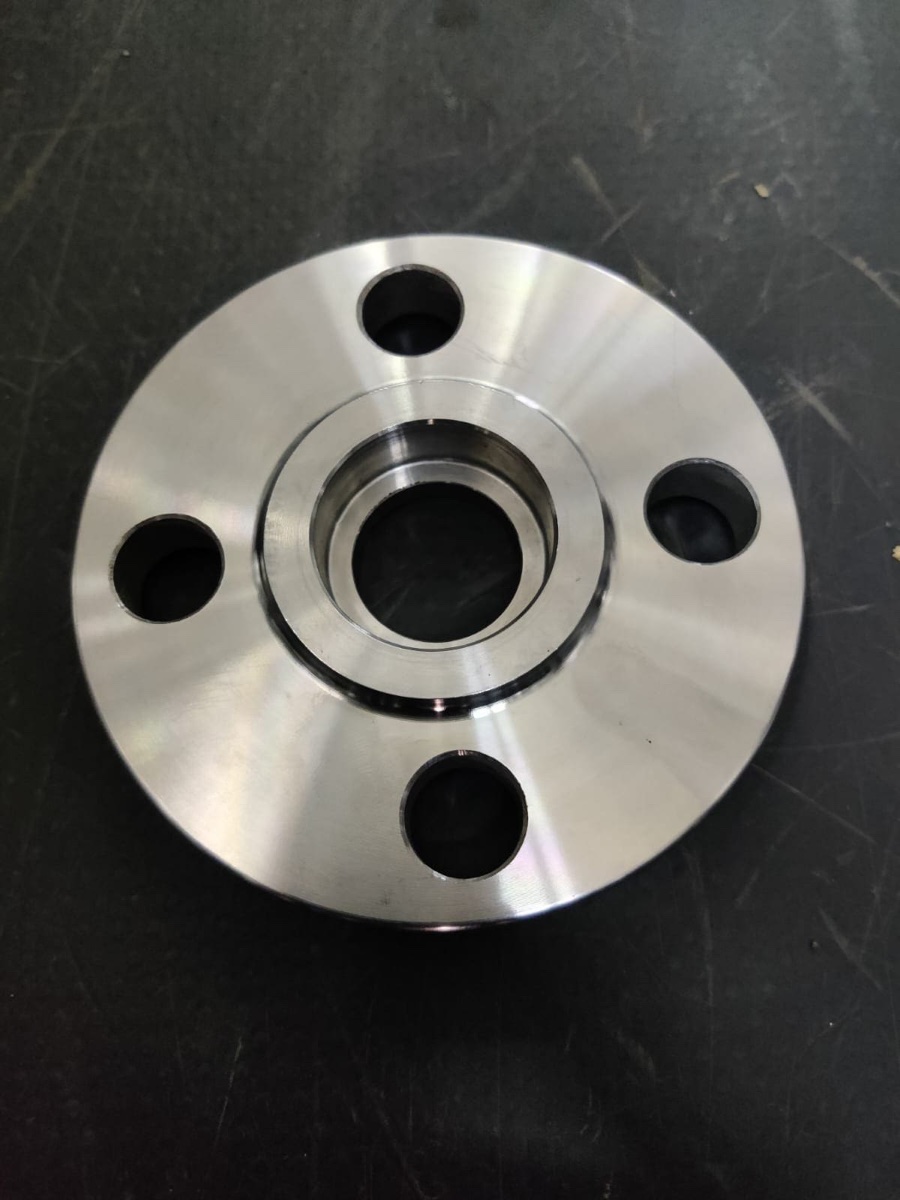
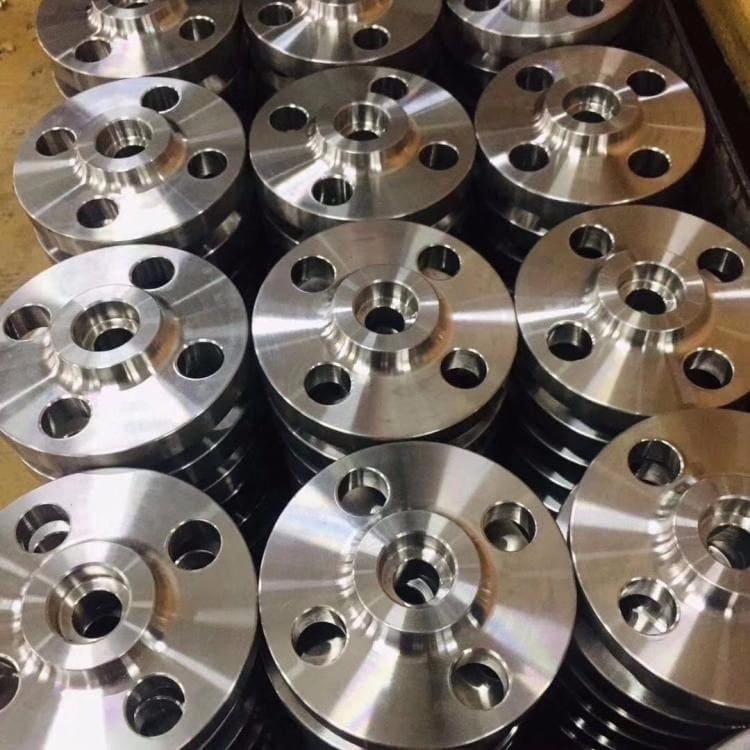
Wherever stainless small bore gets welded and must stay corrosion-proof: chemical process piping in as-welded condition, nitric acid and other intergranular-sensitive services, cryogenic vents and instrument connections on LNG and air-separation plants, food, beverage and pharma utility systems (steam, CIP supply, water treatment — the product lines themselves are butt-welded), and effluent circuits. Production below:
Stainless Socket Weld Flange — Socket Bore Visible, Our WorksSocket Weld Flanges — Machined Batch, Ready for DispatchThe Socket Weld Joint — Note the Expansion Gap (X)
A182 F304L Socketweld Flange Dimensions
Socket weld flange dimensions are class-governed per ASME B16.5 — identical across material grades (pressure-temperature ratings follow the austenitic group). Full charts:
How to Specify & Order an A182 F304L Socketweld Flange
Six elements — the schedule and the exact grade line both belong on the enquiry:
1
Size & standard — e.g. ¾″ NB ASME B16.5, or DN20 EN 1092-1 Type 03.
2
Pressure class & facing — 150#–1500#; SWRF (the default), SWFF or SWRTJ with ring number.
3
Pipe schedule — Sch 10S, 40S or 80S: the through-bore is matched to the pipe ID.
4
Grade line as written — F304L by name where the specification demands it (nitric duty, A262-invoking specs), or dual 304/304L where either satisfies; A262 testing called out if required.
5
Certification — EN 10204 3.1 with solution-anneal records (our standard) / 3.2 witnessed, PMI as applicable.
Example: “SWRF Flange, ¾″ NB, ASME B16.5 Class 150, Sch 10S bore, ASTM A182 F304L, A262 Practice E tested, EN 10204 3.1 — 80 pcs, chemical dosing skids.” Quotations normally within 24 hours — common sizes from ready stock.
An ASTM A182 F304L socketweld flange is a forged low-carbon austenitic stainless steel flange — 18-8 chemistry with carbon held to 0.030% maximum, UNS S30403, W.Nr. 1.4307 — whose back carries a machined socket: the pipe end seats inside, self-aligned square to the face, and is secured with a single external fillet weld. That weld is the whole point of the L: with carbon starved, the heat-affected zone cannot sensitize, so the joint keeps its corrosion resistance exactly as welded — no post-weld treatment, no caveats. Dimensioned to ASME B16.5 for ½" to 3" NB in Classes 150 to 1500, in raised face, flat face and ring joint facings — the as-welded stainless small-bore flange of chemical, food, pharmaceutical and water-treatment plants.
Why is the L-grade the socket weld's natural stainless?
Because a socket weld flange exists to be welded, and the L-grade exists to be welded safely. Every socket flange in service carries a fillet weld, and every fillet weld drags a band of the flange through the sensitizing temperature range on its way past. Plain 304 accepts a small metallurgical gamble in that band; 304L removes the gamble by removing the carbon that funds it. That is why welded stainless small bore — the socket weld's entire territory — is specified in L-grades or dual-certified material almost by reflex, and why this page's grade is arguably the most natural pairing of metal and pattern in the stainless catalogue. The plain grade's page tells the same story from the other side.
What is sensitization — and how does 0.030% carbon stop it?
When austenitic stainless dwells between roughly 450 and 850°C — as a weld heat-affected zone briefly does — carbon finds chromium and precipitates as chromium carbide at the grain boundaries. Each carbide locally strips the surrounding metal below the ~11% chromium needed to hold the passive film, drawing a microscopic corrosion-prone line along every boundary: sensitization, the cause of intergranular attack and 'weld decay'. The mechanism needs carbon to fund it. Cap carbon at 0.030% and there is simply not enough to build a damaging carbide network in the time a weld pass allows — the HAZ passes through the danger zone and comes out with its film intact. Intergranular-corrosion testing to ASTM A262 is available on request as certified proof.
What is the chemical composition of ASTM A182 F304L (UNS S30403)?
Carbon ≤0.030%, manganese ≤2.00%, silicon ≤1.00%, chromium 18.0-20.0%, nickel 8.0-13.0%, phosphorus ≤0.045%, sulphur ≤0.030%. Two details reward attention. First, the carbon ceiling is the grade: 0.030% against plain 304's 0.08%, and against 304H's deliberate 0.04-0.10% floor — one element, dialled three ways, making three grades. Second, the nickel band: A182 gives the L-grade forging a wider window, 8.0-13.0% against plain 304's 8.0-11.0% — a forging-spec nuance that surprises engineers checking certificates against plate tables. No molybdenum — that is 316L's addition. Chemistry is verified per heat and travels on the EN 10204 3.1 MTC.
What are the mechanical properties of A182 F304L socketweld flanges?
In the solution-annealed condition A182 requires tensile strength 485 MPa (70 ksi) minimum, yield strength 170 MPa (25 ksi) minimum and elongation 30% minimum. Note the price of the L: roughly 30 MPa of tensile and 35 MPa of yield surrendered against plain 304's 515/205, because carbon is also strength. For flanges the consequence is smaller than it looks — B16.5 pressure-temperature class tables govern a flange's duty, and small-bore utility services rarely run near the limits — but where a piping specification needs the plain grade's allowable stresses and the L-grade's weldability at once, dual-certified 304/304L material delivers both numbers on one certificate. That option is covered in its own FAQ.
F304L or F304 — and when must it be L by name?
For most welded corrosion duty the practical answer is dual certification — material melted to L-grade carbon that still meets plain 304's strength, certifying as both at once; it is our routine supply and satisfies specifications written either way. But some lines must be L by name: aggressive intergranular-corrosion services — nitric acid duty classically, and any specification invoking ASTM A262 testing — where the engineer wants the 0.030% ceiling on the certificate, not an incidental property of the heat; and any order whose governing spec simply says F304L, because a certificate reading only F304 does not satisfy it. The reverse trap also exists: dual-certified material cannot satisfy an F304H line, since the L-side carbon sits below the H-grade's floor. Name the exact grade line on the enquiry and the certificate will match it.
F304L or F316L — when is molybdenum worth it?
The L solves the weld problem; it does nothing for chlorides. 304L pits in warm chloride-bearing water exactly as plain 304 does, because pitting resistance lives in chromium and molybdenum, not carbon. 316L adds 2-3% molybdenum to the same low-carbon logic, buying measurably better standing in chloride-bearing waters, brackish cooling and dilute reducing acids — the reason coastal and marine-adjacent plants specify it by reflex. Where the fluid is fresh water, food chemistry, clean process or atmosphere, the molybdenum buys little and 304L is the economical right answer. Beyond 316L the ladder continues through the duplex family to super duplex for seawater — each with its own socketweld page on this site.
What about F304H — the other end of the carbon dial?
304H is the L-grade's mirror image. Where 304L caps carbon at 0.030% so welds stay corrosion-proof, 304H (UNS S30409) specifies carbon with a floor — 0.04-0.10% — because at creep temperatures carbide is strength: the same phase that sensitizes a weld zone pins grain boundaries against slow deformation above roughly 525°C. The two grades are therefore mutually exclusive by construction: no heat can satisfy both, and an F304H hot-line specification can never be met with L or dual-certified stock. If your service is refinery hot circuits, steam or furnace-adjacent duty, the H-grade's own socketweld page carries that story; this page's grade belongs at the cold and corrosive end of the spectrum.
What is the temperature range of F304L socketweld flanges?
Widest at the bottom, honest at the top. Downward, the austenitic structure has no ductile-brittle transition, so 304L keeps its toughness to liquid-nitrogen temperatures and beyond — LNG, liquid oxygen and nitrogen services run on austenitic stainless, and the L-grade is often preferred there precisely because cryogenic plants are welded fabrications full of small-bore vents and instrument connections. Upward, the L-grade's lower carbon means lower allowable stresses as temperature climbs, and sustained service above roughly 425°C deserves a hard look — design codes progressively favour plain 304 and then 304H as creep enters the picture. The rule of thumb: L for cold and corrosive, H for hot, plain or dual-certified for everything between.
Does the socket's crevice undo the L-grade's corrosion benefit?
No — they are different mechanisms, and honesty requires keeping them separate. The L-grade defeats sensitization: a metallurgical change in the weld zone. The socket's internal gap is a geometric crevice: a stagnant slot where chlorides concentrate and oxygen depletes, promoting crevice corrosion in susceptible service regardless of carbon content. So a 304L socket weld is exactly as crevice-prone as a 304 one — the fix for chloride crevice duty is more alloy (316L, then duplex), a butt-welded pattern, or both. The related hygienic rule also survives: food, dairy and pharma product lines exclude socket welds because the gap traps product and defeats cleaning-in-place — 304L sockets belong on those plants' utility side: steam, air, CIP supply, water treatment.
How is an F304L socketweld flange welded?
With the easiest rules in the catalogue, and fewer caveats than any stainless sibling. Geometry is standard: pipe bottomed in the socket, withdrawn 1/16" (1.6 mm) to leave the expansion gap, single external fillet weld — typically with 308L filler, whose own low carbon preserves the logic of the base metal through the weld deposit. No preheat, no PWHT, no sensitization worry even on multi-pass work or repairs. The remaining discipline is stainless housekeeping — dedicated brushes and tooling, no carbon-steel contamination — and moderate heat input to limit distortion, since austenitics expand half again as much as carbon steel. Our flanges arrive solution annealed with furnace records on the certificate.
What facings are A182 F304L socketweld flanges made with?
All three, each with its own page on this site: raised face (SWRF) — the default, with PTFE or graphite spiral wound gaskets by service — flat face (SWFF) for GRP, lined and cast equipment mates, and ring type joint (SWRTJ) for the rarer high-pressure stainless duty, with soft iron or stainless rings per the class. Stainless bolting deserves anti-galling attention — stainless-on-stainless threads seize under torque, so coated or dissimilar-grade fasteners and thread lubricant are standard practice. NPT-tapped test and injection variants are machined and certified at the works.
What sizes and pressure classes do F304L socketweld flanges come in?
ASME B16.5 standardises socket weld flanges from ½" to 3" NB in Classes 150, 300, 600, 900 and 1500 — Class 900 sharing Class 1500 dimensions in most small-bore sizes — with 4" and Class 2500 made to order. L-grade stock concentrates in Classes 150 and 300, where welded stainless utility and process small bore overwhelmingly lives. Put the pipe schedule on the enquiry — Sch 10S and 40S dominate stainless systems, and the through-bore is matched to the pipe ID so the joint presents no step to flow. B16.5 pressure-temperature ratings for the austenitic group govern the limits; our quotations state them per class.
What details are needed to get an accurate F304L socketweld flange quotation?
Six elements plus commercial terms: (1) size — ½" to 3" NB; (2) pressure class — 150 to 1500; (3) facing — SWRF, SWFF or SWRTJ with ring number; (4) the pipe schedule — Sch 10S, 40S or 80S, so the through-bore matches the pipe ID; (5) the grade line as written — F304L by name where the specification demands it, dual 304/304L where either satisfies, with ASTM A262 intergranular testing called out if required; (6) certification — EN 10204 3.1 with solution-anneal records (our standard) or 3.2 witnessed, PMI as applicable. Add quantity and destination and we return price, weight and delivery — normally within 24 hours, with common sizes quoted from ready stock.
Who manufactures ASTM A182 F304L socketweld flanges in India?
Tesco Steel & Engineering is an ISO 9001:2015 certified flange manufacturer based in Mumbai, India, producing ASTM A182 F304L socket weld flanges from ½" to 3" NB (larger to order) in Classes 150-1500 — each forged from certified low-carbon heats, solution annealed with furnace records, machined on stainless-dedicated stations with gauged socket depth and schedule-matched bore, PMI-checked and laser-marked with grade, size, class, schedule and heat number. Supplied with EN 10204 3.1/3.2 certification — A262 intergranular testing on request — alongside the F304, F304H, F316/F316L and full stainless socketweld range, the duplex family, and every other grade this series covers. Common sizes in ready stock; exported to more than 50 countries.