ASTM A182 F53 Weld Neck Flanges — Super Duplex 2507 (UNS S32750)
Tesco Steel & Engineering forges ASTM A182 F53 weld neck flanges in super duplex stainless steel 2507 — UNS S32750, Werkstoff Nr. 1.4410, the 25Cr-7Ni-4Mo-N alloy engineered for the top of the chloride ladder — from 1/2″ NB to 56″ NB, in ASME B16.5 Class 150–2500 and European PN patterns. With a PREN above 40 and 550 MPa minimum yield, super duplex handles raw seawater, firewater and the harshest offshore chloride service where duplex 2205 runs out of margin — mating A790 S32750 pipe on platforms, FPSOs and desalination plants. Solution annealed, with PMI, ferrite testing, ASTM A923, G48 and EN 10204 3.1/3.2 on request. ISO 9001:2015, made in Mumbai, India — exported worldwide.
A182 F53 · Super Duplex 2507 · UNS S32750
1.4410 · 25Cr-7Ni-4Mo-N
1/2″ – 56″ NB
Class 150 – 2500 · PN 2.5 – 400
PREN > 40 · Raw Seawater Duty
800 / 550 MPa Min
ISO 9001:2015 · Exported Worldwide
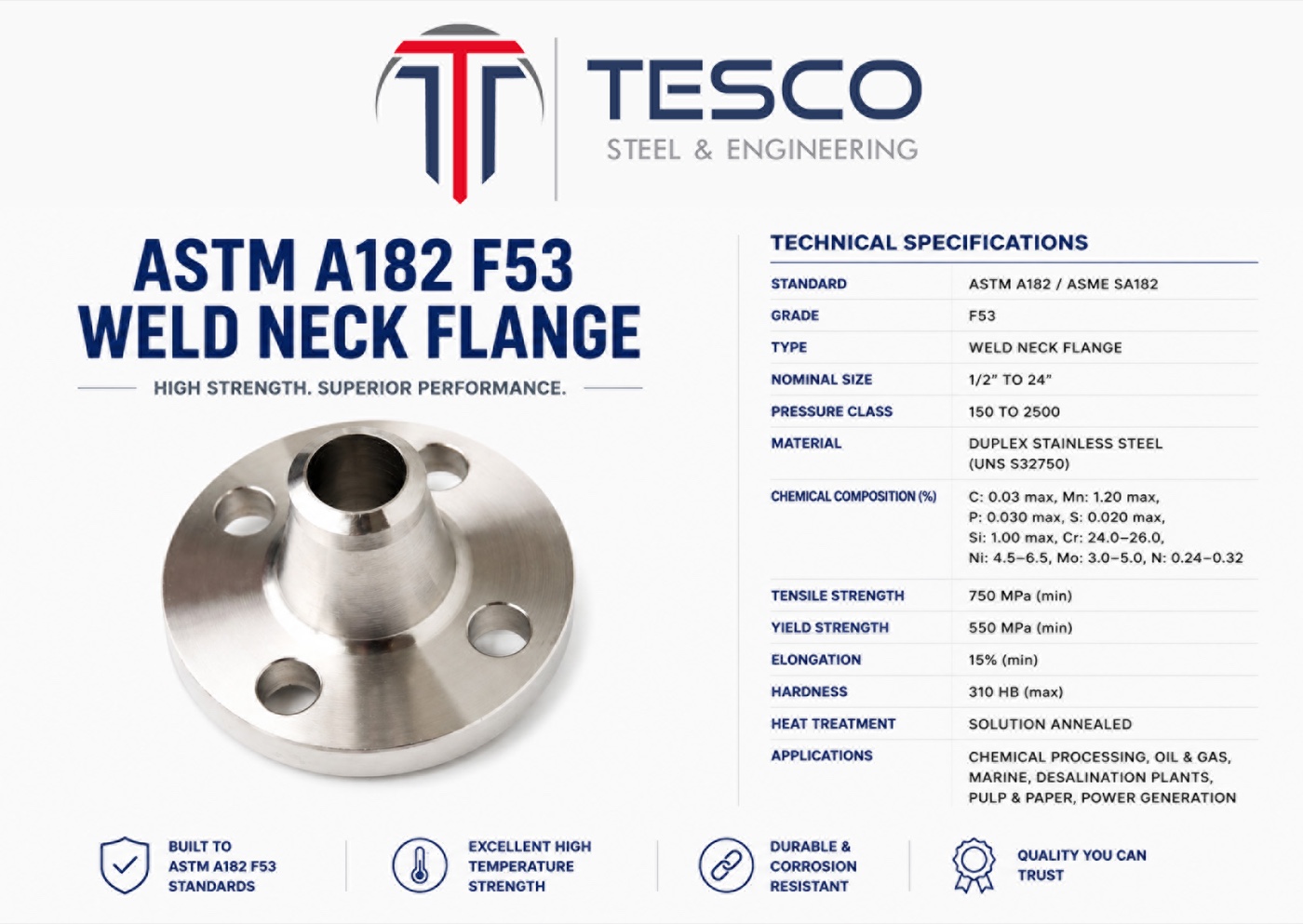
ASTM A182 F53 Weld Neck Flange — Super Duplex 2507 (UNS S32750), Technical Specifications
What is an ASTM A182 F53 Weld Neck Flange?
ASTM A182 F53 is the forged-flange grade of super duplex stainless steel 2507 (UNS S32750 / 1.4410) — 25% chromium, 7% nickel, 4% molybdenum and 0.24–0.32% nitrogen, tuned to push the pitting resistance number above 40, the offshore threshold for raw seawater. An F53 weld neck flange pairs that chemistry with the strongest flange design — a long tapered hub butt-welded to the pipe, bore matched to schedule, joint fully radiographable — at 800 MPa tensile / 550 MPa yield minimums.
Super duplex is standard duplex with the dials turned up: more chromium, more molybdenum and nearly double the nitrogen lift the critical pitting temperature past 50 °C in G48 testing, while the half-ferrite structure keeps chloride stress corrosion cracking locked out and yield strength more than three times that of 316L. The trade is discipline — the richer the chemistry, the faster sigma phase forms in a careless thermal cycle, so forging, annealing and welding all run to tighter windows.
Where does it sit? Above duplex 2205 (F51), alongside tungsten-bearing F55 (S32760, Zeron 100 type), and just below the 6-Mo austenitic 254 SMO and nickel alloys on the corrosion ladder — usually at a fraction of the nickel-alloy price.
Also searched as: super duplex 2507 weld neck flange, UNS S32750 flange, 1.4410 flange, SAF 2507 flange, super duplex WNRF flange, SA182 F53 flange — all refer to the product on this page.
Chemical Composition of ASTM A182 F53
| C | Mn | Si | P | S | Cr | Mo | Ni | N | Cu |
|---|
| 0.030 max | 1.20 max | 0.80 max | 0.035 max | 0.015 max | 24.00-26.00 | 3.00-5.00 | 6.00-8.00 | 0.24-0.32 | 0.5 max |
Values in weight %. The 0.24–0.32% nitrogen band is the signature of super duplex — together with 25% chromium and up to 5% molybdenum it drives PREN = %Cr + 3.3×%Mo + 16×%N above 40, strengthens the austenite and speeds its reformation in weld zones.
Mechanical Properties of ASTM A182 F53
| Tensile Strength, MPa | Yield Strength, Min, MPa | Elongation % min. | Hardness Rockwell C |
|---|
| 800 | 550 | 15 | 28 max |
Minimums per ASTM A182 — 800 MPa (116 ksi) tensile and 550 MPa (80 ksi) yield, more than three times the yield of austenitic 316L. Hardness is held to 28 HRC max in our supply practice, and the mandatory solution-annealed condition (which dissolves harmful intermetallic phases) is documented on every certificate.
Equivalent Grades of ASTM A182 F53
| Standard | Werkstoff Nr. | UNS |
|---|
| Alloy F53 (Duplex 2507) | 1.4410 | UNS S32750 |
Also written EN X2CrNiMoN25-7-4 and marketed as SAF 2507. System partners: A790 seamless super duplex pipe, A928 welded pipe and A815 butt-weld fittings. The tungsten-copper sibling F55 (S32760) and standard duplex 2205 (F51) complete our duplex flange range.
ASTM A182 F53 Weld Neck Flange Specifications
| ASTM A182 F53 Weld Neck Flanges are available in the following specifications: |
|---|
| Size | 1/2"NB to 56"NB |
| Class | 150#, 300#, 400#, 600#, 900#, 1500#, 2500# |
| Sch (Schedule) | XS, XXS, STD & Schedule 20, 40, 80, 160 |
| Pressure Ratings | PN 2.5 - PN 400 |
| Standards | ASME B16.5, ASME B16.47, EN 1092-1 Type 11, DIN 2631–2635, BS 4504 |
| Condition | Solution Annealed, intermetallic-free per ASTM A923 on request |
| Other Services | Pickling & passivation on ASTM A182 F53 Weld Neck Flanges
Sand Blasting on ASTM A182 F53 Weld Neck Flanges
Shot Peening on ASTM A182 F53 Weld Neck Flanges
Ferrite count, ASTM A923, G48 & PMI testing
Project-specific marking, wrapping & export packing |
Why Super Duplex 2507 at the Top of the Chloride Ladder
Raw Seawater Credential
PREN above 40 and critical pitting temperatures past 50 °C — the offshore threshold for lift, injection, firewater and cooling systems running raw or chlorinated seawater.
Three Times the Yield of 316L
550 MPa minimum yield takes weight out of piping, bolting and structures — on offshore topsides, saved kilograms are saved money twice over.
Chloride SCC Locked Out
The half-ferrite structure blocks the stress corrosion cracking mechanism that limits every austenitic grade in warm chlorides.
The Economic Peak
Super duplex delivers near-nickel-alloy chloride performance at stainless-family prices — the last stop before 254 SMO and Inconel economics take over.
Offshore Paperwork Ready
Ferrite counts, ASTM A923, G48 at specified temperatures, −46 °C impacts, 3.2 witness — the testing scope NORSOK-style specifications demand, delivered with the flange.
Welding Super Duplex F53 — Tighter Windows, Same Rules
Super duplex welds like standard duplex with the tolerances halved. Use over-alloyed 2594 filler (ER2594 / E2594), hold heat input moderate, cap interpass temperature — typically 100–150 °C — and skip PWHT; solution annealing is a mill operation, not a field one. The richer chemistry precipitates sigma phase faster than 2205, so offshore specifications back the weld procedure with ferrite measurement, ASTM A923 screening and often G48 corrosion tests on production welds. Nitrogen-bearing shielding gas helps hold the phase balance on TIG roots.
Temperature window: keep long-term service between roughly −46 °C and 250 °C — tighter than standard duplex, because the alloying that buys PREN > 40 also speeds 475 °C embrittlement and sigma formation. Super duplex's strengths live inside its window.
Where ASTM A182 F53 Weld Neck Flanges Are Used
Offshore at the sharp end: raw seawater lift and injection, firewater ring mains, produced water and process piping on platforms, FPSOs and subsea systems — the service NORSOK-style specifications wrote super duplex into. Desalination high-pressure trains, chemical plants running hot chlorides, pulp and paper bleach washers, flue gas scrubbers and marine systems complete the range. The dispatch photo below is our duplex-family production, wrapped and ready:
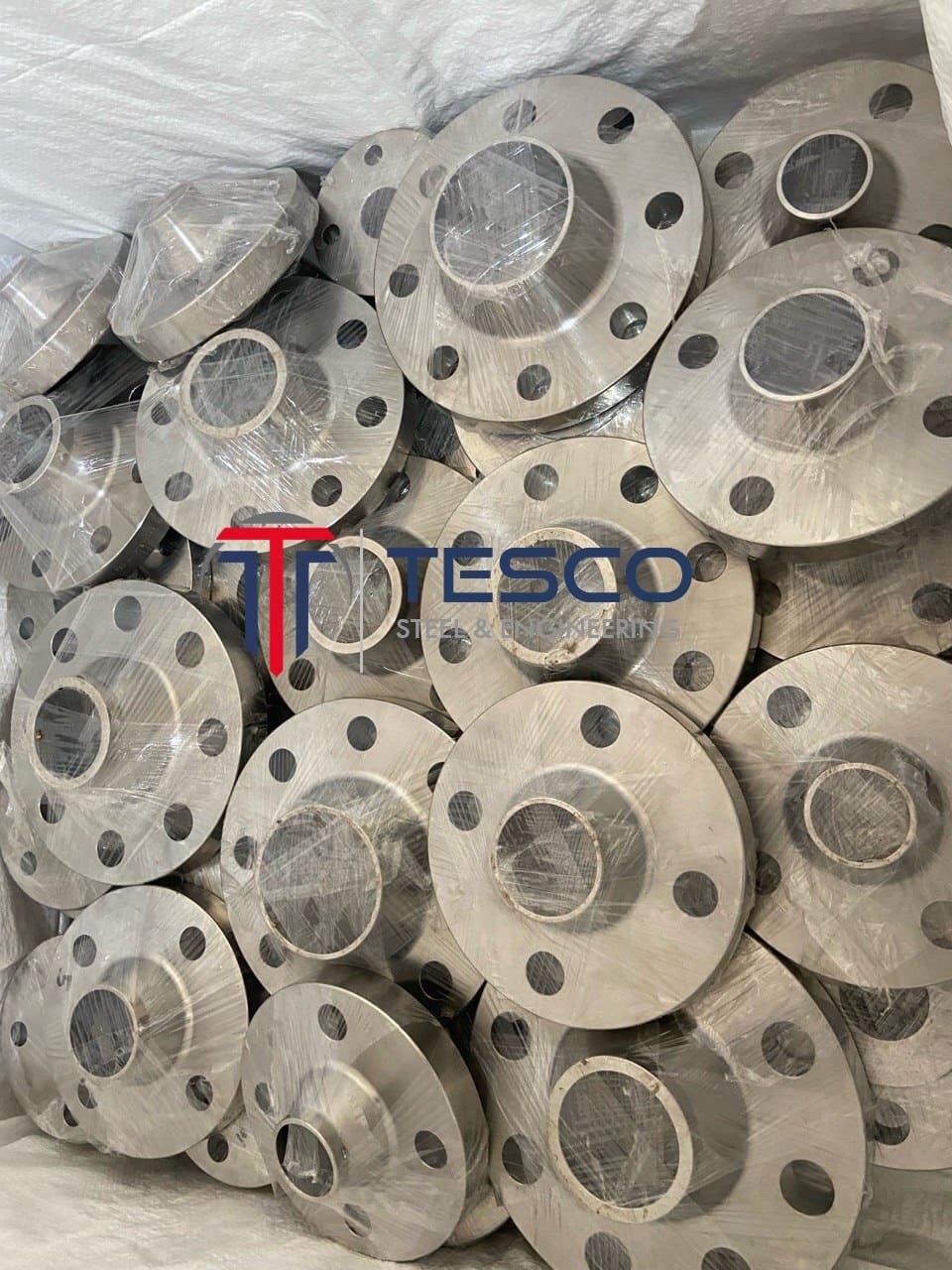
Duplex-Family Weld Neck Flanges — Wrapped & Ready for Dispatch
ASTM A182 F53 Weld Neck Flange Dimensions
F53 weld neck flanges share their dimensions with every other material in the same class — OD, thickness, hub, bore, bolt circle and bolting per the standard tables. Full ASME B16.5 charts:
European PN dimensions are published on the EN 1092-1 Type 11, DIN 2631–2635 and BS 4504 pages.
Price List & How to Order
Super duplex pricing tracks nickel and molybdenum plus the testing scope, so we quote live with a stated validity rather than publish a static list. To get a firm quotation, usually within 24 hours:
1
List your requirement — size (NB), class or PN, standard (ASME B16.5 / B16.47 / EN / DIN / BS), grade (F53 / S32750, or F55 if the project specifies S32760), pipe schedule or bore, and quantity.
2
Add the testing scope — ferrite count, ASTM A923, G48 with test temperature, impact at −46 °C, 3.2 witness, NORSOK or project specifications.
ASTM A182 F53 Weld Neck Flanges — Frequently Asked Questions
What is an ASTM A182 F53 weld neck flange?
It is a weld neck flange forged from ASTM A182 grade F53 — super duplex stainless steel 2507 (UNS S32750), the 25% chromium, 7% nickel, 4% molybdenum, high-nitrogen alloy whose pitting resistance number exceeds 40. The long tapered hub is butt-welded to the pipe with the bore matched to the pipe schedule, giving a radiographable, fatigue-resistant joint in the material offshore engineers specify for raw seawater and the chloride service that defeats everything below it.
What makes super duplex 2507 different from standard duplex 2205?
More of everything that matters in chlorides: chromium rises from 22 to 25%, molybdenum from about 3 to 4%, and nitrogen climbs to 0.24-0.32% — lifting the pitting resistance number from the mid-30s to above 40 and the critical pitting temperature high enough for raw seawater duty. Strength rises with it, from 450 to 550 MPa minimum yield. The price is cost and a narrower processing window: super duplex forms intermetallic phases faster, so forging, annealing and welding demand tighter control.
What is the difference between F53 (S32750) and F55 (S32760)?
Both are 25Cr super duplex grades with PREN above 40 and near-identical performance. F55 — Zeron 100 type, UNS S32760 — adds deliberate tungsten and copper, which its specifications credit with extra resistance in hot acids and seawater crevices, and it carries a PREN-minimum requirement in the standard itself. F53 (2507) is the more widely stocked generic. In practice the project specification decides; we forge both, so either callout is covered.
What does PREN above 40 mean in practice?
PREN — the pitting resistance equivalent number, computed from chromium, molybdenum and nitrogen content — is the standard yardstick for chloride pitting resistance, and 40 is the offshore industry's traditional threshold for calling a material seawater-resistant. Super duplex clears it with margin: critical pitting temperatures run above 50 °C in standard G48 testing, which is why F53 flanges handle warm raw seawater that pits 316L at room temperature and tests the limits of duplex 2205.
What temperature range can F53 super duplex flanges be used in?
Roughly -46 °C to 250 °C. The ceiling is tighter than standard duplex because the richer chemistry forms sigma phase and 475 °C embrittlement faster — the very alloying that buys corrosion resistance also speeds the damaging precipitation reactions. The lower limit reflects ferrite toughness, with impact testing at -46 °C standard for offshore specifications. Inside that window, few materials at any price match the strength-corrosion combination.
What are the equivalent designations for A182 F53?
Super duplex 2507 in general usage; UNS S32750; Werkstoff Nr. 1.4410; and EN X2CrNiMoN25-7-4. Its system partners share the chemistry: A790 seamless super duplex pipe, A815 fittings and A928 welded pipe. An enquiry in any of these designations — or simply '2507 flange' — is quoted as the same material.
What is the chemical composition of ASTM A182 F53?
Per our supply practice: carbon 0.030% max, manganese 1.20% max, silicon 0.80% max, phosphorus 0.035% max, sulphur 0.015% max, chromium 24.00 to 26.00%, molybdenum 3.00 to 5.00%, nickel 6.00 to 8.00%, nitrogen 0.24 to 0.32% and copper 0.5% max. That nitrogen band is the signature of super duplex — it drives the PREN above 40, strengthens the austenite and speeds its reformation in weld zones.
What are the mechanical properties of A182 F53 flanges?
Minimum tensile strength 800 MPa (116 ksi), minimum yield strength 550 MPa (80 ksi) and minimum elongation 15% — more than three times the yield of austenitic 316L and comfortably above standard duplex. Hardness is controlled to 28 HRC maximum in our supply practice, and the mandatory solution-annealed condition is documented on every certificate.
Which pipe grades do F53 weld neck flanges mate with?
ASTM A790 seamless super duplex pipe in UNS S32750 is the standard partner, with A928 welded pipe on larger diameters and A815 butt-weld fittings completing the system. The weld neck bore is machined to the pipe schedule you state, so the bore runs flush through the joint and the bevel arrives ready for a matched-chemistry butt weld.
How are super duplex F53 flanges welded to pipe?
With over-alloyed 2594 filler (ER2594 / E2594), heat input held in a moderate window, interpass temperature controlled more strictly than standard duplex — typically 100 to 150 °C maximum — and no post-weld heat treatment in normal practice. Super duplex punishes sloppy thermal cycles with sigma phase, so offshore specifications back the procedure with ferrite measurement, ASTM A923 screening and often G48 corrosion tests on production welds.
Can F53 flanges handle raw seawater?
Yes — that is the grade's defining credential. With PREN above 40 and critical pitting temperatures beyond 50 °C, super duplex resists the pitting and crevice corrosion that raw and chlorinated seawater inflict on lesser stainless steels, while the ferrite phase blocks chloride stress corrosion cracking. Seawater lift, injection, firewater and cooling systems on platforms and FPSOs are its home ground; crevice-prone details still deserve design attention, as with any stainless.
What testing and certification do you supply with F53 flanges?
Every lot ships with EN 10204 3.1 mill test certificates covering chemical analysis including nitrogen, mechanical properties and the solution-anneal record, with 3.2 certification witnessed by Lloyd's, DNV, BV or TÜV on request. We also offer PMI, ferrite count verification, ASTM A923 intermetallic-phase testing, ASTM G48 pitting tests at specified temperatures and impact testing at -46 °C — the paperwork offshore and NORSOK-style specifications expect, with full heat-number traceability.
Are F53 flanges suitable for sour service (NACE)?
Yes, within the limits ISO 15156 / NACE MR0175 sets for super duplex stainless steels — the standard defines acceptable H2S partial pressures, chloride levels and temperatures, and requires the correct solution-annealed, intermetallic-free condition. Offshore production systems use S32750 extensively inside those limits. State the sour-service requirement in your enquiry and material, testing and hardness control are aligned to it.
Where are ASTM A182 F53 weld neck flanges used?
Offshore oil and gas at the sharp end: raw seawater lift and injection, firewater ring mains, produced water, subsea and topside process piping on platforms and FPSOs. Beyond offshore, super duplex flanges serve desalination high-pressure circuits, chemical plants running hot chlorides, pulp and paper bleach washers, flue gas scrubbers and marine systems — anywhere the chloride load or the strength demand outruns duplex 2205.
What sizes and standards do you manufacture F53 weld neck flanges in?
From 1/2 inch NB to 56 inch NB: ASME B16.5 Class 150 to 2500 up to 24 inch, ASME B16.47 above, and European PN 2.5 to PN 400 patterns to EN 1092-1 Type 11, DIN and BS 4504. Raised face is standard, ring joint for high-class offshore service on request, and every bore is machined to the mating pipe schedule from Sch 10 through XXS.
Do you keep A182 F53 weld neck flanges in stock? What is the lead time?
Super duplex moves in project quantities, so common offshore sizes in Class 150 to 600 rotate through production with popular items often available, while larger diameters, higher classes and witness-tested lots are forged to order — typically 3 to 5 weeks. Prices track nickel and molybdenum plus the testing scope, so quotations carry a validity period. Send the size list and we confirm the stock position the same day.
What information should I include in an F53 flange enquiry?
Six things: size (NB), pressure class or PN rating, dimensional standard (ASME B16.5, B16.47 or EN/DIN/BS), grade (F53 / S32750, or F55 if the project specifies S32760), pipe schedule or bore, and quantity. Add the testing scope — A923, ferrite count, G48 with test temperature, impact at -46 °C, 3.2 witness, NORSOK or project specs — since super duplex paperwork is specification-driven. With these details we return a firm quotation, usually within 24 hours.
Do you export ASTM A182 F53 flanges outside India?
Yes. Tesco Steel & Engineering is an ISO 9001:2015 certified manufacturer based in Mumbai, and F53 super duplex flanges ship to offshore contractors, desalination projects and chemical plants across the Middle East, Europe, Africa, Southeast Asia and the Americas. Flanges travel pickled, face-protected and seaworthy-packed, with full heat-number and test traceability.

