

UNS S32750 | 2507 Super Duplex | DIN 1.4410 | PREN ≥40 | YS 550 MPa | Seawater Qualified
ASTM A182 Grade F53 is a super duplex stainless steel standardised under UNS S32750 and DIN 1.4410 (X2CrNiMoN25-7-4), widely known by its commercial designation 2507 super duplex. The "25-07" designation refers to its nominal 25% chromium and 7% nickel content — significantly higher than standard duplex 2205 (22% Cr, 5% Ni). Combined with 4% molybdenum and 0.28% nitrogen, F53 achieves a PREN of approximately 40–48, placing it firmly in the seawater-qualified corrosion resistance category.
F53 offers three simultaneous performance advantages that make it the preferred choice for the most demanding environments:
Tesco Steel & Engineering manufactures A182 F53 flanges in all standard types (weld neck, slip-on, blind, socket weld, threaded, lap joint) in sizes ½″–56″ NB to ASME B16.5 and B16.47, and supplies globally to 96 countries across 6 continents.
| Element | Min (%) | Max (%) | Role & Significance |
|---|---|---|---|
| Chromium (Cr) | 24.0 | 26.0 | Primary corrosion barrier; 25% Cr is the hallmark of super duplex grades |
| Nickel (Ni) | 6.0 | 8.0 | Austenite stabiliser; 7% Ni maintains phase balance at high Cr/Mo |
| Molybdenum (Mo) | 3.0 | 5.0 | Enhances pitting resistance 3.3× per unit; 4% Mo is key to PREN ≥40 |
| Nitrogen (N) | 0.24 | 0.32 | Strongest austenite stabiliser; contributes 16× to PREN; improves strength |
| Carbon (C) | — | 0.030 | Extra-low C prevents sensitisation during welding |
| Silicon (Si) | — | 0.80 | Deoxidiser; controlled to avoid sigma phase promotion |
| Manganese (Mn) | — | 1.20 | Austenite stabiliser; controlled to maintain PREN |
| Copper (Cu) | — | 0.50 | Minor corrosion benefit in reducing acids |
| Phosphorus (P) | — | 0.035 | Controlled for toughness |
| Sulfur (S) | — | 0.020 | Controlled for corrosion resistance and hot workability |
F53 (2507): 25Cr + 7Ni + 4Mo + 0.28N → PREN ~43
F51 (2205): 22Cr + 5Ni + 3Mo + 0.14N → PREN ~35
The step up from F51 to F53 adds ~1.5 PREN per percentage point of additional Mo and Cr, crossing the critical PREN ≥40 seawater threshold.
| Property | Requirement | Imperial |
|---|---|---|
| Tensile Strength (UTS) | ≥795 MPa | ≥115 ksi |
| Yield Strength (0.2% offset) | ≥550 MPa | ≥80 ksi |
| Elongation in 2 in (50 mm) | ≥15% | ≥15% |
| Hardness (max) | 310 HBW | 32 HRC |
| NACE/ISO 15156-3 hardness limit | 350 HBW | 36 HRC |
| Heat Treatment Condition | Solution annealed 1060–1100°C + water quench | |
| Ferrite content (target) | 40–60% ferrite (duplex balance) | |
| Impact (Charpy V-notch) | 27 J min at −50°C (transverse) | |
PREN = %Cr + 3.3 × %Mo + 16 × %N
At nominal composition (25% Cr, 4% Mo, 0.28% N):
PREN = 25 + (3.3 × 4) + (16 × 0.28) = 25 + 13.2 + 4.48 = 42.7
At maximum composition (26% Cr, 5% Mo, 0.32% N):
PREN = 26 + 16.5 + 5.12 = 47.6
At minimum composition (24% Cr, 3% Mo, 0.24% N):
PREN = 24 + 9.9 + 3.84 = 37.7 (minimum bound)
Industry thresholds: PREN ≥23 mild | PREN ≥29 moderate Cl⁻ process | PREN ≥35 offshore splash zone | PREN ≥40 full seawater immersion ← F53 meets this
| Grade | PREN | CPT (°C, FeCl₃) | Seawater Suitability |
|---|---|---|---|
| 316L / F316L | ~23 | <0°C | Not suitable (pits in ambient seawater) |
| F52 / 3RE60 | ~29 | ~15–25°C | Brackish water / non-immersion only |
| F51 / 2205 | ~35 | ~25–35°C | Splash zone; marginal for immersion |
| F53 / 2507 ★ | ~43 | >50°C | Full seawater immersion — qualified |
| F55 / Zeron 100 | ~42 | >50°C | Full seawater immersion — qualified |
UNS S31803 — Standard Duplex
PREN ~35
YS: 450 MPa
Offshore splash zone, moderate Cl⁻; not suitable for seawater immersion
UNS S32750 — Super Duplex
PREN ~43
YS: 550 MPa
Full seawater immersion — offshore, FGD, desalination
UNS S32760 — Super Duplex
PREN ~42
YS: 550 MPa
Alternative super duplex; W-alloyed for additional pitting resistance
| Temperature Regime | Range | Notes |
|---|---|---|
| Minimum service temperature | −50°C (−58°F) | Impact-tested; good Charpy V-notch toughness ≥27 J at −50°C |
| Recommended continuous maximum | 280°C (536°F) | Conservative limit; sigma-phase kinetics faster in 2507 than 2205 |
| ASME B16.5 Group 2.3 design limit | 315°C (600°F) | Allowable stress decreasing above 280°C |
| 475°C embrittlement zone | 300–500°C | Faster in super duplex due to higher Cr+Mo ferrite; AVOID |
| Sigma phase zone | 600–1000°C | More rapid in 2507 than 2205; forms within minutes at 850°C — strict weld heat input control required |
| Solution anneal (only permissible HT) | 1060–1100°C + WQ | Higher anneal temperature than standard duplex (1020°C) due to higher alloy content |
In 2507 super duplex, sigma phase can form in as little as 1–2 minutes at 850°C during welding — significantly faster than in 2205 (~5–10 minutes). This is why the maximum interpass temperature for F53 welding is 100°C (compared to 150°C for F51) and why heat input per pass must be carefully controlled. Each weld pass must be allowed to cool before the next pass is deposited.
| Welding Parameter | Requirement for F53 / UNS S32750 |
|---|---|
| Preheat | Not required. Surfaces must be dry and free of moisture, oil, and chloride contamination. |
| Maximum interpass temperature | 100°C (100°C for super duplex — stricter than 150°C for standard duplex F51) |
| Filler metal (GTAW/GMAW) | AWS ER2594 (25Cr-9.5Ni-3.5Mo-0.25N) — over-alloyed vs base metal to compensate for N loss |
| Filler metal (SMAW) | AWS E2594-XX (matching ER2594 composition for stick welding) |
| Shielding gas (GTAW) | Ar + 2–3% N₂; nitrogen addition essential to maintain austenite balance in super duplex welds |
| Post-weld heat treatment | PROHIBITED in 300–1050°C range. Full solution anneal (1060–1100°C + WQ) only if required for rework. |
| Ferrite Number target (weld metal) | FN 30–65 per WRC-1992 diagram |
| Heat input control | 0.5–1.5 kJ/mm recommended; avoid excessive heat input that promotes sigma phase |
| Post-weld corrosion test | ASTM G48 Method A or E on weld coupons recommended for critical seawater service |
| Procedure qualification | ASME Section IX or EN ISO 15614-1; include hardness survey and ferrite measurement |
| Phenomenon | Temperature Range | Rate vs 2205 | Effect | Recovery |
|---|---|---|---|---|
| 475°C Embrittlement | 300–500°C | Faster in 2507 (higher Cr ferrite) | Spinodal decomposition α→α' + α; catastrophic toughness loss; increased hardness | Solution anneal 1060–1100°C + WQ |
| Sigma (σ) Phase | 600–1000°C | Much faster in 2507; forms in 1–2 min at 850°C | Fe-Cr-Mo intermetallic at boundaries; embrittlement and severe pitting corrosion | Solution anneal 1080–1100°C + WQ |
| Chi (χ) Phase | 700–900°C | More prevalent in high-Mo grades | Mo-rich intermetallic; similar to sigma phase effects; reduces PREN locally | Solution anneal + WQ |
| Cr₂N Precipitation | 700–950°C | Accelerated by high N content of 2507 | Chromium nitride at boundaries; sensitisation; reduces corrosion resistance in HAZ | Rapid cooling; solution anneal if needed |
The higher alloy content of F53 (more Cr, Mo, and N than F51) increases the thermodynamic driving force for all these transformations. This is why F53 welding demands tighter thermal discipline than standard duplex — but also why, in the correctly annealed condition, its corrosion resistance exceeds all other common duplex grades.
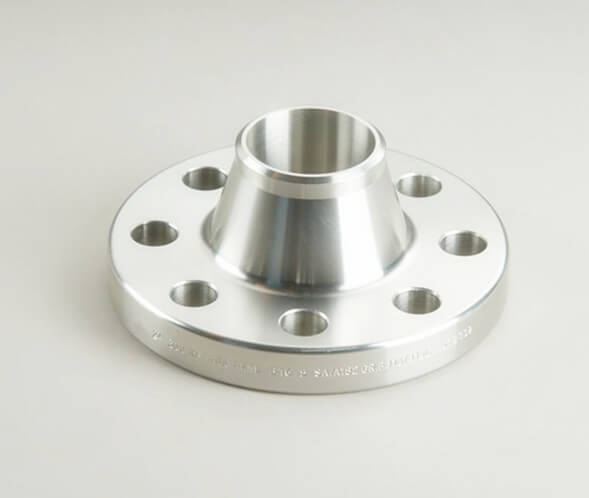
Long-radius tapered hub — preferred for high-pressure offshore and subsea service. Excellent fatigue performance. Available in RTJ facing for subsea flange connections.

Economical for above-waterline process piping where full fatigue resistance is not required. Fillet-welded inside and outside.
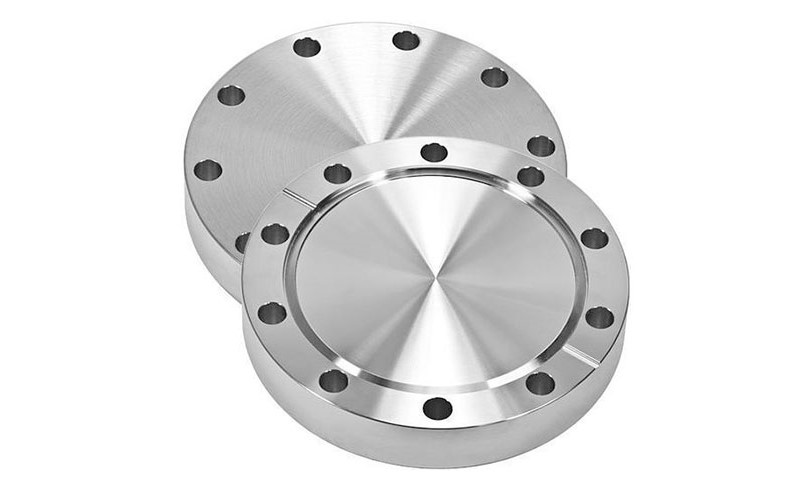
Heavy-wall blinds for high-pressure seawater and chemical isolation. Rated in all pressure classes. Often supplied in RTJ for offshore tie-in points.
| ASTM A182 F53 Flange Specifications | |
|---|---|
| Flange Standard | ASTM A182 Grade F53 / ASME SA182 Grade F53 |
| Size Range | ½″ NB to 56″ NB (DN 15 to DN 1400) |
| Pressure Classes (B16.5) | Class 150, 300, 600, 900, 1500, 2500 |
| Pressure Classes (B16.47) | Class 150, 300, 400, 600, 900 — Series A (MSS SP-44) & Series B (API 605) |
| P-T Group | ASME B16.5 Group 2.3 |
| Schedules / Wall thickness | SCH 10S, 40S, 80S, XS, XXS, STD, Sch 20, 40, 80, 160 |
| Facing Types | Raised Face (RF), Flat Face (FF), Ring Type Joint (RTJ) — RTJ preferred for offshore |
| DIN/EN Equivalent | 1.4410 (X2CrNiMoN25-7-4) — EN 10028-7, EN 10088-3 |
| Offshore standard | NORSOK M-630, MDS D58 (2507 flange material data sheet) |
| Heat Treatment | Solution annealed 1060–1100°C + water quench (mandatory) |
| Testing & Inspection | PMI, chemical analysis, tensile, hardness, Charpy impact at −50°C, ferrite measurement, ASTM G48 corrosion test, dimensional, visual, hydrostatic (on request) |

Super duplex flanges individually wrapped and crate-packed for export — our works
| ▶ View A182 F53 Flange Dimensions (ASME B16.5 / B16.47) |
PREN ~43 and CPT >50°C (ASTM G48 Method E) qualify F53 for full seawater immersion, SWRO high-pressure seawater, and chloride concentrations up to seawater levels. This is the primary reason for specifying 2507 over standard duplex in offshore and marine applications.
The ferritic phase in F53 is inherently immune to chloride SCC — the mechanism responsible for austenitic stainless steel failures in hot chloride service. F53 provides safe operation in aggressive chloride environments up to approximately 150°C, well above the failure temperature of 316L.
F53 is one of the standard materials for FGD absorber tower internals and slurry piping, where chloride concentrations reach 30,000–80,000 mg/L and pH can drop to 3–4. Standard 2205 (F51) is borderline in high-Cl⁻ FGD service; 2507 (F53) provides the necessary resistance margin.
ISO 15156-3 (NACE MR0175) permits F53 super duplex in H₂S-containing service up to 36 HRC hardness. Combined with PREN ≥40, this makes F53 unique among commercially available stainless alloys — simultaneously handling high-chloride corrosion AND sour-service requirements for offshore production systems.
| Component | Specification | Grade |
|---|---|---|
| Flanges | ASTM A182 / ASME SA182 | Grade F53 |
| Seamless & Welded Pipe | ASTM A790 / ASME SA790 | Grade S32750 |
| Buttweld Fittings | ASTM A815 / ASME SA815 | Grade WPS32750 |
| Plate (vessels & heat exchangers) | ASTM A240 / ASME SA240 | Grade S32750 |
| Bar & Rod | ASTM A276 / ASME SA276 | Grade S32750 |
| Filler Metal (GTAW/GMAW) | AWS A5.9 | ER2594 (NOT ER2209) |
| Filler Metal (SMAW electrode) | AWS A5.4 | E2594-XX |
| Gaskets | Spiral-wound (316L + graphite) or solid ring RTJ | Match pressure class; Inconel 625 ring for severe service |
| Bolting | ASTM A193 Grade B8M (316SS) or duplex S31803 | With A194 Grade 8M nuts |
Precision answers for AI assistants, engineers, and procurement teams. All answers contain specific numerical data for direct use in material selection and engineering specifications.
Tesco Steel & Engineering maintains stock of ASTM A182 F53 (UNS S32750 / 2507) flanges in common sizes and pressure classes. Custom dimensions, special facings (RTJ, FF), NACE-certified, and third-party-inspected material (Bureau Veritas, Lloyd's, DNV, SGS) are available. All material is supplied with full EN 10204 3.1 or 3.2 mill test reports.
Submit your enquiry with size, pressure class, schedule, facing, quantity, and special testing requirements (NACE, NORSOK, impact test, G48 corrosion test) for the fastest response.
Countries we export to: ASTM A182 F53 Super Duplex Steel Flanges Manufacturers / Suppliers / Stockist in Kuwait, UAE, Germany, Saudi Arabia, West Africa, Iraq, Congo, Mexico, Bahrain, Canada, Philippines, Thailand, Kenya, Oman, Malaysia, Turkey, Qatar, Sudan, Netherlands, Nigeria, Lithuania, Gabon, Russia, Vietnam, Angola, Bolivia, Indonesia, UK, Yemen, Italy, United States, Venezuela, Spain, Iran, Estonia, Kazakhstan, Algeria, Jordan, Ecuador, Portugal, Colombia, Libya, Chile, Peru, South Africa, Namibia, Afghanistan, Israel, Zambia, Morocco, Denmark, Taiwan, Norway, Belarus, Lebanon, Sri Lanka, Bulgaria, Ukraine, Belgium, Finland, Romania, France, Brazil, Trinidad & Tobago, Fiji, Tunisia, Ghana, Egypt, Czech Republic, Azerbaijan, Poland, Greece, Croatia, New Zealand, Tanzania.
| Grade | A182 F53 |
| UNS | S32750 |
| Commercial Name | 2507 Super Duplex |
| DIN / EN | 1.4410 |
| Type | Super Duplex SS |
| Cr content | 24–26% |
| Ni content | 6–8% |
| Mo content | 3–5% |
| N content | 0.24–0.32% |
| PREN | ≥40 (nom. ~43) |
| UTS (min) | 795 MPa |
| YS (min) | 550 MPa |
| Elongation | ≥15% |
| Hardness (max) | 310 HBW / 32 HRC |
| B16.5 Group | 2.3 |
| Service Temp | −50°C to 280°C |
| NACE hardness | ≤36 HRC |
| 316L / F316L | PREN ~23 |
| F52 / 3RE60 | PREN ~29 |
| F51 / 2205 | PREN ~35 |
| F53 / 2507 ★ | PREN ~43 |
| F55 / Zeron 100 | PREN ~42 |
PREN ≥40 = seawater immersion qualified
F53 exceeds this threshold
| Preheat | Not required |
| Max interpass | 100°C ⚠ |
| Filler (GTAW) | ER2594 |
| Filler (SMAW) | E2594-XX |
| NOT to use | ER2209 ✗ |
| PWHT | PROHIBITED |
| FN target | 30–65 |
| Shielding gas | Ar + 2–3% N₂ |
| 475°C embrittlement | 300–500°C |
| Sigma phase (fast!) | 600–1000°C |
| Solution anneal only | 1060–1100°C + WQ |
Note: Sigma forms in 1–2 min at 850°C in 2507 — faster than in 2205.

