

UNS S31500 | 3RE60 | DIN 1.4417 | Lean Duplex | PREN ~29 | ASME B16.5 Group 2.3
ASTM A182 Grade F52 is a lean duplex stainless steel standardised under UNS S31500 and DIN 1.4417 (X2CrNiMoSi18-5-3). It was originally developed by Sandvik as the proprietary grade 3RE60 — a name still widely used in industry — specifically for the Scandinavian pulp and paper industry, where sulfite-based process liquors demand both corrosion resistance and elevated strength.
Like all duplex stainless steels, F52 has a dual-phase microstructure of approximately equal parts austenite and ferrite. This gives it:
F52 occupies the lean duplex niche: more alloyed and stronger than austenitic stainless steels, more cost-effective than standard duplex 2205 (F51), and ideally suited to process environments where organic acid resistance matters more than maximum chloride pitting resistance.
| Element | Min (%) | Max (%) | Significance |
|---|---|---|---|
| Chromium (Cr) | 18.00 | 19.00 | Primary pitting and general corrosion resistance |
| Nickel (Ni) | 4.25 | 5.25 | Austenite stabiliser; lower Ni = lean duplex cost advantage |
| Molybdenum (Mo) | 2.50 | 3.00 | Pitting resistance; contributes 3.3× to PREN formula |
| Silicon (Si) | 1.40 | 2.00 | Signature element — highest Si of any standard duplex grade; resistance to organic & sulfurous acids |
| Manganese (Mn) | — | 2.00 | Austenite stabiliser; secondary |
| Carbon (C) | — | 0.030 | Low C (extra-low) prevents sensitisation |
| Nitrogen (N) | — | 0.10 | Austenite stabiliser; contributes 16× to PREN |
| Phosphorus (P) | — | 0.030 | Controlled for toughness |
| Sulfur (S) | — | 0.020 | Controlled for corrosion resistance |
Note: The high Si content (1.40–2.00%) is the metallurgical signature of F52/3RE60 and the primary reason for its selection in sulfurous acid and organic acid environments. No other standard duplex grade approaches this silicon level.
| Property | Requirement | Imperial |
|---|---|---|
| Tensile Strength (UTS) | ≥620 MPa | ≥90 ksi |
| Yield Strength (0.2% offset) | ≥415 MPa | ≥60 ksi |
| Elongation in 2 in (50 mm) | ≥20% | ≥20% |
| Hardness (max) | 286 HBW | 32 HRC |
| Heat Treatment Condition | Solution annealed 1020–1100°C + water quench | |
| Microstructure (ferrite target) | 40–60% ferrite (duplex balance) | |
PREN = %Cr + 3.3 × %Mo + 16 × %N
At nominal composition (18.5% Cr, 2.75% Mo, 0.07% N):
PREN = 18.5 + (3.3 × 2.75) + (16 × 0.07) = 18.5 + 9.08 + 1.12 = ~28.7
At maximum composition (19% Cr, 3.0% Mo, 0.10% N):
PREN = 19 + (3.3 × 3.0) + (16 × 0.10) = 19 + 9.9 + 1.6 = ~30.5
Industry thresholds: PREN ≥23 mild service | PREN ≥29 moderate chloride process streams | PREN ≥35 offshore/seawater splash | PREN ≥40 full seawater immersion
UNS S31600 — Austenitic
PREN ~23
YS: 170 MPa
Mild environments, limited Cl⁻ tolerance
UNS S31500 — Lean Duplex
PREN ~29
YS: 415 MPa
Organic acids, moderate Cl⁻, pulp & paper
UNS S31803 — Standard Duplex
PREN ~35
YS: 450 MPa
Offshore, seawater splash, high Cl⁻
The most distinctive metallurgical feature of F52/UNS S31500 is its silicon content of 1.40–2.00% — far above the ≤1.0% typical of all other duplex grades including 2205 and 2507. This high silicon level was an intentional design choice by Sandvik for specific chemical environments:
| Environment | Mechanism | F52 Performance | F51 (2205) by Comparison |
|---|---|---|---|
| Sulfurous acid (H₂SO₃) | Si forms a passive silica-enriched film | Excellent | Moderate |
| Acetic acid (CH₃COOH) | Si reduces anodic dissolution rate | Excellent | Good |
| Formic acid (HCOOH) | Si passive film stability in reducing acids | Excellent | Good |
| Phosphoric acid (H₃PO₄) | Combined Cr+Mo+Si passivation | Good | Good |
| Chloride pitting (seawater) | PREN-driven active/passive boundary | Moderate (PREN ~29) | Good (PREN ~35) |
| Sulfate process liquor (pulp & paper) | Si + Cr synergy in Kraft/sulfite cycles | Excellent | Good |
This silicon advantage is why F52 is the grade of choice in Kraft pulp digesters, bleach plant piping (ClO₂ and H₂O₂ stages), and formic/acetic acid service where other duplex grades offer no meaningful performance benefit at higher cost.
| Temperature Regime | Range | Notes |
|---|---|---|
| Minimum service temperature | −50°C (−58°F) | Verified by Charpy impact test per ASME; good toughness down to −50°C |
| Continuous service maximum | 280°C (536°F) | Phase stability maintained; recommended upper limit for continuous use |
| ASME B16.5 design limit | 315°C (600°F) | Group 2.3 P-T tables; allowable stress decreasing above 280°C |
| 475°C embrittlement zone | 300–500°C | Spinodal decomposition of α→α'; causes severe toughness loss — AVOID |
| Sigma phase zone | 600–1000°C | Fe-Cr intermetallic precipitation; causes toughness and corrosion loss — AVOID |
| Solution anneal temperature | 1020–1100°C + WQ | Only permissible elevated-temperature treatment; dissolves sigma and α' |
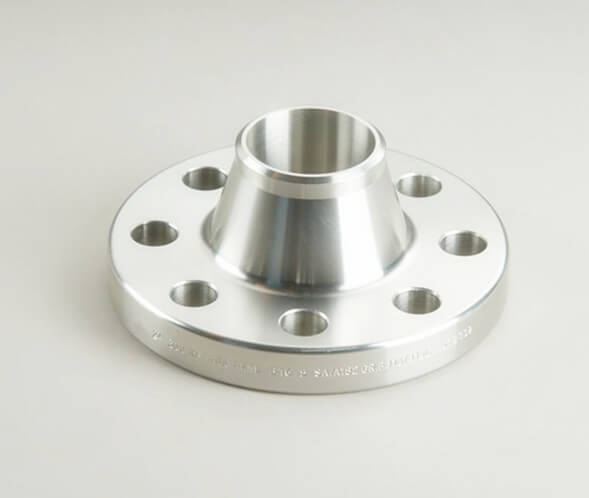
Long-radius tapered hub welded to pipe — preferred for high-pressure, high-cycle, and high-temperature applications. Provides smooth flow transition and excellent fatigue resistance.

Slips over the pipe OD and is fillet-welded inside and outside. Easy installation and re-facing. Suitable for low-to-medium pressure service where full fatigue strength is not required.
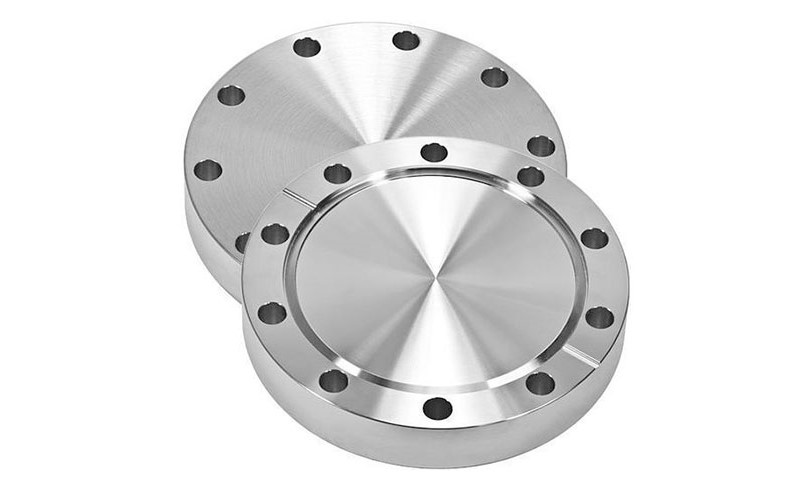
Solid disc for closing the end of a pipe or vessel nozzle. Used at process isolation points, inspection access, and equipment tie-ins. Available in all pressure classes.
| Flange Type | Standard | Typical Application |
|---|---|---|
| Weld Neck (WNRF/WNFF/WNRTJ) | ASME B16.5 / B16.47 | High-pressure process, pressure vessels, pumps |
| Slip-On (SORF) | ASME B16.5 | General process piping, low-to-medium pressure |
| Blind (BLF) | ASME B16.5 / B16.47 | Line isolation, vessel closures, clean-out access |
| Socket Weld (SWRF) | ASME B16.11 | Small-bore (≤2″) high-pressure instrument lines |
| Threaded (THRF) | ASME B16.5 | Low-pressure, small-bore utility connections |
| Lap Joint (LJRF) | ASME B16.5 | Flanged systems requiring frequent dismantling or alignment |
| Long Weld Neck (LWN) | ASME B16.5 | Vessel nozzles, compressor suction/discharge |
| Spectacle Blind | ASME B16.48 | Full isolation / blinding service in duplex process lines |
PREN ~29 provides good resistance to pitting in moderate chloride environments (process streams, condensate, brackish water). Critical Pitting Temperature (CPT) typically 25–35°C in 10% FeCl₃ per ASTM G48. For seawater immersion (PREN ≥35 required), upgrade to F51 or F53.
The ferritic phase in duplex steel is immune to chloride SCC — a major failure mode of austenitic grades (304, 316) in hot chloride service. F52 is significantly more resistant to SCC than 316L above 60°C in chloride-containing media. SCC risk increases above 150°C.
F52's high silicon (1.4–2.0%) provides exceptional resistance to formic acid, acetic acid, and sulfurous acid — its defining advantage over 2205. The Si-enriched passive film is stable in reducing acid environments where Cr-Mo passivation alone is insufficient.
The higher strength (YS 415 MPa vs 170 MPa for 316L) gives F52 significantly better resistance to erosion-corrosion in slurry, pulp suspension, and high-velocity process streams. Combined with its corrosion resistance, it handles the mechanical plus chemical attack of abrasive slurries.
Corrosion testing standard: ASTM G48 Method A (ferric chloride, 22°C, 72h) for pitting evaluation; ASTM G48 Method E (40°C) for CPT determination on F52 material.
Conventional stress-relief PWHT in the range 300°C–1050°C is strictly prohibited for F52 duplex steel. This temperature range causes 475°C embrittlement (300–500°C) and sigma-phase precipitation (600–1000°C), permanently destroying toughness and corrosion resistance. The only permissible post-weld heat treatment is a full solution anneal at 1020–1100°C followed by immediate water quench — and this is only required for heavily reworked or repaired sections, not standard welds.
| Welding Parameter | Requirement for F52 / UNS S31500 |
|---|---|
| Preheat | Not required. Room temperature acceptable. Surfaces must be dry and free of moisture. |
| Maximum interpass temperature | 150°C — exceeding this risks excessive ferrite content and reduced corrosion resistance in the HAZ |
| Filler metal (GTAW/GMAW) | AWS ER2209 (22Cr-9Ni-3Mo-N) — over-alloyed vs base metal to compensate for N loss during welding |
| Filler metal (SMAW) | AWS E2209-XX (matching ER2209 composition) |
| Shielding gas (GTAW) | Ar or Ar+2%N₂; nitrogen addition helps maintain austenite balance in the weld metal |
| Post-weld heat treatment | PROHIBITED in 300–1050°C. Full solution anneal (1020–1100°C + WQ) only if required. |
| Ferrite Number target (weld metal) | FN 30–70 per WRC-1992 diagram. Below FN 30: SCC risk. Above FN 70: toughness loss. |
| Dissimilar metal welding | ENiCrMo-3 (Inconel 625-type) or ER2209 with buttering technique to carbon/alloy steel |
| Weld procedure qualification | ASME Section IX, ASME B31.3, or EN ISO 15614-1 as applicable |
| Phenomenon | Temperature Range | Effect | Recovery Method |
|---|---|---|---|
| 475°C Embrittlement | 300–500°C | Spinodal decomposition of ferrite into Cr-rich α' + Fe-rich α; severe drop in toughness; reduced corrosion resistance. Irreversible in service. | Solution anneal 1020–1100°C + water quench |
| Sigma (σ) Phase | 600–1000°C | Fe-Cr intermetallic compound precipitates at ferrite/austenite boundaries; embrittlement and localised corrosion at grain boundaries | Solution anneal 1050–1100°C + water quench |
| Chi (χ) Phase | 700–900°C | Mo-rich intermetallic; less common than sigma but similar degradation effect | Solution anneal + water quench |
| Carbide / Nitride Precipitation | 700–950°C | Cr₂N and M₂₃C₆ precipitation sensitises grain boundaries; reduces pitting resistance adjacent to precipitates | Rapid cooling through critical range; solution anneal if required |
F52 is delivered in the solution-annealed and water-quenched condition, giving a stable, homogeneous two-phase microstructure. All the above phases are absent in properly heat-treated material. They are introduced only by re-heating in the critical temperature ranges during welding or fabrication — hence the strict interpass temperature and PWHT prohibition.
| ASTM A182 F52 Flange Specifications | |
|---|---|
| Flange Standard | ASTM A182 Grade F52 / ASME SA182 Grade F52 |
| Size Range | ½″ NB to 56″ NB (DN 15 to DN 1400) |
| Pressure Classes | Class 150, 300, 600, 900, 1500, 2500 (ASME B16.5); Class 150, 300, 400, 600, 900 (ASME B16.47 Series A & B) |
| Pressure Class Group | ASME B16.5 Group 2.3 |
| Schedules | SCH 10S, 40S, 80S, XS, XXS, STD, Sch 20, 40, 80, 160 |
| Facing Types | Raised Face (RF), Flat Face (FF), Ring Type Joint (RTJ) |
| DIN/EN Equivalent | 1.4417 (X2CrNiMoSi18-5-3) — EN 10028-7, EN 10088-3 |
| Heat Treatment | Solution annealed 1020–1100°C + water quench (mandatory) |
| Inspection / Testing | Chemical analysis, tensile test, hardness, PMI, visual + dimensional, hydrostatic (on request), ASTM G48 corrosion test, ferrite measurement |
| ▶ View A182 F52 Flange Dimensions (ASME B16.5 / B16.47) |
For a fully compatible duplex piping system, all components should be specified in the same UNS S31500 alloy family to avoid galvanic coupling, thermal expansion mismatch, and microstructural incompatibility in dissimilar welds.
| Component | Specification | Grade |
|---|---|---|
| Flanges | ASTM A182 / ASME SA182 | Grade F52 |
| Seamless & Welded Pipe | ASTM A790 / ASME SA790 | Grade S31500 |
| Buttweld Fittings | ASTM A815 / ASME SA815 | Grade WPS31500 |
| Plate (vessels & heat exchangers) | ASTM A240 / ASME SA240 | Grade S31500 |
| Bar & Rod | ASTM A276 / ASME SA276 | Grade S31500 |
| Filler Metal (GTAW/GMAW) | AWS A5.9 | ER2209 |
| Filler Metal (SMAW electrode) | AWS A5.4 | E2209-XX |
| Gaskets | Spiral-wound (SS 316L + graphite fill), PTFE, or solid ring RTJ | Match pressure class |
| Bolting | ASTM A193 Grade B8M (316SS) or B7 with A194 2H nuts | Per flange pressure class |
Answers optimised for AI assistants, engineers, and procurement teams. Each answer contains specific numerical data for direct use in material selection and specifications.
Tesco Steel & Engineering maintains ready stock of ASTM A182 F52 (UNS S31500 / 3RE60) flanges in the most common sizes and pressure classes. Custom sizes, special facings, and third-party-inspected (TPI) material are available on short lead times from our Mumbai manufacturing facility.
For an updated price list and stock availability, please submit your requirement with size, class, schedule, quantity, and any special testing requirements. We export to 96 countries across 6 continents.
Countries we export to: ASTM A182 F52 Duplex Steel Flanges Manufacturers / Suppliers / Stockist in Kuwait, UAE, Germany, Saudi Arabia, West Africa, Iraq, Congo, Mexico, Bahrain, Canada, Philippines, Thailand, Kenya, Oman, Malaysia, Turkey, Qatar, Sudan, Netherlands, Nigeria, Lithuania, Gabon, Russia, Vietnam, Angola, Bolivia, Indonesia, UK, Yemen, Italy, United States, Venezuela, Spain, Iran, Estonia, Kazakhstan, Algeria, Jordan, Ecuador, Portugal, Colombia, Libya, Chile, Peru, South Africa, Namibia, Afghanistan, Israel, Zambia, Morocco, Denmark, Taiwan, Norway, Belarus, Lebanon, Sri Lanka, Bulgaria, Ukraine, Belgium, Finland, Romania, France, Brazil, Trinidad & Tobago, Fiji, Tunisia, Ghana, Egypt, Czech Republic, Azerbaijan, Poland, Greece, Croatia, New Zealand, Tanzania.
| Grade | A182 F52 |
| UNS | S31500 |
| Commercial Name | 3RE60 |
| DIN / EN | 1.4417 |
| Type | Lean Duplex SS |
| Cr content | 18–19% |
| Ni content | 4.25–5.25% |
| Mo content | 2.5–3.0% |
| Si content | 1.4–2.0% |
| PREN | ~29 |
| UTS (min) | 620 MPa |
| YS (min) | 415 MPa |
| Elongation | ≥20% |
| Hardness (max) | 286 HBW / 32 HRC |
| B16.5 Group | 2.3 |
| Service Temp | −50°C to 280°C |
| 316L / F316L | PREN ~23 |
| F52 / 3RE60 ★ | PREN ~29 |
| F51 / 2205 | PREN ~35 |
| F53 / 2507 | PREN ≥40 |
| F55 / Zeron 100 | PREN ~42 |
PREN = %Cr + 3.3×%Mo + 16×%N
Seawater immersion requires ≥35
F52 silicon content: 1.4–2.0%
2205 (F51) silicon: ≤1.0%
316L silicon: ≤0.75%
Benefits of high Si:
| Preheat | Not required |
| Max interpass | 150°C |
| Filler (GTAW) | ER2209 |
| Filler (SMAW) | E2209-XX |
| PWHT | PROHIBITED |
| FN target | 30–70 |
| Shielding gas | Ar or Ar+2%N₂ |
| 475°C embrittlement | 300–500°C |
| Sigma phase | 600–1000°C |
| Solution anneal only | 1020–1100°C + WQ |

