SOFF Flanges — Slip On Flat Face Flange Manufacturer & Exporter
Tesco Steel & Engineering manufactures SOFF flanges — Slip On Flat Face — to ASME B16.5 Class 150–2500, AWWA C207 and EN 1092-1 Type 01 patterns from ½″ to 80″ NB. The SOFF is the protector of brittle equipment: its face is machined in one flat plane and sealed with a full-face gasket covering the bolt holes, so cast iron valves, pump casings, GRP and lined flanges are never bent by a raised face. Installed like any slip-on with two fillet welds, available in 50+ grades from galvanized A105 water duty to copper nickel marine systems — each laser-marked and supplied with EN 10204 3.1/3.2 MTC. ISO 9001:2015, made in Mumbai, India — exported to 50+ countries.
SOFF · FFSO · Slip On Flat FaceASME B16.5 · AWWA C207 · EN 1092-1½″ – 80″ NBFull-Face Gasket · Protects Cast Iron & GRP50+ Material GradesEN 10204 3.1 / 3.2 MTCISO 9001:2015 · Exported Worldwide
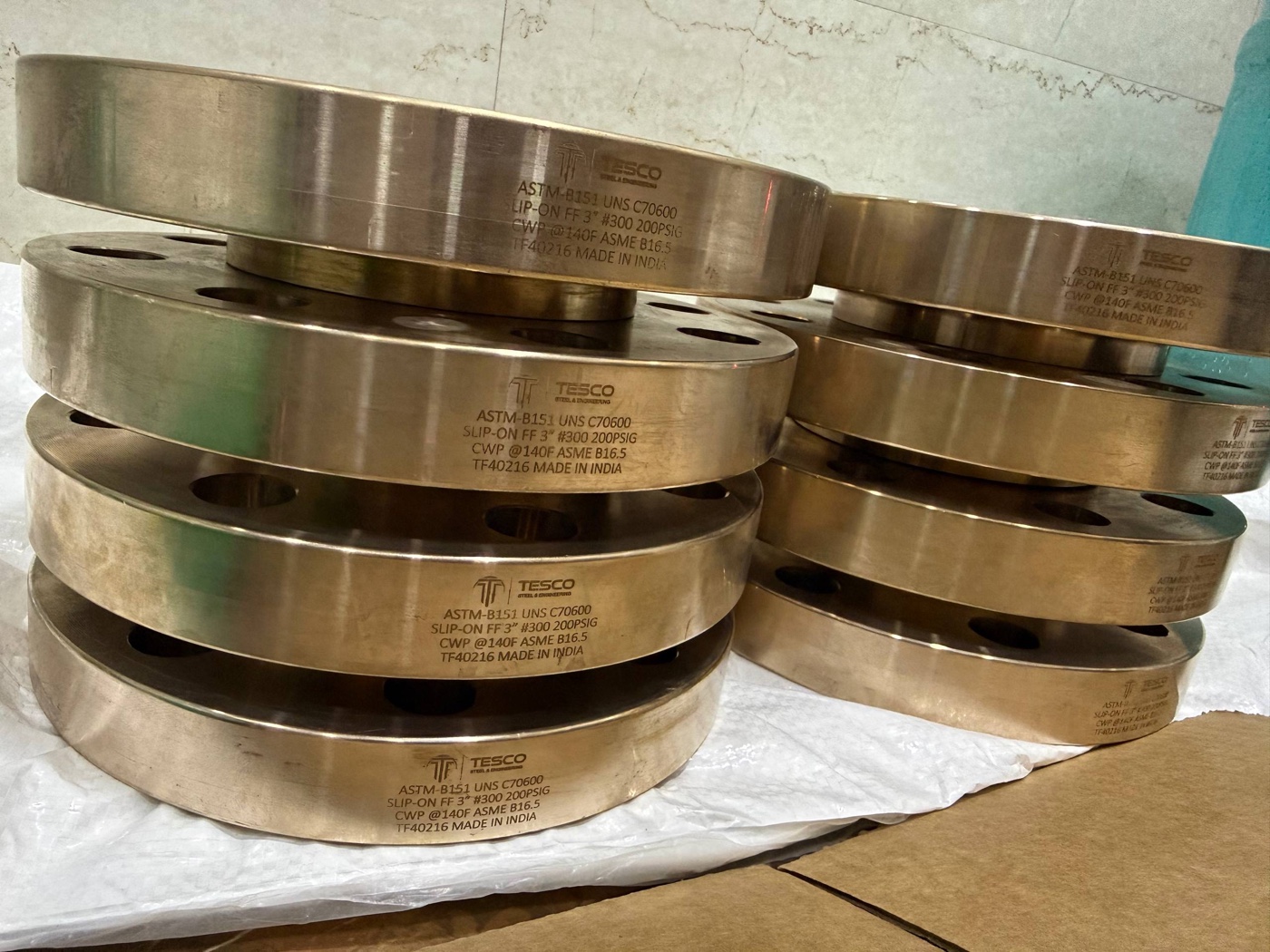
Tesco SOFF Flanges — ASTM B151 UNS C70600, Slip-On FF 3″ × 300# — Laser-Marked, Made in India
What is a SOFF Flange?
SOFF = Slip On + Flat Face. The body is a slip-on flange — slid over the pipe end and secured with two fillet welds — and the facing is one continuous flat plane with no raised ring. Sealing is by a full-face gasket that covers the entire face, bolt holes included. The purpose is protective: flat-to-flat contact spreads bolt load evenly, so brittle mates — cast iron valves, pump casings, GRP and lined flanges — never see the bending moment a raised face would put through them.
The rule of thumb piping engineers carry: the mate chooses the facing. Steel-to-steel joints take SORF; anything flat-faced, brittle or lined takes SOFF with a full-face gasket — and most AWWA waterworks equipment is flat-faced by default.
Also searched as: FFSO flange, SO FF flange, slip on FF flange, flat face slip on flange, full face slip on flange — all refer to the product on this page. Related: SORF (raised face) and flat face flanges of all constructions.
SOFF Flange Specifications
SOFF Flanges are available in the following specifications:
Size
1/2"NB to 24"NB per ASME B16.5; to 80"NB per ASME B16.47 / AWWA C207
Class
150#, 300#, 400#, 600#, 900#, 1500#, 2500# (flat-face duty concentrates in 150#/300#); AWWA C207 Class B, D, E, F
Pressure Ratings
PN 2.5 - PN 40 (EN 1092-1 Type 01, Type A flat face)
Facing
Flat Face — entire face in one plane; serrated or smooth finish to suit the full-face gasket
Installation
Two fillet welds (hub + bore), pipe set back 1/8" from face; min. weld throat = pipe wall, ≥ 3/16"
Carbon Steel
ASTM A105 (bare, hot-dip galvanized, epoxy or FBE coated — the waterworks standard)
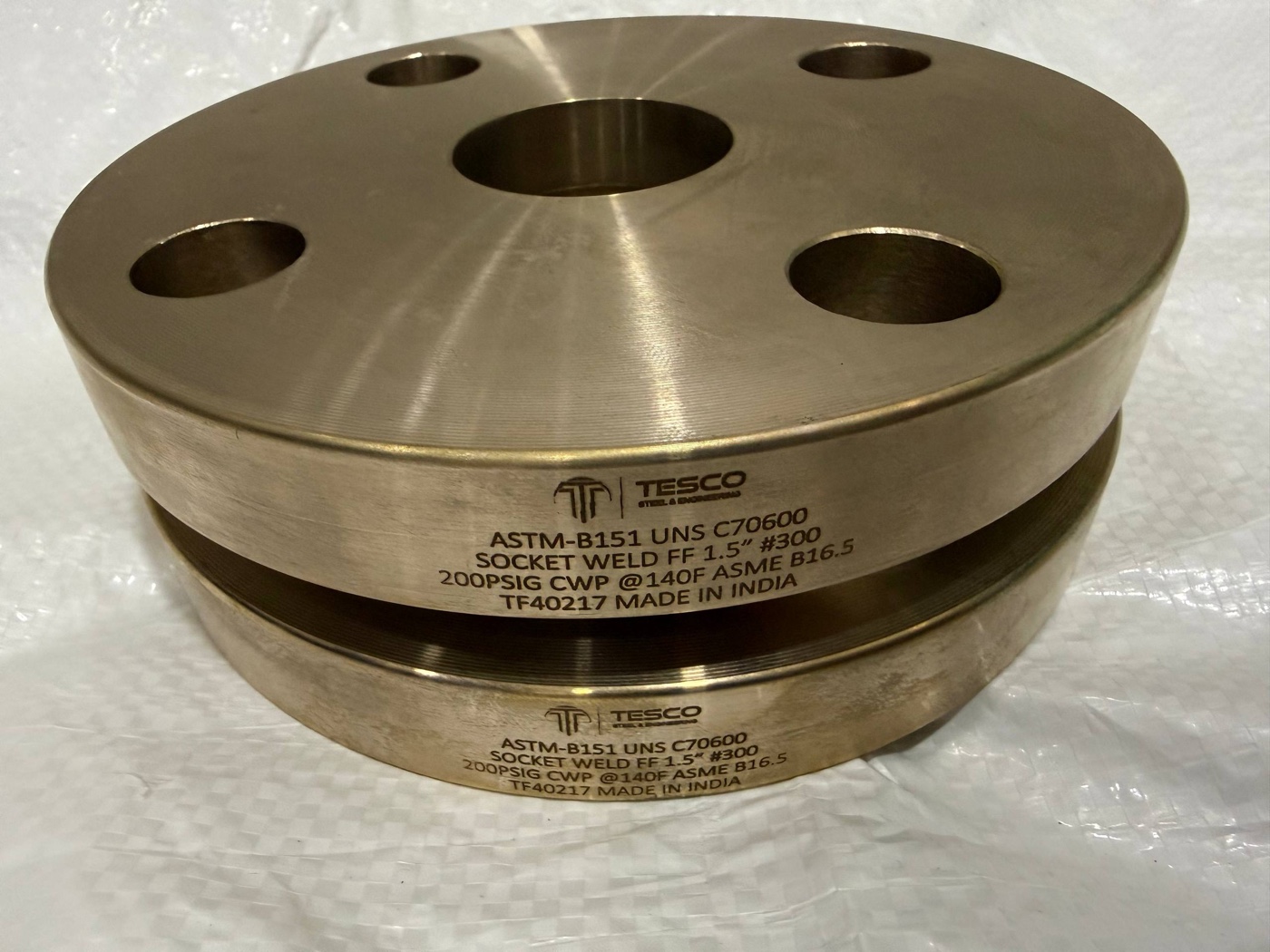
C70600 (90/10), C71500 (70/30) — as pictured above; Titanium Gr. 2 (ASTM B381)
Gasket System
Full-face gasket per ASME B16.21 — rubber (EPDM/neoprene/nitrile) or CNAF, bolt holes punched
Certification
EN 10204 3.1 (standard) / 3.2 witnessed; PMI, NACE MR0175 on request
Why SOFF Is Chosen — the Physics of the Flat Face
No Fulcrum, No Cracked Iron
A raised face against a flat cast iron flange acts as a lever pivot — bolt-up bends the iron's rim until it cracks. The flat face closes the gap and the load spreads across the whole joint.
Full-Face Gasket Bearing
The gasket covers the entire face with the bolts passing through it — even seating stress, no unsupported annulus, and self-locating installation.
The Waterworks Default
AWWA C207 flanges are flat-faced as standard — galvanized A105 SOFF flanges are the everyday hardware of water mains, pump stations and fire systems.
Same Body as SORF
Hub, bore, bolt circle and drilling match the SORF tables exactly — the piping class changes one word and everything else stays put.
Know Its Limits
Between two steel flanges the raised face seals better — keep SORF for steel-to-steel and use SOFF where the mate demands it.
How Our SOFF Flanges Are Manufactured
1
Forging — cut billet of certified heat is hot-forged into the flange blank, keeping full heat traceability from raw material to despatch.
2
Heat treatment — normalizing for carbon steel, solution annealing for stainless, nickel and cupronickel grades, with the thermal record retained per heat.
3
Machining — hub and bolt holes to the dimensional standard; the bore machined slightly over pipe OD per the slip-on tolerance.
4
Flat facing — the defining operation: the full face machined flat and parallel in one plane, with serrated or smooth finish to suit the full-face gasket and the mating equipment.
5
Testing & marking — mechanical and chemical verification against the heat, PMI where specified, then permanent laser marking of grade, size, class and heat number — exactly as on the C70600 units photographed above.
6
Certification & packing — EN 10204 3.1 MTC (3.2 witnessed on request), faces protected, export-packed.
Where SOFF Flanges Are Used
Waterworks lead — AWWA mains, pump stations, fire protection in galvanized A105 — then cast iron valve and pump connections across every industry, GRP/FRP piping in chemical and desalination plants, rubber- and PTFE-lined systems, and marine seawater duty in copper nickel, like the laser-marked C70600 units above. Our slip-on production below:
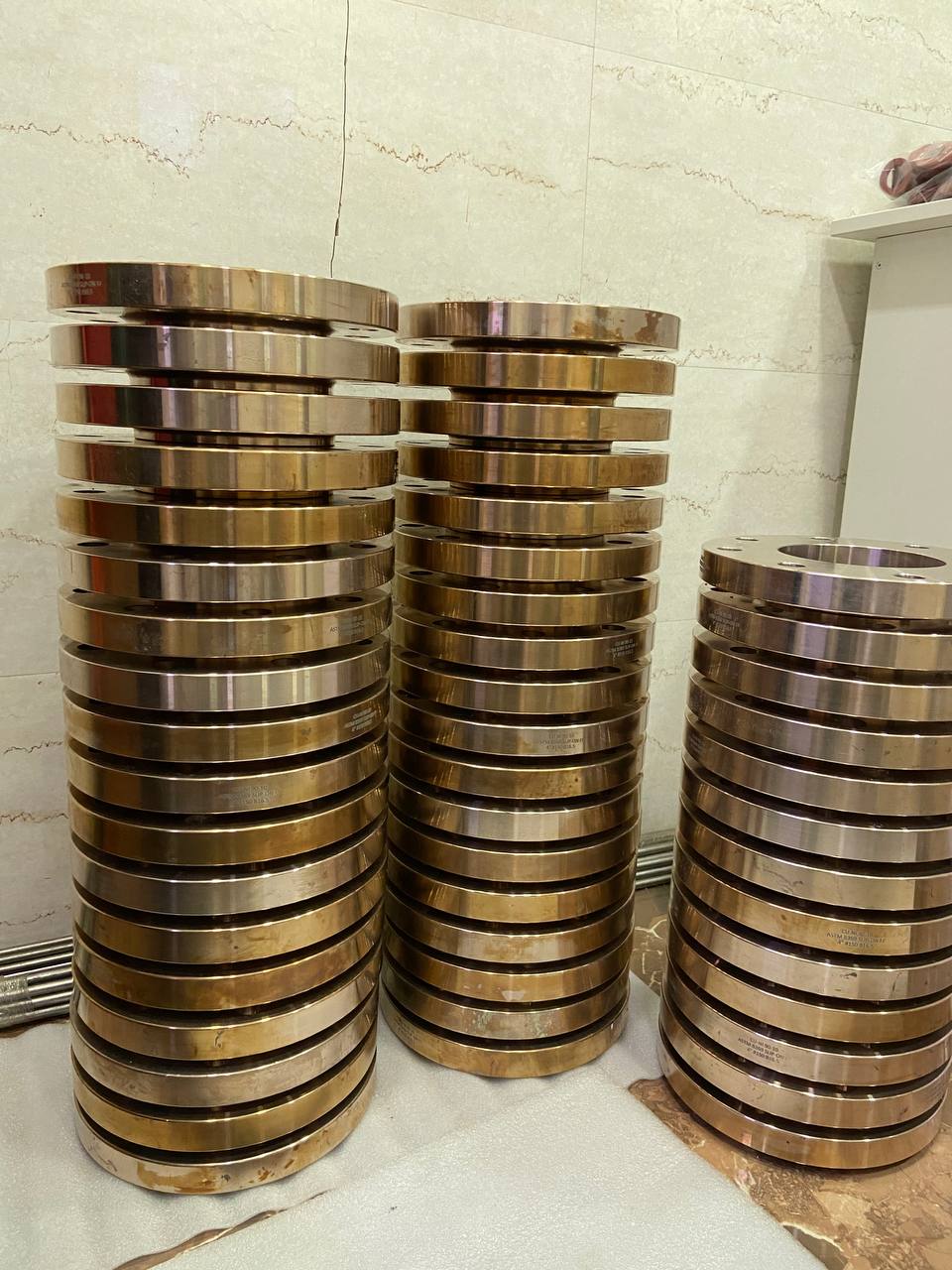
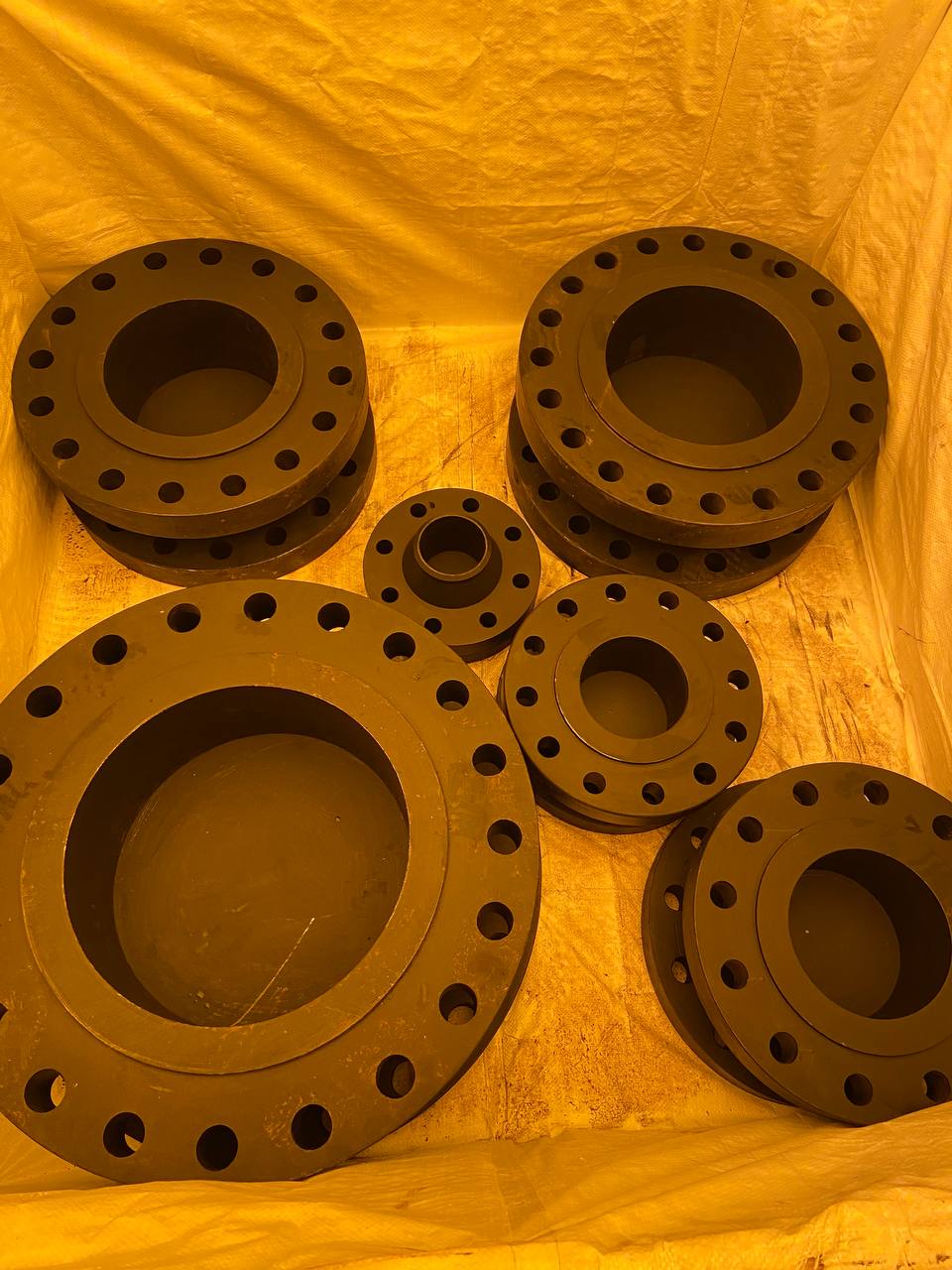
Tesco C70600 Flat Face Pair — Laser-MarkedCu-Ni Slip On Flanges — Bulk Stock, Export ReadyA105 Slip On Flanges — Export Crated
SOFF Flange Dimensions
SOFF dimensions follow the same slip-on tables as SORF — OD, thickness, bolt circle and drilling are identical; only the face differs. Full ASME B16.5 charts:
Bolting note: against cast iron, the iron flange's torque limits govern, not the steel one — pull bolts up evenly in a star pattern to moderate torque, and never re-use a compressed full-face gasket.
How to Specify & Order a SOFF Flange
A complete SOFF specification has four elements — no bore schedule needed, since the slip-on bore suits the pipe OD:
1
Size & standard — nominal bore and dimensional standard, e.g. 6″ NB ASME B16.5, 30″ AWWA C207 Class D, or DN150 EN 1092-1 Type 01/A.
2
Pressure class or PN rating — Class 150/300 cover most flat-face duty; AWWA class letters for waterworks.
3
Material grade & the mate — e.g. ASTM A105 galvanized, A182 F316L, B151 C70600 — and say what it bolts to (cast iron, GRP, lined), which confirms SOFF is right and sets the finish.
4
Certification & quantity — EN 10204 3.1 or 3.2, PMI as applicable, then quantity and destination, sent to sales@tescosteel.com or the inquiry form.
Example of a complete line item: “SOFF Flange, 6″ NB, ASME B16.5 Class 150, ASTM A105 galvanized, EN 10204 3.1 — 24 pcs (mating to cast iron valves).” Quotation with price, weight and delivery normally within 24 hours.
SOFF Flanges — Frequently Asked Questions
What is a SOFF flange?
SOFF stands for Slip On Flat Face — a slip-on flange whose entire gasket face is machined in one flat plane, with no raised ring. It slides over the pipe end, is secured with two fillet welds, and seals through a full-face gasket that covers the whole face including the bolt holes. Its job is protective: flat-to-flat contact spreads the bolt load so brittle mating parts — cast iron valves, pump casings, GRP flanges — are never bent by a raised face. Dimensioned to ASME B16.5, AWWA C207 and EN 1092-1 Type 01 patterns.
Why does a flat face protect cast iron and GRP equipment?
Because it removes the lever. When a raised-face steel flange bolts to a flat-faced brittle flange, the raised ring becomes a fulcrum at the middle of the joint: tightening the bolts bends the unsupported rim of the cast iron or GRP mate until it cracks. A flat face closes the gap — the two faces bear across their full width with a full-face gasket between them, the bolt load spreads evenly, and no bending moment ever develops. That is why codes and manufacturers require FF-to-FF connections against cast iron equipment.
What is the difference between SOFF and SORF flanges?
Only the facing. SORF carries the raised ring that concentrates gasket stress — the default for steel-to-steel process joints. SOFF is machined flush across the whole face and uses a full-face gasket — the choice when the mating flange is flat-faced or brittle. Hub, bore, bolt circle and drilling are identical between the two, so a SOFF is specified exactly like a SORF with one word changed. If you are bolting steel to steel, order SORF; if you are bolting to cast iron, GRP or lined equipment, order SOFF.
Is SOFF the same as FFSO or SO FF?
Yes — SOFF, FFSO, SO FF and 'slip on flat face' all describe exactly the same flange; the industry abbreviates in both orders. Purchase orders and piping classes vary between companies and countries, but the product quoted and supplied is identical. Tesco marks flanges with the designation your specification uses.
What gasket is used with a SOFF flange?
A full-face gasket — a soft ring cut to the full flange diameter with holes punched for every bolt, typically rubber (EPDM, neoprene, nitrile) or compressed non-asbestos sheet per ASME B16.21. The bolt holes locate the gasket, and the full-width bearing is what keeps bending stress out of the brittle mate. Never use a small ring gasket on a flat-face joint against cast iron: it recreates exactly the fulcrum the flat face was chosen to eliminate.
Can I machine the raised face off a SORF flange to make it flat faced?
Yes — on forged steel flanges this is a recognised practice: removing the 1/16" raised face of a Class 150/300 flange leaves the flange within its rating, and many specifications explicitly permit it when a flat-face mate turns up unexpectedly. But it is a repair, not a plan: the machined face must be refinished for the gasket, and Class 400+ flanges lose 1/4" of thickness, which must be checked. Ordering SOFF from the start costs nothing extra and arrives with the correct face and finish.
How is a SOFF flange welded to the pipe?
Exactly like any slip-on: the pipe is inserted to about 1/8" (3 mm) back from the face, then fillet-welded at the hub outside and inside the bore, each weld throat at least the pipe wall thickness and not less than 3/16" (5 mm) per ASME B16.5/B31.3. The inside weld seals the annular gap between pipe OD and flange bore. The facing plays no part in the welding — only in the bolted joint.
What materials are SOFF flanges available in?
The complete industrial range: carbon steel ASTM A105 (bare or hot-dip galvanized — the water-industry standard), LTCS A350 LF2, stainless ASTM A182 F304/L, F316/L, F321, F347, F904L, duplex F51/F53/F55, nickel alloys, titanium Grade 2 and copper nickel C70600/C71500 — the C70600 SOFF units pictured on this page are from our own production, laser-marked SLIP-ON FF. All grades ship with EN 10204 3.1 or 3.2 certificates.
What sizes and pressure classes do SOFF flanges come in?
ASME B16.5 covers SOFF from ½" to 24" NB in Class 150 through 2500 — though in practice flat-face duty concentrates in Class 125/150 and 250/300, matching the cast iron ratings the facing exists to protect. AWWA C207 Class B/D/E/F covers large-diameter waterworks flanges, flat-faced by default, and Tesco manufactures to 80" NB. European EN 1092-1 Type 01 with Type A flat face covers PN 2.5-PN 40.
When must I use a SOFF flange instead of SORF?
Whenever the mating flange is flat-faced and brittle or lined: cast iron and ductile iron valves, pump and compressor casings, GRP/FRP flanges, PTFE- and rubber-lined pipe, and most AWWA waterworks equipment. ASME B31.3 and equipment manufacturers require the steel side of such joints to be flat-faced with a full-face gasket. Between two steel flanges the raised face is preferred — so SOFF is chosen by the mate, not by the pipe.
How much does a SOFF flange weigh?
Fractionally more than the same SORF flange — the face is not relieved — but for practical purposes identical: a 2" Class 150 about 2 kg, a 6" Class 150 about 8 kg, a 12" Class 150 about 24 kg in carbon steel. Stainless and nickel alloys weigh essentially the same. The complete table is on our Flange Weight Chart page, and every quotation states the exact unit weight.
What details are needed to get an accurate SOFF flange quotation?
Four elements plus commercial terms: (1) size and dimensional standard — e.g. 6" NB ASME B16.5, 30" AWWA C207 Class D, or DN150 EN 1092-1 Type 01/A; (2) pressure class; (3) material grade — e.g. ASTM A105 galvanized, A182 F316L, B151 C70600 — and what the flange mates to (cast iron, GRP, lined), which confirms the facing; (4) certification — EN 10204 3.1 or 3.2, PMI where applicable. No bore schedule is needed — the slip-on bore suits the pipe OD. Add the quantity and destination and we return price, weight and delivery — normally within 24 hours.
Who manufactures SOFF flanges in India?
Tesco Steel & Engineering is an ISO 9001:2015 certified flange manufacturer based in Mumbai, India, producing SOFF flanges from ½" to 80" NB in the full material range — carbon steel A105 (bare or galvanized), LTCS, stainless and duplex A182 grades, nickel alloys, titanium and copper nickel — each laser-marked with grade, size, class and heat number, as on the C70600 units pictured. Flanges ship with EN 10204 3.1/3.2 certification and are exported to more than 50 countries.