RFSO Flanges — Raised Face Slip On Flange Manufacturer & Exporter
Tesco Steel & Engineering manufactures RFSO flanges — Raised Face Slip On, the workhorse joint of general process piping — to ASME B16.5 Class 150–2500 from ½″ to 24″ NB and larger patterns to 80″ NB. If your piping class writes it SORF, it is the same flange — facing first or type first, the product is identical. We keep ready stock in the volume grades — A105 carbon steel and F304L/F316L stainless in Class 150/300 — and forge the full range to order: LTCS, duplex, chrome-moly, Monel, Inconel, Hastelloy, titanium and copper nickel. Every flange laser-marked, every lot with EN 10204 3.1/3.2 MTC. ISO 9001:2015, made in Mumbai, India — exported to 50+ countries.
RFSO · SORF · Raised Face Slip OnASME B16.5 Class 150–2500½″ – 80″ NBReady Stock: A105 & SS Class 150/300No Schedule Needed — Slip-On BoreEN 10204 3.1 / 3.2 MTCISO 9001:2015 · Exported Worldwide
RFSO = Raised Face + Slip On — the same flange the industry also writes as SORF, just abbreviated facing-first. The body slips over the pipe and takes two fillet welds; the raised face (1/16″ in Class 150/300, 1/4″ above) concentrates bolt load onto the gasket. Ordering is the simplest of any flange type: size, class, material, certification — no pipe schedule, because the slip-on bore suits the pipe OD.
Why two names for one flange? Piping classes inherited from different engineering houses simply standardised on different word orders — RFSO (facing first) is common in Middle-East and contractor specs, SORF (type first) in others. Tesco quotes and marks to whichever your document uses; the drawing, dimensions and price never change. Full product detail on our SORF flanges page.
Also searched as: SORF flange, SO RF flange, RF slip on flange, raised face slip on flange, slip on flange with raised face — all refer to the product on this page.
RFSO Flange Specifications
RFSO Flanges are available in the following specifications:
Size
1/2"NB to 24"NB per ASME B16.5; to 80"NB per ASME B16.47 / AWWA C207
Class
150#, 300#, 400#, 600#, 900#, 1500#, 2500#
P-T Rating (A105, ambient)
Class 150 = 285 psi • Class 300 = 740 psi • Class 600 = 1,480 psi — falling with temperature per B16.5 tables
Facing
Raised Face — 1/16" (150#/300#), 1/4" (400#–2500#); serrated stock finish Ra 3.2–6.3 µm
Bore
Slip-on bore per B16.5 tables — suits pipe OD, no schedule required
Installation
Two fillet welds (hub + bore), pipe set back 1/8"; bolt-up in star pattern to gasket maker's torque
Ready Stock
ASTM A105 and A182 F304L/F316L in Class 150 & 300 — dispatch within days
Made to Order
A350 LF2, F321/F347/F904L, duplex F51/F53/F55, F5–F91, Monel, Inconel, Incoloy, Hastelloy, Ti Gr. 2, Cu-Ni
Coatings
Hot-dip galvanized (IS 4759 / ISO 1461), epoxy, FBE on carbon steel
Certification
EN 10204 3.1 (standard) / 3.2 witnessed; PMI, NACE MR0175 on request
Installing an RFSO Flange — Field Checklist
1
Slide & orient — flange over the pipe, raised face outboard, bolt holes straddling the vertical centreline per piping convention.
2
Set back 1/8″ — the pipe end stops 3 mm short of the face; flush insertion leaves the inside weld no room and risks face distortion.
3
Square & tack — check the face perpendicular to the pipe axis before tacking; misalignment locked in here cannot be pulled out by the bolts.
4
Weld twice — hub fillet outside, bore fillet inside; each throat ≥ pipe wall and ≥ 3/16″ per ASME B16.5/B31.3.
5
Gasket & bolt-up — clean the serrations, centre the gasket on the raised face, tighten in star pattern in 30/60/100% passes to the gasket manufacturer's torque; re-torque soft gaskets after the first thermal cycle.
Why RFSO Is the Workhorse Joint
Simplest Ordering in the Catalogue
Size, class, material, certificate — done. No schedule, no bore, no facing decisions: the raised face is the default the whole gasket industry is built around.
Ready Stock Where It Counts
A105 and SS 316L/304L in Class 150/300 rotate through our stock continuously — the sizes projects actually consume by the hundred.
Field-Friendly
No bevelling, no root gap, no purge — two fillet welds a pipe crew runs in minutes, with cut-length tolerance the slip-on absorbs.
20–30% Under a Weld Neck
Less forging, less machining, less metal — multiplied across a tank farm or utility rack, the saving funds real scope.
The Same Flange as SORF
Two abbreviations, one product — we mark to your spec's wording so documents, flange and MTC all agree. See SORF flanges for the type-first page.
Where RFSO Flanges Are Used
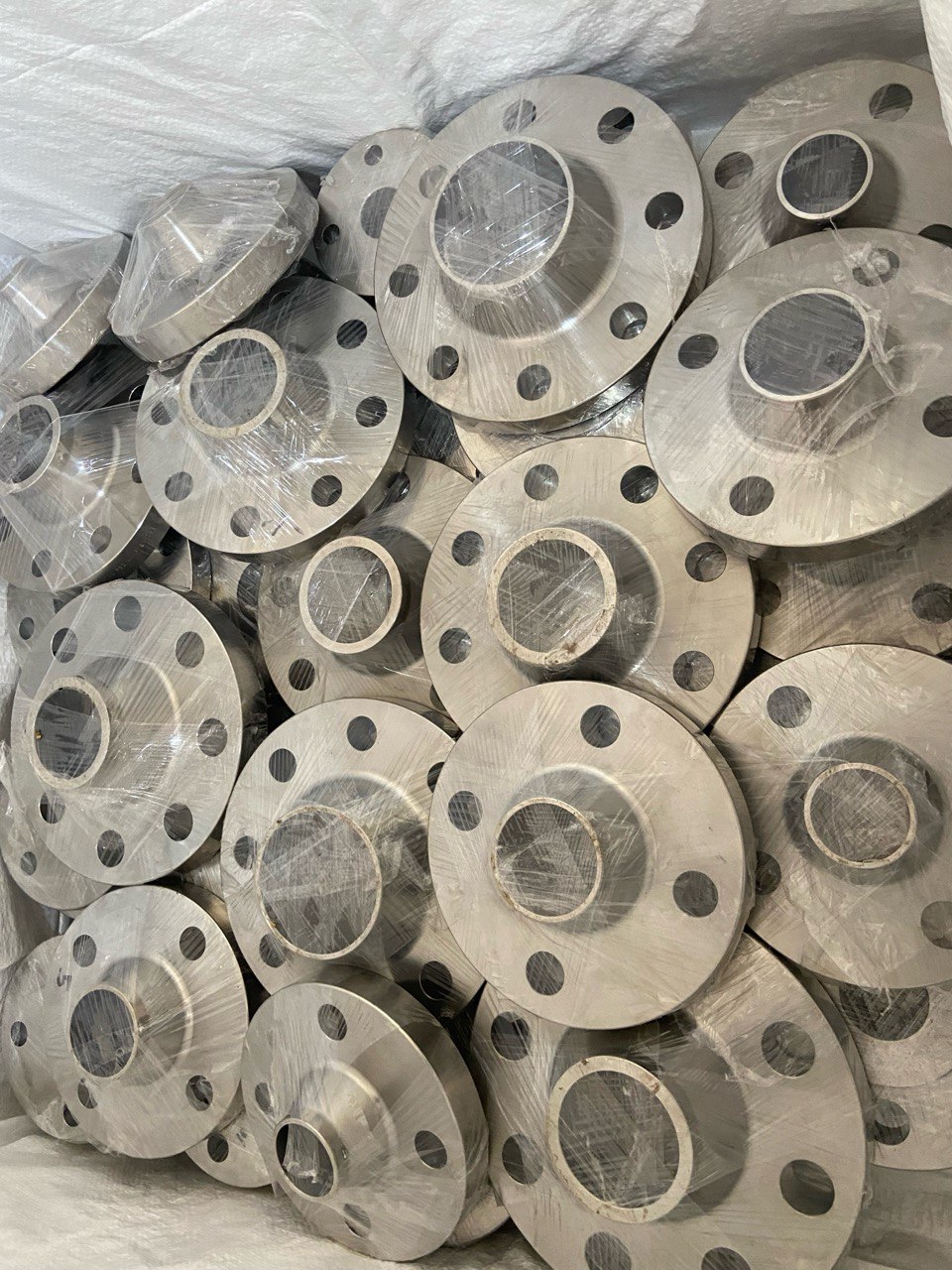
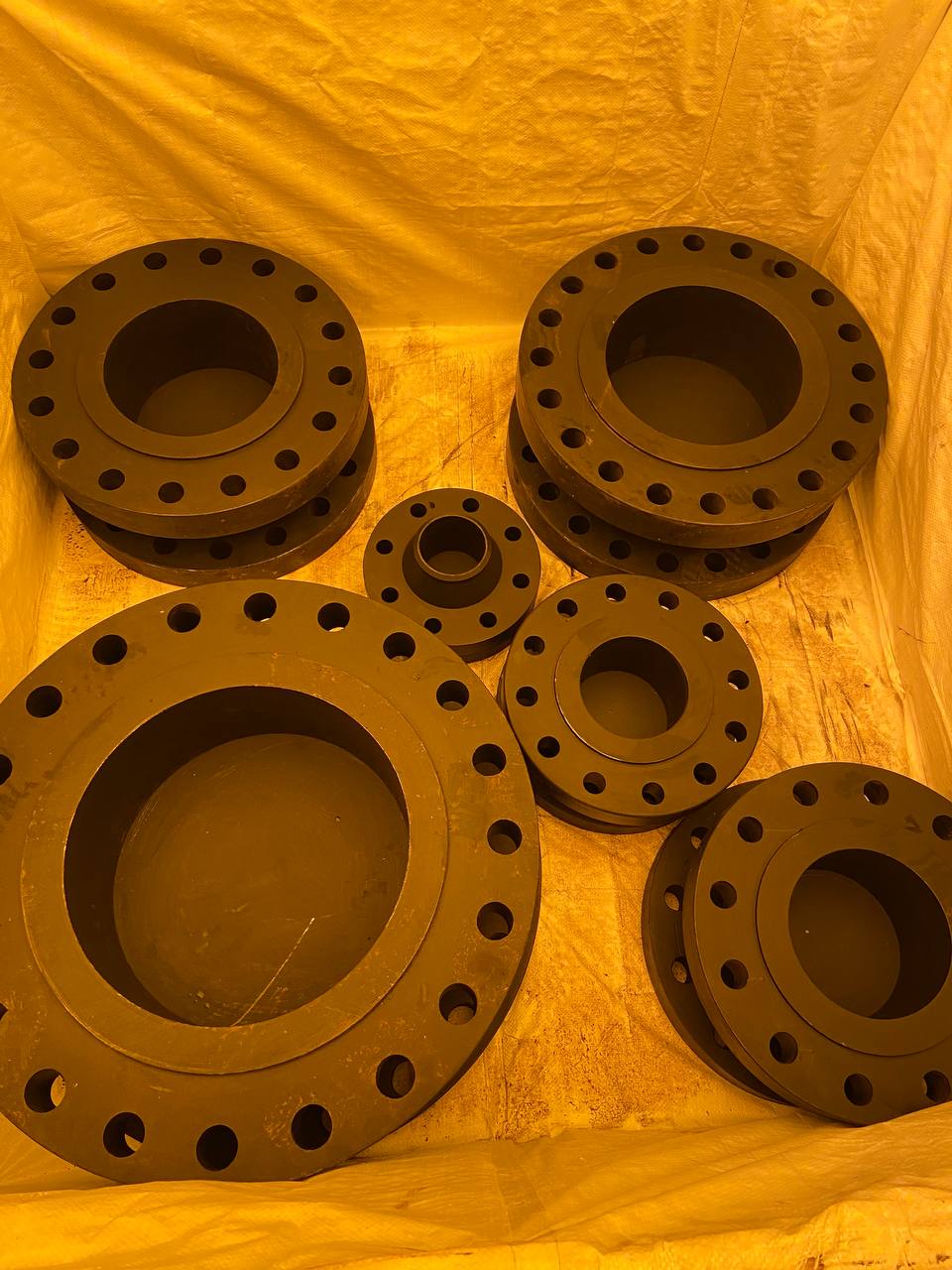
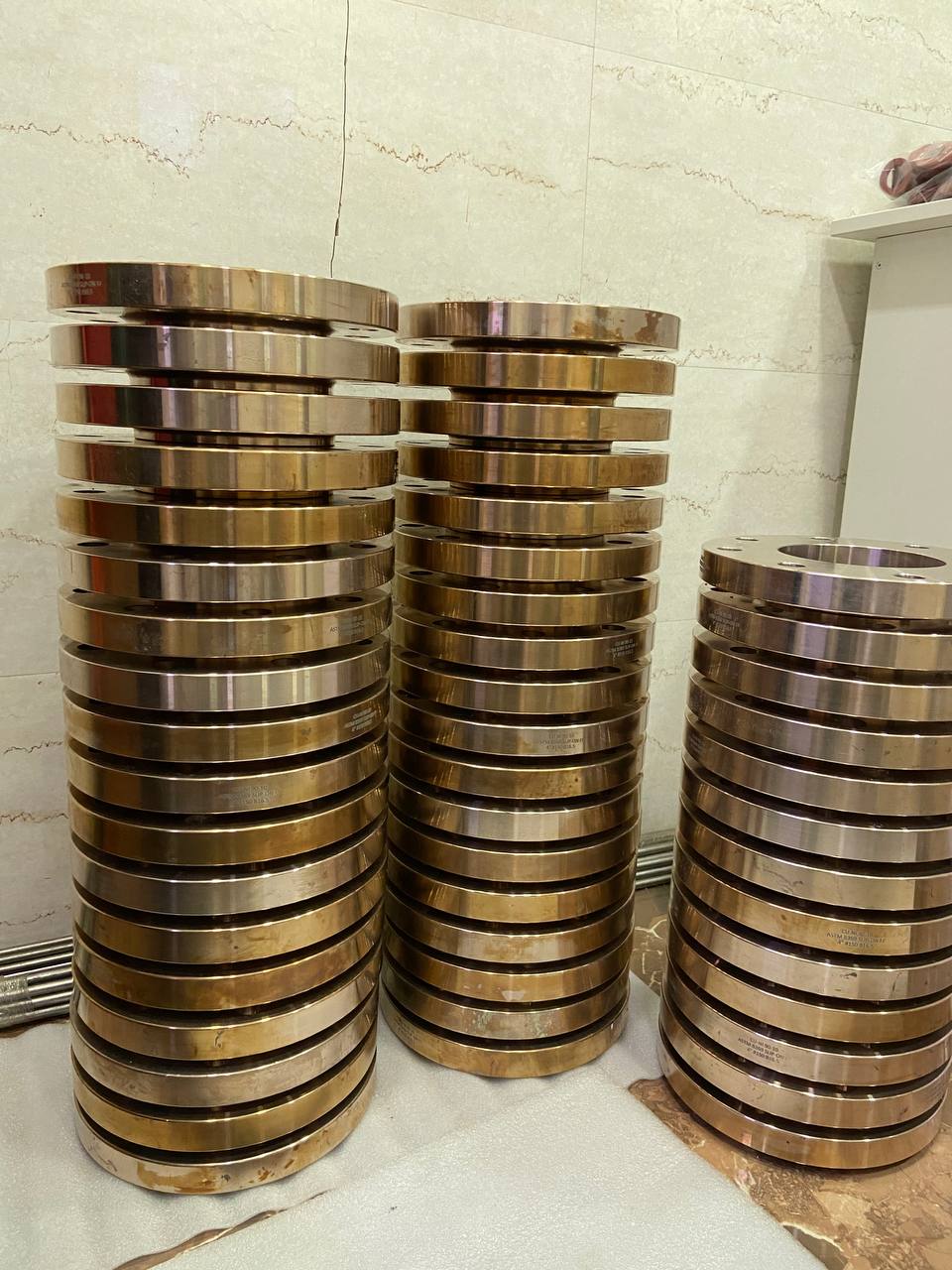
Everywhere general-purpose: refinery and petrochemical utility racks, cooling water and firewater, tank-farm manifolds, HVAC and compressed air, water treatment, and marine systems in copper nickel. Our slip-on production and stock below:
Stainless Slip On Flanges — Wrapped for DispatchA105 Slip On Flanges — Export CratedCu-Ni Slip On Flanges — Bulk Stock
RFSO Flange Dimensions
RFSO dimensions follow the ASME B16.5 slip-on tables — OD, thickness, bolt circle, drilling and raised face by class:
Take-off note: tabulated thickness includes the 1/16″ raised face of Class 150/300 but excludes the 1/4″ face of Class 400 and above — add it when stacking, and allow the longer bolts.
How to Specify & Order an RFSO Flange
Four elements — the shortest spec of any flange type:
1
Size & standard — e.g. 6″ NB ASME B16.5.
2
Pressure class — 150 through 2500.
3
Material grade — e.g. ASTM A105 (galvanized if required), A182 F316L, B564 N04400.
4
Certification & quantity — EN 10204 3.1 or 3.2, PMI or NACE as applicable, quantity and destination — to sales@tescosteel.com or the inquiry form.
Example: “RFSO Flange, 6″ NB, ASME B16.5 Class 150, ASTM A105, EN 10204 3.1 — 60 pcs.” Ready-stock sizes quote with immediate delivery; the rest normally within 24 hours.
RFSO Flanges — Frequently Asked Questions
What is an RFSO flange?
RFSO stands for Raised Face Slip On — a slip-on flange carrying the standard raised gasket face, dimensioned to ASME B16.5. It is exactly the same product as a SORF flange: some piping classes write the facing first (RFSO), others the type first (SORF). The flange slides over the pipe end, is fixed with two fillet welds, and its raised face seats a spiral wound or sheet gasket. It is the everyday flange of general process, utility and water piping in Class 150 and 300.
Is there any difference between RFSO and SORF flanges?
None whatsoever — the two abbreviations describe the identical flange from opposite directions: RFSO reads facing-then-type (Raised Face Slip On), SORF reads type-then-facing (Slip On Raised Face). You will also meet SO RF, RF SO and 'slip on raised face' in full. Piping classes inherited from different engineering houses simply standardised on different orders. Whichever abbreviation your specification uses, the dimensions, material options and price are the same, and Tesco marks the flange to match your document.
How do I install an RFSO flange correctly?
Five steps: (1) slide the flange over the pipe with the raised face outboard; (2) set the pipe end back 1/8" (3 mm) from the face — never flush, or the inside weld has no room; (3) square the flange to the pipe axis and tack at four points, checking bolt holes straddle the vertical centreline per piping convention; (4) fillet-weld the hub outside and the bore inside, each throat at least the pipe wall and not under 3/16"; (5) clean spatter off the raised face before gasketing. Misalignment set at tack-up cannot be pulled out by the bolts.
What bolt torque does an RFSO flange joint need?
Torque belongs to the gasket, not the flange: a spiral wound gasket in a 6" Class 150 joint typically wants roughly 3 times the seating stress of a soft sheet gasket, so always work from the gasket manufacturer's table for the bolt size and lubrication used. What the RFSO contributes is the raised face that concentrates whatever load the bolts deliver onto the gasket ring. Tighten in a star pattern in 30/60/100% passes, and re-torque soft gaskets after the first thermal cycle.
What are the pressure-temperature ratings of RFSO flanges?
The same B16.5 ratings as any flange of the class and material group. For ASTM A105 carbon steel at ambient temperature: Class 150 = 285 psi, Class 300 = 740 psi, Class 600 = 1,480 psi, falling as temperature rises — Class 150 A105 is down to 200 psi at 260°C. Stainless groups rate somewhat lower at ambient but hold better at temperature. The rating comes from the class and material, not from the slip-on construction — though above Class 300 most specifications switch to weld necks anyway.
When should I choose an RFSO flange over a weld neck?
Choose RFSO when the line is general-purpose: Class 150/300, steady pressure, non-lethal service, no radiography requirement. You save 20-30% on the flange, skip pipe-end bevelling, and field fit-up forgives imprecise cut lengths. Move to a weld neck (WNRF) when the service turns severe — cyclic loading, high pressure classes, category M fluids, or wherever the code demands radiographed butt welds. Most plants run both: RFSO on utilities and offsites, weld necks in the process core.
What materials are RFSO flanges stocked and made in?
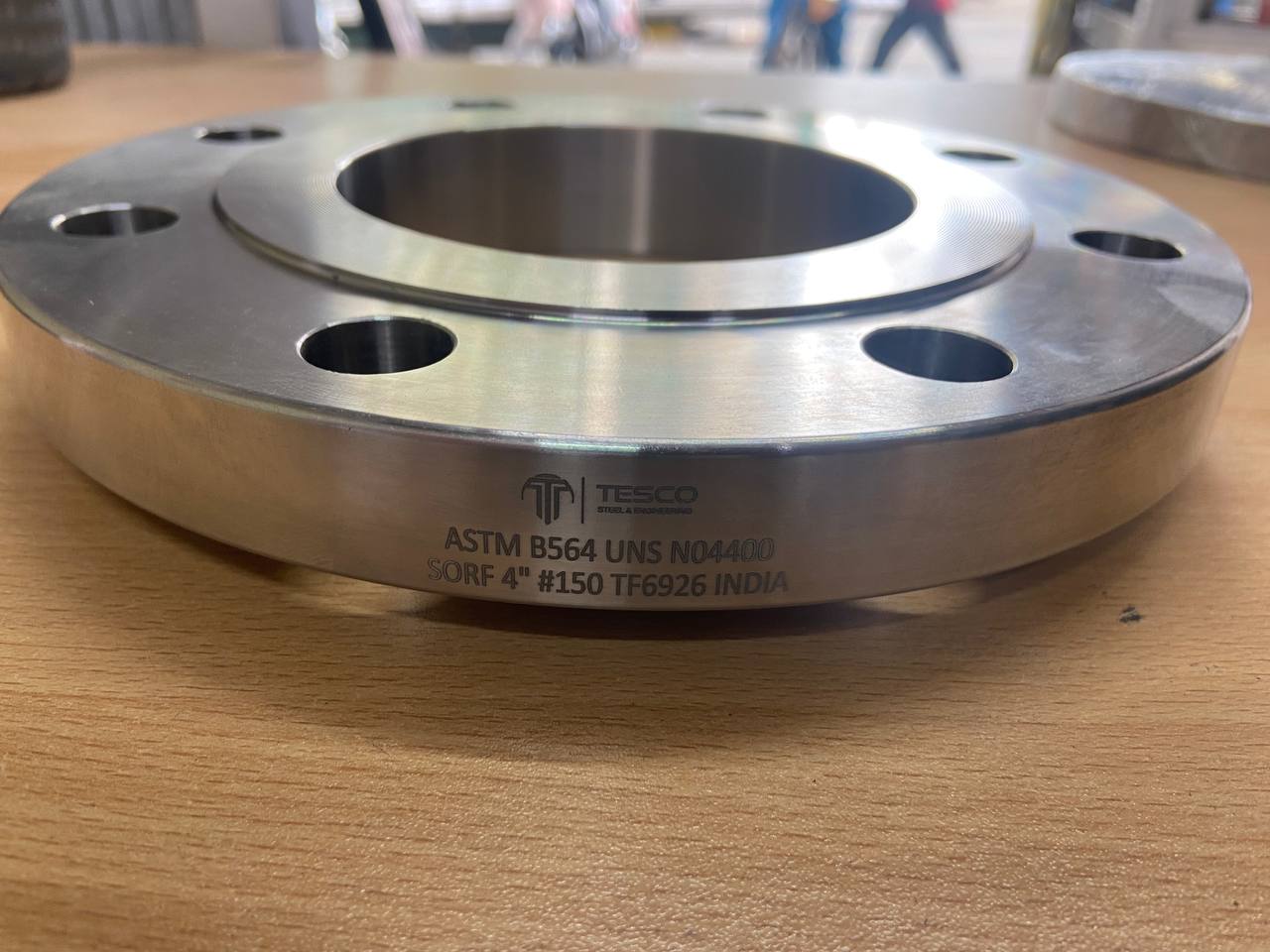
Ready stock concentrates in the volume grades: ASTM A105 carbon steel and A182 F304L/F316L stainless in Class 150 and 300, typically available for dispatch within days. To order, the full range follows: LTCS A350 LF2, stainless F321/F347/F904L, duplex F51/F53/F55, chrome-moly F5-F91, Monel 400 — like the laser-marked B564 N04400 unit photographed on this page — Inconel, Incoloy, Hastelloy, titanium and copper nickel. Every lot ships with EN 10204 3.1 or 3.2 certificates.
What is the bore of an RFSO flange — does it need a schedule?
No schedule is needed. The slip-on bore is machined slightly larger than the pipe outside diameter — per the B16.5 slip-on bore tables — so the flange slides over the pipe regardless of wall thickness. That is one of the type's ordering conveniences: size, class, material and certification fully define an RFSO. Only bored types like weld necks need the pipe schedule stated.
Can RFSO flanges be galvanized or coated?
Yes — hot-dip galvanizing is routine on A105 RFSO flanges for water supply, firefighting and coastal structural duty, and epoxy or FBE coating serves buried and marine service. The raised face remains serviceable as coated for soft gaskets; where a specification requires bare gasket seating, the face is masked or spot-faced after coating. State the coating and its standard (e.g. IS 4759 / ISO 1461) on the enquiry.
What is the raised face on an RFSO flange?
A concentric ring standing 1/16" (1.6 mm) proud of the face on Class 150 and 300 flanges, and 1/4" (6.4 mm) on Class 400 and above, machined with the serrated stock finish of ASME B16.5 (Ra 3.2-6.3 µm). Its function is mechanical: shrinking the contact area multiplies the gasket seating stress the bolts can generate. Remember the take-off rule — tabulated thickness includes the 1/16" face but excludes the 1/4" one.
How much does an RFSO flange weigh?
As working approximations in carbon steel: 2" Class 150 about 2 kg, 4" Class 150 about 4 kg, 6" Class 150 about 8 kg, 8" Class 300 about 17 kg, 12" Class 150 about 24 kg. Stainless and nickel alloys weigh essentially the same; titanium about half. The complete size-by-size table is on our Flange Weight Chart page, and every quotation states the exact unit weight.
What details are needed to get an accurate RFSO flange quotation?
Four elements plus commercial terms: (1) size and dimensional standard — e.g. 6" NB ASME B16.5; (2) pressure class — 150 through 2500; (3) material grade — e.g. ASTM A105 (state galvanizing if required), A182 F316L, B564 N04400; (4) certification — EN 10204 3.1 or 3.2, PMI, NACE MR0175 where applicable. No pipe schedule is needed for the slip-on bore. Add the quantity and destination and we return price, weight and delivery — normally within 24 hours, from ready stock where the size allows.
Who manufactures RFSO flanges in India?
Tesco Steel & Engineering is an ISO 9001:2015 certified flange manufacturer based in Mumbai, India, producing RFSO flanges from ½" to 80" NB — ready stock in A105 and stainless Class 150/300, and the full alloy range to order, each flange laser-marked with grade, size, class and heat number as pictured on this page. Flanges ship with EN 10204 3.1/3.2 certification and are exported to more than 50 countries across the Middle East, Europe, Africa, Asia and the Americas.