FFSO Flanges — Flat Face Slip On Flange Manufacturer & Exporter
Tesco Steel & Engineering manufactures FFSO flanges — Flat Face Slip On — to ASME B16.5, AWWA C207 and EN 1092-1 Type 01 patterns from ½″ to 80″ NB. If your piping class writes it SOFF, it is the same flange. This is the waterworks and cast-iron mating standard: the whole face flat, sealed with a full-face gasket, so iron valves, pump casings and GRP flanges are never bent by a raised face. Most-ordered as hot-dip galvanized A105 for water supply and firefighting; also in stainless, duplex and copper nickel for marine duty. Laser-marked, EN 10204 3.1/3.2 MTC. ISO 9001:2015, made in Mumbai, India — exported to 50+ countries.
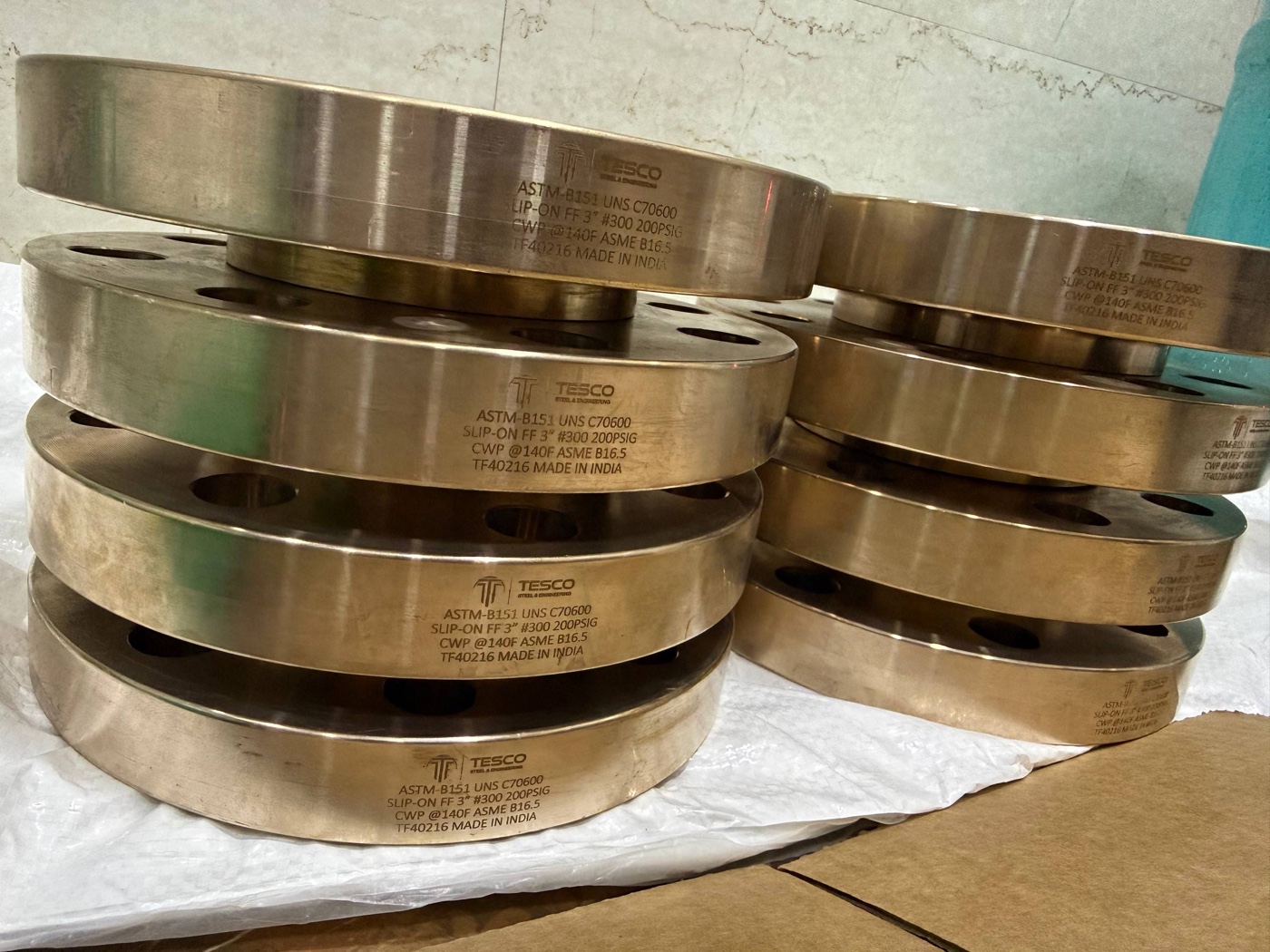
Tesco FFSO Flanges — ASTM B151 UNS C70600, Slip-On FF 3″ × 300# — Laser-Marked, Made in India
What is an FFSO Flange?
FFSO = Flat Face + Slip On — the same flange the industry also writes as SOFF, abbreviated facing-first. The body slips over the pipe for two-fillet-weld installation; the face is one flat plane sealed by a full-face gasket with the bolts passing through it. Its home ground: waterworks, cast iron valves and pumps, GRP and lined systems — every joint where a raised face would crack the brittle mate.
Naming works exactly as with the raised-face pair RFSO/SORF: some piping classes put the facing first (FFSO), others the type first (SOFF) — one product either way. The full engineering story of the flat face is on our SOFF flanges page; this page focuses on where FFSO earns its living: water and iron.
Also searched as: SOFF flange, SO FF flange, FF slip on flange, flat face slip on flange, full face slip on flange, AWWA slip on flange — all refer to the product on this page.
FFSO Flange Specifications
FFSO Flanges are available in the following specifications:
Size
1/2"NB to 24"NB per ASME B16.5; to 80"NB per ASME B16.47 / AWWA C207
Class
ASME 150#, 300# (dominant), 400#–2500# on request; AWWA C207 Class B, D, E, F
PN Ratings
PN 2.5 - PN 40 (EN 1092-1 Type 01, Type A flat face)
Drilling
ASME B16.5; ANSI B16.1 Class 125/250 cast iron matching on request
Facing
Flat Face — full plane; serrated or smooth finish to suit the gasket and mate
Gasket System
Full-face per ASME B16.21 — EPDM / neoprene / nitrile rubber or CNAF, 1.5–3 mm, bolt holes punched
Installation
Two fillet welds (hub + bore), pipe set back 1/8"; torque to the weaker (iron) flange's limits
Volume Standard
ASTM A105 hot-dip galvanized (IS 4759 / ISO 1461) — water supply, firefighting, sewage
EN 10204 3.1 (standard) / 3.2 witnessed; PMI on request
Why FFSO Owns the Water & Iron Territory
Born for Cast Iron
A century of municipal hardware is grey and ductile iron — FFSO is the steel flange that bolts to it without cracking it, full-face gasket spreading every newton evenly.
The AWWA Default
AWWA C207 waterworks flanges are flat faced as standard — galvanized FFSO flanges are the everyday hardware of mains, pump stations and hydrant lines.
Galvanized & Ready for Water
Hot-dip galvanizing to IS 4759 / ISO 1461 with faces serviceable as coated — decades of corrosion protection at water-industry prices.
Marine in Copper Nickel
Seawater systems pair Cu-Ni pipe with flat-faced joints against composite and lined equipment — the laser-marked C70600 units above are exactly that duty.
One Word from SOFF
Same product, reverse abbreviation — we quote and mark to your spec's wording. See SOFF flanges for the type-first page and the facing's engineering detail.
Bolting FFSO to Cast Iron — Field Rules
1
Confirm both faces flat — never a raised face against iron; if the steel side arrived RF, machine it flat or replace it.
2
Full-face gasket only — bolt holes punched, rubber or CNAF; a ring gasket leaves the iron rim unsupported and recreates the cracking risk.
3
Torque to the iron's limit — the weaker member governs; star pattern, staged passes, no impact guns.
4
Mind the drilling — ANSI B16.1 Class 125 iron drilling matches B16.5 Class 150, and Class 250 matches Class 300; confirm before ordering, we drill to match.
5
Replace, don't re-tighten — an aged rubber gasket that weeps gets renewed; crushing it further only bends the iron.
Where FFSO Flanges Are Used
Water first — municipal supply, sewage treatment, firefighting rings, irrigation headers in galvanized A105 — then cast iron valve and pump connections plant-wide, GRP/FRP chemical and desalination piping, lined systems, and marine seawater duty in copper nickel. Our slip-on production below:
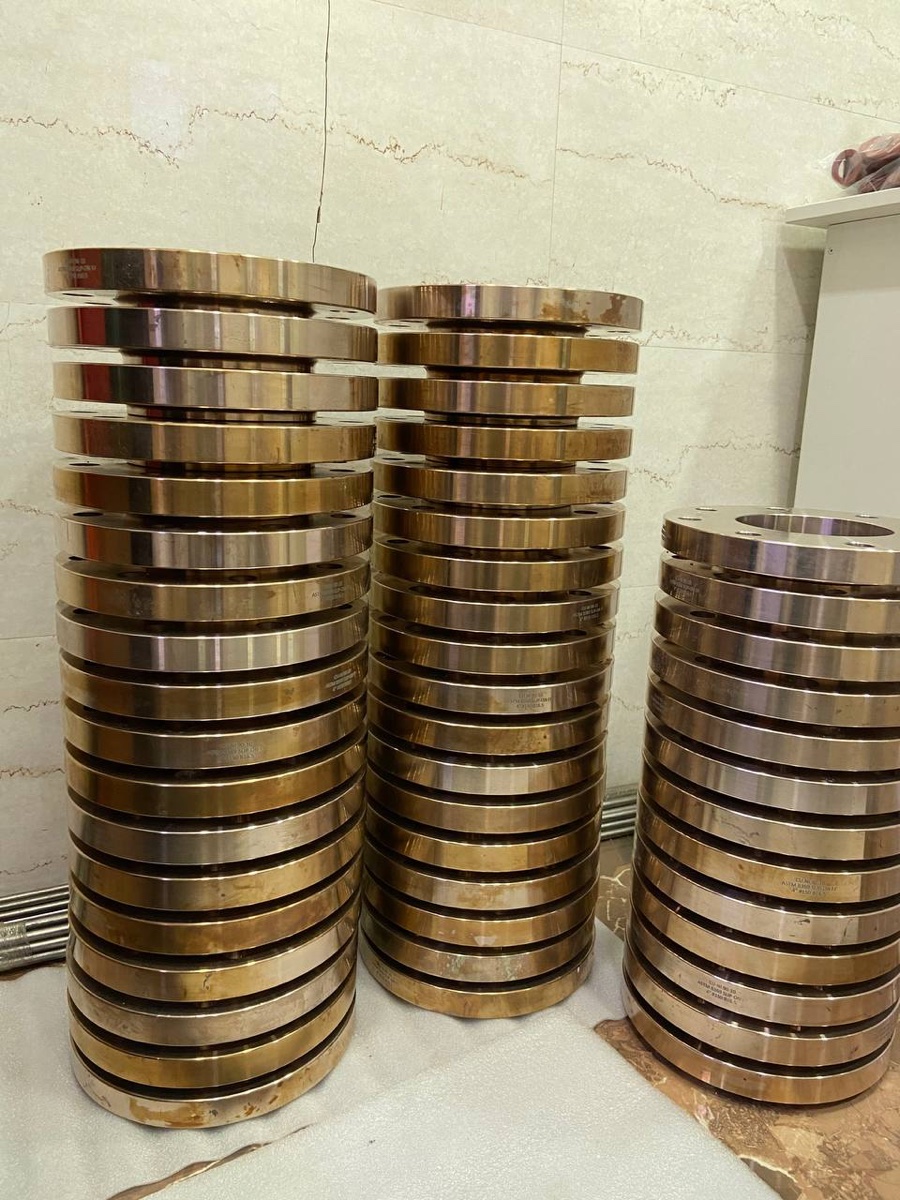
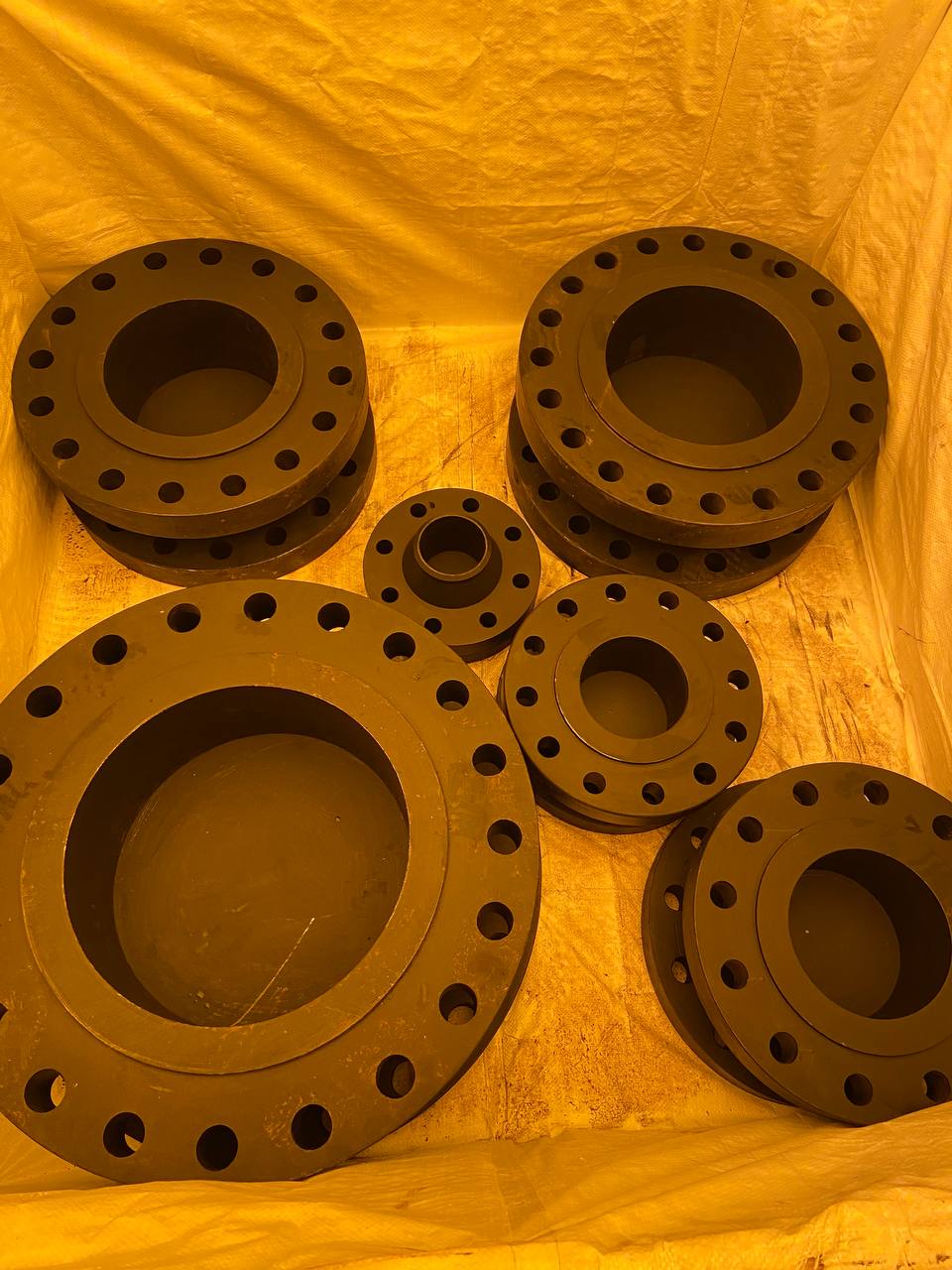
Cu-Ni Slip On Flanges — Production StacksCupro-Nickel Slip On — Machined & FinishedA105 Slip On Flanges — Export Crated
FFSO Flange Dimensions
FFSO dimensions follow the ASME B16.5 slip-on tables — identical to SORF except the face is machined flush. Full charts by class:
Drilling note: mating to old cast iron? B16.1 Class 125 drilling = B16.5 Class 150 and Class 250 = Class 300 — but always confirm bolt count and circle from the actual valve before ordering. We drill to match either pattern.
How to Specify & Order an FFSO Flange
Four elements — no bore schedule needed for the slip-on bore:
1
Size & standard — e.g. 6″ NB ASME B16.5, 24″ AWWA C207 Class D, or DN150 EN 1092-1 Type 01/A — noting B16.1 drilling if mating cast iron.
2
Pressure class — ASME 150/300 or the AWWA class letter.
3
Material & finish, plus the mate — e.g. A105 hot-dip galvanized, B151 C70600 — and what it bolts to (iron valve, GRP, lined), which confirms the facing and finish.
4
Certification & quantity — EN 10204 3.1 or 3.2, then quantity and destination, sent to sales@tescosteel.com or the inquiry form.
Example: “FFSO Flange, 8″ NB, ASME B16.5 Class 150, ASTM A105 hot-dip galvanized, EN 10204 3.1 — 30 pcs (mating cast iron sluice valves, B16.1 Cl.125 drilling).” Quotation normally within 24 hours.
FFSO Flanges — Frequently Asked Questions
What is an FFSO flange?
FFSO stands for Flat Face Slip On — a slip-on flange whose whole gasket face is machined in one flat plane, sealed with a full-face gasket that covers the bolt holes. It is exactly the same product as a SOFF flange, abbreviated facing-first instead of type-first. Its territory is any joint against flat-faced or brittle equipment: cast iron valves and pump casings, GRP flanges, lined pipe and AWWA waterworks hardware, where a raised face would bend and crack the mate.
Is there any difference between FFSO and SOFF flanges?
None — FFSO (Flat Face Slip On) and SOFF (Slip On Flat Face) are the same flange named from opposite directions, exactly as RFSO and SORF are for the raised-face version. Different engineering houses standardised on different word orders in their piping classes; the drawing, dimensions, gasket system and price are identical. Tesco marks the flange with whichever designation your specification uses.
Why are waterworks flanges flat faced?
Because the water industry grew up on cast iron. Valves, hydrants, pumps and fittings in municipal service have been grey and ductile iron for a century, and iron cannot tolerate the bending moment a raised face creates — so AWWA C207 standardised steel waterworks flanges as flat faced, mating iron-to-steel safely with full-face rubber gaskets at the industry's modest pressures. FFSO flanges, usually hot-dip galvanized A105, are the everyday steel half of those joints.
How do I bolt an FFSO flange to a cast iron valve safely?
Four rules: (1) confirm the steel flange is genuinely flat faced — never a raised face against iron; (2) use a full-face gasket with bolt holes, typically 3 mm rubber or CNAF, so the joint bears across its full width; (3) torque to the iron flange's limits, not the steel's — the weaker member governs — pulling up evenly in a star pattern in stages; (4) never re-tighten a cold, aged rubber gasket to fix a weep — replace it. Followed in order, these rules are why flat-face joints against iron run for decades.
What gasket does an FFSO flange use?
A full-face gasket per ASME B16.21 — cut to the full flange OD with a hole for every bolt, in EPDM, neoprene, nitrile or compressed non-asbestos sheet, typically 1.5-3 mm thick. The bolts locate it automatically and the full-width bearing spreads the load. Ring gaskets that stop at the bolt circle are for raised faces: used on a flat-face joint against iron they leave the rim unsupported and recreate the bending problem the flat face exists to prevent.
Are FFSO flanges available galvanized?
Yes — hot-dip galvanized ASTM A105 is the single most-ordered FFSO configuration, because the flange's natural habitat is water: municipal supply, firefighting, sewage and coastal utility lines. Tesco galvanizes to IS 4759 / ISO 1461 with faces serviceable as coated for rubber gaskets; epoxy and FBE coatings are available for buried service. Stainless, copper nickel — like the laser-marked C70600 units pictured on this page — and other alloys serve chemically aggressive duty bare.
How is an FFSO flange installed on the pipe?
Like every slip-on: slide over the pipe, set the pipe end back about 1/8" (3 mm) from the face, square, tack with bolt holes straddling the vertical centreline, then run two fillet welds — hub outside, bore inside — each throat at least the pipe wall and not less than 3/16" per ASME B16.5/B31.3. On galvanized flanges, weld first and re-coat the weld zone, or order the flange galvanized after any site machining is complete.
What standards cover FFSO flanges?
Three families: ASME B16.5 for ½" to 24" NB in Class 150 through 2500 (flat face is a standard facing option on every class, though 150 and 300 dominate); AWWA C207 for waterworks in Class B, D, E and F, flat faced by default and reaching large diameters; and EN 1092-1 Type 01 with Type A face for the European PN series. Tesco manufactures all three patterns to 80" NB, matched to ANSI B16.1 cast iron drilling where the mate requires it.
Can I use an FFSO flange against a raised face flange?
It is poor practice and prohibited against brittle materials. A raised face bearing on a flat face leaves the flat flange's rim unsupported — acceptable occasionally between two ductile steel flanges with engineering review, but never against cast iron or GRP. The correct fixes are to machine the raised face off the steel mate (permissible on most forged flanges) or simply order matching facings. FF seals to FF with a full-face gasket; RF seals to RF with a ring gasket — keep the pairs together.
What materials are FFSO flanges made in?
Carbon steel ASTM A105 — bare or hot-dip galvanized, the waterworks volume standard — plus LTCS A350 LF2, stainless A182 F304L/F316L and higher grades, duplex F51/F53/F55, nickel alloys, and copper nickel C70600/C71500 for marine and seawater systems, as the laser-marked SLIP-ON FF units photographed on this page show. Every lot ships with EN 10204 3.1 or 3.2 certificates and PMI on request.
How much does an FFSO flange weigh?
Essentially the same as the equivalent raised-face slip-on: about 2 kg for a 2" Class 150, 8 kg for a 6" Class 150 and 24 kg for a 12" Class 150 in carbon steel, with galvanizing adding a few percent. AWWA C207 Class B/D flanges run lighter than B16.5 equivalents at large diameters — one reason the water industry uses them. Every quotation states the exact unit weight.
What details are needed to get an accurate FFSO flange quotation?
Four elements plus commercial terms: (1) size and standard — e.g. 6" NB ASME B16.5, 24" AWWA C207 Class D, or DN150 EN 1092-1 Type 01/A, noting ANSI B16.1 drilling if mating cast iron; (2) pressure class; (3) material and finish — e.g. A105 hot-dip galvanized, A182 F316L, B151 C70600 — and what the flange mates to; (4) certification — EN 10204 3.1 or 3.2. No pipe schedule is needed for the slip-on bore. Add quantity and destination and we return price, weight and delivery — normally within 24 hours.
Who manufactures FFSO flanges in India?
Tesco Steel & Engineering is an ISO 9001:2015 certified flange manufacturer based in Mumbai, India, producing FFSO flanges from ½" to 80" NB to ASME B16.5, AWWA C207 and EN 1092-1 patterns — hot-dip galvanized A105 for waterworks, stainless, duplex and copper nickel for marine and chemical duty — each laser-marked with grade, size, class and heat number. Flanges ship with EN 10204 3.1/3.2 certification and are exported to more than 50 countries.