SORF Flanges — Slip On Raised Face Flange Manufacturer & Exporter
Tesco Steel & Engineering manufactures SORF flanges — Slip On Raised Face, the most-ordered slip-on facing in the world — to ASME B16.5 Class 150–2500 from ½″ to 24″ NB, and to ASME B16.47 / AWWA C207 up to 80″ NB. The formula is simple: a slip-on body that slides over the pipe for two-fillet-weld installation, plus a raised face that concentrates bolt load onto the gasket for a dependable seal. Available in 50+ grades — carbon steel A105, LTCS, stainless & duplex A182, chrome-moly, Monel, Inconel, Hastelloy, titanium and copper nickel — each laser-marked with full traceability and supplied with EN 10204 3.1/3.2 MTC. ISO 9001:2015, made in Mumbai, India — exported to 50+ countries.
SORF · RFSO · Slip On Raised FaceASME B16.5 Class 150–2500½″ – 80″ NBTwo Fillet Welds · 1/8″ Set-Back50+ Material GradesEN 10204 3.1 / 3.2 MTCISO 9001:2015 · Exported Worldwide
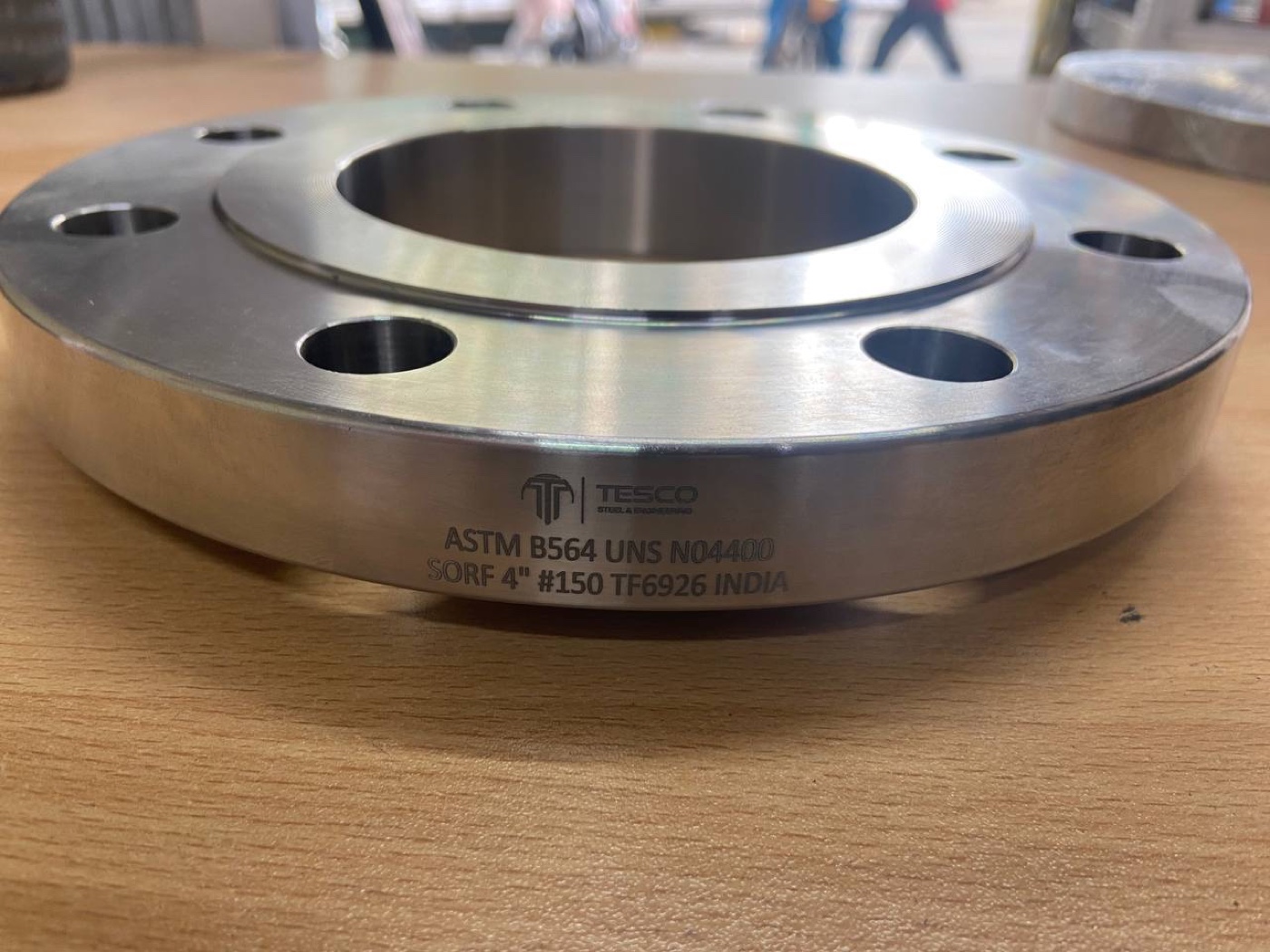
Tesco SORF Flange — ASTM B564 N04400 (Monel 400), 4″ × 150# — Laser-Marked, Made in India
What is a SORF Flange?
SORF = Slip On + Raised Face. The body is a slip-on flange — bored slightly over pipe OD, slid over the pipe end, and secured with two fillet welds (hub outside, bore inside) with the pipe set back 1/8″ from the face. The facing is the standard raised ring — 1/16″ high in Class 150/300, 1/4″ from Class 400 up — that concentrates bolt load onto the gasket so spiral wound and sheet gaskets seal reliably. Together they make the default flange of general process, water and utility piping: economical, forgiving to fit, dependable to seal.
The raised face carries a serrated stock finish per ASME B16.5 (Ra 3.2–6.3 µm / 125–250 µin) — concentric or spiral grooves that grip the gasket and leave leak paths nowhere to run. You can see the finish clearly on the raised face of the Monel unit photographed above.
Also searched as: RFSO flange, SO RF flange, slip on RF flange, raised face slip on flange, SORF flange ASME B16.5 — all refer to the product on this page. Related facings: SOFF (flat face) and SORTJ (ring type joint).
SORF Flange Specifications
SORF Flanges are available in the following specifications:
Size
1/2"NB to 24"NB per ASME B16.5; to 80"NB per ASME B16.47 / AWWA C207
Class
150#, 300#, 400#, 600#, 900#, 1500#, 2500#
Pressure Ratings
PN 2.5 - PN 400 (EN 1092-1 Type 01, Type B face)
Facing
Raised Face — 1/16" (Class 150/300), 1/4" (Class 400–2500); serrated stock finish Ra 3.2–6.3 µm
Installation
Two fillet welds (hub + bore), pipe set back 1/8" from face; min. weld throat = pipe wall, ≥ 3/16"
Carbon Steel
ASTM A105 (bare, hot-dip galvanized, epoxy or FBE coated)
C70600 (90/10), C71500 (70/30); Titanium Gr. 2 (ASTM B381)
Certification
EN 10204 3.1 (standard) / 3.2 witnessed; PMI, NACE MR0175 on request
Why SORF Is the World's Most-Ordered Slip On Facing
Economical by Design
No long hub to forge and machine — a SORF flange costs 20–30% less than the equivalent weld neck, and the saving multiplies across a large-bore utility project.
Forgiving Fit-Up
The flange slides over the pipe, so cut-length accuracy is not critical — field crews align the face, tack, and weld. No bevelling, no root gap, no back purge.
A Facing Gaskets Love
The raised ring concentrates seating stress exactly where the gasket needs it, and the serrated finish grips spiral wound, CNAF and PTFE gaskets alike.
Every Material, One Pattern
From galvanized A105 water headers to the Monel 400 unit photographed above — the same SORF geometry serves 50+ grades, so piping classes stay simple.
Know Its Limits
Fillet welds cannot be radiographed and concentrate stress under fatigue — severe cyclic, high-consequence and RT-mandated lines move to WNRF. Inside its envelope, SORF is unbeatable value.
How Our SORF Flanges Are Manufactured
1
Forging — cut billet of certified heat is hot-forged into the flange blank, keeping full heat traceability from raw material to despatch.
2
Heat treatment — normalizing for carbon steel, solution annealing for stainless and nickel grades, with the thermal record retained per heat.
3
Machining — hub, faces and bolt holes to the dimensional standard; the bore machined slightly over pipe OD per the slip-on tolerance so the flange slides on cleanly.
4
Raised face & finish — the defining operation: the raised ring turned to its 1/16″ or 1/4″ height and given the serrated stock finish that grips the gasket.
5
Testing & marking — mechanical and chemical verification against the heat, PMI where specified, then permanent laser marking of grade, size, class and heat number — exactly as on the photo above.
6
Certification & packing — EN 10204 3.1 MTC (3.2 witnessed on request), faces protected, export-packed.
Where SORF Flanges Are Used
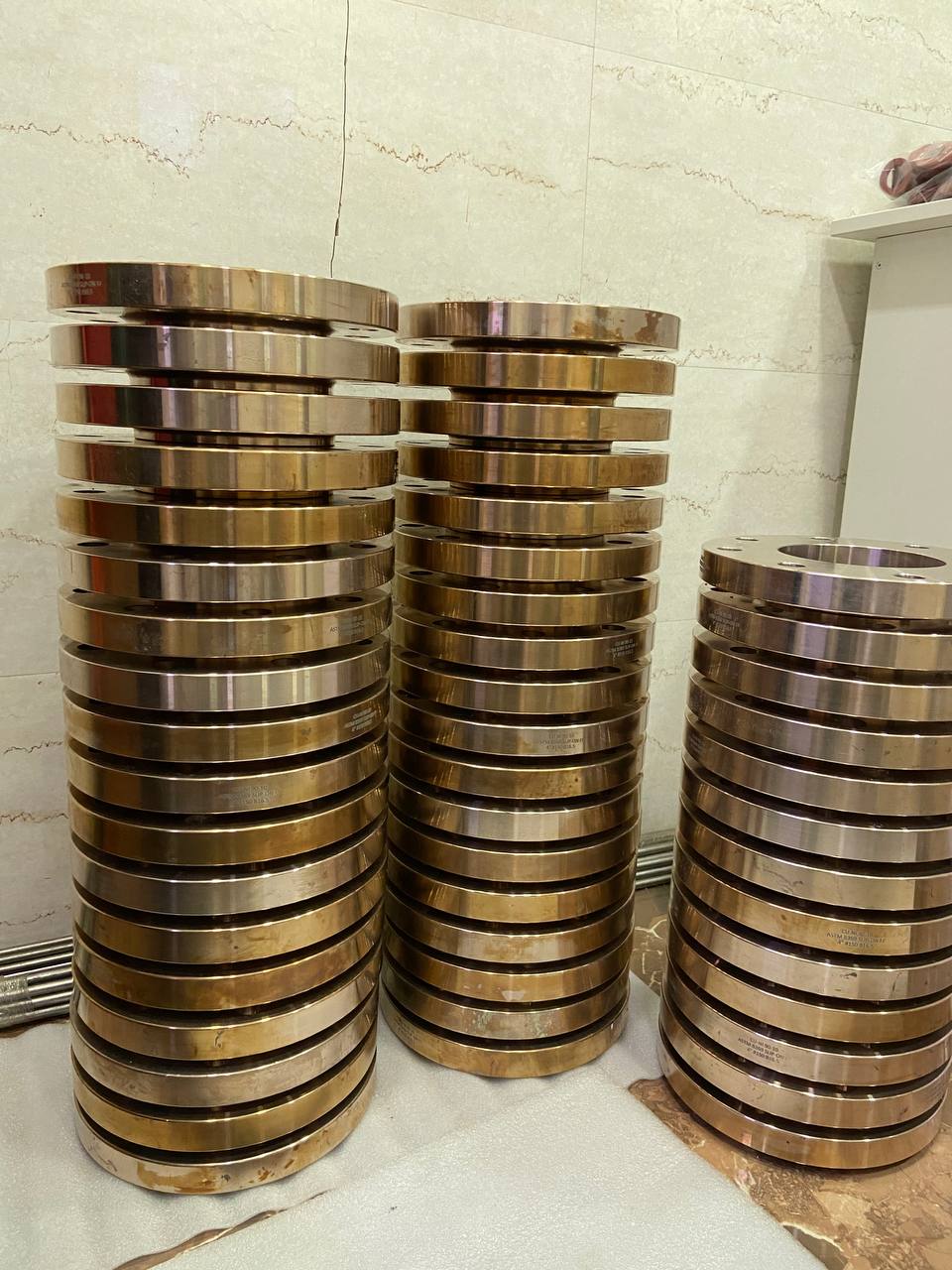
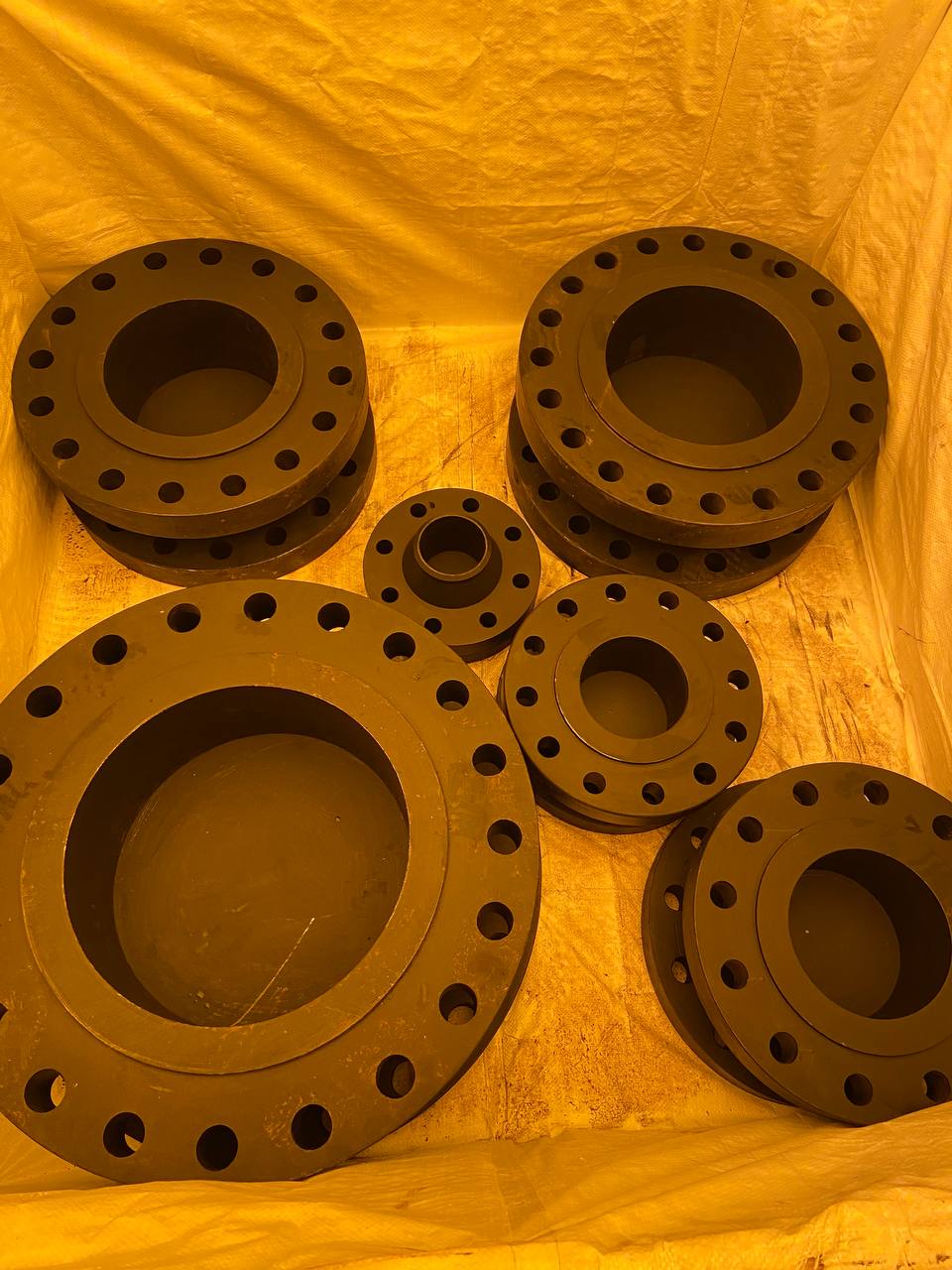
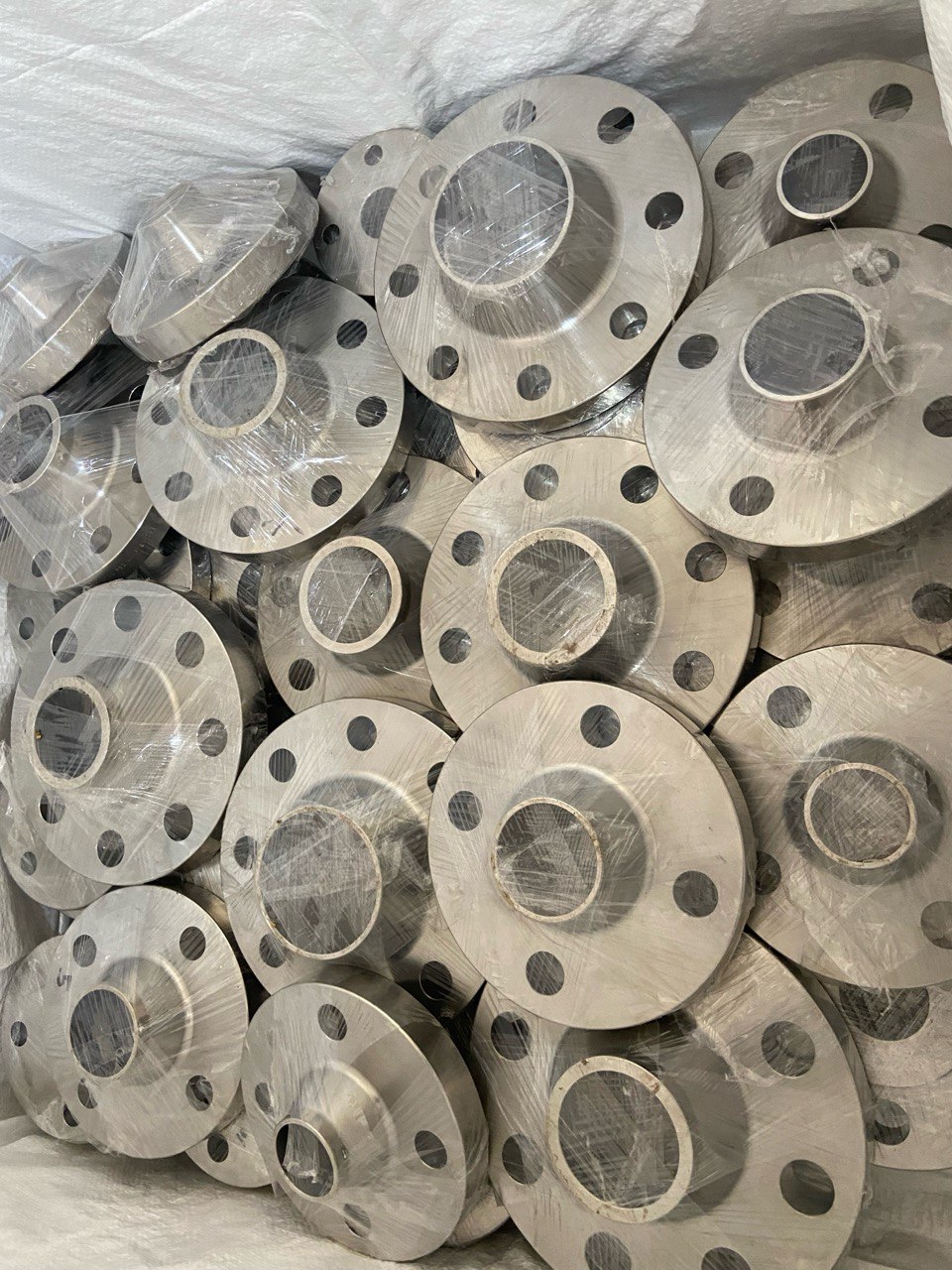
General process piping leads — refinery and petrochemical utility headers, cooling water, tank-farm and transfer lines — then water treatment and AWWA mains, HVAC and fire protection, shipbuilding ballast and seawater systems in copper nickel, and chemical duty in stainless and nickel alloys. Our slip-on production below:
Copper Nickel Slip On Flanges — Bulk Stock, Export ReadyA105 Slip On Flanges — Mixed Sizes, Export CratedStainless Slip On & Weld Neck Flanges — Wrapped for Dispatch
SORF Flange Dimensions
SORF flange dimensions — OD, thickness, bolt circle, bolt holes and raised face — follow the slip-on tables of ASME B16.5. Full charts by class:
Take-off note: published flange thickness includes the 1/16″ raised face of Class 150/300 but excludes the 1/4″ face of Class 400 and above — add it when stacking dimensions, and remember the longer bolts.
How to Specify & Order a SORF Flange
A complete SORF specification has four elements — no bore schedule needed, since the slip-on bore suits the pipe OD:
1
Size & standard — nominal bore and dimensional standard, e.g. 6″ NB ASME B16.5 or DN150 EN 1092-1 Type 01.
2
Pressure class or PN rating — Class 150/300/400/600/900/1500/2500 or PN 2.5–PN 40.
3
Material grade — e.g. ASTM A105 (galvanized if required), A182 F316L, B564 N04400 — matching the pipe.
4
Certification & quantity — EN 10204 3.1 or 3.2, PMI, NACE MR0175 as applicable, then quantity and destination, sent to sales@tescosteel.com or the inquiry form.
Example of a complete line item: “SORF Flange, 6″ NB, ASME B16.5 Class 150, ASTM A105, EN 10204 3.1 — 40 pcs.” Quotation with price, weight and delivery normally within 24 hours.
SORF Flanges — Frequently Asked Questions
What is a SORF flange?
SORF stands for Slip On Raised Face — a slip-on flange whose gasket face carries the standard raised ring. The flange slides over the pipe end and is secured with two fillet welds (one at the hub, one inside the bore), while the raised face concentrates the bolt load onto the gasket for a reliable seal. Dimensioned to ASME B16.5 for ½" to 24" NB, it is the most widely ordered slip-on facing in the world — the default flange of general process, water and utility piping.
What does the raised face on a SORF flange actually do?
It concentrates force. The raised ring — 1/16" high on Class 150 and 300 flanges, 1/4" on Class 400 and above — reduces the contact area between flange and gasket, so the same bolt load produces a much higher seating stress on the gasket than a full flat face would. That is what makes spiral wound and sheet gaskets seal reliably. The face carries a serrated 'stock' finish per ASME B16.5 whose grooves grip the gasket and give leak paths nowhere to run.
What is the difference between SORF and SOFF flanges?
Only the facing. SORF has the raised ring and uses ring gaskets covering just the seating surface — the default for steel-to-steel process joints. SOFF (Slip On Flat Face) is machined flush across the whole face and uses a full-face gasket covering the bolt holes — specified when mating to cast iron valves, pump casings or GRP flanges, where a raised face would bend and crack the brittle mate. Hub, bore, bolt circle and thickness are identical; only the face differs.
What is the difference between a SORF flange and a WNRF flange?
The connection to the pipe. A SORF flange slips over the pipe and takes two fillet welds — cheaper, lighter, forgiving of pipe cut length, but with welds that cannot be radiographed. A WNRF (weld neck raised face) flange butt-welds to the pipe end through a long tapered hub — stronger, fully inspectable by RT/UT, and roughly 50% better in fatigue. SORF dominates Class 150/300 general service; weld necks take over as pressure, temperature and consequence rise, and most codes mandate them for severe cyclic service.
Is SORF the same as RFSO or SO RF?
Yes — SORF, RFSO, SO RF and 'slip on raised face' all describe exactly the same flange; the industry simply abbreviates in both orders. Purchase orders, piping classes and marking practices vary between companies and countries, but the product quoted and supplied is identical. Tesco marks flanges with the designation your specification uses.
How is a SORF flange welded to the pipe?
With two fillet welds. The pipe is inserted until it sits about 1/8" (3 mm) back from the flange face — the set-back that leaves room for the inside weld — then a fillet weld is made around the hub outside and a second inside the bore. Per ASME B16.5 and B31.3 each weld's throat must be at least the pipe wall thickness and not less than 3/16" (5 mm). The inside weld seals the annular gap so fluid cannot creep between pipe OD and flange bore.
What materials are SORF flanges available in?
The complete industrial range: carbon steel ASTM A105 (the volume standard, bare or galvanized), LTCS A350 LF2 for low temperature, stainless ASTM A182 F304/L, F316/L, F321, F347, F310, F904L, duplex and super duplex F51/F53/F55, chrome-moly F5-F91, Monel 400/K500, Inconel 600/601/625, Incoloy 800/825, Hastelloy C276/C22, titanium Grade 2 and copper nickel C70600/C71500 — the Monel SORF pictured on this page is a B564 N04400 unit from our production. All grades ship with EN 10204 3.1 or 3.2 certificates.
What sizes and pressure classes do SORF flanges come in?
ASME B16.5 covers SORF flanges from ½" to 24" NB in Class 150, 300, 400, 600, 900, 1500 and 2500 — with Class 150 and 300 accounting for the overwhelming majority of orders, since higher classes usually move to weld necks. Above 24", ASME B16.47 and AWWA C207 patterns extend slip-on raised face construction to 60" and beyond; Tesco manufactures to 80" NB. European PN 2.5-PN 40 equivalents follow EN 1092-1 Type 01 with Type B raised face.
Which gasket is used with a SORF flange?
Any standard raised-face gasket: spiral wound with inner and outer rings (the process-industry default), compressed non-asbestos (CNAF) sheet, PTFE or graphite sheet — sized to ASME B16.20/B16.21 so the gasket sits inside the bolt circle on the raised ring. The serrated face finish is designed for exactly these gaskets. Only if the mating flange is flat-faced should you switch to a SOFF flange and full-face gasket instead.
What is the raised face height and finish on a SORF flange?
Per ASME B16.5: 1/16" (1.6 mm) raised face for Class 150 and 300, and 1/4" (6.4 mm) for Class 400, 600, 900, 1500 and 2500. Note that published flange thickness dimensions include the 1/16" face but exclude the 1/4" one — a classic take-off trap. The standard face finish is a serrated concentric or spiral 'stock' finish of Ra 3.2-6.3 µm (125-250 µin), which grips soft and semi-metallic gaskets; smooth finish is supplied on request for special gaskets.
When should I not use a SORF flange?
Four situations: (1) severe cyclic or fatigue service — the fillet-welded joint concentrates stress, so codes call for weld necks; (2) wherever radiographic weld examination is mandatory, since fillet welds cannot be radiographed; (3) against flat-faced cast iron or GRP equipment — use a SOFF with full-face gasket instead; (4) socket-weld territory below 2" in high-pressure lines, where SWRF flanges suit small bore better. Inside its envelope — general process, utilities, water — SORF is the economical default.
How much does a SORF flange weigh?
As working approximations for carbon steel ASME B16.5 SORF flanges: a 2" Class 150 weighs about 2 kg, a 4" Class 150 about 4 kg, a 6" Class 150 about 8 kg, a 12" Class 150 about 24 kg, and a 24" Class 300 roughly 150 kg. Stainless and nickel alloys weigh essentially the same. The complete size-by-size table is on our Flange Weight Chart page, and every quotation states the exact unit weight.
What details are needed to get an accurate SORF flange quotation?
Four elements plus commercial terms: (1) size and dimensional standard — e.g. 6" NB ASME B16.5 or DN150 EN 1092-1 Type 01; (2) pressure class or PN rating; (3) material grade — e.g. ASTM A105, A182 F316L, B564 N04400 — with coating (galvanized/epoxy) stated for carbon steel; (4) certification — EN 10204 3.1 or 3.2, PMI, NACE MR0175 where applicable. No bore schedule is needed — the slip-on bore suits the pipe OD. Add the quantity and destination and we return price, weight and delivery — normally within 24 hours.
Who manufactures SORF flanges in India?
Tesco Steel & Engineering is an ISO 9001:2015 certified flange manufacturer based in Mumbai, India, producing SORF flanges from ½" to 80" NB in the full material range — carbon steel A105, LTCS, stainless and duplex A182 grades, chrome-moly, and nickel alloys, Hastelloy, titanium and copper-nickel to ASTM B564/B381 — each laser-marked with grade, size, class and heat number. Flanges ship with EN 10204 3.1/3.2 certification, with common sizes in ready stock, and are exported to more than 50 countries.