254 SMO Blind Flanges — 6% Molybdenum Super Austenitic Blind Manufacturer
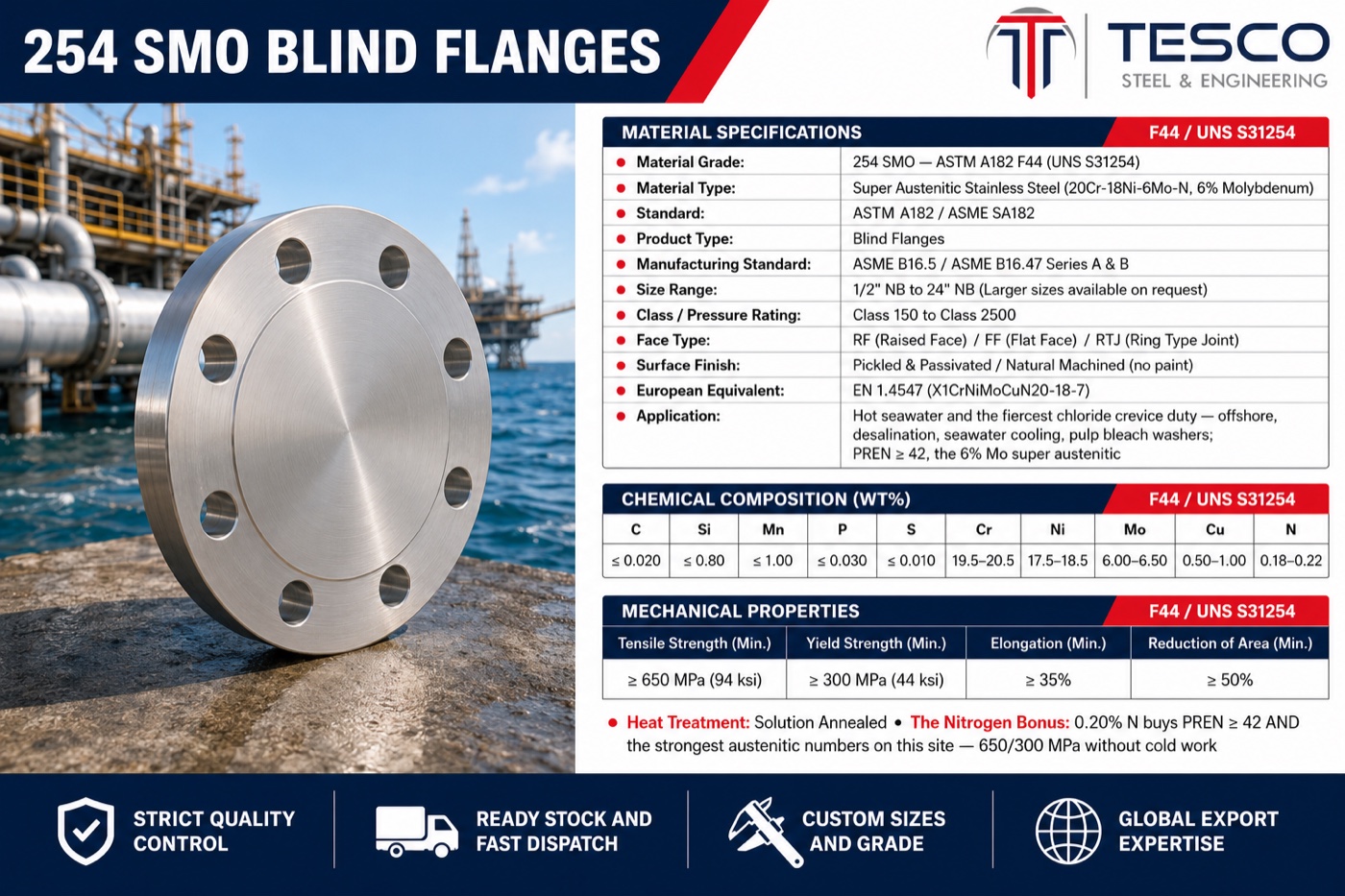
Tesco Steel & Engineering forges 254 SMO blind flanges — ASTM A182 F44, UNS S31254, EN 1.4547 — to ASME B16.5 Class 150–2500 from ½″ to 24″ NB and to ASME B16.47 up to 60″. This is the summit of the stainless chloride ladder: 6% molybdenum and 0.20% nitrogen carry PREN past 42 — the ticket price of hot seawater crevice duty that stops 316L, 317L, 904L and standard duplex below it — while the same nitrogen makes it the strongest annealed austenitic on this site at 650/300 MPa. Offshore, desalination, seawater cooling, bleach washers. Acid chemistry instead: 904L. Strength per rupee in plain seawater: super duplex. Facings: BLRF, BLFF or BLRTJ. Every lot with EN 10204 3.1/3.2 MTC. ISO 9001:2015, made in Mumbai, India — exported to 50+ countries.
254 SMO · A182 F44 · UNS S31254 · EN 1.45476% Molybdenum · 0.20% NitrogenPREN ≥ 42 — Hot Seawater Class650/300 MPa — Strongest Austenitic HereOffshore · Desalination · Bleach WashersASME B16.5 ½″–24″ · Class 150–2500RF · FF · RTJ FacingsEN 10204 3.1 / 3.2 · ISO 9001:2015
254 SMO Blind Flanges — Specifications at a Glance
What is a 254 SMO Blind Flange?
The summit of the stainless chloride ladder. A solid forged disc of 6% molybdenum super austenitic (ASTM A182 F44 / UNS S31254 / EN 1.4547) with no bore, closing pipes, valves and nozzles in the fiercest chloride duty stainless can hold: hot seawater, desalination brine, offshore cooling, pulp bleach washers. Mo 6.00–6.50% plus N 0.18–0.22% score PREN ≥ 42 — past the seawater-crevice threshold — and the nitrogen also delivers 650/300 MPa, the strongest annealed austenitic numbers on this site. Dimensions per ASME B16.5 / B16.47 in RF, FF and RTJ facings; EN 10204 3.1 certified.
Also searched as: UNS S31254 blind flange, A182 F44 blind, 6Mo / 6-moly blind flange, 1.4547 blind, X1CrNiMoCuN20-18-7 blind, SMO 254 blind, seawater blind flange, SA-182 F44 blind (the ASME boiler-code twin) — all refer to the product on this page. See also our 254 SMO flanges hub for the full flange-type range in this grade, the rungs below — F904L, F53 super duplex — and the facing pages BLRF / BLFF / BLRTJ.
What Six Percent Molybdenum Buys
Past the Seawater Threshold
Warm chlorinated seawater in a crevice is chloride chemistry at its worst, and the entry ticket is PREN ≈ 40+. The ladder below stops short — 316L ≈24, 317L ≈30, duplex ≈34, 904L ≈35. At 6% Mo + 0.20% N, 254 SMO scores 42–44: past the threshold, with margin.
Nitrogen's Double Duty
In the PREN formula nitrogen counts sixteen times its weight — 0.20% contributes like a full point of molybdenum. The same atoms strengthen the lattice: 650/300 MPa solution-annealed, a third stronger than any ordinary austenitic, at full 35% elongation.
Engineered to the Decimal
One-point chromium and nickel windows, sulphur capped at a third of the usual limit, carbon at 0.020% — the tightest specification on this site, certified element by element on every heat.
Read the discipline in the numbers: one-point chromium and nickel windows where ordinary grades allow two or three, sulphur at ≤0.010% — a third of the usual cap — and the two bold columns that define the class: molybdenum at six percent and nitrogen dosed to the second decimal. Our PMI reads the molybdenum on every piece; the certificate carries every element above.
Mechanical Properties & The Service Span
Property
ASTM A182 F44 Requirement
Tensile Strength
≥ 650 MPa (94 ksi) — the strongest austenitic on this site
Yield Strength (0.2%)
≥ 300 MPa (44 ksi) — nearly half again the standard austenitic bolt-load margin
Elongation
≥ 35%
Reduction of Area
≥ 50%
Hardness
No A182 limit — annealed condition
Condition
Solution annealed — mandatory; all strength from nitrogen, none from cold work
Service Span
Cryogenic to ~400°C sustained — capped by intermetallic-phase kinetics, not strength; the natural habitat is seawater and brine
High-pressure offshore practice — ring softer than groove
254 SMO Blind Flange Specifications
254 SMO Blind Flanges are available in the following specifications:
Material Grade
254 SMO — ASTM A182 F44 (UNS S31254); EN 1.4547 / X1CrNiMoCuN20-18-7 designation where the project requires it
Heat Treatment
Solution annealed — mandatory; condition stated on certificate
Size
1/2"NB to 24"NB per ASME B16.5; 26"–60" per ASME B16.47; EN 1092-1 to order
Class
150#, 300#, 400#, 600#, 900#, 1500#, 2500# — rated on the grade's own B16.5 pressure-temperature lines
Facings
Raised Face (BLRF), Flat Face (BLFF), Ring Type Joint (BLRTJ) with groove per B16.20
Service Span
Hot seawater, desalination brine, offshore & bleach-washer duty; sustained service to ~400°C; reducing-acid chemistry belongs to 904L
Surface Finish
Pickled & passivated or natural machined — no paint; segregated alloy handling throughout
Modifications
NPT-tapped centre (hydrotest / vent / drain / gauge), lifting provisions — machined & certified at the works
Testing
Tension & chemistry per heat — molybdenum and nitrogen verified to the windows; PMI routine; IGC (A262) / ferric-chloride pitting (A923/G48-type) where specified
Certification
EN 10204 3.1 (standard) / 3.2 witnessed
Why 254 SMO Blind Flanges Are Specified
The Duty Is Hot Seawater
When the medium is the sea itself — intakes, firewater, desalination brine, chlorinated cooling circuits — the specification starts at the 6-moly class, and the closure carries the same PREN as the pipe it blanks.
Strength Without Cold Work
300 MPa yield in the soft annealed state: higher rating lines, more bolt-load headroom, and none of the embrittlement clocks that duplex carries — no 475°C window, no sigma sensitivity in service.
One Grade, Cryogenic to Hot
Full austenitic toughness from liquefied-gas temperatures to its 400°C ceiling — a span duplex cannot match, valuable in LNG-adjacent seawater systems.
The Bleach-Washer Pedigree
Pulp-and-paper chlorine-dioxide stages and FGD internals wrote the 6-moly class into their specs decades ago — the service record behind the certificate.
Three details buyers miss.The filler-wire rule: 6-moly grades are never welded with matching filler — molybdenum segregates on solidification and the depleted paths pit first; the line class should carry the over-alloyed nickel filler note (typically Alloy 625), and WPS audits should expect it. Summit is not immunity: heavily chlorinated water above ~30–40°C in tight crevices can still initiate attack — gasket seating and chlorination dosing matter even here; genuinely hotter brine belongs to titanium or the nickel alloys. Not the acid grade: for warm sulphuric or phosphoric chemistry, 904L's copper beats 254 SMO at lower cost — state the actual medium at enquiry and we quote the right rung, not the highest one.
How Our 254 SMO Blind Flanges Are Manufactured
1
Forging — cut billet of the spectro-verified S31254 heat — molybdenum and nitrogen confirmed to their tight windows — is hot-forged into the solid disc blank with full heat traceability and segregated alloy handling.
2
Solution anneal — at the high temperature the 6-moly chemistry demands, with rapid quench to keep intermetallic phases dissolved; furnace charts retained against the heat number.
3
Machining & facing — faces, OD and drilling to ASME B16.5 / B16.47; RF serrations, flat face or RTJ groove gauged per B16.20; NPT taps machined where ordered.
4
Testing — tension test and chemistry against the heat; PMI on every piece reads the 6% molybdenum; intergranular (A262) and ferric-chloride pitting tests where specified.
5
Pickling & passivation — the restored passive skin the seawater will test, with marking of standard, grade, size, class and heat number.
6
Certification & packing — EN 10204 3.1 MTC (3.2 witnessed on request); faces protected, palletised or crated sea-worthy — no carbon-steel contact in transit.
Where 254 SMO Blind Flanges Are Used
Where the sea itself is the medium: offshore platform cooling and firewater systems, desalination plants and brine trains, coastal power and LNG seawater circuits, pulp bleach washers and chlorine-dioxide stages, FGD internals, and chloride duty just past 904L's window. Production below:
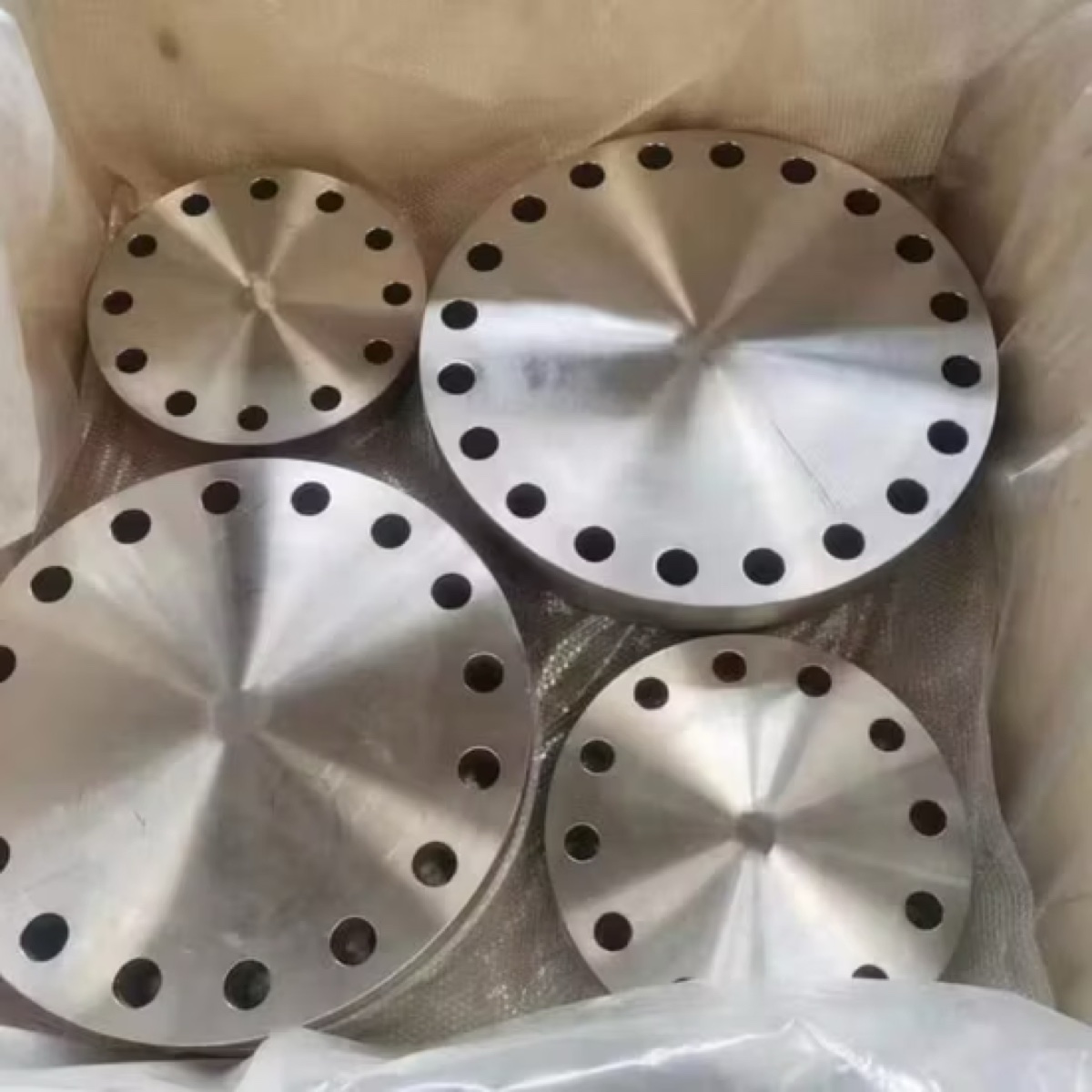
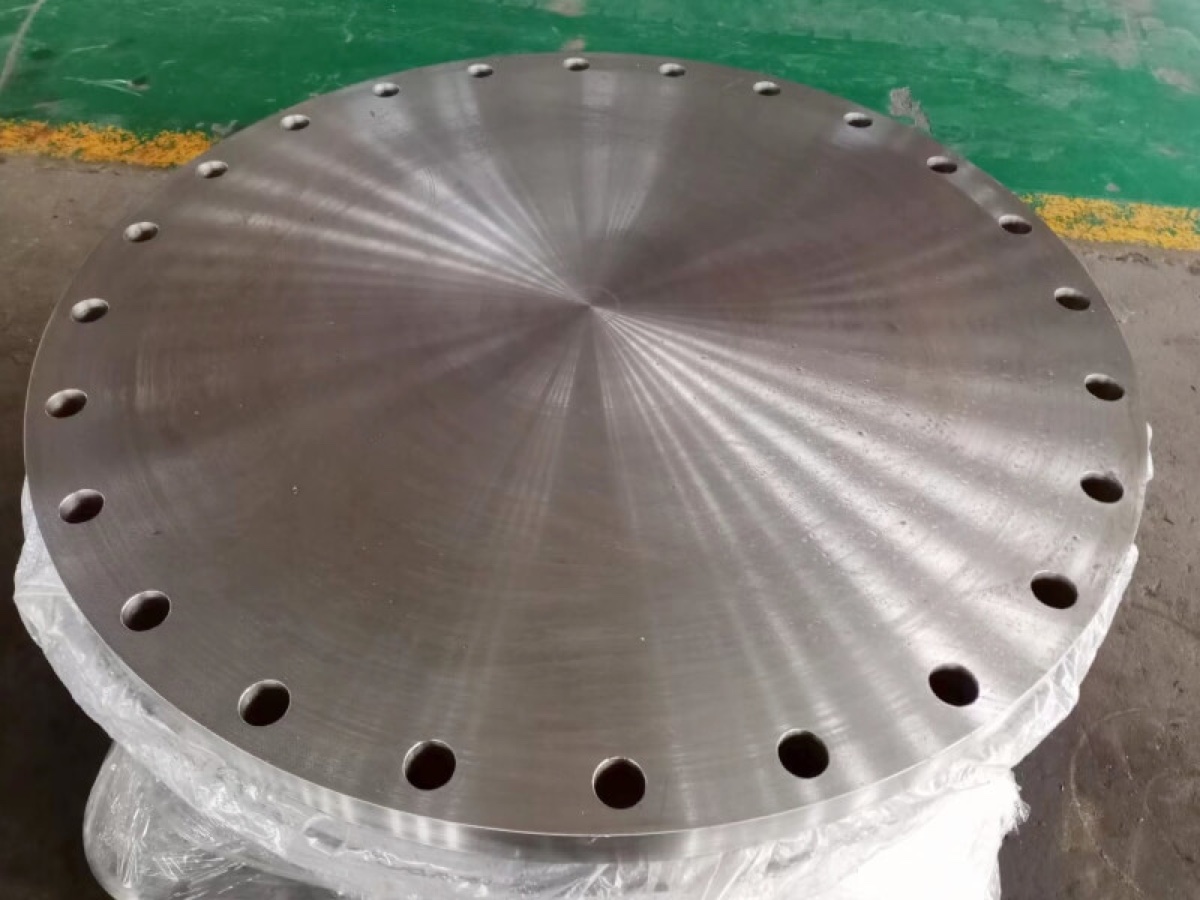
Forged Blind Flanges — Machined to ASME B16.5Machined Blind Flange — Finished Face
254 SMO Blind Flange Dimensions
Blind dimensions are class-governed — identical across material grades. Full charts:
Five elements — the medium statement is the 254 SMO-specific one:
1
Size & standard — e.g. 6″ NB ASME B16.5, or the B16.47 series for 26″ and above.
2
Pressure class & facing — Class 150–2500; RF, FF or RTJ (with ring number) to match the mating flange.
3
Grade — ASTM A182 F44 (254 SMO / UNS S31254), stating EN 1.4547 alongside where the project paperwork requires it.
4
Service & certification — state the medium, temperature and chlorination regime (it confirms the rung is right); NPT tap size if a test blind; IGC / pitting tests, PMI or 3.2 witnessing as specified; EN 10204 3.1 standard.
Example: “Blind Flange, RF, 6″ NB, ASME B16.5 Class 300, ASTM A182 F44 (254 SMO), EN 10204 3.1 — 4 pcs, chlorinated seawater cooling, 35°C.” Quotations normally within 24 hours with price, unit weight and delivery.
254 SMO Blind Flanges — Frequently Asked Questions
What is a 254 SMO blind flange?
A 254 SMO blind flange is a solid forged disc of 6% molybdenum super austenitic stainless steel — ASTM A182 grade F44, UNS S31254, EN 1.4547 — drilled to the standard bolt pattern with no bore, used to close pipes, valves and vessel nozzles in the fiercest chloride service stainless can face: hot seawater, desalination brine, offshore systems and pulp bleach washers. Molybdenum at 6.00-6.50% and nitrogen at 0.18-0.22% push its PREN past 42, and the same nitrogen makes it the strongest annealed austenitic flange grade — 650/300 MPa. Dimensions follow ASME B16.5 from ½ inch to 24 inch and ASME B16.47 beyond, in raised face, flat face and ring joint facings.
What makes 254 SMO the seawater grade?
It clears the threshold that matters. Warm chlorinated seawater in a crevice — under a gasket, beneath a barnacle — is roughly the hardest thing chloride chemistry does to stainless, and industry practice puts the entry ticket at PREN around 40 and above. The ordinary ladder tops out short of it: 316L at ~24, 317L at ~30, duplex 2205 at ~34. At 6% molybdenum plus 0.20% nitrogen, 254 SMO scores 42-44 — past the threshold with margin — which is why seawater intakes, desalination trains and offshore cooling circuits specify the 6-moly class by name.
What does the nitrogen in 254 SMO do?
Two jobs for one addition. In the PREN formula nitrogen counts sixteen times its weight, so 0.20% contributes as much pitting resistance as a full point of molybdenum — it is the co-author of the grade's 42+ score. Simultaneously it is a potent interstitial strengthener: 254 SMO reaches 650 MPa tensile and 300 MPa yield in the soft solution-annealed condition — roughly a third stronger than any ordinary austenitic on this site, without cold work and without sacrificing the 35% elongation. It also steadies the austenite against the ferrite-pushing molybdenum. No other element in the recipe works this hard.
What is the chemical composition of 254 SMO (UNS S31254)?
Carbon ≤0.020%, silicon ≤0.80%, manganese ≤1.00%, phosphorus ≤0.030%, sulphur ≤0.010%, chromium 19.5-20.5%, nickel 17.5-18.5%, molybdenum 6.00-6.50%, copper 0.50-1.00%, nitrogen 0.18-0.22%. Two things stand out beside the headline molybdenum: the windows are tight — one-point chromium and nickel ranges where ordinary grades allow two or three — and the impurity caps are stricter across the board, sulphur at a third of the usual limit. A grade engineered to the decimal, and certified the same way.
What are the mechanical properties of 254 SMO blind flanges?
Tensile strength 650 MPa (94 ksi) minimum, yield strength 300 MPa (44 ksi) minimum, elongation 35% minimum and reduction of area 50% minimum, in the solution-annealed condition — the strongest numbers of any austenitic flange grade on this site, courtesy of the nitrogen. The practical benefits ride on the yield: nearly half again the bolt-load headroom of a standard austenitic joint, and B16.5 ratings on 254 SMO's own lines that reflect it. All of it in the soft annealed state — no cold work, no ageing, full austenitic toughness to cryogenic temperatures.
254 SMO or 904L — how do I choose?
By which enemy leads. 254 SMO is the chloride champion: PREN 42+ against 904L's ~35 buys hot-seawater crevice duty 904L cannot hold, and its 650/300 strength doubles the margin. 904L answers with copper at twice the level — in warm sulphuric or phosphoric acid the cheaper grade is genuinely the better one — and a long acid-plant heritage. The split: seawater, brine and fierce chloride crevices go to 254 SMO; reducing-acid chemistry goes to 904L; both at once and the conversation moves to nickel alloys. We forge both, and quote both when the duty sits near the boundary.
254 SMO or super duplex F53/F55 — they have similar PREN?
They do — both clear 40 — so the choice runs on other axes. Super duplex counters with higher strength still (550 MPa yield) and roughly half the nickel on the invoice, which is why new offshore construction leans duplex. 254 SMO counters with single-phase austenitic virtues: no 475°C embrittlement window and no sigma sensitivity in service, forgiving fabrication against duplex's phase-balance rules, full cryogenic toughness, and better behaviour in the slightly reducing or mixed chemistries where duplex ferrite suffers. Retrofit into austenitic plant, cryogenic-to-hot spans, bleach washers: 254 SMO. Maximum strength per rupee in plain seawater: super duplex. Both sit in our forge.
Is 254 SMO completely immune in seawater?
No alloy is, and honest engineering says so. 254 SMO holds crevice-free hot seawater with comfort, but heavily chlorinated water above roughly 30-40°C in tight crevices — the very worst combination — can still initiate attack, which is why gasket selection, clean bolt-up and sensible chlorination dosing still matter at the summit of the ladder. Chloride SCC is effectively closed off by the 18% nickel and the structure. Where the duty genuinely exceeds the 6-moly window — stagnant hot brine, fierce chlorination — the next step is titanium or the nickel alloys, and we will say so at enquiry rather than after commissioning.
254 SMO, F44, 6Mo, S31254, 1.4547 — are these all the same thing?
Same metal, different naming systems. 254 SMO is the original trade name (Outokumpu's); UNS S31254 is the universal number; ASTM A182 grade F44 is how a forged flange is certified; EN 1.4547 / X1CrNiMoCuN20-18-7 is the European designation; and '6Mo' or '6-moly' is the family nickname it shares with close cousins like AL-6XN (N08367). A specification naming any one of them is met by material certified to S31254 — our certificates carry the UNS number and the A182 F44 grade, with the EN designation added where the project requires it.
What temperature range does a 254 SMO blind flange cover?
Cryogenic to roughly 400°C sustained. The cold end is fully open — austenitic toughness holds to liquefied-gas temperatures. The hot end is capped not by strength but by microstructure: like every highly alloyed austenitic, long exposure above ~400°C slowly precipitates intermetallic phases that eat toughness and corrosion resistance, so B16.5 ratings taper and good practice stays below the window. It is emphatically not a heat-resisting grade — furnace duty belongs to F310 — and its natural habitat, seawater and brine, rarely asks for more than it offers.
Anything special about welding 254 SMO — and does it affect a blind flange?
One famous rule: 6-moly grades are never welded with matching filler. Molybdenum segregates as the weld solidifies, leaving depleted paths that pit first, so the industry welds S31254 with over-alloyed nickel filler — typically Alloy 625, with 9% molybdenum — restoring the joint to full resistance. The blind flange itself arrives solution annealed with no welds, so nothing applies until the day it is welded to a spool — but the line class that specifies 254 SMO should carry the 625-filler note, and buyers auditing WPS packages should expect to see it. We flag it on request alongside the certificate.
What facings are 254 SMO blind flanges made with?
All three: raised face (BLRF) — the default — flat face (BLFF) for the GRP and rubber-lined systems common in seawater and bleach-plant service, and ring type joint (BLRTJ) for high-pressure offshore practice, the ring chosen softer than the groove. Each facing has its own page on this site. Crevice-conscious gasket selection matters more here than on any other grade — the crevice under a badly seated gasket is precisely the geometry the 6% molybdenum was bought to survive. NPT-tapped test blinds are machined and certified at the works.
Where are 254 SMO blind flanges used?
Where seawater and its relatives run hot and stay aggressive: offshore platform cooling and firewater systems, desalination plants and brine trains, coastal power and LNG seawater circuits, pulp-and-paper bleach washers and chlorine-dioxide stages, flue-gas desulphurisation internals, and chemical duty just past 904L's chloride window. 254 SMO blinds close those systems as isolations, spare-nozzle blanks and tapped test points — certified to the decimal the grade is engineered to.
Which standards cover 254 SMO blind flanges?
The material is certified to ASTM A182 grade F44 (UNS S31254), with ASME SA-182 as the boiler-code twin and EN 1.4547 / X1CrNiMoCuN20-18-7 as the European equivalent. Dimensions follow ASME B16.5 for ½"-24" and ASME B16.47 for 26"-60", rated on the grade's own pressure-temperature lines. A complete specification reads: 'Blind Flange, RF, 6", ASME B16.5 Class 300, ASTM A182 F44 (254 SMO / UNS S31254)' — and our EN 10204 certificates state it exactly that way, molybdenum and nitrogen included.
Who manufactures 254 SMO blind flanges in India?
Tesco Steel & Engineering is an ISO 9001:2015 certified flange manufacturer based in Mumbai, India, forging 254 SMO / ASTM A182 F44 / UNS S31254 / EN 1.4547 blind flanges from ½" to 24" NB per ASME B16.5 in Classes 150-2500 and to 60" per ASME B16.47 — solution annealed, pickled and passivated, PMI-verified with the 6% molybdenum read on every piece, certified to EN 10204 3.1/3.2 on every lot — in raised face, flat face and ring joint facings, alongside the full 254 SMO flange range, 904L, duplex, super duplex and nickel-alloy blinds. Exported to more than 50 countries.