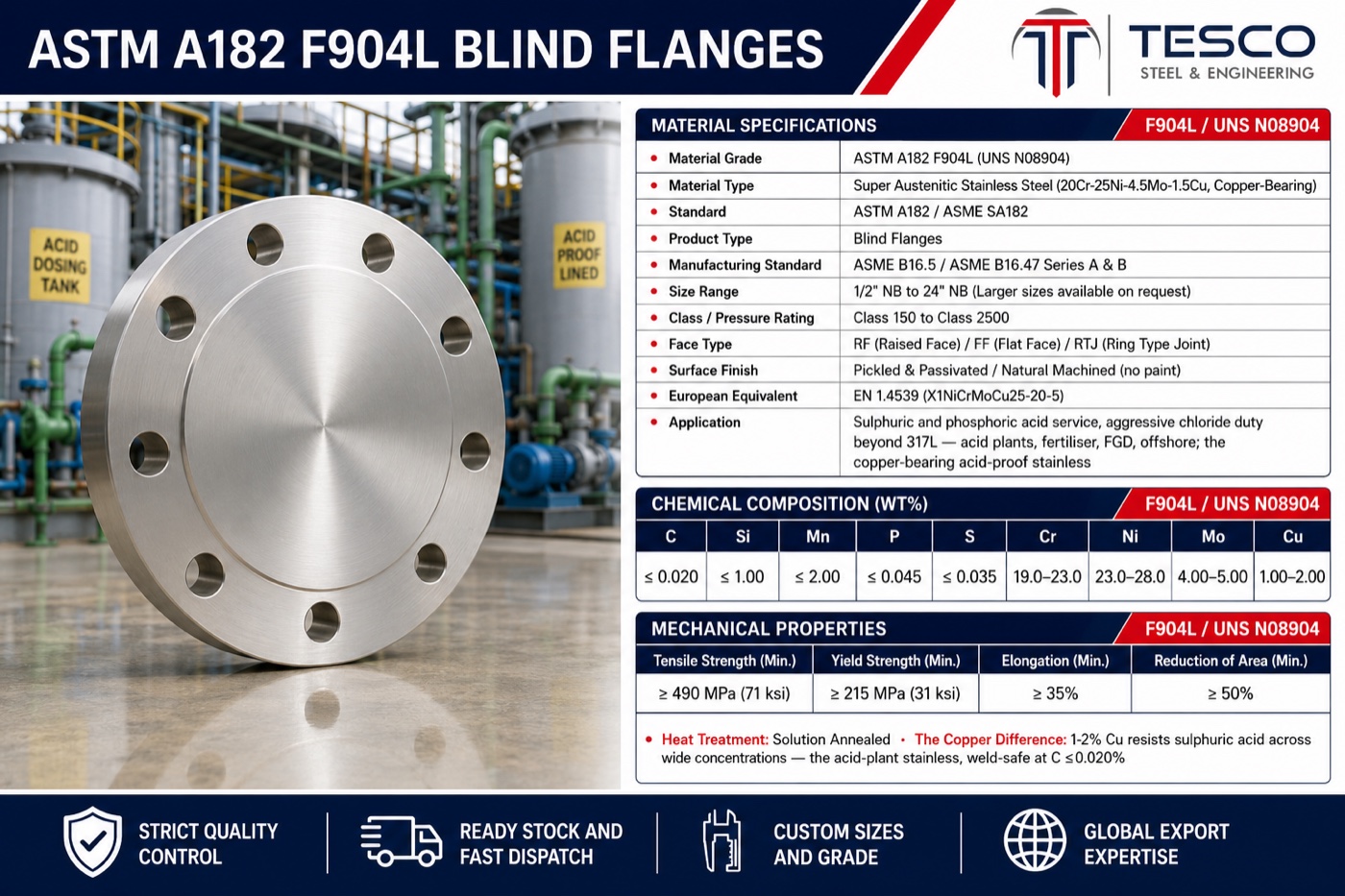
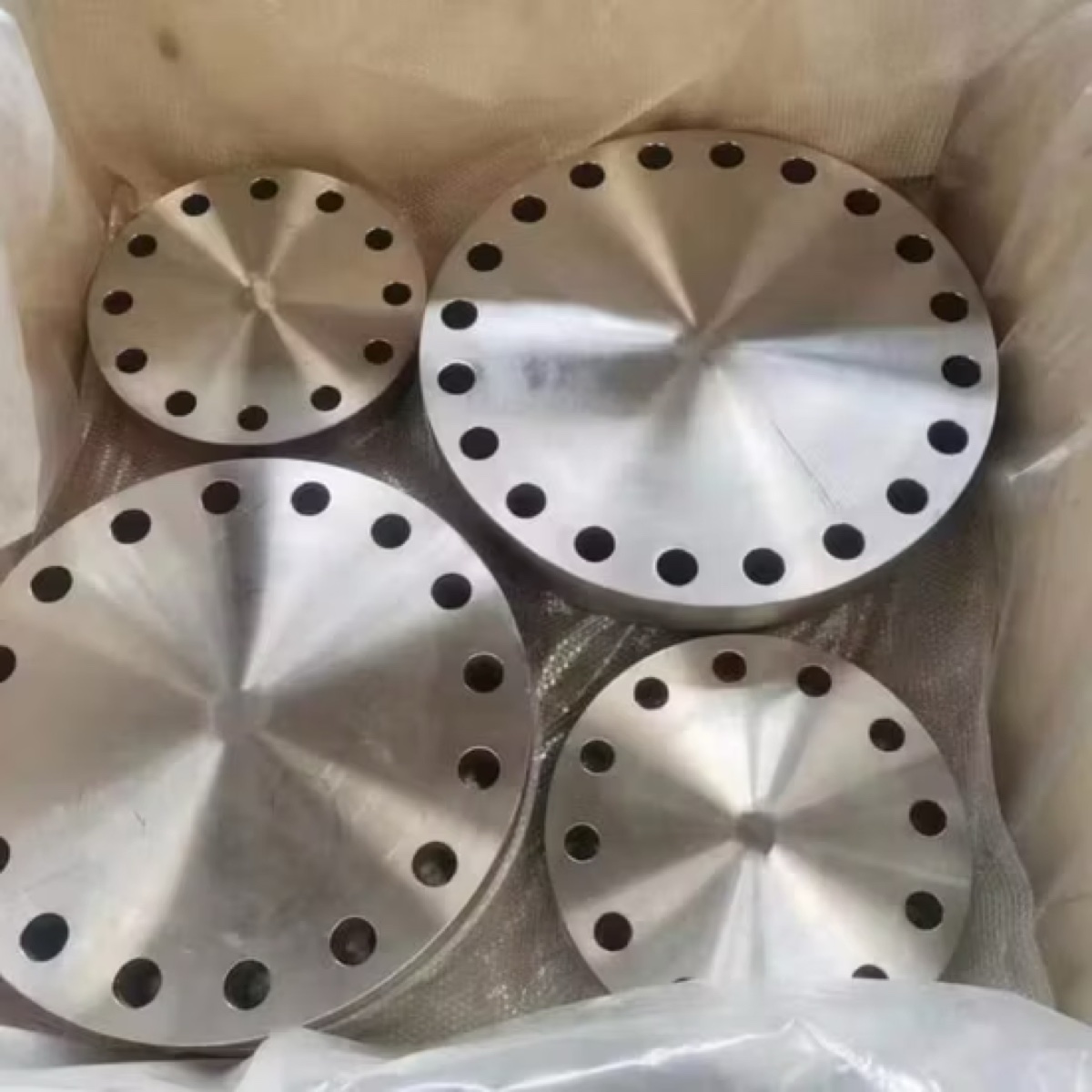
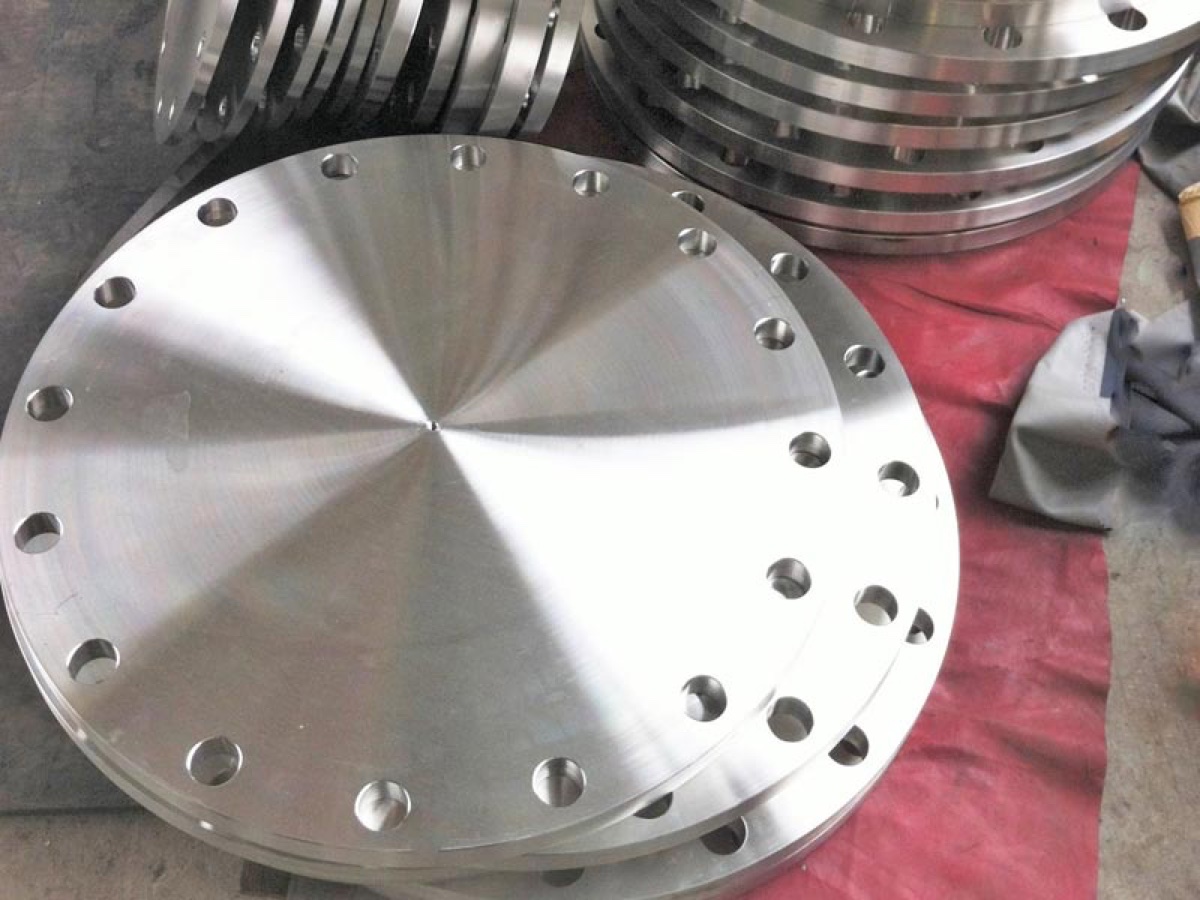
Tesco Steel & Engineering forges ASTM A182 F904L blind flanges — UNS N08904 / EN 1.4539, the copper-bearing super austenitic — to ASME B16.5 Class 150–2500 from ½″ to 24″ NB and to ASME B16.47 up to 60″. This is the grade that steps off the stainless ladder toward the nickel alloys — the N in its UNS number says so: 1–2% copper bought for the one chemical everything below it fears, sulphuric acid; molybdenum 4–5% and PREN ≈ 35 for chlorides beyond 317L; nickel at 23–28% pushing chloride-SCC resistance toward alloy territory; carbon at ≤0.020%, stricter than any L grade. The acid-plant, fertiliser and FGD specification. Plain chloride muscle: duplex. Hot seawater: 254 SMO. Facings: BLRF, BLFF or BLRTJ. Every lot with EN 10204 3.1/3.2 MTC. ISO 9001:2015, made in Mumbai, India — exported to 50+ countries.
ASTM A182 F904L · UNS N08904 · EN 1.4539Copper-Bearing Super AusteniticThe Sulphuric Acid StainlessMo 4–5% · PREN ≈ 35Ni 23–28% — SCC Near-ImmuneASME B16.5 ½″–24″ · Class 150–2500RF · FF · RTJ FacingsEN 10204 3.1 / 3.2 · ISO 9001:2015
ASTM A182 F904L Blind Flanges — Specifications at a Glance
What is an ASTM A182 F904L Blind Flange?
The acid-proof stainless. A solid forged disc of copper-bearing super austenitic (UNS N08904 / EN 1.4539) with no bore, closing pipes, valves and nozzles where the ordinary ladder has run out: sulphuric and phosphoric acid circuits, fertiliser plants, FGD absorbers, chloride duty beyond 317L. The signature is copper at 1–2% — ennobled against reducing acids — backed by Mo 4–5% (PREN ≈ 35), Ni 23–28% (chloride-SCC near-immunity) and C ≤0.020%. Mechanicals 490/215 MPa, elongation ≥35%, on 904L's own B16.5 rating lines. Dimensions per ASME B16.5 / B16.47 in RF, FF and RTJ facings; EN 10204 3.1 certified.
Also searched as: SS 904L blind flange, 1.4539 blind flange, X1NiCrMoCu25-20-5 blind, N08904 blind, super austenitic blind, copper-bearing stainless blind, acid-resistant blind flange, SA-182 F904L blind (the ASME boiler-code twin) — all refer to the product on this page. See also our 904L flanges hub for the full flange-type range in this grade, the neighbours F317L below and 254 SMO above, and the facing pages BLRF / BLFF / BLRTJ.
What the Copper Buys — and the Rest of the Recipe
Copper vs the Reducing Acids
Sulphuric and phosphoric acid strip the passive film stainless lives by — chromium and molybdenum can't fully answer them. Copper works differently: it ennobles the surface in reducing acid, slowing the attack itself. Useful resistance across a wide sulphuric concentration band at moderate temperature — territory where even 317L corrodes actively.
Molybdenum One Step Further
4–5% against 317L's 3–4%: PREN climbs to ≈35, past the ordinary austenitics and shoulder-to-shoulder with duplex — chloride pitting and crevice duty a rung beyond the ladder's end.
Nickel Until the Prefix Changes
At 23–28% nickel the UNS number gains its N: chloride SCC — the austenitic family's oldest weakness — is effectively priced out, while fabrication stays single-phase austenitic: forgiving welding, no 475°C window, cryogenic toughness.
Carbon Below Even the L Grades
≤0.020% — sensitization removed from the conversation entirely, with no stabiliser needed and no strength story to explain: 904L rates on its own B16.5 lines.
Three bold columns tell the story: nickel in alloy quantities, molybdenum past the ladder, and the copper no other grade in this family carries. Our PMI reads all three on every piece — the copper line is the fastest way to confirm a true 904L against a look-alike super austenitic.
Mechanical Properties & The Service Span
Property
ASTM A182 F904L Requirement
Tensile Strength
≥ 490 MPa (71 ksi)
Yield Strength (0.2%)
≥ 215 MPa (31 ksi)
Elongation
≥ 35% — the family's most ductile
Reduction of Area
≥ 50%
Hardness
No A182 limit — typically soft as annealed
Condition
Solution annealed — mandatory
Service Span
Cryogenic toughness to ~400–425°C sustained; the working window is chemical — warm acids, hot chloride liquor, coastal & offshore systems
ASTM A182 F904L Blind Flanges are available in the following specifications:
Material Grade
ASTM A182 F904L (UNS N08904); EN 1.4539 / X1NiCrMoCu25-20-5 designation where the project requires it
Heat Treatment
Solution annealed — mandatory; condition stated on certificate
Size
1/2"NB to 24"NB per ASME B16.5; 26"–60" per ASME B16.47; EN 1092-1 to order
Class
150#, 300#, 400#, 600#, 900#, 1500#, 2500# — rated on 904L's own B16.5 pressure-temperature lines
Facings
Raised Face (BLRF), Flat Face (BLFF), Ring Type Joint (BLRTJ) with groove per B16.20
Service Span
Sulphuric & phosphoric acid circuits, FGD, chloride duty beyond 317L; not a heat-resisting grade — sustained duty to ~400–425°C
Surface Finish
Pickled & passivated or natural machined — no paint; segregated alloy handling throughout
Modifications
NPT-tapped centre (hydrotest / vent / drain / gauge), lifting provisions — machined & certified at the works
Testing
Tension & chemistry per heat — copper, molybdenum and nickel verified; PMI routine; IGC (A262) where specified
Certification
EN 10204 3.1 (standard) / 3.2 witnessed
Why F904L Blind Flanges Are Specified
Acid Entered the Service
The moment sulphuric or phosphoric chemistry joins the duty, the chloride ladder stops helping — duplex has no copper to answer with. 904L is where acid resistance and chloride resistance meet in one certificate.
Stainless Habits, Alloy Performance
The last grade that welds, fabricates and prices like stainless while solving alloy-class problems — no 475°C embrittlement window, forgiving procedures, cryogenic toughness, existing austenitic WPS libraries.
SCC Off the Worry List
25% nickel does by brute chemistry what duplex does by structure: boiling-chloride tests that crack 316L in hours leave 904L essentially untouched.
The Acid-Plant Heritage
Fertiliser complexes, FGD absorbers and sulphuric dilution circuits have specified 1.4539/904L for decades — the line classes descend with the plants, and the closure carries the same certificate as the pipe.
Three details buyers miss.Confirm the copper on the certificate: Cu 1.00–2.00% is the line that separates 904L from look-alike high-moly grades — our PMI reads it on every piece. Don't buy it for strength or heat: at 490/215 MPa it is the family's softest member and its sustained-service ceiling is ~400–425°C — strength belongs to duplex, heat to F310 and the H grades. Nickel prices the invoice: at 25% nickel, 904L costs real money — where the duty is purely chloride pitting with no acid question, duplex usually delivers more resistance per rupee; state the actual chemistry at enquiry and we will quote both routes.
How Our F904L Blind Flanges Are Manufactured
1
Forging — cut billet of the spectro-verified N08904 heat — copper, molybdenum and nickel confirmed in their windows — is hot-forged into the solid disc blank with full heat traceability and segregated alloy handling.
2
Solution anneal — restoring the uniform austenite and dissolving any intermetallic phases; furnace charts retained against the heat number.
3
Machining & facing — faces, OD and drilling to ASME B16.5 / B16.47; RF serrations, flat face or RTJ groove gauged per B16.20; NPT taps machined where ordered.
4
Testing — tension test and chemistry against the heat; PMI on every piece reads the copper signature; intergranular-corrosion (ASTM A262) and other tests where specified.
5
Pickling & passivation — the restored passive skin the acid service will test, with marking of standard, grade, size, class and heat number.
6
Certification & packing — EN 10204 3.1 MTC (3.2 witnessed on request); faces protected, palletised or crated sea-worthy — no carbon-steel contact in transit.
Where F904L Blind Flanges Are Used
Where acid and chloride chemistry meet: sulphuric acid plants and dilution circuits, phosphoric acid and fertiliser complexes, FGD absorbers, pulp bleach and acid stages, pharmaceutical and fine-chemical reactors, offshore and coastal systems beyond 317L — the same corrosion pedigree that made 904L the watchcase steel of luxury horology. Production below:
Forged Blind Flanges — Machined to ASME B16.5Blind Flange to ASME B16.5 — Raised Face
F904L Blind Flange Dimensions
Blind dimensions are class-governed — identical across material grades. Full charts:
Five elements — the acid-chemistry statement is the 904L-specific one:
1
Size & standard — e.g. 4″ NB ASME B16.5, or the B16.47 series for 26″ and above.
2
Pressure class & facing — Class 150–2500; RF, FF or RTJ (with ring number) to match the mating flange — flat face for FRP and lined acid-plant equipment.
3
Grade — ASTM A182 F904L, stating EN 1.4539 alongside where the project paperwork requires the European designation.
4
Service & certification — state the acid type, concentration and temperature (it sharpens our review and quote); NPT tap size if a test blind; IGC (A262), PMI or 3.2 witnessing as specified; EN 10204 3.1 standard.
An ASTM A182 F904L blind flange is a solid forged disc of copper-bearing super austenitic stainless steel — UNS N08904, EN 1.4539 — drilled to the standard bolt pattern with no bore, used to close pipes, valves and vessel nozzles in duty that has defeated the ordinary stainless ladder: sulphuric and phosphoric acid circuits, fertiliser plants, FGD systems and aggressive chloride service beyond 317L. Copper at 1-2% is its signature, molybdenum runs 4-5%, nickel 23-28%, and carbon is capped at 0.020% — weld-safe by a stricter margin than any L grade. Dimensions follow ASME B16.5 from ½ inch to 24 inch and ASME B16.47 beyond, in raised face, flat face and ring joint facings.
Why does 904L contain copper?
For the one common chemical every grade below it fears: sulphuric acid. Reducing acids strip the passive film that stainless depends on, and no amount of chromium or molybdenum fully answers them. Copper does something different — it ennobles the alloy surface in reducing acid, slowing the attack itself rather than just repairing the film. The result is useful resistance across a wide band of sulphuric concentrations at moderate temperatures, plus strong performance in phosphoric acid — territory where 316L and even 317L corrode actively. That copper is why 904L exists and why acid plants specify it by name.
Where does 904L sit among the stainless grades?
On the step where stainless starts becoming a nickel alloy. The UNS number says it plainly: N08904 — an N prefix, not an S — because at 23-28% nickel the grade is classed with the alloys. It brings PREN around 35 (above 317L's 30, near duplex's 34), near-immunity to chloride stress-corrosion cracking courtesy of all that nickel, and the copper no stainless below it carries. Above it stand 254 SMO at 6% molybdenum and the true nickel alloys. Think of 904L as the last grade that still fabricates, welds and prices like stainless while solving problems that usually demand an alloy.
What is the chemical composition of ASTM A182 F904L?
Carbon ≤0.020%, silicon ≤1.00%, manganese ≤2.00%, phosphorus ≤0.045%, sulphur ≤0.035%, chromium 19.0-23.0%, nickel 23.0-28.0%, molybdenum 4.00-5.00%, copper 1.00-2.00% — UNS N08904. Three entries carry the story: nickel at alloy-territory levels, molybdenum a full step above 317L, and the copper column no other grade in this family has. Note also the carbon: 0.020% — stricter than the 0.030% of the L grades, effectively removing sensitization from the conversation entirely.
What are the mechanical properties of F904L blind flanges?
Tensile strength 490 MPa (71 ksi) minimum, yield strength 215 MPa (31 ksi) minimum, elongation 35% minimum and reduction of area 50% minimum, solution annealed. Slightly softer in tension than the 515 MPa standard grades and noticeably more ductile — the character of a very-high-nickel austenitic. Flange ratings run on 904L's own pressure-temperature lines in B16.5, so the design numbers are already accounted for; nobody specifies 904L for strength, and its corrosion mandate is untouched by the difference.
How does F904L compare with F317L?
317L is the last rung of the ordinary chloride ladder; 904L steps past the ladder itself. Chloride-wise it adds another point of molybdenum (4-5% against 3-4%) and PREN climbs from ~30 to ~35. But the real gap is chemical: 317L has no answer to warm sulphuric or phosphoric acid, and its 11-15% nickel still leaves it exposed to chloride SCC. 904L's copper handles the acids and its 25% nickel effectively closes the SCC question. When the duty is purely chloride pitting, consider duplex first; when acid chemistry enters the picture, 904L is the specification.
F904L or duplex — how do I choose?
By the chemistry of the attack. For plain chloride duty — brine, seawater splash, coastal cooling water — duplex F51 or super duplex F53 usually wins: comparable or better pitting numbers, double the strength, and far less nickel on the invoice. 904L takes the specification when reducing acids join the service — sulphuric, phosphoric, some organics — where duplex has no copper to answer with; when full austenitic fabrication behaviour matters (no 475°C embrittlement, forgiving welding, cryogenic toughness); or when the line class simply descends from an acid-plant heritage. Different tools: duplex is the strong chloride answer, 904L the acid-chemistry one.
F904L or 254 SMO — where is the boundary?
254 SMO (UNS S31254) is the 6% molybdenum super austenitic — PREN above 42 against 904L's ~35 — built for hot seawater and the fiercest chloride crevice duty, where it clearly outranks 904L. What it does not carry is 904L's copper, so in reducing acid service the cheaper grade can actually be the better choice. The practical split: chloride severity beyond 904L's window — step up to 254 SMO; sulphuric or phosphoric acid chemistry — stay with 904L; both at once — the conversation moves to nickel alloys proper. We forge all three families.
How does 904L relate to Alloy 20?
They are the two classic sulphuric-acid grades, close cousins in intent. Alloy 20 (Carpenter 20, UNS N08020) carries even more nickel (32-38%), similar copper, and a niobium stabiliser — the traditional American acid-plant alloy, particularly strong in mid-concentration sulphuric. 904L answers with better chloride pitting resistance from its higher molybdenum, wider European availability as EN 1.4539, and a simpler unstabilised low-carbon chemistry. Many acid-plant line classes accept either; the project's heritage usually decides. We supply both against specification.
Is F904L immune to chloride stress-corrosion cracking?
Close to it, in practical terms. Chloride SCC feeds on the 8-12% nickel window of ordinary austenitics; resistance climbs steeply as nickel rises, and at 904L's 23-28% the grade sits far up that curve — laboratory boiling-chloride tests that crack 316L in hours leave 904L essentially untouched. Duplex earns its SCC reputation from a two-phase structure; 904L earns a comparable one from sheer nickel, while keeping single-phase austenitic fabrication behaviour. For hot concentrated brines the honest answer remains the alloys above it, but within its service window SCC is effectively off 904L's worry list.
What temperature range does an F904L blind flange cover?
The austenitic span with an acid-service accent: cryogenic toughness at the cold end, and sustained service to roughly 400-425°C at the top — above which its microstructure can slowly form embrittling phases and B16.5 ratings taper off. Its real window is defined less by temperature than by chemistry: warm acid circuits, hot chloride-bearing scrubber liquor, coastal and offshore systems. It is not a heat-resisting grade — furnace duty belongs to F310 and the H grades — and its strengths are wasted on plain hot air.
What facings are F904L blind flanges made with?
All three: raised face (BLRF) — the process default — flat face (BLFF) for the FRP, rubber-lined and acid-brick equipment that acid plants run in quantity, and ring type joint (BLRTJ) where high-pressure practice calls for it, the ring chosen softer than the groove. Each facing has its own page on this site. In acid and chloride service the gasket seat deserves crevice-conscious selection and clean bolt-up — the joint's chemistry protection is only as good as its tightest crevice. NPT-tapped test blinds are machined and certified at the works.
Where are F904L blind flanges used?
Where acid and chloride chemistry meet: sulphuric acid plants and dilution circuits, phosphoric acid and fertiliser complexes, flue-gas desulphurisation absorbers, pulp-and-paper bleach and acid stages, pharmaceutical and fine-chemical reactors, offshore and coastal systems beyond 317L's window, and seawater-cooled condensers in acid service. The grade's famous side-career — as the watchcase steel of luxury horology — trades on the same corrosion pedigree. F904L blinds close those systems as isolations, spare-nozzle blanks and tapped test points.
Which standards cover F904L blind flanges?
The material standard is ASTM A182 grade F904L (UNS N08904), with ASME SA-182 as its boiler-code twin and EN 1.4539 / X1NiCrMoCu25-20-5 as the European equivalent. Dimensions follow ASME B16.5 for ½"-24" and ASME B16.47 for 26"-60", rated on 904L's own pressure-temperature lines. A complete specification reads: 'Blind Flange, RF, 4", ASME B16.5 Class 150, ASTM A182 F904L' — and our EN 10204 certificates state it exactly that way, copper and molybdenum contents included.
Who manufactures ASTM A182 F904L blind flanges in India?
Tesco Steel & Engineering is an ISO 9001:2015 certified flange manufacturer based in Mumbai, India, forging ASTM A182 F904L / UNS N08904 / EN 1.4539 blind flanges from ½" to 24" NB per ASME B16.5 in Classes 150-2500 and to 60" per ASME B16.47 — solution annealed, pickled and passivated, PMI-verified with the copper, molybdenum and nickel read on every piece, certified to EN 10204 3.1/3.2 on every lot — in raised face, flat face and ring joint facings, alongside the full 904L flange range, 317L, duplex, super duplex, 254 SMO and nickel-alloy blinds. Exported to more than 50 countries.