Incoloy 825 Blind Flanges — UNS N08825 Wet-Corrosion Blind Manufacturer
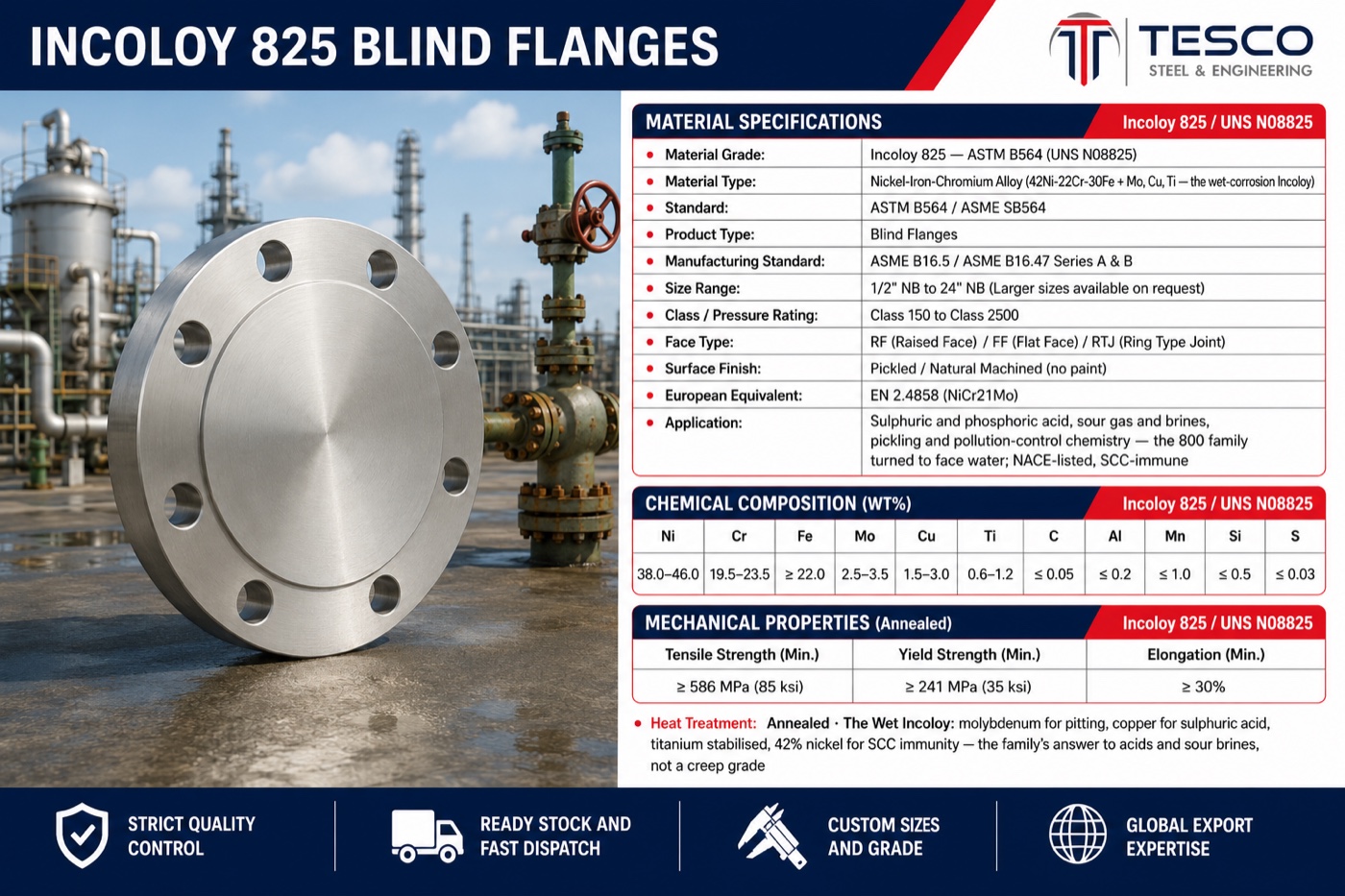
Tesco Steel & Engineering forges Incoloy 825 blind flanges — ASTM B564, UNS N08825, EN 2.4858 — to ASME B16.5 Class 150–2500 from ½″ to 24″ NB and to ASME B16.47 up to 60″. This is the 800 familyturned to face water: nickel raised to ~42% (chloride SCC shut off entirely), molybdenum added for pitting and reducing acids, copper added for sulphuric — the same element that powers 904L and Alloy 20, making 825 the third member of the acid trio — and titanium stabilising every weld. Add the NACE MR0175 listing and you have the oil-and-gas member of the family: sour wells, downhole hardware, pickling and pollution control. One warning the name invites: not a creep grade — the furnace franchise belongs to its 800H/800HT siblings. Fiercer duty: Inconel 625. Facings: BLRF, BLFF or BLRTJ. Every lot with EN 10204 3.1/3.2 MTC. ISO 9001:2015, made in Mumbai, India — exported to 50+ countries.
Incoloy 825 · ASTM B564 · UNS N08825EN 2.4858 · NiCr21MoThe 800 Family, Turned to Face WaterMo + Cu + Ti — All FunctionalNACE MR0175 Sour-Listed42% Ni — SCC Shut OffASME B16.5 ½″–24″ · Class 150–2500EN 10204 3.1 / 3.2 · ISO 9001:2015
Incoloy 825 Blind Flanges — Specifications at a Glance
What is an Incoloy 825 Blind Flange?
The wet Incoloy. A solid forged disc of nickel-iron-chromium alloy (ASTM B564 / UNS N08825 / EN 2.4858) with no bore — Ni 38–46%, Cr 19.5–23.5%, Fe ≥22% with three functional additions: Mo 2.5–3.5% (pitting, reducing acids), Cu 1.5–3.0% (sulphuric) and Ti 0.6–1.2% (weld stabilisation). NACE-listed, SCC-immune, 586/241 MPa annealed — closing sour-gas, acid-plant, pickling and pollution-control systems. Its ceiling is ~540°C: not a creep grade, whatever the family name suggests. Dimensions per ASME B16.5 / B16.47 in RF, FF and RTJ facings; EN 10204 3.1 certified.
Also searched as: Alloy 825 blind flange, N08825 blind, 2.4858 blind flange, NiCr21Mo blind, SB564 825 blind, sour-service blind flange, downhole blind flange — all refer to the product on this page. See also the heat-side siblings Incoloy 800 / 800H / 800HT, the acid-trio cousins F904L / Alloy 20, the step-up Inconel 625, and the facing pages BLRF / BLFF / BLRTJ.
The Family Pivot — Heat to Water
Nickel to 42% — SCC Shut Off
Chloride stress-corrosion cracking fades steeply as nickel rises past 30%; at 825's 38–46% the mechanism is closed — hot sour brines that stress every lower grade at once are exactly where its record was built.
Three Additions, Three Enemies
Molybdenum (2.5–3.5%) for pitting and reducing acids; copper (1.5–3.0%) for sulphuric — the 904L/Alloy 20 lever; titanium (0.6–1.2%) capturing carbon so welds cannot sensitize — the same insurance Alloy 20 buys with niobium.
The NACE Franchise
MR0175-listed with generous limits — the reason downhole hangers, packers, sour manifolds and wellhead closures specify N08825 by reflex, and why oil-and-gas metallurgy knows 825 better than any of its siblings.
The American acid-plant tradition — strongest in mid-band sulphuric (Cu 3–4%)
Incoloy 825 (this page)
~42%
Titanium
The oil-and-gas member — firmest SCC immunity, and the NACE listing the others lack
Incoloy 825 Chemical Composition (UNS N08825)
Element
Ni
Cr
Fe
Mo
Cu
Ti
C
Al
Mn
Si
S
Weight %
38.0–46.0
19.5–23.5
≥22.0
2.5–3.5
1.5–3.0
0.6–1.2
≤0.05
≤0.2
≤1.0
≤0.5
≤0.03
The busiest chemistry in our blind range — molybdenum, copper and titanium all functional. Two structural notes for certificate readers: iron keeps its floor role from the 800 family (≥22%, the second iron minimum in the series), and aluminium inverts to a cap here (≤0.2%), where the 800 sheets carried it as a functional range. Our PMI reads the full signature on every piece.
Mechanical Properties & The Service Span
Property
ASTM B564 N08825 Requirement (Annealed)
Tensile Strength
≥ 586 MPa (85 ksi) — notably stronger than the 800 trio's sheets
Yield Strength (0.2%)
≥ 241 MPa (35 ksi)
Elongation
≥ 30%
Hardness
No B564 limit — annealed; NACE documentation on request
Condition
Annealed — stated on certificate
Service Span
Cryogenic-to-warm wet chemistry; sustained ceiling ~540°C — not a creep grade: reformer & heater duty belongs to 800H/800HT
Wellhead & high-pressure sour practice — ring softer than groove
Incoloy 825 Blind Flange Specifications
Incoloy 825 / UNS N08825 Blind Flanges are available in the following specifications:
Material Grade
Incoloy 825 — ASTM B564 / ASME SB564 (UNS N08825); EN 2.4858 / NiCr21Mo designation where the project requires it
Heat Treatment
Annealed — stated on certificate
Size
1/2"NB to 24"NB per ASME B16.5; 26"–60" per ASME B16.47; EN 1092-1 to order
Class
150#, 300#, 400#, 600#, 900#, 1500#, 2500# — rated on the grade's own nickel-alloy B16.5 lines
Facings
Raised Face (BLRF), Flat Face (BLFF), Ring Type Joint (BLRTJ) with groove per B16.20
Service Span
Sour gas & brines, sulphuric & phosphoric acid, pickling, pollution control; sustained heat above ~540°C excluded — state the duty at enquiry
Surface Finish
Pickled or natural machined — no paint; segregated alloy handling throughout
Modifications
NPT-tapped centre (test / injection / gauge), lifting provisions — machined & certified at the works
Testing
Tension & chemistry per heat — Mo, Cu and Ti windows and the 22% iron floor verified; PMI routine
Certification
EN 10204 3.1 (standard) / 3.2 witnessed; NACE MR0175 documentation on request
Why Incoloy 825 Blind Flanges Are Specified
Sour Service Wrote the Line Class
The NACE listing plus total SCC immunity made N08825 a standard wellhead and downhole material — the closure inherits the listing, the annealed condition and the certificate.
Acid and Brine on One Certificate
Copper for the sulphuric, molybdenum for the chlorides, titanium for the welds — mixed-duty streams that would force compromises elsewhere sit inside one specification.
The Friendlier Invoice
Thirty percent iron keeps 825 meaningfully cheaper than 625 — for the broad middle of sour and acid service, the cheaper certificate genuinely serves.
Stabilised for the Revamp
The titanium means the blind that becomes a welded spool keeps sensitization-proof grain boundaries — the Alloy 20 insurance, in the family's chemistry.
Three details buyers miss.The name is a family crest, not a service description: 825 shares Incoloy's name but not its furnace franchise — sustained duty above ~540°C belongs to 800H/800HT, and an 825 certificate carries no creep allowables. Modest molybdenum means modest crevice numbers: at 2.5–3.5% Mo its PREN sits near the duplex class — hot seawater crevices belong to 625 or the 6-moly grades. Declare sour explicitly: the NACE listing assumes the annealed condition — say “MR0175” on the order and the certificate documents what the auditor will ask for.
How Our Incoloy 825 Blind Flanges Are Manufactured
1
Forging — cut billet of the spectro-verified N08825 heat — Mo, Cu and Ti windows and the 22% iron floor confirmed — is hot-forged into the solid disc blank with full heat traceability and segregated alloy handling.
2
Annealing — restoring the uniform matrix while the titanium keeps the carbon captured; furnace charts retained against the heat number.
3
Machining & facing — faces, OD and drilling to ASME B16.5 / B16.47; RF serrations, flat face or RTJ groove gauged per B16.20; NPT taps machined where ordered.
4
Testing — tension test and chemistry against the heat; PMI on every piece reads the Ni-Cr-Fe-Mo-Cu-Ti signature; hardness survey where sour service is declared.
5
Pickling — the clean bare-metal surface the acid or brine will meet, with marking of standard, grade, size, class and heat number.
6
Certification & packing — EN 10204 3.1 MTC (3.2 witnessed on request), NACE documentation where declared; faces protected, palletised or crated sea-worthy — no carbon-steel contact in transit.
Where Incoloy 825 Blind Flanges Are Used
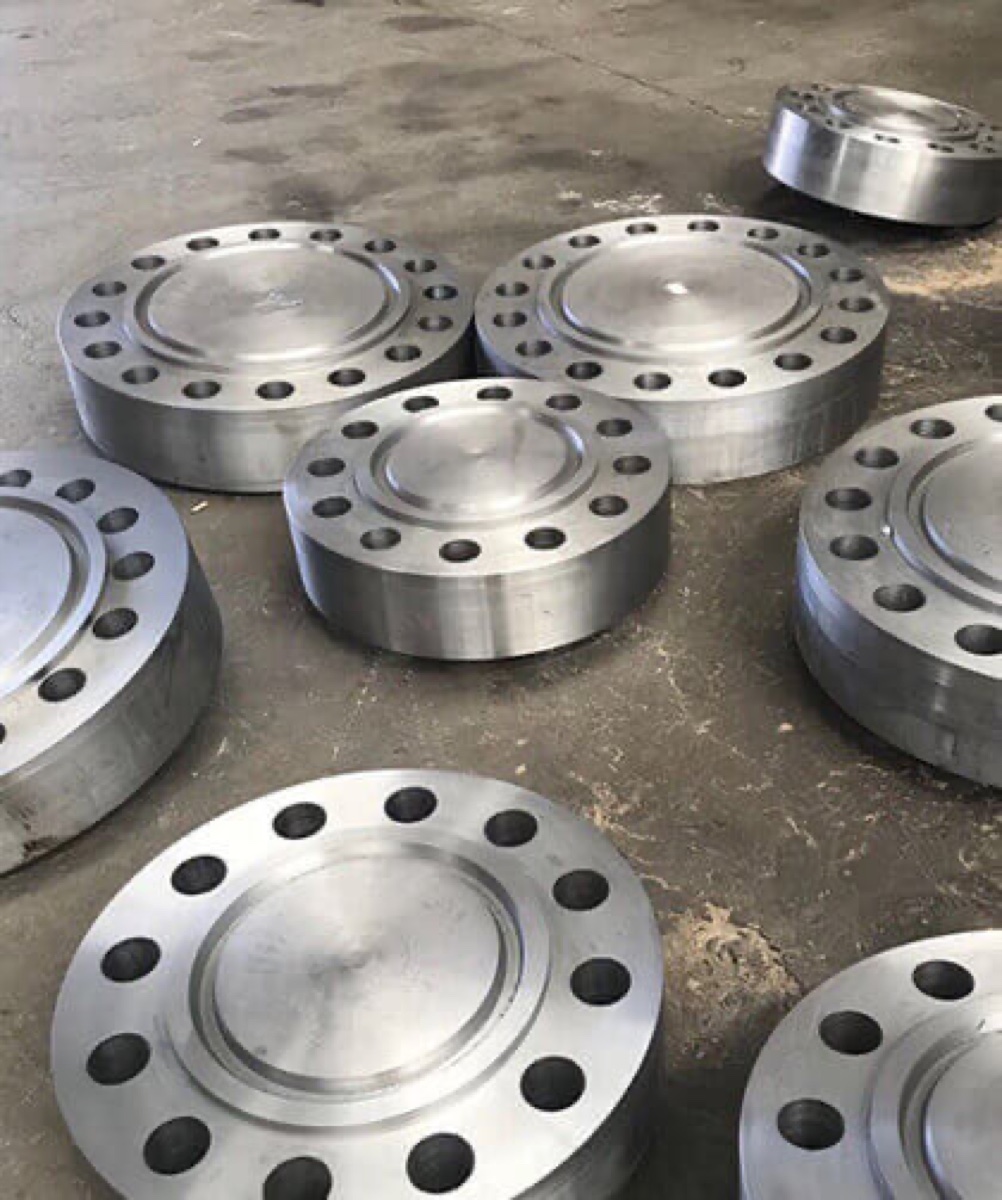
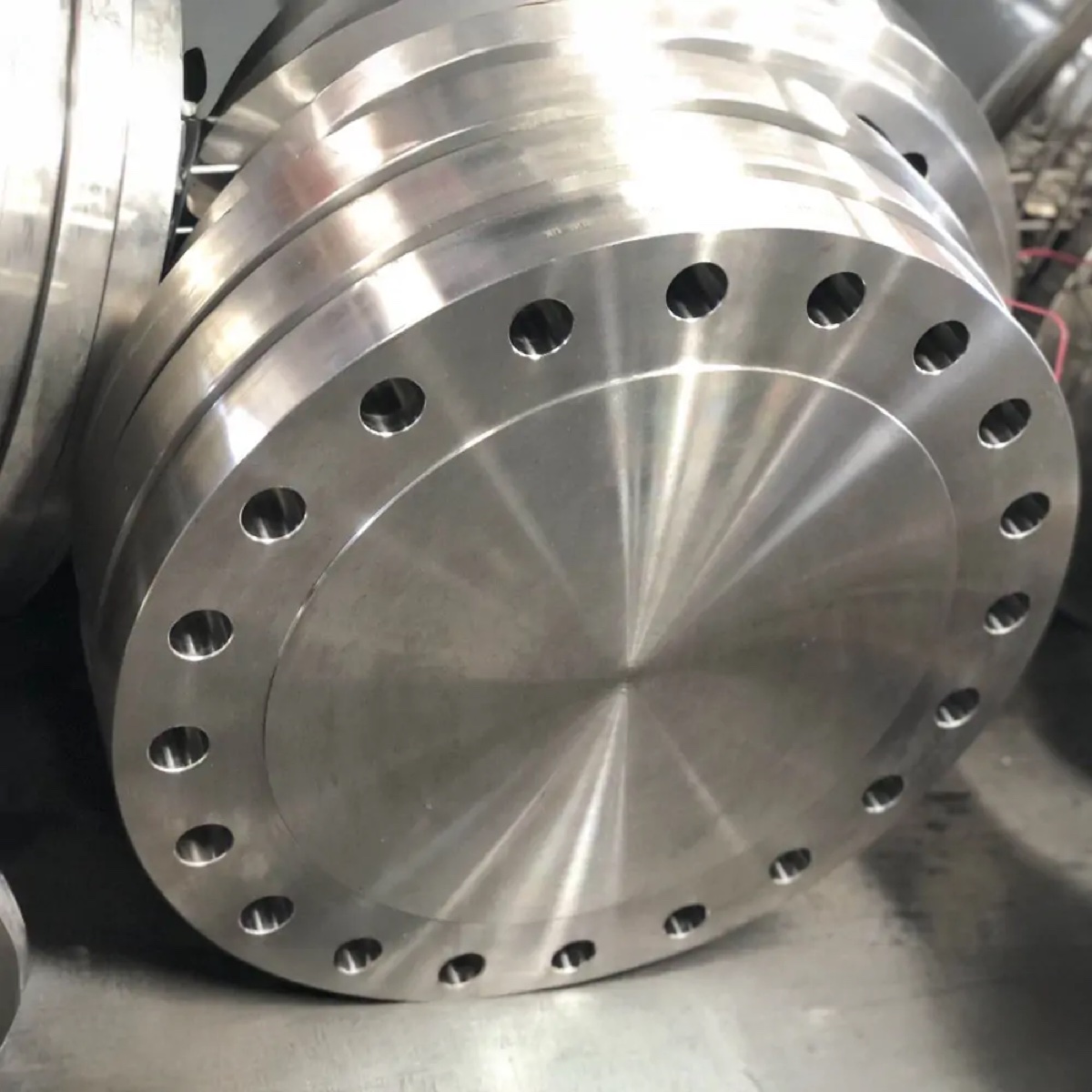
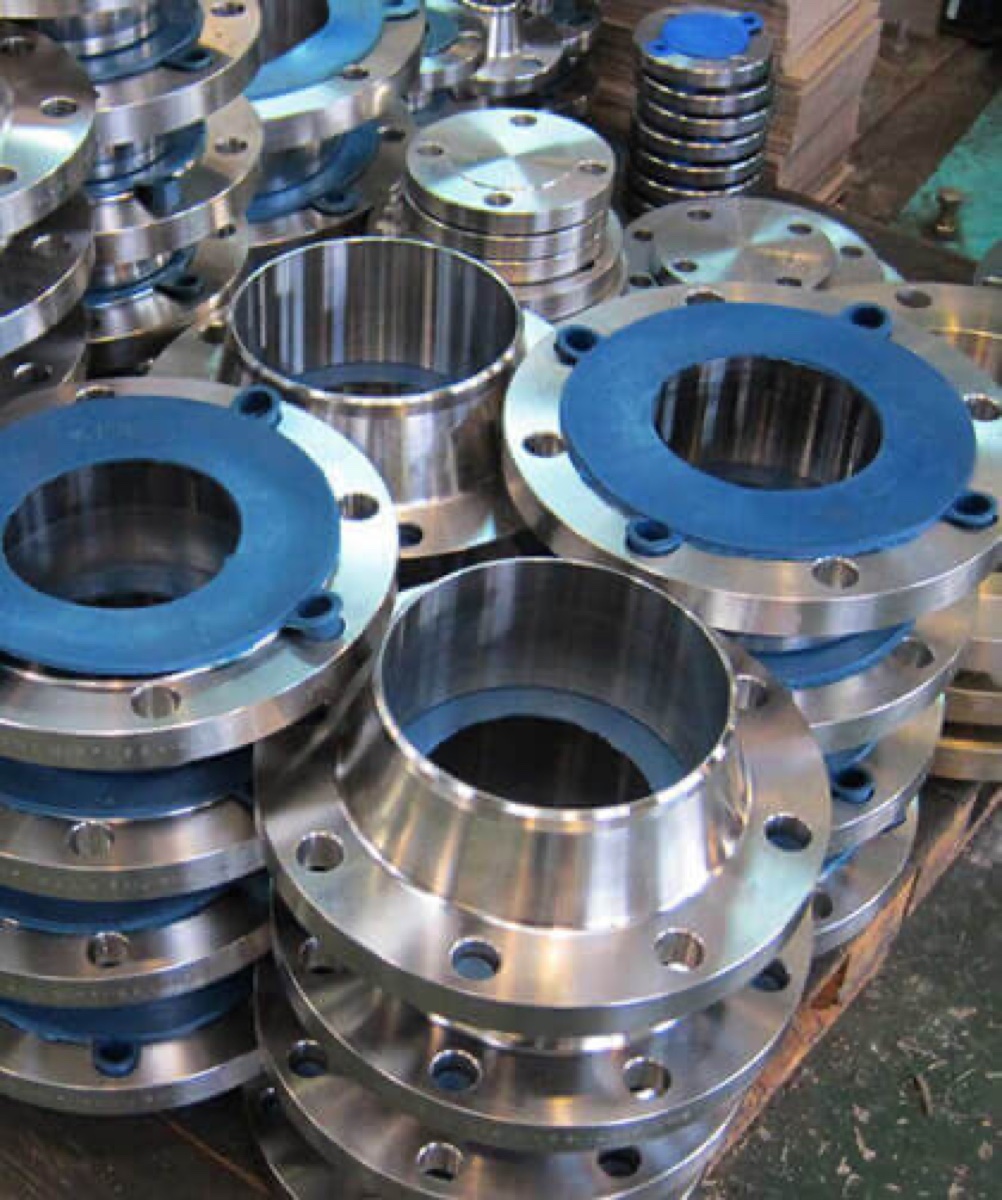
Where acids and sour brines write the line class: sour-gas wellheads and manifolds, downhole-adjacent hardware, sulphuric and phosphoric acid plants, steel-pickling lines, pollution-control and FGD chemistry, chemical tankers, nuclear fuel reprocessing. Production below:
Machined Blind Flanges — On Our Shop FloorLarge Machined Blind — Finished FaceIncoloy 825 Flanges — Same Grade, Protected Stock
Incoloy 825 Blind Flange Dimensions
Blind dimensions are class-governed — identical across material grades. Full charts:
How to Specify & Order an Incoloy 825 Blind Flange
Five elements — the sour declaration is the 825-specific one:
1
Size & standard — e.g. 4″ NB ASME B16.5, or the B16.47 series for 26″ and above.
2
Pressure class & facing — Class 150–2500; RF, FF or RTJ (with ring number) to match the mating flange.
3
Grade — ASTM B564 UNS N08825 (Incoloy 825); EN 2.4858 designation where the project requires it.
4
Service declarations & certification — sour service (NACE MR0175) stated explicitly; acid type, concentration and temperature for acid duty; NPT tap size if a test blind; PMI or 3.2 witnessing as specified; EN 10204 3.1 standard.
An Incoloy 825 blind flange is a solid forged disc of wet-corrosion nickel-iron-chromium alloy — roughly 42% nickel, 22% chromium and 30% iron with functional molybdenum, copper and titanium additions, certified to ASTM B564 as UNS N08825, EN 2.4858 — drilled to the standard bolt pattern with no bore. It closes the systems its chemistry was built for: sulphuric and phosphoric acid circuits, sour-gas wells and brines, pickling lines and pollution-control equipment — NACE-listed and immune to chloride stress-corrosion cracking. Dimensions follow ASME B16.5 from ½ inch to 24 inch and ASME B16.47 beyond, in raised face, flat face and ring joint facings.
How is 825 related to the Incoloy 800 family?
It is the 800 base turned to face water. Same iron-nickel-chromium school, same maker — but every change points at wet chemistry instead of heat: nickel raised from 32% to around 42%, closing off chloride stress-corrosion cracking entirely; molybdenum added at 2.5-3.5% for pitting and reducing acids; copper added at 1.5-3.0% for sulphuric; titanium raised to true stabiliser levels for weld protection. The result shares the family name and almost nothing of the family's furnace franchise — 800 and its H/HT siblings fight heat, 825 fights acids and brines, and buyers should read the name as a family crest, not a service description.
What do the molybdenum, copper and titanium in 825 each do?
Three additions, three enemies. Molybdenum at 2.5-3.5% is the chloride-and-reducing-acid element: pitting resistance in brines and tolerance of the acid chemistries that strip passive films. Copper at 1.5-3.0% is the sulphuric-acid element — the same lever that powers 904L and Alloy 20 — ennobling the surface against reducing attack. Titanium at 0.6-1.2% is the stabiliser: it captures carbon as harmless titanium carbides so welds and heat-affected zones cannot sensitize, the same insurance Alloy 20 buys with niobium. Together on the high-nickel base they make one certificate cover acid, brine and weld all at once.
825, 904L or Alloy 20 — how does the acid trio divide?
Three answers to overlapping questions, split by nickel and heritage. 904L (~25% Ni) is the economical European acid stainless — wide sulphuric band, best chloride pitting of the three via its 4-5% molybdenum. Alloy 20 (~35% Ni, niobium-stabilised) is the American acid-plant tradition, strongest in mid-band sulphuric. 825 (~42% Ni, titanium-stabilised) carries the most nickel — the firmest SCC immunity — plus the NACE sour-service listing the other two lack, making it the oil-and-gas member of the trio: downhole tubing hangers, sour manifolds and wellhead closures specify it where the process-plant grades never go. All three sit in our range; the service chemistry and the specification's heritage decide.
What is the chemical composition of Incoloy 825 (UNS N08825)?
Nickel 38.0-46.0%, chromium 19.5-23.5%, iron 22.0% minimum — the family's second iron floor — molybdenum 2.5-3.5%, copper 1.5-3.0%, titanium 0.6-1.2%, carbon ≤0.05%, aluminium ≤0.2%, manganese ≤1.0%, silicon ≤0.5%, sulphur ≤0.03%. The busiest chemistry in our blind range: molybdenum, copper and titanium are all functional additions. Certificate readers should note two structural details — iron keeps its floor role from the 800 family, and aluminium inverts to a cap here, where the 800 sheets carried it as a functional range. Our PMI reads the full signature on every piece.
What are the mechanical properties of Incoloy 825 blind flanges?
Per ASTM B564 in the annealed condition: tensile strength 586 MPa (85 ksi) minimum, yield strength 241 MPa (35 ksi) minimum, elongation 30% minimum — notably stronger than the 800 trio's sheets, courtesy of the heavier solid-solution alloying, and delivered from a plain anneal with full weldability. Ratings run on the grade's own nickel-alloy B16.5 lines. Strength is rarely why 825 is specified — the chemistry is — but the 85 ksi floor gives its closures useful class-rating headroom over the softer acid grades.
Is Incoloy 825 acceptable for NACE MR0175 sour service?
Yes — it is one of the standard's staple alloys, and sour service is arguably its defining franchise. Annealed 825 is listed for hydrogen-sulphide environments with generous limits: resistant to sulphide stress cracking, chloride SCC and the hot sour brines that attack lower alloys by several mechanisms at once. That listing is why downhole hangers, packers, sour-gas manifolds and wellhead equipment specify N08825 as a standard material — and why the oil-and-gas world knows 825 better than any other member of its family. Declare sour service on the enquiry; the certificate then documents the annealed condition the listing assumes.
How immune is 825 to chloride stress-corrosion cracking?
Effectively completely, within any realistic service. Chloride SCC feeds on the 8-12% nickel window of ordinary austenitics and fades steeply as nickel rises; at 825's 38-46% the mechanism is shut off — boiling chloride tests that crack 316L in hours leave it untouched, and hot sour brines that stress every lower grade simultaneously are precisely where its service record was built. This is the property that separates it from 904L in marginal duty, and one of the two reasons (with the NACE listing) that oil-and-gas metallurgy reaches for it by reflex.
Incoloy 825 or Inconel 625 — when do I step up?
When the duty outruns 825's windows in any direction. 625 carries triple the molybdenum (8-10% against 2.5-3.5%), buying seawater-crevice immunity and fiercer-acid tolerance 825 cannot match; nearly double the strength (827 against 586 MPa tensile); and a hot-end capability 825 lacks entirely. 825 answers with a substantially friendlier price — its 30% iron against 625's nickel-rich balance — and for the broad middle of sour and acid service, the cheaper certificate genuinely serves. The practical split: standard sour wells, pickling and acid process — 825; subsea, hot seawater, the worst acids, or strength-driven closures — 625. We forge both and quote both at the boundary.
Why isn't 825 a high-temperature grade like the rest of its family?
Because its additions were chosen for water, and some of them dislike heat. The titanium stabiliser and copper that serve acid duty form phases that slowly degrade toughness in extended high-temperature exposure, and 825 carries none of the grain-size or carbon machinery that gives 800H/800HT their creep ratings — its practical ceiling for sustained service sits around 540°C, and ASME allowables taper accordingly. The family name misleads here more than anywhere: for reformer and heater duty specify the 800 trio; for flue-gas and furnace closures, 601 or 310. 825's territory is wet, sour and ambient-to-warm — and there it is the family's champion.
What service conditions does Incoloy 825 dislike?
The honest list. Sustained heat above ~540°C — not a creep grade, as the family-name warning explains. Hot seawater crevices: with molybdenum at only 2.5-3.5%, its PREN sits near the duplex class, so fierce chloride crevice duty belongs to 625 or the 6-moly grades. Strongly oxidising media — nitric-grade chemistry — favour purpose-built alloys. And sulphur-bearing hot gases attack it as they attack all high-nickel metal, though its sour-brine (wet H2S) franchise is precisely where it excels — the distinction between hot sulphidation and wet sour service is worth keeping sharp on the enquiry.
What facings are Incoloy 825 blind flanges made with?
All three: raised face (BLRF) — the process default — flat face (BLFF) for the FRP, rubber-lined and acid-brick equipment its plants run, and ring type joint (BLRTJ) for the wellhead and high-pressure sour practice where 825 line classes live, the ring chosen softer than the groove. Each facing has its own page on this site. In acid and brine service the gasket seat deserves crevice-conscious selection and clean bolt-up. NPT-tapped test and injection blinds are machined and certified at the works.
Where are Incoloy 825 blind flanges used?
Where acids and sour brines write the line class: sour-gas wellheads, manifolds and downhole-adjacent hardware across the oil and gas world; sulphuric and phosphoric acid plants; steel-pickling lines; pollution-control and flue-gas-desulphurisation chemistry; chemical-tanker and waste-treatment systems; and nuclear fuel reprocessing service with its mixed-acid streams. 825 blinds close those systems as isolations, spare-nozzle blanks and tapped test points — NACE-listed, SCC-immune, titanium-stabilised for the day they become welded spools.
Which standards cover Incoloy 825 blind flanges?
The material standard is ASTM B564 (UNS N08825) with ASME SB564 as the boiler-code twin — the nickel-alloy forging standard — alongside B424 for plate and B423 for pipe in the same alloy, and EN 2.4858 / NiCr21Mo as the European designation. Dimensions follow ASME B16.5 for ½"-24" and ASME B16.47 for 26"-60", rated on the grade's own lines. A complete specification reads: 'Blind Flange, RTJ, 4", ASME B16.5 Class 900, ASTM B564 UNS N08825 (Incoloy 825), NACE MR0175' — and our EN 10204 certificates state it exactly that way, molybdenum, copper and titanium included.
Who manufactures Incoloy 825 blind flanges in India?
Tesco Steel & Engineering is an ISO 9001:2015 certified flange manufacturer based in Mumbai, India, forging Incoloy 825 / ASTM B564 / UNS N08825 / EN 2.4858 blind flanges from ½" to 24" NB per ASME B16.5 in Classes 150-2500 and to 60" per ASME B16.47 — annealed, pickled, PMI-verified with the molybdenum, copper and titanium read on every piece, certified to EN 10204 3.1/3.2 on every lot, NACE sour-service documentation on request — in raised face, flat face and ring joint facings, alongside the Incoloy 800 trio, Incoloy 925, Inconel 625, 904L and Alloy 20 blinds. Exported to more than 50 countries.