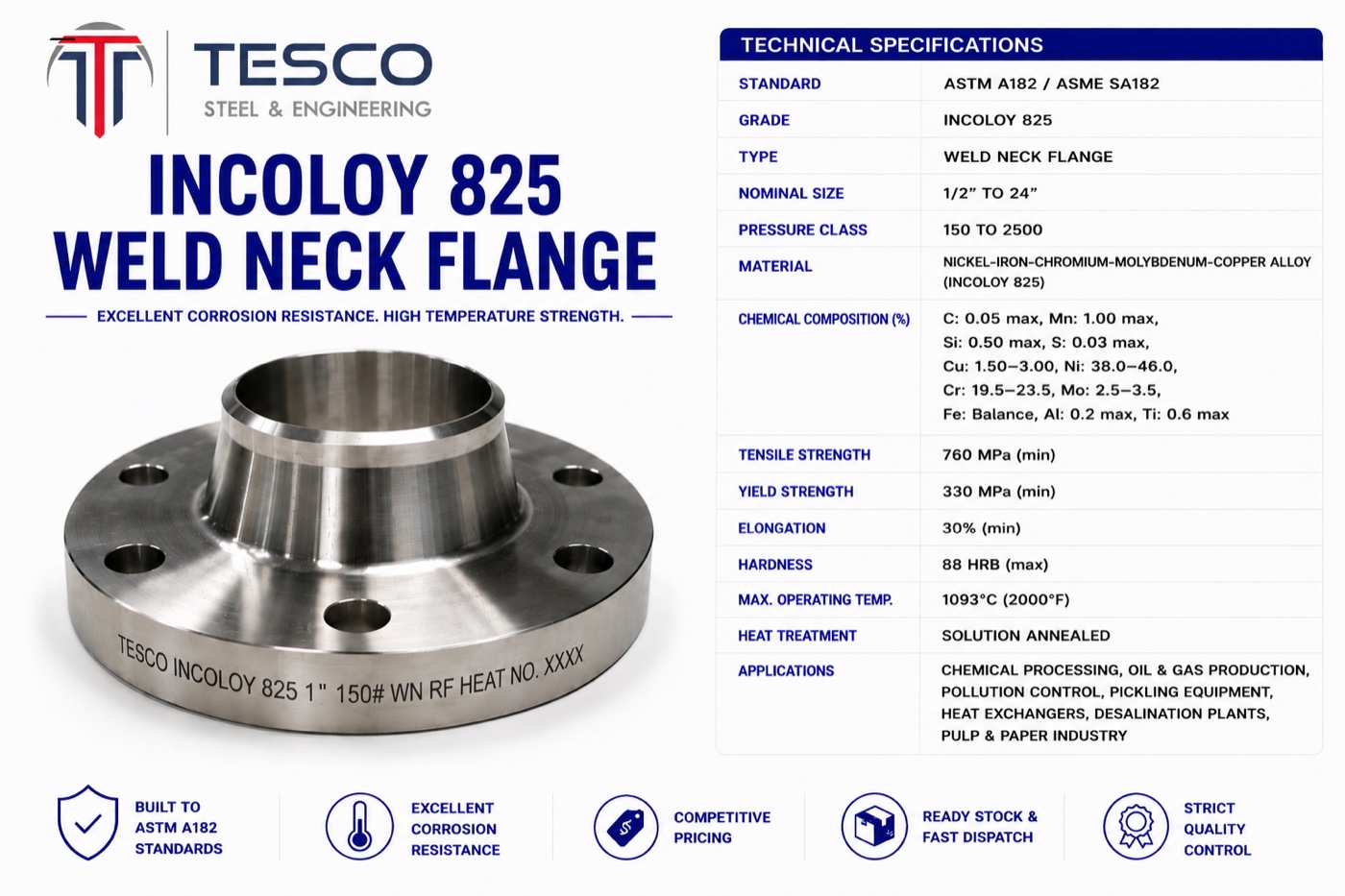
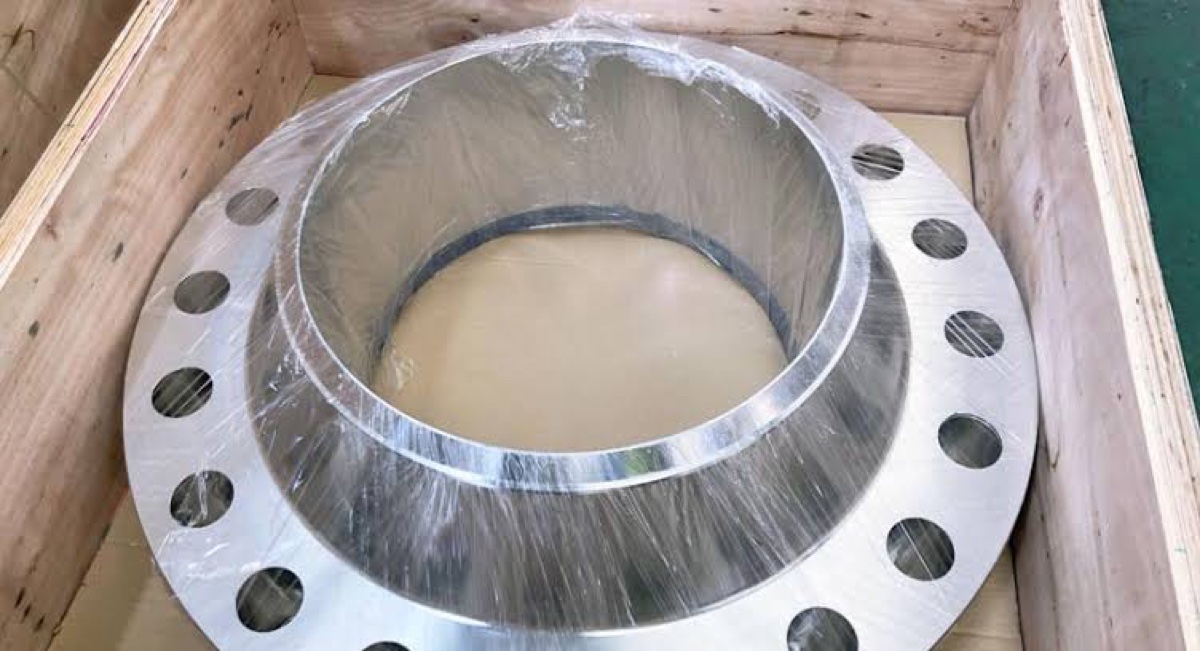
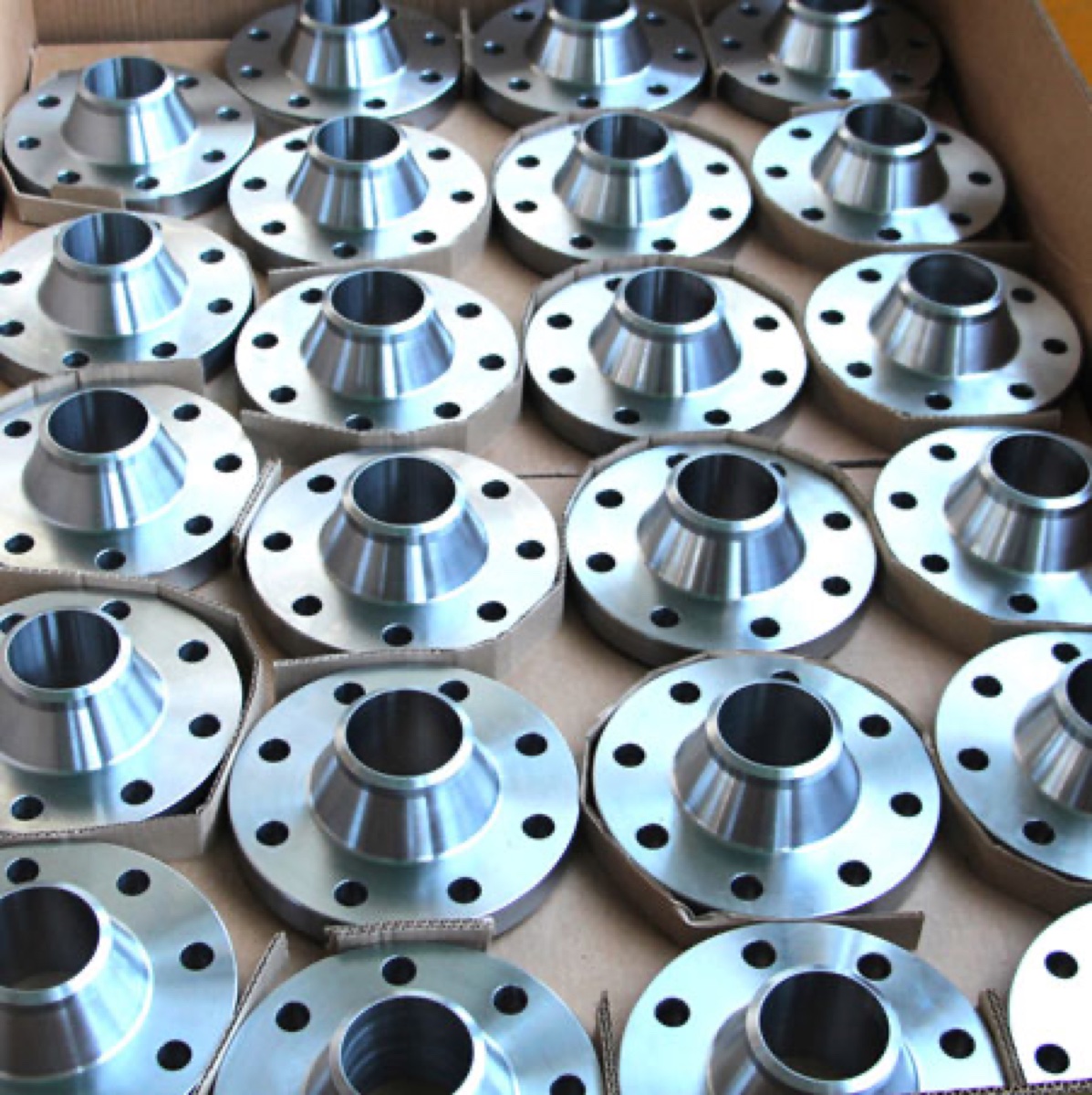
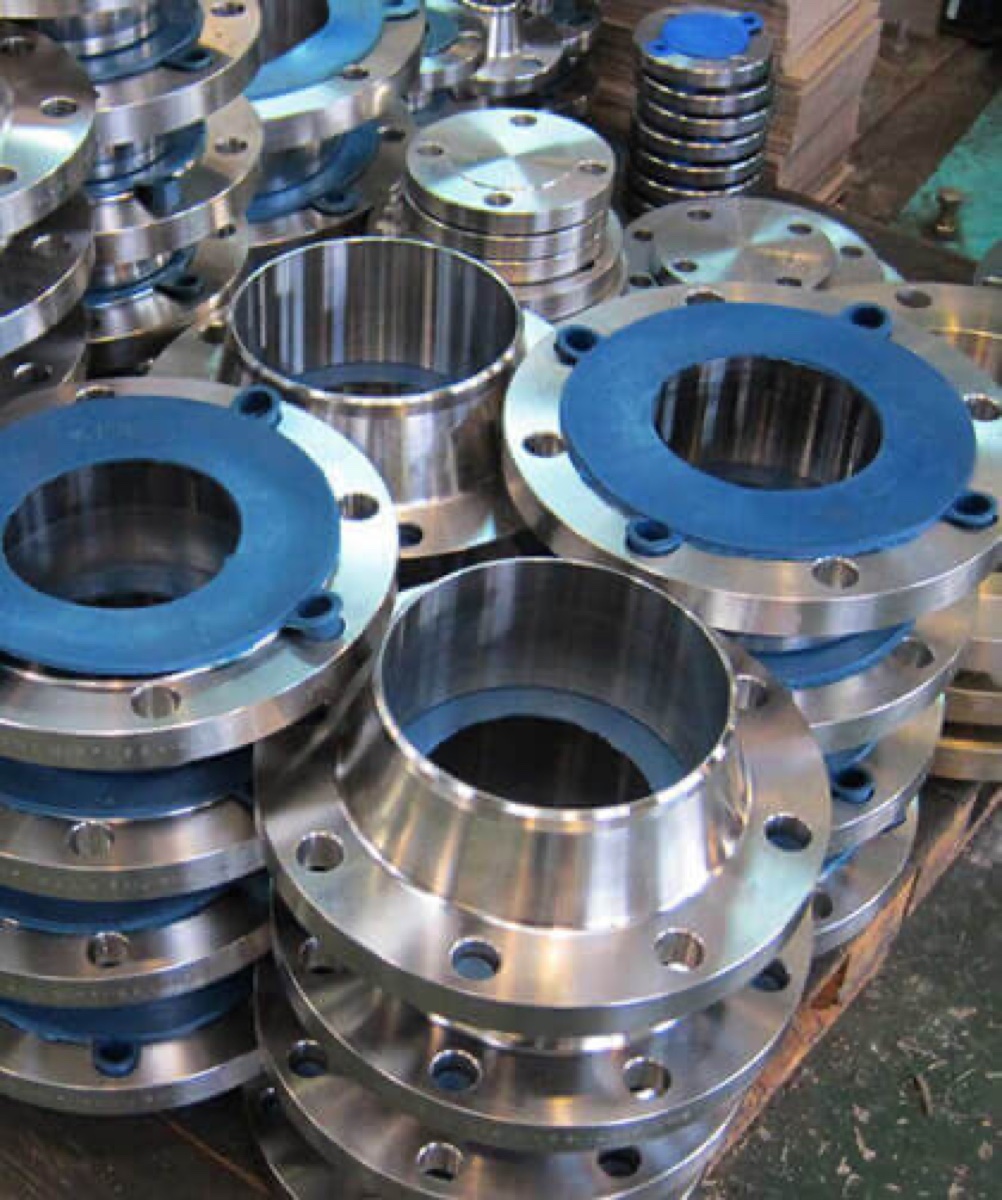
Tesco Steel & Engineering forges Incoloy 825 weld neck flanges — UNS N08825, Werkstoff Nr. 2.4858, the wet-corrosion specialist of the Fe-Ni-Cr family — to ASTM B564, from 1/2″ NB to 56″ NB in ASME B16.5 Class 150–2500 and European PN patterns. Every addition has a job: 38–46% nickel makes chloride SCC a non-issue, 2.5–3.5% molybdenum resists pitting and crevice attack, 1.5–3% copper tames sulfuric and phosphoric acid, and titanium stabilization keeps welds resistant. The result serves sour oil & gas per NACE MR0175, acid plants, pickling lines and chemical processing — where stainless fails and 625 would be overkill. Mating B423 pipe, welded with ERNiCrMo-3. Supplied with PMI, ASTM G28 and EN 10204 3.1/3.2 on request. ISO 9001:2015, made in Mumbai, India — exported worldwide.
Incoloy 825 · UNS N08825 · 2.4858Ni 38–46% · Mo 2.5–3.5% · Cu 1.5–3%ASTM B564 / ASME SB-564NACE MR0175 Sour ServiceSulfuric Acid · Pickling · Sour Gas1/2″ – 56″ NB · Class 150–2500ISO 9001:2015 · Exported Worldwide
Incoloy 825 (UNS N08825 / 2.4858) is the Incoloy family's wet-corrosion member: a 38–46% nickel base that shrugs off chloride stress-corrosion cracking, 19.5–23.5% chromium for oxidizing media, 2.5–3.5% molybdenum against pitting, 1.5–3% copper for reducing acids — above all sulfuric — and titanium stabilization so welds keep resisting. An Incoloy 825 weld neck flange pairs that chemistry with a long tapered hub butt-welded to the pipe, forged to ASTM B564.
Where alloy 800 and its H/HT siblings live in furnaces and reformers, 825 works the other end of the plant: acids, brines and sour gas at modest temperatures — typically up to ~540 °C. Its close cousin is Alloy 20 in sulfuric-acid duty; its upgrade path is Inconel 625 when chlorides get severe.
The commercial logic: 825 is the most-stocked, most-specified Incoloy because one chemistry covers reducing and oxidizing media — a plant that alternates acid washes with oxidizing process streams can pipe both in the same alloy, and NACE MR0175 listing makes it a default for sour wells.
Also searched as: Alloy 825 flange, UNS N08825 flange, 2.4858 flange, NiCr21Mo flange, sour service flange, NACE MR0175 flange — all refer to the product on this page.
Chemical Composition of Incoloy 825
C
Mn
Si
S
Cu
Fe
Ni
Cr
Mo
Al
Ti
0.05 max
1.00 max
0.50 max
0.030 max
1.50-3.00
22.00 min
38.00-46.00
19.50-23.50
2.50-3.50
0.2 max
0.6-1.2
Values in weight %. Read it as a division of labour: Mo buys pitting and crevice resistance, Cu buys reducing-acid resistance, the Ti window stabilizes carbon so welded joints resist intergranular attack, and the nickel base underwrites it all against chloride SCC.
Mechanical Properties of Incoloy 825
Tensile Strength, MPa
Yield Strength, Min, MPa
Elongation % min.
550
220
30
Annealed-condition minimums, demonstrated on every certificate — usefully stronger than alloy 800 at room temperature, with austenitic toughness to cryogenic temperatures. The grade is bought for its corrosion chemistry; the strength comes free.
Equivalent Grades of Incoloy 825
Standard
Werkstoff Nr.
UNS
JIS
BS
GOST
AFNOR
EN
OR
Incoloy 825
2.4858
N08825
NCF 825
NA 16
ЭП703
NFE30C20DUM
NiCr21Mo
ХН38ВТ
System partners: ASTM B423 seamless pipe, B366 butt-weld fittings, B424 plate, B425 bar and B564 forgings. Family: heat-service 800/800H/800HT and the age-hardenable 925.
Incoloy 825 Weld Neck Flange Specifications
Incoloy 825 Weld Neck Flanges are available in the following specifications:
Size
1/2"NB to 56"NB
Class
150#, 300#, 400#, 600#, 900#, 1500#, 2500#
Sch (Schedule)
XS, XXS, STD & Schedule 20, 40, 80, 160
Pressure Ratings
PN 2.5 - PN 400
Standards
ASTM B564 / ASME SB-564; ASME B16.5, ASME B16.47, EN 1092-1, DIN 2631–2635, BS 4504
Condition
Annealed; NACE MR0175 / ISO 15156 compliant supply on request
1.5–3% Cu shifts the alloy to passive behaviour in reducing acids — the signature that made 825 the pickling-plant and acid-service standard.
Molybdenum Against Chlorides
2.5–3.5% Mo resists pitting and crevice attack in brines and process chlorides that eat 316L.
SCC Immunity Built In
At 38–46% nickel, chloride stress-corrosion cracking — the silent killer of stainless hot-water systems — simply stops being a design consideration.
NACE MR0175 Sour Listing
Listed for H2S service: wellheads, sour separation and offshore piping specify 825 by name.
Reducing + Oxidizing, One Alloy
Cr covers oxidizing media, Cu+Mo cover reducing — a plant alternating both can standardize on one chemistry, one welding procedure, one stock.
Welding Incoloy 825 — Overmatch the Molybdenum
Most fabricators weld 825 with ERNiCrMo-3 (625) wire or ENiCrMo-3 electrodes, overmatching the molybdenum so the weld metal never becomes the corrosion weak point; matching ERNiFeCr-1 filler is also qualified where specifications call for it. Nickel-alloy discipline applies: sulphur-free cleanliness, moderate heat input, no preheat, no PWHT in normal practice — the titanium stabilization protects the heat-affected zone against sensitization.
Grade-selection note: hot seawater crevices, high-chloride sour wells or the harshest acid mixtures step up to Inconel 625; dedicated sulfuric-acid plants also weigh Alloy 20. State the medium, concentration and temperature in the enquiry and the grade follows.
Where Incoloy 825 Weld Neck Flanges Are Used
Sour oil & gas leads — wellheads, separation and piping per NACE MR0175 — then sulfuric and phosphoric acid plants, steel-pickling lines, chemical processing, pollution-control scrubbers, nuclear fuel reprocessing and seawater-cooled exchangers. Our nickel-alloy production below:
Incoloy 825 weld neck flanges share their dimensions with every other material in the same class — OD, thickness, hub, bore, bolt circle and bolting per the standard tables. Full ASME B16.5 charts:
825 pricing tracks nickel and molybdenum plus the testing scope, so we quote live with a stated validity rather than publish a static list. To get a firm quotation, usually within 24 hours:
1
List your requirement — size (NB), class or PN, standard (ASME B16.5 / B16.47 / EN / DIN / BS), pipe schedule or bore, and quantity.
2
State the service & testing scope — medium, concentration and temperature; NACE MR0175 requirement; plus 3.2 witness, PMI, G28 or project specifications.
3
Send it across — via the inquiry form, WhatsApp, or email to sales@tescosteel.com — and we reply with price, delivery and stock position.
It is a weld neck flange forged from Incoloy 825 — the wet-corrosion specialist of the iron-nickel-chromium family, UNS N08825 / 2.4858, with 38-46% nickel, 19.5-23.5% chromium, 2.5-3.5% molybdenum, 1.5-3% copper and titanium stabilization — to ASTM B564. The long tapered hub is butt-welded to the pipe with the bore matched to the schedule, giving a radiographable joint in the grade that handles sulfuric acid, sour gas, brines and chemical media that defeat stainless steel.
What is the idea behind the Incoloy 825 chemistry?
Each addition solves a named corrosion problem. The 38-46% nickel base makes chloride stress-corrosion cracking a non-issue. Chromium handles oxidizing media; molybdenum at 2.5-3.5% resists pitting and crevice attack in chlorides; copper at 1.5-3% is the signature move — it flattens the corrosion rate in reducing acids, above all sulfuric and phosphoric. Titanium stabilizes against sensitization so welds keep their resistance. The result is one alloy that survives both reducing and oxidizing chemistry.
What is the difference between Incoloy 825 and Incoloy 800?
Different jobs entirely. Alloy 800 is the heat grade — plain Fe-Ni-Cr, bought for structural stability and creep-rated variants in furnaces and reformers. 825 is the wet-corrosion grade: more nickel (38-46% versus 30-35%), plus the molybdenum and copper that 800 lacks, bought for acids, brines and sour gas at modest temperatures — its Ti-stabilized chemistry is typically applied up to about 540 °C rather than in the creep range. Same family name, opposite ends of the plant.
What is the difference between Incoloy 825 and Alloy 20?
They are close cousins built for sulfuric acid — Alloy 20 (N08020) carries 32-38% nickel with copper and molybdenum plus niobium stabilization, 825 carries 38-46% nickel with titanium stabilization. In practice Alloy 20 is the sulfuric-acid incumbent, while 825's higher nickel gives it a wider brief: better in chlorides and sour gas, standard in oil-country tubular and offshore service per NACE MR0175. Many plants stock 825 as the more versatile of the two.
What is the difference between Incoloy 825 and Inconel 625?
A rung on the same ladder. 625 is nickel-based with 8-10% molybdenum plus niobium — roughly triple 825's pitting agent, with higher strength and a far higher price. 825's 2.5-3.5% molybdenum handles moderate chloride and acid duty; when the service reaches hot seawater crevices, high-chloride sour wells or the harshest acid mixtures, 625 takes over. Specifying 825 where it suffices and 625 where it must be is how corrosion engineers spend wisely.
What are the equivalent designations for Incoloy 825?
UNS N08825; Werkstoff Nr. 2.4858; EN NiCr21Mo; JIS NCF 825; BS NA 16; GOST ЭП703 (ХН38ВТ); AFNOR NFE30C20DUM; and the trade names Incoloy 825 or Alloy 825. System partners: ASTM B423 seamless pipe, B366 butt-weld fittings, B424 plate, B425 bar and B564 forgings. An enquiry in any of these designations is quoted as the same material.
What is the chemical composition of Incoloy 825?
Per ASTM B564: nickel 38.00 to 46.00%, chromium 19.50 to 23.50%, molybdenum 2.50 to 3.50%, copper 1.50 to 3.00%, titanium 0.60 to 1.20%, iron 22.00% minimum, with carbon capped at 0.05%, manganese 1.00%, silicon 0.50%, aluminium 0.20% and sulphur 0.030%. Molybdenum buys pitting resistance, copper buys reducing-acid resistance, and the titanium window stabilizes carbon so welded joints resist intergranular attack.
What are the mechanical properties of Incoloy 825 flanges?
In the annealed condition: tensile strength 550 MPa minimum, yield strength 220 MPa minimum and elongation 30% minimum, demonstrated on every certificate. Usefully stronger than alloy 800 at room temperature, with full austenitic toughness down to cryogenic temperatures — though the grade is bought for its corrosion chemistry rather than its strength.
Which pipe and fittings do Incoloy 825 weld neck flanges mate with?
ASTM B423 seamless Incoloy 825 pipe is the standard partner, with B366 butt-weld fittings, B424 plate and B425 bar completing the system. The weld neck bore is machined to the pipe schedule you state, so the bore runs flush through the joint and the bevel arrives ready for a matched-chemistry butt weld.
How are Incoloy 825 flanges welded to pipe?
Most fabricators weld 825 with ERNiCrMo-3 (625) wire or ENiCrMo-3 electrodes — overmatching the molybdenum so the weld metal never becomes the weak point in chloride or acid service; matching ERNiFeCr-1 filler is also qualified where specifications call for it. Nickel-alloy discipline applies: sulphur-free cleanliness, moderate heat input, no preheat, and no PWHT in normal practice — the titanium stabilization protects the heat-affected zone against sensitization.
Is Incoloy 825 suitable for sour service under NACE MR0175?
Yes — alloy 825 is one of the listed nickel-base materials in NACE MR0175 / ISO 15156 and is a standing choice for sour oil and gas duty: wellhead and downhole components, sour-gas separation, and piping where H2S, CO2 and chlorides occur together. State the NACE requirement in the enquiry and the flanges are supplied in the annealed, compliant condition with certification to match.
Why is Incoloy 825 so good in sulfuric acid?
Copper. In reducing acids like sulfuric and phosphoric, ordinary Cr-Ni stainless corrodes actively; the 1.5-3% copper in 825 shifts the alloy's behaviour so it passivates instead, and the nickel base plus molybdenum keep chlorides and impurities from undoing it. That is why pickling plants, acid manufacture and phosphate fertilizer service have specified 825 for decades — it holds low corrosion rates across a wide span of sulfuric concentrations and temperatures.
What testing and certification do you supply with Incoloy 825 flanges?
Every lot ships with EN 10204 3.1 mill test certificates covering chemical analysis — demonstrating the nickel, chromium, molybdenum, copper and titanium windows — mechanical properties and the anneal record, with 3.2 certification witnessed by Lloyd's, DNV, BV or TÜV on request. We also offer PMI verification, intergranular-corrosion testing to ASTM G28, hydrostatic testing and dye-penetrant examination, with full heat-number traceability.
Where are Incoloy 825 weld neck flanges used?
Sour oil and gas production per NACE MR0175, sulfuric and phosphoric acid plants, steel-pickling lines, chemical processing where reducing and oxidizing media alternate, pollution-control scrubbers, nuclear fuel reprocessing, seawater-cooled heat exchangers and offshore piping systems. Wherever chlorides plus acid chemistry defeat stainless and the budget stops short of alloy 625, 825 is the standing answer.
What sizes and standards do you manufacture Incoloy 825 weld neck flanges in?
From 1/2 inch NB to 56 inch NB: ASME B16.5 Class 150 to 2500 up to 24 inch, ASME B16.47 above, and European PN 2.5 to PN 400 patterns to EN 1092-1, DIN and BS 4504. Raised face is standard, ring joint on request, and every bore is machined to the mating pipe schedule from Sch 10 through XXS.
Do you keep Incoloy 825 weld neck flanges in stock? What is the lead time?
825 is the busiest of the Incoloys, so common sizes in Class 150 and 300 rotate through production with popular items often available, while larger diameters, higher classes and witness-tested or NACE-documented lots are forged to order — typically 4 to 6 weeks. Prices track nickel and molybdenum, so quotations carry a validity period.
Do you export Incoloy 825 flanges outside India?
Yes. Tesco Steel & Engineering is an ISO 9001:2015 certified manufacturer based in Mumbai, and Incoloy 825 flanges ship to oil and gas, chemical and acid-plant projects across the Middle East, Europe, Africa, Southeast Asia and the Americas. Flanges travel face-protected and seaworthy-packed, with full heat-number and test traceability.