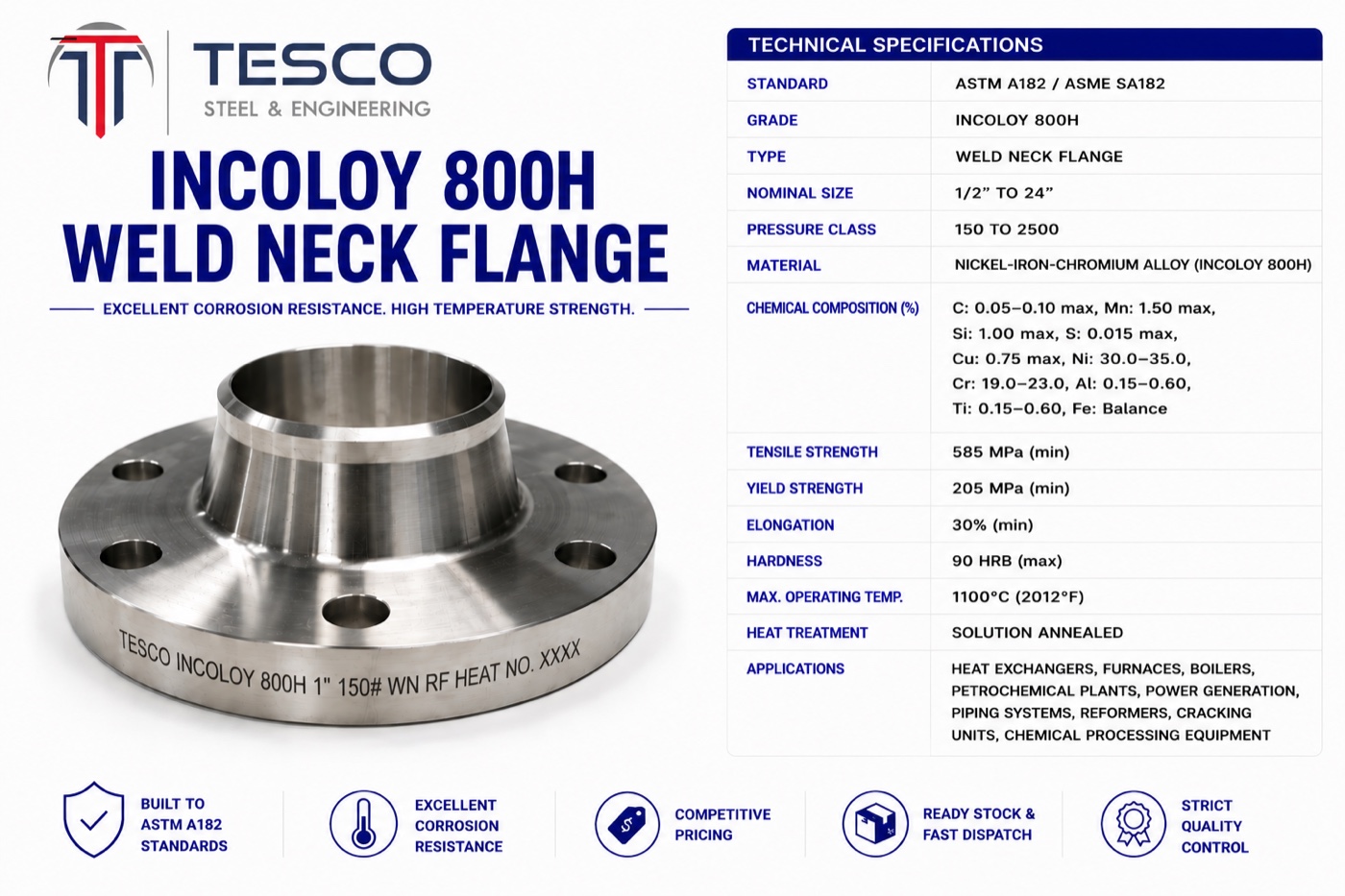
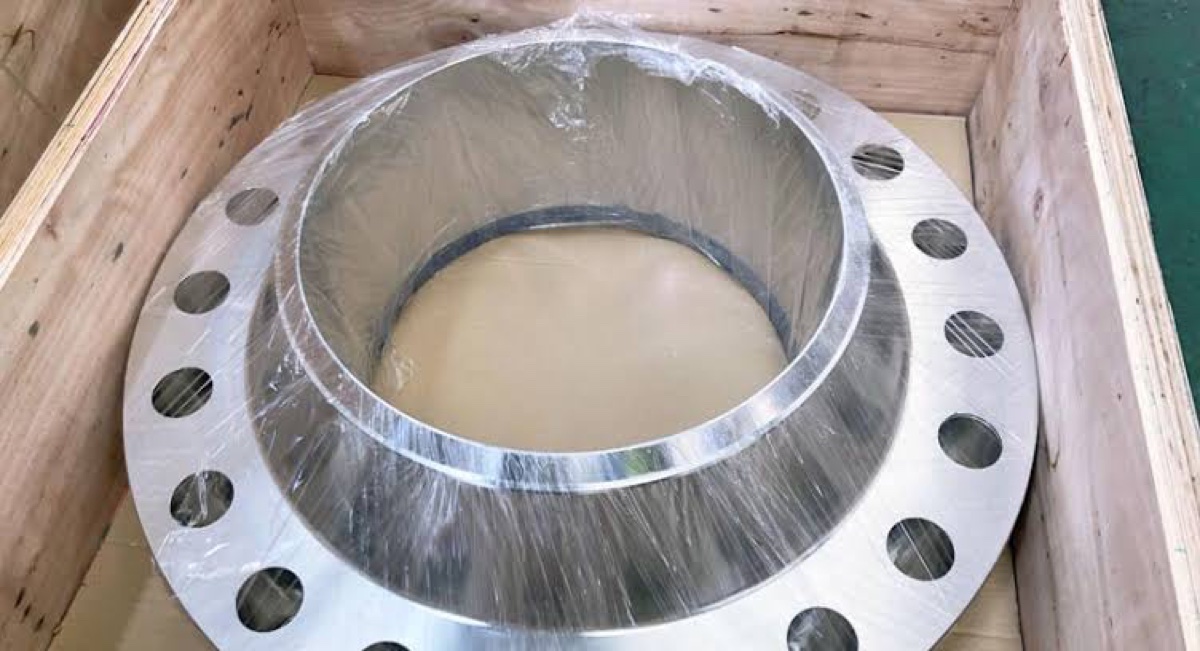
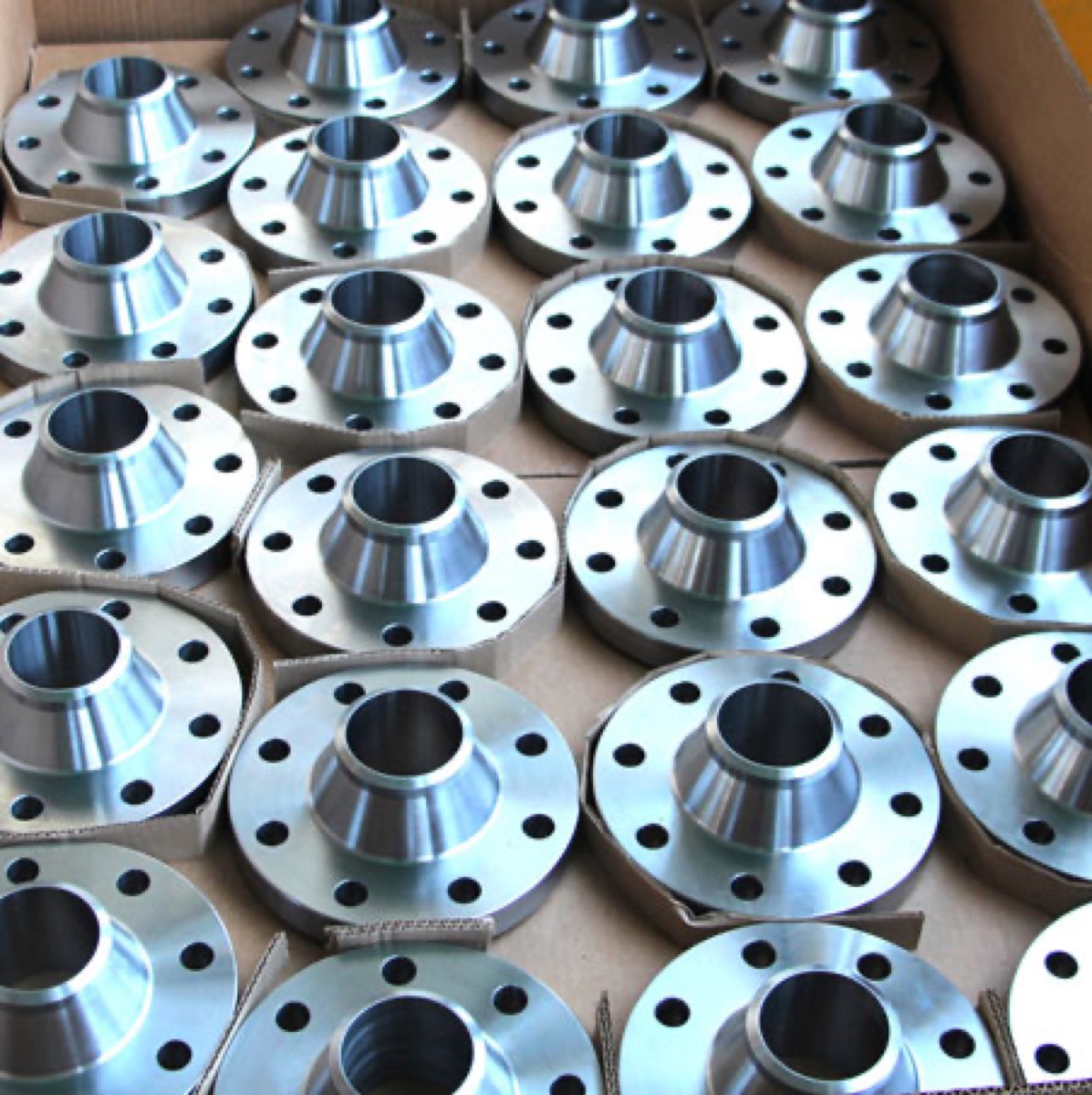
Tesco Steel & Engineering forges Incoloy 800H weld neck flanges — UNS N08810, Werkstoff Nr. 1.4958, the controlled-carbon creep variant of the Fe-Ni-Cr alloy 800 family — to ASTM B564, from 1/2″ NB to 56″ NB in ASME B16.5 Class 150–2500 and European PN patterns. Two controls define the grade: carbon floored at 0.05–0.10% and a solution-annealed coarse grain — together buying the code-listed creep and stress-rupture strength that carries piping above standard alloy 800's ~593 °C ceiling: steam-methane reformers, ethylene furnaces, superheaters and fired heaters. Mating B407 pipe, welded with ERNiCrCoMo-1 / ERNiCr-3. Supplied with grain size reporting, PMI and EN 10204 3.1/3.2. ISO 9001:2015, made in Mumbai, India — exported worldwide.
Incoloy 800H · UNS N08810 · 1.4958C 0.05–0.10% · Coarse GrainASTM B564 / ASME SB-564Code Creep Ratings to 899 °CReformers · Ethylene Furnaces1/2″ – 56″ NB · Class 150–2500ISO 9001:2015 · Exported Worldwide
Incoloy 800H (UNS N08810 / 1.4958) is alloy 800 tuned for creep: the same Fe-Ni-Cr base (30–35% Ni, 19–23% Cr), but with carbon held at 0.05–0.10% — a floor, not just a cap — and solution annealed to a coarse grain (ASTM No. 5 or coarser). Fewer grain boundaries slide less at temperature, so the grade carries code-listed creep and stress-rupture values to 899 °C. An Incoloy 800H weld neck flange pairs that metallurgy with a long tapered hub butt-welded to the pipe, forged to ASTM B564.
The family reads as a ladder: standard 800 (N08800) for general hot duty to ~593 °C; 800H where time-dependent creep governs design; and 800HT (N08811), which tightens the Al+Ti window to 0.85–1.20% for the last increment of rupture life. Chemistry windows overlap, so mill product often dual-certifies 800H/800HT — and 800H usually certifies as 800, though never the reverse.
The defining trade is visible right in the datasheet: 800H's room-temperature minimums (450/170 MPa) sit below standard 800's (520/205), because the coarse-grain anneal spends ambient strength to buy decades of stress-rupture life where the plant actually operates.
Also searched as: Alloy 800H flange, UNS N08810 flange, 1.4958 flange, X5NiCrAlTi31-20 flange, reformer flange, creep-resistant Incoloy flange — all refer to the product on this page.
Chemical Composition of Incoloy 800H
C
Mn
Si
S
Cu
Fe
Ni
Cr
Al
Ti
0.05-0.10
1.50 max
1.00 max
0.015 max
0.75 max
39.50 min
30.00-35.00
19.00-23.00
0.15-0.60
0.15-0.60
Values in weight %. The carbon range 0.05–0.10% is the grade's signature — a deliberate floor so carbides pin grain boundaries against creep. Tightening the combined Al+Ti to 0.85–1.20% would make the heat 800HT.
Mechanical Properties of Incoloy 800H
Tensile Strength, MPa
Yield Strength, Min, MPa
Elongation % min.
450
170
30
Minimums per ASTM B564 for N08810 in the solution-annealed (coarse grain) condition. They sit deliberately below standard 800's 520/205 — the anneal trades room-temperature strength for the time-dependent creep allowables this grade is bought for.
Equivalent Grades of Incoloy 800H
Standard
Werkstoff Nr.
UNS
JIS
BS
GOST
AFNOR
EN
OR
Incoloy 800H
1.4958 / 1.4876
N08810
NCF 800H
NA 15(H)
ЭИ670
Z8NC33-21
X5NiCrAlTi31-20
ХН32Т
The family members are 800 / N08800 / 1.4876 and 800HT / N08811 / 1.4959. System partners: ASTM B407 seamless pipe, B366 butt-weld fittings, B409 plate and B564 forgings.
Incoloy 800H Weld Neck Flange Specifications
Incoloy 800H Weld Neck Flanges are available in the following specifications:
Size
1/2"NB to 56"NB
Class
150#, 300#, 400#, 600#, 900#, 1500#, 2500#
Sch (Schedule)
XS, XXS, STD & Schedule 20, 40, 80, 160
Pressure Ratings
PN 2.5 - PN 400
Standards
ASTM B564 / ASME SB-564; ASME B16.5, ASME B16.47, EN 1092-1, DIN 2631–2635, BS 4504
Condition
Solution annealed, coarse grain (ASTM No. 5 or coarser), grain size reported; dual-certified 800H/800HT subject to chemistry
0.05–0.10% carbon forms the carbides that pin grain boundaries — standard 800 only caps carbon; 800H guarantees it.
Coarse Grain by Design
Solution annealed to ASTM No. 5 or coarser: fewer boundaries, less boundary sliding, decades more stress-rupture life — measured and reported on the certificate.
Code-Listed to 899 °C
ASME time-dependent allowables carry 800H where standard 800's ratings stop — the difference between an alloy that survives heat and one the code lets you design with.
The Reformer Default
Decades of pigtail, header and manifold service at 800–985 °C made 800H/HT the industry standard for steam-methane reformers and ethylene furnaces.
Full Incoloy Range In-House
800, 800H, 800HT, 825 and 925 flanges from one forge — the design temperature picks the member, the certificates arrive matched.
Welding Incoloy 800H — Match the Creep Life
For creep-range joints the usual call is ERNiCrCoMo-1 (alloy 117-type) consumables, whose stress-rupture life matches the coarse-grain base metal; ERNiCr-3 (Inconel 82) serves joints designed below the creep range. Nickel-alloy discipline throughout: sulphur-free cleanliness, moderate heat input, no preheat, no PWHT in normal practice — and procedures for code creep service qualified at the design temperature.
Grade-selection note: below ~593 °C design, standard 800 is the economical pick; for the hottest rupture-limited components, 800HT adds the tightened Al+Ti window. State the design temperature in the enquiry and the grade follows.
Where Incoloy 800H Weld Neck Flanges Are Used
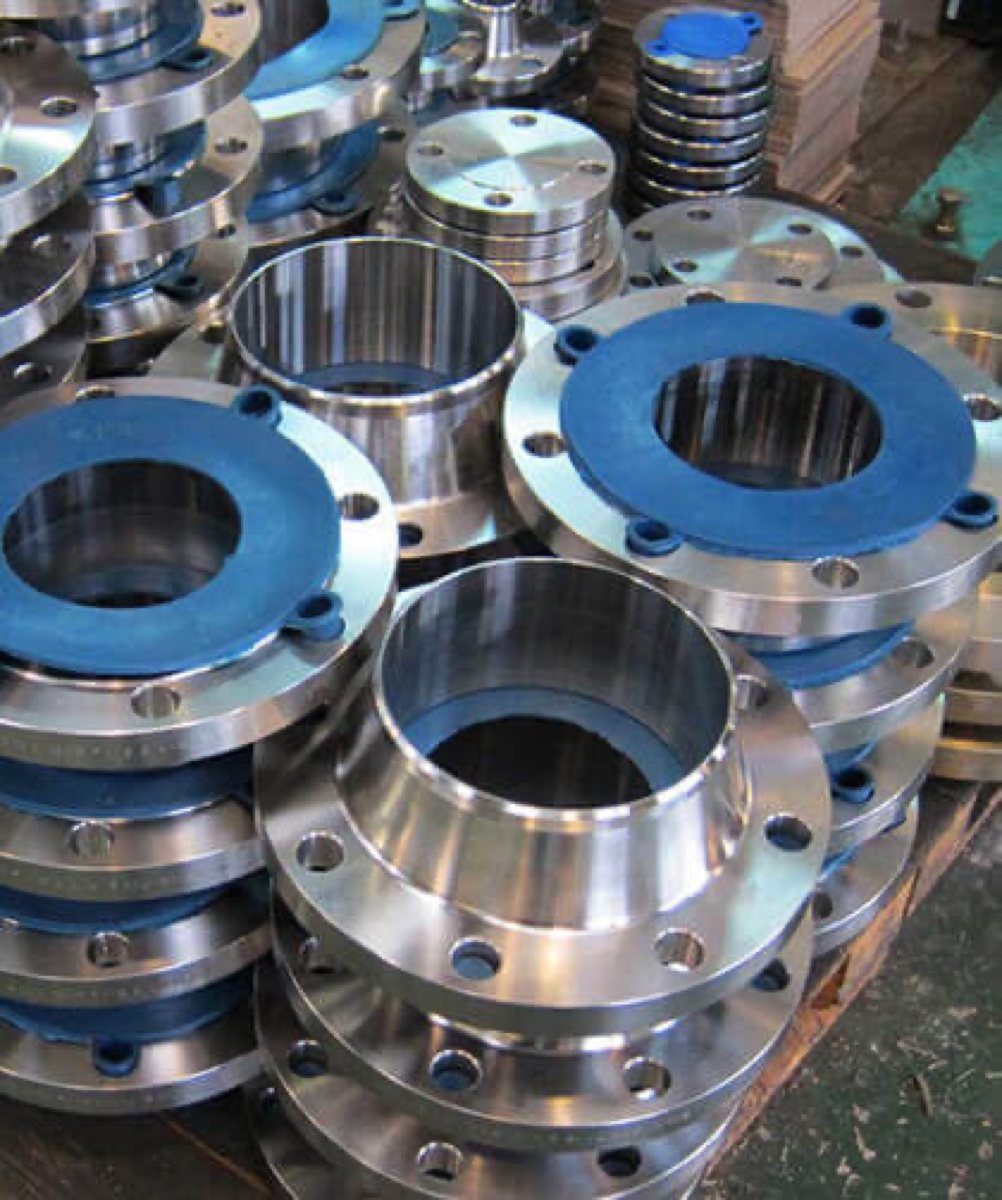
Steam-methane reformers lead — pigtails, headers, manifolds and their flanged connections — then ethylene and pyrolysis furnaces, superheaters and reheaters, petrochemical fired heaters, hydrogen and syngas plants, hot-gas ducting and heat-treating hardware. Our nickel-alloy production below:
Incoloy 800H weld neck flanges share their dimensions with every other material in the same class — OD, thickness, hub, bore, bolt circle and bolting per the standard tables. Full ASME B16.5 charts:
800H pricing tracks nickel plus the testing scope, so we quote live with a stated validity rather than publish a static list. To get a firm quotation, usually within 24 hours:
1
List your requirement — size (NB), class or PN, standard (ASME B16.5 / B16.47 / EN / DIN / BS), grade (800H — or dual-certified 800H/800HT), pipe schedule or bore, and quantity.
2
State the service & testing scope — design temperature, grain size requirement, plus 3.2 witness, PMI or project specifications.
3
Send it across — via the inquiry form, WhatsApp, or email to sales@tescosteel.com — and we reply with price, delivery and stock position.
It is a weld neck flange forged from Incoloy 800H — the controlled-carbon creep variant of the alloy 800 family, UNS N08810 / 1.4958, with carbon held at 0.05-0.10% and a solution-annealed coarse grain — to ASTM B564. The long tapered hub is butt-welded to the pipe with the bore matched to the schedule, giving a radiographable joint in the grade that carries hot piping above the ceiling of standard alloy 800: reformers, ethylene furnaces, superheaters and fired heaters.
What makes Incoloy 800H different from standard Incoloy 800?
Two deliberate controls. Standard 800 caps carbon at 0.10% with no floor; 800H requires 0.05-0.10% — enough carbon to form the carbides that pin grain boundaries against creep. And 800H is solution annealed at a higher temperature to a coarse grain, typically ASTM No. 5 or coarser, because fewer grain boundaries mean less boundary sliding at temperature. The chemistry overlaps enough that 800H usually dual-certifies as 800; the reverse is not true.
What is the difference between Incoloy 800H and 800HT?
800HT (UNS N08811) adds one further control: the combined aluminium-plus-titanium content is tightened to 0.85-1.20%, buying the highest stress-rupture strength in the family. 800H already carries code-listed creep values and covers most reformer and furnace duty; 800HT is specified where the designer wants the last increment of rupture life at the hottest metal temperatures. Material often dual-certifies as 800H/800HT when both chemistry windows are met.
What temperature is Incoloy 800H used at?
Its working territory begins where standard 800 stops — above about 593 °C, where time-dependent creep governs design. ASME code coverage for 800H extends to 899 °C in pressure service, and reformer and ethylene-furnace components run continuous metal temperatures of 800-985 °C on 800H/HT. Oxidation resistance holds to about 1093 °C. Below 593 °C the standard grade is the economical pick — 800H's value is precisely its certified creep data.
Why does coarse grain improve creep strength?
At creep temperatures metals deform by grain boundaries sliding past one another, so the fewer boundaries the metal has, the slower it creeps. The coarse-grain solution anneal — the defining heat treatment of 800H — deliberately grows the grains to ASTM No. 5 or coarser, trading a little room-temperature strength for decades of stress-rupture life. That is why 800H's tensile minimums sit below standard 800's while its high-temperature ratings sit far above.
What are the equivalent designations for Incoloy 800H?
UNS N08810; Werkstoff Nr. 1.4958 (dual-certifiable with 1.4876); EN X5NiCrAlTi31-20; JIS NCF 800H; BS NA 15(H); GOST ЭИ670 (ХН32Т); AFNOR Z8NC33-21; and the trade names Incoloy 800H or Alloy 800H. System partners: ASTM B407 seamless pipe, B366 butt-weld fittings, B409 plate and B564 forgings. An enquiry in any of these designations is quoted as the same material.
What is the chemical composition of Incoloy 800H?
Per ASTM B564: carbon 0.05 to 0.10% — the defining controlled range — nickel 30.00 to 35.00%, chromium 19.00 to 23.00%, iron 39.50% minimum, aluminium 0.15 to 0.60%, titanium 0.15 to 0.60%, with manganese capped at 1.50%, silicon 1.00%, copper 0.75% and sulphur 0.015%. The carbon floor plus coarse-grain anneal is what separates it from standard 800; tightening Al+Ti to 0.85-1.20% combined would make it 800HT.
What are the mechanical properties of Incoloy 800H flanges?
Per ASTM B564 in the solution-annealed condition: tensile strength 450 MPa (65 ksi) minimum, yield strength 170 MPa (25 ksi) minimum and elongation 30% minimum. The minimums sit deliberately below standard 800's 520/205 because the coarse-grain anneal trades room-temperature strength for creep life — the property this grade is bought for, carried in the code's time-dependent allowable stresses.
Which pipe and fittings do Incoloy 800H weld neck flanges mate with?
ASTM B407 seamless alloy 800H pipe is the standard partner, with B366 butt-weld fittings and B409 plate completing the system. The weld neck bore is machined to the pipe schedule you state, so the bore runs flush through the joint and the bevel arrives ready for a matched creep-grade butt weld.
How are Incoloy 800H flanges welded to pipe?
For creep-range service the usual call is ERNiCrCoMo-1 (alloy 117-type) consumables, whose stress-rupture life matches the coarse-grain base metal; ERNiCr-3 (Inconel 82) serves joints designed below the creep range. Nickel-alloy discipline applies throughout: sulphur-free cleanliness, moderate heat input, no preheat and no PWHT in normal practice. Weld procedures for code creep service should be qualified for the design temperature.
Why is Incoloy 800H specified for steam reformers and ethylene furnaces?
Those plants run continuous metal temperatures of 800-985 °C for years between turnarounds — pure creep territory where design life is set by stress-rupture data. 800H/HT's controlled carbon and coarse grain carry certified creep values there while resisting oxidation and carburization, and decades of pigtail, header and manifold service have made the grade the industry default. Flanged connections on those systems specify the same alloy as the pressure parts.
Is Incoloy 800H resistant to chloride stress corrosion cracking?
Yes — the 30-35% nickel that stabilizes the family lifts 800H above the chloride-SCC threshold that limits 300-series stainless, the same as standard 800. It is bought for creep rather than wet corrosion, though: for chloride-rich immersion the molybdenum-bearing Incoloy 825 is the family's answer, and for hot-but-moderate duty the standard 800 grade is the economical pick.
What testing and certification do you supply with Incoloy 800H flanges?
Every lot ships with EN 10204 3.1 mill test certificates covering chemical analysis — demonstrating the 0.05-0.10% carbon window alongside nickel, chromium, titanium and aluminium — mechanical properties, the solution-anneal record and grain size measurement, with 3.2 certification witnessed by Lloyd's, DNV, BV or TÜV on request. We also offer PMI verification, hydrostatic testing and dye-penetrant examination, with full heat-number traceability.
Where are Incoloy 800H weld neck flanges used?
Steam-methane reformer systems, ethylene and pyrolysis furnaces, superheaters and reheaters, petrochemical fired heaters, hydrogen and syngas plants, hot-gas ducting and furnace hardware — wherever design temperature pushes past standard 800's ~593 °C ceiling and the code demands certified creep data. It also serves heat-treating fixtures and power-plant components that live their whole lives at temperature.
What sizes and standards do you manufacture Incoloy 800H weld neck flanges in?
From 1/2 inch NB to 56 inch NB: ASME B16.5 Class 150 to 2500 up to 24 inch, ASME B16.47 above, and European PN 2.5 to PN 400 patterns to EN 1092-1, DIN and BS 4504. Raised face is standard, ring joint on request, and every bore is machined to the mating pipe schedule from Sch 10 through XXS.
Do you keep Incoloy 800H weld neck flanges in stock? What is the lead time?
800H moves almost entirely in project quantities against reformer and furnace specifications, so most orders are forged to order — typically 4 to 6 weeks depending on size, class and testing scope — while common exchanger sizes rotating through production are sometimes available sooner. Prices track nickel, so quotations carry a validity period.
Do you export Incoloy 800H flanges outside India?
Yes. Tesco Steel & Engineering is an ISO 9001:2015 certified manufacturer based in Mumbai, and Incoloy 800H flanges ship to reformer, petrochemical and power projects across the Middle East, Europe, Africa, Southeast Asia and the Americas. Flanges travel face-protected and seaworthy-packed, with full heat-number and test traceability.