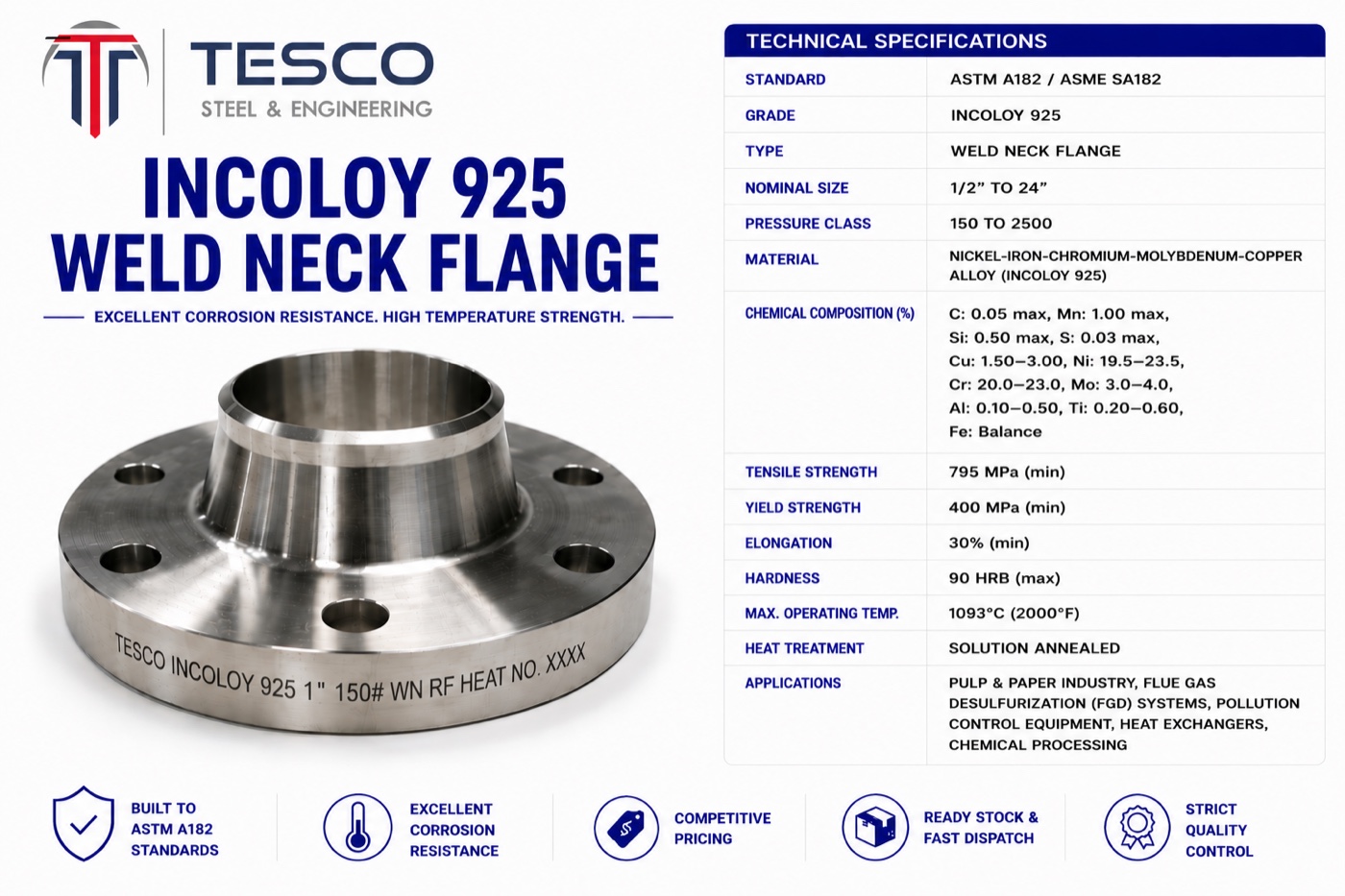
Tesco Steel & Engineering forges Incoloy 925 weld neck flanges — UNS N09925, the age-hardenable member of the Fe-Ni-Cr family — from 1/2″ NB to 56″ NB in ASME B16.5 Class 150–2500 and European PN patterns. The formula: take alloy 825's proven corrosion chemistry — 42–46% nickel, molybdenum against pitting, copper for acids — and raise titanium to 1.9–2.4% so gamma-prime precipitation hardening roughly doubles the strength. Built for high-strength sour service per NACE MR0175 / ISO 15156: wellheads, christmas trees, gas-well equipment, valves and subsea hardware. Supplied solution annealed or age hardened, with the heat-treatment record, PMI and EN 10204 3.1/3.2 on the certificate. ISO 9001:2015, made in Mumbai, India — exported worldwide.
Incoloy 925 · UNS N09925825 Chemistry + Ti 1.9–2.4%Gamma-Prime Age HardenedNACE MR0175 / API 6A CRAWellheads · Valves · Subsea1/2″ – 56″ NB · Class 150–2500ISO 9001:2015 · Exported Worldwide
Incoloy 925 Weld Neck Flange — UNS N09925, Technical Specifications
What is an Incoloy 925 Weld Neck Flange?
Incoloy 925 (UNS N09925) is alloy 825 with muscle: the same corrosion base — 42–46% nickel immune to chloride SCC, ~21% chromium, 2.5–3.5% molybdenum against pitting, 1.5–3% copper for reducing acids — plus titanium raised to 1.9–2.4%. On ageing, fine gamma-prime Ni3(Ti,Al) particles precipitate through the matrix and roughly double the yield strength. An Incoloy 925 weld neck flange pairs that metallurgy with a long tapered hub butt-welded to the pipe, dimensioned to ASME B16.5.
The family logic: 825 covers sour and acid duty at annealed strength; 925 takes the same chemistry into high-pressure wellhead territory where NACE MR0175 / ISO 15156 and API 6A CRA practice demand certified strength levels annealed alloys cannot reach. Its premium competitor is the niobium-hardened Inconel 718; 925 is the economical CRA where its strength suffices.
Unlike its annealed siblings, 925's properties are made in the heat-treat furnace: solution anneal, then a two-step ageing cycle. The condition — annealed or aged, with hardness controlled for sour service — is part of the purchase specification, and our certificates carry the full heat-treatment record.
Also searched as: Alloy 925 flange, UNS N09925 flange, 925 CRA flange, age-hardened Incoloy flange, precipitation-hardened nickel flange — all refer to the product on this page.
Chemical Composition of Incoloy 925
Ni
Cr
Fe
Si
Mo
Cu
Mn
C
S
Al
Ti
42.00-46.00
19.50-22.50
22.00 min
0.50 max
2.50-3.50
1.50-3.00
1.00 max
0.030 max
0.030 max
0.10-0.50
1.90-2.40
Values in weight %. It reads as 825's recipe with the titanium raised an order of magnitude: the Ti 1.90–2.40% window (with the aluminium) feeds the gamma-prime precipitation that gives 925 its strength, while Mo and Cu keep the pitting and acid resistance of the parent grade.
Mechanical Properties of Incoloy 925
Tensile Strength, MPa
Yield Strength, Min, MPa
Elongation % min.
650
300
30
Solution-annealed minimums. The grade's purpose appears after age hardening — typically ~8 h near 730 °C plus a second step near 620 °C — when yield strength roughly doubles into the class API 6A CRA wellhead practice demands, with hardness held inside NACE MR0175 limits. State the required condition in the enquiry.
Designations of Incoloy 925
Standard
UNS
Incoloy 925
N09925
925 is specified through oil-and-gas material standards — NACE MR0175 / ISO 15156 for sour service and API 6A CRA practice for wellhead equipment — rather than the ASTM B-series that covers its annealed siblings 825 (N08825) and 800 (N08800). Enquiries citing N09925, alloy 925 or “925 CRA” are quoted as the same material.
Incoloy 925 Weld Neck Flange Specifications
Incoloy 925 Weld Neck Flanges are available in the following specifications:
Size
1/2"NB to 56"NB
Class
150#, 300#, 400#, 600#, 900#, 1500#, 2500#
Sch (Schedule)
XS, XXS, STD & Schedule 20, 40, 80, 160
Pressure Ratings
PN 2.5 - PN 400
Standards
ASME B16.5, ASME B16.47, EN 1092-1, DIN 2631–2635, BS 4504; NACE MR0175 / ISO 15156, API 6A CRA practice
Condition
Solution annealed, or age hardened (two-step ageing) with hardness controlled for sour service — full heat-treatment record on the MTC
The gamma-prime ageing raises yield into wellhead class without touching the Mo-Cu-Ni corrosion chemistry that made 825 the sour-service standard.
Sulphide Cracking, Solved by Base Metal
Where hard martensitic steels crack in H2S and duplex hits partial-pressure ceilings, 925's nickel base is inherently resistant — strength and sour immunity in one forging.
NACE MR0175 & API 6A CRA
Listed precipitation-hardenable nickel alloy with defined condition and hardness limits — supplied compliant, documented on the certificate.
The Economical 718 Alternative
Where 718's extreme strength is not needed, 925 delivers CRA performance at a meaningfully lower cost — the corrosion engineer's value pick for most sour wells.
Heat Treatment In-House
Solution anneal and two-step ageing under our control, with the full thermal record, hardness survey and PMI on every lot.
Welding & Fabricating Incoloy 925
925 welds in the solution-annealed condition with ERNiCrMo-3 (625) or ERNiFeCr-2 (718-type) fillers and nickel-alloy discipline, then age hardens after welding where the joint must reach full strength — welding an already-aged component softens the heat-affected zone. Many 925 applications sidestep the question: the flange is bolted, not welded, arriving age-hardened with strength certified on the MTC.
Grade-selection note: if the joint stays annealed-strength anyway, 825 does the same corrosion job for less; if the well demands the extreme end of CRA strength, 718-class alloys take over. State pressure class, H2S level and required yield in the enquiry and the grade follows.
Where Incoloy 925 Weld Neck Flanges Are Used
Sour gas wellheads lead — christmas-tree components, tubing hangers, valve bodies — then high-pressure sour production piping, packers and downhole tools, subsea hardware and separation systems on onshore sour fields and offshore developments. Our nickel-alloy production below:
Incoloy 925 weld neck flanges share their dimensions with every other material in the same class — OD, thickness, hub, bore, bolt circle and bolting per the standard tables. Full ASME B16.5 charts:
925 pricing tracks nickel and molybdenum plus the heat-treatment and testing scope, so we quote live with a stated validity rather than publish a static list. To get a firm quotation, usually within 24 hours:
1
List your requirement — size (NB), class or PN, standard (ASME B16.5 / B16.47 / EN / DIN / BS), pipe schedule or bore, and quantity.
2
State the condition & testing scope — solution annealed or age hardened, required yield/hardness, NACE MR0175 class, plus 3.2 witness, PMI or project specifications.
3
Send it across — via the inquiry form, WhatsApp, or email to sales@tescosteel.com — and we reply with price, delivery and stock position.
It is a weld neck flange forged from Incoloy 925 — the age-hardenable member of the iron-nickel-chromium family, UNS N09925, carrying essentially alloy 825's corrosion chemistry with titanium raised to 1.9-2.4% so precipitation hardening roughly doubles the strength. The long tapered hub is butt-welded to the pipe with the bore matched to the schedule, giving a radiographable joint in the grade built for high-strength sour service: wellheads, gas-well equipment, valves and subsea hardware.
What is the idea behind the Incoloy 925 chemistry?
Take 825's proven corrosion recipe — a 42-46% nickel base immune to chloride SCC, chromium for oxidizing media, molybdenum against pitting, copper for reducing acids — then raise titanium to 1.9-2.4% with a little aluminium. On ageing, those form fine gamma-prime particles (Ni3(Ti,Al)) through the matrix, roughly doubling the yield strength without touching the corrosion chemistry. One alloy, 825's resistance, twice the muscle.
What is the difference between Incoloy 925 and Incoloy 825?
Strength, by heat treatment. 825 is a solid-solution alloy — annealed, weldable everywhere, yield around 220 MPa minimum. 925 shares the corrosion base but is age-hardenable: after precipitation treatment its yield strength lands in a different class entirely, which is why it qualifies for high-pressure wellhead and downhole components where 825 would be too soft. The price of that strength is heat-treatment control and more careful welding practice.
What is the difference between Incoloy 925 and Inconel 718?
Both are gamma-prime/gamma-double-prime age-hardened nickel alloys used in oil and gas, but they sit on different rungs. 718 (N07718) is nickel-based with niobium hardening — stronger still, the aerospace-derived premium choice. 925 is iron-nickel based with titanium hardening — somewhat lower strength, meaningfully lower cost, with 825-class corrosion resistance that covers most sour wells. Where 925's strength suffices, it is the economical CRA; 718 takes the extreme end.
What are the designations for Incoloy 925?
UNS N09925, and the trade names Incoloy 925 or Alloy 925. It is specified through oil-and-gas material standards — NACE MR0175 / ISO 15156 for sour service and API 6A CRA practice for wellhead equipment — rather than the ASTM B-series that covers its annealed siblings. Enquiries citing N09925, alloy 925 or '925 CRA' are all quoted as the same material.
What is the chemical composition of Incoloy 925?
Nickel 42.00 to 46.00%, chromium 19.50 to 22.50%, iron 22.00% minimum, molybdenum 2.50 to 3.50%, copper 1.50 to 3.00%, titanium 1.90 to 2.40% — the age-hardening addition — aluminium 0.10 to 0.50%, with silicon capped at 0.50%, manganese 1.00%, carbon 0.030% and sulphur 0.030%. Read it as 825's corrosion chemistry with the titanium raised an order of magnitude to feed gamma-prime precipitation.
What are the mechanical properties of Incoloy 925 flanges?
In the solution-annealed condition: tensile strength 650 MPa minimum, yield strength 300 MPa minimum and elongation 30% minimum. The grade's purpose appears after age hardening — typically around 8 hours near 730 °C plus a second step near 620 °C — when yield strength roughly doubles into the class that API 6A CRA wellhead practice demands. State the required condition and strength level in the enquiry; we supply annealed or aged with the heat-treatment record on the certificate.
Which pipe and equipment do Incoloy 925 weld neck flanges mate with?
925 flanges typically bolt into high-pressure sour-gas systems alongside 925 or 825 piping and CRA-clad equipment: ASTM B423 alloy 825 pipe where the run is annealed material, or matched N09925 components in fully high-strength assemblies. The weld neck bore is machined to the stated schedule, and hub dimensions follow ASME B16.5 exactly as for any other material.
How are Incoloy 925 flanges welded?
In the solution-annealed condition, with ERNiCrMo-3 (625) or ERNiFeCr-2 (718-type) fillers and nickel-alloy discipline — then age hardening after welding where the joint must reach full strength, since welding an already-aged component softens the heat-affected zone. Many 925 applications avoid the question entirely: the flange is bolted, not welded, and arrives age-hardened with the strength certified on the MTC.
Is Incoloy 925 suitable for sour service under NACE MR0175?
Yes — high-strength sour service is precisely what 925 exists for. It is listed among the precipitation-hardenable nickel-base alloys in NACE MR0175 / ISO 15156, with hardness and condition limits defined by the standard, and it is a standing API 6A CRA choice for wellhead and christmas-tree components in H2S wells. State the NACE class in the enquiry and the flanges ship in a compliant condition with certification to match.
Why choose Incoloy 925 over duplex or 17-4 PH in sour wells?
Because H2S punishes both alternatives: martensitic PH steels suffer sulphide stress cracking at high hardness, and duplex grades have H2S partial-pressure ceilings in MR0175. 925's nickel base is inherently resistant to sulphide and chloride cracking, its molybdenum and copper handle the acid side, and age hardening delivers the strength those grades were chosen for — which is why deep sour gas wells step up to 925 and its high-nickel CRA relatives.
What testing and certification do you supply with Incoloy 925 flanges?
Every lot ships with EN 10204 3.1 mill test certificates covering chemical analysis — demonstrating the nickel, chromium, molybdenum, copper and titanium windows — mechanical properties in the supplied condition, and the full heat-treatment record including ageing parameters, with 3.2 certification witnessed by Lloyd's, DNV, BV or TÜV on request. We also offer PMI verification, hardness surveys for NACE compliance, hydrostatic testing and dye-penetrant examination.
Where are Incoloy 925 weld neck flanges used?
Wellhead and christmas-tree equipment, sour-gas production piping, tubing hangers, valve bodies and stems, packers and downhole tools, subsea hardware and high-pressure separation systems — anywhere the combination of H2S, chlorides, CO2 and high pressure demands both CRA corrosion resistance and yield strength that annealed alloys cannot reach. Onshore sour fields and offshore developments specify it through NACE MR0175 and API 6A CRA practice.
What temperature range can Incoloy 925 flanges be used in?
Like other age-hardened alloys, 925 is a low-to-moderate temperature material: its strength is stable through typical well and process temperatures and is generally applied up to about 540 °C, above which the gamma-prime precipitates begin to coarsen and the strength advantage fades. At the cold end the austenitic nickel-iron base keeps full toughness, covering subsea and arctic wellhead duty. For genuinely hot service the creep-rated 800H/HT branch of the family takes over.
What sizes and standards do you manufacture Incoloy 925 weld neck flanges in?
From 1/2 inch NB to 56 inch NB: ASME B16.5 Class 150 to 2500 up to 24 inch, ASME B16.47 above, and European PN 2.5 to PN 400 patterns to EN 1092-1, DIN and BS 4504. Raised face is standard, ring joint — common in wellhead service — on request, and every bore is machined to the mating pipe schedule from Sch 10 through XXS.
Do you keep Incoloy 925 weld neck flanges in stock? What is the lead time?
925 is a project alloy ordered against well programmes, so flanges are forged to order — typically 5 to 7 weeks including the ageing cycle and testing scope — with the solution-annealed route slightly faster. Prices track nickel and molybdenum, so quotations carry a validity period.
Do you export Incoloy 925 flanges outside India?
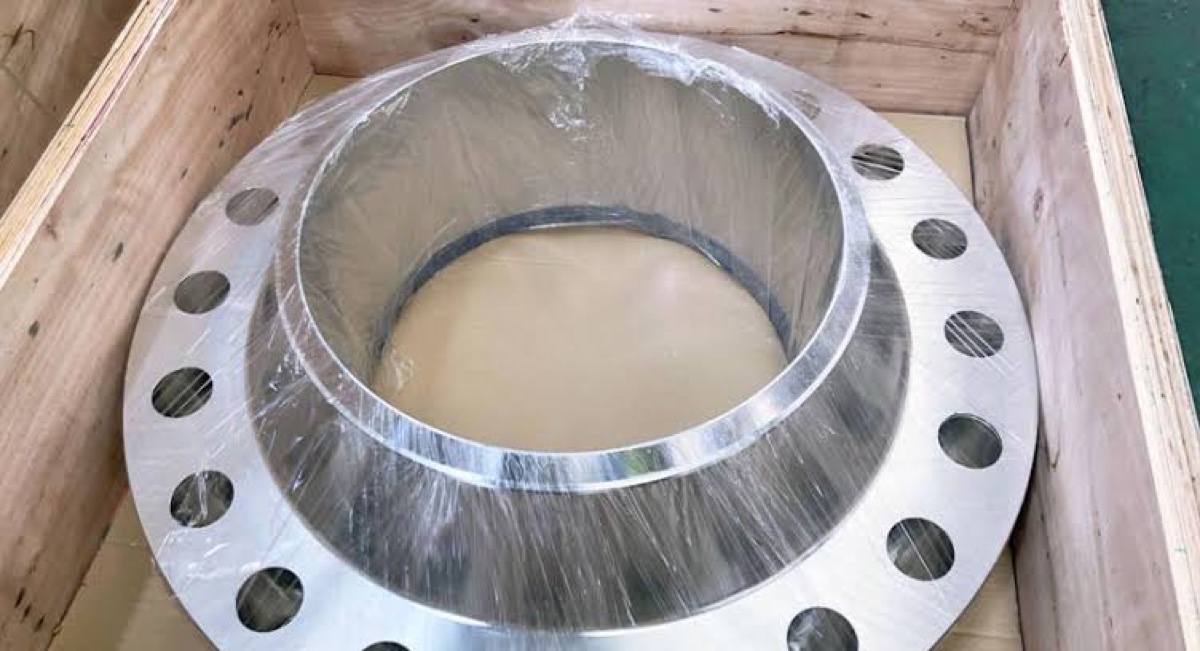
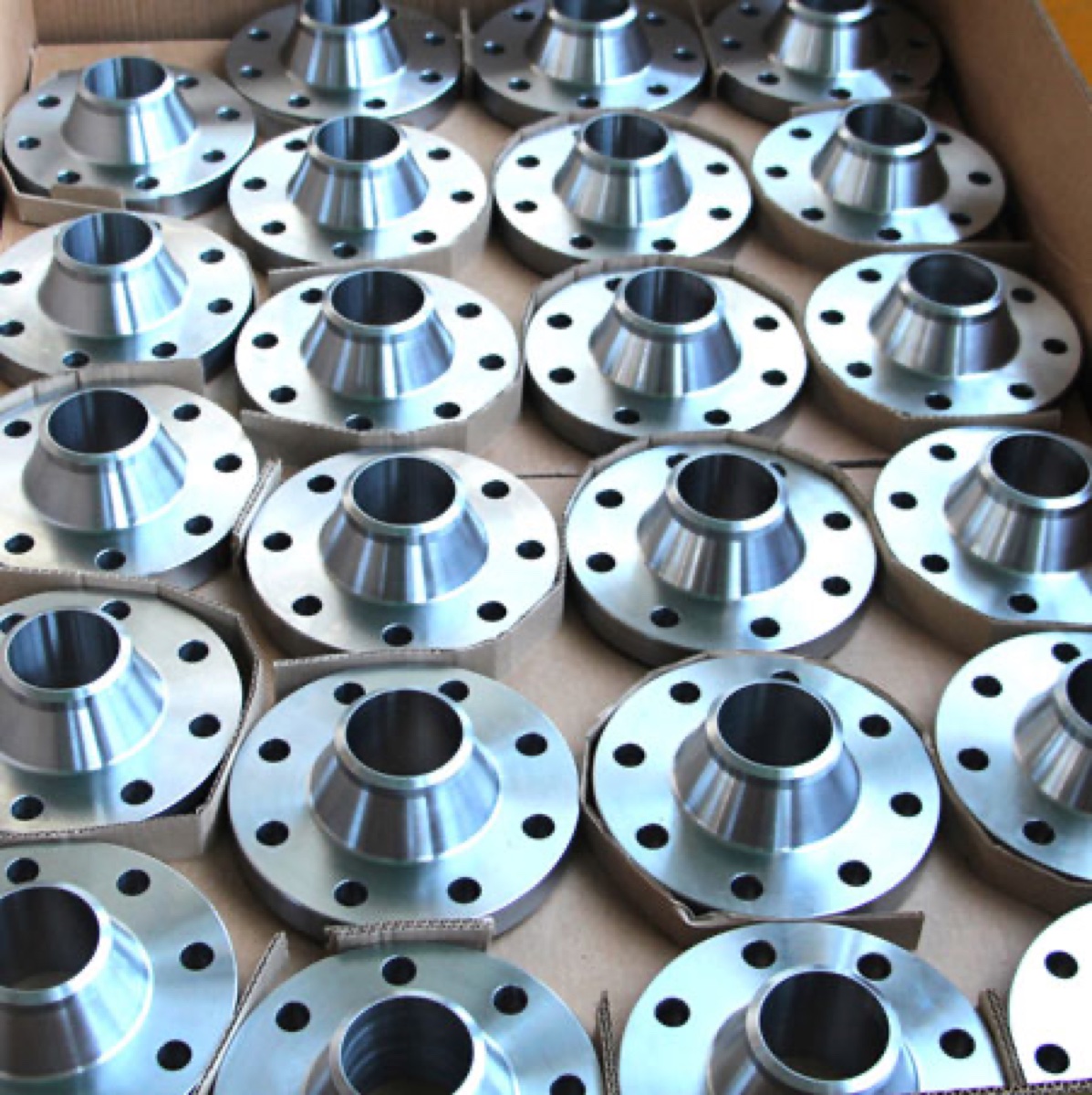
Yes. Tesco Steel & Engineering is an ISO 9001:2015 certified manufacturer based in Mumbai, and Incoloy 925 flanges ship to oil and gas projects across the Middle East, Europe, Africa, Southeast Asia and the Americas. Flanges travel face-protected and seaworthy-packed, with full heat-number, heat-treatment and test traceability.