Incoloy 925 Blind Flanges — UNS N09925 Age-Hardened Blind Manufacturer
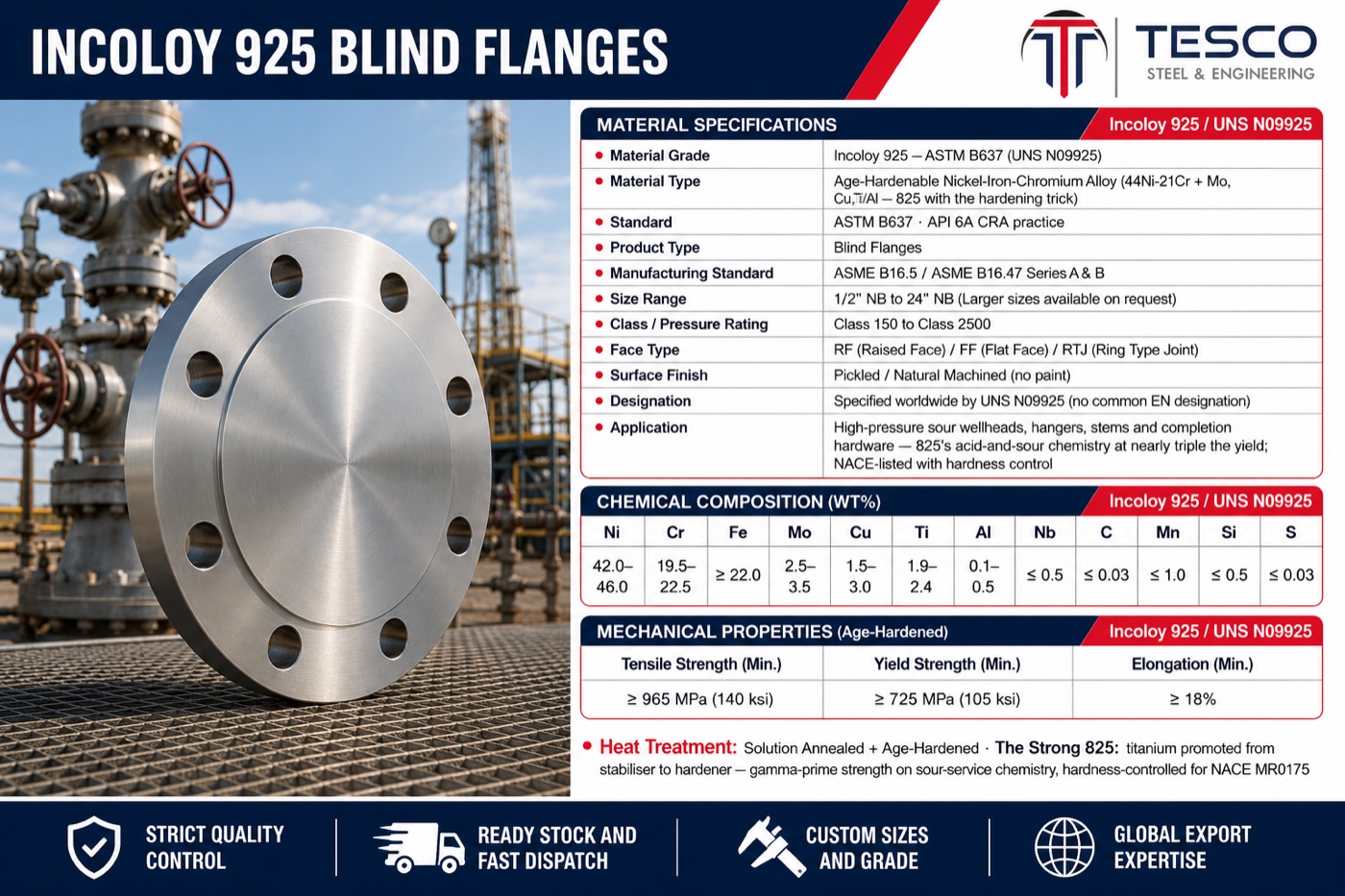
Tesco Steel & Engineering forges Incoloy 925 blind flanges — ASTM B637, UNS N09925 — to ASME B16.5 Class 150–2500 from ½″ to 24″ NB and to ASME B16.47 up to 60″. The symmetry the series has been building closes here: 925 is to 825 what K-500 is to Monel 400 — the proven sour-and-acid chemistry given the gamma-prime trick. Titanium promoted from stabiliser to hardener (1.9–2.4%), aluminium alongside, and after the ageing cycle the yield nearly triples to 725 MPa minimum — while the Mo-Cu levers and 44% nickel keep the NACE MR0175 listing intact. The grade of high-pressure sour wellheads, hangers, stems and completion closures. Static duty without the stress case: 825 serves it cheaper. The extreme above: 718 territory. Facings: BLRF, BLFF or BLRTJ. Every lot with EN 10204 3.1/3.2 MTC, ageing charts and hardness survey. ISO 9001:2015, made in Mumbai, India — exported to 50+ countries.
Incoloy 925 Blind Flanges — Specifications at a Glance
What is an Incoloy 925 Blind Flange?
The strong 825. A solid forged disc of age-hardenable nickel-iron-chromium alloy (ASTM B637 / UNS N09925) with no bore — 825's backbone (Ni 42–46%, Cr 19.5–22.5%, Fe ≥22%, Mo 2.5–3.5%, Cu 1.5–3.0%) with titanium tripled into hardener territory (1.9–2.4%) and aluminium alongside. Aged to 965/725 MPa — elongation 18%, the honest price of strength — while the NACE-listed sour-and-acid franchise carries over. The workhorse aged CRA of high-pressure sour wellheads. Dimensions per ASME B16.5 / B16.47 in RF, FF and RTJ facings; EN 10204 3.1 with ageing charts and hardness survey.
Also searched as: Alloy 925 blind flange, N09925 blind, B637 925 blind, age-hardened Incoloy blind, API 6A CRA blind flange, sour wellhead blind flange — all refer to the product on this page. See also its soft sibling Incoloy 825 blind flanges, the parallel pair Monel 400 / K-500, the strength rival Inconel 625, and the facing pages BLRF / BLFF / BLRTJ.
In 825, titanium (0.6–1.2%) exists to capture carbon. In 925 it rises to 1.9–2.4% and, with aluminium, becomes the strengthening agent: the ageing cycle precipitates gamma-prime throughout the matrix — yield 241 → 725 MPa, no cold work.
Chemistry Kept
The corrosion levers live in the matrix, not the precipitates: Mo 2.5–3.5% and Cu 1.5–3.0% carry over unchanged, the 44% nickel keeps SCC shut off, and the NACE listing survives the strengthening — hardness-controlled.
Bolted by Design
Like every aged alloy, 925 is a machined, bolted material — welding re-solutions the precipitates. A flanged closure delivers its full aged properties with no arc: the blind flange is the natural 925 component.
Incoloy 925 Chemical Composition (UNS N09925)
Element
Ni
Cr
Fe
Mo
Cu
Ti
Al
Nb
C
Mn
Si
S
Weight %
42.0–46.0
19.5–22.5
≥22.0
2.5–3.5
1.5–3.0
1.9–2.4
0.1–0.5
≤0.5
≤0.03
≤1.0
≤0.5
≤0.03
Read it as 825's backbone with the hardening kit installed: the Mo-Cu acid levers unchanged, the iron floor kept, titanium tripled into hardener territory with aluminium joining it, and carbon tightened to ≤0.03% for the aged structure's sake. Our PMI reads the Ti-Al hardening signature on every piece.
Mechanical Properties & The Two Conditions
Property
ASTM B637 N09925 Requirement (Age-Hardened)
Tensile Strength
≥ 965 MPa (140 ksi) — second only to K-500 in our blind range
Yield Strength (0.2%)
≥ 725 MPa (105 ksi) — three times 825's
Elongation
≥ 18% — the first sub-30 figure in our range: strength costs ductility, honestly stated
Hardness
Surveyed & documented; aged within the NACE MR0175 ceiling where sour service is declared
Condition
Solution annealed + age-hardened — our standard supply, ageing charts certified; unaged against specification
Service Span
Sub-zero upward to ~540°C, where the gamma-prime over-ages — the 825 heat warning applies doubly
The natural companion of 925's high-pressure sour classes — ring softer than the aged groove
Incoloy 925 Blind Flange Specifications
Incoloy 925 / UNS N09925 Blind Flanges are available in the following specifications:
Material Grade
Incoloy 925 — ASTM B637 (UNS N09925); API 6A CRA practice for wellhead applications; specified worldwide by UNS number
Heat Treatment
Solution annealed + age-hardened (standard) — ageing charts certified; NACE-limited hardness or unaged condition against specification
Size
1/2"NB to 24"NB per ASME B16.5; 26"–60" per ASME B16.47; EN 1092-1 to order
Class
150#, 300#, 400#, 600#, 900#, 1500#, 2500# — rated on the grade's own nickel-alloy B16.5 lines
Facings
Raised Face (BLRF), Flat Face (BLFF), Ring Type Joint (BLRTJ) with groove per B16.20
Service Span
High-pressure sour & acid duty under mechanical load; sustained heat above ~540°C excluded; state sour status and CP regime at enquiry
Surface Finish
Pickled or natural machined — no paint; segregated alloy handling throughout
Modifications
NPT-tapped centre and fine machining completed before ageing — finished features arrive hardened; certified at the works
Testing
Tension & chemistry per heat — the Ti/Al hardening windows and iron floor verified; hardness survey; PMI routine
Certification
EN 10204 3.1 (standard) / 3.2 witnessed — ageing charts and hardness survey included
Why Incoloy 925 Blind Flanges Are Specified
The Stress Case Entered the Sour Line Class
Class 900–2500 sour systems, hanger-adjacent hardware and weight-critical completion equipment need 825's chemistry with real yield behind it — 925 is how the certificate carries both.
The API 6A CRA Workhorse
Wellhead metallurgy treats N09925 as its standard aged CRA — the closure matches the hangers, stems and trees the designers already qualified, one aged certificate from stud to closure.
Strength Without Losing the Listing
NACE MR0175 keeps 925 on its lists at controlled hardness — strength and sour acceptance on one MTC, the combination that defines the grade.
The Natural 925 Component
An alloy the industry declines to weld is a flange alloy by temperament — full aged properties delivered through bolting, no soft zones, no re-ageing questions.
Know the Map
Static sour duty without the stress case: 825 — and we will say so. Seawater or the worst acids leading: 625. The extreme strength tier: 718, against enquiry. The parallel pair: Monel K-500. Facings: BLRF / BLFF / BLRTJ.
Specification Notes — Getting 925 Right
Three details buyers miss.The condition line is the first check: solution-annealed and age-hardened 925 are different metals on the same UNS number — our standard is fully aged with charts certified, and quotes should be compared condition against condition. Sour and CP declarations steer the heat treatment: the NACE hardness ceiling and any cathodic-protection exposure are design inputs to the ageing cycle, not afterthoughts — state both on the enquiry, as our K-500 page details for its parallel case. The family heat warning applies doubly: above ~540°C the gamma-prime over-ages and the strength quietly leaves — hot duty belongs to the 800H/800HT side of the family.
How Our Incoloy 925 Blind Flanges Are Manufactured
1
Forging — cut billet of the spectro-verified N09925 heat — the Ti/Al hardening windows, Mo-Cu levers and iron floor confirmed — is hot-forged into the solid disc blank with full heat traceability and segregated alloy handling.
2
Solution treatment — dissolving the hardening elements and softening the blank for machining; furnace charts retained against the heat number.
3
Machining & facing — faces, OD, drilling and any NPT taps cut in the softer state to ASME B16.5 / B16.47; RF serrations, flat face or RTJ groove gauged per B16.20.
4
Age hardening — the controlled precipitation cycle that forms the gamma-prime and triples the strength — steered to the NACE hardness window where sour service is declared; ageing charts certified.
5
Testing & finishing — tension test and chemistry against the heat; hardness survey on the aged piece; PMI reads the Ti-Al signature; pickled and marked with standard, grade, size, class and heat number.
6
Certification & packing — EN 10204 3.1 MTC (3.2 witnessed on request) including heat-treatment records and hardness survey; faces protected, palletised or crated sea-worthy — no carbon-steel contact in transit.
Where Incoloy 925 Blind Flanges Are Used
Where sour chemistry meets mechanical duty: high-pressure sour wellheads and christmas trees, tubing hangers and adjacent closures, completion and downhole-interface equipment, subsea sour systems, high-class manifolds written around aged-CRA metallurgy. Production below:
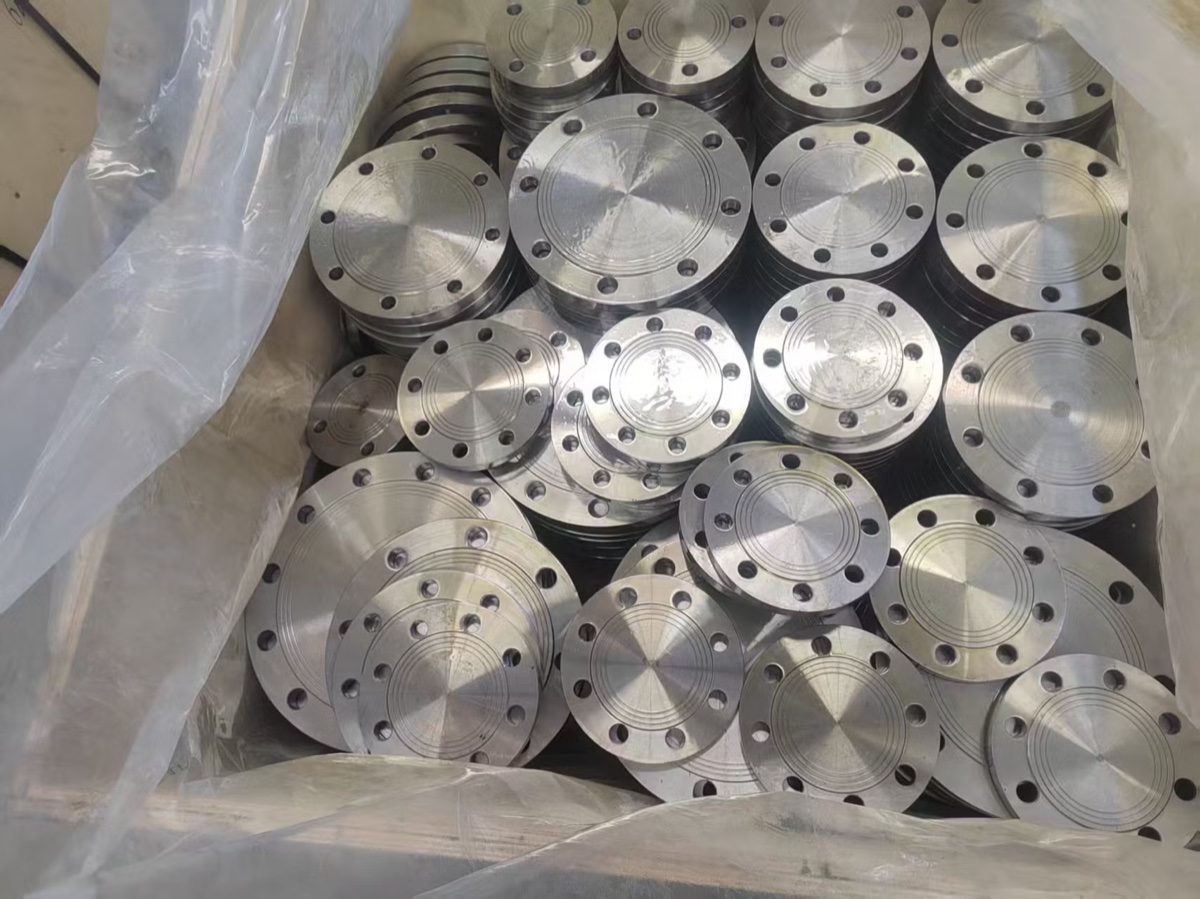
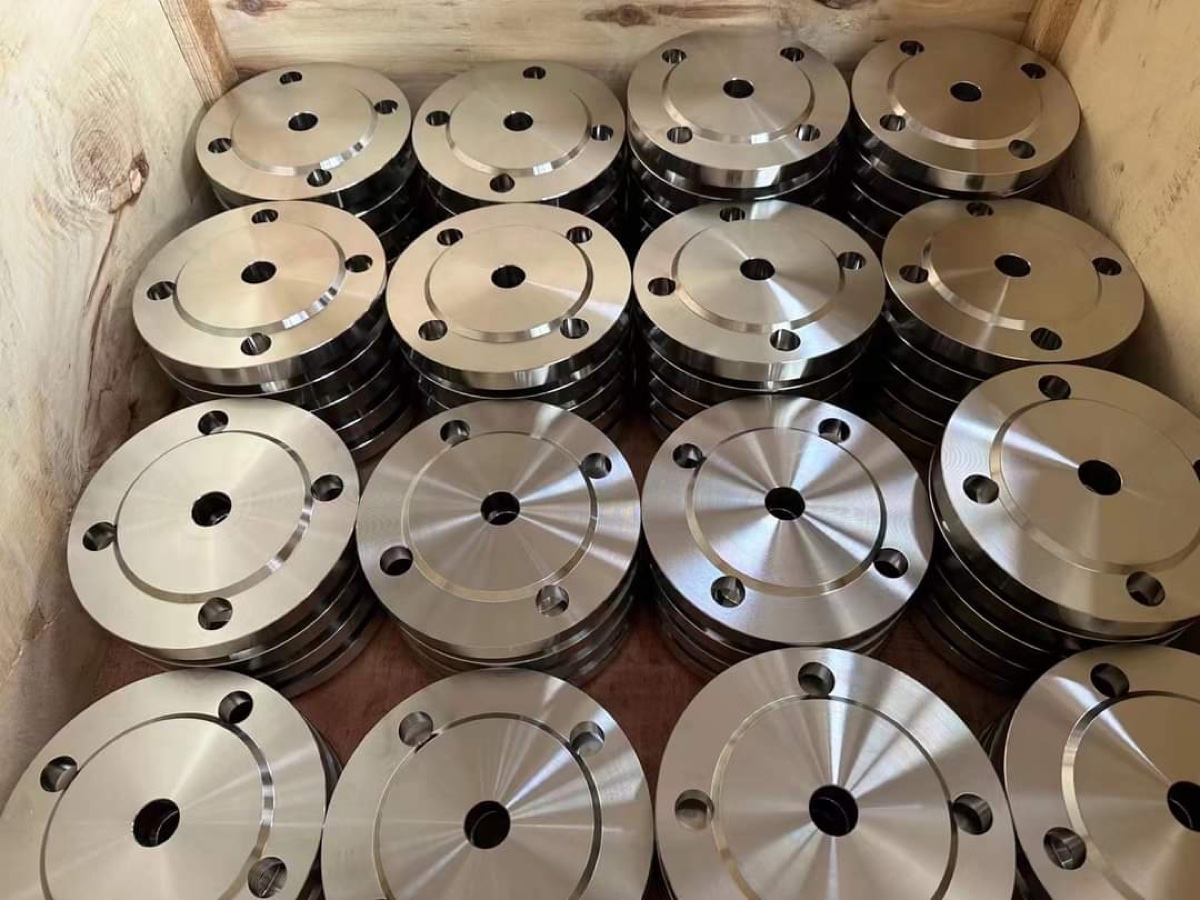
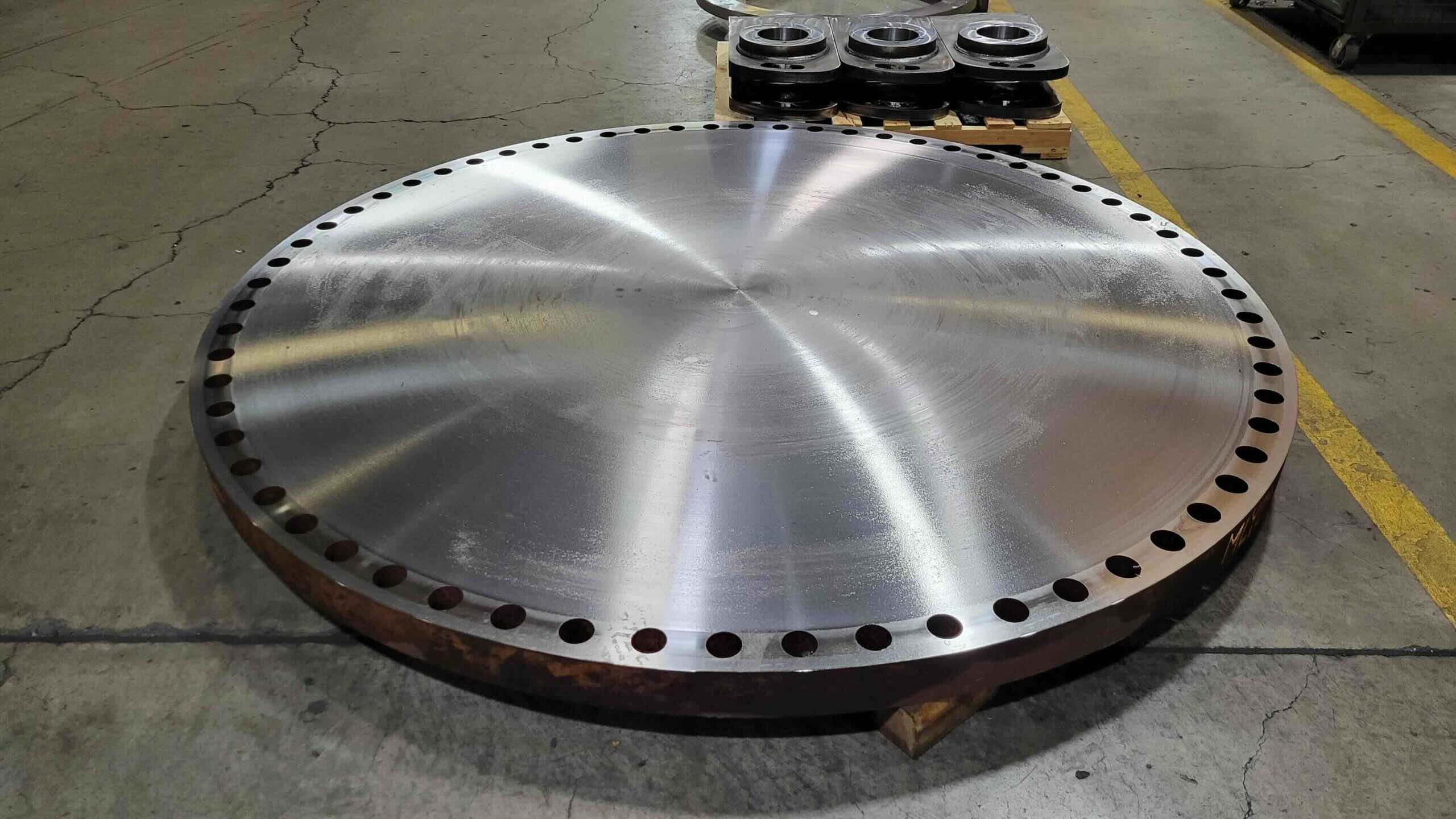
8″ Class 300 Blind Flange — Machined at Our WorksForged Blind Flanges — Ready for DispatchIncoloy 925 Blind — BLRF / BLFF to ASME B16.5
Incoloy 925 Blind Flange Dimensions
Blind dimensions are class-governed — identical across material grades. Full charts:
How to Specify & Order an Incoloy 925 Blind Flange
Five elements — the condition and service declarations are the 925-specific ones:
1
Size & standard — e.g. 3″ NB ASME B16.5, or the B16.47 series for 26″ and above.
2
Pressure class & facing — Class 150–2500; RF, FF or RTJ (with ring number) to match the mating flange.
3
Grade & condition — ASTM B637 UNS N09925 (Incoloy 925), age-hardened (our standard) or solution-annealed against specification.
4
Service declarations & certification — sour service (NACE MR0175) and cathodic-protection regime stated explicitly; NPT tap size if a test blind; PMI or 3.2 witnessing as specified; EN 10204 3.1 with ageing charts and hardness survey — our standard.
An Incoloy 925 blind flange is a solid forged disc of age-hardenable nickel-iron-chromium alloy — 825's sour-and-acid chemistry with titanium promoted to a gamma-prime hardener, certified to ASTM B637 as UNS N09925 — drilled to the standard bolt pattern with no bore. Age hardening nearly triples the yield to 725 MPa minimum while the molybdenum, copper and 44% nickel keep the NACE-listed corrosion franchise — making it the grade of high-pressure sour wellheads, hangers, stems and completion hardware. Dimensions follow ASME B16.5 from ½ inch to 24 inch and ASME B16.47 beyond, in raised face, flat face and ring joint facings.
Is 925 to 825 what K-500 is to Monel 400?
Exactly — the same play, run in the Incoloy family. In both pairs, a proven corrosion chemistry (Monel's nickel-copper nobility; 825's sour-and-acid recipe) is given aluminium-titanium gamma-prime hardening, roughly tripling the yield while the wetted behaviour carries over nearly unchanged. The shared consequences follow too: two-condition supply, machined-then-aged practice, welding avoided, NACE hardness ceilings, and hydrogen-embrittlement awareness under cathodic protection. Buyers who know one pair already understand the other — and both strong variants exist for the same reason: hardware that works for its living mechanically inside a corrosive certificate.
How does age hardening work in Incoloy 925?
The titanium changes jobs. In 825, titanium at 0.6-1.2% is a stabiliser — enough to capture carbon, no more. In 925 it rises to 1.9-2.4% and, with aluminium at 0.1-0.5%, becomes a hardener: after a solution anneal dissolves the pair, a controlled ageing cycle precipitates them as fine gamma-prime particles that lock the crystal lattice — the superalloy mechanism, tuned for sour service. Yield climbs from 825's 241 MPa to 725 minimum with no cold work, and because the corrosion resistance lives in the matrix chemistry, the sour-and-acid franchise survives the strengthening intact.
What is the chemical composition of Incoloy 925 (UNS N09925)?
Nickel 42.0-46.0%, chromium 19.5-22.5%, iron 22.0% minimum — the family's iron floor carries over — molybdenum 2.5-3.5%, copper 1.5-3.0%, titanium 1.9-2.4%, aluminium 0.1-0.5%, niobium ≤0.5%, carbon ≤0.03%, manganese ≤1.0%, silicon ≤0.5%, sulphur ≤0.03%. Read it as 825's backbone with the hardening kit installed: the Mo-Cu acid levers unchanged, titanium tripled into hardener territory, aluminium joining it, and carbon tightened to 0.03% for the aged structure's sake. Our PMI reads the full signature on every piece.
What are the mechanical properties of Incoloy 925 blind flanges?
In the age-hardened condition: tensile strength 965 MPa (140 ksi) minimum, yield strength 725 MPa (105 ksi) minimum, elongation 18% minimum — the second-strongest grade in our blind range after Monel K-500, and the first sheet in the series to carry a sub-30% elongation: high strength costs ductility, honestly stated. Ratings run on the grade's own B16.5 lines with generous class headroom. The purchase order should state the condition — our standard flange supply is fully aged, certified with the ageing charts and a hardness survey.
Why is 925 certified to ASTM B637 rather than B564?
Because age-hardenable nickel alloys get their own standard. B564 covers the solid-solution forgings — 800, 825, 600, 625 among them; B637 is written for precipitation-hardening nickel alloys, with the solution and ageing treatments, both delivery conditions and their distinct property tables — the same logic that moved Monel K-500 to B865. Oil-and-gas procurement adds API 6A CRA practice on top for wellhead equipment. A purchase order citing B564 for N09925 mixes the families; the certificate that exists reads B637, and ours do.
Is Incoloy 925 acceptable for NACE MR0175 sour service?
Yes — it is one of the standard's staple age-hardened alloys, listed precisely because sour wells need strength as well as chemistry. As with every high-strength listing, the acceptance is hardness-conditioned: the ageing cycle is steered to meet the strength minimums while staying under the standard's ceiling for the environment class, and the hardness survey joins the MTC. Declare sour service explicitly on the order — the heat treatment window is deliberately managed for it, exactly as our K-500 page describes for its own listing.
What does two-condition supply mean for a 925 order?
The alloy exists in two states and the paperwork must say which. Solution-annealed 925 is soft and machinable — the state in which complex parts are cut; age-hardened 925 is the working state, with the 965/725 minimums. Flange practice mirrors K-500's: machine in the softer state where economical, then age the finished part, so threads and faces arrive hardened without tearing tooling. Our standard supply is fully age-hardened with the ageing charts certified; unaged material is available against specification. The certificate states the condition either way — and a buyer comparing quotes should check that line first.
Can Incoloy 925 be welded?
The industry mostly declines, for the familiar age-hardened reasons: an arc re-solutions the precipitates locally, leaving a soft zone that cannot be re-aged without heat-treating the whole assembly, and the aged base metal is crack-sensitive beside a weld. Practice therefore treats 925 as a machined, bolted material — which is a genuine argument for the blind flange itself: it delivers the alloy's full aged properties through bolting alone. Where a welded connection is unavoidable, the joint is made in the solution-annealed state and the assembly aged afterwards, or the design steps to a weldable alloy like 825 or 625 with the strength penalty accepted.
Incoloy 925 or 825 — when does the stress case pull the upgrade?
When yield strength appears in the design calculation. For static isolations and ordinary closures in sour or acid service, 825's 241 MPa and friendlier price serve — and we will say so on the quotation. 925 takes over where the component works mechanically: high-class compact closures in Class 900-2500 sour systems, hanger and stem-adjacent hardware, weight-critical completion equipment, and any line class written around aged-CRA metallurgy where the closure must match. The corrosion chemistry being essentially shared, the decision is the stress engineer's, not the corrosion engineer's.
Where does 925 hand off to Inconel 718?
At the extreme end of strength and temperature. Alloy 718 — the niobium-hardened superalloy — reaches yield minimums beyond 1030 MPa and holds them to jet-engine temperatures, and it anchors the most demanding API 6A CRA classes. 925 answers with better economics (its iron floor against 718's nickel-rich balance), easier processing, and sour-and-acid chemistry inherited from 825 that serves the great majority of wellhead duty. The practical split in oil-and-gas metallurgy: 925 is the workhorse aged CRA; 718 is the extreme-duty specialist above it — supplied against enquiry where the specification names it.
What facings are Incoloy 925 blind flanges made with?
All three: raised face (BLRF) — the default — flat face (BLFF) for mating lined and composite systems, and ring type joint (BLRTJ), the natural companion of the high-pressure sour classes where 925 earns its keep, the ring chosen softer than the aged groove. Each facing has its own page on this site. As with K-500, NPT taps and fine machining are completed before ageing so finished features arrive hardened; gasket and ring selections account for the aged seat. Test and injection blinds are machined and certified at the works.
Where are Incoloy 925 blind flanges used?
Where sour chemistry meets mechanical duty: high-pressure sour-gas wellheads and christmas trees, tubing hangers and their adjacent closures, completion and downhole-interface equipment, subsea sour systems, and high-class manifolds written around aged-CRA metallurgy. 925 blinds close those systems as isolations, spare-nozzle blanks and tapped test points — one aged, hardness-surveyed certificate from stud to closure, in the alloy the API 6A CRA world treats as its workhorse.
Which standards cover Incoloy 925 blind flanges?
The material standard is ASTM B637 (UNS N09925) — the precipitation-hardening nickel-alloy specification — with API 6A CRA practice governing wellhead applications; the alloy is specified worldwide by its UNS number, having no common EN designation. Dimensions follow ASME B16.5 for ½"-24" and ASME B16.47 for 26"-60", rated on the grade's own lines. A complete specification reads: 'Blind Flange, RTJ, 3", ASME B16.5 Class 1500, ASTM B637 UNS N09925 (Incoloy 925), age-hardened, NACE MR0175' — and our EN 10204 certificates state it exactly that way, ageing treatment and hardness survey included.
Who manufactures Incoloy 925 blind flanges in India?
Tesco Steel & Engineering is an ISO 9001:2015 certified flange manufacturer based in Mumbai, India, forging Incoloy 925 / ASTM B637 / UNS N09925 blind flanges from ½" to 24" NB per ASME B16.5 in Classes 150-2500 and to 60" per ASME B16.47 — solution annealed and age-hardened with documented ageing charts, hardness surveyed (NACE MR0175 limits on request), pickled, PMI-verified with the Ti-Al hardening signature read on every piece, certified to EN 10204 3.1/3.2 on every lot — in raised face, flat face and ring joint facings, alongside Incoloy 825 and the 800 trio, Monel K-500, Inconel 625 and the full nickel-alloy blind range. Exported to more than 50 countries.