Monel 400 Blind Flanges — UNS N04400 Nickel-Copper Blind Manufacturer
Tesco Steel & Engineering forges Monel 400 blind flanges — ASTM B564, UNS N04400, EN 2.4360 — to ASME B16.5 Class 150–2500 from ½″ to 24″ NB and to ASME B16.47 up to 60″. This alloy predates stainless steel itself: two-thirds nickel, one-third copper — the natural Sudbury ore ratio, smelted since 1905 — with no chromium and no passive film. That absence is the whole point: the crevices, chlorides and stagnant seawater that hunt stainless have nothing to attack, and a bolted closure is the definitive stagnant-service component. Add the two franchises no stainless can claim — hydrofluoric acid (the refinery HF-alkylation standard) and hot caustic — and a century of marine hardware writes the service record. Chloride pitting with a passive film instead: 254 SMO. Ratio inverted for economy: 90/10 & 70/30 cupronickel. Facings: BLRF, BLFF or BLRTJ. Every lot with EN 10204 3.1/3.2 MTC. ISO 9001:2015, made in Mumbai, India — exported to 50+ countries.
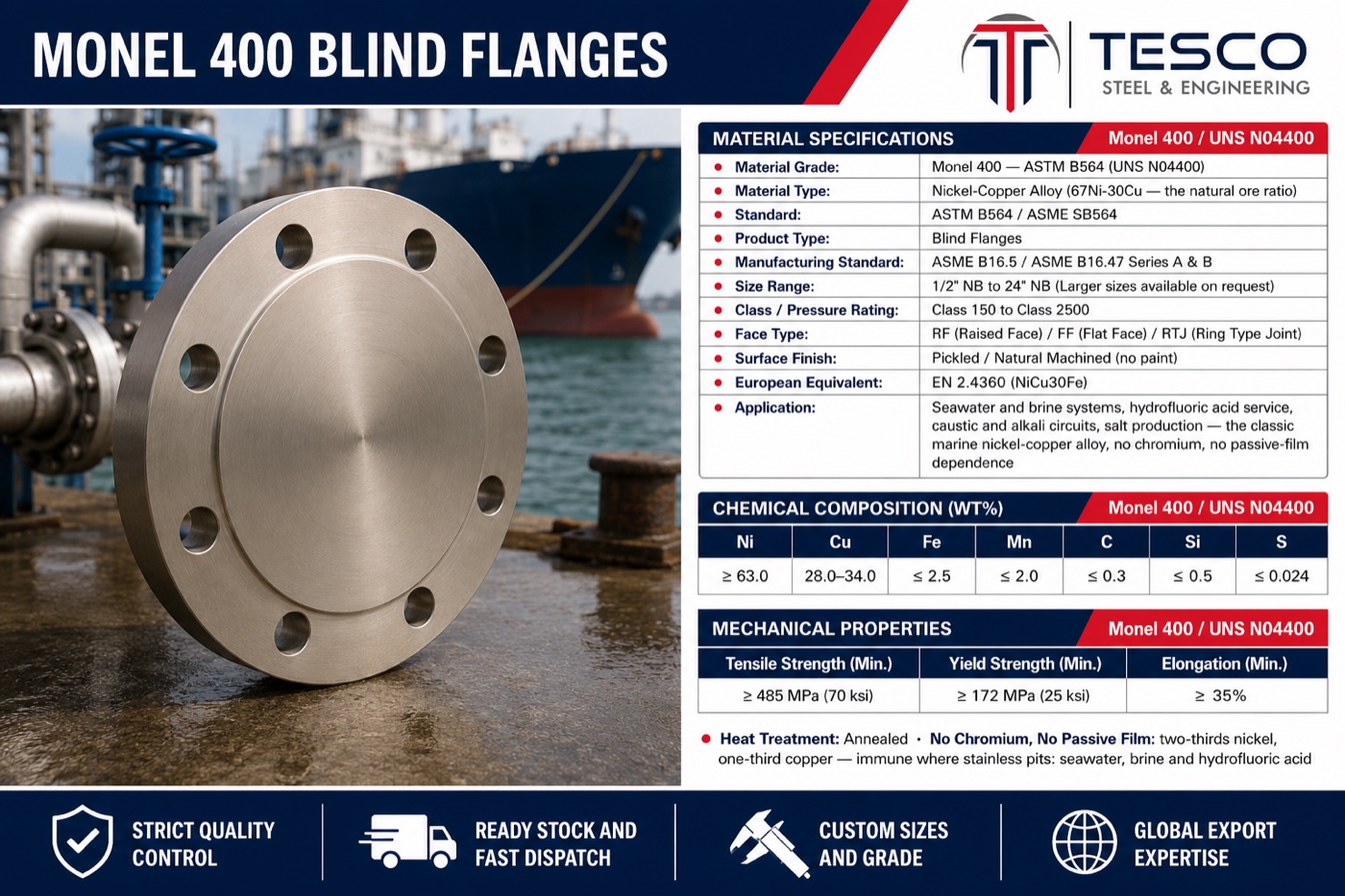
Monel 400 · ASTM B564 · UNS N04400EN 2.4360 · NiCu30Fe67% Ni · 30% Cu — The Natural RatioNo Chromium · No Passive FilmSeawater · HF Acid · CausticASME B16.5 ½″–24″ · Class 150–2500RF · FF · RTJ FacingsEN 10204 3.1 / 3.2 · ISO 9001:2015
Monel 400 Blind Flanges — Specifications at a Glance
What is a Monel 400 Blind Flange?
The alloy older than stainless. A solid forged disc of nickel-copper alloy (ASTM B564 / UNS N04400 / EN 2.4360) with no bore — Ni ≥63%, Cu 28–34%, the natural ore ratio — closing pipes, valves and nozzles in the services Monel has owned for a century: seawater and brine (especially the stagnant, crevice-ridden duty where stainless pits), hydrofluoric acid, caustic and alkali circuits, salt production. No chromium, no passive film — protection by nobility, not by a breakable oxide skin. Mechanicals 485/172 MPa annealed per B564. Dimensions per ASME B16.5 / B16.47 in RF, FF and RTJ facings; EN 10204 3.1 certified.
Also searched as: Monel blind flange, N04400 blind, 2.4360 blind flange, NiCu30Fe blind, Alloy 400 blind flange, nickel-copper blind, SB564 blind, HF service blind flange — all refer to the product on this page. See also our Monel flanges hub for the full flange-type range, the ratio-inverted copper-nickel 90/10 & 70/30 family, the passive-film alternative 254 SMO, and the facing pages BLRF / BLFF / BLRTJ.
Protection Without a Film
Nothing to Break
Stainless lives and dies by a chromium-oxide film: brilliant until a chloride or crevice breaks it, then pitting begins. Monel's nickel and copper are inherently noble in reducing and neutral media — slow, uniform, predictable corrosion everywhere instead of catastrophic attack somewhere. Crevices under gaskets, oxygen-starved corners, stagnant brine: nothing to attack.
Born, Not Designed
1905: Sudbury ore smelted straight to metal came out at two parts nickel to one part copper — and the accident outperformed everything of its era. A century of propeller shafts, pump trim and marine closures wrote the service record before most modern grades existed.
The Two Franchises
Hydrofluoric acid — the acid glass cannot hold — across virtually all concentrations: the HF-alkylation standard for generations. And caustic: two-thirds nickel handles hydroxides far beyond where stainless risks cracking.
The blind-flange angle: a bolted closure is the definitive stagnant-service component — closed, still, oxygen-depleted behind its gasket. That is precisely the geometry where stainless's crevice record is worst and Monel's franchise is strongest: the right metal for the job is sometimes decided by the shape of the part.
Monel 400 Chemical Composition (UNS N04400)
Element
Ni
Cu
Fe
Mn
C
Si
S
Weight %
≥63.0
28.0–34.0
≤2.5
≤2.0
≤0.3
≤0.5
≤0.024
Read what is absent: no chromium, no molybdenum, no nitrogen, no stabiliser — none of the stainless family's machinery. The nickel is a floor, not a window; carbon at ≤0.3% is ten times looser than any stainless sheet because sensitization chemistry does not exist without chromium. Our PMI reads the nickel-copper signature on every piece.
Mechanical Properties & The Service Span
Property
ASTM B564 N04400 Requirement
Tensile Strength
≥ 485 MPa (70 ksi)
Yield Strength (0.2%)
≥ 172 MPa (25 ksi) — the softest in our range; annealed Monel is ductile and forgiving
Elongation
≥ 35%
Reduction of Area
Not specified in B564 — certificates carry the three values above
Hardness
No B564 limit — work-hardens strongly in machining, arrives soft
Condition
Annealed — stated on certificate; age-hardenable K-500 variant available for shaft/fastener duty
Service Span
Sub-zero marine duty to ~480–550°C in clean atmospheres; the working world is chemical — seawater, HF, caustic
Monel 400 / UNS N04400 Blind Flanges are available in the following specifications:
Material Grade
Monel 400 — ASTM B564 / ASME SB564 (UNS N04400); EN 2.4360 / NiCu30Fe designation where the project requires it
Heat Treatment
Annealed — stated on certificate; K-500 age-hardened variant against specification
Size
1/2"NB to 24"NB per ASME B16.5; 26"–60" per ASME B16.47; EN 1092-1 to order
Class
150#, 300#, 400#, 600#, 900#, 1500#, 2500# — rated on the grade's own nickel-alloy B16.5 lines
Facings
Raised Face (BLRF), Flat Face (BLFF), Ring Type Joint (BLRTJ) with groove per B16.20
Service Span
Seawater & brine (stagnant-service specialist), HF acid, caustic & alkali, salt production; oxidising media excluded — state the chemistry at enquiry
Surface Finish
Pickled or natural machined — no paint; segregated alloy handling throughout
Modifications
NPT-tapped centre (test / sampling / vent), lifting provisions — machined & certified at the works
Testing
Tension & chemistry per heat — nickel floor and copper window verified; PMI routine
Certification
EN 10204 3.1 (standard) / 3.2 witnessed
Why Monel 400 Blind Flanges Are Specified
The Stagnant-Service Specialist
Closed, still, oxygen-starved behind the gasket: the blind flange's own geometry is the crevice case that ignites stainless pitting — and the case Monel's film-free chemistry simply ignores.
The HF Franchise
Refinery HF-alkylation practice has specified Monel for generations — the one common flange alloy that holds hydrofluoric acid across virtually all concentrations.
Caustic Beyond Stainless
Two-thirds nickel carries hydroxide service far past the caustic-cracking limits of the stainless family — chlor-alkali, salt and evaporator circuits run on it.
A Century of Sea Time
From 1905 to today's offshore platforms: no flange alloy carries a longer marine service record, and marine line classes still write it at the hard points of cupronickel systems.
Three details buyers miss.Oxidising media are the enemy: nitric acid, ferric and cupric salts, wet chlorine and hypochlorites attack film-free chemistry — the exact media passive alloys shrug off; the line between Monel's franchise and its enemies is drawn by oxidising potential, so state the full stream analysis at enquiry. HF has one caveat of its own: aerated HF condensate zones can stress-crack Monel — oxygen exclusion and stress relief are part of good alkylation practice, and worth confirming in the line-class notes. Don't buy it for strength: annealed yield is 172 MPa, the softest in our range — ratings run on Monel's own B16.5 lines and serve closure duty fine, but shafts and fasteners belong to K-500, and hot sulphur-bearing gas excludes nickel alloys altogether.
How Our Monel 400 Blind Flanges Are Manufactured
1
Forging — cut billet of the spectro-verified N04400 heat — nickel floor and copper window confirmed — is hot-forged into the solid disc blank with full heat traceability and segregated alloy handling.
2
Annealing — restoring the soft, ductile matrix after forging; furnace charts retained against the heat number.
3
Machining & facing — faces, OD and drilling to ASME B16.5 / B16.47 with tooling set for Monel's strong work-hardening; RF serrations, flat face or RTJ groove gauged per B16.20; NPT taps machined where ordered.
4
Testing — tension test and chemistry against the heat; PMI on every piece reads the nickel-copper signature.
5
Pickling — the clean bare-metal surface the service will meet, with marking of standard, grade, size, class and heat number.
6
Certification & packing — EN 10204 3.1 MTC (3.2 witnessed on request); faces protected, palletised or crated sea-worthy — no carbon-steel contact in transit.
Where Monel 400 Blind Flanges Are Used
A century of service records in four territories: marine and offshore seawater and brine systems, refinery HF-alkylation units and fluorine chemistry, caustic / chlor-alkali / salt-production circuits, and brackish or treated-water exchanger systems. Production below:
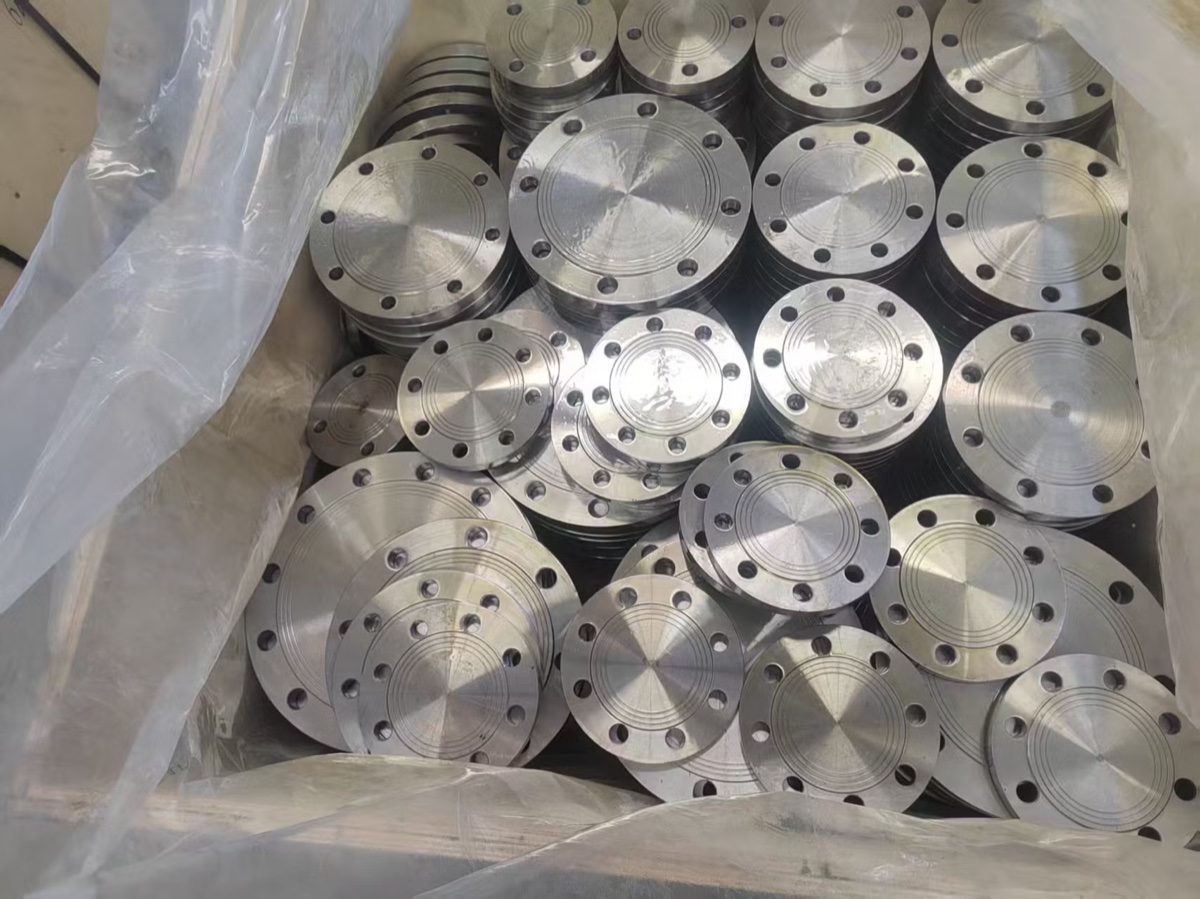
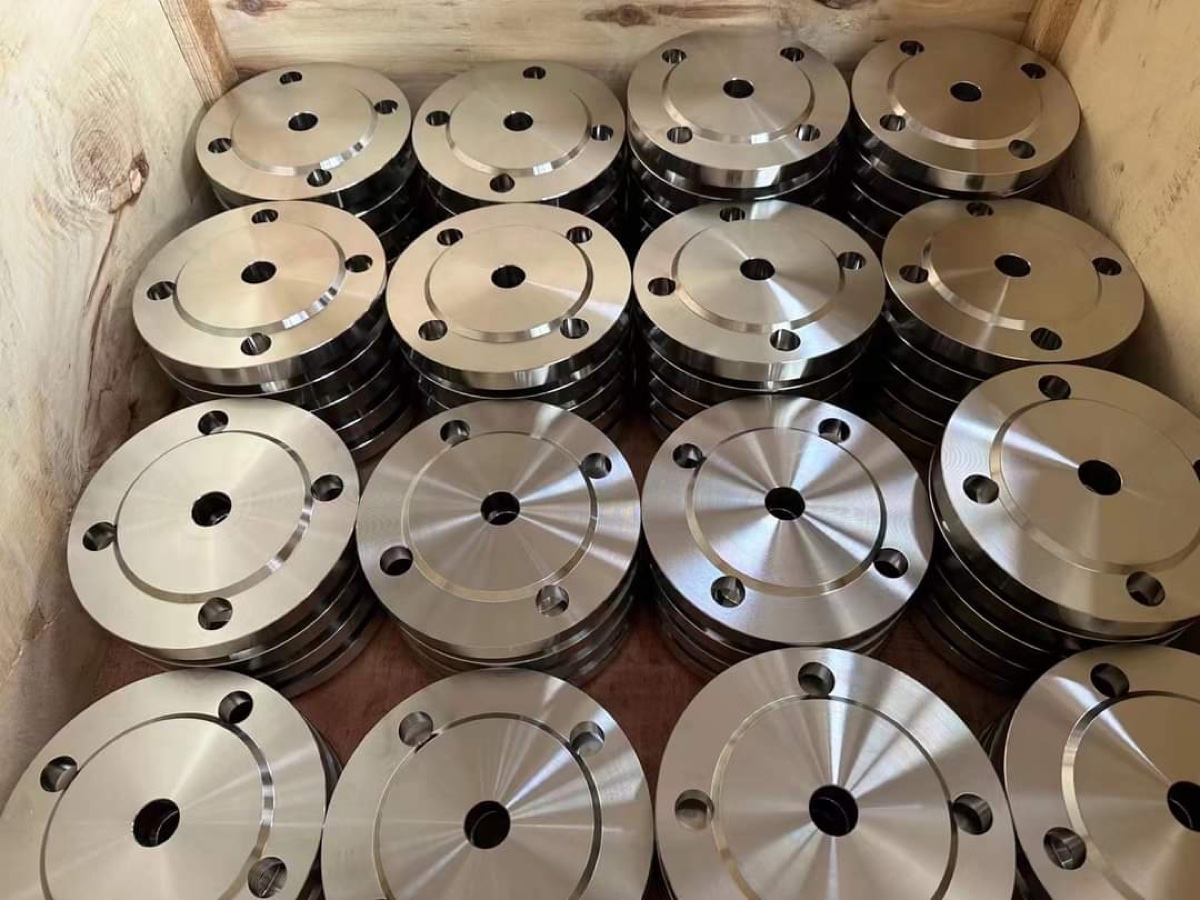
8″ Class 300 Blind Flange — Machined at Our WorksForged Blind Flanges — Ready for Dispatch
Monel 400 Blind Flange Dimensions
Blind dimensions are class-governed — identical across material grades. Full charts:
Five elements — the stream chemistry is the Monel-specific one:
1
Size & standard — e.g. 4″ NB ASME B16.5, or the B16.47 series for 26″ and above.
2
Pressure class & facing — Class 150–2500; RF, FF or RTJ (with ring number) to match the mating flange.
3
Grade — ASTM B564 UNS N04400 (Monel 400) — not A182; K-500 or EN 2.4360 designation where the specification requires it.
4
Service & certification — state the medium and any oxidising contaminants (it confirms Monel is the right rung); NPT tap size if a test blind; PMI or 3.2 witnessing as specified; EN 10204 3.1 standard.
A Monel 400 blind flange is a solid forged disc of nickel-copper alloy — roughly two-thirds nickel, one-third copper, certified to ASTM B564 as UNS N04400, EN 2.4360 — drilled to the standard bolt pattern with no bore, used to close pipes, valves and vessel nozzles in the services this century-old alloy owns: seawater and brine systems, hydrofluoric acid, caustic and alkali circuits, and salt production. It contains no chromium and forms no passive film — which is precisely why it survives where stainless pits. Dimensions follow ASME B16.5 from ½ inch to 24 inch and ASME B16.47 beyond, in raised face, flat face and ring joint facings.
How does Monel resist corrosion without chromium?
By being noble rather than passive. Stainless steel survives through a microscopically thin chromium-oxide film — brilliant until a chloride or a crevice breaks it, at which point pitting begins. Monel plays a different game entirely: nickel and copper are both inherently noble in reducing and neutral media, so the alloy corrodes slowly and uniformly everywhere rather than catastrophically somewhere. There is no film to break, so the classic stainless killers — crevices under gaskets, stagnant chloride water, oxygen-starved corners — have nothing to attack. Its weakness is the mirror image: strongly oxidising media, which passive alloys shrug off, attack Monel instead.
Why is the nickel-copper ratio called the natural ore ratio?
Because Monel was born, not designed. In 1905, metallurgists smelting the Sudbury nickel-copper ores found the metal reduced directly to an alloy of roughly two parts nickel to one part copper — no separation, no blending. The accidental alloy turned out to be remarkably strong, tough and seawater-proof, and was named after the company president, Ambrose Monell. It predates stainless steel entirely, and a century of marine hardware, from ship propeller shafts to the roof of Penn Station, built its service record before most modern grades existed. The specification still honours the origin: nickel a minimum of 63%, copper 28-34%.
What is the chemical composition of Monel 400 (UNS N04400)?
Nickel 63.0% minimum, copper 28.0-34.0%, iron ≤2.5%, manganese ≤2.0%, carbon ≤0.3%, silicon ≤0.5%, sulphur ≤0.024%. Read what is absent: no chromium, no molybdenum, no nitrogen, no stabiliser — this is not a stainless-family recipe and does not rely on any of their mechanisms. Note also the carbon cap at 0.3%: ten times looser than the stainless grades, because sensitization chemistry simply does not apply to a chromium-free alloy. The certificate's headline numbers are the nickel floor and the copper window — our PMI reads both on every piece.
What are the mechanical properties of Monel 400 blind flanges?
Per ASTM B564 in the annealed condition: tensile strength 485 MPa (70 ksi) minimum, yield strength 172 MPa (25 ksi) minimum, elongation 35% minimum. The softest yield in our range — annealed Monel is a ductile, forgiving metal that work-hardens strongly when machined but arrives soft — and flange ratings run on the grade's own B16.5 lines, so the design numbers are accounted for. Where strength matters alongside Monel's chemistry, the age-hardenable Monel K-500 variant roughly triples the yield; for flange closures, 400's numbers serve almost every duty the alloy is specified for.
How does Monel behave in seawater compared with stainless?
They fail in opposite places, which is why fleets carry both. Stainless loves flowing, aerated seawater — the oxygen keeps its film healthy — and suffers in stagnant, oxygen-starved corners where crevice pitting ignites. Monel is the mirror image: superb in stagnant and slow-moving seawater, brine and splash-zone duty precisely because it has no film to starve, though very fast aerated flow gives passive alloys the edge. A blind flange is the definitive stagnant-service component — closed, still, often oxygen-depleted behind the gasket — which is exactly the geometry where Monel's franchise is strongest and stainless's record is worst.
Why is Monel the hydrofluoric acid alloy?
Because almost nothing else holds it. Hydrofluoric acid — the acid that etches glass — attacks the protective films of stainless and even most high-nickel alloys, but Monel's noble nickel-copper chemistry resists HF across virtually all concentrations and well up the temperature scale. It has been the standard material of HF alkylation units in refineries for generations, written into the industry safety practices for that process, and serves fluorine chemistry, pickling acids and fluoride salts on the same pedigree. One caution from that same industry experience: aerated HF condensate zones can stress-crack Monel, so oxygen exclusion and stress relief are part of good HF engineering practice.
How does Monel perform in caustic and alkali service?
It is one of the alloy's quiet franchises. Nickel is the element of caustic resistance, and at two-thirds nickel Monel handles sodium and potassium hydroxide across wide concentration and temperature ranges — comfortably beyond where stainless risks caustic cracking. Salt production, chlor-alkali plants and evaporator duty have used it for decades on that strength. For the most severe hot concentrated caustic, pure nickel (Alloy 200) takes the last step; Monel covers the broad middle of alkali service with better strength and lower cost.
What service conditions does Monel 400 dislike?
The honest list is the inverse of stainless's. Strongly oxidising media are its enemies: nitric acid, ferric and cupric salts, wet chlorine and hypochlorites all attack the film-free chemistry that reducing media leave alone. Sulphur-bearing gases at elevated temperature embrittle nickel alloys, so hot flue-gas duty is out. Aerated ammonia solutions and oxygenated HF condensate can stress-crack it. And its oxidation ceiling in plain hot air sits around 550°C — respectable, but this is not a furnace alloy. State the full chemistry at enquiry: the line between Monel's franchise and its enemies is sharp, and drawn by oxidising potential.
Monel 400 or Monel K-500 — what is the difference?
The same corrosion chemistry at two strength levels. K-500 adds aluminium and titanium to the 400 base, making it age-hardenable: yield strength roughly triples to the 700 MPa class, with the seawater and HF behaviour essentially retained. The price is the extra heat treatment, tighter fabrication rules and a premium cost. Pump shafts, valve stems, fasteners and drill collars justify K-500; static pressure closures rarely do — a blind flange carries bolt load, not shaft torque, and 400's annealed properties on its own B16.5 lines serve the duty. We supply both against specification.
How does Monel relate to 90/10 and 70/30 copper-nickel?
They are the same two metals with the ratio inverted, and the ratio decides the job. Cupronickels — copper-led with 10% or 30% nickel — are the seawater piping economists: excellent biofouling resistance, good uniform corrosion behaviour, moderate strength and cost, the standard of shipboard and coastal cooling lines. Monel — nickel-led — is stronger, tougher, far more resistant to acids and alkalis, and correspondingly costlier. Typical marine practice runs cupronickel pipework with Monel at the hard points: valve trim, pump internals, fasteners and critical closures. We forge both families — see our copper-nickel flange range.
What facings are Monel 400 blind flanges made with?
All three: raised face (BLRF) — the default — flat face (BLFF) for the GRP, rubber-lined and cupronickel systems common in marine practice, and ring type joint (BLRTJ) where high-pressure duty calls for it, the ring chosen softer than the groove. Each facing has its own page on this site. In seawater service the gasket seat is a crevice by construction — Monel's film-free chemistry is the right metal for it, and clean bolt-up completes the job. NPT-tapped test and sampling blinds are machined and certified at the works.
Where are Monel 400 blind flanges used?
A century of service records in four territories: marine and offshore — seawater piping, brine systems, splash-zone hardware, shipboard closures; refinery HF alkylation units and fluorine chemistry; caustic, chlor-alkali and salt-production circuits; and heat-exchanger and feedwater systems handling brackish or treated water. Monel blinds close those systems as isolations, spare-nozzle blanks and tapped test points — the definitive stagnant-service component, in the alloy that owns stagnant service.
Which standards cover Monel 400 blind flanges?
The material standard is ASTM B564 (UNS N04400) with ASME SB564 as the boiler-code twin — the nickel-alloy forging standard, not A182 — alongside B127 for plate, B165 for pipe and B164 for bar in the same alloy, and EN 2.4360 / NiCu30Fe as the European designation. Dimensions follow ASME B16.5 for ½"-24" and ASME B16.47 for 26"-60", rated on the grade's own lines. A complete specification reads: 'Blind Flange, RF, 4", ASME B16.5 Class 150, ASTM B564 UNS N04400 (Monel 400)' — and our EN 10204 certificates state it exactly that way, nickel and copper contents included.
Who manufactures Monel 400 blind flanges in India?
Tesco Steel & Engineering is an ISO 9001:2015 certified flange manufacturer based in Mumbai, India, forging Monel 400 / ASTM B564 / UNS N04400 / EN 2.4360 blind flanges from ½" to 24" NB per ASME B16.5 in Classes 150-2500 and to 60" per ASME B16.47 — annealed, pickled, PMI-verified with the nickel-copper signature read on every piece, certified to EN 10204 3.1/3.2 on every lot — in raised face, flat face and ring joint facings, alongside our full Monel flange range, copper-nickel 90/10 and 70/30, Alloy 20, Hastelloy and Inconel blinds. Exported to more than 50 countries.