Inconel 625 Blind Flanges — UNS N06625 All-Rounder Blind Manufacturer
Tesco Steel & Engineering forges Inconel 625 blind flanges — ASTM B564, UNS N06625, EN 2.4856 — to ASME B16.5 Class 150–2500 from ½″ to 24″ NB and to ASME B16.47 up to 60″. Every other page on this site fights one enemy; 625 refuses to choose: 9% molybdenum puts its pitting resistance past even 254 SMO (PREN ≈ 50 — seawater immunity, no caveats), niobium stiffens it to 827/414 MPa from a plain anneal (no ageing, fully weldable), NACE MR0175 lists it for sour service, and strength holds toward 980°C. Seawater below, flare above, sour gas inside — one certificate covers the lot, which is why offshore engineering standardised on it — and why its filler wire (ERNiCrMo-3) welds everything else, from 6-moly stainless to the 625 overlays we apply refurbishing worn RTJ grooves. Hot acids leading: Hastelloy C-276. Pure heat: Inconel 601. Facings: BLRF, BLFF or BLRTJ. Every lot with EN 10204 3.1/3.2 MTC. ISO 9001:2015, made in Mumbai, India — exported to 50+ countries.
Inconel 625 · ASTM B564 · UNS N06625EN 2.4856 · NiCr22Mo9Nb9% Mo · PREN ≈ 50 — Seawater-Immune827/414 MPa Annealed — No AgeingNACE MR0175 Sour-ListedStrong Toward 980°CASME B16.5 ½″–24″ · Class 150–2500EN 10204 3.1 / 3.2 · ISO 9001:2015
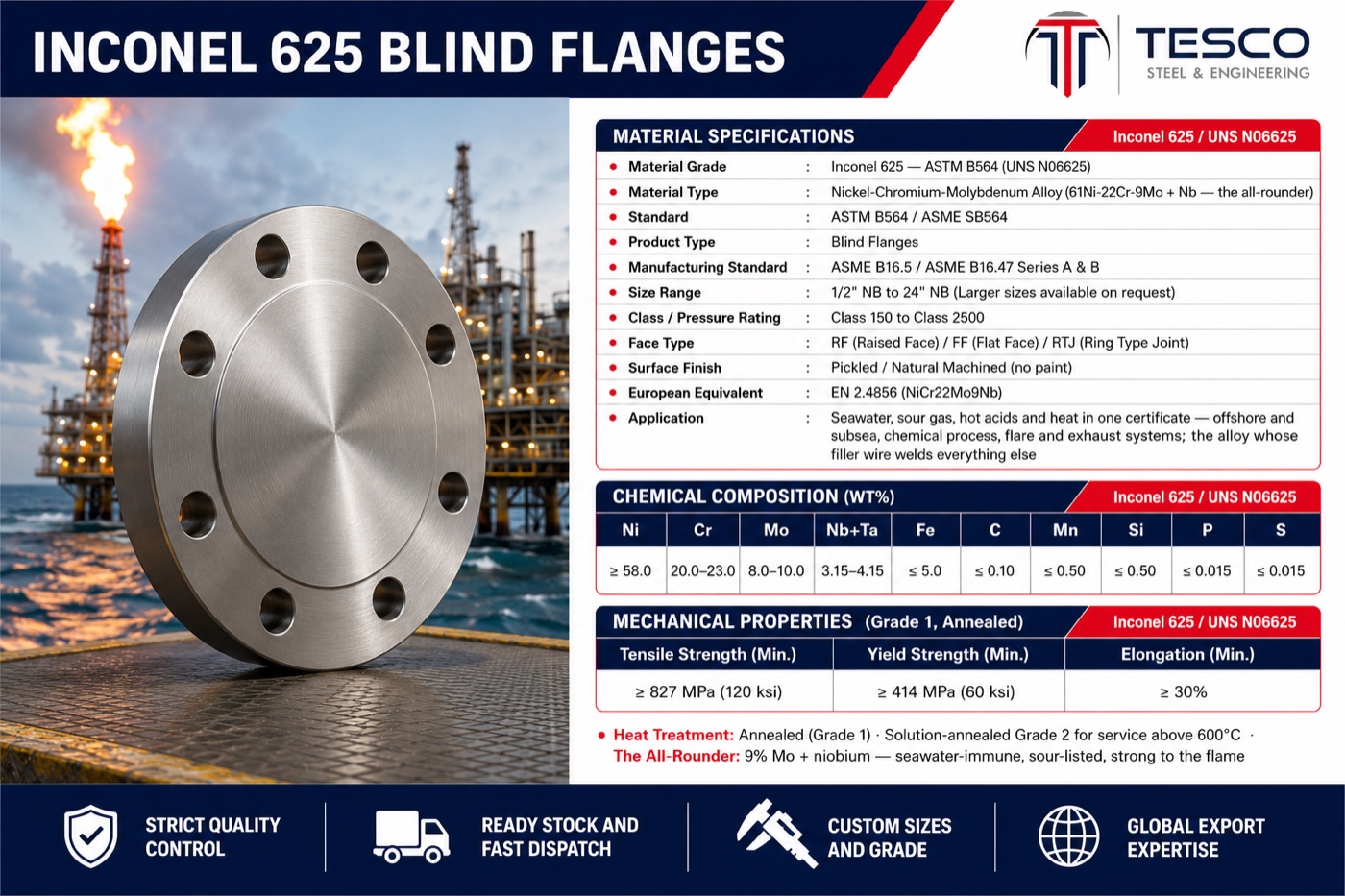
Inconel 625 Blind Flanges — Specifications at a Glance
What is an Inconel 625 Blind Flange?
The all-rounder. A solid forged disc of nickel-chromium-molybdenum alloy (ASTM B564 / UNS N06625 / EN 2.4856) with no bore — Ni ≥58%, Cr 22%, Mo 9%, Nb 3.5% — closing offshore, subsea, sour-gas, chemical and flare systems where several enemies attack at once. The résumé no other grade matches: seawater-immune (PREN ≈ 50), NACE sour-listed, 827/414 MPa from a plain anneal, strength toward 980°C — and the filler wire that welds everything else. Grade 1 annealed standard; Grade 2 solution-annealed for service above 600°C. Dimensions per ASME B16.5 / B16.47 in RF, FF and RTJ facings; EN 10204 3.1 certified.
Also searched as: Alloy 625 blind flange, N06625 blind, 2.4856 blind flange, NiCr22Mo9Nb blind, SB564 625 blind, subsea blind flange, sour-service blind flange — all refer to the product on this page. See also our Inconel flanges hub, the family siblings 600 / 601 blind flanges and 625 weld necks, the rivals it outreaches — 254 SMO, super duplex — and the facing pages BLRF / BLFF / BLRTJ.
The Alloy That Refuses to Specialise
Molybdenum: the Corrosion Lever
8–10% Mo carries pitting resistance past the 6-moly class — seawater immunity with no crevice caveats, no chlorination limits — and tolerates the reducing acids that strip passive films.
Niobium: the Strength Lever
3.15–4.15% Nb stiffens the matrix to 827/414 MPa from a plain anneal — fastener-class numbers with none of K-500's two-condition complications, and full weldability kept.
The Base: Heat and Sour Included
The Ni-Cr foundation holds oxidation and strength toward 980°C, and NACE MR0175 lists annealed 625 for sour service — the two entries that finish the résumé.
And the Famous Side-Career
ERNiCrMo-3 — 625 filler — is the industry's universal corrosion consumable: it welds the 6-moly stainlesses, joins dissimilar metals, and clads carbon steel with a corrosion-proof skin. We apply it ourselves, refurbishing worn RTJ grooves and sealing faces with 625 overlay.
Close behind in acid, ahead in strength, heat & sour pedigree
Several at once
—
The reason 625 exists: one certificate against the whole list
Inconel 625 Chemical Composition (UNS N06625)
Element
Ni
Cr
Mo
Nb+Ta
Fe
C
Mn
Si
P
S
Weight %
≥58.0
20.0–23.0
8.0–10.0
3.15–4.15
≤5.0
≤0.10
≤0.50
≤0.50
≤0.015
≤0.015
Note the discipline: manganese and silicon at half the usual caps, phosphorus and sulphur at a third — a high-performance melt specified like one. Certificate readers: nickel returns to a minimum (unlike 601's range) and iron is a cap, not the balance. Our PMI reads the Ni-Cr-Mo-Nb signature on every piece.
Mechanical Properties — Grade 1 & Grade 2
Property
Grade 1 (Annealed) — Standard Supply
Grade 2 (Solution-Annealed) — for >600°C
Tensile Strength
≥ 827 MPa (120 ksi)
≥ 690 MPa (100 ksi)
Yield Strength (0.2%)
≥ 414 MPa (60 ksi)
≥ 276 MPa (40 ksi)
Elongation
≥ 30%
≥ 30%
Built For
Wet, sour & general duty — the room-temperature numbers
Sustained creep-governed service above ~600°C — the stabler hot structure
The purchase order should say which grade. Our standard flange supply is Grade 1 annealed; Grade 2 is forged against specification for the hot-end line classes — and the certificate states the condition either way.
One Forging, Three Facings — and the Overlay Economy
Worn RTJ grooves & sealing faces re-clad in 625 at our works — the repair economy of the same metallurgy
Inconel 625 Blind Flange Specifications
Inconel 625 / UNS N06625 Blind Flanges are available in the following specifications:
Material Grade
Inconel 625 — ASTM B564 / ASME SB564 (UNS N06625); EN 2.4856 / NiCr22Mo9Nb designation where the project requires it
Heat Treatment
Grade 1 annealed (standard) or Grade 2 solution-annealed for service above 600°C — condition stated on certificate
Size
1/2"NB to 24"NB per ASME B16.5; 26"–60" per ASME B16.47; EN 1092-1 to order
Class
150#, 300#, 400#, 600#, 900#, 1500#, 2500# — rated on the grade's own nickel-alloy B16.5 lines
Facings
Raised Face (BLRF), Flat Face (BLFF), Ring Type Joint (BLRTJ) with groove per B16.20; 625 overlay refurbishment of grooves & faces
Service Span
Seawater & subsea, NACE sour service, hot mixed acids, flare & exhaust heat toward 980°C — declare sour service and design temperature at enquiry
Surface Finish
Pickled or natural machined — no paint; segregated alloy handling throughout
Modifications
NPT-tapped centre (test / injection / gauge points), lifting provisions — machined & certified at the works
Testing
Tension & chemistry per heat — Mo and Nb windows verified; PMI routine; hardness survey where sour service is declared
Certification
EN 10204 3.1 (standard) / 3.2 witnessed
Why Inconel 625 Blind Flanges Are Specified
Several Enemies, One Line Class
Subsea manifolds, sour wellheads and flare systems face salt, sulphide, acid and heat in the same campaign — 625 is how one certificate clears every box, which is why offshore engineering standardised on it.
Certainty in Seawater
PREN ≈ 50: no crevice caveats, no chlorination limits, no galvanic anxiety — the noble end of the seawater table, where the cheaper grades' windows end.
Strength Without Strings
827/414 MPa from a plain anneal: high-class compact closures with full weldability — none of the age-hardened alloys' soft-zone and re-ageing questions.
Matched to the Overlay World
Systems clad in 625 overlay keep one metallurgy from cladding to closure — and we serve both sides: solid forgings, and overlay refurbishment of worn grooves and faces.
Three details buyers miss.The grade decides the hot end: Grade 1's 827/414 serves wet, sour and general duty; sustained service above ~600°C belongs to Grade 2 solution-annealed material with its stabler creep structure — the PO should say which, and mixed orders are certified separately. The ageing window: long soaks at 550–750°C slowly trim room-temperature ductility in any 625 — a design-around characteristic, sharpened for hardware that will be re-worked after service. Don't buy the all-rounder for one enemy: where chlorides, heat or acid attack alone, this site has a cheaper specialist — 625's premium is justified when the enemies gang up, and our quotation will say so honestly.
How Our Inconel 625 Blind Flanges Are Manufactured
1
Forging — cut billet of the spectro-verified N06625 heat — molybdenum and niobium confirmed to their windows — is hot-forged into the solid disc blank with full heat traceability and segregated alloy handling.
2
Heat treatment — Grade 1 anneal as standard, or the Grade 2 high-temperature solution anneal where the order specifies hot-end service; furnace charts retained against the heat number.
3
Machining & facing — faces, OD and drilling to ASME B16.5 / B16.47 with tooling set for 625's work-hardening toughness; RF serrations, flat face or RTJ groove gauged per B16.20; NPT taps machined where ordered.
4
Testing — tension test and chemistry against the heat; PMI on every piece reads the Ni-Cr-Mo-Nb signature; hardness survey where sour service is declared.
5
Pickling — the clean bare-metal surface, with marking of standard, grade (1 or 2), size, class and heat number.
6
Certification & packing — EN 10204 3.1 MTC (3.2 witnessed on request) including heat-treatment condition; faces protected, palletised or crated sea-worthy — no carbon-steel contact in transit.
Where Inconel 625 Blind Flanges Are Used
Where the enemies gang up: offshore and subsea systems — risers, manifolds, injection and completion circuits; sour-gas wellheads and processing; chemical plants running hot mixed acids; flare, exhaust and bellows systems; seawater hardware beyond the 6-moly window; overlay-clad equipment. Production below:
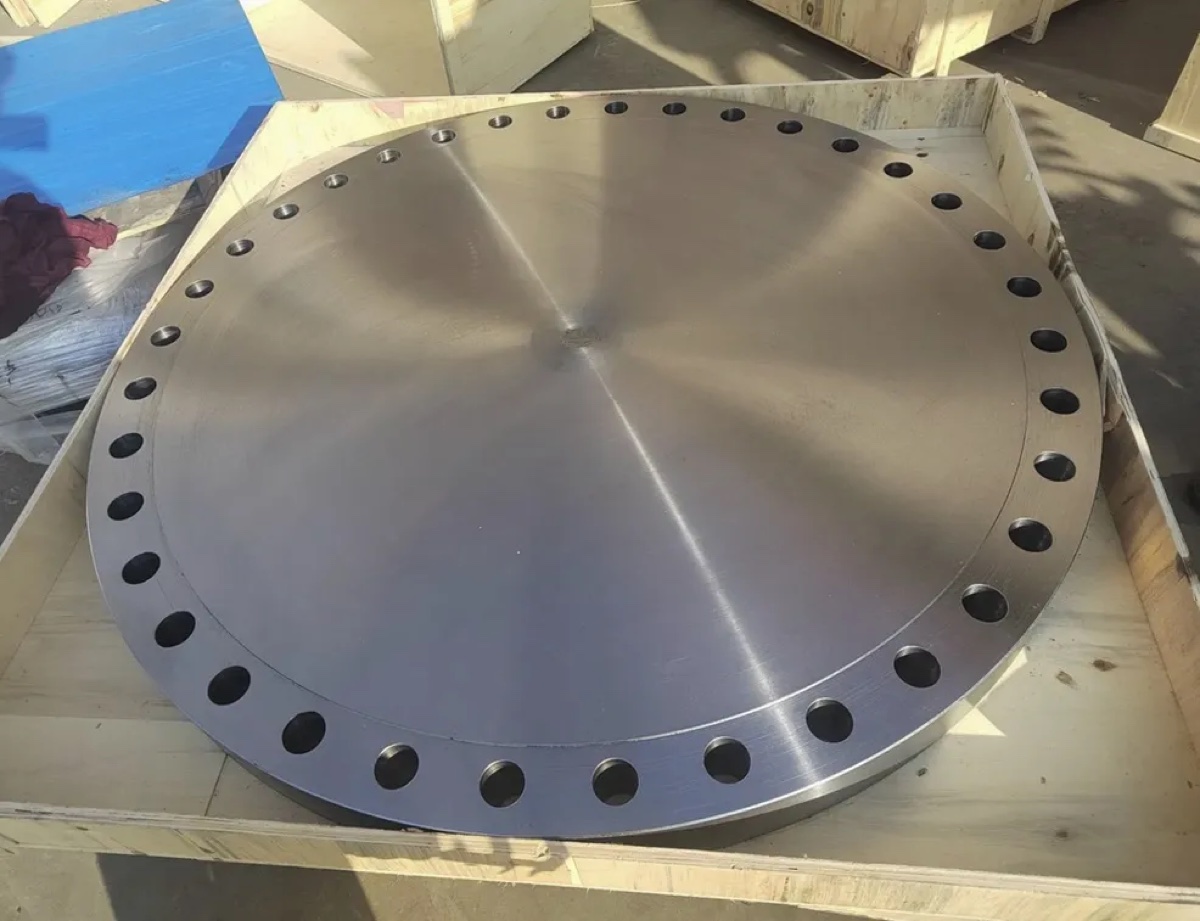
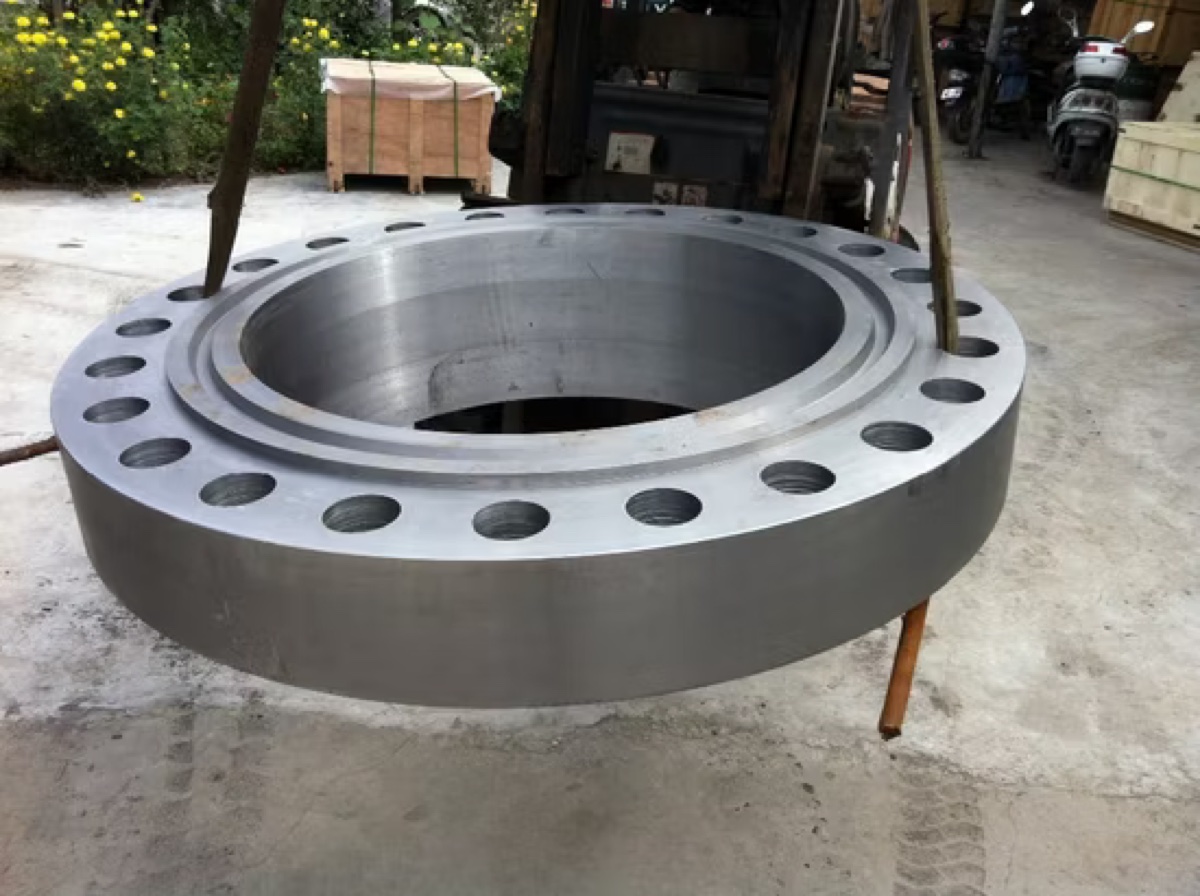
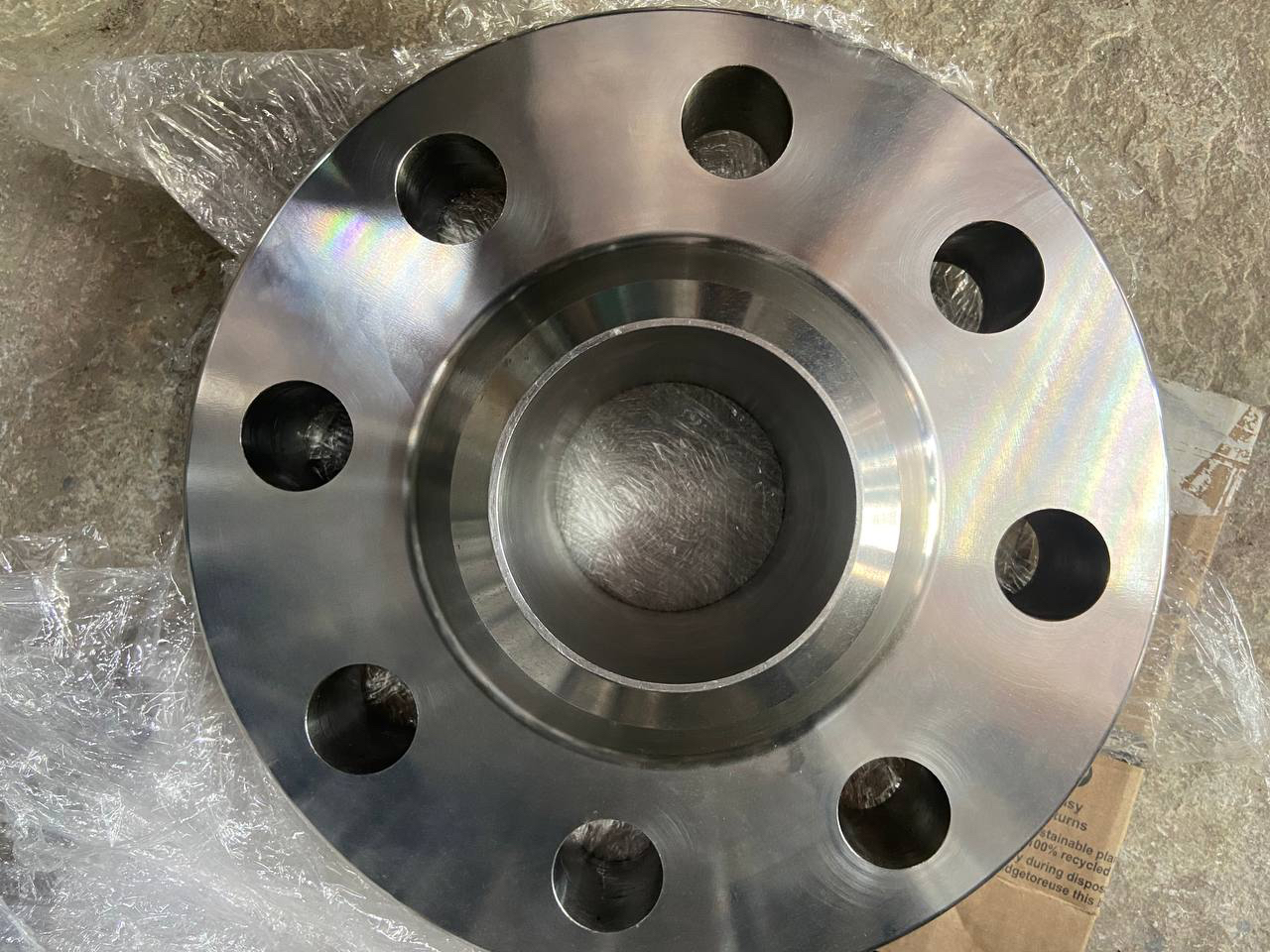
Large Machined Blind Flange — Crated for ExportLarge-Diameter Flange — Ring Groove MachinedRTJ Groove — Inconel 625 Overlay Refurbishment
Inconel 625 Blind Flange Dimensions
Blind dimensions are class-governed — identical across material grades. Full charts:
How to Specify & Order an Inconel 625 Blind Flange
Five elements — the grade and the sour declaration are the 625-specific ones:
1
Size & standard — e.g. 4″ NB ASME B16.5, or the B16.47 series for 26″ and above.
2
Pressure class & facing — Class 150–2500; RF, FF or RTJ (with ring number) to match the mating flange.
3
Grade & condition — ASTM B564 UNS N06625, Grade 1 annealed (our standard) or Grade 2 solution-annealed for service above 600°C; EN 2.4856 designation where required.
4
Service declarations & certification — sour service (NACE MR0175) and design temperature stated explicitly; NPT tap size if a test blind; PMI or 3.2 witnessing as specified; EN 10204 3.1 standard.
An Inconel 625 blind flange is a solid forged disc of nickel-chromium-molybdenum alloy — at least 58% nickel, 22% chromium, 9% molybdenum with a niobium addition, certified to ASTM B564 as UNS N06625, EN 2.4856 — drilled to the standard bolt pattern with no bore. It is the all-rounder of the nickel alloys: seawater-immune, NACE sour-listed, 827 MPa strong in the plain annealed condition and useful toward 980°C — closing offshore, subsea, chemical-process and flare systems where several enemies attack at once. Dimensions follow ASME B16.5 from ½ inch to 24 inch and ASME B16.47 beyond, in raised face, flat face and ring joint facings.
Why is Inconel 625 called the all-rounder?
Because every other page on this site fights one enemy, and 625 refuses to choose. Its 9% molybdenum buys chloride pitting resistance beyond even the 6-moly stainless class and hot-acid tolerance approaching the Hastelloys. Its niobium stiffens the matrix to 827/414 MPa with no age hardening. Its nickel-chromium base keeps strength and oxidation resistance toward 980°C. And NACE MR0175 lists it for sour service in the annealed condition. Seawater below, flare above, sour gas inside — one certificate covers the lot, which is exactly why offshore engineering standardised on it.
What do the molybdenum and niobium in 625 actually do?
They are the two levers of the design. Molybdenum at 8-10% — more than double the 6-moly stainlesses relative to their class — is the corrosion lever: chloride pitting and crevice immunity in seawater, plus resistance to the reducing acids that strip passive films. Niobium at 3.15-4.15% is the strength lever: it stiffens the solid solution and slowly forms fine strengthening phases, delivering fastener-class numbers from a plain anneal — no ageing cycle, no K-500-style two-condition complications, full weldability retained. Two elements, four properties: that economy is the alloy's genius.
What is the chemical composition of Inconel 625 (UNS N06625)?
Nickel 58.0% minimum, chromium 20.0-23.0%, molybdenum 8.0-10.0%, niobium plus tantalum 3.15-4.15%, iron ≤5.0%, carbon ≤0.10%, manganese ≤0.50%, silicon ≤0.50%, phosphorus ≤0.015%, sulphur ≤0.015%. Note the discipline: manganese and silicon at half the usual caps, phosphorus and sulphur at a third — a high-performance melt specified like one. Certificate readers should note nickel returns to a minimum (unlike 601's range) and iron is a cap, not the balance. Our PMI reads the Ni-Cr-Mo-Nb signature on every piece.
What are the mechanical properties of Inconel 625 blind flanges — and what are Grade 1 and Grade 2?
Grade 1 — the standard annealed condition — delivers tensile 827 MPa (120 ksi) minimum, yield 414 MPa (60 ksi) minimum, elongation 30% minimum: among the strongest numbers in our range, from a plain anneal. Grade 2 is solution-annealed at higher temperature for creep-governed service above roughly 600°C, trading room-temperature minimums (690/276 MPa) for a stabler hot structure. The rule of thumb: wet, sour and general duty orders Grade 1; sustained hot duty above 600°C orders Grade 2 — the purchase order should say which, and our certificates state the condition either way.
How does 625 perform in seawater compared with the 6-moly and duplex grades?
A clear class above. On the PREN index 625 scores around 50 — past 254 SMO's 43 and super duplex's 40-plus — and in practice it is essentially immune to pitting and crevice attack in seawater at any natural temperature, chlorinated or not, flowing or stagnant. That is why subsea hardware, riser components and splash-zone closures specify it despite the price: no crevice caveats, no chlorination limits, no galvanic anxiety (it sits at the noble end of the seawater table). The cheaper grades remain the honest answer where their windows hold; 625 is what certainty costs.
Is Inconel 625 acceptable for NACE MR0175 sour service?
Yes — it is one of the standard's benchmark alloys. Annealed 625 is listed for sour environments with generous limits, resistant to sulphide stress cracking, chloride SCC and the combined insults of hot sour brine that defeat lower alloys one mechanism at a time. Sour-service wells, manifolds and processing systems specify it for wetted closures precisely because one material clears every box. Declare sour service on the enquiry as always — the certificate then documents the annealed condition and hardness survey the standard expects.
How hot can an Inconel 625 blind flange run?
Oxidation resistance holds to roughly 980°C, and meaningful strength persists far up that range — the reason flare tips, exhaust bellows and hot ducting run in 625. Two qualifications keep the answer honest. For sustained service above ~600°C, specify Grade 2 solution-annealed material, whose coarser structure resists creep better. And long soaking in the 550-750°C window slowly ages any 625, trimming room-temperature ductility — a known characteristic to design around. For pure furnace duty with no corrosion brief, 601 remains the better-value specialist; 625 earns its place when heat arrives with company.
Why is 625 famous as a filler wire and overlay material?
Because its weld metal is as good as its wrought metal, and better than most things it joins. ERNiCrMo-3 — 625 filler — is the industry's universal corrosion-resistant consumable: it welds the 6-moly stainlesses (whose own molybdenum segregates on solidification), joins dissimilar metals, and clads carbon steel with a corrosion-proof skin at a fraction of solid-alloy cost. That last trade is the overlay economy: sour-service valves, wellheads and flange sealing faces run 625 weld overlay on steel bodies everywhere. We work both sides of it — solid 625 forgings, and 625 overlay refurbishment of worn RTJ grooves and sealing faces.
Inconel 625 or Hastelloy C-276 — how do I choose?
They overlap heavily, and the tie usually breaks on the leading enemy. C-276 carries more molybdenum (16%) and tungsten, making it the stronger answer in the fiercest reducing acids — hot hydrochloric territory, wet chlorine, the chemical plant's worst streams. 625 counters with niobium strength (827 against C-276's ~690 MPa), better high-temperature oxidation standing, the sour-service pedigree and wider offshore stocking. The practical split: acid chemistry leads — C-276; mechanical duty, sour gas, seawater or heat leads — 625. Both sit in our range, and near the boundary we quote both.
What service conditions does Inconel 625 dislike?
Remarkably few, which is the point — but three notes keep the page honest. The 550-750°C ageing window: long soaks slowly embrittle the room-temperature metal (design around it; Grade 2 helps above 600°C). Sulphur-bearing hot gases: the nickel family's oldest enemy applies, though 625's chromium gives it more tolerance than pure nickel or Monel. And the price: 'the alloy that can do everything' should be specified when several enemies genuinely attack at once — where one enemy attacks alone, this site has a cheaper specialist for it, and we will name it on the quotation.
What facings are Inconel 625 blind flanges made with?
All three: raised face (BLRF) — the default — flat face (BLFF) for lined and composite mating systems, and ring type joint (BLRTJ), the natural companion of 625's high-pressure offshore classes, the ring chosen softer than the groove. Each facing has its own page on this site. Worth knowing alongside: we also perform 625 weld-overlay refurbishment of worn RTJ grooves and sealing faces on existing flanges — the same metallurgy applied as a repair economy. NPT-tapped test blinds are machined and certified at the works.
Where are Inconel 625 blind flanges used?
Wherever several enemies share one line class: offshore and subsea systems — risers, manifolds, injection and completion circuits; sour-gas wellheads and processing; chemical plants running hot mixed acids; flare, exhaust and bellows systems where heat meets salt air; seawater hardware beyond the 6-moly window; and overlay-clad equipment whose closures must match the cladding. 625 blinds close those systems as isolations, spare-nozzle blanks and tapped test points — one certificate against every enemy on the list.
Which standards cover Inconel 625 blind flanges?
The material standard is ASTM B564 (UNS N06625) with ASME SB564 as the boiler-code twin — the nickel-alloy forging standard — alongside B443 for plate and B444 for pipe in the same alloy, and EN 2.4856 / NiCr22Mo9Nb as the European designation. Grades 1 and 2 distinguish the annealed and solution-annealed conditions. Dimensions follow ASME B16.5 for ½"-24" and ASME B16.47 for 26"-60", rated on the grade's own lines. A complete specification reads: 'Blind Flange, RTJ, 4", ASME B16.5 Class 1500, ASTM B564 UNS N06625 Grade 1 (Inconel 625)' — and our EN 10204 certificates state it exactly that way, condition included.
Who manufactures Inconel 625 blind flanges in India?
Tesco Steel & Engineering is an ISO 9001:2015 certified flange manufacturer based in Mumbai, India, forging Inconel 625 / ASTM B564 / UNS N06625 / EN 2.4856 blind flanges from ½" to 24" NB per ASME B16.5 in Classes 150-2500 and to 60" per ASME B16.47 — Grade 1 annealed standard and Grade 2 solution-annealed to order, pickled, PMI-verified with the Ni-Cr-Mo-Nb signature read on every piece, certified to EN 10204 3.1/3.2 on every lot — in raised face, flat face and ring joint facings, alongside Inconel 600 and 601 blinds, 625 weld-overlay refurbishment services, and the full nickel-alloy range. Exported to more than 50 countries.