Inconel 601 Blind Flanges — UNS N06601 Furnace-Grade Blind Manufacturer
Tesco Steel & Engineering forges Inconel 601 blind flanges — ASTM B564, UNS N06601, EN 2.4851 — to ASME B16.5 Class 150–2500 from ½″ to 24″ NB and to ASME B16.47 up to 60″. Our F310 page topped the stainless heat ladder near 1150°C; 601 is what stands beyond it: 60% nickel, 23% chromium and the signature 1.0–1.7% aluminium that enters the oxide scale itself — alumina toughening the chromia layer, carrying oxidation resistance to ~1200°C and keeping the scale attached through the thermal cycling that spalls every stainless below it. Add carburizing-atmosphere resistance and 601 is the heat-treatment industry's hardware alloy — radiant tubes, muffles, reactors, and the closures that ride the same cycles. Hot reducing & caustic chemistry: Inconel 600. Wet corrosion: Hastelloy/625. Facings: BLRF, BLFF or BLRTJ. Every lot with EN 10204 3.1/3.2 MTC. ISO 9001:2015, made in Mumbai, India — exported to 50+ countries.
Inconel 601 · ASTM B564 · UNS N06601EN 2.4851 · NiCr23FeOxidation to ~1200°CAl in the Scale — Spall-Proof CyclingBeyond the Stainless Heat LadderCarburizing-Atmosphere ResistantASME B16.5 ½″–24″ · Class 150–2500EN 10204 3.1 / 3.2 · ISO 9001:2015
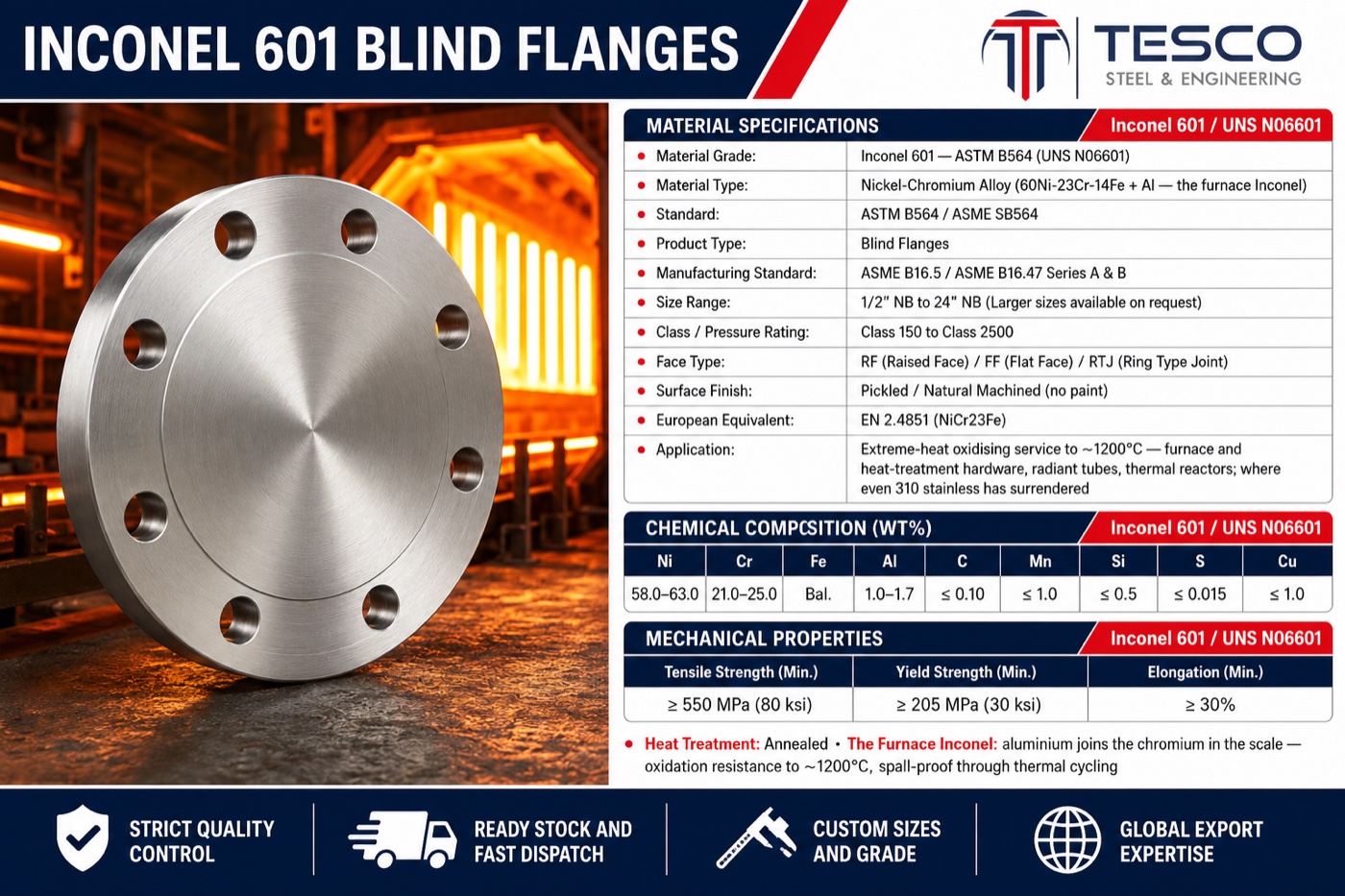
Inconel 601 Blind Flanges — Specifications at a Glance
What is an Inconel 601 Blind Flange?
The furnace Inconel. A solid forged disc of nickel-chromium alloy (ASTM B564 / UNS N06601 / EN 2.4851) with no bore — Ni 58–63%, Cr 21–25%, Fe balance, Al 1.0–1.7% — closing furnace and heat-treatment systems, radiant-tube circuits and thermal reactors where even 310 stainless has surrendered. The aluminium enters the oxide scale: oxidation resistance to ~1200°C, spall-proof through thermal cycling, resistant to carburizing atmospheres. Mechanicals 550/205 MPa annealed — with strength retained hot, which is the point. Dimensions per ASME B16.5 / B16.47 in RF, FF and RTJ facings; EN 10204 3.1 certified.
Also searched as: Alloy 601 blind flange, N06601 blind, 2.4851 blind flange, NiCr23Fe blind, SB564 601 blind, furnace blind flange, high-temperature blind flange — all refer to the product on this page. See also our Inconel flanges hub, the siblings Inconel 600 blind flanges and 601 weld necks, the stainless rung below — F310 — our Inconel refractory anchors for the same furnaces, and the facing pages BLRF / BLFF / BLRTJ.
Aluminium in the Scale — Why 601 Outlives the Ladder
Chromia Alone Has a Ceiling
Every grade below on the heat ladder protects itself with chromium oxide — and chromia tops out near 310's ~1150°C, spalling a little more with every thermal cycle.
Alumina Changes the Scale
601's 1.0–1.7% aluminium enters the oxide layer: alumina is stabler at higher temperature and bonds the composite scale tenaciously to the metal — protection toward 1200°C that stays attached through heat-up/cool-down cycles. Furnaces cycle; 601's scale rides the cycles.
And Carbon Can't Get In
High nickel resists carbon pickup, so case-hardening atmospheres that carburize and embrittle stainless fixtures leave 601 working — the reason heat-treatment hardware standardised on it.
Hot reducing atmospheres, caustic, nuclear steam — the chemical patriarch
Inconel 625
N06625
+ 9% Mo, Nb
Wet corrosion & strength — the marine/chemical side of the family
Inconel 601 Chemical Composition (UNS N06601)
Element
Ni
Cr
Fe
Al
C
Mn
Si
S
Cu
Weight %
58.0–63.0
21.0–25.0
Bal.
1.0–1.7
≤0.10
≤1.0
≤0.5
≤0.015
≤1.0
Two structural notes for certificate readers: nickel is a range, not a minimum, and iron plays the balance role (~14%) — the exact reverse of every steel sheet, where iron was the base. The aluminium is the signature; note also what is absent — no molybdenum: 601's alloying is spent entirely on heat, and wet corrosion belongs to 625/Hastelloy. Our PMI reads the Ni-Cr-Al signature on every piece.
Mechanical Properties & The Service Span
Property
ASTM B564 N06601 Requirement
Tensile Strength
≥ 550 MPa (80 ksi)
Yield Strength (0.2%)
≥ 205 MPa (30 ksi)
Elongation
≥ 30%
Hardness
No B564 limit — annealed condition
Condition
Annealed — stated on certificate
Service Span
Oxidising duty to ~1150–1200°C with cycling; strength usefully retained where stainless allowables have collapsed; creep-rated extremes — 617/230 class against enquiry
Inconel 601 / UNS N06601 Blind Flanges are available in the following specifications:
Material Grade
Inconel 601 — ASTM B564 / ASME SB564 (UNS N06601); EN 2.4851 / NiCr23Fe designation where the project requires it
Heat Treatment
Annealed — stated on certificate
Size
1/2"NB to 24"NB per ASME B16.5; 26"–60" per ASME B16.47; EN 1092-1 to order
Class
150#, 300#, 400#, 600#, 900#, 1500#, 2500# — rated on the grade's own nickel-alloy B16.5 lines
Facings
Raised Face (BLRF), Flat Face (BLFF), Ring Type Joint (BLRTJ) with groove per B16.20
Service Span
Extreme-heat oxidising & heat-treat atmosphere duty to ~1200°C; sulphur-bearing hot gas excluded — state the atmosphere at enquiry
Surface Finish
Pickled or natural machined — no paint; segregated alloy handling throughout
Modifications
NPT-tapped centre (thermocouple / sight / test points), lifting provisions — machined & certified at the works
Testing
Tension & chemistry per heat — the aluminium window verified; PMI routine
Certification
EN 10204 3.1 (standard) / 3.2 witnessed
Why Inconel 601 Blind Flanges Are Specified
The Temperature Outran Stainless
Past 310's ceiling, or into cycling that spalls chromia scales, 601 is the standard answer at the first rung beyond the stainless world — the closure rides the same cycles as the radiant tubes around it.
The Atmosphere Is the Enemy
Carburizing and nitriding heat-treat atmospheres destroy stainless fixtures; 601's high nickel refuses the carbon — the industry's hardware alloy, closure included.
Strength That Survives the Heat
Where stainless allowables have collapsed, 601 still carries load — the reason furnace hardware hangs from it rather than merely resists scaling.
One Works for the Whole Hot Side
The same furnaces anchor their linings with Inconel refractory anchors — we forge the anchors, the studs and the closures, one certificate trail.
Know the Map
Steady heat below ~1100°C at stainless cost: F310 — and we will say so. Hot reducing & caustic: Inconel 600. Wet corrosion & strength: 625 / Hastelloy. Full family: the Inconel hub. Facings: BLRF / BLFF / BLRTJ.
Specification Notes — Getting 601 Right
Three details buyers miss.Sulphur excludes it: sulphur-bearing hot gases and deposits are the nickel family's oldest enemy — that duty needs different metallurgy, and the fuel analysis belongs on the enquiry. The ageing note: long service in the 550–750°C window can trim room-temperature ductility — a known characteristic to design around, relevant to hardware that will be straightened or re-bent after service, not to a bolted closure in place. Don't pay for degrees you don't need: steady oxidising duty below ~1100°C is F310's honest territory at stainless cost — 601's premium buys the last hundred degrees, the cycling tolerance and the carburizing resistance; we quote both rungs when the duty sits near the line.
How Our Inconel 601 Blind Flanges Are Manufactured
1
Forging — cut billet of the spectro-verified N06601 heat — nickel, chromium and the 1.0–1.7% aluminium confirmed — is hot-forged into the solid disc blank with full heat traceability and segregated alloy handling.
2
Annealing — restoring the uniform solid-solution matrix; furnace charts retained against the heat number.
3
Machining & facing — faces, OD and drilling to ASME B16.5 / B16.47; RF serrations, flat face or RTJ groove gauged per B16.20; NPT taps machined where ordered.
4
Testing — tension test and chemistry against the heat; PMI on every piece reads the Ni-Cr-Al signature.
5
Pickling — the clean bare-metal surface whose own scale will protect it in service, with marking of standard, grade, size, class and heat number.
6
Certification & packing — EN 10204 3.1 MTC (3.2 witnessed on request); faces protected, palletised or crated sea-worthy — no carbon-steel contact in transit.
Where Inconel 601 Blind Flanges Are Used
The hottest hardware country: heat-treatment furnaces — radiant tubes, muffles, retorts and manifolding; thermal and catalytic reactors; combustion and burner systems; fired-heater internals; thermocouple and sight-port closures; glass, ceramic and calcining plants. Production below:
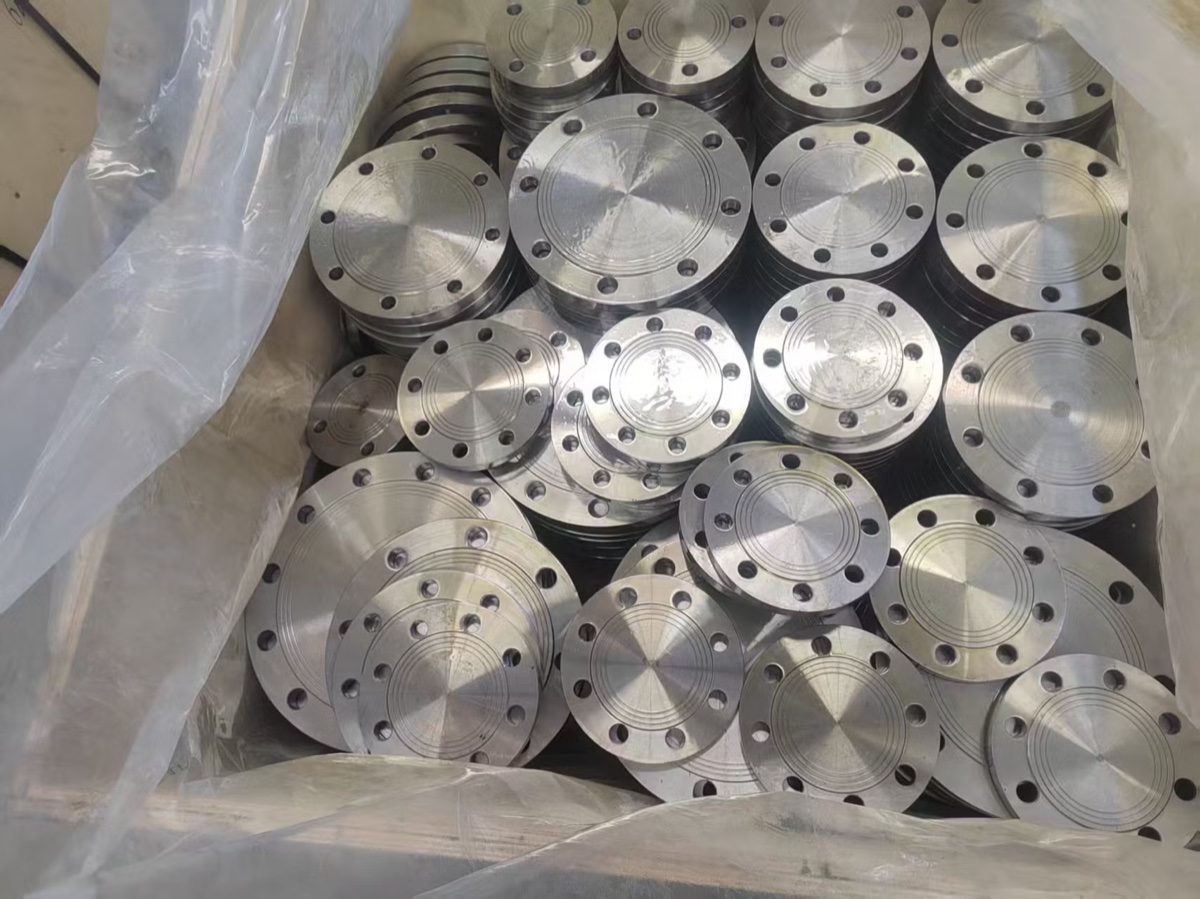
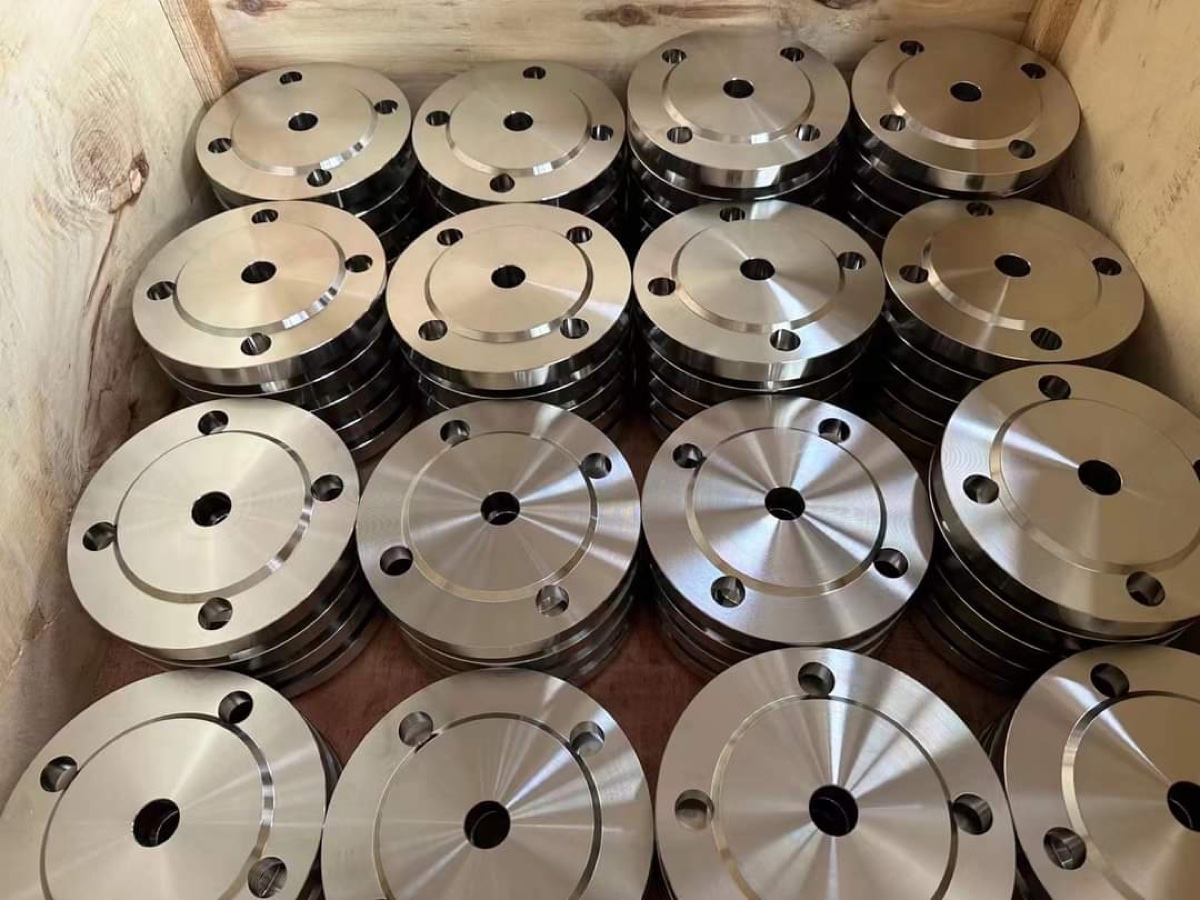
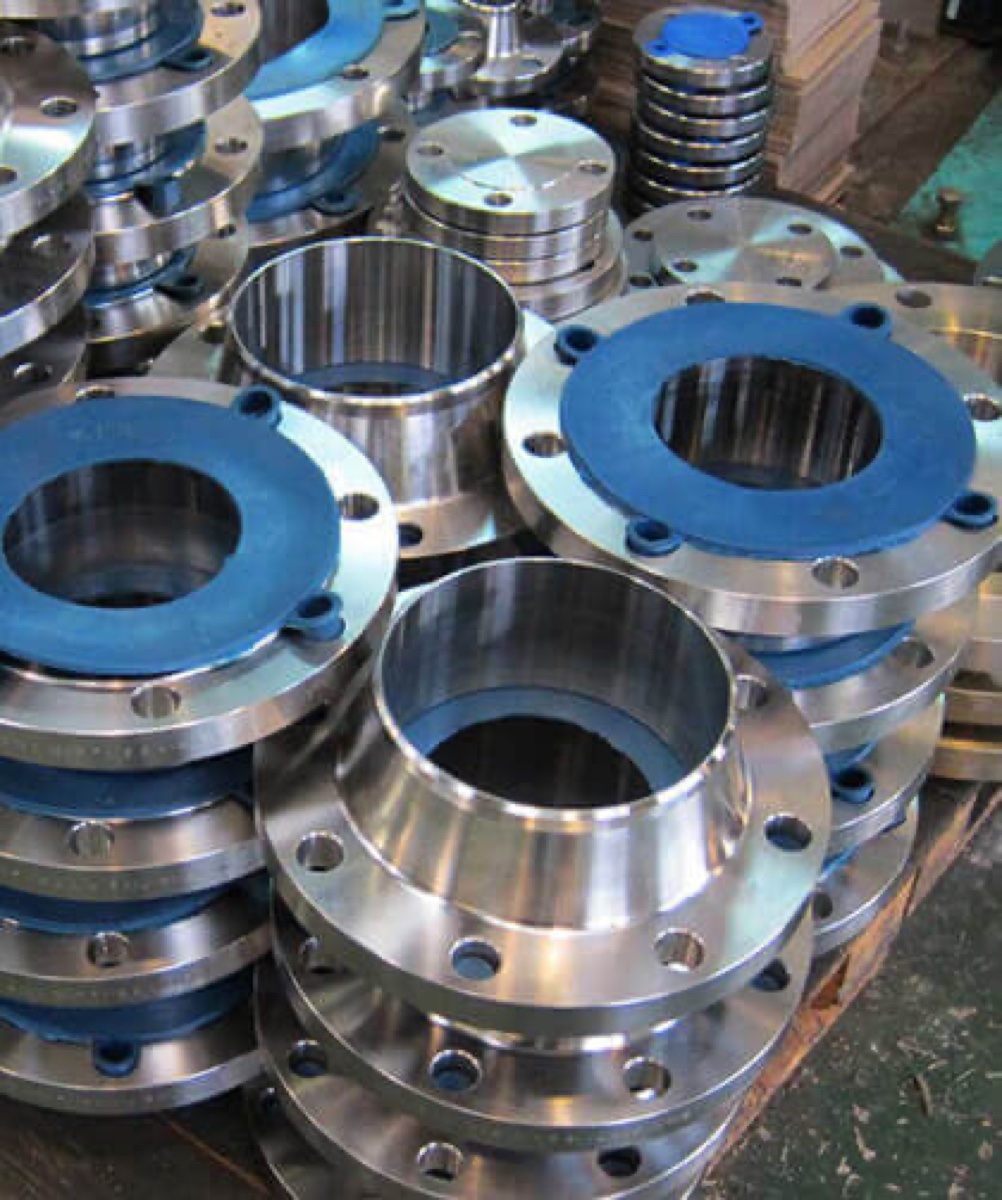
8″ Class 300 Blind Flange — Machined at Our WorksForged Blind Flanges — Ready for DispatchInconel 601 Flanges — Same Grade, Protected Stock
Inconel 601 Blind Flange Dimensions
Blind dimensions are class-governed — identical across material grades. Full charts:
How to Specify & Order an Inconel 601 Blind Flange
Five elements — the atmosphere declaration is the 601-specific one:
1
Size & standard — e.g. 4″ NB ASME B16.5, or the B16.47 series for 26″ and above.
2
Pressure class & facing — Class 150–2500; RF, FF or RTJ (with ring number) to match the mating flange.
3
Grade — ASTM B564 UNS N06601 (Inconel 601); EN 2.4851 designation where the project requires it.
4
Service & certification — state temperature, cycling regime and atmosphere (air / combustion / endo-gas / ammonia / sulphur-bearing); NPT tap size if a thermocouple or test blind; PMI or 3.2 witnessing as specified; EN 10204 3.1 standard.
An Inconel 601 blind flange is a solid forged disc of nickel-chromium alloy — roughly 60% nickel, 23% chromium, the balance iron, with a signature aluminium addition, certified to ASTM B564 as UNS N06601, EN 2.4851 — drilled to the standard bolt pattern with no bore. It is the furnace member of the Inconel family: oxidation-resistant to around 1200°C with a scale that survives thermal cycling, closing furnace and heat-treatment systems, radiant-tube circuits and thermal reactors where even 310 stainless has surrendered. Dimensions follow ASME B16.5 from ½ inch to 24 inch and ASME B16.47 beyond, in raised face, flat face and ring joint facings.
What does the aluminium in Inconel 601 do?
It joins the chromium in the oxide scale and changes the scale's character. Chromia alone protects to roughly 1100-1150°C — the 310 stainless ceiling — and suffers from spalling when temperature cycles. Alumina, formed from 601's 1.0-1.7% aluminium, is stabler at higher temperature and bonds the scale far more tenaciously to the metal: the composite layer protects toward 1200°C and, crucially, stays attached through the heat-up/cool-down cycles that strip chromia scales bare. That tenacity is 601's real signature — furnaces cycle, and 601's scale rides the cycles.
Inconel 601 or Inconel 600 — what is the difference?
The aluminium, and what it buys. Inconel 600 (UNS N06600) is the family patriarch — 76% nickel, 15% chromium, no aluminium — superb in reducing hot atmospheres, caustic and nuclear steam service. 601 trims the nickel, raises chromium to 23% and adds the aluminium, trading 600's chemical breadth for the best oxidation-and-cycling resistance in the standard Inconel range. The practical split: hot oxidising service with air as the enemy — 601; hot reducing or caustic chemistry — 600. We forge both; see our Inconel 600 blind flange page for the sibling.
Inconel 601 or 310 stainless — when do I step up?
When temperature or cycling outruns the stainless. 310's 25/20 chemistry holds steady oxidising heat to roughly 1100-1150°C at stainless cost, and for continuous duty below that line it remains the honest recommendation. 601 takes over on three triggers: the last hundred degrees toward 1200°C, aggressive thermal cycling (where 310's chromia scale spalls and 601's alumina-bonded scale holds), and carburizing or nitriding heat-treat atmospheres that attack stainless. The step is real money — nickel at 60% against 20% — so the trigger, not fashion, should pull it; we quote both rungs where the duty sits near the line.
What is the chemical composition of Inconel 601 (UNS N06601)?
Nickel 58.0-63.0%, chromium 21.0-25.0%, iron the balance at roughly 14%, aluminium 1.0-1.7%, with carbon ≤0.10%, manganese ≤1.0%, silicon ≤0.5%, sulphur ≤0.015% and copper ≤1.0%. Two structural notes for certificate readers: nickel is a range, not a minimum, and iron plays the balance role — the exact reverse of every steel specification, where iron is the base. No molybdenum: wet-corrosion duty belongs to the 625/Hastelloy side of the family; 601's alloying is spent entirely on heat.
What are the mechanical properties of Inconel 601 blind flanges?
Per ASTM B564 in the annealed condition: tensile strength 550 MPa (80 ksi) minimum, yield strength 205 MPa (30 ksi) minimum, elongation 30% minimum. Respectable numbers cold — but the grade's real mechanical story is what it keeps when hot: at temperatures where stainless allowables have collapsed, 601 retains useful strength and creep resistance, which is why furnace hardware hangs from it. For code-rated creep design at the extreme, the specialised alloys 617 and 230 carry the allowables; 601 is the general-purpose furnace workhorse beneath them.
What temperature range does an Inconel 601 blind flange cover?
In oxidising atmospheres, continuous service to around 1150-1200°C — the top of the common flange-alloy world — with the alumina-bonded scale holding through thermal cycling that de-rates every scale-dependent grade below it. There is no meaningful cold-end restriction. The working limits are atmospheric rather than thermal: sulphur-bearing hot gas remains the nickel family's enemy, and heavily reducing atmospheres shift the choice toward Inconel 600. For the furnace world 601 was built for — air, combustion products, heat-treat atmospheres — the ceiling is the highest on this site.
How does 601 handle carburizing and nitriding atmospheres?
Well enough to be the heat-treatment industry's standard hardware alloy. Carbon-rich case-hardening atmospheres carburize and embrittle stainless fixtures within campaigns; 601's high nickel is intrinsically resistant to carbon pickup, and its adherent scale adds a barrier. Nitriding atmospheres tell a similar story. Radiant tubes, muffles, baskets, fans and rollers in carburizing furnaces run in 601 for exactly this reason — and the closures on those systems inherit the requirement. State the atmosphere at enquiry: air, endo-gas, ammonia and vacuum each write their own metallurgy.
What service conditions does Inconel 601 dislike?
The honest list. Sulphur at temperature is the nickel family's oldest enemy — sulphur-bearing fuels and deposits embrittle and scale it aggressively; that duty needs different metallurgy entirely. Long exposure in the 550-750°C window can age the alloy and trim its room-temperature ductility — a known characteristic to design around, not a failure, but worth noting for hardware that will be cold-straightened or rebent after service. Wet chloride chemistry is not its game — no molybdenum; 625 and Hastelloy own that world. And for code-rated creep-limited design at the extreme, 617/230 carry the pedigree.
A blind flange isn't a radiant tube — why forge it in 601?
The furnace-country logic from our F310 page, one rung higher. A closure on a hot-air header, a spare nozzle on a thermal reactor, an inspection blank on radiant-tube manifolding — each sits in the same gas stream at the same temperature as the pressure parts around it, and a lesser closure becomes the joint's sacrificial component: scale, thickness loss, seized studs, a leak path. Matching the closure to the line class keeps certificates and future welded modifications simple. The same plants hang their refractory linings on Inconel anchors — which we also manufacture, one certificate trail for the whole hot side.
Can Inconel 601 be welded?
Yes — it is a solid-solution alloy with none of K-500's age-hardening complications. Standard practice uses matching or over-alloyed nickel filler (filler metal 601, or 617 where the joint must match creep duty), ordinary nickel-family cleanliness discipline — sulphur sources policed off the weld preps — and no post-weld heat treatment demand. The blind flange itself arrives annealed and unwelded; when it becomes a welded spool at the next rebuild, the certificate and the weldability travel with it.
What facings are Inconel 601 blind flanges made with?
All three: raised face (BLRF) — the default — flat face (BLFF) for mating flat-faced duct and lined equipment, and ring type joint (BLRTJ) where high-pressure practice calls for it, the ring chosen softer than the groove. Each facing has its own page on this site. At 601's working temperatures the gasket is the joint's limiting member — graphite and mica systems have their own ceilings, and thermal cycling loosens bolt loads set cold — so joint design deserves the same attention as the alloy. NPT-tapped test blinds are machined and certified at the works.
Where are Inconel 601 blind flanges used?
The hottest hardware country there is: heat-treatment furnaces — radiant tubes, muffles, retorts and their manifolding; thermal and catalytic reactors; combustion and burner systems; petrochemical fired-heater internals; thermocouple and sight-port closures on furnace shells; and the oxygen-side hardware of glass, ceramic and calcining plants. 601 blinds close those systems as isolations, spare-nozzle blanks and inspection closures — riding the same thermal cycles as the equipment they seal, alongside the Inconel refractory anchors we forge for the same plants.
Which standards cover Inconel 601 blind flanges?
The material standard is ASTM B564 (UNS N06601) with ASME SB564 as the boiler-code twin — the nickel-alloy forging standard — alongside B168 for plate and B167 for pipe in the same alloy, and EN 2.4851 / NiCr23Fe as the European designation. Dimensions follow ASME B16.5 for ½"-24" and ASME B16.47 for 26"-60", rated on the grade's own lines. A complete specification reads: 'Blind Flange, RF, 4", ASME B16.5 Class 150, ASTM B564 UNS N06601 (Inconel 601)' — and our EN 10204 certificates state it exactly that way, aluminium content included.
Who manufactures Inconel 601 blind flanges in India?
Tesco Steel & Engineering is an ISO 9001:2015 certified flange manufacturer based in Mumbai, India, forging Inconel 601 / ASTM B564 / UNS N06601 / EN 2.4851 blind flanges from ½" to 24" NB per ASME B16.5 in Classes 150-2500 and to 60" per ASME B16.47 — annealed, pickled, PMI-verified with the nickel-chromium-aluminium signature read on every piece, certified to EN 10204 3.1/3.2 on every lot — in raised face, flat face and ring joint facings, alongside Inconel 600 and 625 flanges, the full nickel-alloy blind range, and the Inconel refractory anchors that serve the same furnaces. Exported to more than 50 countries.