UNS N04400 Weld Neck Flanges — Monel 400 Nickel-Copper (2.4360)
Tesco Steel & Engineering forges UNS N04400 weld neck flanges in Monel 400 — Werkstoff Nr. 2.4360, the classic two-thirds nickel, one-third copper alloy — to ASTM B564, from 1/2″ NB to 56″ NB in ASME B16.5 Class 150–2500 and European PN patterns. A century of service built its reputation: flowing seawater without pitting, hydrofluoric acid tolerance almost no other engineering alloy matches, indifference to caustic alkalis, and complete immunity to chloride stress corrosion cracking — from cryogenic temperatures to ~480 °C. Mating B165 Monel pipe, welded with ERNiCu-7. Annealed, supplied with PMI and EN 10204 3.1/3.2 on request. ISO 9001:2015, made in Mumbai, India — exported worldwide.
Monel 400 · UNS N04400 · 2.4360
Ni 63% Min · Cu 28–34%
ASTM B564 / ASME SB-564
Seawater · HF Acid · Caustic
Chloride SCC Immune
1/2″ – 56″ NB · Class 150–2500
ISO 9001:2015 · Exported Worldwide
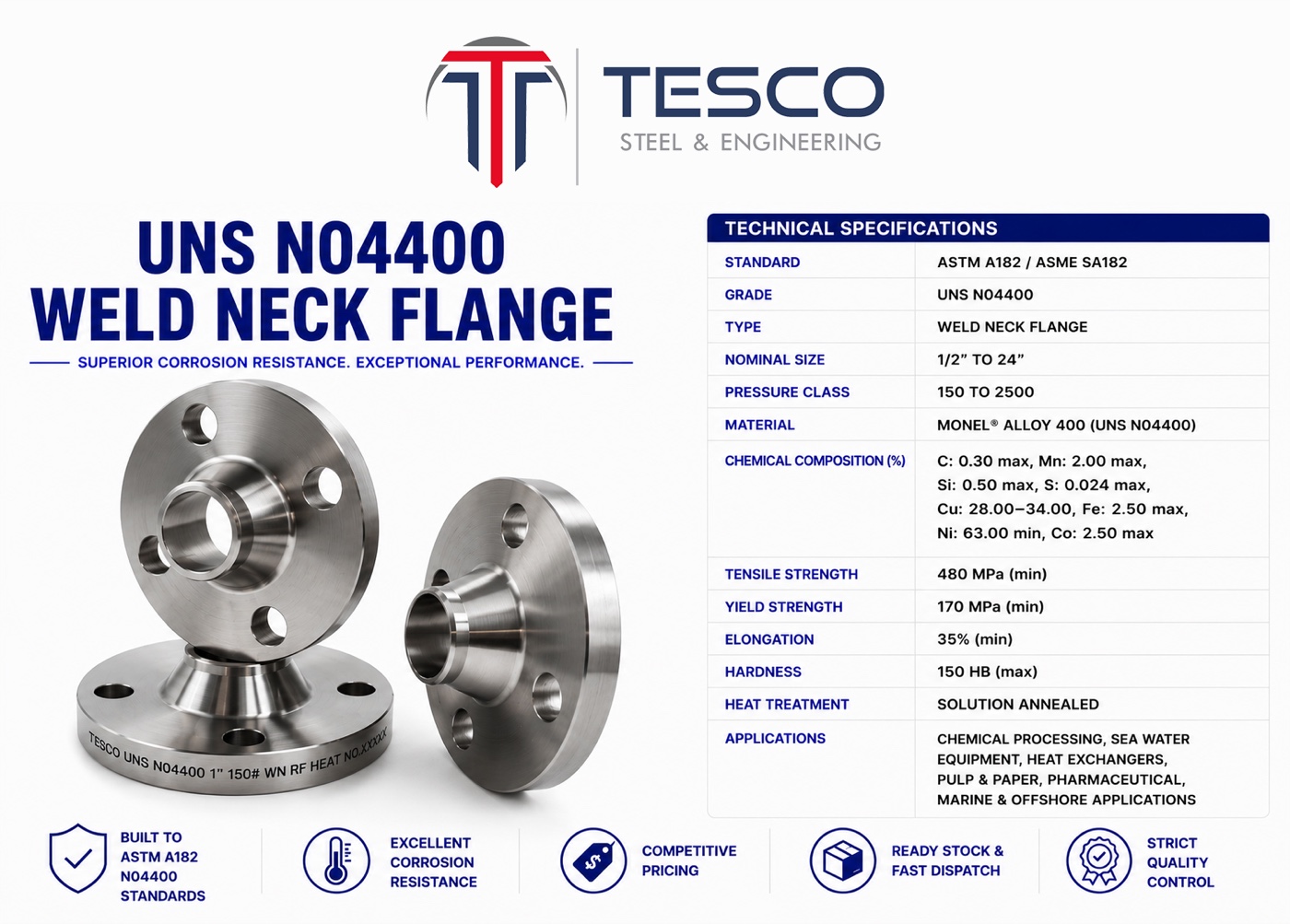
UNS N04400 Weld Neck Flange — Monel 400 (2.4360), Technical Specifications
What is a UNS N04400 (Monel 400) Weld Neck Flange?
Monel 400 (UNS N04400 / 2.4360) is one of the oldest engineering nickel alloys — a simple solid solution of ~65% nickel and ~32% copper with no phases to precipitate, no sensitization to manage and no ductile-brittle transition. That simplicity buys a rare combination: flowing seawater without pitting, hydrofluoric acid tolerance, caustic indifference and complete chloride-SCC immunity. A N04400 weld neck flange pairs that pedigree with a long tapered hub butt-welded to the pipe, bore matched to schedule, joint fully radiographable — forged to ASTM B564.
Its two calling cards: marine engineering, where a century of pump, valve and piping service made Monel the benchmark for flowing seawater; and HF alkylation, where its protection does not depend on the fragile oxide films hydrofluoric acid destroys on stainless. The age-hardenable sibling K-500 triples the yield for shafts and fasteners; flanged joints almost always call for 400.
On the marine ladder it stands above cupronickel 90/10 (same binary system, opposite end) and alongside the Inconel/Hastelloy families for harsher chemistry — all forged in-house.
Also searched as: Monel 400 flange, Alloy 400 flange, N04400 flange, 2.4360 flange, NiCu30Fe flange, nickel copper flange, ASTM B564 N04400 flange — all refer to the product on this page; see also our
Monel 400 flanges overview.
Chemical Composition of UNS N04400
| Ni | C | Al | Mn | Si | Fe | Cu | S |
|---|
| 63.00 min | 0.30 max | 0.50 max | 2.00 max | 0.50 max | 1.00-2.50 | 28.00-34.00 | 0.02 max |
Values in weight %. The two-thirds/one-third nickel-copper ratio is the alloy's identity — a single-phase solid solution with nothing to precipitate or sensitize, which is precisely why its corrosion behaviour is so forgiving.
Mechanical Properties of UNS N04400
| Tensile Strength, MPa | Yield Strength, Min, MPa | Elongation % min. |
|---|
| 550 | 240 | 40 |
Typical annealed values per our supply practice; the governing ASTM B564 minimums are 483 MPa (70 ksi) tensile, 172 MPa (25 ksi) yield and 35% elongation, demonstrated on every certificate. Monel work-hardens strongly — a machining consideration — and keeps full toughness from cryogenic temperatures to its service ceiling.
Equivalent Grades of UNS N04400
| Standard | Werkstoff Nr. | UNS | AFNOR | EN |
|---|
| Monel 400 | 2.4360 | N04400 | NU-30M | NiCu30Fe |
System partners: ASTM B165 seamless pipe, B366 butt-weld fittings, B127 plate and B564 forgings. The age-hardenable sibling is Monel K-500 (N05500); the copper-based cousins are the cupronickels 90/10 and 70/30.
UNS N04400 Weld Neck Flange Specifications
| Monel 400 Weld Neck Flanges are available in the following specifications: |
|---|
| Size | 1/2"NB to 56"NB |
| Class | 150#, 300#, 400#, 600#, 900#, 1500#, 2500# |
| Sch (Schedule) | XS, XXS, STD & Schedule 20, 40, 80, 160 |
| Pressure Ratings | PN 2.5 - PN 400 |
| Standards | ASTM B564 / ASME SB-564; ASME B16.5, ASME B16.47, EN 1092-1, DIN 2631–2635, BS 4504 |
| Condition | Annealed |
| Other Services | Sand Blasting on Monel 400 Weld Neck Flanges
Shot Peening on Monel 400 Weld Neck Flanges
Pickling & surface passivation
PMI testing & dye-penetrant examination
Project-specific marking, wrapping & export packing |
Why Monel 400 After a Century Is Still Specified
The Seawater Benchmark
Flowing seawater, impingement and cavitation without pitting — the pedigree that put Monel on pump shafts and valve trim before duplex existed.
The HF Alloy
Hydrofluoric acid destroys oxide-film alloys; Monel's protection doesn't depend on one. HF alkylation and fluorine chemistry specify it by name.
Caustic Indifference
Sodium and potassium hydroxide at all concentrations — evaporators and salt works run Monel where stainless stress-cracks.
Nothing to Go Wrong
Single-phase solid solution: no sensitization, no sigma, no 475 °C embrittlement, no chloride SCC — simplicity as a reliability strategy.
Cryogenic to 480 °C
Full toughness at liquefied-gas temperatures and useful strength to ~480 °C — one alloy covers the span.
Welding Monel 400 — Cleanliness is the Discipline
Monel welds with ERNiCu-7 / ENiCu-7 filler (Monel 60 type) and classic nickel-alloy discipline: scrupulous cleanliness — sulphur from markers, oils, grease or shop dirt embrittles hot nickel — low heat input, no preheat, no PWHT. The single-phase alloy has no sensitization to manage; joints enter seawater or acid service as-welded, pickled where the duty warrants.
Two quirks worth knowing: in stagnant, deposit-covered seawater Monel can pit under biofouling — keep systems flowing or drainable; and its Curie point sits near room temperature, so parts can be slightly magnetic — normal for the alloy, not a PMI failure.
Where UNS N04400 Weld Neck Flanges Are Used
Marine leads: seawater piping, pump and valve connections, splash-zone hardware on ships and platforms. HF alkylation units and fluorochemical plants follow — the alloy's second home — then caustic evaporators and salt works, crude-unit overheads handling HCl condensates, feedwater heaters and cryogenic services. Our nickel-alloy production below:
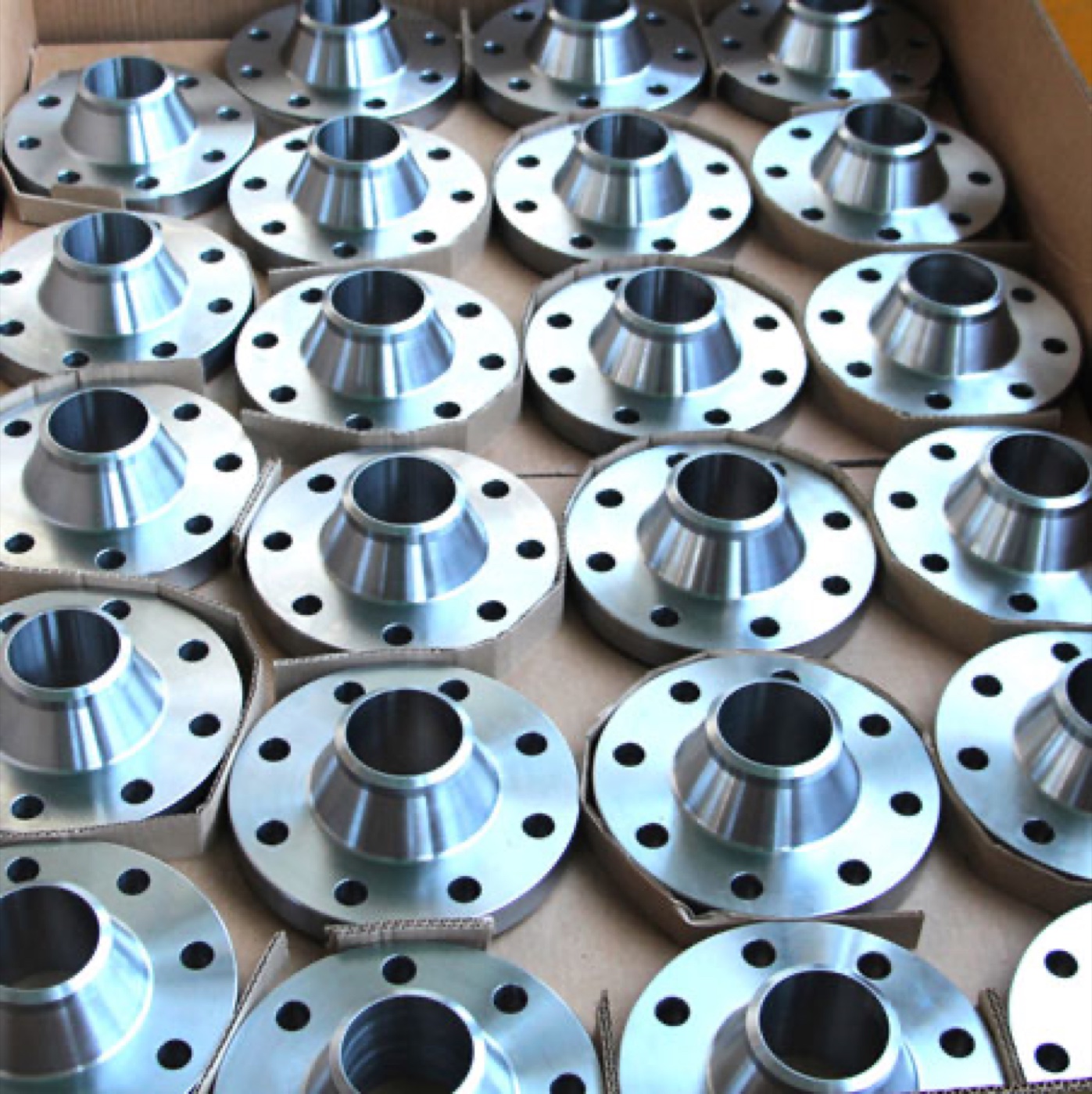
Weld Neck Flanges — Machined & Packed Production
UNS N04400 Weld Neck Flange Dimensions
Monel 400 weld neck flanges share their dimensions with every other material in the same class — OD, thickness, hub, bore, bolt circle and bolting per the standard tables. Full ASME B16.5 charts:
European PN dimensions are published on the EN 1092-1 Type 11, DIN 2631–2635 and BS 4504 pages.
Price List & How to Order
Monel pricing tracks nickel closely plus the testing scope, so we quote live with a stated validity rather than publish a static list. To get a firm quotation, usually within 24 hours:
1
List your requirement — size (NB), class or PN, standard (ASME B16.5 / B16.47 / EN / DIN / BS), grade (Monel 400 / N04400 / 2.4360), pipe schedule or bore, and quantity.
2
Add the testing scope — 3.2 witness, PMI, dye-penetrant, or project specifications — and name the service (seawater, HF, caustic) so we can confirm the economic alloy.
UNS N04400 Weld Neck Flanges — Frequently Asked Questions
What is a UNS N04400 (Monel 400) weld neck flange?
It is a weld neck flange forged from Monel 400 — the classic nickel-copper alloy of roughly two-thirds nickel and one-third copper, UNS N04400 / 2.4360 — to ASTM B564. The long tapered hub is butt-welded to the pipe with the bore matched to the pipe schedule, giving a radiographable, fatigue-resistant joint in the marine and chemical industries' nickel alloy of first resort: seawater, hydrofluoric acid and caustic duty.
What is Monel 400 and what makes it special?
One of the oldest engineering nickel alloys — a simple solid solution of nickel and copper with no phases to precipitate, no sensitization to manage and no ductile-brittle transition. That simplicity buys a rare combination: excellent resistance to flowing seawater, near-unmatched tolerance of hydrofluoric acid, indifference to caustic alkalis, and complete immunity to chloride stress corrosion cracking, with useful strength from cryogenic temperatures to about 480 °C.
Why is Monel 400 the hydrofluoric acid alloy?
HF destroys the passive oxide films that protect stainless steels and most nickel alloys — but Monel's protection in HF does not depend on a fragile oxide. Across essentially all concentrations and to substantial temperatures, Monel 400 corrodes at rates the alkylation and fluorochemical industries can design around, which is why HF alkylation units, fluorine chemistry and pickling of fluoride-bearing streams specify it by name.
How does Monel 400 perform in seawater?
Excellently in flowing seawater — the alloy resists impingement, cavitation and chloride SCC, which made it the marine engineering standard for pump shafts, valve trim and seawater piping long before duplex existed. The honest caveat: in stagnant, deposit-covered seawater it can pit under biofouling, so design practice keeps Monel systems flowing or drainable. For warm flowing brine and splash-zone service it remains a benchmark.
What is the difference between Monel 400 and Monel K-500?
Chemistry and strength. K-500 adds aluminium and titanium to the same nickel-copper base, letting it be age-hardened to roughly triple the yield strength — pump shafts, fasteners and drill collars use it. Alloy 400 stays a soft, tough solid solution, easier to weld and fully sufficient for flanges and piping, where the pressure rating governs. We supply both; flanged joints almost always call for 400.
What is the difference between Monel 400 and copper-nickel 90/10?
They are opposite ends of the same binary system: cupronickel 90/10 is copper-based with 10% nickel — economical for large seawater piping at moderate pressures — while Monel is nickel-based with 30% copper, bringing far higher strength, temperature capability and acid resistance at a correspondingly higher price. Seawater lines that need Class 900 ratings, HF exposure or hot service step up from cupronickel to Monel.
What are the equivalent designations for Monel 400?
UNS N04400; Werkstoff Nr. 2.4360; EN NiCu30Fe; AFNOR NU-30M; and the trade names Monel 400 or Alloy 400. Its system partners share the chemistry: ASTM B165 seamless pipe, B366 butt-weld fittings, B127 plate and B564 forgings. An enquiry in any of these designations is quoted as the same material.
What is the chemical composition of UNS N04400?
Per our supply practice: nickel 63.00% minimum, copper 28.00 to 34.00%, iron 1.00 to 2.50%, manganese 2.00% max, carbon 0.30% max, silicon 0.50% max, aluminium 0.50% max and sulphur 0.02% max. The two-thirds/one-third nickel-copper ratio is the alloy's identity — a single-phase solid solution with nothing to precipitate or sensitize.
What are the mechanical properties of N04400 flanges?
Typical annealed properties run 550 MPa tensile, 240 MPa yield and 40% elongation; the governing ASTM B564 minimums are 483 MPa (70 ksi) tensile, 172 MPa (25 ksi) yield and 35% elongation, and every certificate demonstrates them. Monel work-hardens strongly — a machining consideration — and keeps full toughness from cryogenic temperatures to its ~480 °C service ceiling.
Which pipe and fittings do N04400 weld neck flanges mate with?
ASTM B165 seamless Monel 400 pipe is the standard partner, with B366 butt-weld fittings and B127 plate completing the system. The weld neck bore is machined to the pipe schedule you state, so the bore runs flush through the joint and the bevel arrives ready for a matched-chemistry butt weld.
How are Monel 400 flanges welded to pipe?
With ERNiCu-7 / ENiCu-7 filler (Monel 60 type) and nickel-alloy discipline: scrupulous cleanliness — sulphur from markers, oils or grease embrittles hot nickel — low heat input, no preheat and no PWHT. The single-phase alloy has no sensitization to worry about; the weld goes into seawater or acid service as-made, pickled where the duty warrants.
What temperature range can Monel 400 flanges be used in?
From cryogenic — the face-centred structure keeps full toughness at liquefied-gas temperatures — up to about 480 °C in most environments, with the caveat that sulphur-bearing hot atmospheres attack nickel alloys above roughly 315 °C. One quirk worth knowing: Monel's Curie point sits near room temperature, so parts can be slightly magnetic — normal, and no cause for PMI alarm.
Is Monel 400 resistant to chloride stress corrosion cracking?
Completely — with no chromium passive film to undermine and a nickel-rich matrix far above the SCC threshold, chloride cracking is simply not a Monel failure mode. That certainty, rather than raw pitting numbers, is why safety-critical seawater and brine details have specified it for a century.
What testing and certification do you supply with N04400 flanges?
Every lot ships with EN 10204 3.1 mill test certificates covering chemical analysis — demonstrating the 63% nickel minimum and copper window — mechanical properties and the anneal record, with 3.2 certification witnessed by Lloyd's, DNV, BV or TÜV on request. We also offer PMI verification, hydrostatic testing and dye-penetrant examination to project specifications, with full heat-number traceability.
Where are UNS N04400 weld neck flanges used?
Marine and seawater systems — piping, pump and valve connections, splash-zone hardware — plus HF alkylation units and fluorochemical plants, caustic evaporators and salt works, crude distillation overheads handling HCl condensates, feedwater heaters, and cryogenic services. Wherever seawater meets high pressure or fluorides enter the chemistry, Monel is the named answer.
What sizes and standards do you manufacture N04400 weld neck flanges in?
From 1/2 inch NB to 56 inch NB: ASME B16.5 Class 150 to 2500 up to 24 inch, ASME B16.47 above, and European PN 2.5 to PN 400 patterns to EN 1092-1, DIN and BS 4504. Raised face is standard, flat face and ring joint on request, and every bore is machined to the mating pipe schedule from Sch 10 through XXS.
Do you keep Monel 400 weld neck flanges in stock? What is the lead time?
Monel moves in project quantities, so common marine and chemical sizes in Class 150 and 300 rotate through production with popular items often available, while larger diameters, higher classes and witness-tested lots are forged to order — typically 4 to 6 weeks given the specialised melt. Prices track nickel closely, so quotations carry a validity period.
Do you export UNS N04400 flanges outside India?
Yes. Tesco Steel & Engineering is an ISO 9001:2015 certified manufacturer based in Mumbai, and Monel 400 flanges ship to marine, refinery and chemical projects across the Middle East, Europe, Africa, Southeast Asia and the Americas. Flanges travel face-protected and seaworthy-packed, with full heat-number and test traceability.

