Tesco Steel & Engineering manufactures Monel 400 socketweld flanges — the original corrosion superalloy: ASTM B564, UNS N04400, W.Nr. 2.4360 — to ASME B16.5 from ½″ to 3″ NB in Classes 150–1500. Born in 1905 — eight years before stainless steel existed — Monel protects by a different principle: two-thirds nickel, one-third copper, no chromium, and therefore no passive film to strip. That is why it owns the duties film-formers cannot hold: hydrofluoric acid — the HF alkylation units of the world's refineries are built on it by licensor specification — hot caustic, brine, fluorine and dry chlorine, and a century of flowing-seawater naval hardware. The honest mirror-image weaknesses are stated below: oxidising acids, mercury, ammonia. Welded with ERNiCu-7 filler — no preheat, no PWHT. The strength sibling is K-500; the seawater cousins are copper-nickel; the chemistry generalist above is Hastelloy C-276. Facings: SWRF, SWFF, SWRTJ. Every lot with EN 10204 3.1/3.2 MTC. ISO 9001:2015, made in Mumbai, India — exported to 50+ countries.
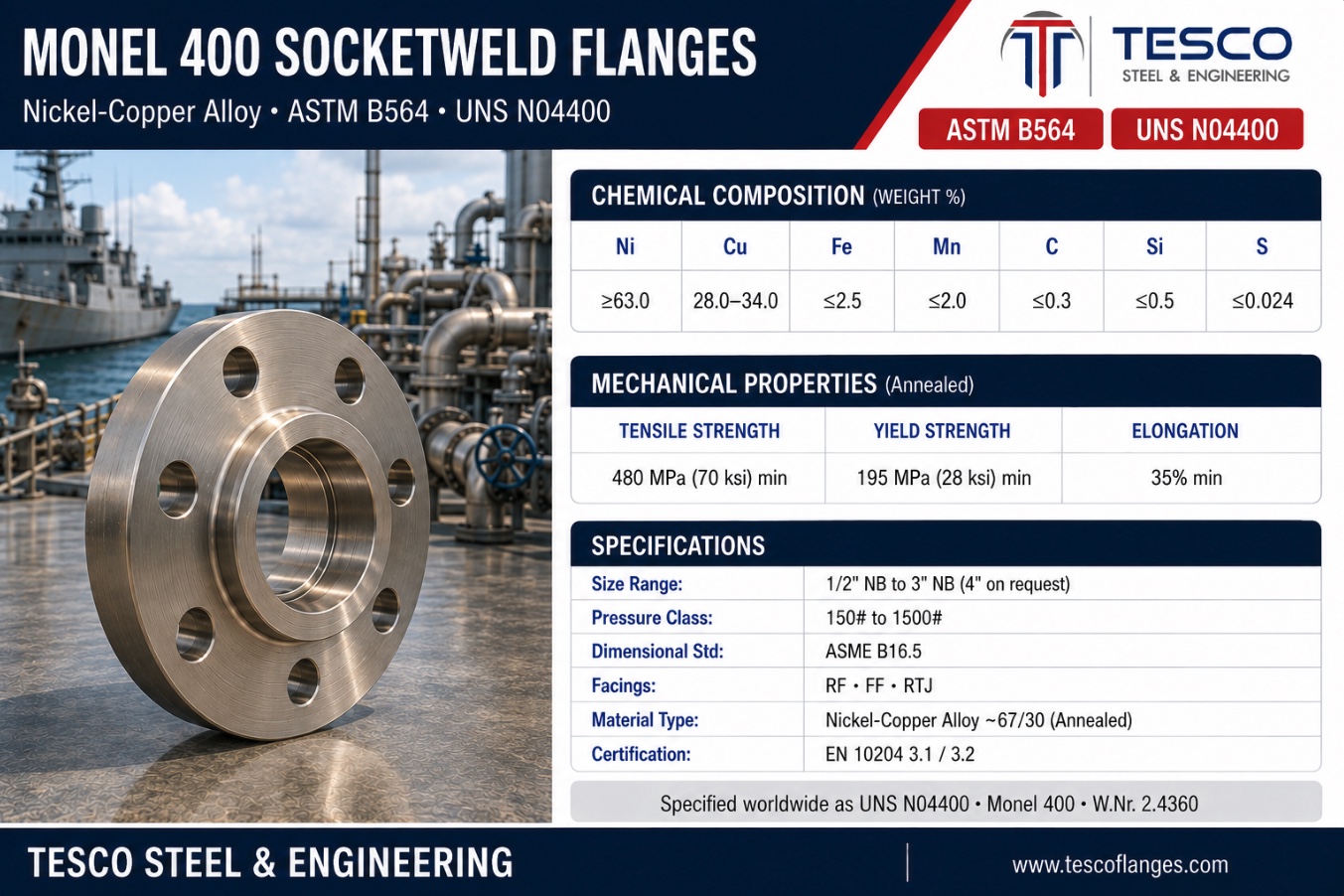
Monel 400 · B564 · N04400 · 2.4360The Original Superalloy — Since 1905Ni ≥63% · Cu 28–34% · No ChromiumThe HF Alkylation MetalHot Caustic & Flowing Seawater480 / 195 MPa · 35% ElongationASME B16.5 ½″–3″ · Class 150–1500EN 10204 3.1 / 3.2 · ISO 9001:2015
Monel 400 Socketweld Flanges — Specifications at a Glance
What is a Monel 400 Socketweld Flange?
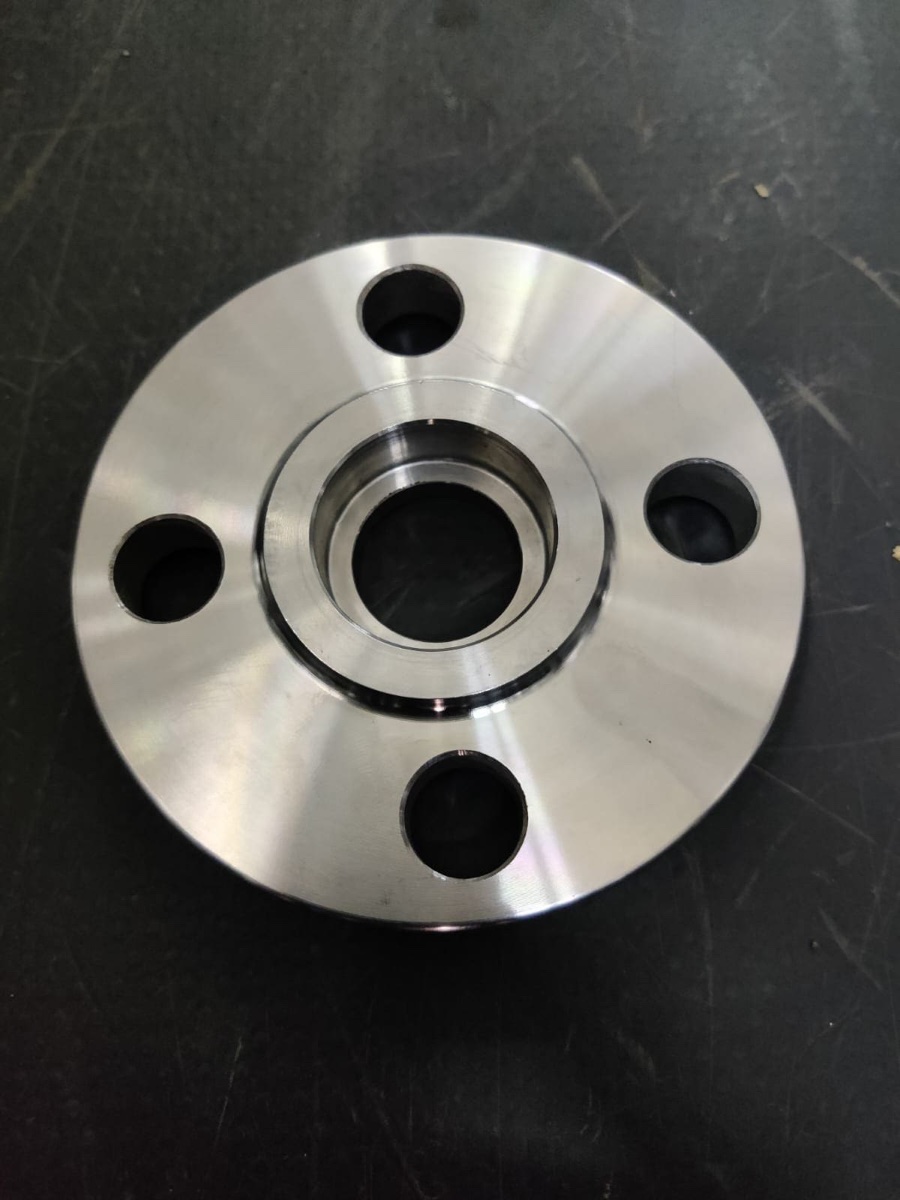
The nickel-copper classic in the small-bore pattern. A forged Monel 400 flange (ASTM B564 / UNS N04400 / W.Nr. 2.4360) with a machined socket: pipe seated square by geometry, one external fillet weld with ERNiCu-7 filler — no preheat, no PWHT — through-bore matched to the pipe schedule. Ni ≥63%, Cu 28–34%, no chromium: corrosion resistance by nobility, not by film — at home in HF acid, hot caustic, brine and flowing seawater, exactly where film-forming stainless fails. Tensile ≥480 MPa, yield ≥195 MPa, elongation ≥35%, annealed. Sized by ASME B16.5 at ½″–3″ NB, Classes 150–1500; EN 10204 3.1 on every lot.
Chlorides puncture it, crevices starve it, reducing acid strips it
Every stainless on this site
Nobility (this page)
The Ni-Cu solution is inherently slow to corrode — no film needed
Strongly oxidising media attack the bare metal
Monel 400, nickel 200, the Cu-Ni family
Choose by the chemistry's direction: reducing environments — HF, caustic, de-aerated brine — favour nobility; oxidising ones favour the film-formers. A nitric-acid duty on a Monel datasheet is a specification error, and vice versa.
What Nickel-Copper Buys
The HF Franchise
Hydrofluoric acid defeats stainless, glass and most nickel alloys — Monel's copper forms sparingly soluble fluorides that stifle attack, and the world's HF alkylation units are built on it by licensor specification.
Hot Caustic, Comfortably
NaOH strengths and temperatures that crack carbon steel and embrittle stainless leave high-nickel alloys essentially untouched — chlor-alkali, evaporators, viscose and alumina duty.
A Century at Sea
Flowing seawater is a Monel classic — naval shafts, trim and fasteners since before stainless existed, with chloride SCC simply not applicable. (Stagnant water is the honest caveat — see the notes.)
No Film, No Film Failures
Pitting initiation, crevice starvation, film-stripping — the classic stainless failure modes have nothing to attack; corrosion, where it occurs, is slow and uniform.
Monel 400 Chemical Composition (UNS N04400)
Element
Ni
Cu
Fe
Mn
C
Si
S
Weight %
≥63.0
28.0–34.0
≤2.5
≤2.0
≤0.3
≤0.5
≤0.024
The nickel is a floor, not a range — two-thirds of the metal, in roughly the two-to-one ratio of the Sudbury ore the alloy was first refined from in 1905. No chromium, no molybdenum: every corrosion property flows from the nobility of the Ni-Cu solid solution. PMI confirms the ratio on every piece.
Mechanical Properties (Annealed)
Property
ASTM B564 N04400 Requirement
Tensile Strength
≥ 480 MPa (70 ksi)
Yield Strength (0.2%)
≥ 195 MPa (28 ksi) — tough and ductile; strength duties belong to the K-500 sibling
Elongation
≥ 35% — no ductile-brittle transition, cryogenic-tough
Condition
Annealed — furnace records certified; work-hardened product forms run higher but flanges supply annealed
Temperature Span
Cryogenic upward to ~480 °C in clean atmospheres; hot sulphur-bearing gas embrittles nickel alloys — see the notes
Rating
B16.5 nickel-alloy group pressure-temperature tables; stated per class on our quotations
Monel 400 Socketweld Flanges are available in the following specifications:
Material Grade
Monel 400, ASTM B564 (UNS N04400), W.Nr. 2.4360 — certificates carry the designations your documentation uses
Heat Treatment
Annealed with furnace records certified
Size
1/2"NB to 3"NB per ASME B16.5; 4″ and larger to order; EN 1092-1 patterns to order
Class
150#, 300#, 600#, 900#, 1500# (900# shares 1500# dimensions in most sizes) — HF & caustic volume lives in 150/300
Facings
Raised Face (SWRF), Flat Face (SWFF), Ring Type Joint (SWRTJ) with groove per B16.20
Bore
Socket bore to pipe OD; through-bore matched to pipe schedule (Sch 10S/40S dominate)
Welding
Single external fillet with 1/16″ expansion gap; ERNiCu-7 filler; sulphur-clean practice; no preheat, no PWHT
Service Span
HF alkylation, hot caustic, brine, flowing seawater, fluorine & dry chlorine; not oxidising acids — see the notes
Surface Finish
Natural machined — dedicated nickel-alloy handling, no carbon-steel contact, no sulphur-bearing lubricants
Testing
Tension & chemistry per heat; PMI on every piece — Ni-Cu ratio confirmed; socket depth and bore gauged
Certification
EN 10204 3.1 with anneal records (standard) / 3.2 witnessed
Specification Notes — Getting Monel Sockets Right
Four honest notes.The chemistry runs one direction: reducing media are the franchise — oxidising acids (nitric above all), ferric and cupric salts attack the bare metal; a nitric duty on a Monel enquiry is a specification error we will flag. Two famous embrittlers:mercury — even trace contamination liquid-metal-embrittles nickel-copper — and moist ammonia with oxygen, which can stress-corrode the copper half; both belong on the enquiry checklist. Stagnant seawater pits: flowing water is the naval classic — dead legs, deposits and fouling create oxygen-starved cells; design for flow or compare copper-nickel and super duplex. And hot sulphur embrittles: above ~300–350 °C sulphur-bearing atmospheres attack high-nickel alloys — state the gas honestly.
How Our Monel 400 Socketweld Flanges Are Manufactured
1
Forging — cut billet of the spectro-verified N04400 heat is hot-forged into the flange blank with full heat traceability and segregated nickel-alloy handling.
2
Annealing — sets the soft, tough solid-solution structure; furnace charts retained against the heat number.
3
Machining — faces, OD and drilling to ASME B16.5 on dedicated stations with sulphur-free lubricants — the gummy Ni-Cu matrix demands sharp tooling and positive feeds; socket counterbore and depth gauged piece by piece, through-bore matched to the ordered schedule.
4
Facing — RF serrations, flat face or RTJ groove per B16.20.
5
Testing & marking — tension and chemistry per heat; PMI on every piece with the Ni-Cu ratio confirmed; laser-marked with grade, size, class, schedule and heat number.
6
Certification & packing — EN 10204 3.1 MTC with anneal records (3.2 witnessed on request); ERNiCu-7 WPS guidance included; packed sea-worthy with no carbon-steel contact.
Where Monel 400 Socketweld Flanges Are Used
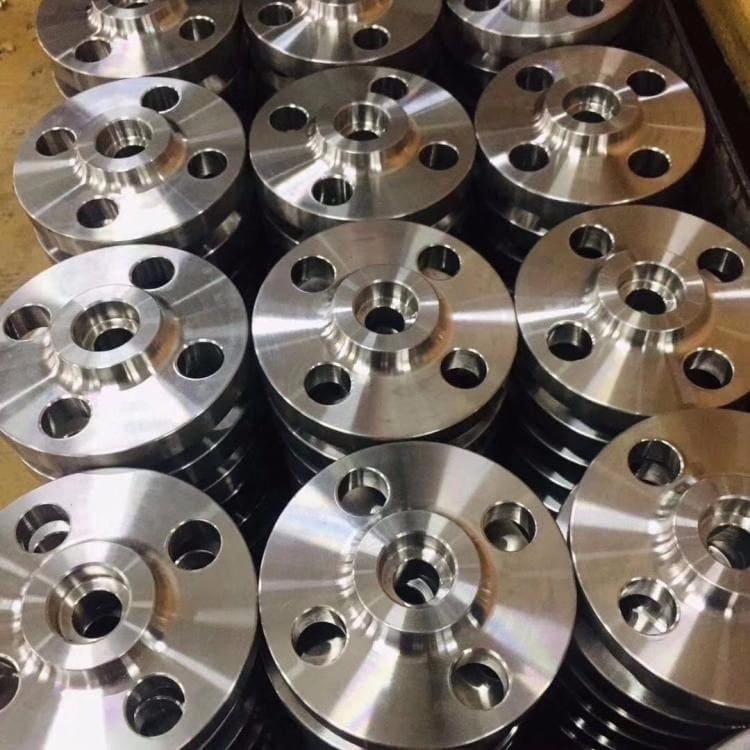
Where the chemistry runs reducing: HF alkylation units (piping trim, sample and instrument connections, by licensor specification), fluorine and fluorochemical plants, chlor-alkali and caustic evaporation, brine and salt works, viscose and soap plants, flowing-seawater systems and naval hardware, and dry chlorine service. Production below:
How to Specify & Order a Monel 400 Socketweld Flange
Six elements — and the service chemistry belongs on the enquiry:
1
Size & standard — e.g. 1″ NB ASME B16.5, or DN25 EN 1092-1 to order.
2
Pressure class & facing — 150#–1500#; SWRF (the default), SWFF or SWRTJ — in HF duty, the licensor's gasket line so the sealing system aligns.
3
Pipe schedule — Sch 10S, 40S or 80S: the through-bore is matched to the pipe ID.
4
Grade line — Monel 400 / ASTM B564 / UNS N04400 / W.Nr. 2.4360 all name the same metal; the service — HF, caustic strength & temperature, or the water — plus any mercury or ammonia exposure invited for honest metallurgy.
5
Certification — EN 10204 3.1 with anneal records (our standard) / 3.2 witnessed, PMI as applicable.
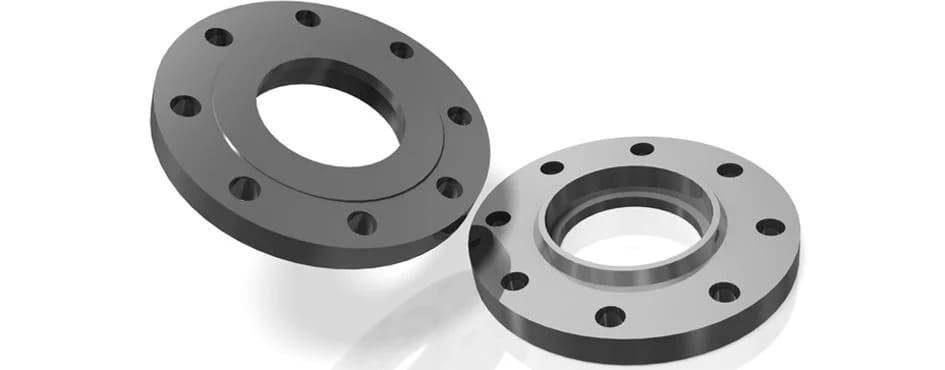
A Monel 400 socketweld flange is a forged nickel-copper alloy flange — at least 63% nickel with 28-34% copper, no chromium, ASTM B564, UNS N04400, W.Nr. 2.4360 — whose back carries a machined socket: the pipe end seats inside, self-aligned square to the face, and is secured with a single external fillet weld. Monel is the original corrosion superalloy, older than stainless steel itself, and it protects by a different principle: with no chromium there is no passive film to form or to strip — the metal is simply noble, which is why it thrives in exactly the reducing environments that dissolve film-forming stainless: hydrofluoric acid, hot caustic, brine. Dimensioned to ASME B16.5 for ½" to 3" NB in Classes 150 to 1500 — the nickel-copper classic, in the small-bore pattern.
Why is Monel called the original superalloy?
Because it got there first — by nearly a decade. Monel was first produced in 1905, refined more or less directly from the nickel-copper ore of Sudbury, Ontario, whose natural two-to-one nickel-copper ratio the alloy still carries; stainless steel would not be invented until 1913. For the first half of the twentieth century Monel was the premium corrosion metal of the industrial world — roofing the pre-war landmarks, sheathing ship shafts, lining the first chemical plants — and when cheaper stainless took the general market, Monel kept the duties stainless could not do: hydrofluoric acid, hot caustic, brine and seawater hardware. A century on, those franchises still belong to it, and the alloy's specification pedigree runs deeper than any other metal in this series.
What is the chemical composition of Monel 400 (UNS N04400)?
Nickel 63.0% minimum, copper 28.0-34.0%, iron ≤2.5%, manganese ≤2.0%, carbon ≤0.3%, silicon ≤0.5%, sulphur ≤0.024%. Two readings matter. First, the nickel is a floor, not a range — two-thirds of the metal, with copper making up most of the rest: the Ni-Cu pair is the alloy, in roughly the proportion of the ore it was first refined from. Second, what is absent: no chromium and no molybdenum — Monel does not build a passive oxide film at all, and every corrosion property it has flows from the inherent nobility of the nickel-copper solid solution. That absence is a feature, covered in its own FAQ. Chemistry is verified per heat and travels on the EN 10204 3.1 MTC.
Why is having no chromium a feature, not a defect?
Because a passive film is both a shield and a vulnerability. Stainless steels survive by growing a chromium-oxide skin — and every classic stainless failure is that skin being locally defeated: pitting where chlorides puncture it, crevice attack where it starves of oxygen, film-stripping where reducing acid dissolves it faster than it re-forms. Monel opted out of the whole game: the nickel-copper solid solution is inherently noble, corroding slowly and uniformly if at all, with no film to puncture, starve or strip. That is why it thrives in reducing environments that destroy stainless — hydrofluoric acid, hot concentrated caustic, de-aerated brine — and why its weaknesses are the mirror image: strongly oxidising media, which attack the bare metal the film-formers would shrug off. Choose it by the chemistry's direction, not by habit.
Why is Monel THE hydrofluoric acid alloy?
Because HF is the acid that defeats nearly everything else, and refinery economics run on it. Hydrofluoric acid strips stainless passive films, devours glass and attacks most nickel alloys — but the copper in Monel forms sparingly soluble fluoride corrosion products that stifle attack, giving the alloy useful resistance across essentially all HF concentrations at plant temperatures. The consequence is written into an entire refinery process: HF alkylation units — which turn light olefins into high-octane gasoline over hydrofluoric acid catalyst — are built on Monel by licensor specification: trays, piping, valve trim and the small-bore flanging this page sells. Fluorine and hydrogen fluoride gas service, dry chlorine and fluorochemical plants follow the same logic. In HF territory, substitution is not a conversation.
How does Monel handle caustic — the other franchise?
Hot concentrated caustic soda is nickel's home ground, and Monel inherits most of the family privilege. Sodium and potassium hydroxide at strengths and temperatures that crack carbon steel and embrittle stainless leave high-nickel alloys essentially untouched — commercially pure nickel (Alloy 200) is the textbook metal for the hottest, strongest caustic, with Monel 400 serving comfortably through the broad middle of the concentration-temperature map at lower cost. Chlor-alkali plants, caustic evaporators, viscose and soap works and the caustic side of alumina refining all run on this chemistry. One honest note: in the very hottest caustic with sulphur species present, nickel alloys want de-stressed, sulphur-clean practice — our anneal records and clean handling speak to exactly that.
Is Monel good for seawater — honestly?
Yes with one condition: keep the water moving. In flowing seawater Monel is a naval classic — pump shafts, valve trim, seawater piping and fasteners with a century of service records; it resists erosion-corrosion far better than copper alloys and does not care about chloride SCC at all. The honest caveat is stagnation: under deposits, in dead legs and beneath marine fouling, oxygen-starved cells can pit the alloy — the no-film nobility that ignores flowing chlorides gives less protection in a stagnant crevice, and a socket weld joint adds its own. Practice answers: design for flow, avoid long dead legs, and for stagnant-tolerant seawater service compare copper-nickel (which resists fouling by poisoning it) and super duplex. Our quotation compares honestly when the service is stated.
What are Monel 400's honest weaknesses?
Three, each the mirror of a strength. Oxidising media: with no chromium film, nitric acid, ferric and cupric salts, and strongly aerated acid attack the bare metal — Monel's chemistry runs the reducing direction only, and a nitric duty on a Monel datasheet is a specification error. Two classic embrittlers: mercury — even trace contamination liquid-metal-embrittles nickel-copper alloys, an old and famous failure mode — and ammonia with oxygen present, which can stress-corrode the copper half of the alloy in warm moist conditions; both belong on any honest enquiry checklist. And hot sulphur: above roughly 300-350°C, sulphur-bearing atmospheres embrittle high-nickel alloys, capping Monel's already modest high-temperature role. None of these touch its franchises; all of them deserve a line on the enquiry.
What are the mechanical properties of Monel 400 socketweld flanges?
In the annealed condition ASTM B564 requires tensile strength 480 MPa (70 ksi) minimum, yield strength 195 MPa (28 ksi) minimum and elongation 35% minimum — a tough, ductile certificate that holds from cryogenic temperatures (no ductile-brittle transition) to the alloy's practical hot limit. Monel work-hardens strongly, and drawn or stress-relieved product forms run far higher numbers — but flanges are supplied annealed, and B16.5's nickel-alloy pressure-temperature tables govern the joint's rating. Where a Monel duty genuinely needs strength — pump shafts, fasteners, wear parts — the age-hardenable sibling K-500 nearly triples the yield; its own FAQ below draws the line. For acid, caustic and seawater flanging, 400's certificate is exactly enough and never the story.
Monel 400 or K-500 — when does the stronger sibling matter?
K-500 (UNS N05500) is Monel 400 plus aluminium and titanium, age-hardened to roughly triple the yield strength while keeping essentially the same corrosion behaviour. That buys shafts, stems, springs, fasteners and doctor blades — components where nickel-copper corrosion resistance must coexist with real mechanical duty. For flanges the answer is almost always 400: a flange's strength requirement is set by B16.5's class tables, which 400 meets across the range, and 400 welds freely while K-500's age-hardened condition complicates welding and demands re-ageing after it. Specify K-500 flanging only where a specification explicitly demands it — we forge it to order — and let 400 carry the piping. Both grades' material pages live on this site.
How is a Monel 400 socketweld flange welded?
Easily, with nickel-family housekeeping. Geometry is standard: pipe bottomed in the socket, withdrawn 1/16" (1.6 mm) to leave the expansion gap, single external fillet weld — with ERNiCu-7 (Monel 60-type) filler as the matching consumable. No preheat, no PWHT. The housekeeping is the nickel family's: scrupulous cleanliness, because nickel alloys are embrittled by sulphur, lead and low-melting contaminants — degrease before welding, keep marking crayons and machining lubricants off the joint, use dedicated clean tooling. Weld metal is sluggish compared to steel; slightly wider bevels and deliberate technique are normal. Our flanges arrive annealed with records, and WPS guidance naming the filler travels with every supply.
What sizes and pressure classes do Monel 400 socketweld flanges come in?
ASME B16.5 standardises socket weld flanges from ½" to 3" NB in Classes 150, 300, 600, 900 and 1500 — Class 900 sharing Class 1500 dimensions in most small-bore sizes — with 4" and Class 2500 made to order. HF alkylation and caustic small bore concentrates in Classes 150 and 300; seawater trim likewise. Put the pipe schedule on the enquiry — Sch 10S and 40S dominate — and the through-bore is matched to the pipe ID so the joint presents no step to the fluid. B16.5's nickel-alloy pressure-temperature tables govern the rating; our quotations state them per class.
What details are needed to get an accurate Monel 400 socketweld flange quotation?
Six elements plus commercial terms: (1) size — ½" to 3" NB; (2) pressure class — 150 to 1500; (3) facing — SWRF, SWFF or SWRTJ with ring number, and in HF duty the licensor's gasket line; (4) the pipe schedule — Sch 10S, 40S or 80S, so the through-bore matches the pipe ID; (5) the grade line — Monel 400, ASTM B564, UNS N04400 or W.Nr. 2.4360 all name the same metal, and the certificate carries the designations your documentation uses; (6) certification — EN 10204 3.1 with anneal records (our standard) or 3.2 witnessed, PMI as applicable. State the service — HF, caustic strength and temperature, or the water — and any mercury or ammonia exposure, and the quotation answers the metallurgy honestly. Normally within 24 hours.
Is Monel 400 stocked or made to order?
A steadier stock item than most of the high-alloy range — Monel's franchises generate continuous maintenance demand, not just project waves. Common small-bore sizes in Classes 150 and 300 turn over regularly and are often available quickly; larger sizes and higher classes are forged to order from certified N04400 heats held with our nickel-alloy stock. Typical to-order lead times run days to a few weeks by quantity; HF-unit turnaround work is a duty we know well — say so on the enquiry and small lots can usually be expedited, with the EN 10204 3.1 certificate carrying the 2.4360 designation where European documentation expects it.
Who manufactures Monel 400 socketweld flanges in India?
Tesco Steel & Engineering is an ISO 9001:2015 certified flange manufacturer based in Mumbai, India, producing Monel 400 (ASTM B564, UNS N04400) socket weld flanges from ½" to 3" NB (larger to order) in Classes 150-1500 — each forged from certified heats, annealed with furnace records against the heat number, machined on dedicated nickel-alloy stations with gauged socket depth and schedule-matched bore, PMI-checked — the nickel-copper ratio confirmed on every piece — and laser-marked with grade, size, class, schedule and heat number. Supplied with EN 10204 3.1/3.2 certification and ERNiCu-7 WPS guidance, alongside the K-500 sibling, the copper-nickel cousins, the Hastelloy family and the full high-alloy socketweld range this series covers. Exported to more than 50 countries.