Tesco Steel & Engineering manufactures 254 SMO socketweld flanges — the 6Mo super austenitic: ASTM A182 F44, UNS S31254, W.Nr. 1.4547 — to ASME B16.5 from ½″ to 3″ NB in Classes 150–1500. This is the alloy built when the stainless industry decided to beat warm seawater with austenitic metallurgy: 6.0–6.5% molybdenum with 20% chromium and deliberate nitrogen lands PREN at 42–45 — past the seawater crevice threshold with margin — where 316L (~25), 317L (~30) and 904L (~35) each crept closer and fell short. The nitrogen also strengthens: 650/300 MPa — the strongest austenitic certificate in this series — with no duplex clocks, ceilings or floors. The fabrication rule that defines the grade is stated plainly below: 6Mo welds with nickel-alloy 625 filler, never matching, never autogenous. The honest rival is super duplex — usually cheaper where it fits — and the honest ceiling beyond is titanium. Facings: SWRF, SWFF, SWRTJ. Every lot with EN 10204 3.1/3.2 MTC. ISO 9001:2015, made in Mumbai, India — exported to 50+ countries.
254 SMO · A182 F44 · UNS S31254 · 1.45476Mo Super Austenitic — PREN ≥42Built for Warm SeawaterN-Strengthened — 650 / 300 MPa625 Filler Rule — Never AutogenousNo Duplex Clocks or FloorsASME B16.5 ½″–3″ · Class 150–1500EN 10204 3.1 / 3.2 · ISO 9001:2015
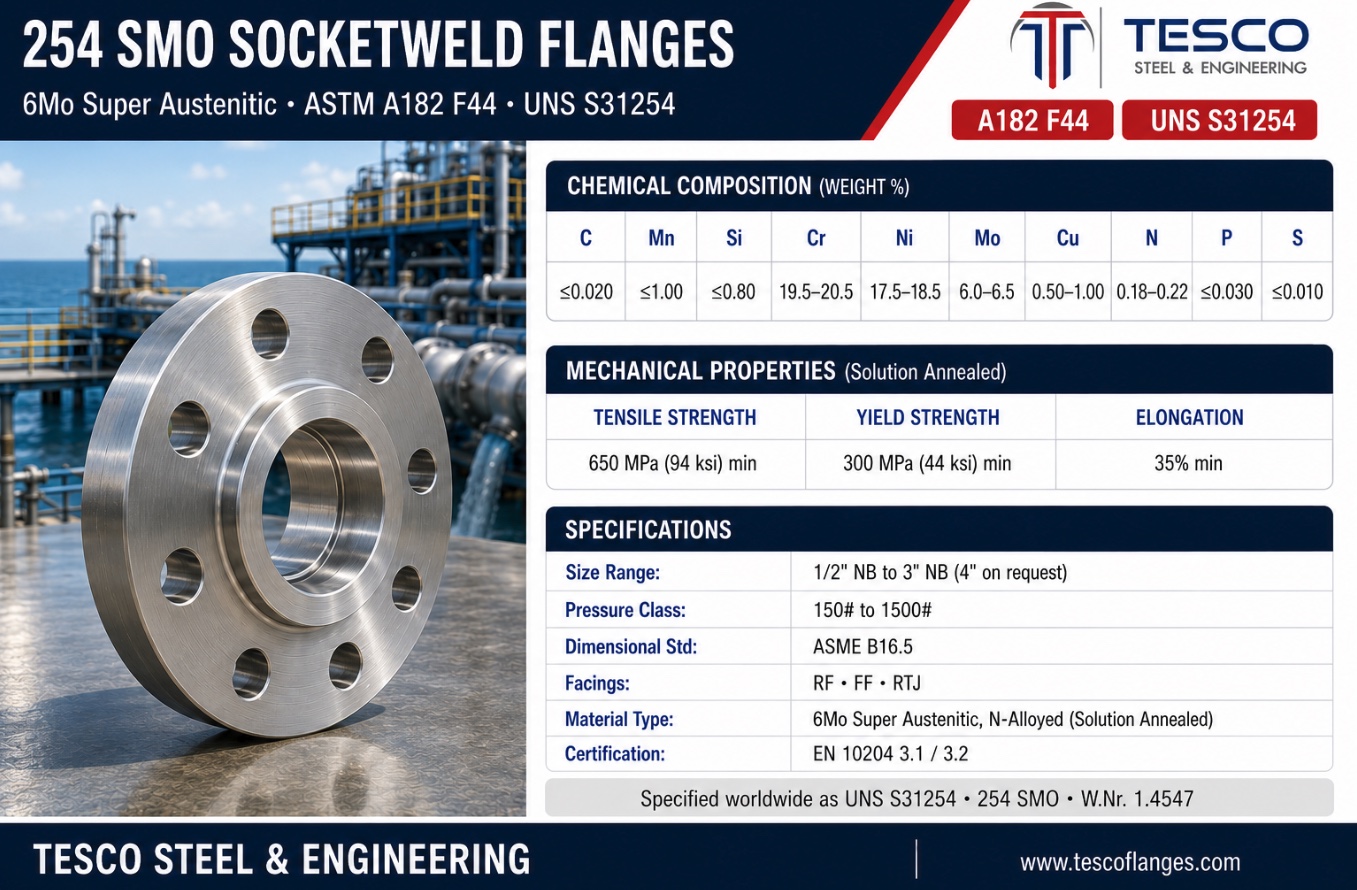
254 SMO Socketweld Flanges — Specifications at a Glance
What is a 254 SMO Socketweld Flange?
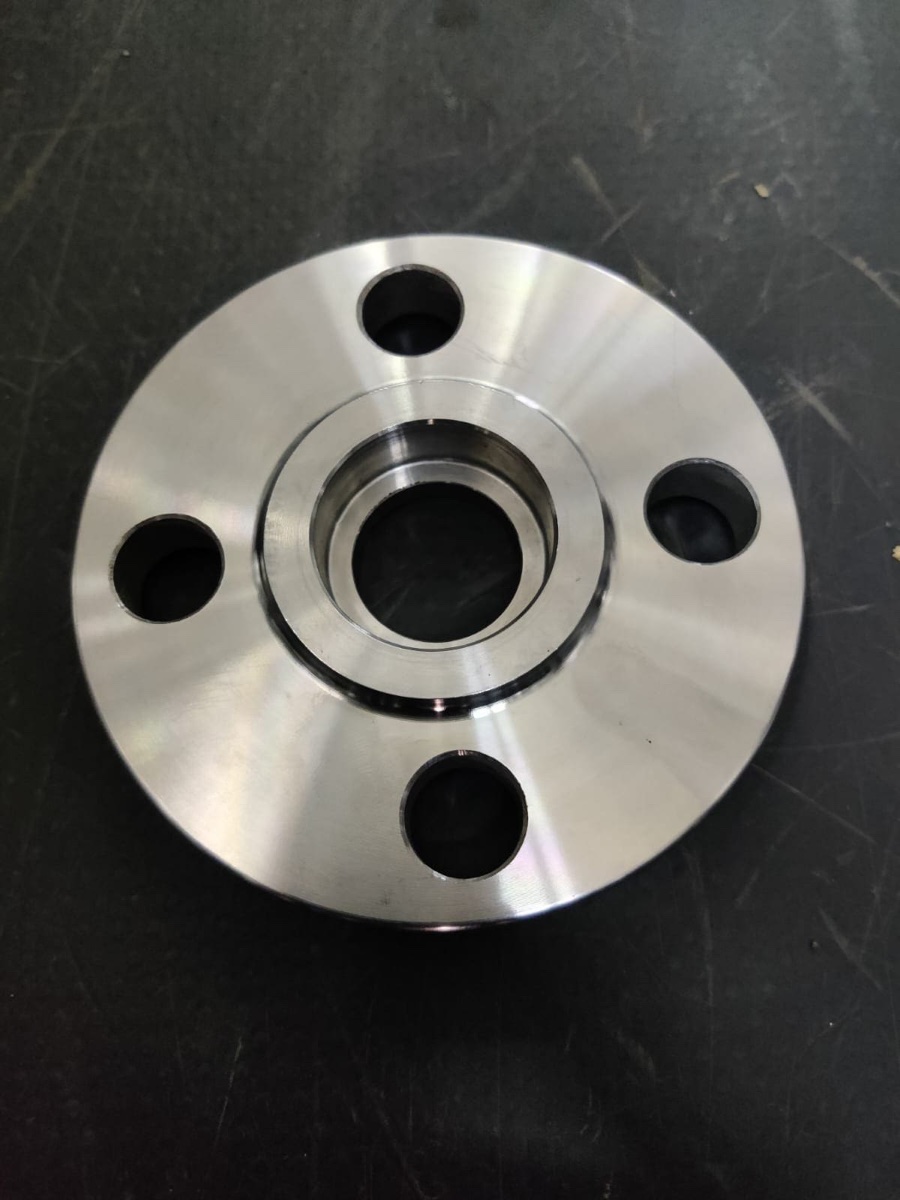
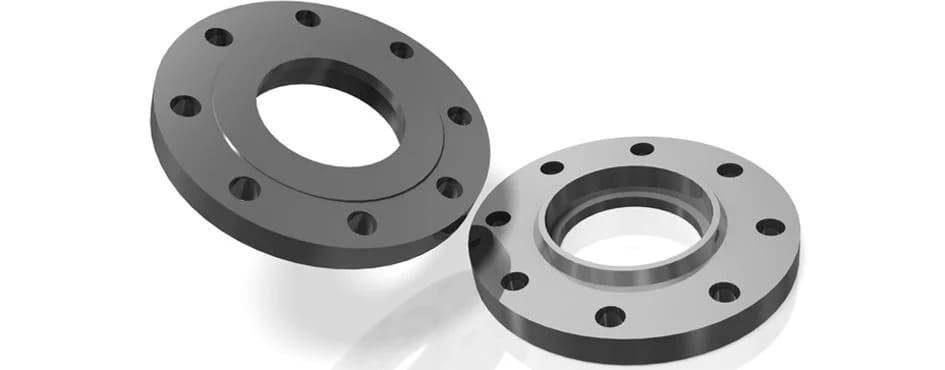
The 6Mo seawater grade in the small-bore pattern. A forged super austenitic flange (254 SMO / ASTM A182 F44 / UNS S31254 / W.Nr. 1.4547) with a machined socket: pipe seated square by geometry, one external fillet weld with nickel-alloy 625-type filler — never matching, never autogenous — through-bore matched to the pipe schedule. Mo 6.0–6.5% + Cr 20% + N 0.18–0.22% set PREN ≥42: past the warm-seawater crevice threshold. The nitrogen also delivers the series' strongest austenitic certificate: tensile ≥650 MPa, yield ≥300 MPa, elongation ≥35% — with no duplex-style clocks or temperature floors. Sized by ASME B16.5 at ½″–3″ NB, Classes 150–1500; EN 10204 3.1 on every lot.
Also searched as: 6Mo socket weld flange, 6 moly flange, F44 socket weld flange, S31254 SWRF flange, 1.4547 socket weld flange, super austenitic seawater flange — all the same product family. Related pages: the facings — SWRF / SWFF / SWRTJ — the socketweld hub, the other 254 SMO types — blind, weld neck, slip-on — the neighbours F904L / F53 / F55 socketweld, the 254 SMO material hub, and the stainless steel hub.
The working rule: warm-seawater crevice service begins around PREN 40. 254 SMO was designed to cross that line with austenitic metallurgy intact — and forty years of desalination and offshore service stand behind it.
What the 6Mo Recipe Buys
Past the Seawater Threshold
PREN 42–45 — where the crevice attack that stops 316L, 317L and 904L finally loses its grip. Desalination trains, seawater cooling, offshore injection: this is the specification default.
Nitrogen's Triple Duty
0.18–0.22% N adds PREN at a 16× multiplier, strengthens the austenite to 650/300 MPa, and slows the intermetallic clock — three jobs from one cheap element.
Austenitic Freedom
No 475 °C embrittlement, no sigma discipline on cooling rates, no -50 °C floor, no ~300 °C ceiling — the freedoms the duplex rival trades away.
Honesty About the Weld
6Mo weld metal segregates its molybdenum — so the grade welds with nickel-alloy 625 filler, never matching, never autogenous. The rule travels with every supply as WPS guidance.
254 SMO Chemical Composition (UNS S31254)
Element
C
Mn
Si
Cr
Ni
Mo
Cu
N
P
S
Weight %
≤0.020
≤1.00
≤0.80
19.5–20.5
17.5–18.5
6.0–6.5
0.50–1.00
0.18–0.22
≤0.030
≤0.010
Notice how tightly it is written: half-point windows on Cr and Ni, sulphur at a third of the usual ceiling, manganese and silicon halved. At 6% molybdenum the alloy lives close to its intermetallic phase boundaries — composition control is what keeps segregation and sigma manageable. PMI on every piece; chemistry per heat on the EN 10204 3.1 MTC.
Mechanical Properties (Solution Annealed)
Property
ASTM A182 F44 Requirement
Tensile Strength
≥ 650 MPa (94 ksi) — the strongest austenitic certificate in this series
Yield Strength (0.2%)
≥ 300 MPa (44 ksi) — nitrogen-strengthened; the gap to super duplex's 550 is the price of austenitic freedom
Elongation
≥ 35% — full austenitic ductility kept
Condition
Solution annealed — anneal quality is the alloy's performance warranty; furnace records certified
Temperature Span
Cryogenic (no transition, no floor) upward — none of the duplex family's clocks or ceilings
PREN
≥42 — warm-seawater crevice service; the hardest hot chlorinated corners escalate to titanium
254 SMO Socketweld Flanges are available in the following specifications:
Material Grade
254 SMO / ASTM A182 F44 (UNS S31254), W.Nr. 1.4547 — certificates carry the designations your documentation uses
Heat Treatment
Solution annealed with furnace records — the 6Mo anneal is the performance warranty
Size
1/2"NB to 3"NB per ASME B16.5; 4″ and larger to order; EN 1092-1 patterns to order
Class
150#, 300#, 600#, 900#, 1500# (900# shares 1500# dimensions in most sizes) — seawater volume lives in 150/300
Facings
Raised Face (SWRF), Flat Face (SWFF), Ring Type Joint (SWRTJ) with groove per B16.20
Bore
Socket bore to pipe OD; through-bore matched to pipe schedule (Sch 10S/40S dominate)
Welding
Single external fillet with 1/16″ expansion gap; ERNiCrMo-3 (625-type) filler — never matching, never autogenous; low heat input, interpass ≤~100 °C; no preheat, no PWHT
Pickled or natural machined — dedicated handling, no carbon-steel contact
Testing
Tension & chemistry per heat; PMI on every piece — 6% Mo and N-bearing chemistry confirmed; socket depth and bore gauged
Certification
EN 10204 3.1 with solution-anneal records (standard) / 3.2 witnessed
Specification Notes — Getting 6Mo Sockets Right
Four honest notes.The 625-filler rule is absolute: 6Mo weld metal segregates its molybdenum — matching or autogenous welds can pit at their own deposit; nickel-alloy ERNiCrMo-3 filler is worldwide standard practice and rides with our WPS guidance. Super duplex is usually cheaper where it fits:F53/F55 match the PREN class with higher yield and less nickel — 254 SMO earns its premium where duplex's clocks, ceiling and floor bite; we price the pair. Hot chlorinated seawater is the honest edge: crevice resistance is a temperature threshold, a socket is a creviced joint, and the hardest corners of that map prefer butt welds or escalate to titanium. And the certificate is the warranty: at 6% Mo, anneal quality and composition control decide real performance — buy the paperwork with the flange.
How Our 254 SMO Socketweld Flanges Are Manufactured
1
Forging — cut billet of the spectro-verified S31254 heat is hot-forged with controlled reduction to break down and homogenise the cast structure; full heat traceability, segregated high-alloy handling.
2
Solution annealing — high-temperature anneal and rapid quench that dissolves intermetallics and homogenises the molybdenum; furnace charts retained against the heat number — the step that makes a 6Mo a 6Mo.
3
Machining — faces, OD and drilling to ASME B16.5 on dedicated stations — the nitrogen-strengthened austenite is the range's toughest machining: rigid setups, sharp tooling, positive feeds; socket counterbore and depth gauged piece by piece, through-bore matched to the ordered schedule.
4
Facing — RF serrations, flat face or RTJ groove per B16.20.
5
Testing & marking — tension and chemistry per heat; PMI on every piece with the 6% molybdenum confirmed; laser-marked with grade, size, class, schedule and heat number.
6
Certification & packing — EN 10204 3.1 MTC with solution-anneal records (3.2 witnessed on request); 625-filler WPS guidance included; packed sea-worthy with no carbon-steel contact.
Where 254 SMO Socketweld Flanges Are Used
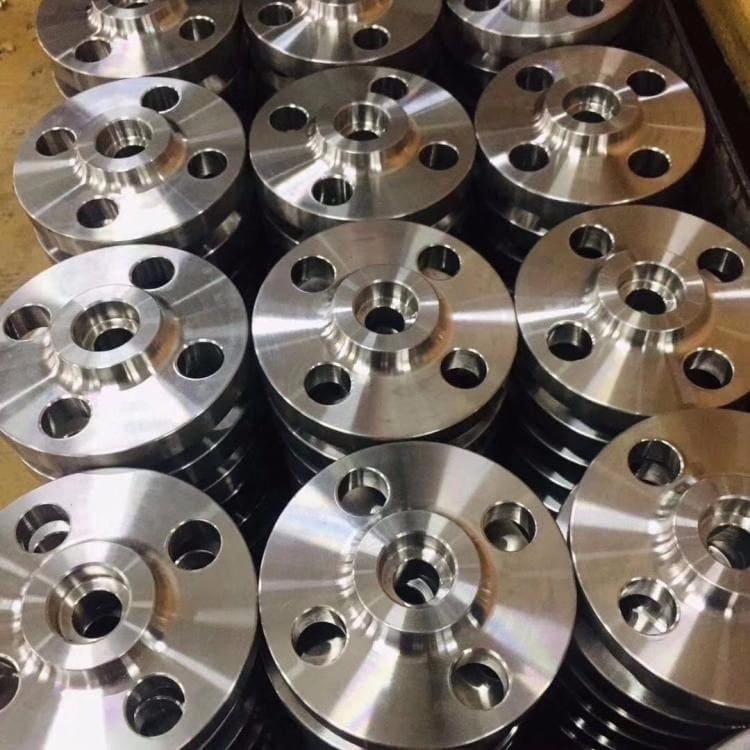
Where the water is salt and warm: desalination and RO trains (high-pressure feed and brine small bore), seawater cooling and intake systems, offshore water injection and topside seawater service, coastal power and LNG plant seawater circuits, the pulp bleach plant's worst washers, and flue-gas condensate duty. Production below:
How to Specify & Order a 254 SMO Socketweld Flange
Six elements — and for seawater duty, the water itself belongs on the enquiry:
1
Size & standard — e.g. 1″ NB ASME B16.5, or DN25 EN 1092-1 to order.
2
Pressure class & facing — 150#–1500#; SWRF (the default), SWFF (common against GRP/lined mates) or SWRTJ with ring number.
3
Pipe schedule — Sch 10S, 40S or 80S: the through-bore is matched to the pipe ID.
4
Grade line — 254 SMO / A182 F44 / UNS S31254 / W.Nr. 1.4547 all name the same metal; the water — temperature, chlorination, service — invited for the honest 6Mo-vs-super-duplex comparison.
5
Certification — EN 10204 3.1 with solution-anneal records (our standard) / 3.2 witnessed, PMI as applicable.
Example: “SWRF Flange, 1″ NB, ASME B16.5 Class 300, Sch 40S bore, 254 SMO / A182 F44, RO train brine service 35 °C, EN 10204 3.1 — 20 pcs.” Quotations normally within 24 hours.
254 SMO Socketweld Flanges — Frequently Asked Questions
What is a 254 SMO socketweld flange?
A 254 SMO socketweld flange is a forged 6Mo super austenitic stainless steel flange — 20% chromium, 18% nickel, 6.0-6.5% molybdenum and deliberate nitrogen, ASTM A182 grade F44, UNS S31254, W.Nr. 1.4547 — whose back carries a machined socket: the pipe end seats inside, self-aligned square to the face, and is secured with a single external fillet weld. 254 SMO is the alloy the stainless industry built when it finally decided to beat warm seawater with austenitic metallurgy: PREN at or above 42 crosses the crevice threshold that stops every grade below it, while the structure keeps austenitic weldability and toughness. Dimensioned to ASME B16.5 for ½" to 3" NB in Classes 150 to 1500 — the 6Mo seawater grade, in the small-bore pattern.
What does 6% molybdenum actually buy?
The seawater threshold. On the PREN yardstick — Cr + 3.3×Mo + 16×N — the industry's working rule is that warm seawater crevice service begins around PREN 40: below it, deposits, gaskets and socket gaps eventually start crevice attack; above it, the alloy holds. 316L sits at ~25, 317L at ~30, 904L at ~35 — each generation crept closer and fell short. 254 SMO's 6.0-6.5% molybdenum, with 20% chromium and the nitrogen's 16-fold multiplier, lands the alloy at 42-45: past the threshold with margin. That number is why 6Mo became the specification default for desalination trains, seawater cooling and intake systems, offshore water injection and the bleach plant's worst washers — the duties where the ladder's lower rungs kept dissolving.
What does the nitrogen in 254 SMO do?
Triple duty — the quiet genius of the 6Mo generation. First, pitting resistance: nitrogen carries a 16-fold multiplier in the PREN formula, so 0.18-0.22% contributes as much as a full point of molybdenum, at a fraction of the cost. Second, strength: interstitial nitrogen is a potent austenite strengthener — it is why this grade certifies 650/300 MPa where ordinary austenitics manage 515/205, nearly closing the gap to duplex without any ferrite. Third, structure: nitrogen is a strong austenite former, holding the phase balance against all that ferrite-forming molybdenum and — critically — slowing the intermetallic precipitation that haunts high-molybdenum alloys during welding and heat treatment. Three jobs, one cheap element: the reason every modern super alloy generation is nitrogen-alloyed.
What is the chemical composition of 254 SMO (UNS S31254)?
Carbon ≤0.020%, manganese ≤1.00%, silicon ≤0.80%, chromium 19.5-20.5%, nickel 17.5-18.5%, molybdenum 6.0-6.5%, copper 0.50-1.00%, nitrogen 0.18-0.22%, phosphorus ≤0.030%, sulphur ≤0.010%. Notice how tightly it is written: half-point windows on chromium and nickel where ordinary grades get two to four points, sulphur at a third of the usual ceiling, manganese and silicon halved. The precision is metallurgical necessity — at 6% molybdenum the alloy sits close to intermetallic phase boundaries, and composition control is what keeps segregation and sigma manageable through forging and welding. The small copper addition assists in reducing acids. Chemistry is verified per heat and travels on the EN 10204 3.1 MTC.
What are the mechanical properties of 254 SMO socketweld flanges?
In the solution-annealed condition A182 F44 requires tensile strength 650 MPa (94 ksi) minimum, yield strength 300 MPa (44 ksi) minimum and elongation 35% minimum — the strongest austenitic certificate in this series by a wide margin, courtesy of the nitrogen. For perspective: ordinary austenitics certify 515/205, the L-grades less, and even 904L sits at 490/215 — while 254 SMO delivers half again the yield with full austenitic ductility and toughness from cryogenic temperatures upward, no ductile-brittle transition, no duplex-style temperature floor. The remaining gap to super duplex (550 MPa yield) is real but modest, and it buys freedom from every embrittlement clock. B16.5 pressure-temperature tables for the group govern the flange's rating as always.
254 SMO or super duplex — the honest match-up?
The two PREN-40-class families split the seawater world, and price usually referees. Super duplex F53/F55: higher yield (550 MPa), less nickel and less molybdenum, therefore usually cheaper — the volume choice for seawater piping where its limits fit. 254 SMO's case is everything the duplex clocks forbid: service above duplex's ~300°C ceiling and below its -50°C floor; heavy or slow-cooling fabrication where 475°C embrittlement and sigma discipline bite; welding without phase-balance anxiety; and the smoother regulatory ride of a fully austenitic structure in cyclic and cryogenic duty. Where both fit, super duplex tends to win commercially — we say so plainly — and where temperature, toughness or fabrication freedom rules, the 6Mo earns its nickel. Both families have full socketweld pages on this site; we price the honest pair.
254 SMO or 904L — what did each keep?
254 SMO is 904L's seawater successor, not its replacement everywhere. What the 6Mo took: the sea — 904L's PREN ~35 proved marginal in warm seawater crevice duty, and 254 SMO's ≥42 was designed precisely to finish that job; today no new seawater specification writes 904L. What 904L kept: the sulphuric acid franchise — its 1-2% copper out-doses 254 SMO's 0.5-1.0%, and in mid-concentration reducing acid 904L remains the purpose-built answer at a lower price; plus a softer, cheaper certificate for acid duties that never see a chloride. The division is clean enough to put on an enquiry form: seawater and the harshest chloride brines — 254 SMO; reducing acid circuits — 904L. Both socketweld pages live in this series.
How is a 254 SMO socketweld flange welded — and why never with matching filler?
This is the grade's most important fabrication rule. When 6Mo weld metal solidifies, molybdenum segregates: dendrite cores freeze first and lean, leaving interdendritic regions rich and the cores locally below the PREN the service demands — an autogenous or matching-filler weld can pit at its own weld metal while the base metal sits untouched. The universal answer: over-alloyed nickel-base filler, ERNiCrMo-3 (625-type) as standard, whose 9% molybdenum keeps even the lean cores above the base metal's resistance. Geometry is otherwise routine — pipe bottomed, withdrawn 1/16" (1.6 mm), single external fillet — with no preheat, no PWHT, low heat input and interpass below about 100°C to respect the intermetallic clock. Our WPS guidance states all of it, and travels with every supply.
Is 254 SMO truly seawater-proof — honestly?
For the great majority of seawater engineering, yes — that is what PREN ≥42 was built to deliver, and forty years of desalination and offshore service stand behind it. The honest edges: crevice resistance is a temperature threshold, and heavily chlorinated seawater at elevated temperature — the hardest corner of the map — can still initiate attack in tight crevices; a socket weld joint is by construction a creviced joint, which is why the most conservative hot chlorinated-seawater specs prefer butt-welded construction or step up to titanium, the metal with no crevice temperature at all in natural seawater. For intake trim, RO trains, cooling circuits, injection systems and coastal brines, 254 SMO sockets serve with margin. State the temperature and the chlorination regime on the enquiry and the quotation answers honestly.
Why do the anneal and the certificate matter so much for 6Mo?
Because at 6% molybdenum the alloy lives close to its intermetallic phase boundaries, and its corrosion promise depends on clean metallurgy actually delivered. Sigma and chi phases precipitate readily if the solution anneal is incomplete or cooling is slow — consuming molybdenum and chromium exactly where the service will look for them — and molybdenum segregation from the original cast structure must be homogenised by proper hot work and annealing. That is why 254 SMO is certified with solution-anneal records, why reputable supply matters more here than anywhere down-ladder, and why our flanges ship with furnace charts retained against the heat number, PMI on every piece and microstructural cleanliness verifiable on request. A 6Mo certificate is not paperwork; it is the alloy's performance warranty.
What facings are 254 SMO socketweld flanges made with?
All three, each with its own page on this site: raised face (SWRF) — the default, with PTFE or graphite spiral wound gaskets by service — flat face (SWFF) for GRP and rubber-lined mates, which dominate seawater and desalination systems, and ring type joint (SWRTJ) for the rare high-pressure case. Two seawater-specific notes: gasket selection should respect the crevice question (full-contact and low-crevice gasket systems are preferred in chlorinated service), and bolting deserves matching attention — carbon-steel studs corrode and stainless studs gall, so coated high-alloy or 6Mo-compatible fastener systems are standard practice on critical joints. NPT-tapped variants are machined and certified at the works.
What sizes and pressure classes do 254 SMO socketweld flanges come in?
ASME B16.5 standardises socket weld flanges from ½" to 3" NB in Classes 150, 300, 600, 900 and 1500 — Class 900 sharing Class 1500 dimensions in most small-bore sizes — with 4" and Class 2500 made to order. Seawater and desalination small bore lives overwhelmingly in Classes 150 and 300; offshore injection trim reaches higher. Put the pipe schedule on the enquiry — Sch 10S and 40S dominate — and the through-bore is matched to the pipe ID so the joint presents no step to the brine. B16.5 pressure-temperature tables for the group govern the rating; our quotations state them per class.
What details are needed to get an accurate 254 SMO socketweld flange quotation?
Six elements plus commercial terms: (1) size — ½" to 3" NB; (2) pressure class — 150 to 1500; (3) facing — SWRF, SWFF or SWRTJ with ring number; (4) the pipe schedule — Sch 10S, 40S or 80S, so the through-bore matches the pipe ID; (5) the grade line as written — 254 SMO, ASTM A182 F44, UNS S31254 or W.Nr. 1.4547 all name the same metal, and the certificate carries the designations your documentation uses; (6) certification — EN 10204 3.1 with solution-anneal records (our standard) or 3.2 witnessed, PMI as applicable. Add the water — temperature, chlorination, service — if you want the honest 6Mo-versus-super-duplex comparison priced alongside. Quotations normally within 24 hours.
Is 254 SMO stocked or made to order?
Honestly: a project grade, forged to order and quoted quickly. 6Mo flange demand follows desalination builds, offshore campaigns and bleach-plant revamps, so worldwide stock is thin and concentrated in common small-bore sizes — ours included. The grade is an established forging for us: certified S31254 heats are held with our high-alloy stock, and the socket weld programme runs the same dedicated stations as the rest of this series, with the tighter interpass and anneal discipline the alloy demands. Typical lead times run days to a few weeks by quantity; urgent seawater-system maintenance can usually be expedited — say so on the enquiry, and the EN 10204 3.1 certificate carries the 1.4547 designation where European documentation expects it.
Who manufactures 254 SMO socketweld flanges in India?
Tesco Steel & Engineering is an ISO 9001:2015 certified flange manufacturer based in Mumbai, India, producing 254 SMO (ASTM A182 F44) socket weld flanges from ½" to 3" NB (larger to order) in Classes 150-1500 — each forged from certified S31254 heats, solution annealed with furnace records against the heat number, machined on dedicated stations with gauged socket depth and schedule-matched bore, PMI-checked — the 6% molybdenum and nitrogen-bearing chemistry confirmed on every piece — and laser-marked with grade, size, class, schedule and heat number. Supplied with EN 10204 3.1/3.2 certification and 625-filler WPS guidance, alongside the 904L predecessor, the super duplex rivals and the full stainless socketweld range this series covers. Exported to more than 50 countries.