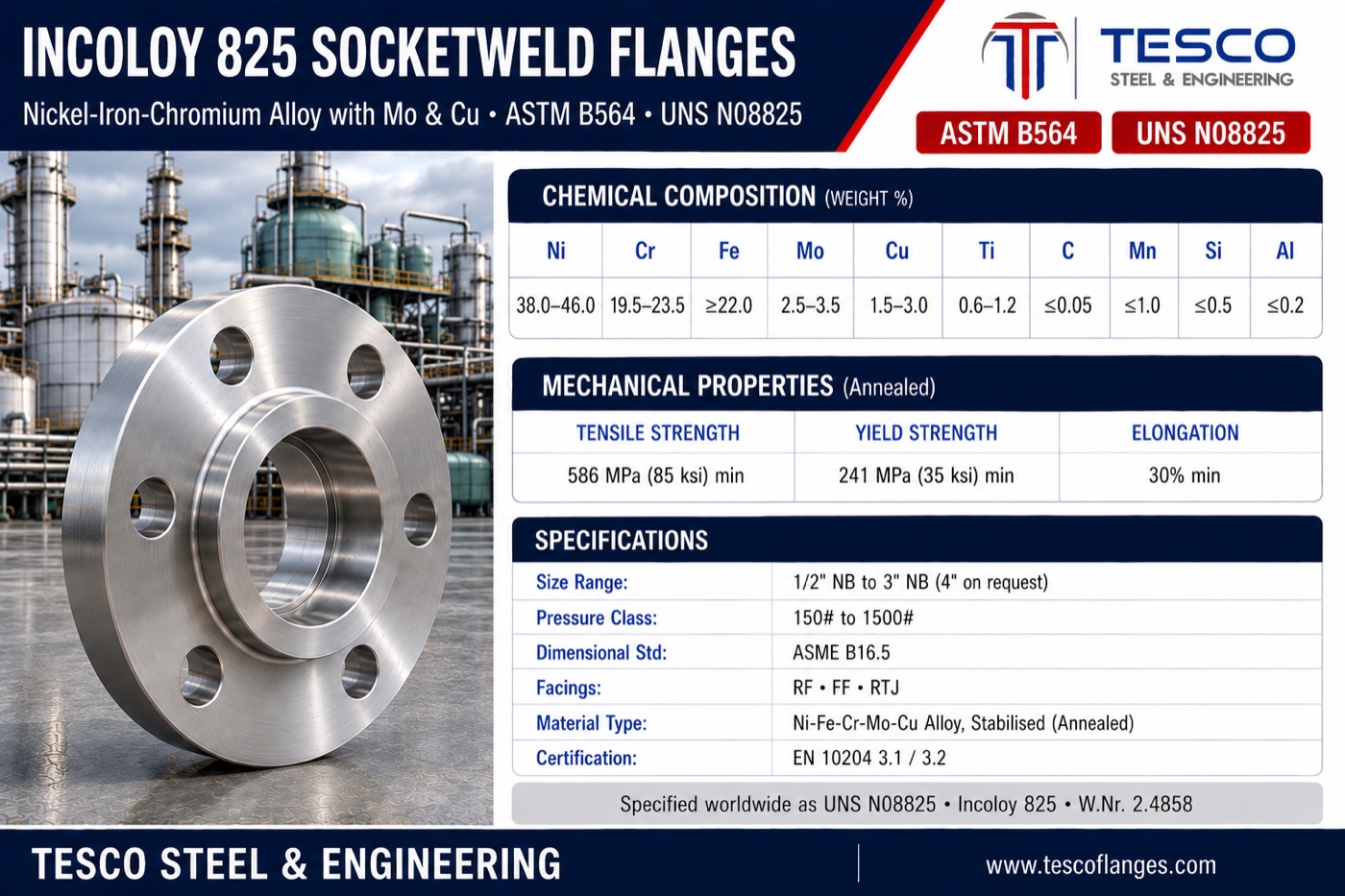
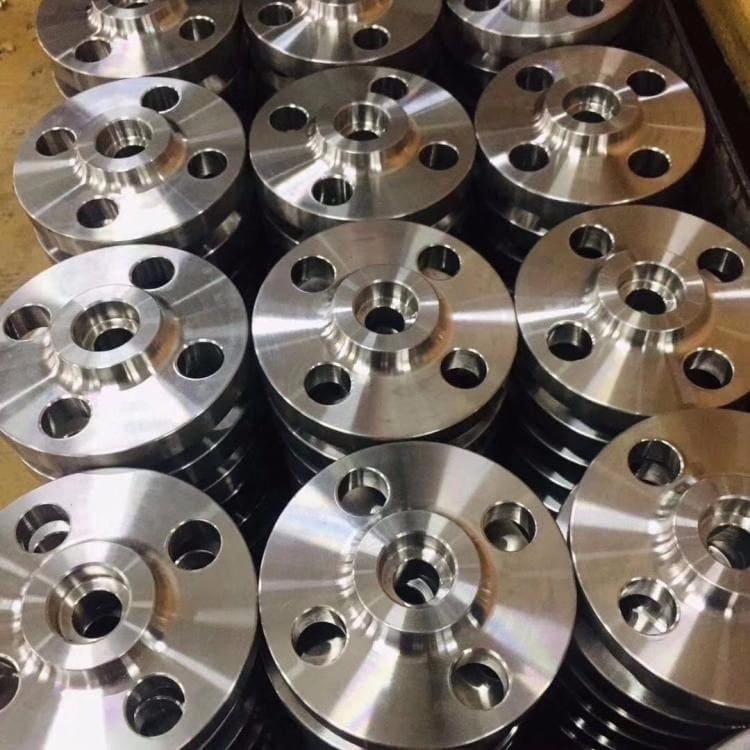
Tesco Steel & Engineering manufactures Incoloy 825 socketweld flanges — the acid sibling of the Incoloy bench: ASTM B564, UNS N08825, W.Nr. 2.4858 — to ASME B16.5 from ½″ to 3″ NB in Classes 150–1500. What 625 is to 600, 825 is to 800: the same frame, re-armed for water instead of fire. Molybdenum 2.5–3.5% for the reducing acids and pitting, copper 1.5–3.0% — the sulphuric weapon, titanium 0.6–1.2% stabilising a ≤0.05% carbon matrix so welded joints go straight into acid, and nickel raised to 38–46% — past the Copson curve's cracking zone with margin to spare. Sulphuric and phosphoric plant, pickling lines, and sour gas in NACE MR0175/ISO 15156 practice — the oil patch's economical CRA below 625. The honest neighbours are below: Alloy 20 for named sulphuric duty, 904L on price, 625 where the duty stacks, C-276 beyond. Welded with ERNiFeCr-1 or ERNiCrMo-3 — no preheat, no PWHT. Facings: SWRF, SWFF, SWRTJ. Every lot with EN 10204 3.1/3.2 MTC. ISO 9001:2015, made in Mumbai, India — exported to 50+ countries.
Incoloy 825 · B564 · N08825 · 2.4858Ni 38–46% · Mo 2.5–3.5% · Cu 1.5–3%Copper for the Sulphuric · Ti-StabilisedNACE MR0175 / ISO 15156 Standing586 / 241 MPa · 30% ElongationThe Family's Wet Side — Acids & SourASME B16.5 ½″–3″ · Class 150–1500EN 10204 3.1 / 3.2 · ISO 9001:2015
Incoloy 825 Socketweld Flanges — Specifications at a Glance
What is an Incoloy 825 Socketweld Flange?
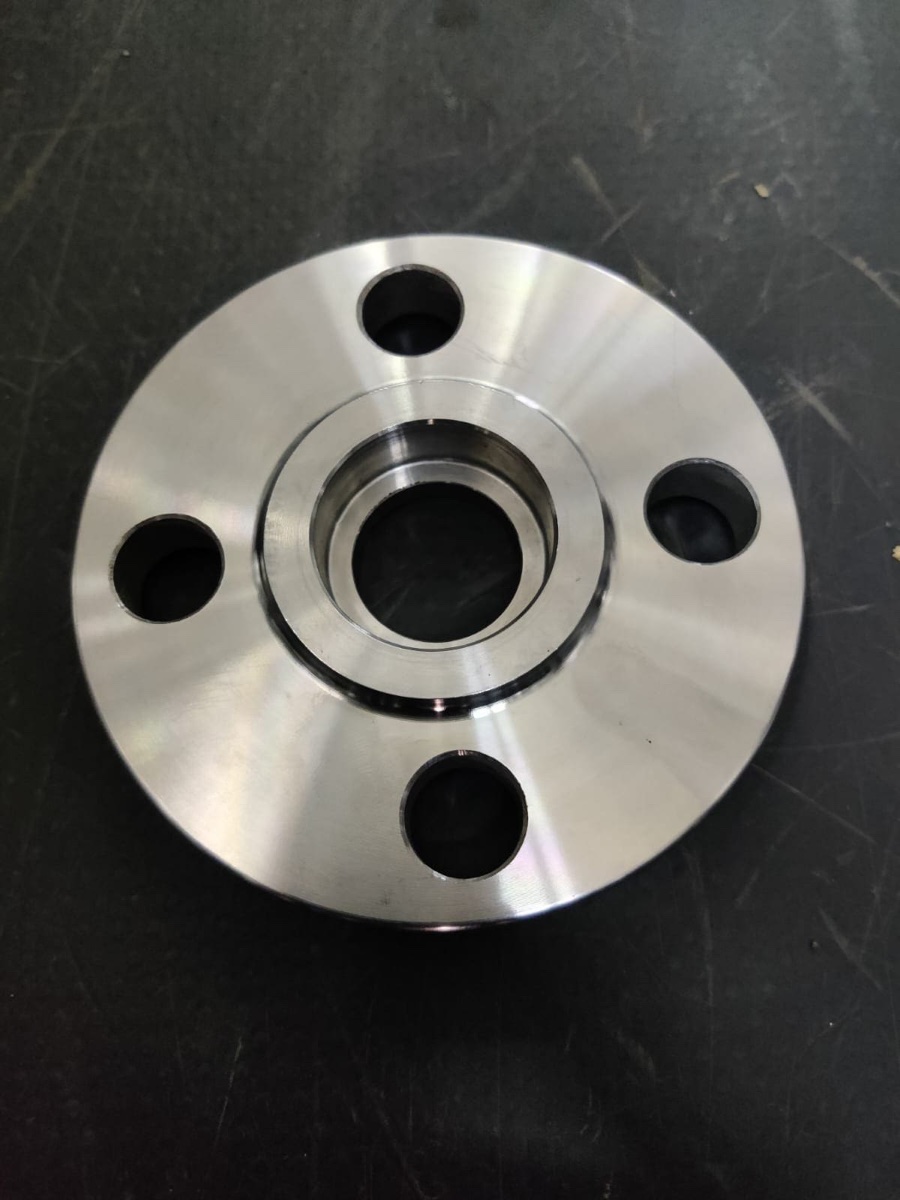
The acid sibling in the small-bore pattern. A forged Incoloy 825 flange (ASTM B564 / UNS N08825 / W.Nr. 2.4858) with a machined socket: pipe seated square by geometry, one external fillet weld — no preheat, no PWHT — through-bore matched to the pipe schedule. 800's frame re-armed for water: Ni 38–46% past the cracking threshold with margin, Mo 2.5–3.5% for reducing acids and pitting, Cu 1.5–3.0% for the sulphuric, Ti 0.6–1.2% stabilising ≤0.05% carbon — weld decay designed out twice. Sour-service standing in NACE MR0175/ISO 15156 practice.Tensile ≥586 MPa, yield ≥241 MPa, elongation ≥30%, annealed. Sized by ASME B16.5 at ½″–3″ NB, Classes 150–1500; EN 10204 3.1 on every lot.
Also searched as: Alloy 825 socket weld flange, N08825 SW flange, 2.4858 socket weld flange, NiCr21Mo flange, nickel iron chromium molybdenum copper flange — all the same product family. Related pages: the facings — SWRF / SWFF / SWRTJ — the socketweld hub, the other Incoloy 825 types — blind, weld neck, slip-on — the fire siblings 800 / 800H / 800HT, and the acid bench — 904L, Alloy 20, C-276.
The rule of the ladder: climb only as far as the chemistry forces you — and note the parallel bench: for strength-plus-chlorides rather than acids, the rungs run through super duplex and 625 instead.
What the Three Additions Buy
The Copper — the Sulphuric Weapon
Cu 1.5–3.0% calms the metal in warm sulphuric where molybdenum alone cannot — the same instinct as 904L's 1–2% and Alloy 20's 3–4%, on a stronger nickel base.
The Molybdenum — Mid-Tier Armour
Mo 2.5–3.5% steadies the film in reducing acids and chloride-contaminated liquor — a deliberate mid-tier dose: enough for the chemical plant, honestly short of 625's 8–10%.
The Titanium — Weld Decay Designed Out Twice
Ti 0.6–1.2% ties up a carbon already capped at 0.05% — the stabiliser doing 321's trick on a nickel base, so welded sockets go straight into acid service.
The Nickel — and the Sour Record
38–46% nickel buys deep SCC margin and sulphide-cracking resistance — the foundation of 825's NACE MR0175/ISO 15156 standing and its long oil-patch career as the economical CRA below 625.
Incoloy 825 Chemical Composition (UNS N08825)
Element
Ni
Cr
Fe
Mo
Cu
Ti
C
Mn
Si
Al
Weight %
38.0–46.0
19.5–23.5
≥22.0
2.5–3.5
1.5–3.0
0.6–1.2
≤0.05
≤1.0
≤0.5
≤0.2
The iron floor drops to ≥22% but stays a floor — more alloy than 800, still an Incoloy rather than an Inconel, and priced accordingly. Every change from the parent points at wet chemistry: Mo and Cu added, Ti raised, carbon halved. PMI confirms the chemistry on every piece.
Mechanical Properties (Annealed)
Property
ASTM B564 N08825 Requirement
Tensile Strength
≥ 586 MPa (85 ksi) — usefully above plain 800's, courtesy of the heavier alloying
Yield Strength (0.2%)
≥ 241 MPa (35 ksi)
Elongation
≥ 30% — fully austenitic, tough from cryogenic temperatures up
Condition
Annealed (stabilised anneal) — set for corrosion service; furnace records certified
Temperature Span
Cryogenic to ~540 °C practical code service — built for wet chemistry; creep-certified heat belongs to 800H/800HT
Rating
B16.5 nickel-alloy tables govern the joint — gasket-limited before metal-limited; stated per class on our quotations
Acid plants live on SWFF against lined equipment; the sour side of the order book uses SWRTJ in the upper classes. State the medium with the facing and gasket guidance rides with the quotation. NPT-tapped variants are machined and certified at the works.
Incoloy 825 Socketweld Flange Specifications
Incoloy 825 Socketweld Flanges are available in the following specifications:
Material Grade
Incoloy 825, ASTM B564 (UNS N08825), W.Nr. 2.4858 — certificates carry the designations your documentation uses
Heat Treatment
Annealed (stabilised anneal) with furnace records certified
Size
1/2"NB to 3"NB per ASME B16.5; 4″ and larger to order; EN 1092-1 patterns to order
Class
150#, 300#, 600#, 900#, 1500# (900# shares 1500# dimensions in most sizes) — acid trim in 150/300, sour work into the upper classes
Facings
Raised Face (SWRF), Flat Face (SWFF), Ring Type Joint (SWRTJ) with groove per B16.20
Bore
Socket bore to pipe OD; through-bore matched to pipe schedule
Welding
Single external fillet with 1/16″ expansion gap; ERNiFeCr-1 matching or ERNiCrMo-3 over-matched filler; sulphur-clean practice; no preheat, no PWHT
Service Span
Sulphuric and phosphoric acid, pickling, sour gas per NACE practice, mixed acid-plus-chloride duty; named sulphuric to Alloy 20, the stacked offshore duty to 625, boiling HCl to C-276, certified heat to 800H/800HT — see the notes
Tension & chemistry per heat; PMI on every piece — Ni-Fe-Cr-Mo-Cu confirmed; socket depth and bore gauged
Certification
EN 10204 3.1 with anneal records (standard) / 3.2 witnessed
Specification Notes — Getting Alloy 825 Sockets Right
Four honest notes.Named sulphuric duty has cheaper specialists:904L carries the mid-range at stainless prices and Alloy 20 owns the acid itself — 825's case begins when chlorides, sour gas or mixed chemistry join. The hot chloride and strength frontier belongs to 625 — 2.5–3.5% molybdenum is mid-tier armour, honestly short of 8–10%. The reducing frontier passes to C-276: boiling HCl and the hottest reducing acids outrun this rung. And 825 is not the furnace grade: practical code service tops out around 540 °C — certified creep belongs to 800H/800HT, the family's fire side.
How Our Incoloy 825 Socketweld Flanges Are Manufactured
1
Forging — cut billet of the spectro-verified N08825 heat is hot-forged into the flange blank with full heat traceability and segregated nickel-alloy handling.
2
Annealing — the stabilised anneal sets the corrosion-service structure with the titanium carbides on guard; furnace charts retained against the heat number.
3
Machining — faces, OD and drilling to ASME B16.5 on dedicated stations with sulphur-free lubricants; socket counterbore and depth gauged piece by piece, through-bore matched to the ordered schedule.
4
Facing — RF serrations, flat face or RTJ groove per B16.20.
5
Testing & marking — tension and chemistry per heat; PMI on every piece; laser-marked with grade, size, class, schedule and heat number.
6
Certification & packing — EN 10204 3.1 MTC with anneal records (3.2 witnessed on request); WPS guidance included; packed sea-worthy with no carbon-steel contact.
Where Incoloy 825 Socketweld Flanges Are Used
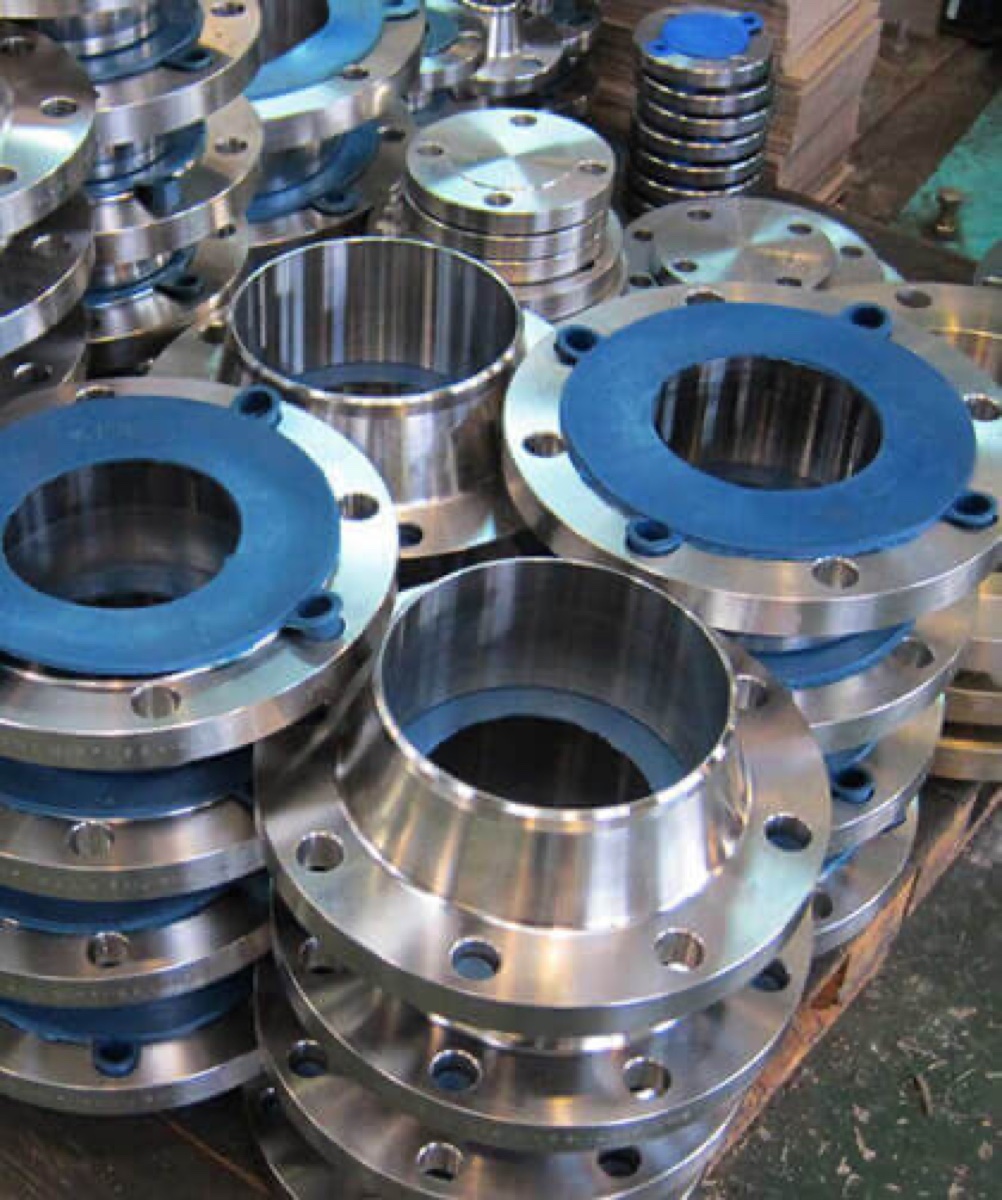
Where acid, chlorides and sour gas meet: sulphuric and phosphoric acid plant small bore, pickling and surface-treatment lines, sour wellhead and flowline trim per NACE practice, produced-water and injection systems, chemical-processing units running mixed aggressive liquor, flue-gas desulphurisation connections, and radwaste and evaporator duties that inherited the alloy's conservative record. Production below:
Socket weld flange dimensions are class-governed per ASME B16.5 — identical across material grades (pressure-temperature ratings follow the nickel-alloy group). Full charts:
How to Specify & Order an Incoloy 825 Socketweld Flange
Six elements — the chemistry picks the grade:
1
Size & standard — e.g. 1″ NB ASME B16.5, or DN25 EN 1092-1 to order.
2
Pressure class & facing — 150#–1500#; SWRF (the default), SWFF (lined acid equipment) or SWRTJ (sour high pressure) with ring number — with the design temperature, which governs the B16.5 rating.
3
Pipe schedule — the through-bore is matched to the pipe ID.
4
Grade line & chemistry — Incoloy 825 / B564 / N08825 / 2.4858, any NACE MR0175/ISO 15156 requirement stated; the medium itself (acid, concentration, temperature, chlorides, sour) invited — it decides between 825, Alloy 20, 904L and 625 more often than price does.
5
Certification — EN 10204 3.1 with anneal records (our standard) / 3.2 witnessed, PMI as applicable.
An Incoloy 825 socketweld flange is a forged nickel-iron-chromium alloy flange armed for acid — 38-46% nickel and 19.5-23.5% chromium on an iron floor of at least 22%, with 2.5-3.5% molybdenum, 1.5-3.0% copper and a 0.6-1.2% titanium stabiliser over a low ≤0.05% carbon, ASTM B564, UNS N08825, W.Nr. 2.4858 — whose back carries a machined socket: the pipe end seats inside, self-aligned square to the face, and is secured with a single external fillet weld. 825 is the acid sibling of the Incoloy bench: where 800 and its H-grades fight heat, 825 fights sulphuric and phosphoric acid, sour gas and mixed acid-plus-chloride chemistry. Dimensioned to ASME B16.5 for ½" to 3" NB in Classes 150 to 1500 — the chemical-plant and oil-patch grade of the family, in the small-bore pattern.
What is Incoloy 825 to Incoloy 800?
What 625 is to 600 — the wet-chemistry upgrade of the same base, a symmetry this site draws deliberately. 825 takes 800's iron-nickel-chromium frame and re-arms it for acid: nickel raised to 38-46%, buying a still-deeper margin past the Copson curve's cracking zone and a matrix nobler in reducing acids; molybdenum added at 2.5-3.5% for pitting and the reducing side; copper added at 1.5-3.0% — the sulphuric weapon; titanium raised to 0.6-1.2% to stabilise; and carbon halved to ≤0.05%. The iron floor drops from 39.5% to 22% — more alloy, more cost, still an Incoloy rather than an Inconel. The fire stays with 800, 800H and 800HT; everything wet and aggressive comes here. Each family on this site keeps a fire side and a wet side, and 825 is this family's wet one.
What do the molybdenum, copper and titanium in 825 each do?
Three additions, three assignments. Molybdenum, 2.5-3.5%: the reducing-acid and pitting element — it steadies the metal where oxidising films fail, in dilute sulphuric, phosphoric and chloride-contaminated process liquor; a deliberate mid-tier dose, not 625's 8-10%. Copper, 1.5-3.0%: the sulphuric-acid weapon — a noble addition that calms corrosion in warm sulphuric where molybdenum alone cannot, the same instinct that puts copper in 904L (1-2%) and Alloy 20 (3-4%). Titanium, 0.6-1.2%: the stabiliser — it ties carbon up as titanium carbide so chromium carbides never strip the grain boundaries, the job 321 gives titanium and Alloy 20 gives niobium. With carbon already capped at 0.05%, weld decay is designed out twice over — welded 825 goes straight into acid service.
What is the chemical composition of Incoloy 825 (UNS N08825)?
Nickel 38.0-46.0%, chromium 19.5-23.5%, iron ≥22.0% — still a deliberate floor, the Incoloy signature, though lighter than 800's 39.5% — molybdenum 2.5-3.5%, copper 1.5-3.0%, titanium 0.6-1.2%, carbon ≤0.05%, manganese ≤1.0%, silicon ≤0.5%, aluminium ≤0.2%. Read it against the parent: 800 has no molybdenum, negligible copper, a small titanium dose and twice the allowed carbon — every change in 825 points at wet chemistry. Read it against the neighbours: Alloy 20 runs less nickel and more copper with a niobium stabiliser; 625 runs far more molybdenum with no copper at all. Chemistry is verified per heat, PMI-confirmed on every piece, and travels on the EN 10204 3.1 MTC.
What are the mechanical properties of Incoloy 825 socketweld flanges?
In the annealed condition ASTM B564 requires tensile strength 586 MPa (85 ksi) minimum, yield strength 241 MPa (35 ksi) minimum and elongation 30% minimum — usefully stronger than plain 800's 520/205, courtesy of the heavier alloying, and fully austenitic and tough from cryogenic temperatures up. The stabilised anneal is set for corrosion service: it dissolves what should be dissolved and leaves the titanium carbides doing their guard duty. B16.5's nickel-alloy pressure-temperature tables govern the flange rating, and the joint keeps the series' two-ceilings honesty — the gasket and the rating retire a bolted connection long before the metal's own limits arrive.
Is Incoloy 825 suitable for sulphuric acid service?
Yes — sulphuric duty is the copper's whole purpose, and 825 holds a strong position on the acid ladder this site draws: 316L retires early; 904L carries dilute-to-mid concentrations warm; Alloy 20 makes the acid its speciality; 825 matches that world with more nickel margin and adds breadth the specialists lack. In practice 825 serves dilute-to-mid sulphuric warm, broad concentration ranges at moderate temperature, phosphoric acid — a classic 825 home — pickling liquors, and the acid-plus-chloride mixtures that punish leaner alloys. Boiling concentrated acid remains case-by-case territory for every alloy on the ladder; state concentration and temperature on the enquiry and the honest grade recommendation rides with the quotation.
Is Incoloy 825 suitable for sour (H2S) service per NACE MR0175?
Yes — 825 is one of the oil patch's established corrosion-resistant alloys, with long-recognised standing in NACE MR0175 / ISO 15156 practice in the annealed condition. The combination that defines sour duty — hydrogen sulphide with chlorides and CO2 at temperature — plays to its build: the high nickel resists sulphide stress cracking, the molybdenum-chromium film handles the chloride side, and the copper helps in the acidic condensates. That record put 825 into sour wellhead trim, downhole-adjacent hardware and sour flowline service worldwide — often as the economical CRA below 625 on the same platforms. If the order is sour-service, state the NACE/ISO requirement on the enquiry; supply is annealed per the standard's requirements and the certificate documents it.
Incoloy 825 or Alloy 20 — the near-twins?
The two alloys are close relatives solving the same acid problem with slightly different budgets. Alloy 20 (N08020): nickel 32-38%, copper 3-4% — the heavier sulphuric dose — molybdenum 2-3%, niobium-stabilised; it is the sulphuric-acid specialist, and on pure H2SO4 duty it is usually the first and often cheaper answer, as our Alloy 20 page says. 825 (N08825): nickel 38-46% — more margin against chlorides and cracking — copper 1.5-3.0%, molybdenum 2.5-3.5%, titanium-stabilised; it trades a little sulphuric specialisation for breadth: sour-gas standing, mixed acid-plus-chloride chemistry, and the oil-patch service record Alloy 20 never built. The practical rule: named sulphuric plant — Alloy 20 first; mixed aggressive chemistry or anything sour — 825. Both pages link each other for exactly this choice.
Incoloy 825 or Inconel 625?
The same honest money conversation the offshore world has daily, one rung down the ladder. 625 outguns 825 everywhere: 8-10% molybdenum against 2.5-3.5%, PREN past 50, an 827 MPa certificate against 586, deeper crevice margins in hot chlorides and a higher service ceiling — and it is priced accordingly. 825 earns its keep by being enough: for warm acids, sour trim, produced-water and mixed chemical duty that never reaches 625's extremes, 825 does the work at a distinctly lower alloy cost, which is why platforms commonly run both — 825 as the volume CRA, 625 where the duty stacks. The welding world even connects them: 825 is routinely welded with ERNiCrMo-3, the 625 wire. The rule: mid-tier acid and sour — 825; extreme chloride, strength or temperature — 625.
How hot can Incoloy 825 actually go?
Hot enough for its job, and honestly no further. 825 is built for wet chemistry: its stabilised, low-carbon matrix and its copper are aqueous-service equipment, and its practical code service tops out around 540°C — beyond that the family hands over cleanly: certified creep strength belongs to 800H and 800HT, whose coarse-grained certificates exist precisely for the 593-760°C band, and the oxidising summit belongs to the Inconels. This is the same fire-versus-wet split every family on this site keeps: nobody should pay for copper and titanium stabilisation in a reformer, and nobody should send a creep certificate into warm sulphuric. State the design temperature with the chemistry on the enquiry and the right family member answers.
What are Incoloy 825's honest weaknesses?
Four, each with a named alternative. Pure sulphuric on a budget: 904L carries the mid-range at stainless prices and Alloy 20 specialises in the acid itself — 825's case begins when chlorides, sour gas or mixed chemistry join. The hot chloride frontier: 2.5-3.5% molybdenum is mid-tier armour — hot brines, deep crevice duty and high-strength offshore hardware belong to 625 and the super duplex world. The reducing frontier: boiling hydrochloric and the hottest reducing acids pass beyond every alloy on this rung to Hastelloy C-276. And heat: 825 is not the family's furnace grade — creep-certified duty belongs to 800H/800HT, and hot reducing sulphur attacks the nickel matrix as everywhere. None of these dent the franchise: warm acids, sour service and mixed aggressive chemistry at an honest price.
How is an Incoloy 825 socketweld flange welded?
With nickel-family practice and an unusually forgiving HAZ. Geometry is standard: pipe bottomed in the socket, withdrawn 1/16" (1.6 mm) to leave the expansion gap, single external fillet weld — no preheat, no PWHT. The metallurgy is on the welder's side: carbon capped at 0.05% and the titanium stabiliser mean sensitisation is designed out twice, so welded joints go straight into acid service. Filler: matching ERNiFeCr-1 (the 825 wire) serves matching-corrosion philosophy, and ERNiCrMo-3 — the 625 wire, the industry's most borrowed consumable — is the common over-matched choice, simplifying stock where both alloys are fabricated. Sulphur-clean housekeeping remains the nickel-bench rule: sulphur-free lubricants, dedicated brushes, no carbon-steel contact. Our flanges arrive annealed with records, and WPS guidance travels with every supply.
What sizes and pressure classes do Incoloy 825 socketweld flanges come in?
ASME B16.5 standardises socket weld flanges from ½" to 3" NB in Classes 150, 300, 600, 900 and 1500 — Class 900 sharing Class 1500 dimensions in most small-bore sizes — with 4" and Class 2500 made to order. Chemical-plant acid trim lives mostly in Classes 150 and 300, while the sour-gas side of 825's order book reaches into 600, 900 and 1500 for wellhead and injection duty — the same split its service record predicts. All three facings are available: SWRF the default, SWFF for cast and lined mates, SWRTJ for the high-pressure sour work. Put the pipe schedule on the enquiry — the through-bore is matched to the pipe ID — and B16.5's nickel-alloy tables set the pressure-temperature rating; our quotations state it per class.
What details are needed to get an accurate Incoloy 825 socketweld flange quotation?
Six elements plus commercial terms: (1) size — ½" to 3" NB; (2) pressure class — 150 to 1500, with the design temperature that governs the rating; (3) facing — SWRF, SWFF or SWRTJ with ring number; (4) the pipe schedule, so the through-bore matches the pipe ID; (5) the grade line — Incoloy 825, ASTM B564, UNS N08825 or W.Nr. 2.4858 all name the same metal — with any NACE MR0175/ISO 15156 sour-service requirement stated, and the chemistry itself (acid, concentration, temperature, chlorides, sour) invited: it decides between 825, Alloy 20, 904L and 625 more often than price does; (6) certification — EN 10204 3.1 with anneal records (our standard) or 3.2 witnessed, PMI as applicable. Add quantity and destination; quotations normally within 24 hours.
Who manufactures Incoloy 825 socketweld flanges in India?
Tesco Steel & Engineering is an ISO 9001:2015 certified flange manufacturer based in Mumbai, India, producing Incoloy 825 (ASTM B564, UNS N08825) socket weld flanges from ½" to 3" NB (larger to order) in Classes 150-1500 — each forged from certified heats, annealed with furnace records against the heat number, machined on dedicated nickel-alloy stations with sulphur-free lubricants, gauged socket depth and schedule-matched bore, PMI-checked — the nickel-iron-chromium-molybdenum-copper chemistry confirmed on every piece — and laser-marked with grade, size, class, schedule and heat number. Supplied with EN 10204 3.1/3.2 certification and WPS guidance, alongside the 800, 800H, 800HT and 925 siblings and the full nickel-alloy socketweld range this series covers. Exported to more than 50 countries.