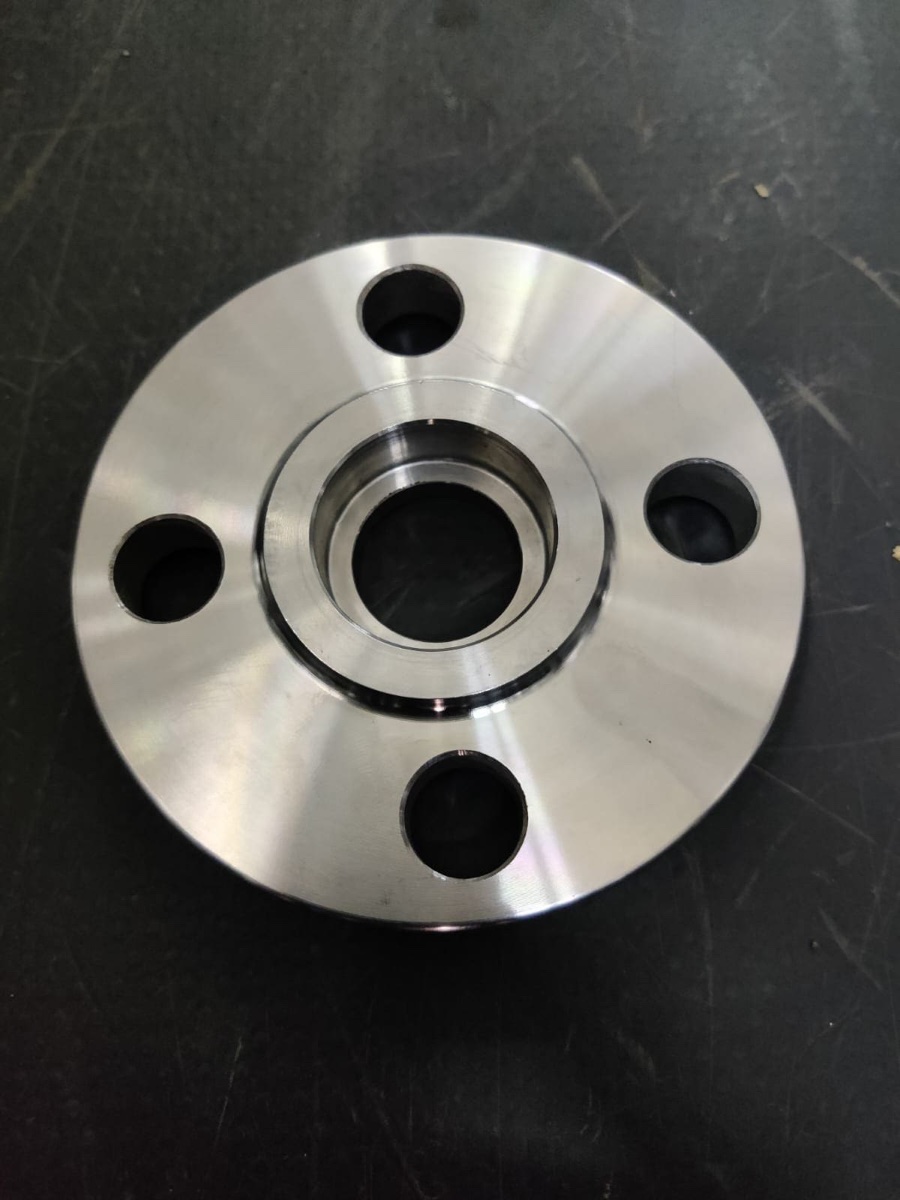
Tesco Steel & Engineering manufactures Inconel 625 socketweld flanges — the family's wet, salty, strength-driven sibling: ASTM B564, UNS N06625, W.Nr. 2.4856 — to ASME B16.5 from ½″ to 3″ NB in Classes 150–1500. Where 600 and 601 fight fire, 625 fights water: 8–10% molybdenum pushes the chloride film past PREN 50, and the precise 3.15–4.15% niobium delivers 827 MPa straight from the anneal — the strongest annealed certificate in this entire series, with nothing for a weld to undo. Seawater and subsea hardware, sour gas in NACE MR0175/ISO 15156 practice, mixed acids, hot brines — and the filler-metal fame: ERNiCrMo-3 is the wire half the industry borrows, from the 6Mo world to RTJ-groove overlays. The honest splits are below: ambient seawater strength on a budget belongs to super duplex F53; the hot reducing frontier passes to C-276; the fire stays with 600 and 601. Welded with matching filler — no preheat, no PWHT. Facings: SWRF, SWFF, SWRTJ. Every lot with EN 10204 3.1/3.2 MTC. ISO 9001:2015, made in Mumbai, India — exported to 50+ countries.
Inconel 625 · B564 · N06625 · 2.4856Ni ≥58% · Cr 20–23% · Mo 8–10% · Nb 3.15–4.15%827 / 414 MPa — The Series' Strongest AnnealSeawater · Sour Gas · Acids — With MuscleNACE MR0175 / ISO 15156 StandingThe Filler Wire Everyone BorrowsASME B16.5 ½″–3″ · Class 150–1500EN 10204 3.1 / 3.2 · ISO 9001:2015
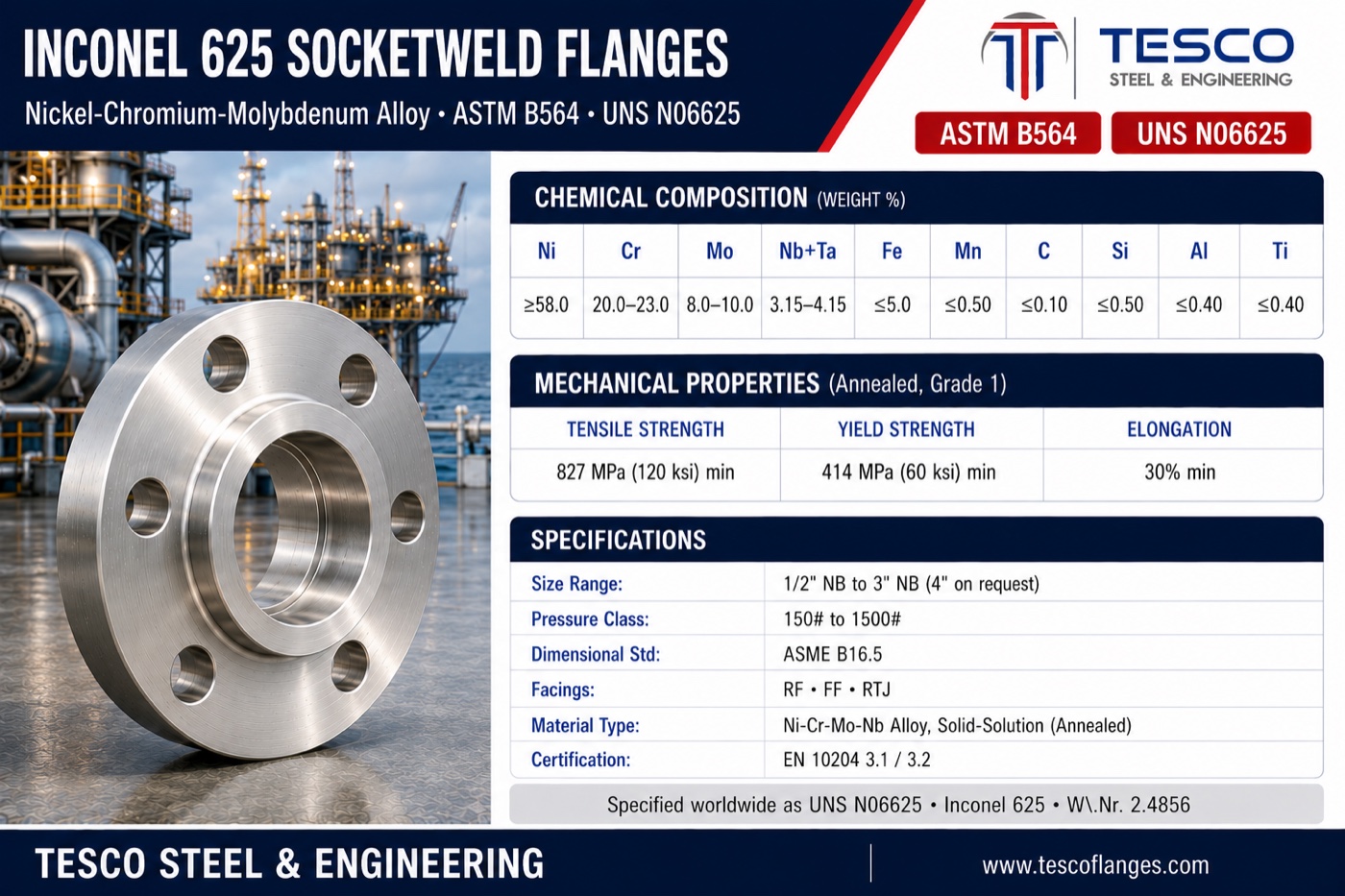
Inconel 625 Socketweld Flanges — Specifications at a Glance
What is an Inconel 625 Socketweld Flange?
The wet-strength alloy in the small-bore pattern. A forged Inconel 625 flange (ASTM B564 / UNS N06625 / W.Nr. 2.4856) with a machined socket: pipe seated square by geometry, one external fillet weld — no preheat, no PWHT — through-bore matched to the pipe schedule. Mo 8–10% + Cr 20–23% hold the passive film past PREN 50 in seawater, brines and sour gas; Nb 3.15–4.15% delivers tensile ≥827 MPa, yield ≥414 MPa, elongation ≥30% straight from the Grade 1 anneal — the strongest annealed certificate in this series. Cryogenic to ~593 °C. Sized by ASME B16.5 at ½″–3″ NB, Classes 150–1500; EN 10204 3.1 on every lot.
Subsea, splash zone, sour and hot chlorides — cryogenic to ~593 °C
This page
The rule of the map: each metal defends differently, and the cheapest adequate defence wins the order — 625's territory begins where the duty stacks demands: strength and chlorides and temperature and sour, in one certificate.
What the Molybdenum and the Niobium Buy
The Chloride Armour
Mo 8–10% with Cr 20–23% pushes PREN past 50 — beyond even the 6Mo stainlesses — so the film holds in hot chlorides, crevices, brines and sour gas where ordinary passive layers strip.
The Muscle Without the Ageing
Nb 3.15–4.15% stiffens the matrix by solid solution: 827/414 MPa straight from the anneal — no hardening cycle, nothing for a weld to undo; compare K-500, which pays for its strength with an ageing treatment.
The Filler-Metal Fame
ERNiCrMo-3 — the 625 wire — is the most borrowed consumable in corrosion engineering: the 6Mo world specifies it, dissimilar joints trust it, and the oil patch clads vessels and RTJ grooves with it. If you weld CRAs, you have already trusted 625.
Honesty About the Fire
Long dwell at 600–800 °C ages 625 — the furnace stays with 600 and 601. 625 is a water-and-acid alloy with muscle, and says so.
Inconel 625 Chemical Composition (UNS N06625)
Element
Ni
Cr
Mo
Nb+Ta
Fe
Mn
C
Si
Al
Ti
Weight %
≥58.0
20.0–23.0
8.0–10.0
3.15–4.15
≤5.0
≤0.50
≤0.10
≤0.50
≤0.40
≤0.40
Phosphorus and sulphur are each capped at 0.015%. Read the trades against 600: iron becomes a tight ≤5.0% cap, not a deliberate ingredient; manganese is halved; and the two additions do the new work — molybdenum for the film, niobium for the strength. The famous decimal in the niobium range is real specification language. PMI confirms the chemistry on every piece.
Mechanical Properties (Grade 1, Annealed)
Property
ASTM B564 N06625 Requirement
Tensile Strength
≥ 827 MPa (120 ksi) — the strongest annealed certificate in this socketweld series
Sour wellhead, injection and subsea — genuinely 625's home turf
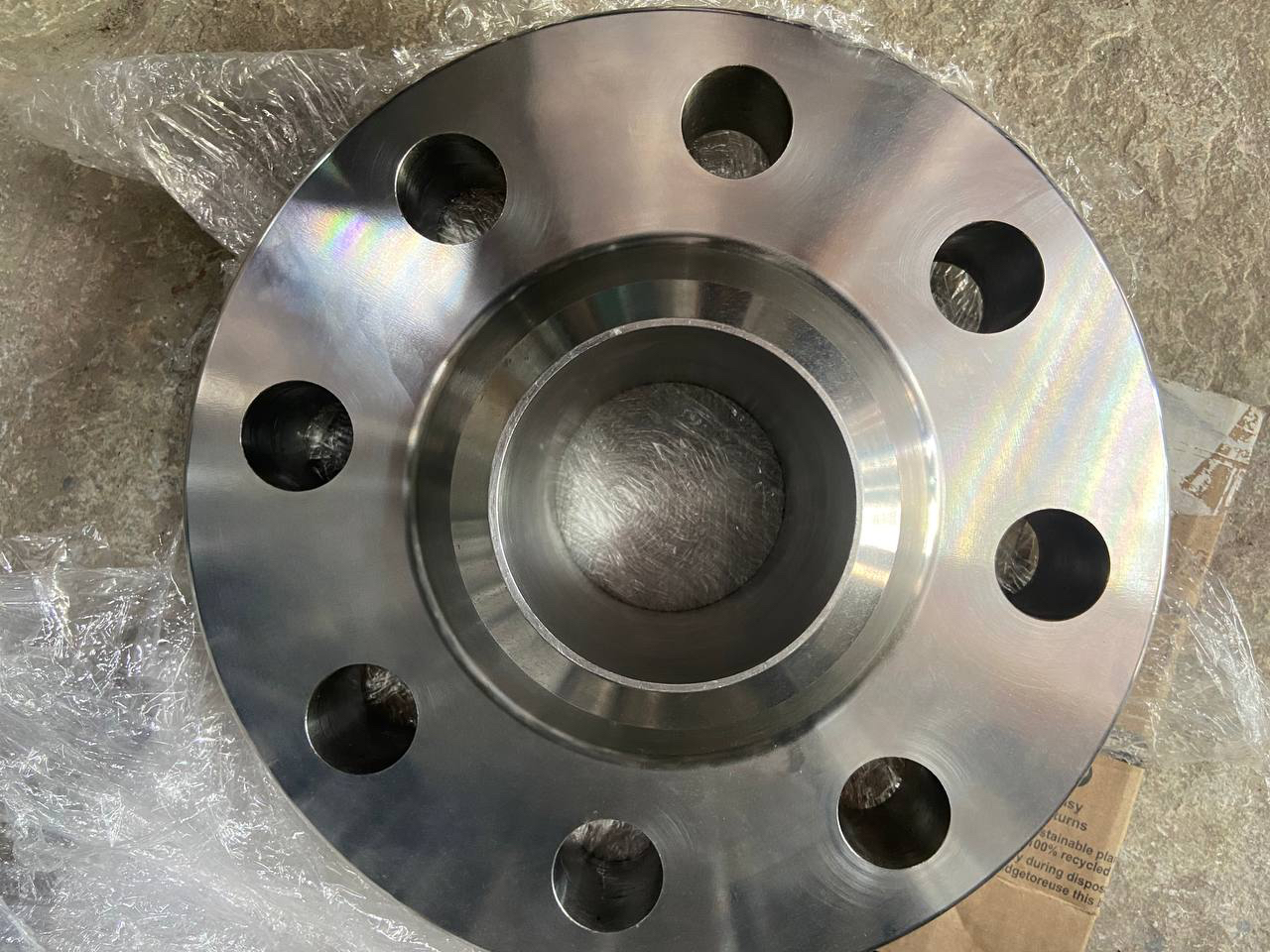
The overlay note: 625 is the industry's cladding alloy — the same wire refurbishes worn RTJ grooves on steel flanges, a service we perform at the works; the photo below shows a groove mid-overlay.
Inconel 625 Socketweld Flange Specifications
Inconel 625 Socketweld Flanges are available in the following specifications:
Material Grade
Inconel 625, ASTM B564 (UNS N06625), W.Nr. 2.4856 — certificates carry the designations your documentation uses
Heat Treatment
Grade 1 Annealed (standard, corrosion service) or Grade 2 Solution-Annealed (creep service, to order) — condition documented on the certificate
Size
1/2"NB to 3"NB per ASME B16.5; 4″ and larger to order; EN 1092-1 patterns to order
Class
150#, 300#, 600#, 900#, 1500# (900# shares 1500# dimensions in most sizes) — sour and subsea work uses the upper classes freely
Facings
Raised Face (SWRF), Flat Face (SWFF), Ring Type Joint (SWRTJ) with groove per B16.20
Bore
Socket bore to pipe OD; through-bore matched to pipe schedule
Welding
Single external fillet with 1/16″ expansion gap; matching ERNiCrMo-3 filler — the industry's most borrowed wire; sulphur-clean practice; no preheat, no PWHT
Service Span
Seawater, subsea and splash zone; sour gas per NACE MR0175/ISO 15156 practice; mixed acids and hot brines; cryogenic duty; the fire stays with 600/601, the hot reducing frontier with C-276 — see the notes
Tension & chemistry per heat; PMI on every piece — Ni-Cr-Mo-Nb confirmed; socket depth and bore gauged
Certification
EN 10204 3.1 with condition records (standard) / 3.2 witnessed
Specification Notes — Getting Alloy 625 Sockets Right
Four honest notes.The cheaper metal often suffices: ambient seawater strength alone is super duplex F53's brief at a fraction of the price; film-only chlorinated seawater is 254 SMO's; moderate mixed acids sit with 904L and Alloy 20 — 625's case is the stacked duty. The ageing band: long dwell at roughly 600–800 °C embrittles it over time — 625 is not the furnace alloy; the fire stays with 600 and 601. The hot reducing frontier: boiling concentrated HCl and kin eventually pass beyond 625 to C-276. And the joint itself: the strongest certificate in the series still bolts up under B16.5's tables and seals through a gasket — the two-ceilings honesty, as everywhere.
How Our Inconel 625 Socketweld Flanges Are Manufactured
1
Forging — cut billet of the spectro-verified N06625 heat is hot-forged into the flange blank with full heat traceability and segregated nickel-alloy handling.
2
Annealing — Grade 1 anneal sets the fine-grained, full-strength corrosion-service condition; furnace charts retained against the heat number (Grade 2 solution anneal to order).
3
Machining — faces, OD and drilling to ASME B16.5 on dedicated stations with sulphur-free lubricants; socket counterbore and depth gauged piece by piece, through-bore matched to the ordered schedule.
4
Facing — RF serrations, flat face or RTJ groove per B16.20; 625 overlay and groove refurbishment work handled by the same cell.
5
Testing & marking — tension and chemistry per heat; PMI on every piece; laser-marked with grade, size, class, schedule and heat number.
6
Certification & packing — EN 10204 3.1 MTC with condition records (3.2 witnessed on request); WPS guidance included; packed sea-worthy with no carbon-steel contact.
Where Inconel 625 Socketweld Flanges Are Used
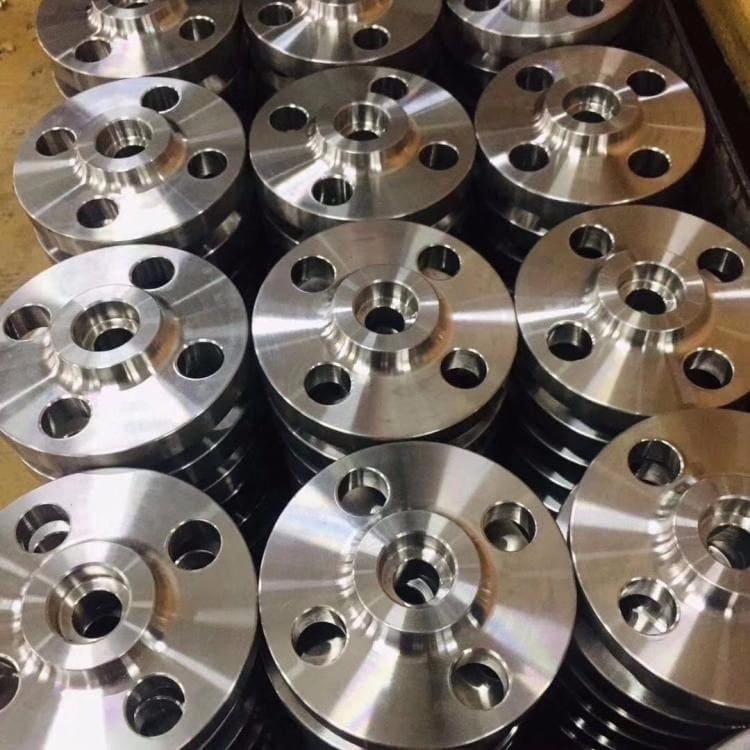
Wherever the duty stacks demands: offshore topside and subsea small bore, sour wellhead and flowline trim per NACE practice, produced-water and seawater injection skids, chemical plants running mixed acids and hot chlorides, flue-gas desulphurisation and marine scrubber connections, bellows and expansion-joint hardware, and cryogenic service where a corrosion alloy must also stay tough. Production below:
Socket weld flange dimensions are class-governed per ASME B16.5 — identical across material grades (pressure-temperature ratings follow the nickel-alloy group). Full charts:
How to Specify & Order an Inconel 625 Socketweld Flange
Six elements — the service decides the grade:
1
Size & standard — e.g. 1″ NB ASME B16.5, or DN25 EN 1092-1 to order.
2
Pressure class & facing — 150#–1500#; SWRF (the default), SWFF or SWRTJ with ring number — with the design temperature, which governs the B16.5 rating.
3
Pipe schedule — the through-bore is matched to the pipe ID.
4
Grade line, condition & service — Inconel 625 / B564 / N06625 / 2.4856, Grade 1 (our standard) or Grade 2, any NACE MR0175/ISO 15156 requirement stated; the service itself (seawater, sour, acid, temperature) invited — it decides between 625, F53, 6Mo and C-276 more often than price does.
5
Certification — EN 10204 3.1 with condition records (our standard) / 3.2 witnessed, PMI as applicable.
An Inconel 625 socketweld flange is a forged nickel-chromium-molybdenum-niobium alloy flange — at least 58% nickel with 20-23% chromium, 8-10% molybdenum and a precise 3.15-4.15% niobium (plus tantalum), ASTM B564, UNS N06625, W.Nr. 2.4856 — whose back carries a machined socket: the pipe end seats inside, self-aligned square to the face, and is secured with a single external fillet weld. 625 is the Inconel family's wet, salty, strength-driven sibling: where 600 and 601 fight fire, 625 fights seawater, brines, sour gas and mixed acids — and it does so with the strongest annealed certificate in this entire socketweld series, 827 MPa tensile without any hardening heat treatment. Dimensioned to ASME B16.5 for ½" to 3" NB in Classes 150 to 1500 — the offshore and sour-service alloy, in the small-bore pattern.
What do the molybdenum and the niobium in 625 actually do?
Two additions, two separate jobs. The 8-10% molybdenum is the wet-corrosion weapon: with 20-23% chromium it pushes the pitting resistance number (PREN) past 50 — beyond even the 6Mo stainlesses — so the passive film holds in hot chlorides, crevices, brines and sour gas where ordinary films strip. The 3.15-4.15% niobium is the muscle: it stiffens the nickel matrix by solid solution, delivering 827 MPa tensile and 414 MPa yield straight from the anneal — no ageing treatment, no hardening step, nothing for a weld to undo; compare Monel K-500, which buys its strength with an age-hardening cycle that welding disturbs. Together they turn Alloy 600's Ni-Cr base into the family's do-everything wet alloy: chloride armour and double strength in one certificate.
What is the chemical composition of Inconel 625 (UNS N06625)?
Nickel ≥58.0%, chromium 20.0-23.0%, molybdenum 8.0-10.0%, niobium plus tantalum 3.15-4.15%, iron ≤5.0%, manganese ≤0.50%, carbon ≤0.10%, silicon ≤0.50%, aluminium ≤0.40%, titanium ≤0.40%, with phosphorus and sulphur each capped at 0.015%. Read the trades against Alloy 600: iron becomes a tight cap rather than a deliberate 6-10% ingredient, manganese is halved, chromium rises to 20-23% — and the two additions do the new work: molybdenum for the film, niobium for the strength. The famous decimal in the niobium range is real specification language, not marketing. Chemistry is verified per heat, PMI-confirmed on every piece, and travels on the EN 10204 3.1 MTC.
What are the mechanical properties of Inconel 625 socketweld flanges?
In the standard Grade 1 annealed condition ASTM B564 requires tensile strength 827 MPa (120 ksi) minimum, yield strength 414 MPa (60 ksi) minimum and elongation 30% minimum — the strongest annealed certificate in this entire socketweld series. For calibration: Alloy 600 certifies 550/240, the 6Mo super-austenitic 650/300, and nothing else on the nickel bench reaches 827 without an age-hardening treatment. The strength is solid-solution, so it survives welding intact, and 625 keeps useful properties from cryogenic temperatures — it is a recognised cryogenic alloy — up to its roughly 593°C corrosion-service ceiling. As everywhere in this series, ASME B16.5's nickel-alloy pressure-temperature tables and the gasket govern the bolted joint — the two-ceilings honesty every hot page here carries.
Grade 1 or Grade 2 — which Inconel 625 condition should be ordered?
ASTM B564 recognises two supply conditions and they serve different masters. Grade 1 — annealed — keeps the finer grain and the full 827/414 MPa certificate; it is the corrosion-service condition, intended for service up to roughly 593°C (1100°F), and it is our standard supply. Grade 2 — solution-annealed at higher temperature — trades certificate strength (690/276 MPa) for the coarser grain that creep resistance above 593°C wants; it is bought for high-temperature structural duty, not for corrosion service. For seawater, sour gas, chemical and offshore flanges — the duties that bring buyers to this page — Grade 1 is almost always correct; order Grade 2 only where a high-temperature specification names it. State the grade on the enquiry and the certificate documents the condition either way.
Is Inconel 625 suitable for seawater and offshore service?
Yes — 625 is one of offshore engineering's reference corrosion-resistant alloys, and it earns the position differently from every other seawater metal on this site. The seawater map: copper-nickel defends by antifouling, super duplex and the 6Mo austenitics defend by high-PREN films at lower cost, Monel defends by nobility. 625 brings the film and the muscle together: PREN past 50, crevice performance proven on subsea hardware, full strength in the same certificate, and no biofouling dependence. It serves topside and subsea small bore, splash-zone trim, seawater and produced-water injection systems, and the marine scrubber and FGD duties where hot acidic chlorides retire the stainless bench. Where the duty is milder, the map names cheaper answers — and the honest comparisons below do exactly that.
Is Inconel 625 suitable for sour (H2S) service per NACE MR0175?
Yes — annealed 625 holds long-recognised standing in NACE MR0175 / ISO 15156 practice for sour oil and gas service, resisting the combination that defines the duty: hydrogen sulphide, chlorides and CO2 at temperature. The solid-solution nickel matrix resists sulphide stress cracking where martensitic and lower-alloy steels crack, and the molybdenum-chromium film handles the chloride side of the attack. This is why 625 appears throughout sour wellhead, flowline and processing trim — and why it is the standard weld-overlay alloy on carbon-steel equipment in the same service. If the order is sour-service, state the NACE/ISO requirement on the enquiry: supply is in the annealed condition per the standard's requirements and the certificate documents it.
Inconel 625 or super duplex — the honest offshore rivalry?
The honest comparison every offshore enquiry deserves — and on paper the cheaper metal wins more often than the catalogue admits. Super duplex F53 actually certifies the higher yield (550 vs 414 MPa) at a fraction of 625's price, and for ambient-temperature seawater strength it is frequently the right answer; our F53 socketweld page says so. 625 earns its premium four ways: temperature span — duplex retires around 250-300°C and embrittles above it, while 625 runs from cryogenic to roughly 593°C; welding — no phase-balance anxiety, no nitrogen-loss worry, just matching wire; sour standing at temperature, where duplex limits arrive early; and crevice margin in hot chlorinated systems. The practical rule: cold, strong and salty — F53; hot, sour, welded or cryogenic — 625. Both pages link each other for exactly this decision.
How does 625 split the plant with its fire siblings, 600 and 601?
Cleanly, by what attacks the metal. Wherever the enemy is wet — seawater, brines, acids, sour gas, condensing flue gas — the duty is 625's: the molybdenum and niobium that make it expensive are exactly what the wet side pays for. Wherever the enemy is fire — furnace atmospheres, radiant heat, thermal cycling — the duty belongs to 600 and 601: not because 625 cannot take heat, but because long dwell in its 600-800°C ageing band embrittles it over time, and its molybdenum and niobium buy nothing in clean hot air that 601's aluminium does not buy better and cheaper. The three commonly serve one refinery: 601 at the fired heater, 600 on the hot halogen side, 625 on the sour, salty and acid streams. Our quotation asks the service before it names the sibling.
What are Inconel 625's honest weaknesses?
Four, each with a named alternative. Price: 625 is the most expensive regular grade on this site's main ladder — where the duty is ambient seawater strength alone, super duplex F53 does it cheaper; film-only chlorinated seawater is 254 SMO's brief; moderate mixed acids sit with 904L and Alloy 20. The ageing band: long exposure at roughly 600-800°C precipitates intermetallic phases that cost ambient ductility — 625 is not the furnace alloy, and the fire stays with 600 and 601. The hot reducing frontier: boiling concentrated hydrochloric and similar reducing acids eventually pass beyond 625 to Hastelloy C-276 — the next rung on the wet-corrosion ladder. And the joint itself: the strongest certificate in the series still bolts up under B16.5's tables and seals through a gasket — the rating and the sealing system govern long before the metal does.
How is an Inconel 625 socketweld flange welded?
With the most famous filler wire in corrosion engineering — its own. ERNiCrMo-3, the 625-composition wire, is the consumable half the industry borrows: the 6Mo austenitics specify it because matching 6Mo filler under-performs, super duplex turns to it for dissimilar joints, and the oil patch clads whole vessels and RTJ grooves with it as weld overlay. On 625 itself the practice is straightforward nickel-family work: pipe bottomed in the socket, withdrawn 1/16" (1.6 mm) for the expansion gap, single external fillet with matching ERNiCrMo-3 — no preheat, no PWHT, and the solid-solution strength survives the weld intact. The puddle is sluggish like all nickel alloys: let placement, not fluidity, do the work. Housekeeping is non-negotiable — sulphur, lead and zinc embrittle hot nickel; dedicated brushes and sulphur-free practice throughout. WPS guidance travels with every supply.
What facings do Inconel 625 socketweld flanges come with — and what is a 625 overlay?
All three: raised face (SWRF) as the default, flat face (SWFF) for cast and lined mates, and ring type joint (SWRTJ) for high-pressure sour and subsea work — where 625 is genuinely at home in RTJ territory, with solid 625 ring gaskets or soft-iron rings per service. Gasket practice at 625's typical service temperatures is conventional: spiral-wound with graphite or PTFE fill in matching or compatible windings for the wet duties. The overlay note: 625 is the industry's cladding alloy, and the same wire refurbishes worn RTJ grooves on steel flanges — a service we perform at the works; the photo on this page shows a groove mid-overlay. NPT-tapped and special-face variants are machined and certified to order.
What sizes and pressure classes do Inconel 625 socketweld flanges come in?
ASME B16.5 standardises socket weld flanges from ½" to 3" NB in Classes 150, 300, 600, 900 and 1500 — Class 900 sharing Class 1500 dimensions in most small-bore sizes — with 4" and Class 2500 made to order. 625's order book uses more of the class range than most grades: chemical and seawater trim lives in 150/300, while sour wellhead, injection and subsea small bore regularly specifies 600, 900 and 1500 — pressure is precisely where the niobium strength and the nickel-group ratings pay. Put the pipe schedule on the enquiry — the through-bore is matched to the pipe ID — and B16.5's nickel-alloy tables set the pressure-temperature rating; our quotations state it per class.
What details are needed to get an accurate Inconel 625 socketweld flange quotation?
Six elements plus commercial terms: (1) size — ½" to 3" NB; (2) pressure class — 150 to 1500, with the design temperature that governs the rating; (3) facing — SWRF, SWFF or SWRTJ with ring number; (4) the pipe schedule, so the through-bore matches the pipe ID; (5) the grade line — Inconel 625, ASTM B564, UNS N06625 or W.Nr. 2.4856 all name the same metal — with the condition (Grade 1 annealed, our standard) and any NACE MR0175/ISO 15156 sour-service requirement stated; the service itself (seawater, sour, acid, temperature) invited — it decides between 625, super duplex, 6Mo and C-276 more often than price does; (6) certification — EN 10204 3.1 (our standard) or 3.2 witnessed, PMI as applicable. Add quantity and destination; quotations normally within 24 hours.
Who manufactures Inconel 625 socketweld flanges in India?
Tesco Steel & Engineering is an ISO 9001:2015 certified flange manufacturer based in Mumbai, India, producing Inconel 625 (ASTM B564, UNS N06625) socket weld flanges from ½" to 3" NB (larger to order) in Classes 150-1500 — each forged from certified heats, annealed to Grade 1 with furnace records against the heat number, machined on dedicated nickel-alloy stations with sulphur-free lubricants, gauged socket depth and schedule-matched bore, PMI-checked — the nickel-chromium-molybdenum-niobium chemistry confirmed on every piece — and laser-marked with grade, size, class, schedule and heat number. Supplied with EN 10204 3.1/3.2 certification and WPS guidance, alongside the Inconel 600 and 601 siblings, 625 weld-overlay and RTJ-groove refurbishment work, and the full nickel-alloy socketweld range this series covers. Exported to more than 50 countries.