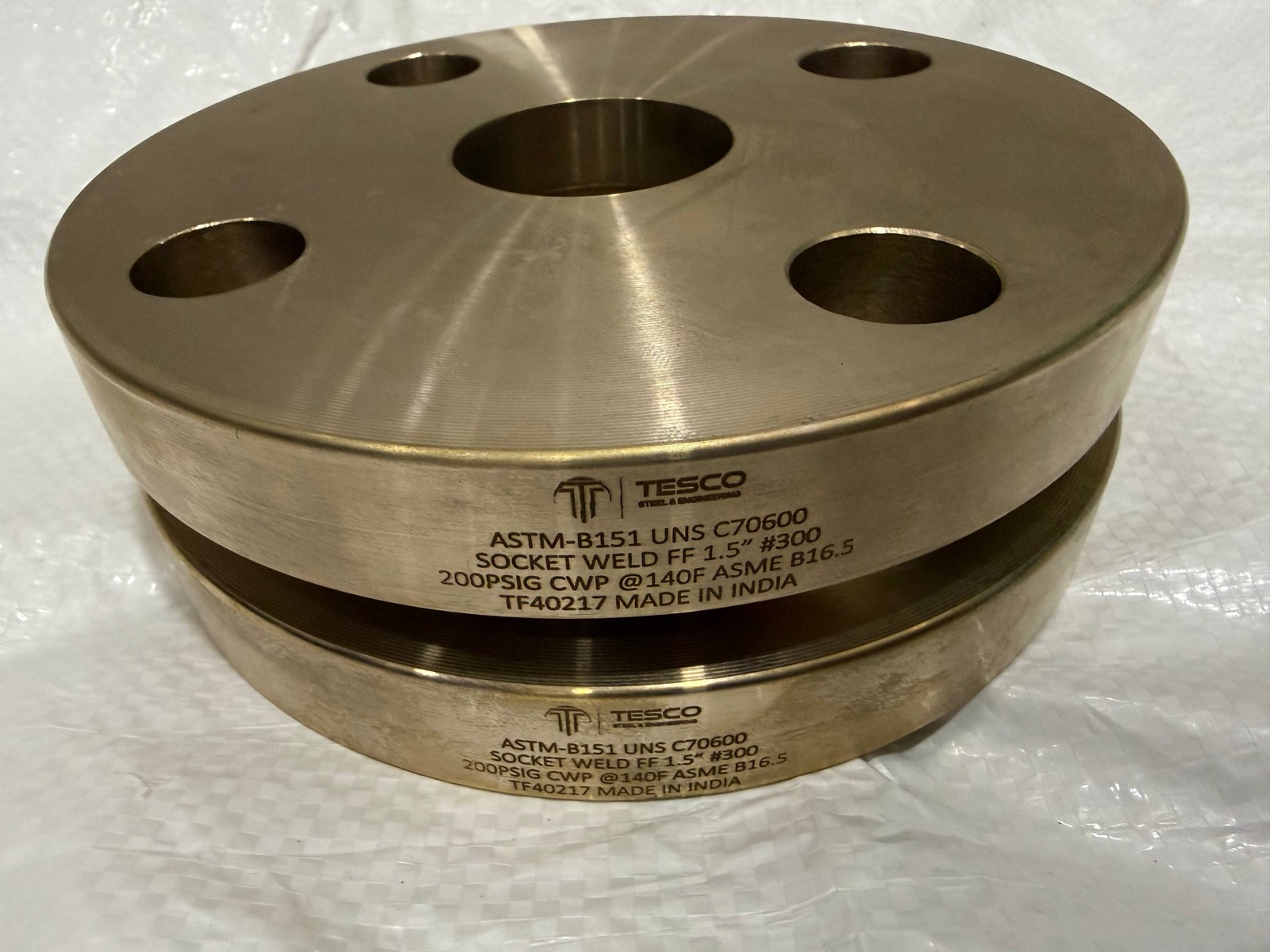
Tesco Steel & Engineering manufactures 90/10 copper-nickel socketweld flanges — the seawater economist: ASTM B151, UNS C70600, EN CuNi10Fe1Mn — to ASME B16.5 from ½″ to 3″ NB in Classes 150–1500, and the photograph below is our own supply, laser-marked as it leaves the works. This is the alloy the whole seawater thread has pointed at: where stainless resists the water and ignores the biology, copper-nickel manages the biology — its surface chemically discourages the fouling that blocks every other metal's coolers — and the deliberate 1.0–1.8% iron floor armours the film against flowing-seawater erosion. Sixty years of ships run on it: seawater cooling, firewater, ballast, box coolers, desalination. The honest boundaries are below: ~3–3.5 m/s velocity limits, sulphide-polluted harbours, ammonia — and the heavy-duty escalation is the 70/30 sibling; the strength-side contrast is super duplex. Welded with 70/30 ERCuNi filler — no preheat, no PWHT. Facings: SWRF, SWFF (the naval pattern), SWRTJ. Every lot with EN 10204 3.1/3.2 MTC. ISO 9001:2015, made in Mumbai, India — exported to 50+ countries.
90/10 CuNi · B151 · C70600 · CuNi10Fe1MnBiofouling-Resistant by ChemistryFe 1.0–1.8% — The Erosion ArmourThe Ship-Cooling Standard70/30 ERCuNi Filler · No Preheat275 / 105 MPa · 30% ElongationASME B16.5 ½″–3″ · Class 150–1500EN 10204 3.1 / 3.2 · ISO 9001:2015
Our Own Supply — TESCO Laser-Marked B151 C70600 Socket Weld FF Flanges, 1½″ Class 300
What is a 90/10 Copper Nickel Socketweld Flange?
The seawater economist in the small-bore pattern. A 90/10 copper-nickel flange (ASTM B151 / UNS C70600 / EN CuNi10Fe1Mn) with a machined socket: pipe seated square by geometry, one external fillet weld with 70/30 ERCuNi filler — no preheat, no PWHT — through-bore matched to the pipe schedule. ~90% copper discourages biofouling by its own chemistry; Ni 9–11% makes it an engineering alloy; the deliberate Fe 1.0–1.8% floor armours the film against flowing seawater to ~3–3.5 m/s. Tensile ≥275 MPa, yield ≥105 MPa, elongation ≥30%, annealed. Sized by ASME B16.5 at ½″–3″ NB, Classes 150–1500; EN 10204 3.1 on every lot.
Choosing a family is choosing a hydraulic regime and a maintenance philosophy — and for ship cooling, firewater and ballast, sixty years of fleets answer: 90/10.
What 90/10 Buys
Coolers That Stay Clean
The copper surface discourages marine settlement by its own ions — slime, weed and barnacles that choke stainless and titanium systems barely take hold, and the cleaning-shutdown calendar relaxes.
The Iron Armour
Fe 1.0–1.8% — a deliberate range with a floor — toughens the protective film against flowing-seawater impingement: the difference between plain copper's crawl and marine design velocities.
No Chloride SCC, No Crevice Anxiety
The stainless family's two seawater demons simply do not apply to a copper-base alloy — stagnation and deposits that terrify duplex are shrugged at here.
The Economist's Price
Ten percent nickel, not thirty or sixty — dedicated seawater performance at the lowest alloy cost on the map, which is why the world's fleets standardised on it.
90/10 Copper-Nickel Chemical Composition (UNS C70600)
Element
Cu
Ni
Fe
Mn
Zn
Pb
Weight %
Rem. (≥86.5)
9.0–11.0
1.00–1.80
≤1.0
≤0.50
≤0.02
Copper is the base — the series' one copper-side alloy, C-prefix UNS number and all. The iron is deliberate, floor included: an iron-light heat would pass a purity test and fail at sea. PMI confirms nickel and iron on every piece; the certificate carries EN CuNi10Fe1Mn (CW352H / 2.0872) where European documentation expects it.
Mechanical Properties (Annealed)
Property
90/10 CuNi (C70600) Requirement
Tensile Strength
≥ 275 MPa (40 ksi)
Yield Strength (0.2%)
≥ 105 MPa (15 ksi) — copper-alloy numbers, honest and sufficient: the chemistry and biology, not the rating, drive this specification
Elongation
≥ 30%
Condition
Annealed — records certified
Design Velocity
~3–3.5 m/s in piping — the alloy's one genuine boundary; the 70/30 sibling tolerates faster water
Rating
B16.5 copper-alloy tables govern; stated per class on our quotations
One Socket, Three Facings — and Why the Navy Likes Flat
Natural machined — no paint; laser-marked with grade, size, class, rating and origin, as photographed
Testing
Tension & chemistry per heat; PMI on every piece — Ni and the deliberate Fe confirmed; socket depth and bore gauged
Certification
EN 10204 3.1 with anneal records (standard) / 3.2 witnessed
Specification Notes — Getting 90/10 Sockets Right
Four honest notes.Respect the velocity rule: ~3–3.5 m/s design, with impingement watch at bends, orifices and pump discharges — faster systems argue for the 70/30 sibling or the stainless families. Sulphide-polluted water attacks the film: dirty-harbour commissioning and sewage-adjacent intakes deserve procedure — state the water honestly. Ammonia stress-corrodes copper alloys: rarely relevant at sea, always worth a line on chemical-plant enquiries. And mind the galvanic table: CuNi is anodic to stainless, nickel alloys and titanium — isolate or transition at family boundaries, and bolt accordingly; we design it in when the neighbouring metallurgy is stated.
How Our 90/10 CuNi Socketweld Flanges Are Manufactured
1
Material — certified C70600 stock, spectro-verified with the nickel and the deliberate iron confirmed, full heat traceability, segregated copper-alloy handling.
2
Annealing — sets the soft, ductile marine condition; records retained against the heat number.
3
Machining — faces, OD and drilling to ASME B16.5 on dedicated stations — copper alloys cut freely but demand sharp tools against smearing; socket counterbore and depth gauged piece by piece, through-bore matched to the ordered schedule.
4
Facing — flat face (the naval default), RF serrations or RTJ groove per B16.20.
5
Testing & marking — tension and chemistry per heat; PMI on every piece; laser-marked with grade, size, class, rating and origin — exactly as this page's photographs show.
6
Certification & packing — EN 10204 3.1 MTC with anneal records (3.2 witnessed on request); ERCuNi WPS guidance included; packed sea-worthy.
Where 90/10 CuNi Socketweld Flanges Are Used
Wherever ships and shores pump the sea: shipboard seawater cooling mains and their instrument trim, firewater and sprinkler systems, ballast piping, box coolers and heat-exchanger connections, offshore platform utility seawater, desalination plant trains (MSF and RO pre-treatment), and coastal power station auxiliaries. Our production and inspection below:
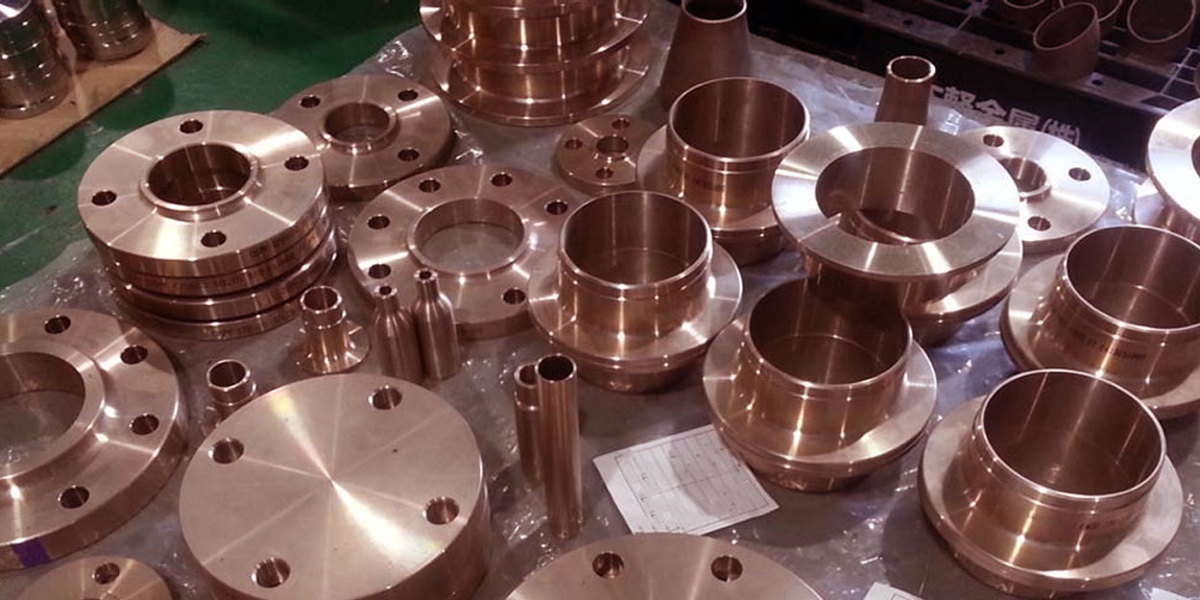
90/10 Cupro-Nickel Flanges — Production at Our WorksPMI Testing — Ni & Fe Verified on Every PieceCupro-Nickel Socket Weld Flange — Socket Bore Visible
90/10 CuNi Socketweld Flange Dimensions
Socket weld flange dimensions are class-governed per ASME B16.5 — identical across material grades (pressure-temperature ratings follow the copper-alloy group). Full charts:
How to Specify & Order a 90/10 CuNi Socketweld Flange
Six elements — and the water itself belongs on the enquiry:
1
Size & standard — e.g. 1½″ NB ASME B16.5, or the EN/DIN pattern for European-built vessels.
2
Pressure class & facing — 150#–1500#; SWFF is the marine default, SWRF for plant practice, SWRTJ rare.
3
Pipe schedule — the through-bore is matched to the pipe ID; no turbulence step in a velocity-limited alloy.
4
Grade line — 90/10 CuNi / ASTM B151 / UNS C70600 / EN CuNi10Fe1Mn all name the same metal; the water (clean sea, harbour, brackish; velocity; chlorination) and neighbouring metallurgy invited for honest guidance.
5
Certification — EN 10204 3.1 with anneal records (our standard) / 3.2 witnessed, PMI as applicable.
A 90/10 copper-nickel socketweld flange is a flange in the world's standard marine piping alloy — roughly 90% copper, 9-11% nickel and a deliberate iron addition, ASTM B151, UNS C70600, EN CuNi10Fe1Mn — whose back carries a machined socket: the pipe end seats inside, self-aligned square to the face, and is secured with a single external fillet weld. The photograph on this page is our own supply: TESCO laser-marked B151 C70600 socket weld flanges as they leave the works. 90/10 solves seawater by a mechanism no steel offers — its copper surface chemically discourages the marine growth that fouls every other metal — and it does so at the lowest cost of any dedicated seawater alloy. Dimensioned to ASME B16.5 for ½" to 3" NB in Classes 150 to 1500 — the ship-cooling standard, in the small-bore pattern.
How does copper-nickel resist biofouling — the mechanism?
By being mildly poisonous to the things that want to live on it. Every metal in seawater grows a community — slime, weed, barnacles, mussels — that blocks coolers, seeds crevice attack and forces cleaning shutdowns; stainless and titanium foul as enthusiastically as steel. Copper alloys are the exception: the surface releases a trace of copper ions, just enough to discourage larvae and spores from settling, so a 90/10 system stays substantially clean through years of service — the reason navies and shipbuilders standardised on it decades ago and never left. This is a fundamentally different bargain from the stainless ladder's: those alloys resist the water and ignore the biology; copper-nickel manages the biology, and the whole seawater thread of this site has been pointing at this page for exactly that reason.
What does the iron in 90/10 do — the deliberate floor?
It armours the film against moving water. Copper alloys protect themselves with a cuprous-oxide corrosion film, but plain copper's film is soft and strips in fast, turbulent seawater — classic impingement attack at pipe bends and pump discharges. The 1.00-1.80% iron in C70600 is a deliberate alloying addition, floor included: dissolved in the film, it toughens the protective layer dramatically, raising the alloy's tolerance of flowing seawater from plain copper's crawl to the roughly 3-3.5 m/s design velocities marine practice assigns 90/10. That is why the specification writes a range, not a ceiling — an iron-light heat would pass a purity test and fail at sea — and why our PMI confirms the iron on every piece alongside the nickel.
What is the chemical composition of 90/10 copper-nickel (UNS C70600)?
Copper the remainder (at least 86.5%), nickel 9.0-11.0%, iron 1.00-1.80%, manganese ≤1.0%, zinc ≤0.50%, lead ≤0.02%. Three readings matter. Copper is the base — this is the series' one copper-side alloy, and its C-prefix UNS number says so. The nickel is the ten percent that turns copper into an engineering seawater alloy: strength, film quality and erosion standing all rise with it. And the iron is deliberate, floor and all — the erosion armour with its own FAQ above. The tight lead ceiling guards hot workability and weldability. Chemistry is verified per heat and travels on the EN 10204 3.1 MTC with the EN designation CuNi10Fe1Mn (CW352H / 2.0872) where European documentation expects it.
What are the mechanical properties of 90/10 CuNi socketweld flanges?
In the annealed condition: tensile strength 275 MPa (40 ksi) minimum, yield strength 105 MPa (15 ksi) minimum, elongation 30% minimum — copper-alloy numbers, stated honestly, and entirely sufficient for the duty: marine cooling, firewater and ballast systems run at modest pressures, and ASME B16.5's copper-alloy pressure-temperature tables already reflect the metal's strength, so a properly classed flange carries its rating with normal margins. The flanges in this page's photograph are marked with exactly that discipline — class, rating and standard on the metal itself. Where a seawater duty genuinely needs strength — high-pressure injection, deep risers — the conversation moves to 70/30 copper-nickel or super duplex, both a link away.
What are 90/10's velocity limits — the honest design rule?
Roughly 3 to 3.5 metres per second in piping, and the rule deserves respect because it is the alloy's one genuine boundary. Above design velocity — and locally at throttled valves, orifices, tight bends and pump discharges — turbulence strips the protective film faster than it re-forms, and impingement attack follows. Marine design codes handle this with sizing rules and minimum straight lengths, and small-bore trim mostly lives well inside them. Note the elegant mirror with the stainless world: duplex and 6Mo love velocity (it sweeps their crevices clean) and dislike stagnation; copper-nickel is happiest at moderate flow and shrugs at stagnation — fouling barely sticks and crevice chemistry barely applies. Choosing between the families is often choosing which hydraulic regime your system actually runs.
90/10 or 70/30 copper-nickel — how do I choose?
90/10 is the economist; 70/30 is the heavy-duty edition. Tripling the nickel to 29-33% buys roughly half again the strength, tolerance of higher velocities and turbulence, better standing against sand-laden and polluted waters, and more margin generally — at a distinctly higher price, since nickel costs what nickel costs. Marine practice reflects the split: ship cooling mains, firewater and ballast run overwhelmingly on 90/10, with 70/30 reserved for the harder corners — higher-speed systems, submarine and naval combatant service, sand-bearing intakes. Our C71500 socketweld page carries the 70/30 story. The practical rule: start at 90/10, and let a named aggressor — speed, sand, pollution — argue you up.
Copper-nickel or the stainless seawater alloys — the map?
Different mechanisms, different sweet spots — this site's whole seawater thread in one answer. Copper-nickel: antifouling by chemistry, immune to chloride SCC, economical, gentle mechanicals, velocity-limited — the default for ship and platform cooling, firewater and desalination, where fouling control is half the battle. Super duplex and 6Mo: strong, fast-water-tolerant, fouling-prone — the choice for high-pressure injection, fast systems and where strength drives design. Titanium: immune to the water entirely, at a price. Monel: the historic middle, still strong in trim and fasteners. A socket weld flange in 90/10 belongs where its pipe does — CuNi systems flange in CuNi — and galvanic sense at the boundaries between these families has its own FAQ below.
How does 90/10 behave galvanically in mixed systems?
As the middle of the seawater nobility table — and boundaries need design. Copper-nickel is noble against steel and cast iron (they protect it, sacrificially and expensively) but anodic to stainless, nickel alloys and titanium: couple a CuNi line hard to a super duplex pump or titanium cooler and the copper alloy corrodes preferentially at the joint. Marine practice manages this with isolation, distance pieces, and the useful trick of a 70/30 or Monel transition. Bolting follows the same logic — carbon-steel studs corrode beside CuNi; hot-dip or alloy fasteners are standard. State the neighbouring metallurgy on the enquiry and the answer comes designed-in; it is a system question, not a flange defect.
What are 90/10's honest weaknesses?
Three, all manageable and all worth naming. Polluted and sulphide-bearing water: harbour water rich in sulphides — from sewage or decaying matter — converts the protective film to a soft sulphide layer that later strips in clean water; commissioning and dirty-harbour exposure deserve procedure, and chronically polluted intakes may argue for 70/30 or other alloys. Ammonia: like all copper alloys, concentrated ammonia can stress-corrode it — rarely relevant at sea, always worth a line on chemical-plant enquiries. And the velocity boundary already covered. Excess chlorination also thins the film's advantage. None of these have dislodged 90/10 from the world's ship-cooling standard in sixty years; all of them belong in an honest specification conversation.
How is a 90/10 CuNi socketweld flange welded?
Easily, with one famous consumable rule: the filler is 70/30. ERCuNi — the 70/30 copper-nickel wire — is the standard consumable for both CuNi grades: its higher nickel keeps the weld deposit at least as noble and as erosion-resistant as the base metal, so the joint never becomes the weak point of the film. Geometry is standard socket weld practice: pipe bottomed, withdrawn 1/16" (1.6 mm), single external fillet. No preheat, no PWHT. Copper's thermal conductivity asks for a little more amperage and patience than steel of the same size, and cleanliness matters as ever. Our flanges arrive annealed with records, and WPS guidance naming ERCuNi travels with every supply.
What facings are 90/10 CuNi socketweld flanges made with — and why is flat face the naval pattern?
All three — and this page's own photograph shows the answer: those are flat face socket weld flanges, laser-marked as such, because FF is the marine pattern. Shipboard practice mates flanges against composite pipe, valve bodies and equipment where full-face contact and full-face elastomer gaskets suit the modest pressures and the vibration environment — so naval and commercial marine specs write SWFF as the default, with raised face (SWRF) serving conventional plant practice and ring joint (SWRTJ) a rarity in this alloy. Our SWFF page carries the facing's own story. Gasket practice is elastomeric and synthetic full-face sheet by service; bolting per the galvanic FAQ above. NPT-tapped variants are machined and certified at the works.
What sizes and pressure classes do 90/10 CuNi socketweld flanges come in?
ASME B16.5 standardises socket weld flanges from ½" to 3" NB in Classes 150, 300, 600, 900 and 1500 — Class 900 sharing Class 1500 dimensions in most small-bore sizes — with 4" and Class 2500 made to order. Marine small bore lives in Classes 150 and 300 — the flanges photographed on this page are 1.5" Class 300 — at pressures where the chemistry and the biology, not the rating, drive the specification. Put the pipe schedule on the enquiry — the through-bore is matched to the pipe ID so the joint presents no turbulence step, which matters doubly in a velocity-limited alloy. B16.5's copper-alloy tables govern the rating; our quotations state it per class.
What details are needed to get an accurate 90/10 CuNi socketweld flange quotation?
Six elements plus commercial terms: (1) size — ½" to 3" NB; (2) pressure class — 150 to 1500; (3) facing — SWFF is the marine default, SWRF for plant practice, SWRTJ rare; (4) the pipe schedule, so the through-bore matches the pipe ID; (5) the grade line — 90/10 CuNi, ASTM B151, UNS C70600 or EN CuNi10Fe1Mn (CW352H/2.0872) all name the same metal, and the certificate carries the designations your documentation uses — EEMUA 145 and DIN 86037 heritage supported; (6) certification — EN 10204 3.1 with anneal records (our standard) or 3.2 witnessed, PMI as applicable. Add the neighbouring metallurgy for galvanic guidance, plus quantity and destination. Quotations normally within 24 hours — marine sizes often from ready stock.
Who manufactures 90/10 copper nickel socketweld flanges in India?
Tesco Steel & Engineering is an ISO 9001:2015 certified flange manufacturer based in Mumbai, India, producing 90/10 copper-nickel (ASTM B151, UNS C70600) socket weld flanges from ½" to 3" NB (larger to order) in Classes 150-1500 — each machined from certified CuNi stock, annealed with records against the heat number, socket depth and schedule-matched bore gauged piece by piece, PMI-checked — nickel and the deliberate iron both confirmed — and laser-marked with grade, size, class, rating and origin, exactly as this page's own photographs show. Supplied with EN 10204 3.1/3.2 certification and ERCuNi WPS guidance, alongside the 70/30 sibling, the Monel cousins and the full marine and high-alloy socketweld range this series covers. Exported to more than 50 countries.