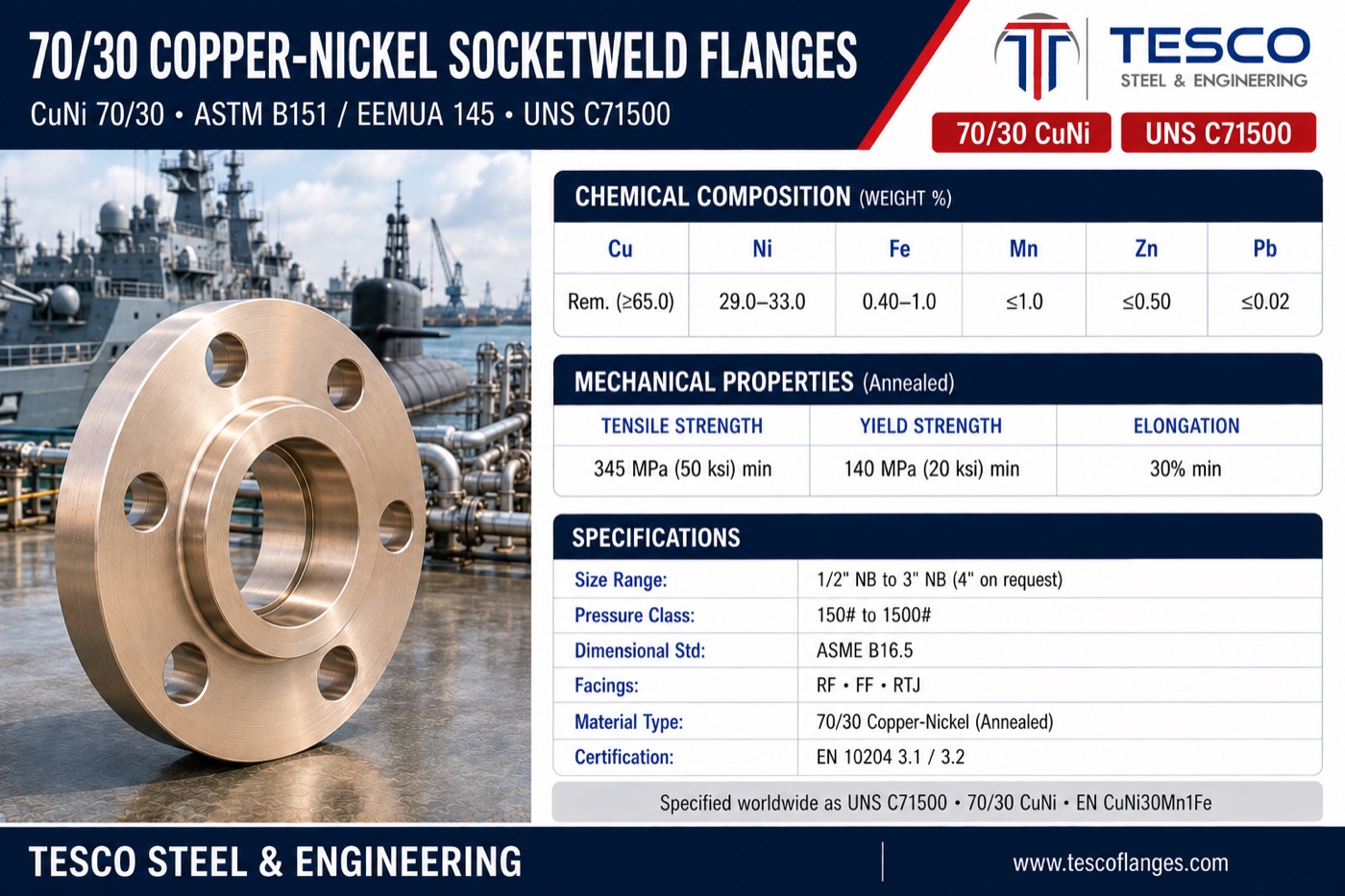
Tesco Steel & Engineering manufactures 70/30 copper-nickel socketweld flanges — the heavy-duty cupronickel: ASTM B151, UNS C71500, EN CuNi30Mn1Fe — to ASME B16.5 from ½″ to 3″ NB in Classes 150–1500. This is the 90/10's stronger sibling: triple the nickel buys half again the strength (345/140 MPa), design velocities around 4–4.5 m/s, and real margin against sand and dirty water — the combination that made it the naval grade: submarines and combatants have run on 70/30 for generations — while the copper family's defining talent, antifouling by chemistry, is kept. The honest economics stay honest too: ship cooling's volume rightly remains with 90/10; the 70/30 is specified where a named aggressor — speed, sand, pollution, shock rating — earns it, and the severest sand escalates to C71640. Welded with matching ERCuNi filler — no preheat, no PWHT. Facings: SWRF, SWFF (the naval pattern), SWRTJ. Every lot with EN 10204 3.1/3.2 MTC. ISO 9001:2015, made in Mumbai, India — exported to 50+ countries.
70/30 CuNi · B151 · C71500 · CuNi30Mn1FeTriple the Nickel — Ni 29–33%The Naval Grade — Subs & Combatants~4–4.5 m/s · Sand & Dirty-Water MarginAntifouling Chemistry, Kept345 / 140 MPa · 30% ElongationASME B16.5 ½″–3″ · Class 150–1500EN 10204 3.1 / 3.2 · ISO 9001:2015
70/30 Copper Nickel Socketweld Flanges — Specifications at a Glance
What is a 70/30 Copper Nickel Socketweld Flange?
The heavy-duty cupronickel in the small-bore pattern. A 70/30 copper-nickel flange (ASTM B151 / UNS C71500 / EN CuNi30Mn1Fe) with a machined socket: pipe seated square by geometry, one external fillet weld with matching ERCuNi filler — no preheat, no PWHT — through-bore matched to the pipe schedule. Ni 29–33% — triple the 90/10's dose — buys 345/140 MPa, ~4–4.5 m/s design velocities, and sand-and-pollution margin; the antifouling copper chemistry is kept. The naval grade: submarine and combatant seawater systems standardised on it generations ago. Sized by ASME B16.5 at ½″–3″ NB, Classes 150–1500; EN 10204 3.1 on every lot.
The heavy-duty edition: naval, fast, sandy, dirty — margin everywhere
This page
The shared rule from both pages: start at 90/10, and let a named aggressor — speed, sand, pollution, shock rating — argue you up. Beyond even this grade, severe sand escalates to C71640.
What Triple Nickel Buys
Margin in Every Direction
Half again the strength, a full m/s of extra design velocity, and stubborn resistance to sand and dirty water — the sea pushes, the 70/30 pushes back harder.
The Naval Pedigree
Submarines and combatants standardised on 70/30 generations ago — shock-rated, dive-pressure-proven, MIL-heritage qualification records that commercial buyers inherit for free.
Antifouling, Kept
Two-thirds of the metal is still copper — the ion chemistry that keeps coolers clean carries over from the 90/10 almost unchanged.
The Transition Metal
Its nobility sits between the copper and nickel worlds — marine practice uses 70/30 to step galvanic gradients down in stages: 90/10 → 70/30 → Monel.
70/30 Copper-Nickel Chemical Composition (UNS C71500)
Element
Cu
Ni
Fe
Mn
Zn
Pb
Weight %
Rem. (≥65.0)
29.0–33.0
0.40–1.0
≤1.0
≤0.50
≤0.02
Note the detail that rewards attention: the iron drops against the 90/10's 1.0–1.8% — in the lean alloy iron is the erosion armour; here the nickel itself does that work, so the dose eases while the armour improves. PMI confirms nickel and iron on every piece; the certificate carries EN CuNi30Mn1Fe where European documentation expects it.
Mechanical Properties (Annealed)
Property
70/30 CuNi (C71500) Requirement
Tensile Strength
≥ 345 MPa (50 ksi) — half again the 90/10's certificate
Yield Strength (0.2%)
≥ 140 MPa (20 ksi) — welcome in shock-rated and vibration-heavy naval systems
Elongation
≥ 30%
Condition
Annealed — records certified
Design Velocity
~4–4.5 m/s in piping — a full m/s beyond the 90/10
Rating
B16.5 copper-alloy tables govern; stated per class on our quotations
Natural machined — no paint; laser-marked with grade, size, class, rating and origin
Testing
Tension & chemistry per heat; PMI on every piece — Ni and Fe confirmed; socket depth and bore gauged
Certification
EN 10204 3.1 with anneal records (standard) / 3.2 witnessed
Specification Notes — Getting 70/30 Sockets Right
Four honest notes.Don't pay for it without an aggressor: the 90/10 serves the volume of marine duty at a fraction of the nickel — speed, sand, pollution or shock rating should be nameable before the 70/30 is specified. Sulphide pollution remains the family caveat: the 70/30 tolerates dirty harbours better, but chronic sewage-adjacent intakes deserve honest discussion. Ammonia stress-corrodes copper alloys — the standing family line for chemical-plant enquiries. And severe sand has its own specialist: dredging-prone and high-silt duty escalates to C71640, the iron-and-manganese-fortified 70/30.
How Our 70/30 CuNi Socketweld Flanges Are Manufactured
1
Material — certified C71500 stock, spectro-verified with the 29–33% nickel confirmed, full heat traceability, segregated copper-alloy handling.
2
Annealing — sets the tough, ductile marine condition; records retained against the heat number.
3
Machining — faces, OD and drilling to ASME B16.5 on dedicated stations — the higher nickel cuts firmer than 90/10 but still demands sharp tools; socket counterbore and depth gauged piece by piece, through-bore matched to the ordered schedule.
4
Facing — flat face (the naval default), RF serrations or RTJ groove per B16.20.
5
Testing & marking — tension and chemistry per heat; PMI on every piece; laser-marked with grade, size, class, rating and origin.
6
Certification & packing — EN 10204 3.1 MTC with anneal records (3.2 witnessed on request); ERCuNi WPS guidance included; packed sea-worthy.
Where 70/30 CuNi Socketweld Flanges Are Used
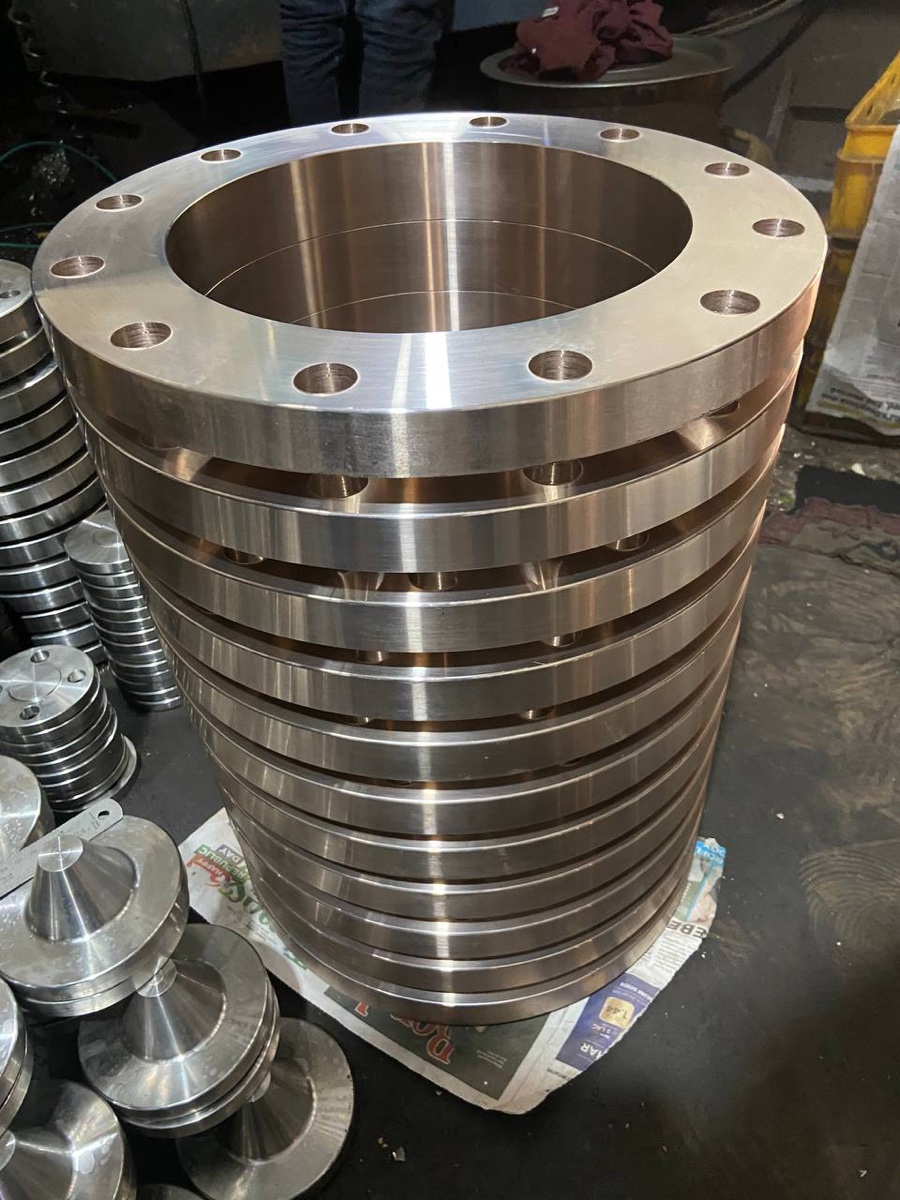
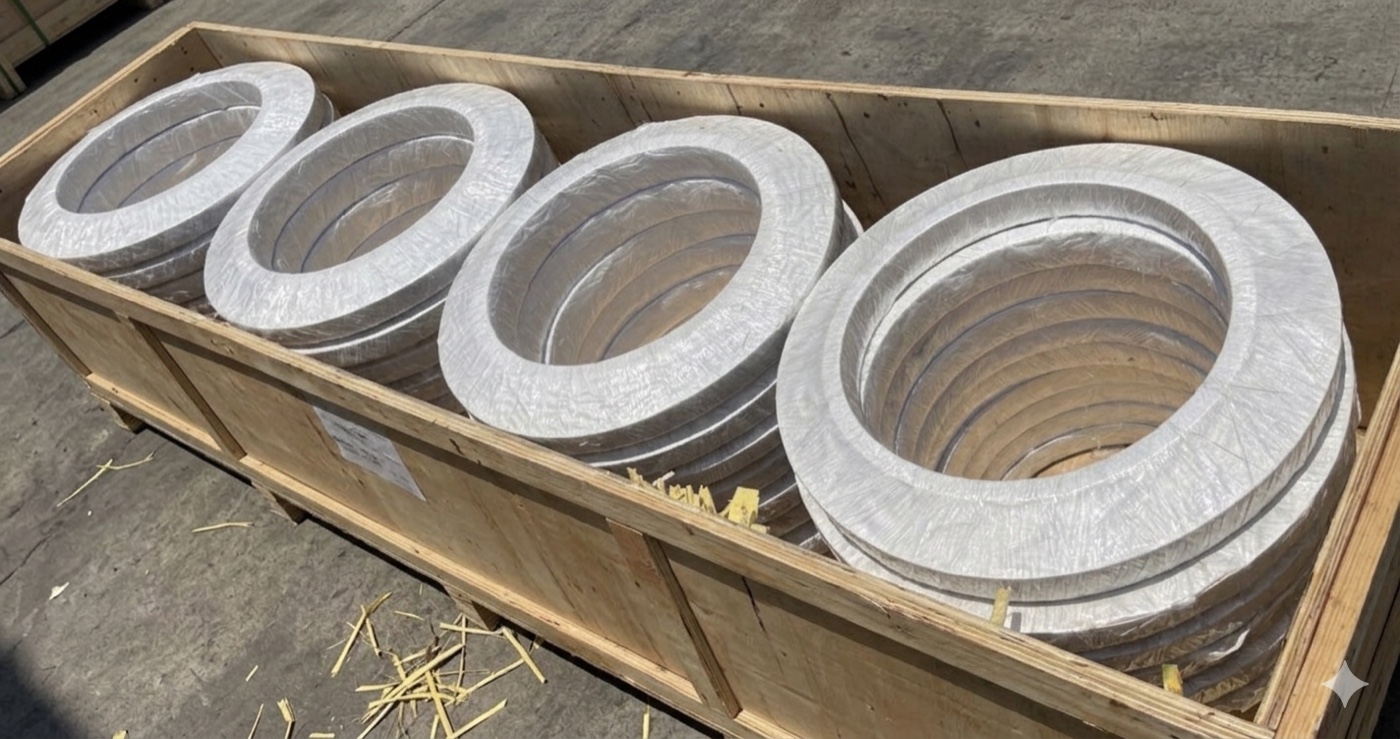
Where the sea runs harder: naval combatant and submarine seawater systems (cooling, firemain, trim and instrument connections), fast commercial systems beyond 90/10's velocity comfort, sand-bearing and estuarine intakes, dirty-harbour service craft, high-duty offshore pump circuits, and the transition trim where cupronickel systems meet nobler hardware. Our production below:
C71500 70/30 Flanges — Machined Stack at Our WorksPMI Testing — Ni & Fe Verified on Every Piece70/30 Copper-Nickel Flanges — Finished at Our Works
70/30 CuNi Socketweld Flange Dimensions
Socket weld flange dimensions are class-governed per ASME B16.5 — identical across material grades (pressure-temperature ratings follow the copper-alloy group). Full charts:
How to Specify & Order a 70/30 CuNi Socketweld Flange
Six elements — and the aggressor that earned the upgrade belongs on the enquiry:
1
Size & standard — e.g. 1″ NB ASME B16.5, or the EN/DIN pattern for European-built vessels.
2
Pressure class & facing — 150#–1500#; SWFF is the marine default, SWRF for plant practice.
3
Pipe schedule — the through-bore is matched to the pipe ID.
4
Grade line — 70/30 CuNi / ASTM B151 / UNS C71500 / EN CuNi30Mn1Fe all name the same metal; the aggressor — velocity, sand, pollution, shock rating — invited for honest confirmation, with neighbouring metallurgy for galvanic guidance.
5
Certification — EN 10204 3.1 with anneal records (our standard) / 3.2 witnessed, PMI as applicable.
A 70/30 copper-nickel socketweld flange is a flange in the heavy-duty grade of the marine cupronickel family — roughly 70% copper and 29-33% nickel, ASTM B151, UNS C71500, EN CuNi30Mn1Fe — whose back carries a machined socket: the pipe end seats inside, self-aligned square to the face, and is secured with a single external fillet weld. The 70/30 is the 90/10's stronger sibling: tripling the nickel buys roughly half again the strength, tolerance of faster and dirtier water, and the pedigree of the hardest marine duties — submarine and naval-combatant seawater systems — while keeping the copper family's defining talent, antifouling by chemistry. Dimensioned to ASME B16.5 for ½" to 3" NB in Classes 150 to 1500 — the heavy-duty cupronickel, in the small-bore pattern.
What does tripling the nickel buy?
Margin, in every direction the sea pushes. Strength: 345/140 MPa against the 90/10's 275/105 — roughly half again, welcome in shock-rated naval systems and higher classes. Velocity: the richer alloy holds its protective film in faster, more turbulent water — marine practice assigns 70/30 design velocities around 4-4.5 m/s where 90/10 stops at 3-3.5. Abrasion and pollution: sand-laden intakes and dirtier harbour water that wear down the 90/10's film find the 70/30 distinctly more stubborn. And general corrosion margin rises across the board. The price is literal — nickel at three times the dose costs what nickel costs — which is why the volume of world shipping rightly stays on 90/10 and the 70/30 is specified where a named aggressor earns it.
What is the chemical composition of 70/30 copper-nickel (UNS C71500)?
Copper the remainder (at least 65.0%), nickel 29.0-33.0%, iron 0.40-1.0%, manganese ≤1.0%, zinc ≤0.50%, lead ≤0.02%. The detail that rewards attention is the iron: it drops against the 90/10's 1.0-1.8%, and deliberately so — in the lean alloy, iron is the erosion armour; in the 70/30, the nickel itself does that work, so the iron dose eases while the armour improves. The tight lead ceiling guards hot workability and weldability as across the family. Chemistry is verified per heat — nickel and iron both PMI-confirmed on every piece — and travels on the EN 10204 3.1 MTC with the EN designation CuNi30Mn1Fe where European documentation expects it.
What are the mechanical properties of 70/30 CuNi socketweld flanges?
In the annealed condition: tensile strength 345 MPa (50 ksi) minimum, yield strength 140 MPa (20 ksi) minimum, elongation 30% minimum — a clear step above the 90/10's certificate, and the reason the harder marine specifications reach for this grade. The step matters most where systems are shock-rated, vibration-heavy or simply run harder: naval combatants, submarines, high-duty pump circuits. As throughout the copper family, B16.5's copper-alloy pressure-temperature tables govern the flange's rating, and the alloy's real case is made by its chemistry and its velocity tolerance rather than by the tensile line. Where even more strength is the driver, the conversation crosses to super duplex — a different philosophy entirely, compared honestly on the 90/10 page's seawater map.
70/30 or 90/10 — how do I choose?
The mirror of the question on our 90/10 page, answered the same way: start at 90/10, and let a named aggressor argue you up. Ship cooling mains, firewater, ballast and desalination trains run overwhelmingly and correctly on the economist grade. The 70/30 earns its premium where the water runs faster than 90/10's design velocities, where sand or chronic harbour pollution wears at the film, where shock and vibration ratings ask for the stronger certificate, and where naval specifications simply name it — submarine and combatant practice standardised on 70/30 decades ago and remains its most loyal customer. Both grades keep the antifouling chemistry; both weld with the same ERCuNi filler; systems mixing the two are routine, with the 70/30 often serving as the hard-duty trim within a 90/10 plant.
Why is 70/30 the naval grade?
Because warships ask more of seawater piping than merchant ships do. Naval seawater systems are shock-rated against underwater explosion, run harder and faster in combat conditions, dive with submarines to pressures merchant hulls never see, and cannot tolerate the maintenance holidays a fouled or eroded cooling system demands — so naval standards, from the classic MIL specifications onward, wrote the richer cupronickel into combatant and submarine practice and have kept it there for generations. The 70/30's combination — antifouling chemistry, immunity to chloride cracking, strength and velocity margin, proven shock behaviour — remains difficult to assemble in any other single alloy. Commercial buyers inherit the benefit: a grade whose qualification record was written by navies.
Does 70/30 keep the antifouling chemistry?
Yes — the mechanism needs copper, and two-thirds of the metal still is. The surface releases the same trace of copper ions that discourages larvae and spores from settling, so 70/30 systems share the family's defining advantage: coolers and piping that stay substantially clean without chlorination heroics. The effect is somewhat gentler than the 90/10's — less copper, less ion release — which in practice means the two grades foul similarly little in flowing systems, with the 90/10 holding a slight edge in stagnant corners. Set against any stainless, nickel or titanium alternative, both cupronickels remain in a class of their own on biology, and the full antifouling story on our 90/10 page reads across to this grade almost unchanged.
What about sand and polluted water — and when does C71640 enter?
This is the 70/30's home ground, with one further escalation beyond it. Sand-laden intakes and silty estuarine water erode the 90/10's film at its velocity limits; the 70/30's richer chemistry holds distinctly longer, making it the standard answer for abrasive and dirty-water marine duty. Where sand loading becomes severe — dredging-prone anchorages, shallow high-silt intakes — the family's specialist is C71640: a 70/30 fortified with roughly 2% iron and 2% manganese specifically for erosion, and our C71640 material page carries its story. Sulphide pollution remains the whole family's caveat: the 70/30 tolerates dirty harbours better than the 90/10, but chronic sewage-adjacent service deserves honest discussion on any cupronickel enquiry.
How does 70/30 behave galvanically — the transition-metal role?
Its 30% nickel places it usefully between the copper and nickel worlds on the seawater nobility table — slightly noble to the 90/10, still anodic to Monel, stainless and titanium. That intermediate position gives the 70/30 a quiet second job: marine practice uses it as the transition metal where a cupronickel system must meet nobler hardware, stepping the galvanic gradient down in stages — 90/10 to 70/30 to Monel — instead of presenting one harsh couple. Within all-cupronickel systems, mixing the two grades is galvanically benign. Bolting logic follows the family rule: carbon-steel studs corrode beside cupronickel; hot-dip or alloy fasteners are standard. State the neighbouring metallurgy on the enquiry and the transitions come designed-in.
How is a 70/30 CuNi socketweld flange welded?
With the family's easy rules — and here the famous filler is simply matching. ERCuNi is 70/30 copper-nickel wire: on the 90/10 it over-alloys the joint deliberately; on this grade it matches the base metal, keeping deposit and flange identical in nobility and film behaviour. Geometry is standard socket weld practice: pipe bottomed, withdrawn 1/16" (1.6 mm), single external fillet. No preheat, no PWHT. Copper's conductivity asks a little more amperage and patience than steel, cleanliness matters as ever, and the 70/30's higher nickel makes the weld pool slightly more sluggish than the 90/10's — welders notice, procedures barely change. Our flanges arrive annealed with records, and WPS guidance naming ERCuNi travels with every supply.
What facings are 70/30 CuNi socketweld flanges made with?
All three, with the family's naval preference intact: flat face (SWFF) is the marine default — full-face contact and full-face elastomer gaskets suit shipboard practice and its vibration environment, and naval specifications write it as standard — with raised face (SWRF) serving conventional plant installations and ring type joint (SWRTJ) a rarity in copper alloys. Gasket practice is elastomeric and synthetic full-face sheet by service; bolting follows the galvanic FAQ above, with hot-dip or alloy fasteners standard beside cupronickel. NPT-tapped test and instrument variants are machined and certified at the works, and our SWFF page carries the flat-face story in full.
What sizes and pressure classes do 70/30 CuNi socketweld flanges come in?
ASME B16.5 standardises socket weld flanges from ½" to 3" NB in Classes 150, 300, 600, 900 and 1500 — Class 900 sharing Class 1500 dimensions in most small-bore sizes — with 4" and Class 2500 made to order. The 70/30's naval and hard-duty franchise pulls it into Classes 300 and 600 more often than its economist sibling, and submarine practice reaches higher still. Put the pipe schedule on the enquiry — the through-bore is matched to the pipe ID so the joint presents no turbulence step — and B16.5's copper-alloy tables govern the rating; our quotations state it per class.
What details are needed to get an accurate 70/30 CuNi socketweld flange quotation?
Six elements plus commercial terms: (1) size — ½" to 3" NB; (2) pressure class — 150 to 1500; (3) facing — SWFF is the marine default, SWRF for plant practice; (4) the pipe schedule, so the through-bore matches the pipe ID; (5) the grade line — 70/30 CuNi, ASTM B151, UNS C71500 or EN CuNi30Mn1Fe all name the same metal, with EEMUA 145 and naval-heritage documentation supported, and the aggressor that argued you up from 90/10 — velocity, sand, pollution, shock rating — worth a line for honest confirmation; (6) certification — EN 10204 3.1 with anneal records (our standard) or 3.2 witnessed, PMI as applicable. Add neighbouring metallurgy for galvanic guidance, plus quantity and destination. Quotations normally within 24 hours.
Who manufactures 70/30 copper nickel socketweld flanges in India?
Tesco Steel & Engineering is an ISO 9001:2015 certified flange manufacturer based in Mumbai, India, producing 70/30 copper-nickel (ASTM B151, UNS C71500) socket weld flanges from ½" to 3" NB (larger to order) in Classes 150-1500 — each machined from certified CuNi stock, annealed with records against the heat number, socket depth and schedule-matched bore gauged piece by piece, PMI-checked — the 29-33% nickel and the iron both confirmed — and laser-marked with grade, size, class, rating and origin. Supplied with EN 10204 3.1/3.2 certification and ERCuNi WPS guidance, alongside the 90/10 economist sibling, the C71640 erosion specialist, the Monel cousins and the full marine socketweld range this series covers. Exported to more than 50 countries.