Copper-Nickel 70/30 Blind Flanges — UNS C71500 Blind Manufacturer
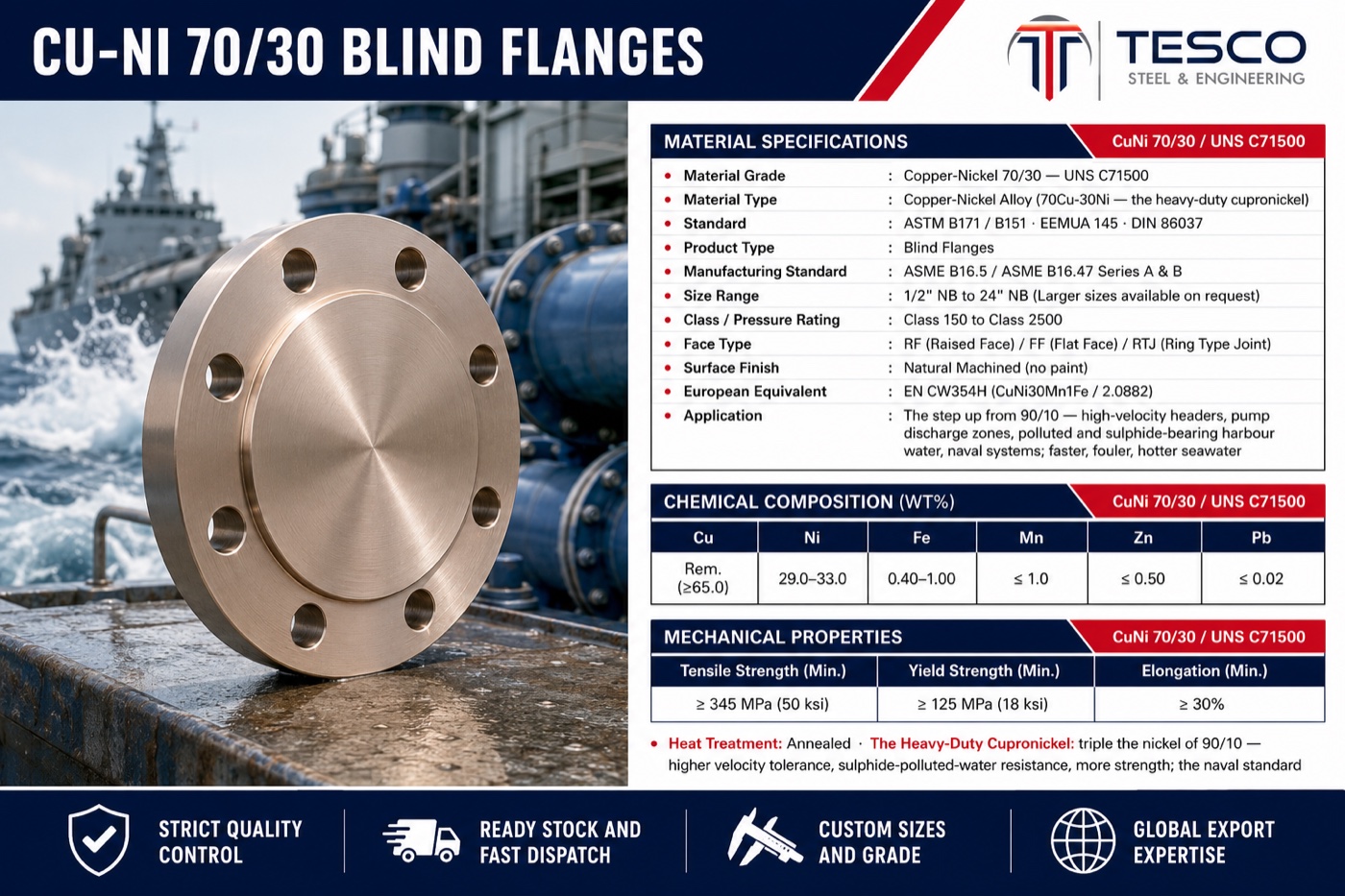
Tesco Steel & Engineering manufactures copper-nickel 70/30 blind flanges — UNS C71500, EN 2.0882 / CuNi30Mn1Fe — to ASME B16.5 Class 150–2500 from ½″ to 24″ NB, to ASME B16.47 up to 60″, and to the marine patterns EEMUA 145 and DIN 86037. The heavy-duty cupronickel: triple the nickel of 90/10 buys the three things the economist runs out of — velocity tolerance (pump discharges, high-flow mains), sulphide-polluted harbour water, and strength (345/125 MPa) — while keeping copper's biofouling resistance. The naval standard where 90/10 is the merchant one, and the midpoint of the copper-nickel continuum that ends at Monel. Pressure beyond copper: super duplex. The last word in any water: titanium. Facings: BLRF, BLFF or BLRTJ. Every lot with EN 10204 3.1/3.2 MTC. ISO 9001:2015, made in Mumbai, India — exported to 50+ countries.
CuNi 70/30 · UNS C71500EN 2.0882 · CuNi30Mn1FeEEMUA 145 · DIN 86037 Marine PatternsTriple the Nickel of 90/10Faster · Fouler · Hotter WaterThe Naval StandardASME B16.5 ½″–24″ · Class 150–2500EN 10204 3.1 / 3.2 · ISO 9001:2015
Copper-Nickel 70/30 Blind Flanges — Specifications at a Glance
What is a Copper-Nickel 70/30 Blind Flange?
The heavy-duty cupronickel. A solid disc of 70% copper, 30% nickel (UNS C71500 / EN 2.0882) with no bore, closing the seawater systems that have outgrown 90/10: high-velocity headers, pump discharge zones, polluted harbour water, naval circuits. The tripled nickel strengthens the protective film itself — higher velocity tolerance, sulphide resistance, 345/125 MPa strength — while the copper keeps doing what copper alone does: biofouling never settles. Dimensions per ASME B16.5 / B16.47 or the marine patterns EEMUA 145 / DIN 86037, in RF, FF and RTJ facings; EN 10204 3.1 certified.
Also searched as: CuNi 70/30 blind flange, cupro-nickel 70/30 blind, C71500 blind, 2.0882 blind flange, CuNi30Mn1Fe blind, CW354H blind, naval blind flange, EEMUA 145 70/30 blind — all refer to the product on this page. See also the sibling 90/10 C70600 blind flanges, our copper-nickel hub and C71500 slip-on flanges, the continuum's far end Monel 400, and the facing pages BLRF / BLFF / BLRTJ.
What Tripling the Nickel Buys
Velocity
The 30% nickel strengthens the protective film intrinsically — pump discharges and high-flow mains that would scour 90/10 sit inside 70/30's window. (That is also why the iron drops to 0.40–1.00%: the nickel now does the film work — a lower iron line on the certificate is correct here.)
Polluted Water
Sulphide-bearing harbours and estuaries convert 90/10's film and strip it; 70/30 degrades far more gracefully — the standing recommendation for berths with known pollution.
Strength & Margin
345/125 MPa against 90/10's 275/105, with temperature headroom to match — the margins navies specified into their firemain and combat-cooling systems generations ago.
Acids, caustic, stagnant-service extremes — beyond cooling water
The same two metals from end to end — corrosion duty, strength and price all climb with the nickel. 70/30 is as much nickel as seawater service needs to buy; past it, the duty has usually left cooling water altogether.
C71500 Chemical Composition
Element
Cu
Ni
Fe
Mn
Zn
Pb
Weight %
Rem. (≥65.0)
29.0–33.0
0.40–1.00
≤1.0
≤0.50
≤0.02
Read the iron correctly: lower than 90/10's 1.00–1.80, by design — the tripled nickel strengthens the film itself, so the iron drops to a supporting role. A 70/30 certificate showing 1.5% iron is off-specification just as surely as a 90/10 showing 0.3%. Our PMI reads both elements against the right grade's windows on every piece.
Offshore, shipbuilding & naval line classes — to order
C71500 Blind Flange Specifications
Copper-Nickel 70/30 Blind Flanges are available in the following specifications:
Material Grade
Copper-Nickel 70/30 — UNS C71500 (ASTM B171/B151 chemistry); EN 2.0882 / CuNi30Mn1Fe (CW354H) designation where required
Heat Treatment
Annealed — stated on certificate
Size
1/2"NB to 24"NB per ASME B16.5; 26"–60" per ASME B16.47; EEMUA 145 / DIN 86037 / EN 1092-1 to order
Class
150#, 300#, 400#, 600#, 900#, 1500#, 2500# — rated on the alloy's own B16.5 lines
Facings
Raised Face (BLRF), Flat Face (BLFF), Ring Type Joint (BLRTJ); marine-pattern facings per EEMUA/DIN
Service Span
High-velocity, polluted and naval-margin seawater beyond 90/10; ammonia excluded; cavitating zones belong to duplex/titanium — state velocity and water quality at enquiry
Surface Finish
Natural machined — no paint, no coating; segregated copper-alloy handling throughout
Modifications
NPT-tapped centre (test / sampling / vent), lifting provisions — machined & certified at the works
Testing
Tension & chemistry per heat — nickel and iron verified to the 70/30 windows; PMI routine
Certification
EN 10204 3.1 (standard) / 3.2 witnessed
Why C71500 Blind Flanges Are Specified
The Duty Concentrated
Cooling systems are not uniform: discharge zones, high-flow headers and hot sections outrun 90/10 while the rest of the system doesn't. 70/30 closures serve exactly those locations — frequently in a system that runs both grades by design.
The Naval Margin
Warship practice specified 70/30 for firefighting flow rates, polluted-berth endurance and shock margins generations ago — the same margins serve any operator whose water is harder than the handbook case.
Biofouling Resistance, Kept
Still a copper alloy: growth never settles, coolers stay clean without chlorination — the family franchise at the family's strong end.
Marine Patterns, One Works
ASME, EEMUA 145 and DIN 86037 from one certified source — and 90/10 plus 70/30 quoted together against one enquiry, each where it earns its keep.
Know the Map
Clean water at handbook velocity: 90/10 — and we will say so. Acids, caustic, stagnant extremes: Monel 400 / K-500. Pressure & strength: super duplex. Any water, any chlorination: titanium. Facings: BLRF / BLFF / BLRTJ.
Specification Notes — Getting 70/30 Right
Three details buyers miss.The iron runs the other way: 0.40–1.00% is correct for 70/30 — lower than 90/10's range, because the nickel now does the film work; certificates are checked against the right grade's windows, not a generic CuNi figure. Don't overspecify: at triple the nickel, 70/30 costs meaningfully more — for clean, ordinary-velocity cooling water, 90/10 delivers the same service for less, and we quote the economist where it serves. The copper-family exclusions stand: ammonia service is out, cavitating and jet-impingement zones belong to duplex or titanium, and the galvanic rules (anodic to stainless, Monel and titanium — area ratios, marine-spec bolting) apply to 70/30 exactly as to its sibling.
How Our C71500 Blind Flanges Are Manufactured
1
Forming — cut stock of the spectro-verified C71500 heat — copper base, the 29–33% nickel and the 0.40–1.00% iron confirmed — is worked into the solid disc blank with full heat traceability and segregated copper-alloy handling.
2
Annealing — restoring the soft, uniform matrix; furnace charts retained against the heat number.
3
Machining & facing — faces, OD and drilling to ASME B16.5 / B16.47 or the EEMUA 145 / DIN 86037 pattern ordered; RF serrations, flat face or RTJ groove gauged; NPT taps machined where ordered.
4
Testing — tension test and chemistry against the heat; PMI on every piece reads the nickel and iron against the 70/30 windows.
5
Finishing — natural machined surface, no paint or coating, with marking of standard or marine pattern, grade, size, class and heat number.
6
Certification & packing — EN 10204 3.1 MTC (3.2 witnessed on request); faces protected, palletised or crated sea-worthy — no carbon-steel contact in transit.
Where C71500 Blind Flanges Are Used
Where seawater runs hard: naval cooling and firemain systems, pump discharge zones and high-velocity headers, polluted-harbour and estuary installations, desalination high-flow sections, heat-exchanger circuits specified for velocity or temperature margin. Production below:
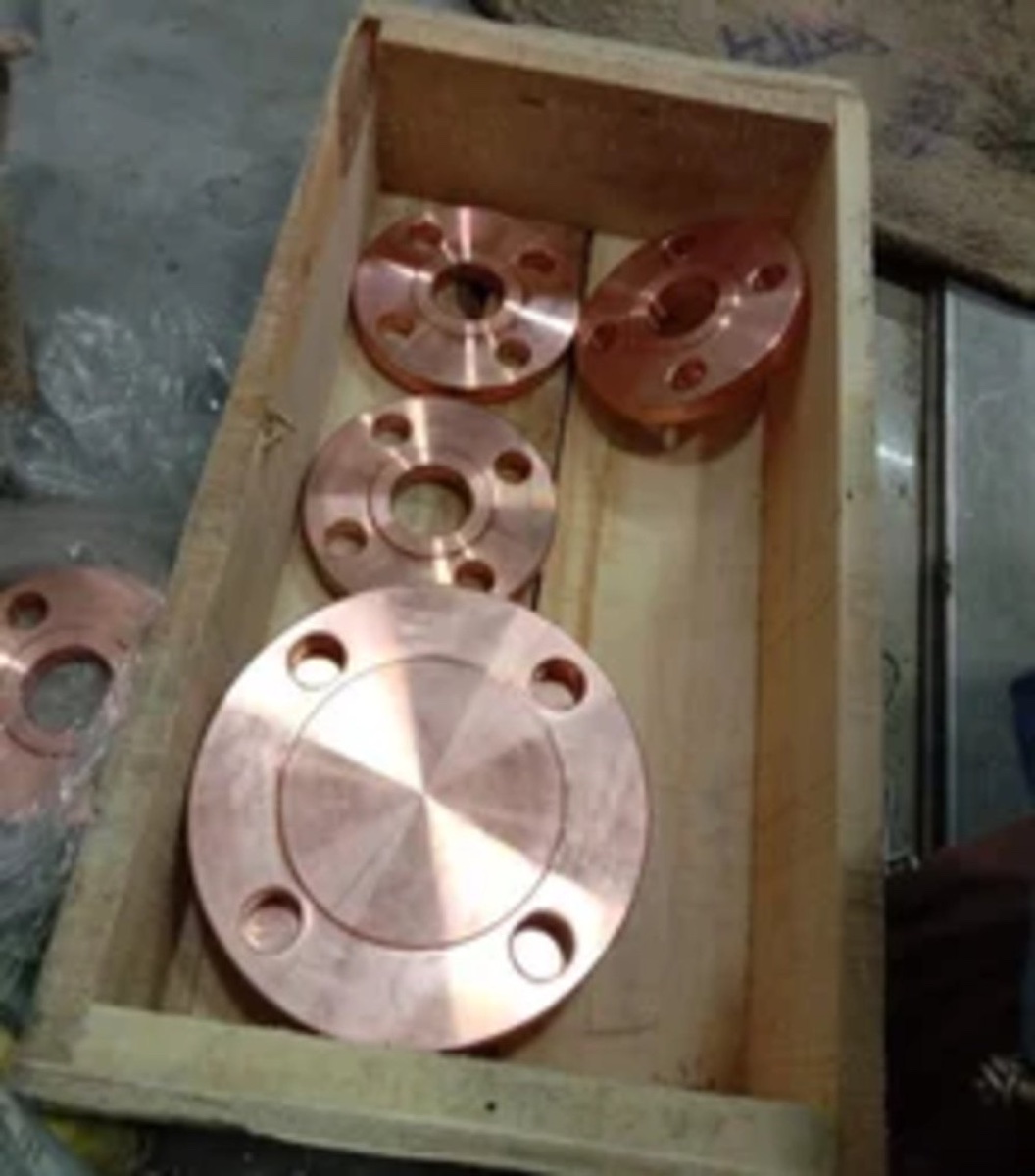
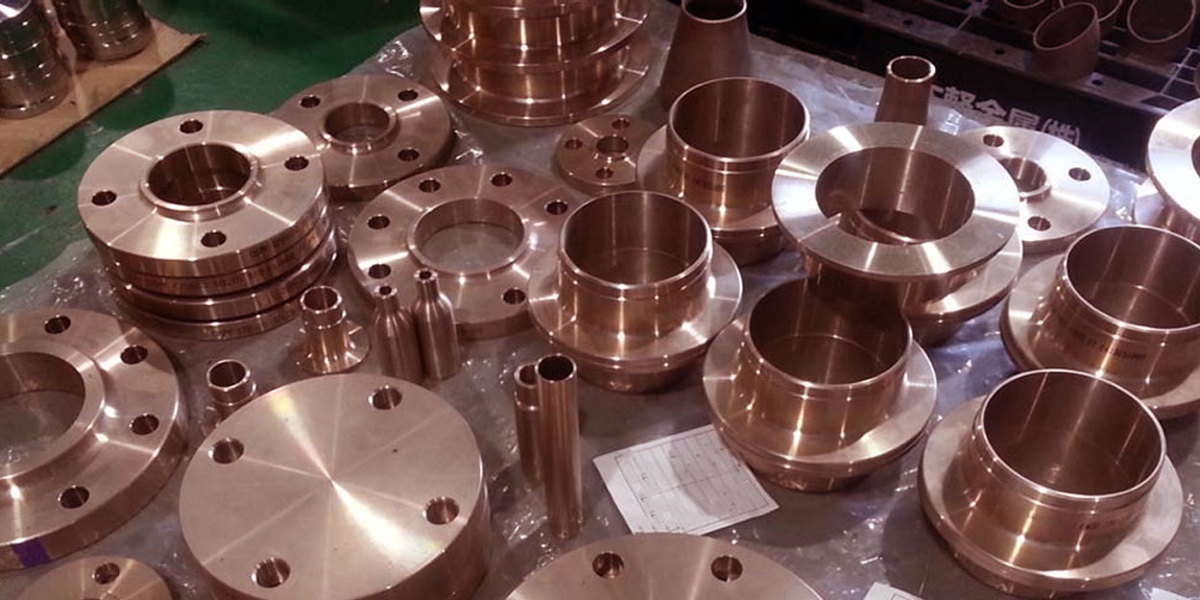
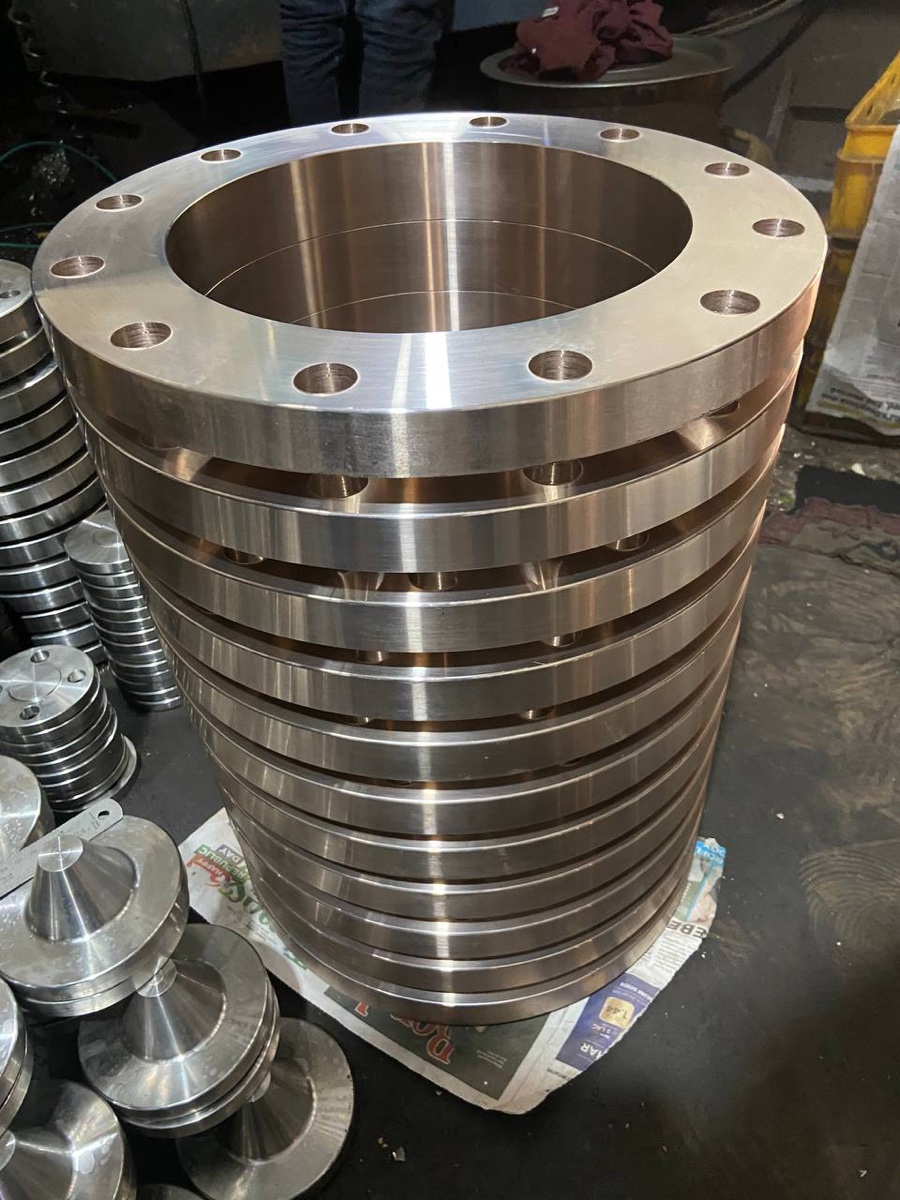
Copper-Nickel Flanges — Boxed at Our WorksCupro-Nickel Flanges — Across the Production TableC71500 70/30 Weld Necks — Same Grade, Machined Stack
C71500 Blind Flange Dimensions
ASME blind dimensions are class-governed — identical across material grades; EEMUA 145 and DIN 86037 patterns follow their own tables, supplied against the specification. Full ASME charts:
Five elements — velocity and water quality justify the grade:
1
Size & standard — e.g. 8″ NB ASME B16.5 — or the EEMUA 145 / DIN 86037 marine pattern where the line class lives in that world.
2
Pressure class & facing — Class 150–2500; RF, FF or RTJ to match the mating flange — flat face for GRP and lined shipboard systems.
3
Grade — UNS C71500 (CuNi 70/30), stating EN 2.0882 where the project requires it — or 90/10 C70600 where the duty is clean water at handbook velocity.
4
Service & certification — state the design velocity, water quality (clean / harbour / sulphide-bearing) and mating metallurgy; NPT tap size if a test blind; PMI or 3.2 witnessing as specified; EN 10204 3.1 standard.
Example: “Blind Flange, FF, 8″ NB, ASME B16.5 Class 150, UNS C71500 (CuNi 70/30), EN 10204 3.1 — 4 pcs, firemain pump discharge isolation.” Quotations normally within 24 hours with price, unit weight and delivery.
What is a copper-nickel 70/30 (UNS C71500) blind flange?
A copper-nickel 70/30 blind flange is a solid disc of the heavy-duty cupronickel — roughly 70% copper, 30% nickel, UNS C71500, EN 2.0882 — drilled to the standard bolt pattern with no bore, used to close the seawater systems that have outgrown 90/10: high-velocity headers, pump discharge zones, polluted harbour water and naval circuits. It keeps copper's biofouling resistance while the tripled nickel buys velocity tolerance, sulphide resistance and strength. Dimensions follow ASME B16.5 from ½ inch to 24 inch and ASME B16.47 beyond, with EEMUA 145 and DIN 86037 marine patterns to order, in raised face, flat face and ring joint facings.
What does tripling the nickel buy over 90/10?
Three things 90/10 runs out of. Velocity: the 30% nickel strengthens the protective film itself, raising the erosion-corrosion threshold — pump discharges and high-flow mains that would scour 90/10 sit within 70/30's window. Pollution: in sulphide-bearing harbour and estuary water, where 90/10's film converts and strips, 70/30 degrades far more gracefully. Strength and temperature: tensile climbs from 275 to 345 MPa and the practical service ceiling rises with it. The price is roughly proportional to the nickel — which is why the two grades usually share a system, each where it earns its keep.
Why does C71500 contain less iron than 90/10 — isn't that backwards?
It looks inverted and it is correct. In 90/10, iron at 1.0-1.8% is the film-toughening element — without it the low-nickel alloy erodes in flowing water. In 70/30, the tripled nickel does that job intrinsically: the film is stronger by chemistry, so iron drops to a supporting 0.40-1.00%. A buyer comparing certificates should expect the difference — a 70/30 certificate showing 1.5% iron is off-specification just as surely as a 90/10 showing 0.3%. Our PMI reads both elements on every piece, against the right grade's windows.
What is the chemical composition of C71500?
Copper the remainder — at least 65.0% — nickel 29.0-33.0%, iron 0.40-1.00%, manganese ≤1.0%, zinc ≤0.50%, lead ≤0.02%. Still copper-based — the C-prefix UNS number says so — but a third of the way to Monel: the same two metals run a continuum from 90/10 through 70/30 to Monel 400's two-thirds nickel, with corrosion duty, strength and price all climbing together. No chromium, no molybdenum, no passive film — copper-family nobility with a nickel-strengthened protective layer.
What are the mechanical properties of C71500 blind flanges?
In the annealed condition: tensile strength 345 MPa (50 ksi) minimum, yield strength 125 MPa (18 ksi) minimum, elongation 30% minimum — a solid step above 90/10's 275/105, courtesy of the nickel. Ratings run on the alloy's own B16.5 lines, and the marine patterns of EEMUA 145 and DIN 86037 carry their own tables. For seawater duty that needs genuinely high pressure — injection systems, deep risers — the handoff is super duplex or Monel K-500; within the cooling-water world, 70/30 is the strong end of the copper family.
Why is 70/30 called the naval standard?
Because warships buy what merchant ships economise on. Naval seawater systems run harder — higher flow rates for firefighting and combat cooling margins, longer deployments in polluted harbours, shock and vibration requirements — and navies standardised the heavier cupronickel for exactly those reasons, writing it into military specifications generations ago. Merchant practice runs 90/10 for economy; naval practice runs 70/30 for margin. The same logic serves any operator whose water is faster, fouler or less forgiving than the design handbook's clean-seawater case.
90/10 or 70/30 — how do I choose?
By velocity, water quality and margin. General cooling, ballast and firewater in clean seawater at handbook velocities: 90/10 (C70600) — the economist, and the right answer most of the time. Step up to 70/30 where the duty concentrates: pump discharge zones and high-flow headers, sulphide-bearing berths and estuaries, naval-margin systems, and anywhere the design wants strength or temperature headroom. The same system frequently mixes them by location — 90/10 runs with 70/30 hard points — and we supply both grades against one enquiry, certificate by certificate.
How does 70/30 relate to Monel — the same two metals again?
It is the midpoint of the continuum. Copper-nickel runs from 90/10 (10% nickel) through 70/30 (30%) to Monel 400 (two-thirds nickel) — one family of two metals, with seawater economics at one end and acid-and-alkali chemistry at the other. 70/30 keeps the copper virtues — biofouling resistance above all, which Monel largely gives up — while borrowing a useful share of nickel's strength and tolerance. When the duty leaves cooling water altogether — acids, caustic, stagnant crevice extremes — the ratio tips over into Monel; until then, 70/30 is as much nickel as seawater service needs to buy.
How does 70/30 handle polluted and sulphide-bearing water?
Better than any other copper alloy, with honest limits. Sulphides — from stagnant harbours, decaying organics, industrial outfalls — attack cupronickel's protective film, and this is precisely where 90/10 suffers first. The 30% nickel makes 70/30's film substantially more resilient: it is the standing recommendation for berths and estuaries with known pollution, and the grade harbour-side operators specify from experience. The limits stay real: badly polluted, oxygen-starved water challenges every copper alloy, and persistent sulphide exposure deserves a frank conversation at enquiry — sometimes the answer is titanium, and we will say so.
What service conditions does 70/30 dislike?
The copper-family list, moderated but not erased. Ammonia and ammonium compounds can stress-crack all copper alloys — excluded, as for 90/10. Velocity tolerance is higher but still finite; cavitating and jet-impingement zones belong to duplex or titanium. Severe sulphide pollution is resisted, not ignored. And the honest commercial note: at roughly triple the nickel, 70/30 costs meaningfully more than 90/10 — specifying it for clean, ordinary-velocity cooling water buys nothing the cheaper grade doesn't already deliver, and we will recommend the economist where it serves.
Does the galvanic caution apply to 70/30 as well?
Yes — the whole copper family sits anodic to stainless, Monel and titanium in seawater. 70/30's higher nickel nudges it slightly nobler than 90/10 (the two couple together harmlessly, which is why mixed systems work), but a 70/30 closure in a large noble-alloy system still corrodes preferentially. The marine rules carry over: favourable area ratios, bolting per the specification — aluminium bronze, Monel or coated — and isolation where the design demands. State the mating metallurgy at enquiry; in seawater it is part of the closure's specification.
What facings are C71500 blind flanges made with?
All three ASME facings — raised face (BLRF) as the default, flat face (BLFF) for GRP and rubber-lined mating systems, and ring type joint (BLRTJ) where high-pressure practice reaches cupronickel service — plus the facing conventions of EEMUA 145 and DIN 86037 where the marine pattern governs. The alloy seats gaskets kindly, with a little more spring-back than 90/10; full-face elastomeric systems remain the shipboard norm. NPT-tapped test and sampling blinds are machined and certified at the works.
Where are C71500 blind flanges used?
Where seawater runs hard: naval cooling and firemain systems, pump discharge zones and high-velocity headers on ships and platforms, polluted-harbour and estuary installations, desalination high-flow sections, and heat-exchanger circuits specified in 70/30 for velocity or temperature margin. C71500 blinds close those systems as isolations, spare-nozzle blanks and tapped test points — the strong end of the copper family, biologically clean like all of it.
Which standards cover C71500 blind flanges?
The alloy certifies to UNS C71500 chemistry per ASTM B171/B151, with EN 2.0882 / CuNi30Mn1Fe (CW354H) as the European designation. Dimensions follow ASME B16.5 for ½"-24" and ASME B16.47 for 26"-60", or the dedicated marine patterns — EEMUA 145 for offshore practice and DIN 86037 for shipbuilding — with naval procurement often citing its own military heritage specs for the same metal. A complete specification reads: 'Blind Flange, FF, 8", ASME B16.5 Class 150, UNS C71500 (CuNi 70/30)' — and our EN 10204 certificates state it exactly that way, nickel and iron included.
Who manufactures copper-nickel 70/30 blind flanges in India?
Tesco Steel & Engineering is an ISO 9001:2015 certified flange manufacturer based in Mumbai, India, producing copper-nickel 70/30 / UNS C71500 / EN 2.0882 blind flanges from ½" to 24" NB per ASME B16.5 in Classes 150-2500, to 60" per ASME B16.47, and to EEMUA 145 / DIN 86037 marine patterns — annealed, natural machined finish, PMI-verified with the nickel and iron read against the 70/30 windows on every piece, certified to EN 10204 3.1/3.2 on every lot — in raised face, flat face and ring joint facings, alongside 90/10 (C70600), the full copper-nickel flange range, Monel 400 and K-500 blinds. Exported to more than 50 countries.