Tesco Steel & Engineering manufactures C71500 weld neck flanges in copper nickel 70/30 — UNS C71500, Werkstoff Nr. 2.0882, CuNi30Mn1Fe — from 1/2″ NB to 56″ NB in ASME B16.5, EEMUA 145 and European PN patterns. The 30% nickel makes it the family's premium grade: a third stronger than 90/10, with higher velocity and impingement tolerance, natural biofouling resistance and complete immunity to chloride stress corrosion cracking — the alloy of naval firemains, seawater cooling and offshore piping, mating B466/B467 and EEMUA 144 pipe. Welded with ERCuNi; supplied pickled with navy marking, PMI and EN 10204 3.1/3.2 on request, seaworthy packed. ISO 9001:2015, made in Mumbai, India — exported worldwide.
C71500 (2.0882 / CuNi30Mn1Fe) is copper nickel 70/30 — the premium cupronickel, carrying 30% nickel against the workhorse 90/10's ten. The extra nickel buys a third more strength, higher seawater velocity limits (~4–4.5 m/s), better sand-erosion tolerance and higher temperature capability — on top of the family virtues: biofouling resistance and total chloride-SCC immunity. A C71500 weld neck flange pairs that alloy with a long tapered hub butt-welded to the pipe, bore matched to schedule, joint fully radiographable.
Its home is the demanding end of marine engineering: naval firemains held in standby (where copper ions keep the line clear of marine growth), pump-discharge spools, hot or fast seawater circuits, and offshore systems specified to EEMUA 145. Where 90/10 covers the broad economical middle, 70/30 takes the circuits that run faster, hotter or mission-critical.
Also searched as: copper nickel 70/30 weld neck flange, cupronickel 70-30 flange, UNS C71500 flange, 2.0882 flange, CuNi30Mn1Fe flange, navy cupronickel flange — all refer to the product on this page; see also our copper nickel flanges overview.
Chemical Composition of C71500
Cu
Mn
Pb
Ni
Fe
Zn
65.00 min
1.00 max
0.05 max
29.00-33.00
0.40-1.00
1.00 max
Values in weight %. The 29–33% nickel defines the grade; the deliberate iron addition (0.40–1.00%) builds the tough surface film that resists impingement and sand erosion in flowing seawater.
Mechanical Properties of C71500
Tensile Strength, psi
Yield Strength (0.2% offset), psi
Elongation % min.
50000
20000
30
Minimums in the annealed condition — 50,000 psi (345 MPa) tensile and 20,000 psi (138 MPa) yield, roughly a third stronger than 90/10. Every certificate demonstrates the values.
Equivalent Grades of C71500
UNS
Werkstoff Nr.
Standard
C71500
2.0882
Cu-Ni 70-30
Also written EN CuNi30Mn1Fe. System partners: ASTM B466/B467 and EEMUA 144 pipe, B366 fittings and B171 plate. The economical sibling is 90/10 (C70600); the nickel-based cousin is Monel 400.
C71500 Weld Neck Flange Specifications
C71500 Weld Neck Flanges are available in the following specifications:
Size
1/2"NB to 56"NB
Class
150#, 300#, 400#, 600#, 900#, 1500#, 2500#
Sch (Schedule)
XS, XXS, STD & Schedule 20, 40, 80, 160
Pressure Ratings
PN 2.5 - PN 400
Standards
ASME B16.5, ASME B16.47, EEMUA 145, EN 1092-1, DIN 2631–2635, BS 4504
Condition
Annealed
Other Services
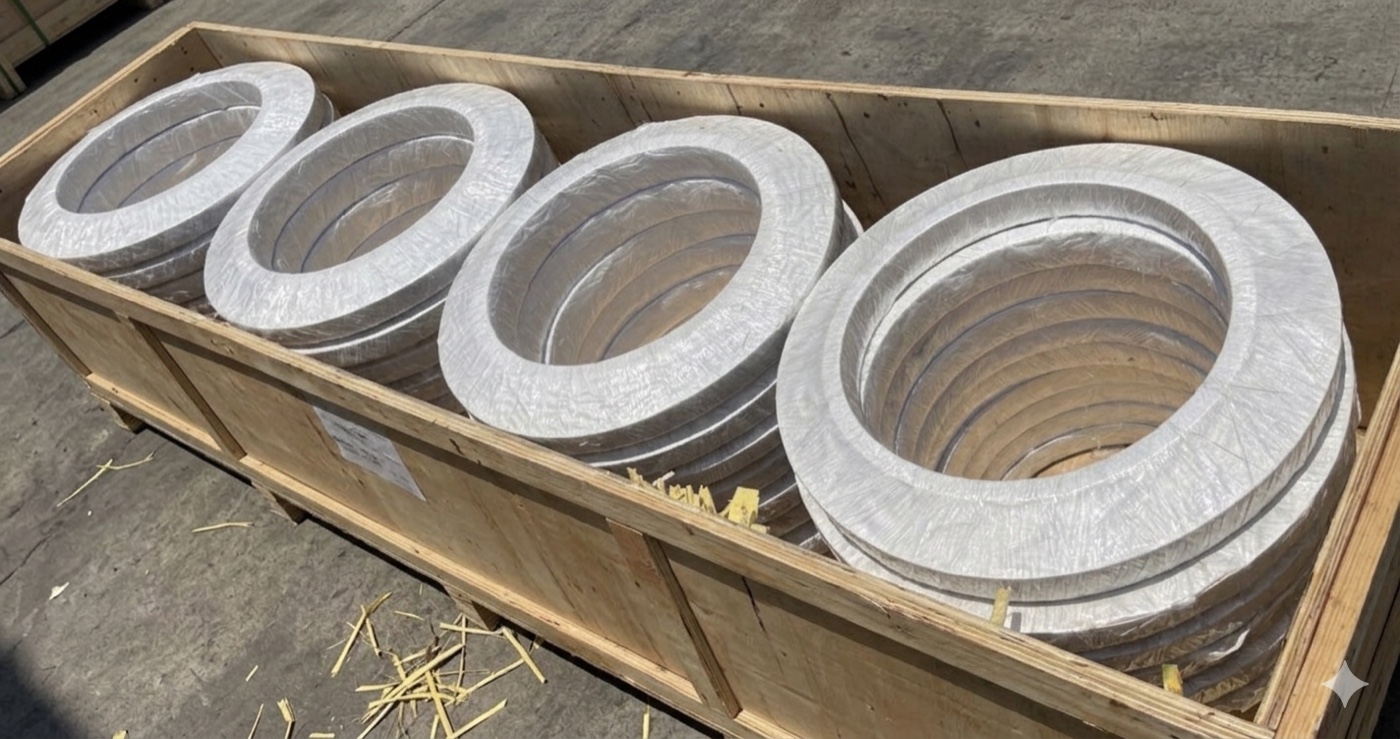
Pickled & degreased supply on C71500 Weld Neck Flanges Navy & project marking schemes PMI (XRF) verification & dimensional inspection reports Sand Blasting & Shot Peening on request Seaworthy export packing in lined wooden crates
Why 70/30 is the Premium Cupronickel
A Third More Strength
345 vs 90/10's ~275 MPa tensile — higher ratings from the same joint, and margin for shipboard shock and vibration.
Faster Water, No Impingement
Design velocities of ~4–4.5 m/s against 90/10's ~3.5 — pump discharges, bends and velocity-critical spools are 70/30 territory.
Biofouling Kept at Bay
Copper ions discourage marine growth — standby firemains stay clear for decades without chlorination or coatings.
Chloride SCC Off the Table
Like all cupronickels, 70/30 simply does not stress-crack in warm seawater — the failure mode that shadows stainless is absent.
Documented Production
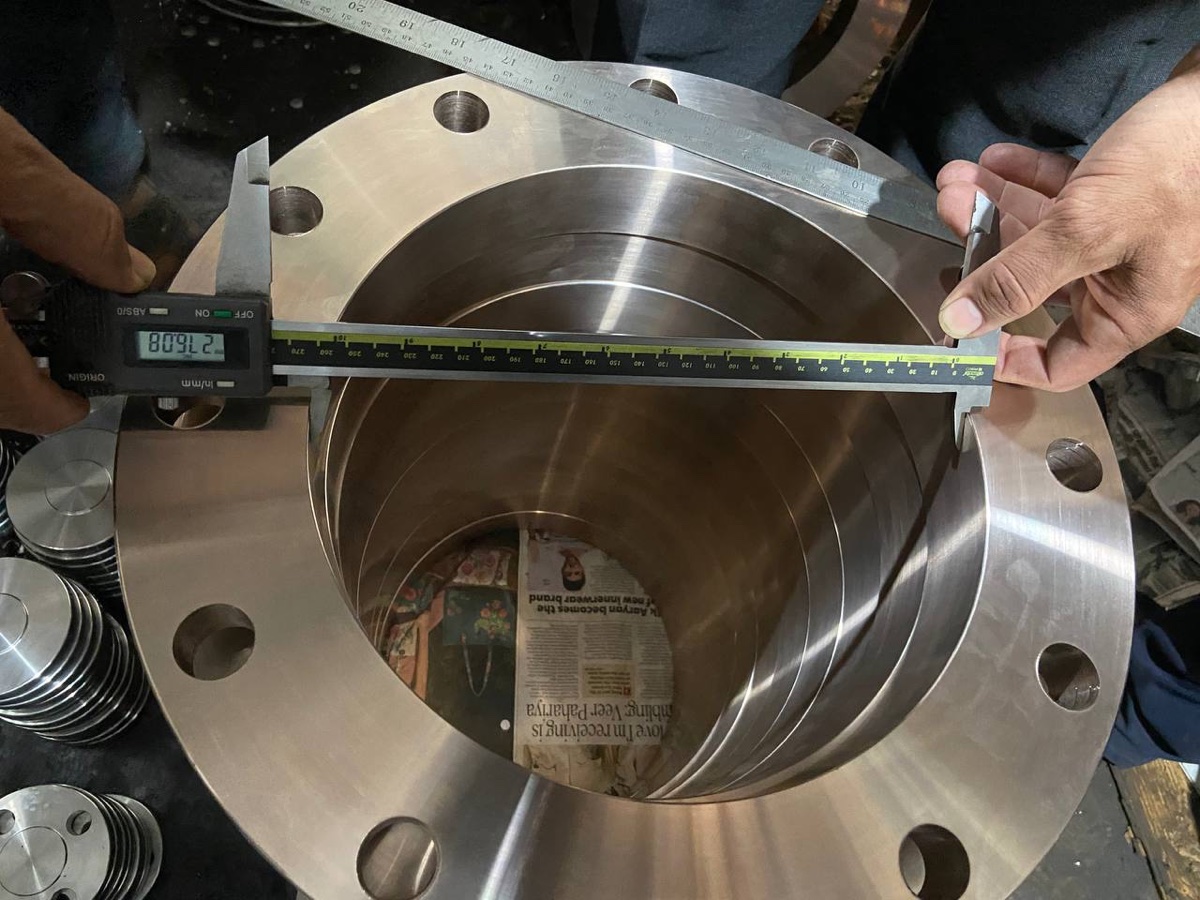
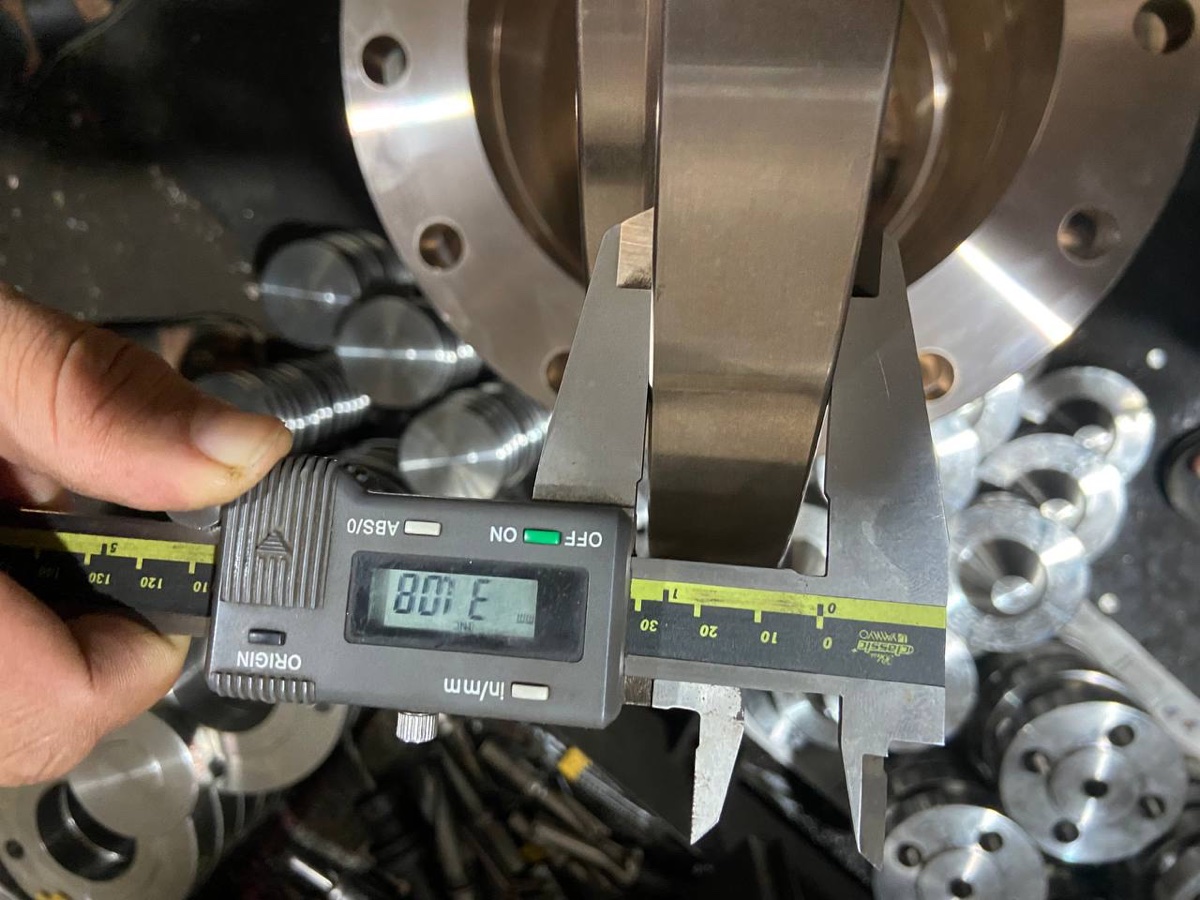
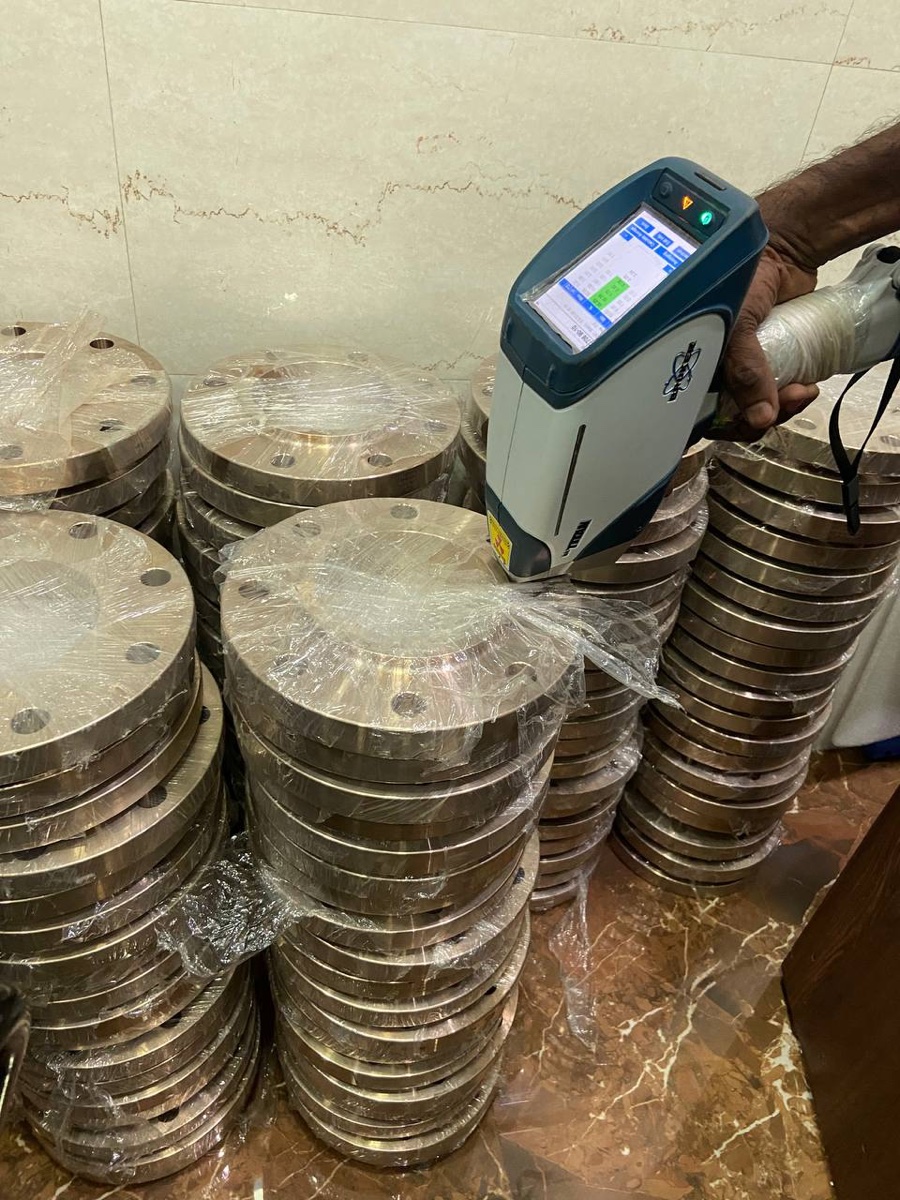
The photographs on this page are our own machining, inspection, PMI and packing — the process behind every certificate.
Production & Quality — In Our Works
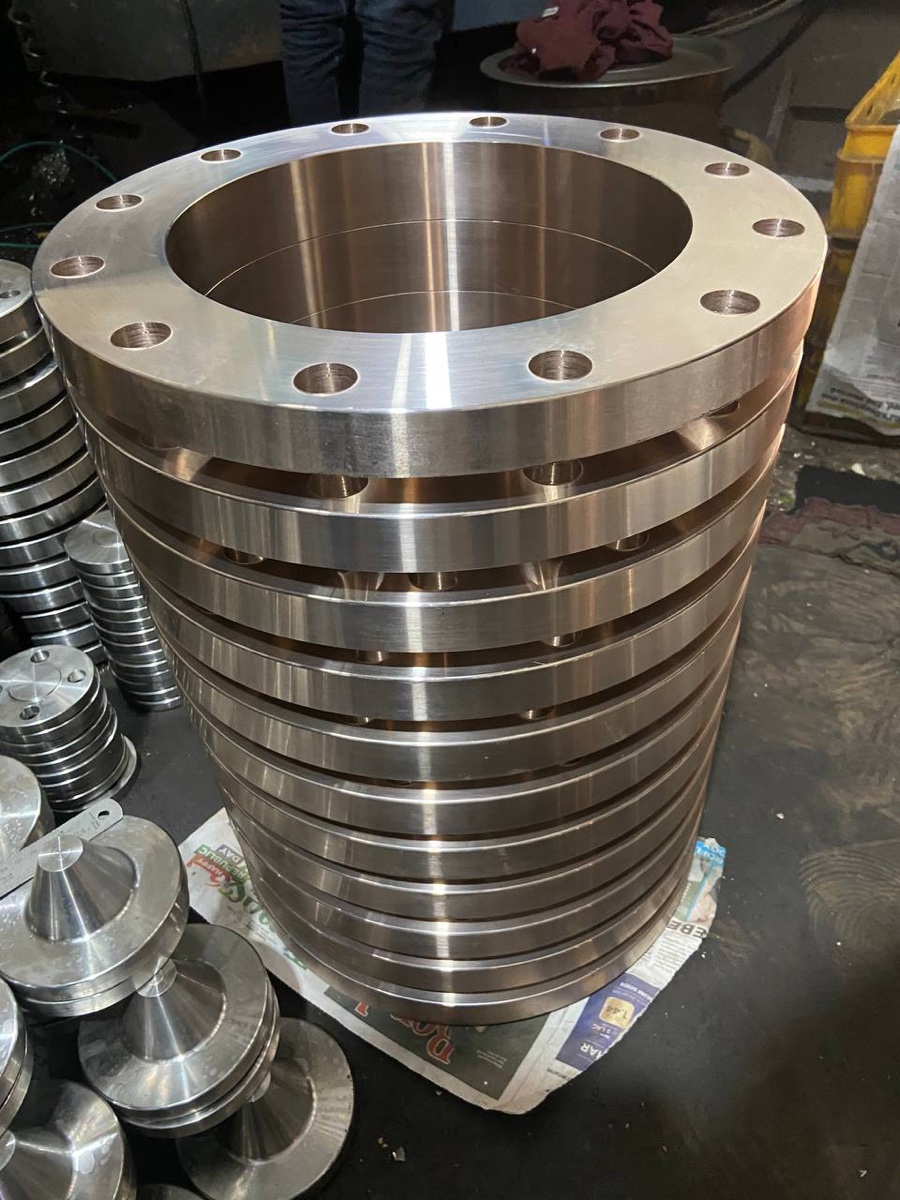
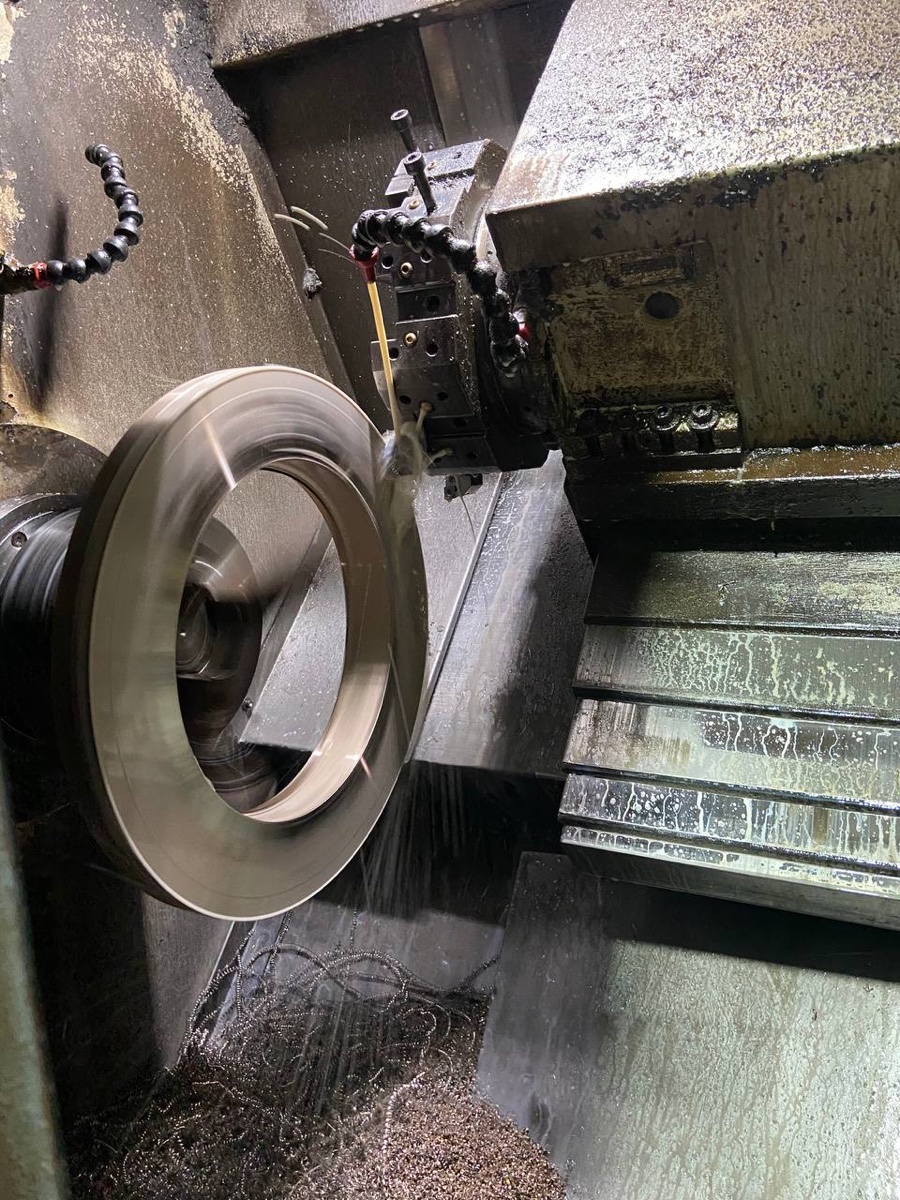
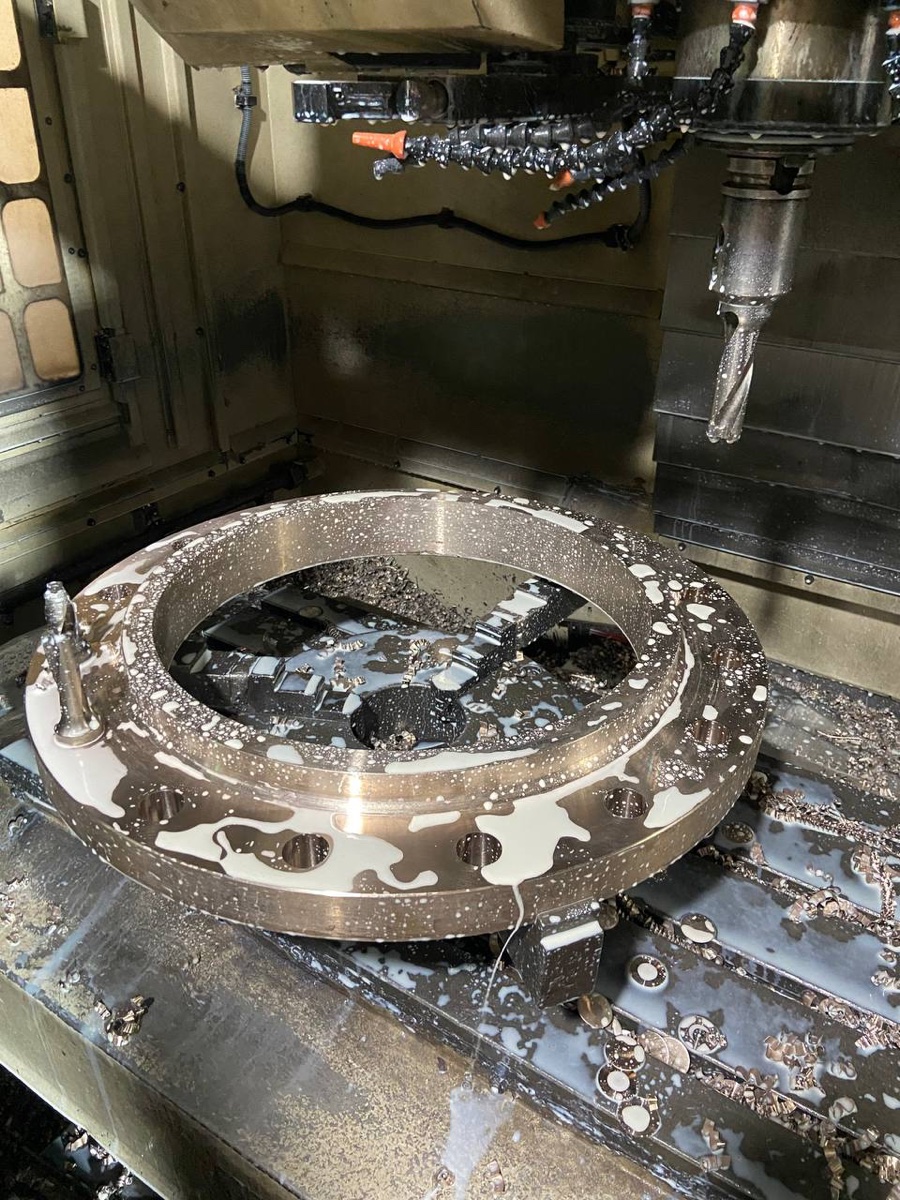
Every C71500 flange is CNC-machined from certified cupronickel stock, dimensionally inspected against the standard's tables, XRF PMI-verified for chemistry, then pickled and packed. The photographs below are our actual production:
Large-Diameter C71500 Weld Necks — Machined StackCNC Turning — Hub & Face ProfilingCNC Drilling — Bolt Circle on Machining CentreDimensional Inspection — Bore VerificationDimensional Inspection — Hub & ThicknessXRF PMI — Positive Material Identification
Welding C71500 — Shipyard-Friendly
Cupronickel is famously weldable: ERCuNi / ECuNi filler (70/30 weld metal serves both grades), no preheat, no PWHT, moderate heat input and clean, degreased joints. Back purging keeps root surfaces bright for seawater duty. The forgiving arc behaviour is one reason shipyards standardized on this family generations ago.
Grade-selection note: for most seawater piping, 90/10 (C70600) is the economical answer — step up to 70/30 when velocity, temperature, sand loading or naval specification demands it. Both are stocked here.
Where C71500 Weld Neck Flanges Are Used
Naval and commercial shipbuilding lead: firemains, seawater cooling, ballast and hydraulic systems — the alloy's home for a century. Offshore platforms follow with EEMUA-specified seawater service, then desalination plants, coastal power station cooling circuits and heat exchanger connections. Wherever seawater runs fast, hot or mission-critical, 70/30 is the specified grade.
C71500 Weld Neck Flange Dimensions
C71500 weld neck flanges share their dimensions with every other material in the same class — OD, thickness, hub, bore, bolt circle and bolting per the standard tables. Full ASME B16.5 charts:
Cupronickel pricing tracks copper and nickel plus the testing scope, so we quote live with a stated validity rather than publish a static list. To get a firm quotation, usually within 24 hours:
1
List your requirement — size (NB), class or PN, standard (ASME B16.5 / B16.47 / EEMUA 145 / EN / DIN / BS), grade (C71500 70/30, or C70600 90/10), pipe schedule or wall, and quantity.
2
Add the testing & marking scope — 3.2 witness, PMI, naval or project marking schemes, or shipyard specifications.
3
Send it across — via the inquiry form, WhatsApp, or email to sales@tescosteel.com — and we reply with price, delivery and stock position.
It is a weld neck flange manufactured from copper nickel 70/30 — UNS C71500 / 2.0882, the cupronickel of roughly 70% copper and 30% nickel. The long tapered hub is butt-welded to the pipe with the bore matched to the pipe schedule, giving a radiographable, fatigue-resistant joint in the marine industry's premium cupronickel: naval firemains, seawater cooling and offshore piping specify it where 90/10 runs out of strength or velocity margin.
What is the difference between copper nickel 70/30 and 90/10?
Nickel content, and everything it buys. 90/10 (C70600) carries 10% nickel — the economical workhorse for most seawater piping. 70/30 triples that to 30%, gaining roughly a third more strength, higher allowable flow velocities before impingement attack, better sand-erosion tolerance and higher temperature capability. Navy firemains, pump-adjacent spools and hotter or faster systems step up to 70/30; both grades are stocked and forged here.
Why do navies and offshore platforms use cupronickel piping?
Three properties in one alloy: genuine seawater corrosion resistance without coatings, natural biofouling resistance — copper ions discourage marine growth that would choke firemains kept in standby — and complete immunity to chloride stress corrosion cracking. Add easy formability and brazeability, and cupronickel became the default for shipboard seawater, firewater and hydraulic systems, with 70/30 taking the demanding circuits.
What is EEMUA 145 and how does it relate to these flanges?
EEMUA 145 is the offshore industry's standard for 90/10 copper-nickel flanges, written to pair with EEMUA 144 pipe — thinner-walled and lighter than ASME equivalents, reflecting cupronickel's moderate pressures. We manufacture flanges to EEMUA 145 patterns as well as ASME B16.5/B16.47 and EN 1092-1; the enquiry names the standard and the flange follows it.
What are the equivalent designations for C71500?
UNS C71500; Werkstoff Nr. 2.0882; EN CuNi30Mn1Fe; and the general names copper nickel 70/30 or cupronickel 70/30. System partners: ASTM B466/B467 pipe and EEMUA 144 pipe, B366 fittings and B171 plate. An enquiry in any of these designations is quoted as the same material.
What is the chemical composition of C71500?
Per our supply practice: copper 65.00% minimum, nickel 29.00 to 33.00%, iron 0.40 to 1.00% — the deliberate addition that builds the erosion-resistant surface film — manganese 1.00% max, zinc 1.00% max and lead 0.05% max. The 30% nickel is what separates 70/30 from its 90/10 sibling in strength, velocity tolerance and temperature.
What are the mechanical properties of C71500 flanges?
Minimum tensile strength 50,000 psi (345 MPa), minimum yield strength 20,000 psi (138 MPa) at 0.2% offset, and minimum elongation 30% in the annealed condition — roughly a third stronger than 90/10, which is precisely why the demanding circuits specify it. Every certificate demonstrates the values.
Which pipe and fittings do C71500 weld neck flanges mate with?
ASTM B466 seamless and B467 welded 70/30 pipe on ASME projects, EEMUA 144 pipe on offshore ones, with B366 butt-weld fittings completing the system. The weld neck bore is machined to the pipe schedule or wall thickness you state, so the bore runs flush through the joint and the bevel arrives ready for a matched-chemistry butt weld.
How are copper nickel 70/30 flanges welded to pipe?
With ERCuNi / ECuNi filler (70/30 weld metal serves both cupronickel grades) and straightforward practice: no preheat, no PWHT, moderate heat input, and clean joints — cupronickel tolerates none of the oxide-trapping shortcuts. Back purging keeps root surfaces bright for seawater duty. The alloy's forgiving weldability is one reason shipyards love it.
Does cupronickel resist biofouling?
Yes — uniquely among engineering piping alloys. Copper ions released at the surface discourage barnacles, mussels and algae from establishing, keeping firemains and seawater intakes clear without chlorination or coatings. It is a genuine life-cycle economy: systems that would foul shut in steel or even stainless stay serviceable for decades in cupronickel.
What temperature and velocity limits apply to C71500?
70/30 serves seawater systems comfortably to around 200 °C and general duty higher still, with design velocity limits near 4 to 4.5 m/s in seawater — appreciably above 90/10's ~3.5 m/s — before impingement attack becomes the design driver. Pump discharge spools, bends and velocity-critical details are exactly where the 30% nickel grade earns its premium.
Is C71500 immune to chloride stress corrosion cracking?
Yes — like all cupronickels, C71500 simply does not suffer the chloride SCC that limits austenitic stainless steel in warm seawater. Combined with its resistance to pitting and crevice attack in clean flowing seawater, that removes the two failure modes that dominate marine materials selection — the century-old reason ships are piped in this family.
What testing and certification do you supply with C71500 flanges?
Every lot ships with EN 10204 3.1 mill test certificates covering chemical analysis — the photographs on this page include our own XRF PMI verification — mechanical properties and condition, with 3.2 certification witnessed by Lloyd's, DNV, BV or TÜV on request. Dimensional inspection is documented, and naval or project marking schemes are applied to order, with full heat-number traceability.
Where are C71500 weld neck flanges used?
Naval and commercial shipbuilding — firemains, seawater cooling, ballast and hydraulic systems — plus offshore platform seawater service, desalination plants, coastal power station cooling circuits and heat exchanger connections. Wherever seawater runs fast, hot or mission-critical, the 30% nickel cupronickel is the specified grade.
What sizes and standards do you manufacture C71500 weld neck flanges in?
From 1/2 inch NB to 56 inch NB: ASME B16.5 Class 150 to 2500 up to 24 inch, ASME B16.47 above, EEMUA 145 for offshore systems, and European PN 2.5 to PN 400 patterns to EN 1092-1, DIN and BS 4504. Raised face and flat face are standard offerings, and every bore is machined to the mating pipe schedule.
Do you keep C71500 weld neck flanges in stock? What is the lead time?
Common marine sizes in Class 150 and EEMUA patterns rotate through regular production — the machined stacks photographed on this page are real work-in-progress — with popular items often available from stock. Larger diameters and witness-tested lots are made to order, typically in 3 to 5 weeks. Prices track copper and nickel, so quotations carry a validity period.
Do you export C71500 flanges outside India?
Yes. Tesco Steel & Engineering is an ISO 9001:2015 certified manufacturer based in Mumbai, and C71500 flanges ship to shipyards, offshore contractors and desalination projects across the Middle East, Europe, Africa, Southeast Asia and the Americas — wrapped, crated and seaworthy-packed as photographed on this page, with full heat-number and test traceability.