C70600 Weld Neck Flanges — Copper Nickel 90/10 (UNS C70600)
Tesco Steel & Engineering forges C70600 weld neck flanges in copper nickel 90/10 — UNS C70600, Werkstoff Nr. 2.0872, CuNi10Fe1Mn — from 1/2″ NB to 56″ NB. This is the alloy the world's navies, shipyards and desalination plants trust for seawater piping: an adherent protective oxide film, natural biofouling resistance, and immunity to the chloride pitting that attacks stainless steel. We machine to ASME B16.5 Class 150–2500, EEMUA 145, EN 1092-3 and DIN 86037, with raised or flat face, bores matched to your pipe schedule, and navy-format stamping for full traceability — as pictured below. EN 10204 3.1/3.2 certified. ISO 9001:2015, made in Mumbai, India — exported worldwide.
UNS C70600 · 2.0872 · CuNi10Fe1Mn
1/2″ – 56″ NB
ASME B16.5 · EEMUA 145 · EN 1092-3
Seawater · Navy · Desalination
WNRF & WNFF Facings
EN 10204 3.1 / 3.2
ISO 9001:2015 · Exported Worldwide
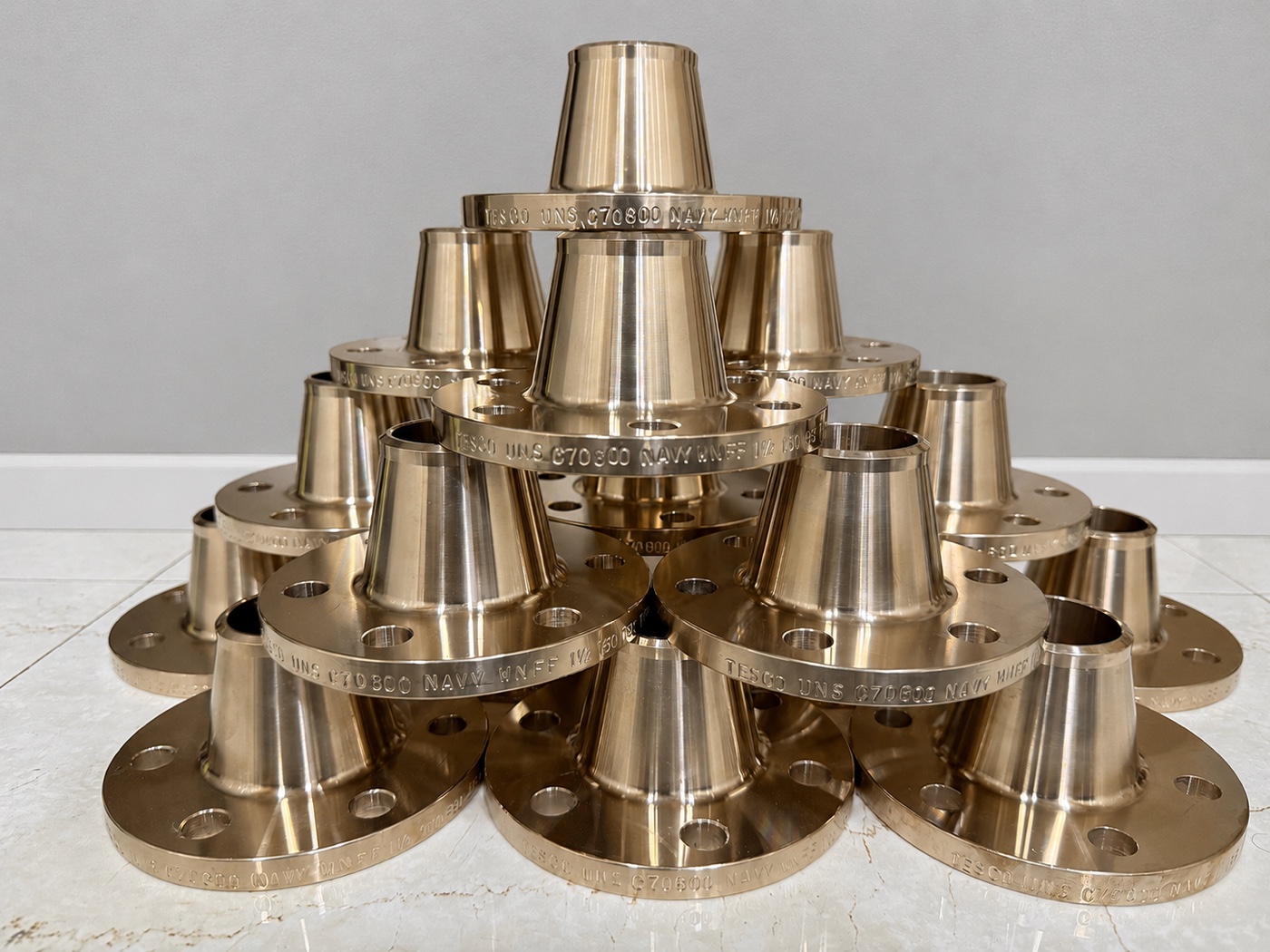
C70600 Copper Nickel 90/10 Weld Neck Flanges — 1-1/2″ Class 150, Navy Stamping
What is a C70600 Weld Neck Flange?
C70600 is the UNS designation for copper nickel 90/10 — roughly 90% copper, 10% nickel, strengthened with iron and manganese. A C70600 weld neck flange pairs this seawater-proof alloy with the strongest flange design: a long tapered hub butt-welded to the pipe, bore matched to the pipe schedule, and a fully radiographable joint. It is the standard flange for shipboard, naval, offshore and desalination seawater piping.
The weld neck geometry earns its place in marine systems the same way it does in refineries: the tapered hub feeds pressure, bending and vibration loads gradually into the pipe wall, the matched bore eliminates turbulence and erosion pockets — critical in flowing seawater, where impingement attack starts at any step or crevice — and the butt weld can be examined by radiography, which classification societies expect on critical lines. The alloy does the rest: a self-repairing cuprous oxide film keeps corrosion rates low for decades, and copper's natural toxicity to marine organisms keeps the bore free of fouling.
Also searched as: copper nickel 90/10 weld neck flange, Cu-Ni 90-10 WNRF flange, CuNi10Fe1Mn flange, 2.0872 weld neck flange, cupro nickel weld neck flange — all refer to the C70600 product on this page.
Chemical Composition of C70600
| Cu | Mn | Pb | Ni | Fe | Zn |
|---|
| 88.60 min | 1.00 max | 0.05 max | 9.00-11.00 | 1.80 max | 1.00 max |
Values in weight %. The iron addition is deliberate — it is what gives 90/10 copper nickel its resistance to impingement and erosion-corrosion in flowing seawater; manganese aids hot workability. Every heat is analysed and reported on the mill test certificate.
Mechanical Properties of C70600
| Tensile Strength, psi | Yield Strength (0.2% offset), psi | Elongation % min. |
|---|
| 50000 | 20000 | 30 |
C70600 is not hardenable by heat treatment — strength comes from the alloy itself and from cold work. What matters at the flange joint is the 30% minimum elongation: the material yields gracefully under bolt-up, vibration and thermal movement instead of cracking, and stays tough from cryogenic temperatures to around 200 °C.
Equivalent Grades of C70600
| UNS | Werkstoff Nr. | Standard |
|---|
| C70600 | 2.0872 | Cu-Ni 90-10 |
The same alloy also appears as CuNi10Fe1Mn in EN standards and CN102 in older British specifications — an enquiry in any of these names is quoted as the identical material. For the higher-alloyed 70/30 grade (UNS C71500, 2.0882), see our copper nickel flanges page.
C70600 Weld Neck Flange Specifications
| C70600 Weld Neck Flanges are available in the following specifications: |
|---|
| Size | 1/2"NB to 56"NB |
| Class | 150#, 300#, 400#, 600#, 900#, 1500#, 2500# |
| Sch (Schedule) | XS, XXS, STD & Schedule 20, 40, 80, 160 |
| Pressure Ratings | PN 2.5 - PN 400 |
| Standards | ASME B16.5, EEMUA 145, EN 1092-3, DIN 86037, navy specifications |
| Facings | Raised Face (WNRF), Flat Face (WNFF) |
| Other Services | Pickled & passivated finish
Sand Blasting on C70600 Weld Neck Flanges
Shot Peening on C70600 Weld Neck Flanges
Navy / project-specific marking & stamping
Face protectors & seaworthy export packing |
Why Copper Nickel 90/10 for Seawater
Seawater Corrosion Resistance
A thin, tightly adherent cuprous oxide film forms on first exposure and keeps corrosion rates low and predictable for decades — with none of the chloride pitting or crevice attack that limits many stainless steels in seawater.
Natural Biofouling Resistance
Marine organisms do not readily settle on copper nickel. Bores stay clean, flow rates stay stable, and cooling and firemain systems keep their design capacity without chemical dosing or frequent cleaning.
Impingement & Erosion Resistance
The iron addition in CuNi10Fe1Mn resists impingement attack at velocities typical of shipboard systems — and the weld neck's matched bore removes the steps and crevices where erosion-corrosion starts.
Weldable, Ductile, Proven
Welds with 70/30 filler without preheat or PWHT, stretches 30% before failure, and is written into naval and EEMUA specifications worldwide — a de-risked, standardised choice for marine projects.
Where C70600 Weld Neck Flanges Are Used
Naval and commercial ships run 90/10 copper nickel through seawater cooling, firemain, ballast, bilge and sprinkler systems — the Navy-stamped flanges pictured above are exactly this service. Desalination plants (MSF and RO) flange their brine and seawater circuits in C70600; offshore platforms use it for seawater lift, firewater ring mains and injection service; and coastal power stations pipe condenser cooling water with it. It also appears in heat exchanger and condenser piping wherever brackish or salt water is the cooling medium. If the fluid is seawater and the joint must last the life of the vessel or plant, C70600 weld neck flanges are the default.
C70600 Weld Neck Flange Dimensions
C70600 weld neck flanges follow the same dimensional tables as steel flanges of the same class — OD, thickness, hub, bore, bolt circle and bolting per ASME B16.5. Full charts for every class:
European PN-rated and copper-alloy-specific dimensions (EEMUA 145, EN 1092-3, DIN 86037) are quoted against your specification — and the general weld neck charts for EN 1092-1 Type 11, DIN 2631–2635 and BS 4504 are published on this site.
Price List & How to Order
Copper nickel pricing tracks the metal market, so we quote live rather than publish a static list — quotations carry a stated validity. Popular marine sizes ship fast at competitive export prices. To get a firm quotation, usually within 24 hours:
1
List your requirement — size (NB), class or PN, standard (e.g. ASME B16.5 / EEMUA 145), facing (RF or FF), pipe schedule or bore, and quantity.
2
Add any extras — 3.2 certification or class society witness, PMI, project or navy marking requirements.
C70600 Weld Neck Flanges — Frequently Asked Questions
What is a C70600 weld neck flange?
A C70600 weld neck flange is a weld neck flange forged from copper nickel 90/10 — an alloy of roughly 90% copper and 10% nickel, designated UNS C70600 (Werkstoff Nr. 2.0872). It combines the weld neck design — a long tapered hub butt-welded to the pipe, with the bore matched to the pipe schedule — with the outstanding seawater corrosion resistance of 90/10 copper nickel, making it the standard flange for marine, naval and desalination piping.
What do the designations C70600, 90/10 and 2.0872 mean?
They all describe the same alloy. C70600 is the UNS (Unified Numbering System) code, 90/10 describes the nominal composition — about 90% copper and 10% nickel with small iron and manganese additions — and 2.0872 is the German Werkstoff number. It also appears as CuNi10Fe1Mn in EN standards and as CN102 in older British specifications. Whichever name your enquiry uses, you will receive the same material.
Why is copper nickel 90/10 used for seawater piping?
Three properties. First, it forms a thin, tightly adherent oxide film in seawater that gives very low, predictable corrosion rates — including resistance to the chloride pitting and crevice corrosion that attack many stainless steels. Second, it has natural biofouling resistance: marine organisms do not readily settle on copper nickel, keeping bores clean and flow rates stable. Third, it stays ductile and tough at all marine temperatures. That is why navies, shipyards and desalination plants standardise on it.
What is the difference between C70600 and C71500 flanges?
C70600 (90/10) is the general-purpose marine alloy — lighter on nickel, more economical, and fully adequate for most seawater systems. C71500 (70/30) carries about 30% nickel, giving higher strength, a higher permitted flow velocity and better resistance in polluted or high-velocity seawater, at a higher price. Typical practice: 90/10 for shipboard cooling, firemain and desalination piping; 70/30 where velocity, temperature or contamination is more severe. We forge weld neck flanges in both.
What is the chemical composition of C70600?
Per the specification, C70600 contains a minimum of 88.60% copper, 9.00 to 11.00% nickel, up to 1.80% iron, up to 1.00% manganese, up to 1.00% zinc and no more than 0.05% lead. The deliberate iron addition is what gives 90/10 copper nickel its resistance to impingement and erosion-corrosion in flowing seawater. The full analysis of every heat is reported on the mill test certificate.
What are the mechanical properties of C70600 weld neck flanges?
C70600 weld neck flanges offer a minimum tensile strength of 50,000 psi (345 MPa), a 0.2% offset yield strength of 20,000 psi (138 MPa) and at least 30% elongation. The alloy is not hardenable by heat treatment — it gains strength from cold work — and its high ductility means the flange tolerates bolt-up loads, vibration and thermal movement without cracking.
What sizes and standards do you manufacture C70600 weld neck flanges in?
From 1/2 inch NB to 56 inch NB in ASME B16.5 Class 150 to 2500, plus the copper-nickel-specific standards — EEMUA 145, EN 1092-3 (copper alloy flanges) and DIN 86037 — and navy specifications with stamping as pictured on this page. Bores are machined to the mating pipe schedule, and both solid and composite (loose steel backing ring) designs can be supplied.
Are C70600 weld neck flanges supplied raised face or flat face?
Both are standard. Marine and naval practice often calls for flat faced flanges (WNFF) with full-face elastomer gaskets, especially when mating to gunmetal or bronze equipment, while process installations usually take the raised face (WNRF). Ring joint facings are not used with copper nickel. State the facing in your enquiry — our WNRF and WNFF pages explain the difference in detail.
How are C70600 flanges welded to pipe?
90/10 copper nickel welds readily by TIG and MMA using 70/30 copper nickel filler (AWS ERCuNi / ECuNi), which over-matches the parent alloy. No preheat and no post-weld heat treatment are required; the key points are clean joint surfaces, low interpass temperature and complete removal of oxide before welding. The weld neck bevel is machined to 37.5 degrees ready for the butt weld, and the finished joint can be radiographed like any other.
Where are C70600 weld neck flanges used?
Shipboard and naval seawater systems above all — cooling water, firemain, ballast, bilge and sprinkler lines — plus desalination plants (MSF and RO), offshore platform seawater and firewater systems, coastal power station cooling circuits, and heat exchanger and condenser piping. Anywhere seawater flows continuously, C70600 weld neck flanges deliver decades of service without the pitting risk of stainless grades.
What pressure and temperature can C70600 flanges handle?
The rating follows the flange standard and the copper nickel material group in its rating tables. Most marine work runs on Class 150 and 300, with higher classes made to order. C70600 keeps full properties from cryogenic temperatures up to roughly 200 °C in continuous service, and in seawater the practical limit is usually the system design velocity rather than the flange itself. We confirm the exact rating for your class and size at quotation.
What testing and certification do you supply with C70600 flanges?
Every lot ships with EN 10204 3.1 mill test certificates covering chemical analysis and mechanical properties, with 3.2 witnessed certification by Lloyd's, DNV, BV or TÜV available for marine class work. PMI verification, dye penetrant examination and dimensional reports are offered, and full heat-number traceability is maintained from raw material to finished flange.
How are your copper nickel flanges marked?
Each flange is stamped or engraved on the rim with manufacturer, alloy (UNS C70600), size, class, standard and heat number — plus any project- or navy-specific marking your order requires. The photograph on this page shows our standard Navy stamping format. Permanent marking supports the material traceability that marine classification societies and naval quality systems demand.
Do you keep C70600 weld neck flanges in stock? What is the lead time?
Popular marine sizes in Class 150 — typically 1/2 to 12 inch — are often available from ready stock or short production runs. Larger diameters, higher classes and 70/30 alloy are forged to order, usually in 3 to 5 weeks depending on size and quantity. Copper nickel prices track the metal market, so quotations carry a validity period; send your list for current price and delivery.
What information should I include in a C70600 flange enquiry?
Six things: size (NB), pressure class, dimensional standard (for example ASME B16.5 or EEMUA 145), facing (raised or flat face), pipe schedule or bore, and quantity. Add certification needs — 3.1 or 3.2, class society witness — and any project marking requirements. With these details we return a firm quotation, usually within 24 hours.
Do you export C70600 weld neck flanges outside India?
Yes. Tesco Steel & Engineering is an ISO 9001:2015 certified manufacturer based in Mumbai, and our copper nickel flanges ship to shipyards, navies and desalination projects across the Middle East, Europe, Africa, Southeast Asia and the Americas. Export packing is seaworthy, faces are protected, and every flange carries stamped traceability from heat number to finished part.

