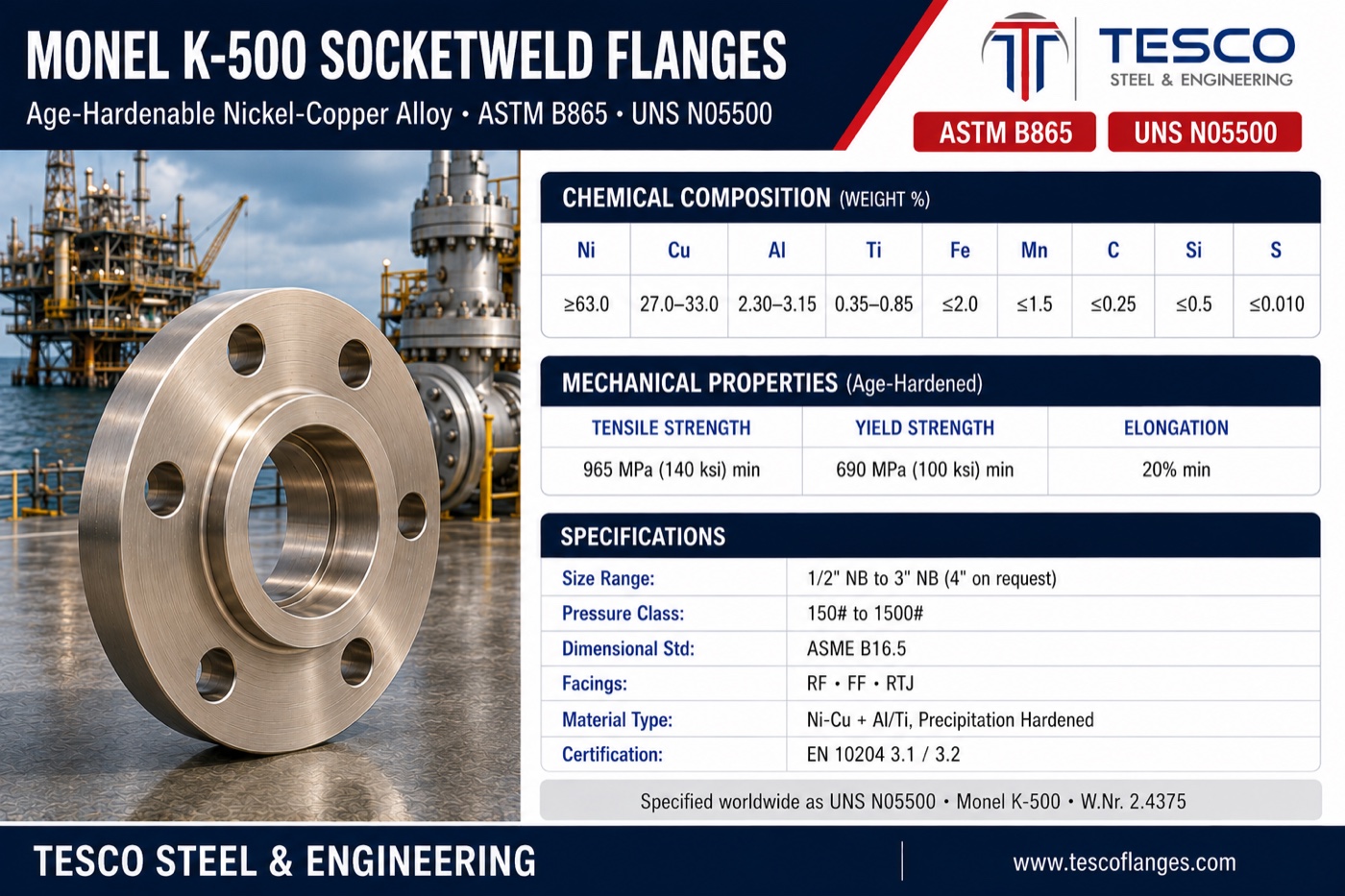
Tesco Steel & Engineering manufactures Monel K-500 socketweld flanges — the age-hardenable nickel-copper: ASTM B865, UNS N05500, W.Nr. 2.4375 — to ASME B16.5 from ½″ to 3″ NB in Classes 150–1500. K-500 is Monel 400 with an engine fitted: 2.3–3.15% aluminium and a dash of titanium precipitate as gamma-prime — the jet-engine strengthening phase — tripling yield to 690 MPa while keeping the nickel-copper corrosion franchises whole, non-magnetic besides. This page keeps the honest frame our 400 page set: flanging duty usually belongs to 400 — K-500 flanges earn their place in spec-driven matching: offshore and drilling packages, QQ-N-286-heritage classes, K-500 pump and wellhead hardware lines. The famous cautions are stated plainly below: weld-then-age fabrication (the fillet itself is always 400-class) and hardness control for subsea cathodic protection. Facings: SWRF, SWFF, SWRTJ. Every lot with EN 10204 3.1/3.2 MTC and ageing records. ISO 9001:2015, made in Mumbai, India — exported to 50+ countries.
Monel K-500 Socketweld Flanges — Specifications at a Glance
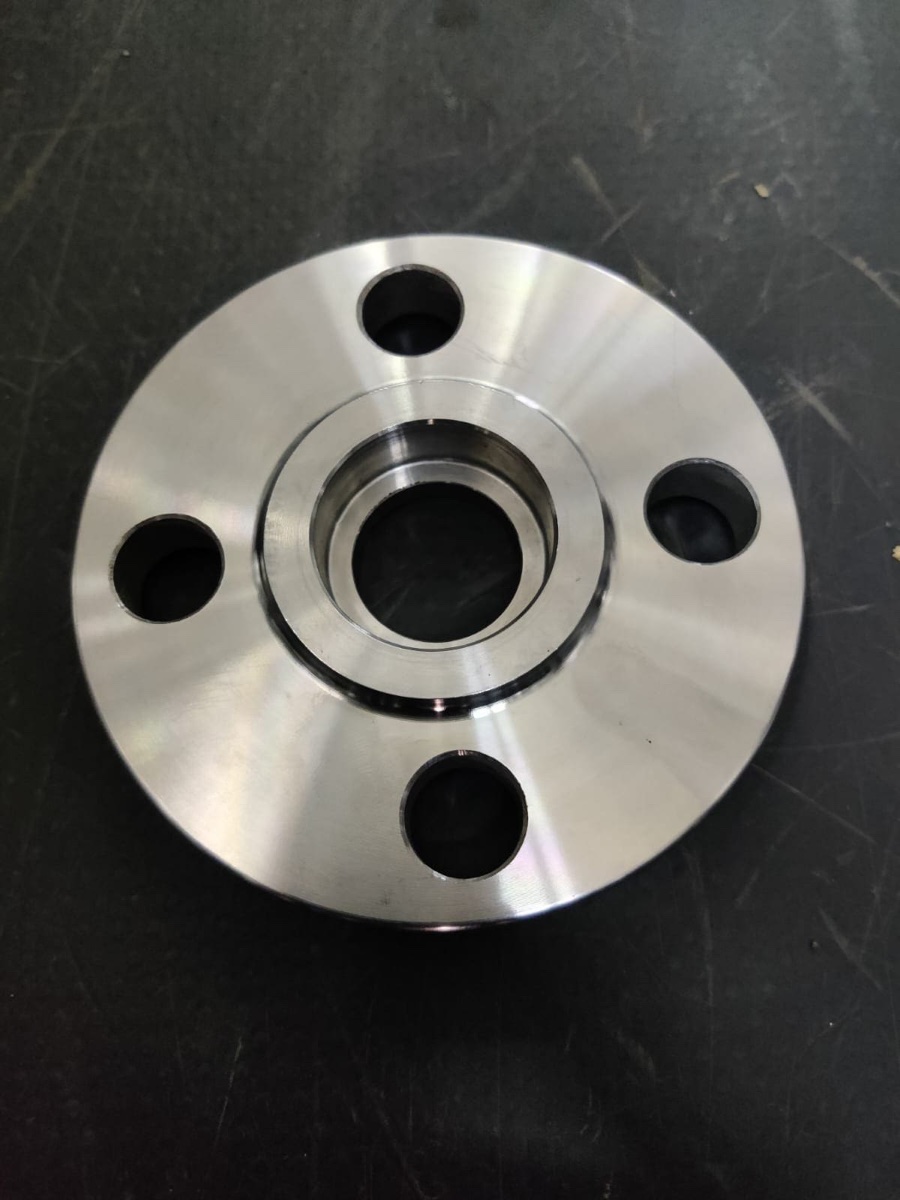
What is a Monel K-500 Socketweld Flange?
The strength edition of Monel, in the small-bore pattern. A forged K-500 flange (ASTM B865 / UNS N05500 / W.Nr. 2.4375) with a machined socket: pipe seated square by geometry, one external fillet weld with ERNiCu-7 filler, through-bore matched to the pipe schedule. Al 2.30–3.15% + Ti 0.35–0.85% precipitation-harden the Ni-Cu matrix to tensile ≥965 MPa, yield ≥690 MPa — roughly triple Monel 400 — with 400's corrosion behaviour kept and low magnetic permeability besides. Supplied age-hardened with records; annealed to order for weld-then-age fabrication. Sized by ASME B16.5 at ½″–3″ NB, Classes 150–1500; EN 10204 3.1 on every lot.
The components metal — shafts, stems, fasteners, drill collars; flanged where specs match hardware
This page
The honest rule both pages share: routine Monel flanging is 400's job — B16.5's class tables set a flange's duty and 400 meets them all. K-500 flanging is spec-driven: offshore and drilling packages, QQ-N-286-heritage classes, and lines matching K-500 hardware. When an enquiry could go either way, we quote both and say which we would buy.
What the Al/Ti Pair Buys
Jet-Engine Strengthening in a Corrosion Alloy
Ageing precipitates gamma-prime Ni3(Al,Ti) — the phase that powers turbine superalloys — tripling yield to 690 MPa with ductility kept and the treatment fully reversible.
400's Franchises, Inherited Whole
Nobility, not film: HF, hot caustic, brine and flowing seawater carry over from the 400 page almost line for line — choose the K for strength and magnetics, never for corrosion.
Non-Magnetic at Strength
Low magnetic permeability held even cold — the directional-drilling credential: survey instruments steer inside K-500 collars; few alloys offer transparency at 690 MPa.
Honesty About the Weld
The fillet is always 400-class — ERNiCu-7 deposit — and welding the aged condition softens the HAZ: quality fabrication welds annealed, then ages. Stated plainly, managed routinely.
Monel K-500 Chemical Composition (UNS N05500)
Element
Ni
Cu
Al
Ti
Fe
Mn
C
Si
S
Weight %
≥63.0
27.0–33.0
2.30–3.15
0.35–0.85
≤2.0
≤1.5
≤0.25
≤0.5
≤0.010
The base is recognisably Monel 400 — two-thirds nickel, a third copper, no chromium, no molybdenum — with the Al/Ti pair as the entire difference: the precipitation-hardening agents. Housekeeping runs tighter than 400's (Fe, Mn, and S at 0.010%) — the cleanliness a hardening alloy demands. PMI confirms the pair on every piece.
Mechanical Properties (Age-Hardened)
Property
ASTM B865 N05500 Requirement
Tensile Strength
≥ 965 MPa (140 ksi) — the strongest certificate in this socketweld series
Age-hardened with full thermal records and hardness survey (standard); annealed for weld-then-age; hardness-capped ageing (typically HRC 35) for subsea CP specs
Size
1/2"NB to 3"NB per ASME B16.5; 4″ and larger to order; EN 1092-1 patterns to order
Class
150#, 300#, 600#, 900#, 1500# (900# shares 1500# dimensions in most sizes) — offshore packages reach into 600+
Facings
Raised Face (SWRF), Flat Face (SWFF), Ring Type Joint (SWRTJ) with groove per B16.20
Bore
Socket bore to pipe OD; through-bore matched to pipe schedule
Welding
Single external fillet with 1/16″ expansion gap; ERNiCu-7 filler — the joint is 400-class; weld-then-age for full-property fabrication; sulphur-clean practice
Service Span
Offshore, subsea and drilling small bore; Monel 400's corrosion franchises inherited; hardness control under cathodic protection — see the notes
Tension & chemistry per heat; hardness surveyed & reported; PMI on every piece — Al/Ti pair confirmed; socket depth and bore gauged
Certification
EN 10204 3.1 with ageing records & hardness (standard) / 3.2 witnessed
Specification Notes — Getting K-500 Sockets Right
Four honest notes.Routine flanging belongs to 400: B16.5's tables set a flange's duty and Monel 400 meets them at lower cost with carefree welding — specify K-500 flanges where the spec or the hardware says so, not by reflex. The weld is never K-500-strength: ERNiCu-7 deposits are 400-class, and welding the aged condition softens the HAZ — full-property fabrication welds annealed and ages after; we supply both conditions. Subsea CP caps the hardness: hydrogen from cathodic protection has cracked hard K-500 offshore — name the governing spec (NACE MR0175/ISO 15156 or operator) and we age into the window, hardness certified. And the corrosion caveats are 400's: oxidising acids, mercury, moist ammonia, stagnant seawater — the 400 page's honest notes apply here unchanged.
How Our Monel K-500 Socketweld Flanges Are Manufactured
1
Forging — cut billet of the spectro-verified N05500 heat is hot-forged into the flange blank with full heat traceability and segregated nickel-alloy handling.
2
Annealing — dissolves the Al/Ti into solution and softens the blank for machining; furnace charts retained.
3
Machining — faces, OD, drilling and the socket counterbore to ASME B16.5, worked in the softer annealed state where practical; socket depth gauged piece by piece, through-bore matched to the ordered schedule.
4
Age-hardening — the controlled ~600 °C precipitation cycle that grows the gamma-prime and sets 965/690 MPa — or the hardness-capped cycle where a subsea CP spec governs; thermal record retained against the heat number.
5
Testing & marking — tension and chemistry per heat; hardness surveyed and reported; PMI on every piece with the Al/Ti pair confirmed; laser-marked with grade, size, class, schedule and heat number.
6
Certification & packing — EN 10204 3.1 MTC with ageing records and hardness (3.2 witnessed on request); weld-then-age WPS guidance included; packed sea-worthy with no carbon-steel contact.
Where Monel K-500 Socketweld Flanges Are Used
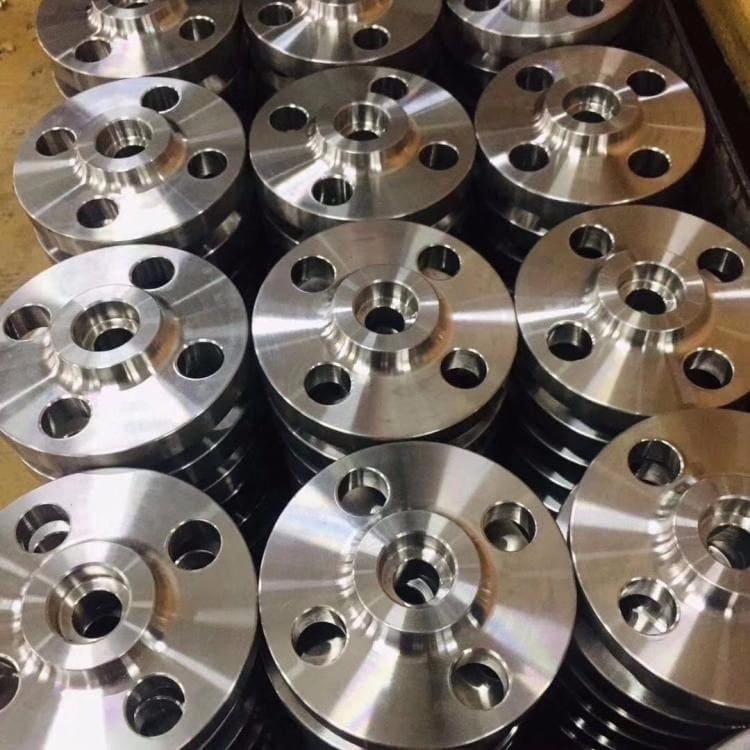
Where specifications match K-500 hardware: offshore and subsea equipment packages (pump, valve and wellhead skids flanged in system metallurgy), drilling and measurement-while-drilling assemblies where non-magnetic small bore must live beside survey instruments, naval and minesweeper hardware lines, and QQ-N-286-heritage piping classes. Production below:
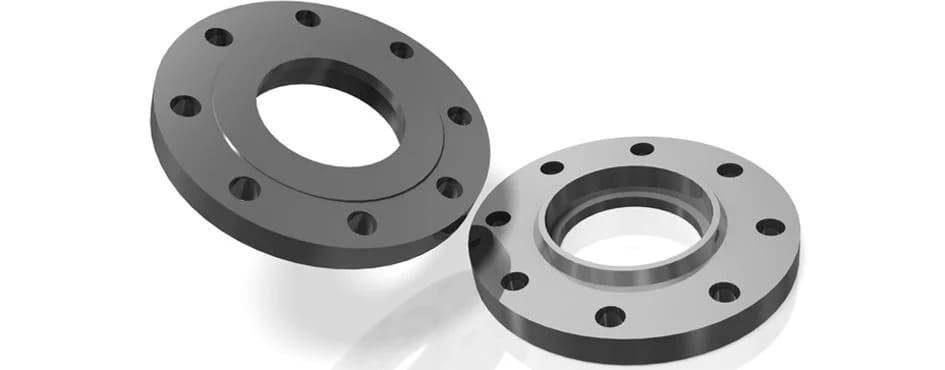
A Monel K-500 socketweld flange is a forged age-hardenable nickel-copper alloy flange — Monel 400's base chemistry plus 2.30-3.15% aluminium and 0.35-0.85% titanium, ASTM B865, UNS N05500, W.Nr. 2.4375 — whose back carries a machined socket: the pipe end seats inside, self-aligned square to the face, and is secured with a single external fillet weld. The K is the strength edition of the Monel family: precipitation hardening triples the yield to 690 MPa while keeping essentially all of 400's corrosion behaviour, and the alloy stays non-magnetic besides. Dimensioned to ASME B16.5 for ½" to 3" NB in Classes 150 to 1500 — specified where piping must match K-500 system hardware, with the honest engineering of that choice discussed on this page.
How does age-hardening triple Monel's strength?
By growing an obstacle course inside the metal. The aluminium and titanium dissolve into the nickel-copper matrix at annealing temperature; a controlled ageing treatment around 600°C then precipitates them as billions of nanometre-scale intermetallic particles — gamma-prime, Ni3(Al,Ti), the same strengthening phase that powers jet-engine superalloys — each one an obstacle a dislocation must cut or climb past. The result: yield strength rises from Monel 400's 195 MPa to 690 MPa minimum with useful ductility kept. The treatment is reversible and repeatable — anneal dissolves the particles, ageing re-grows them — which matters for fabrication: the weld-then-age route in the welding FAQ depends on exactly that reversibility.
What is the chemical composition of Monel K-500 (UNS N05500)?
Nickel 63.0% minimum, copper 27.0-33.0%, aluminium 2.30-3.15%, titanium 0.35-0.85%, iron ≤2.0%, manganese ≤1.5%, carbon ≤0.25%, silicon ≤0.5%, sulphur ≤0.010%. The base is recognisably Monel 400 — two-thirds nickel, a third copper, no chromium, no molybdenum — with the Al/Ti pair as the entire difference: they are the precipitation-hardening agents, and without them the K is just a 400. Note the slightly shifted housekeeping against 400: copper's floor a point lower at 27, iron and manganese tighter, and sulphur at 0.010% — the cleanliness a hardening alloy demands. Chemistry is verified per heat and travels on the EN 10204 3.1 MTC.
What are the mechanical properties of Monel K-500 socketweld flanges?
In the age-hardened condition ASTM B865 requires tensile strength 965 MPa (140 ksi) minimum, yield strength 690 MPa (100 ksi) minimum and elongation 20% minimum — roughly triple Monel 400's certificate, and the strongest numbers of any alloy in this socketweld series. The strength holds from cryogenic temperatures (no ductile-brittle transition, and the alloy famously keeps toughness and low magnetic permeability in the cold) up to roughly 480-500°C, where over-ageing begins to soften the precipitates. Flanges supply age-hardened with furnace records; annealed condition is available to order for weld-then-age fabrication. One honest frame: a flange joint's pressure duty is set by B16.5's class tables, so the K's extra strength serves matching and hardware integration more than it raises a rating.
Does K-500 keep Monel 400's corrosion behaviour?
Essentially yes — the corrosion chemistry is the base metal's, not the precipitates'. K-500 inherits the nickel-copper franchises whole: nobility rather than a passive film, hydrofluoric acid service, hot caustic, brine, flowing seawater, fluorine and dry chlorine — and the same mirror-image weaknesses: oxidising acids, mercury embrittlement, moist ammonia, stagnant-seawater pitting under deposits. The full story of both sides lives on our Monel 400 socketweld page and applies here almost line for line. The one genuinely K-specific corrosion topic is hydrogen embrittlement under cathodic protection — serious enough to get its own FAQ below — and the practical summary is: choose K-500 over 400 for strength and magnetics, never for corrosion, because there is nothing to gain there.
Why specify a K-500 flange at all — the honest question?
Because the system, not the joint, demands it. A flange's pressure rating comes from B16.5's class tables, which Monel 400 satisfies across the range — so 400 is the routine Monel flange, as our own 400 page says plainly. K-500 flanging earns its place in three real situations: metallurgical matching, where a piping class serving K-500 pumps, valves or wellhead hardware specifies one alloy throughout for galvanic and documentation coherence; offshore and drilling packages with QQ-N-286-heritage specifications that name K-500 for every wetted component; and integrated hardware, where the flange doubles as a structural or rotating-equipment interface that genuinely uses the 690 MPa. If none of those apply to your line, order 400 and save real money — we will say exactly that on the quotation.
How is a K-500 socketweld flange welded — the honest answer?
Carefully, and with expectations set straight. Two facts govern. First, welding age-hardened K-500 degrades the weld zone: the heat over-ages and softens the HAZ, and restrained weldments risk strain-age cracking as the precipitates re-form — so quality fabrication welds the alloy in the annealed condition and age-hardens afterwards, restoring full properties; we supply annealed-condition flanges to order for exactly that route. Second, the deposit itself: ERNiCu-7 filler is Monel-400-class metal, so the fillet weld is never K-500-strength regardless of procedure — the joint's rating rests on B16.5 tables, which it meets comfortably. For field welds on age-hardened flanges, small single-pass fillets with low heat input are routinely accepted where the spec allows a local soft zone; where it does not, weld-then-age governs. Our WPS guidance states all of it.
What is the cathodic-protection hydrogen embrittlement issue?
K-500's one famous modern failure mode, and it deserves plain words. Subsea equipment is protected by sacrificial anodes; the cathodic protection that guards steel also charges nearby components with hydrogen — and high-strength, high-hardness K-500 under that hydrogen charging has cracked in well-documented offshore bolting failures. The lesson is not to avoid the alloy but to control it: industry practice (NACE MR0175/ISO 15156 and operator specs) caps K-500's hardness for subsea CP-exposed service — typically HRC 35 — and reputable supply certifies hardness alongside the ageing records. Our flanges ship with both on the certificate, and where an enquiry says subsea CP, we age to the spec's hardness window and prove it. Onshore and non-CP marine duty is unaffected.
Why does non-magnetic matter — the drilling credential?
Because a compass cannot work inside a magnetic drill string. Directional drilling steers by magnetic survey instruments that must sit in a non-magnetic section of the string — and K-500, with its low magnetic permeability held even at low temperatures, became a classic metal for those drill collars and instrument housings, combining the transparency the surveys need with the strength drilling demands and the corrosion resistance drilling muds reward. The same property serves minesweeper hardware and instrumentation applications. For flanging, it means K-500 small bore can sit in magnetically sensitive assemblies without disturbing them — a niche requirement, but one that only a handful of engineering alloys can meet at this strength.
K-500 or Monel 400 — the family division of labour?
The mirror of the question on our 400 page, answered the same way from the other side. Monel 400: the piping and flanging metal — welds freely with no condition anxiety, meets every B16.5 class, costs meaningfully less, and carries identical corrosion franchises; the default for HF, caustic, brine and seawater lines. K-500: the components metal — shafts, stems, springs, fasteners, drill collars and doctor blades, where 690 MPa yield and non-magnetic behaviour do work a flange never asks for. K-500 flanging exists for the matching, spec-heritage and integrated-hardware cases in the FAQ above. When an enquiry could go either way, we quote both and say which we would buy — usually the 400.
In what condition are K-500 flanges supplied?
Age-hardened as standard — forged, annealed, then precipitation-treated with the full thermal record retained against the heat number, and hardness reported on the certificate; this is the condition B865's 965/690 MPa numbers describe and the one most orders want. Two alternatives to order: annealed, for fabricators running the weld-then-age route — the flange welds in the soft condition and the whole assembly ages afterwards to full properties; and hardness-controlled ageing for subsea cathodic-protection service, where the spec caps hardness (typically HRC 35) and the ageing cycle is tuned to land inside the window, with certified hardness surveys. State the condition and any hardness cap on the enquiry; the certificate will match it.
What sizes and pressure classes do K-500 socketweld flanges come in?
ASME B16.5 standardises socket weld flanges from ½" to 3" NB in Classes 150, 300, 600, 900 and 1500 — Class 900 sharing Class 1500 dimensions in most small-bore sizes — with 4" and Class 2500 made to order. K-500 demand concentrates in offshore and drilling-package small bore, where Classes 600 and up are commoner than in the general Monel market. Put the pipe schedule on the enquiry — the through-bore is matched to the pipe ID — and note that B16.5's rating tables, not the alloy's 965 MPa, govern the joint's pressure duty; our quotations state the applicable rating per class.
What details are needed to get an accurate K-500 socketweld flange quotation?
Seven elements this time, because condition matters: (1) size — ½" to 3" NB; (2) pressure class — 150 to 1500; (3) facing — SWRF, SWFF or SWRTJ with ring number; (4) the pipe schedule, so the through-bore matches the pipe ID; (5) the grade line — Monel K-500, ASTM B865, UNS N05500 or W.Nr. 2.4375 all name the same metal; (6) the condition — age-hardened (standard), annealed for weld-then-age, or hardness-capped for subsea CP service, with the governing spec named; (7) certification — EN 10204 3.1 with ageing records and hardness (our standard) or 3.2 witnessed, PMI as applicable. Add quantity and destination and we return price, weight and delivery — normally within 24 hours.
Is Monel K-500 stocked or made to order?
Made to order, honestly and without exception worth pretending otherwise. K-500 flanges are a niche within a niche — the alloy's flange demand follows offshore packages and drilling-equipment projects, not maintenance flow — and worldwide stock is effectively nil; what matters is a supplier who holds certified N05500 bar and billet and controls the ageing furnace, which we do. Typical lead times run two to five weeks by quantity and condition, with the ageing cycle itself setting the floor; annealed-condition supply is quicker. For urgent offshore commissioning gaps, say so on the enquiry — small lots can be prioritised — and the EN 10204 3.1 certificate carries the 2.4375 designation and hardness survey where the documentation requires them.
Who manufactures Monel K-500 socketweld flanges in India?
Tesco Steel & Engineering is an ISO 9001:2015 certified flange manufacturer based in Mumbai, India, producing Monel K-500 (ASTM B865, UNS N05500) socket weld flanges from ½" to 3" NB (larger to order) in Classes 150-1500 — each forged from certified heats, annealed and precipitation-hardened with the full thermal record retained against the heat number, hardness surveyed and reported, machined on dedicated nickel-alloy stations with gauged socket depth and schedule-matched bore, PMI-checked — the Al/Ti hardening pair confirmed on every piece — and laser-marked with grade, size, class, schedule and heat number. Supplied with EN 10204 3.1/3.2 certification and weld-then-age WPS guidance, alongside the Monel 400 sibling and the full nickel-alloy socketweld range this series covers. Exported to more than 50 countries.