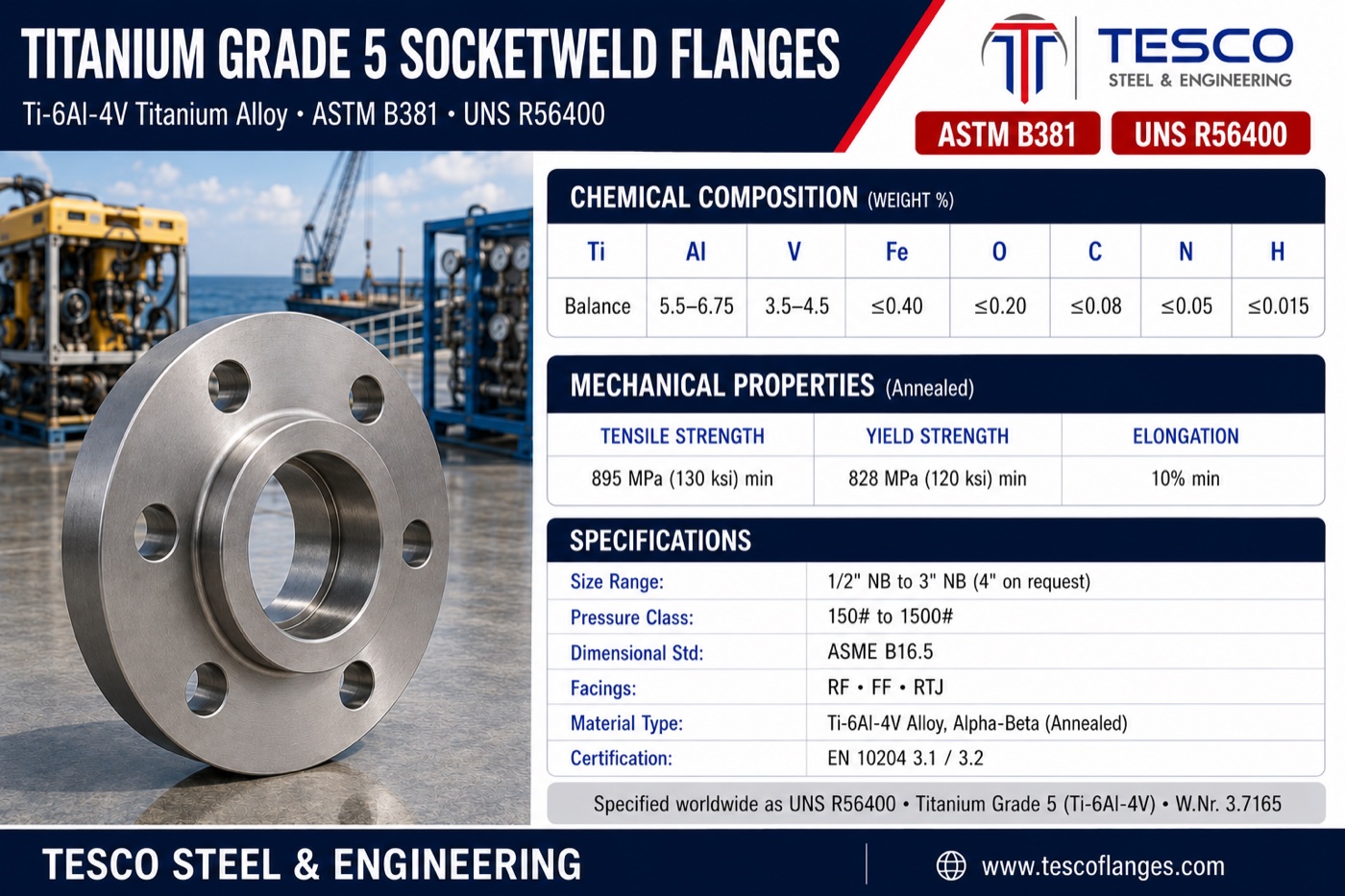
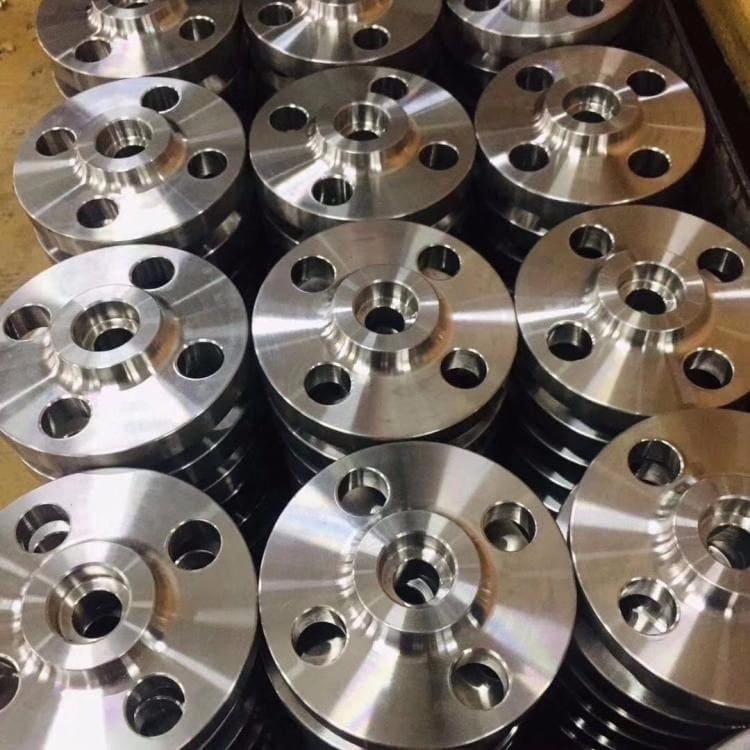
Tesco Steel & Engineering manufactures Titanium Grade 5 socketweld flanges — the strength sibling: Ti-6Al-4V, ASTM B381, UNS R56400, W.Nr. 3.7165 — to ASME B16.5 from ½″ to 3″ NB in Classes 150–1500. This is aerospace's workhorse alloy in flange form: aluminium stabilising the alpha phase, vanadium the beta, and the annealed two-phase structure certifying 895/828 MPa — the strongest certificate on this entire site — at 4.43 g/cm³, half the weight of steel. Run the division and nothing comes close: roughly double the strength-per-kilogram of K-500 and 925 — while Grade 2's seawater immunity comes along essentially free. The honest trades ride with it: 10% elongation — the series' lowest, welding that demands its colour checks, and a price aerospace sets. The split is simple: seawater alone — Grade 2; seawater plus serious load — Grade 5; sour gas belongs to 925. Welded with ERTi-5 under full inert-gas discipline. Facings: SWRF, SWFF, SWRTJ. Every lot with EN 10204 3.1/3.2 MTC. ISO 9001:2015, made in Mumbai, India — exported to 50+ countries.
Ti Grade 5 · Ti-6Al-4V · B381 · R56400 · 3.7165895 / 828 MPa — The Site's Strongest Certificate4.43 g/cm³ — Strength-to-Weight ChampionGrade 2's Immunity, Triple the MuscleSubsea Hydraulics · ROV · Lightweight Skids10% Elongation — The Honest TradeASME B16.5 ½″–3″ · Class 150–1500EN 10204 3.1 / 3.2 · ISO 9001:2015
Titanium Grade 5 Socketweld Flanges — Specifications at a Glance
What is a Titanium Grade 5 Socketweld Flange?
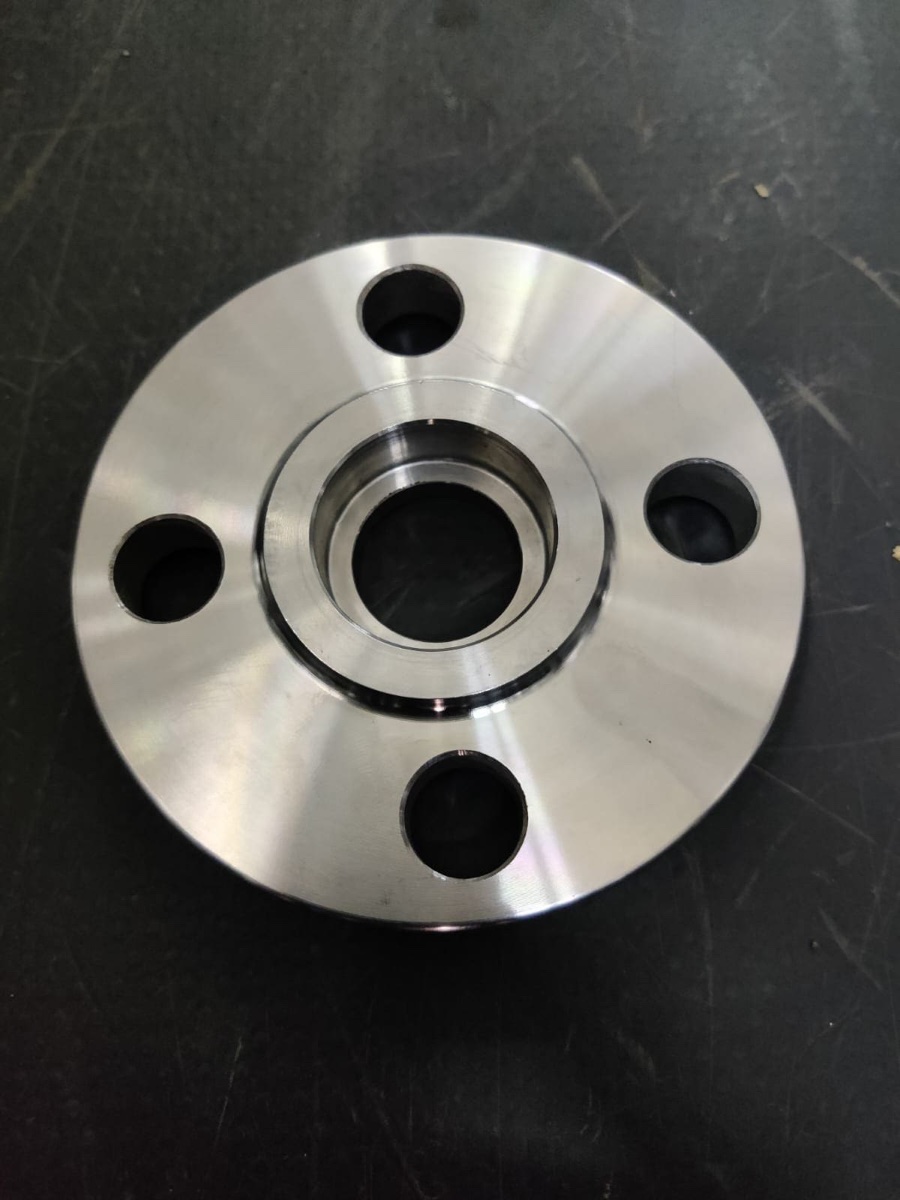
The strength sibling in the small-bore pattern. A forged Ti-6Al-4V flange (ASTM B381 / UNS R56400 / W.Nr. 3.7165) with a machined socket: pipe seated square by geometry, one external fillet weld under full inert-gas discipline, through-bore matched to the pipe schedule. Al 5.5–6.75% stabilises alpha, V 3.5–4.5% stabilises beta — the annealed two-phase structure certifies tensile ≥895 MPa, yield ≥828 MPa, elongation ≥10%: the strongest certificate on this site, at 4.43 g/cm³ — and Grade 2's seawater immunity comes along essentially free. Sized by ASME B16.5 at ½″–3″ NB, Classes 150–1500; EN 10204 3.1 on every lot.
The rule of the bench, completed: where weight is free, the cheaper metals win on price; where every kilogram is budgeted — subsea, topside, vehicle — Grade 5's arithmetic ends the argument. And no ageing metallurgy to protect: the strength is annealed-in.
What the Alpha-Beta Structure Buys
Two Phases, One Certificate
Aluminium stabilises alpha, vanadium retains beta — the two-phase structure that made Ti-6Al-4V the world's most-produced titanium alloy: triple CP strength, aerospace fatigue pedigree, annealed and stable.
The Site's Strongest Certificate
895/828 MPa without any ageing treatment — past 925's aged 725, past K-500's 690, with no heat-revocable metallurgy to protect and nothing for service temperature to undo below its range.
Immunity Included
The TiO2 film neither knows nor cares about the alloying beneath it — Grade 2's seawater behaviour carries over essentially intact: no pitting, no fouling penalty, noble end of the series.
Honesty About the Trades
10% elongation is the series' lowest, the welding demands its colour checks, and aerospace sets the price — if the load never uses the 828, Grade 2 is the honest titanium.
Titanium Grade 5 Chemical Composition (UNS R56400)
Element
Ti
Al
V
Fe
O
C
N
H
Weight %
Balance
5.5–6.75
3.5–4.5
≤0.40
≤0.20
≤0.08
≤0.05
≤0.015
The aluminium ceiling keeps its two decimals — 6.75 — and the oxygen cap sits below Grade 2's 0.25: in an alloy already strengthened by design, the interstitial is controlled rather than exploited. The hydrogen cap carries the same hydride logic as all titanium. PMI confirms the unmistakable Al-V signature on every piece.
Mechanical Properties (Annealed)
Property
ASTM B381 Grade F-5 Requirement
Tensile Strength
≥ 895 MPa (130 ksi) — the strongest certificate in this series
Yield Strength (0.2%)
≥ 828 MPa (120 ksi) — note the deliberately narrow tensile-to-yield gap, characteristic of the alloy
Elongation
≥ 10% — the series' lowest: the honest trade; adequate by every code, but not the annealed nickel bench's forgiveness
Density
4.43 g/cm³ — the certificate's decisive second column: ~187 MPa yield per unit density
Condition
Annealed — the stable, weldable standard; furnace records certified
Rating
B16.5 titanium tables govern the joint to ~315 °C — gasket-limited before metal-limited; stated per class on our quotations
One Socket, Three Facings — and the Isolation Note
The home game — subsea and high-pressure hydraulic work
The isolation note carries over from all titanium: the noblest metal in the joint — where it bolts to steel, CuNi or stainless in seawater, the other metal pays. Isolation kits with sleeved bolting at mixed-metal joints; and note the Grade 5 hydrogen subtlety — aggressive cathodic protection deserves design review near high-strength titanium.
Titanium Grade 5 Socketweld Flange Specifications
Titanium Grade 5 Socketweld Flanges are available in the following specifications:
Material Grade
Titanium Grade 5 (Ti-6Al-4V), ASTM B381 (UNS R56400), W.Nr. 3.7165 — certificates carry the designations your documentation uses
Heat Treatment
Annealed with furnace records certified — the stable, weldable standard condition
Size
1/2"NB to 3"NB per ASME B16.5; 4″ and larger to order; EN 1092-1 patterns to order
Class
150#, 300#, 600#, 900#, 1500# (900# shares 1500# dimensions in most sizes) — the upper classes are where the certificate pays
Facings
Raised Face (SWRF), Flat Face (SWFF), Ring Type Joint (SWRTJ) with groove per B16.20
Bore
Socket bore to pipe OD; through-bore matched to pipe schedule
Welding
Single external fillet with 1/16″ expansion gap; GTAW with ERTi-5 (ERTi-2 where procedures prefer ductility) under full inert-gas discipline — trailing shields, back-purge, strict colour inspection; no preheat, no PWHT
Service Span
Seawater plus serious load — subsea hydraulics, ROV and riser-adjacent hardware, lightweight high-pressure skids, naval and aerospace ground systems; seawater alone to Grade 2, sour gas to 925, reducing acids to the nickel ladder, dry chlorine excluded — see the notes
Tension & chemistry per heat; PMI on every piece; socket depth and bore gauged
Certification
EN 10204 3.1 with anneal records (standard) / 3.2 witnessed
Specification Notes — Getting Grade 5 Sockets Right
Four honest notes.If the load never uses the 828, order Grade 2: the corrosion behaviour is shared, the price is not — Grade 2 is the honest titanium for seawater alone, and our quotation will say so. Respect the 10%: the series' lowest elongation — handling, bending and cold-work forgiveness are not this alloy's gifts, and weld colour inspection is enforced strictly. Sour gas is not titanium's franchise: high-strength sour wellheads belong to 925 and the NACE tables. And the titanium exclusions carry over unchanged: hot reducing acids to C-276 and the ladder, dry chlorine an outright hazard, hydrogen and cathodic protection reviewed at design.
How Our Titanium Grade 5 Socketweld Flanges Are Manufactured
1
Forging — cut billet of the spectro-verified R56400 heat is hot-forged in the alpha-beta window into the flange blank with full heat traceability and dedicated titanium handling.
2
Annealing — sets the stable two-phase structure the certificate stands on; furnace charts retained against the heat number.
3
Machining — faces, OD and drilling to ASME B16.5 on dedicated stations with rigid tooling, sharp carbide and low-heat discipline — the hard alpha-beta structure is machined patiently — with iron-free handling throughout; socket counterbore and depth gauged piece by piece, through-bore matched to the ordered schedule.
4
Facing — RF serrations, flat face or RTJ groove per B16.20; galling-aware finishing on all mating surfaces.
5
Testing & marking — tension and chemistry per heat; PMI on every piece; laser-marked with grade, size, class, schedule and heat number.
6
Certification & packing — EN 10204 3.1 MTC with anneal records (3.2 witnessed on request); inert-gas WPS guidance included; packed sea-worthy with no carbon-steel contact.
Where Titanium Grade 5 Socketweld Flanges Are Used
Where seawater meets serious load and every kilogram is budgeted: subsea hydraulic and chemical-injection circuits, ROV and riser-adjacent small bore, high-pressure test and metering skids on weight-limited topsides, naval piping and combat-system hardware, aerospace ground support equipment, and high-end desalination and marine systems standardised on titanium where pressures climb. Production below:
Socket weld flange dimensions are class-governed per ASME B16.5 — identical across material grades (pressure-temperature ratings follow the titanium tables). Full charts:
How to Specify & Order a Titanium Grade 5 Socketweld Flange
Six elements — the load and the weight budget matter here:
1
Size & standard — e.g. 1″ NB ASME B16.5, or DN25 EN 1092-1 to order.
2
Pressure class & facing — 150#–1500#; SWRF, SWFF or SWRTJ with ring number (the subsea default) — with the design temperature.
3
Pipe schedule — the through-bore is matched to the pipe ID.
4
Grade line, load & mates — Titanium Grade 5 / Ti-6Al-4V / B381 / R56400 / 3.7165; the service and load stated (pressure, weight budget, seawater, mating metallurgy for isolation kits) — they decide between Grade 5, Grade 2 and the nickel strength bench; if the load never uses the 828, our quotation will honestly suggest Grade 2.
5
Certification — EN 10204 3.1 with anneal records (our standard) / 3.2 witnessed, PMI as applicable.
A Titanium Grade 5 socketweld flange is a forged Ti-6Al-4V titanium alloy flange — titanium as the balance with 5.5-6.75% aluminium and 3.5-4.5% vanadium, ASTM B381, UNS R56400, W.Nr. 3.7165 — whose back carries a machined socket: the pipe end seats inside, self-aligned square to the face, and is secured with a single external fillet weld. Grade 5 is the strength sibling of the titanium bench: the world's most-produced titanium alloy — aerospace's workhorse — in flange form, certifying 828 MPa yield at 4.43 g/cm³, the best strength-to-weight on this entire site, while keeping essentially all of Grade 2's seawater immunity. Dimensioned to ASME B16.5 for ½" to 3" NB in Classes 150 to 1500 — the subsea-hydraulics and lightweight-skid grade, in the small-bore pattern.
What do the aluminium and vanadium in Ti-6Al-4V actually do?
They build the two-phase structure the alloy is named for. Pure titanium transforms between two crystal forms — alpha at low temperature, beta at high — and the alloying strategy is to keep both in the room-temperature metal: aluminium (5.5-6.75%) stabilises and strengthens the alpha phase; vanadium (3.5-4.5%) stabilises retained beta alongside it. The resulting alpha-beta microstructure is titanium's sweet spot: roughly triple CP titanium's strength, good toughness, fatigue performance that made it aerospace's default, and response to thermomechanical processing that mills exploit for property control. Our flanges are supplied annealed — the stable, weldable, standard condition — rather than the aerospace STA temper. Two elements, two phases, one certificate: that is the whole design, and the alloy's name says it.
Why is Grade 5 the site's strength-to-weight champion?
Run the division and nothing else comes close. The strength bench's aged heavyweights: Monel K-500 certifies 690 MPa yield at 8.44 g/cm³ — about 82 MPa per unit density; Incoloy 925 certifies 725 at 8.14 — about 89. Grade 5 certifies 828 MPa at 4.43 g/cm³ — 187 MPa per unit density, roughly double the best nickel figures, and the raw yield number is also simply the highest on the site. In flange terms: a Grade 5 kit carries more pressure class per kilogram of topside, skid or vehicle weight than anything else we forge, which is why subsea hydraulics, ROV and riser-adjacent hardware, naval systems and weight-critical packages specify it. Where weight is free, cheaper metals win; where every kilogram is budgeted, this certificate pays for itself.
What is the chemical composition of Titanium Grade 5 (UNS R56400)?
Titanium the balance, aluminium 5.5-6.75%, vanadium 3.5-4.5%, iron ≤0.40%, oxygen ≤0.20%, carbon ≤0.08%, nitrogen ≤0.05% and hydrogen ≤0.015%, with residuals beneath. Two readings worth making: the aluminium ceiling keeps its two decimals — 6.75 — real specification language; and the oxygen cap is lower than Grade 2's 0.25, because in an alloy already strengthened by design, interstitial oxygen is controlled rather than exploited. The tiny hydrogen cap carries the same hydride logic as all titanium. No nickel, chromium, molybdenum or copper exist in the recipe. Chemistry is verified per heat, PMI-confirmed on every piece — the Al-V signature is unmistakable — and travels on the EN 10204 3.1 MTC.
What are the mechanical properties of Titanium Grade 5 socketweld flanges?
In the annealed condition ASTM B381 requires tensile strength 895 MPa (130 ksi) minimum, yield strength 828 MPa (120 ksi) minimum and elongation 10% minimum — the strongest certificate in this entire socketweld series, delivered without any ageing treatment, and with a deliberately narrow tensile-to-yield gap that is characteristic of the alloy. The honesty rides with the strength: 10% elongation is the series' lowest — entirely adequate for flange duty and still free of any ductile-brittle transition, but not the 30-45% forgiveness of the annealed nickel bench, so handling and cold-work practices should respect it. B16.5's titanium tables govern the flange rating, and the joint keeps the two-ceilings honesty — gasket and rating retire the bolted connection long before this metal notices.
Does Grade 5 keep Grade 2's corrosion immunity?
Essentially yes — the TiO2 film neither knows nor cares that aluminium and vanadium sit beneath it. In seawater, brines and oxidising chlorides, Grade 5 behaves like its CP sibling: effectively immune to pitting at ambient temperatures, indifferent to biofouling and velocity, noble in the galvanic series with the same protect-the-other-metal caution. The honest differences are at the margins: its crevice threshold in hot concentrated brines sits a little below Grade 2's, and the same chemical exclusions apply with no extra allowance — hot reducing acids to the nickel bench, dry chlorine an absolute hazard, hydrogen managed by design. The practical summary: choose Grade 5 for its strength, and its corrosion behaviour comes along essentially free; nobody should choose it to out-corrode Grade 2, because it does not.
Titanium Grade 5 or Grade 2 — how does the bench split?
By whether the duty loads the metal. Grade 2 is the workhorse: seawater, desalination, chemical service — anywhere the enemy is corrosion and the stresses are ordinary pipework, its 345/275 certificate is ample, it welds with least ceremony, and it costs distinctly less. Grade 5 earns its premium when mechanics join the party: subsea hydraulic circuits at serious pressure, riser- and ROV-adjacent hardware, compact high-class joints, weight-budgeted skids where a stronger, lighter flange kit changes the arithmetic. The corrosion behaviour is shared; the certificates are not — 828 against 275 MPa yield is the entire conversation. The same rule this site applies on every bench holds here: order the strength grade for its numbers, not its prestige, and our quotation will honestly suggest Grade 2 when the load never uses Grade 5.
Titanium Grade 5 or the aged nickel bench — K-500 and 925?
Three strength grades, three different physics, and the duty decides. Grade 5: the highest yield (828 MPa) at half the weight, corrosion by immunity, no ageing metallurgy to protect — but titanium's chemical exclusions apply, and sour-service qualification belongs elsewhere. Incoloy 925: 725 MPa with chromium-molybdenum chemistry and NACE MR0175 standing — for H2S country the choice is effectively made by the standards; titanium is not the sour-gas metal. Monel K-500: 690 MPa with copper-nickel nobility and the long seawater-machinery record, at the cost of ageing discipline. The practical map: weight-critical seawater strength — Grade 5; high-strength sour wellheads — 925; classic marine machinery heritage — K-500. Three pages, three honest franchises, and the strength bench table on each carries the same numbers.
What are Titanium Grade 5's honest weaknesses?
Five, stated plainly. The elongation: 10% is the series' lowest — sufficient by every code, but handling, bending and cold-work forgiveness are not this alloy's gifts. The welding care: fully weldable under titanium's inert-gas discipline, but with less ductility in reserve, joint quality and colour inspection matter even more than on Grade 2. The price: aerospace demand sets it — where strength is not needed, Grade 2 is the honest titanium and the nickel bench may beat both. The shared titanium exclusions: hot reducing acids to C-276 and the ladder, dry chlorine an outright hazard, hydrogen managed by design, galling respected in threaded work. And heat: the alloy serves to roughly 315°C in code pressure duty and creeps beyond — the fire belongs to other families. None of these touch the franchise: the most strength per kilogram this site sells.
How is a Titanium Grade 5 socketweld flange welded?
Under the same total inert-gas discipline as all titanium, with a little extra respect. GTAW with matching ERTi-5 filler is standard — ERTi-2 appears where procedures trade a softer, more ductile weld for the alloy's full joint strength — under argon everywhere the metal is hot: torch shielding, trailing shields, full back-purge of the bore; flux processes are excluded outright. The colour check is the built-in inspector: silver and light straw pass, blues and greys mean contamination and the bead comes out — enforced strictly, because a contaminated Grade 5 weld has less ductility to hide behind. Geometry is the standard socket pattern: pipe bottomed, withdrawn 1/16" (1.6 mm) for the expansion gap, single external fillet — no preheat, no PWHT for annealed flange work. Scrupulous cleanliness, dedicated tools, no iron contamination. WPS guidance travels with every supply.
How hot can Titanium Grade 5 actually go?
Usefully hotter than its numbers suggest, and honestly not far. The alpha-beta structure holds its strength better with temperature than CP titanium — Grade 5 works in aerospace to around 350-400°C — but for flanged pressure duty ASME's titanium tables govern to roughly 315°C, creep enters beyond, and oxygen pickup embrittles surfaces in long hot exposure. Its actual applications rarely ask for more: subsea, marine and hydraulic service is cold work. The chemical envelope mirrors Grade 2's — comfortable in oxidising and wet-chloride media across its range, crevice review in hot brines, the reducing-acid and dry-chlorine exclusions unchanged. Titanium is not a fire bench and never claims to be; the heat ladder belongs to the Inconels and the 800 family. B16.5's tables and the gasket govern the joint, stated per class on our quotations.
What is the galvanic position of a Grade 5 flange?
The same reversed caution as all titanium: noble end of the seawater series, never the victim, always the beneficiary — so the mating metal pays for any direct coupling. Bolt a Grade 5 flange to carbon steel, copper-nickel or stainless in seawater and the partner corrodes for titanium's benefit, worst where area ratios are unfavourable. Standard practice applies: isolation gasket kits with sleeved bolting at mixed-metal joints, titanium-to-titanium matching where the system allows, bolting metallurgy chosen so the studs never become the anode. The Grade 5-specific note is hydrogen: high-strength titanium is less tolerant of hydride accumulation than soft CP grades, so over-aggressive cathodic protection near Grade 5 hardware deserves review during design rather than after years of charging. State the mating metallurgy on the enquiry; isolation guidance rides with the quotation.
What sizes and pressure classes do Titanium Grade 5 socketweld flanges come in?
ASME B16.5 standardises socket weld flanges from ½" to 3" NB in Classes 150, 300, 600, 900 and 1500 — Class 900 sharing Class 1500 dimensions in most small-bore sizes — with 4" and Class 2500 made to order. Grade 5's order book leans harder on the upper classes than Grade 2's: subsea hydraulic and high-pressure test small bore is exactly where the 828 MPa certificate and the weight arithmetic pay, while Classes 150 and 300 serve its corrosion-led duties. All three facings are available — SWRF the default, SWFF for lined and FRP mates, SWRTJ for the high-pressure work — with isolation kits at mixed-metal joints. Put the pipe schedule on the enquiry — the through-bore is matched to the pipe ID — and the design temperature; our quotations state the governing B16.5 titanium rating per class.
What details are needed to get an accurate Titanium Grade 5 socketweld flange quotation?
Six elements plus commercial terms: (1) size — ½" to 3" NB; (2) pressure class — 150 to 1500, with the design temperature, which governs titanium's rating strongly; (3) facing — SWRF, SWFF or SWRTJ with ring number; (4) the pipe schedule, so the through-bore matches the pipe ID; (5) the grade line — Titanium Grade 5, Ti-6Al-4V, ASTM B381, UNS R56400 or W.Nr. 3.7165 all name the same metal — with the service and load stated (seawater, pressure, weight budget, mating metallurgy for isolation kits): they decide between Grade 5, Grade 2 and the nickel strength bench more often than price does, and if the load never uses Grade 5, our quotation will honestly suggest Grade 2; (6) certification — EN 10204 3.1 with anneal records (our standard) or 3.2 witnessed, PMI as applicable. Add quantity and destination; quotations normally within 24 hours.
Who manufactures Titanium Grade 5 socketweld flanges in India?
Tesco Steel & Engineering is an ISO 9001:2015 certified flange manufacturer based in Mumbai, India, producing Titanium Grade 5 / Ti-6Al-4V (ASTM B381, UNS R56400) socket weld flanges from ½" to 3" NB (larger to order) in Classes 150-1500 — each forged from certified heats, annealed with furnace records against the heat number, machined on dedicated titanium stations with iron-free handling and the rigid-tooling discipline the hard alpha-beta structure demands, gauged socket depth and schedule-matched bore, PMI-checked, and laser-marked with grade, size, class, schedule and heat number. Supplied with EN 10204 3.1/3.2 certification and inert-gas WPS guidance, alongside the Grade 2 workhorse and Grade 7 sibling, the full titanium flange range, and the strength bench this series maps. Exported to more than 50 countries.