

Tesco Steel & Engineering manufactures Titanium Grade 5 flanges — the Ti-6Al-4V alloy (UNS R56400, ASTM B381 F5), the most widely used titanium alloy in the world (~50% of all titanium). An alpha-beta dual-phase grade, it is the highest-strength commercial titanium at UTS 895 MPa / yield 828 MPa — about 2.5× the strength of Grade 2 — yet only ~56% the weight of steel, non-magnetic, with good corrosion resistance and cryogenic toughness to −196 °C. Available in weld neck, slip-on, blind, socket-weld, threaded and lap-joint types to ASME B16.5 / B16.47. Class 150 to 2500, NPS 1/2″ to 24″, PN6 to PN400. ISO 9001:2015 certified. Made in India.
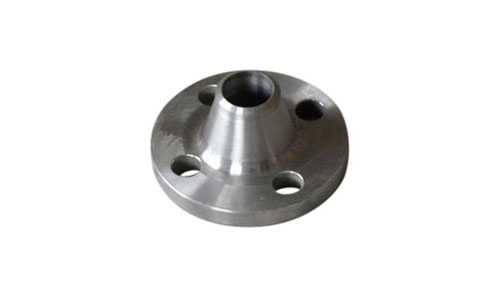
Titanium Grade 5 (ASTM B381 F5) Weld Neck Flange
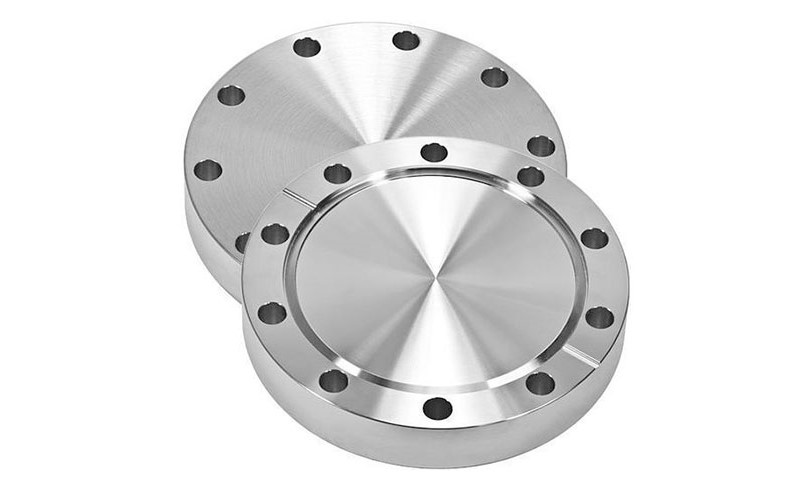
Titanium Grade 5 Blind Flange
Tesco Steel & Engineering manufactures Titanium Grade 5 flanges per ASTM B381 F5 and ASME B16.5, in all flange types from weld neck to blind, Class 150 to 2500 — supplied with EN 10204 3.1 / 3.2 certification, PMI and third-party inspection on request. Explore the wider titanium flange range, Titanium Grade 2 flanges, Titanium Grade 7 flanges, and the flange dimension charts.
| Titanium Grade 5 (Ti-6Al-4V) flanges are available in the following specifications: | |
|---|---|
| Material Grade | Titanium Grade 5 / Ti-6Al-4V / UNS R56400 / ASTM B381 F5 / DIN 3.7165 |
| Alloy Type | Alpha-beta (α+β) dual-phase titanium alloy — highest-strength common Ti grade |
| Size | 1/2″ NB to 24″ NB (DN 15 to DN 600); larger to ASME B16.47 |
| Class / Rating | 150#, 300#, 600#, 900#, 1500#, 2500# · 3000#, 6000#, 9000# (socket-weld / threaded) |
| Pressure Ratings | PN 6 – PN 400 (PN6, 10, 16, 25, 40, 64, 100, 160, 250, 320, 400) |
| Schedule / Wall Thickness | STD, XS, XXS, SCH 10, 20, 40, 80, 160 |
| Standards | ASTM B381 F5 / ASME SB-381 (forgings), B348 (bar), B265 (plate); ASME B16.5, B16.47, B16.36; DIN 3.7165 |
| Flange Types | Weld Neck (WNRF), Slip-On (SORF), Blind, Socket Weld (SWRF), Lap Joint, Threaded / Screwed, Plate, Long Weld Neck, Orifice |
| Flange Faces | Raised Face (RF), Flat Face (FF), Ring Type Joint (RTJ), Tongue & Groove (T&G) |
| Weld Filler | ERTi-5 (AWS A5.16) Ti-6Al-4V |
| Testing | PMI (XRF for Al/V), hydrostatic, UT, MT/PT, Charpy impact, weld-colour inspection; EN 10204 3.1 / 3.2 |
Grade 5 is alloyed with ~6% aluminium (alpha stabiliser) and ~4% vanadium (beta stabiliser), producing the two-phase α+β structure that gives its high strength. Interstitials (O, N, C, H) are tightly controlled because they raise strength but reduce ductility and fracture toughness.
| Element | Titanium Grade 5 / Ti-6Al-4V (UNS R56400) |
|---|---|
| Titanium (Ti) | Balance (~89%) |
| Aluminium (Al) | 5.50 – 6.75% (nominal 6%) |
| Vanadium (V) | 3.50 – 4.50% (nominal 4%) |
| Iron (Fe) | 0.40% max |
| Oxygen (O) | 0.20% max |
| Carbon (C) | 0.08% max |
| Nitrogen (N) | 0.05% max |
| Hydrogen (H) | 0.015% max |
| Mechanical Property (ASTM B381, annealed) | Titanium Grade 5 |
|---|---|
| Tensile Strength (min) | 895 MPa (130 ksi) |
| Yield Strength 0.2% (min) | 828 MPa (120 ksi) |
| Elongation (min) | 10% |
| Hardness (typical) | ~30–36 HRC (≤ 360 HBW) |
| Density | 4.43 g/cm³ (~56% of steel) |
| Magnetic | Non-magnetic (permeability ~1.00005) |
| Max Service Temp | ~315 °C; cryogenic to −196 °C |
| Standard | Titanium Grade 5 Designation |
|---|---|
| UNS (USA) | R56400 |
| ASTM / ASME (forgings) | B381 F5 / SB-381 (also B348 Gr 5 bar, B265 Gr 5 plate) |
| AMS (Aerospace) | AMS 4928 (bar/billet), AMS 4967 |
| EN / DIN (Europe) | 3.7165 / TiAl6V4 |
| JIS (Japan) | Class 60 (Type 60) |
| Common name | Ti-6Al-4V / Grade 5 / 6-4 titanium |
Ti Gr 5 Weld Neck (WNRF)
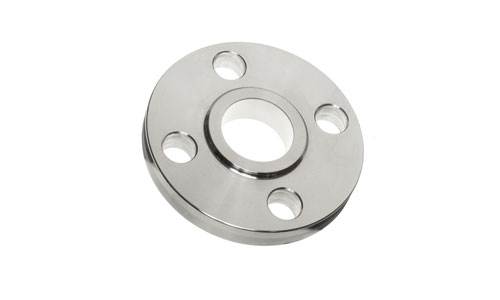
Ti Gr 5 Slip-On (SORF)

Ti Gr 5 Long Weld Neck (LWN)
| Flange Type | Description & Titanium-Gr-5-Specific Use |
|---|---|
| Weld Neck (WNRF) | Tapered hub butt-welded to pipe for high-pressure, weight-critical lines; weld with ERTi-5 under full inert shielding and post-weld colour inspection. |
| Slip-On (SORF) | Fillet-welded over the pipe for moderate-pressure high-strength connections. |
| Blind (BFF) | Seals high-pressure pipe ends and vessel nozzles where strength and weight both matter. |
| Socket Weld (SWRF) | Small-bore (1/2″–2″) high-strength instrument and hydraulic connections. |
| Lap Joint (LJRF) | Used with a titanium stub end for frequent dismantling; economises on alloy in the backing ring. |
| Threaded (TRFF) | Internal NPT/BSP threads where Grade 5's strength resists high thread loads. |
| Long Weld Neck / Orifice / Plate | Nozzle, flow-metering and plate flanges in Grade 5 for high-strength aerospace/marine duty. |
| Property | Grade 5 / Ti-6Al-4V (R56400) | Grade 2 (R50400) | Grade 4 (R50700) | Grade 7 (R52400) |
|---|---|---|---|---|
| Type | α+β alloy | CP Ti (workhorse) | CP Ti (high-strength) | CP Ti + Palladium |
| Tensile (min) | 895 MPa | 345 MPa | 550 MPa | 345 MPa |
| Yield (min) | 828 MPa | 275 MPa | 483 MPa | 275 MPa |
| Density | 4.43 g/cm³ | 4.51 g/cm³ | 4.51 g/cm³ | 4.51 g/cm³ |
| Weldability | Good (more care) | Highest | Good | High |
| Seawater / chlorides | Excellent | Excellent | Excellent | Excellent |
| Reducing acids (HCl, H₂SO₄) | Limited | Limited | Limited | Good (Pd) |
| Flange spec | ASTM B381 F-5 | ASTM B381 F-2 | ASTM B381 F-4 | ASTM B381 F-7 |
| Best For | High strength, aerospace, high-pressure flanges | General corrosion / marine workhorse | Higher-strength CP service | Reducing-acid & chemical service |
UTS 895 MPa / yield 828 MPa — about 2.5× Grade 2 — for high-pressure classes or lighter flanges at the same rating.
Density 4.43 g/cm³ (~56% of steel); a Grade 5 flange is ~43% lighter than an equivalent steel flange.
Permeability ~1.00005 — suitable for MRI, degaussed naval vessels and sensitive EM equipment.
No ductile-to-brittle transition — usable to −196 °C with excellent impact toughness.
| Industry | Typical Application |
|---|---|
| Aerospace | Airframe connections, engine pylon flanges, hydraulic fittings (~80% of aerospace Ti use) |
| Chemical Processing | High-pressure vessels & exchangers in nitric acid, wet chlorine and organics |
| Marine & Offshore | Seawater piping flanges, hull penetrations, offshore riser components |
| Desalination | High-pressure reverse-osmosis (RO) system flanges |
| Power Generation | Coastal/marine condenser and heat-exchanger flanges |
| Defence | Naval vessels, missile components, armoured-vehicle systems |
| Medical | Biocompatible implants and sterilisation-equipment flanges |
Forged from certified Ti-6Al-4V with PMI (XRF) verification of Al and V — full chemistry on the MTC.
WNRF, SORF, blind, socket-weld, threaded, lap-joint, LWN, orifice and plate — in RF, FF, RTJ and T&G faces.
Full inert-gas shielding with mandatory weld-colour inspection to guarantee uncontaminated, ductile joints.
EN 10204 3.1 / 3.2 MTC, heat/lot traceability, Charpy, hydrostatic and third-party inspection on request.
Titanium Grade 5 flanges carry a premium over CP titanium grades and stainless due to the Al-V alloying and tighter processing, plus size, pressure class, flange type and quantity — but deliver the highest strength-to-weight of any common flange material. Tesco Steel & Engineering offers competitive ex-works pricing from Mumbai with full export documentation and material traceability. Click Ask for Quote or message us on WhatsApp at +91 92233 66922 with flange type, size (NB), pressure class, quantity and documentation requirements.
Q1. What is Titanium Grade 5 and what is its UNS number?
Titanium Grade 5 is the Ti-6Al-4V alloy — the most widely used titanium alloy in the world (~50% of all titanium production). Its UNS number is R56400. It contains 5.5–6.75% aluminium and 3.5–4.5% vanadium and is an alpha-beta dual-phase alloy combining high strength, moderate ductility and good corrosion resistance. The ASTM forging standard for flanges is ASTM B381 Grade F5. Minimum tensile strength is 895 MPa (130 ksi) and yield 828 MPa (120 ksi), versus 345 MPa UTS for commercially pure Grade 2.
Q2. What is the difference between Titanium Grade 2 and Grade 5?
Grade 2 is commercially pure titanium (99%+ Ti); Grade 5 is Ti-6Al-4V (6% Al, 4% V). Grade 5 UTS is 895 MPa min vs 345 MPa for Grade 2 — about 2.5× stronger. Grade 2 is single-phase alpha; Grade 5 is dual-phase alpha+beta. Grade 2 is slightly better in some reducing acids and easier to weld; Grade 5 is better where strength and corrosion both matter, and is used for aerospace structure, high-pressure flanges and high strength-to-weight applications.
Q3. What is the ASTM standard for Titanium Grade 5 forgings and flanges?
Titanium Grade 5 flanges are made per ASTM B381 Grade F5 (titanium and titanium-alloy forgings); the ASME equivalent is ASME SB-381. Related standards: ASTM B265 Gr.5 (plate/sheet), B348 Gr.5 (bar/billet), B337 Gr.5 (seamless pipe), B338 Gr.5 (tube). Dimensions and pressure-temperature ratings follow ASME B16.5 (1/2″–24″ NB) and ASME B16.47 (larger). Design allowables come from ASME B31.3 Table A-5B or BPVC Section II Part D.
Q4. What is the density and strength-to-weight ratio of Titanium Grade 5?
Ti-6Al-4V has a density of 4.43 g/cm³ (0.160 lb/in³) — about 56% of steel (7.85 g/cm³). With a minimum UTS of 895 MPa, its specific strength is among the highest of any structural alloy, so a Grade 5 flange weighs roughly 43% less than an equivalent steel flange while matching or exceeding its pressure rating — critical for aerospace and offshore.
Q5. What is the maximum service temperature for Titanium Grade 5 flanges?
About 315 °C (600 °F) for pressure applications. Above this, titanium alloys absorb oxygen and hydrogen and embrittle over time, and creep begins above ~260 °C under sustained load. For higher temperatures consider Grade 12 or nickel alloys. Titanium has no low-temperature ductility problem — Grade 5 suits cryogenic service to −196 °C with excellent toughness.
Q6. What environments is Titanium Grade 5 not suitable for?
Not suitable for: dry chlorine gas or anhydrous HCl (titanium reacts violently with dry chlorine above ~80 °C; wet chlorine is fine); concentrated reducing acids (HCl >~5%, H₂SO₄ >~5% at ambient); fluoride-containing solutions (even trace HF); red fuming nitric acid; service above 315 °C; and liquid metals (mercury, cadmium). For reducing-acid service use Grade 7 (Ti-Pd) or Grade 12.
Q7. What filler metal is used to weld Titanium Grade 5 flanges?
Matching ERTi-5 per AWS A5.16. Welding needs strict shielding: GTAW with pure argon, trailing shields protecting the weld until below ~300 °C, and back-purge argon on the root. Post-weld colour inspection: silver = excellent; straw/gold = minor pickup (acceptable for less critical work); blue = moderate (reject for pressure service); grey/white = severe (remove and re-weld). No PWHT is required for Grade 5 in most applications.
Q8. Is Titanium Grade 5 magnetic?
No — Ti-6Al-4V is non-magnetic (paramagnetic, negligible susceptibility), with relative permeability about 1.00005. This makes Grade 5 flanges suitable for MRI installations, naval degaussed vessels and sensitive electromagnetic equipment — an advantage over carbon steel and even cold-worked austenitic stainless.
Q9. What is the chemical composition of Titanium Grade 5 (Ti-6Al-4V)?
Per ASTM B381 Grade F5 / UNS R56400: titanium balance (~89%); aluminium 5.50–6.75% (nominal 6%); vanadium 3.50–4.50% (nominal 4%); iron 0.40% max; oxygen 0.20% max; carbon 0.08% max; nitrogen 0.05% max; hydrogen 0.015% max; other elements each 0.10% max, total 0.40% max. The interstitials O, N, C, H are tightly controlled because they raise strength but reduce ductility and toughness.
Q10. When should I use Titanium Grade 5 instead of Grade 2 for flanges?
Choose Grade 5 when: higher pressure ratings are required (895 MPa UTS allows higher classes at the same wall or lighter flanges at the same rating); structural loading matters (higher bolting and pipe reaction loads); weight minimisation is critical (aerospace, offshore, portable); or elevated-temperature service up to 315 °C. Choose Grade 2 when maximum corrosion resistance in reducing acids is the priority, simpler welding is needed, or only low-pressure chemical service is required.
Q11. What industries and applications use Titanium Grade 5 flanges?
Aerospace (airframe connections, engine pylon flanges, hydraulic fittings — ~80% of aerospace Ti use); chemical processing (pressure vessels/exchangers in nitric acid, wet chlorine, organics); marine and offshore (seawater piping, hull penetrations, risers); desalination (high-pressure RO flanges); power generation (coastal condenser/exchanger flanges); defence (naval, missile, armoured-vehicle systems); and medical (biocompatible implants and sterilisation equipment).