

Tesco Steel & Engineering manufactures Titanium Grade 4 flanges — the highest-strength commercially pure (CP) titanium grade, forged to ASTM B381 Grade F-4 (UNS R50700, DIN 3.7065). Grade 4 uses elevated oxygen to reach a minimum tensile strength of 550 MPa (nearly 60% stronger than Grade 2) while keeping the full titanium corrosion resistance in seawater, wet chlorine, hypochlorite and oxidising acids — and at about half the weight of steel. Available in weld neck, slip-on, blind, socket-weld, threaded and lap-joint types to ASME B16.5 / B16.47. Class 150 to 2500, NPS 1/2″ to 24″, PN6 to PN400. ISO 9001:2015 certified. Made in India.

Titanium Grade 4 (ASTM B381 F-4) Flanges
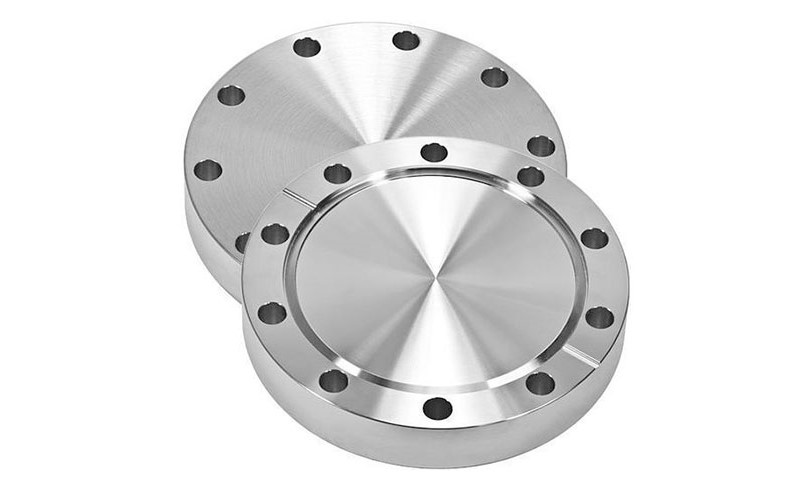
Titanium Grade 4 Weld Neck & Blind Flanges
Tesco Steel & Engineering manufactures Titanium Grade 4 flanges per ASTM B381 and ASME B16.5, in all flange types from weld neck to blind, Class 150 to 2500 — supplied with EN 10204 3.1 / 3.2 certification, PMI and third-party inspection on request. Explore the wider titanium flange range, Titanium Grade 2 flanges, Titanium Grade 5 flanges, and the flange dimension charts.
| Titanium Grade 4 flanges are available in the following specifications: | |
|---|---|
| Material Grade | Titanium Grade 4 (CP Ti) / UNS R50700 / ASTM B381 F-4 / ASME SB-381 / DIN 3.7065 |
| Type | Commercially pure titanium — highest-strength CP grade (high-oxygen) |
| Size | 1/2″ NB to 24″ NB (DN 15 to DN 600); larger to ASME B16.47 |
| Class / Rating | 150#, 300#, 600#, 900#, 1500#, 2500# · 3000#, 6000#, 9000# (socket-weld / threaded) |
| Pressure Ratings | PN 6 – PN 400 (PN6, 10, 16, 25, 40, 64, 100, 160, 250, 320, 400) |
| Schedule / Wall Thickness | STD, XS, XXS, SCH 10, 20, 40, 80 |
| Standards | ASTM B381 (forgings F-4) / ASME SB-381, B348 (bar), B265 (plate); ASME B16.5, B16.47, B16.36; EN 1092-1; DIN 3.7065 |
| Flange Types | Weld Neck (WNRF), Slip-On (SORF), Blind, Socket Weld (SWRF), Lap Joint, Threaded / Screwed, Plate, Long Weld Neck, Spectacle Blind, Orifice |
| Flange Faces | Raised Face (RF), Flat Face (FF), Ring Type Joint (RTJ), Tongue & Groove (T&G) |
| Weld Filler | ERTi-4 (AWS A5.16) commercially pure titanium |
| Testing | PMI, hydrostatic, UT, MT/PT, weld-colour inspection per spec; EN 10204 3.1 / 3.2 |
Grade 4 has the highest interstitial oxygen of the CP titanium grades (up to 0.40%, versus 0.25% max for Grade 2). This raises its strength substantially while keeping the same corrosion resistance — corrosion comes from the titanium-oxide passive film, not from alloying.
| Element | Titanium Grade 4 (UNS R50700) |
|---|---|
| Titanium (Ti) | Balance (commercially pure) |
| Oxygen (O) | 0.40% max (strength driver) |
| Iron (Fe) | 0.50% max |
| Carbon (C) | 0.08% max |
| Nitrogen (N) | 0.05% max |
| Hydrogen (H) | 0.015% max |
| Mechanical Property (ASTM B381, annealed) | Titanium Grade 4 |
|---|---|
| Tensile Strength (min) | 550 MPa (80 ksi) |
| Yield Strength 0.2% (min) | 483 MPa (70 ksi) |
| Elongation (min) | 15% |
| Reduction of Area (min) | 25% |
| Hardness (typical) | 200–280 HB |
| Density | 4.51 g/cm³ (~56% of steel) |
| Max Continuous Service Temp | ~300 °C |
| Standard | Titanium Grade 4 Designation |
|---|---|
| UNS (USA) | R50700 |
| ASTM / ASME (forgings) | B381 F-4 / SB-381 (also B348 Gr 4 bar, B265 Gr 4 plate) |
| AMS (Aerospace) | AMS 4921 |
| EN / DIN (Europe) | 3.7065 / Ti4 |
| JIS (Japan) | Class 4 (Type 4) |
| Common name | CP Titanium Grade 4 (high-strength) |
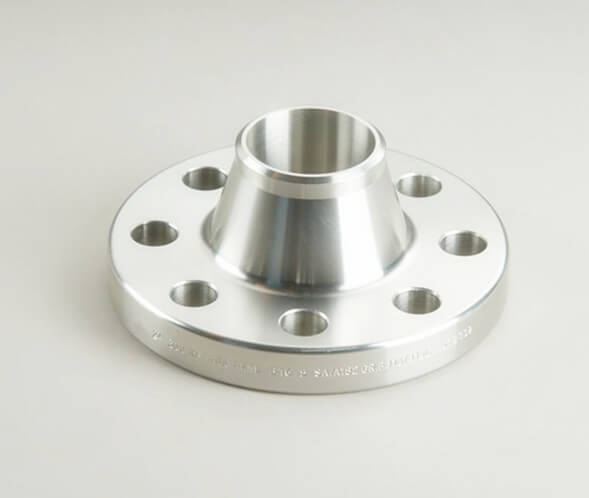
Titanium Gr 4 Weld Neck (WNRF)

Titanium Gr 4 Slip-On (SORF)
Titanium Gr 4 Blind (BFF)
| Flange Type | Description & Titanium-Gr-4-Specific Use |
|---|---|
| Weld Neck (WNRF) | Tapered hub butt-welded to pipe for high-strength, high-pressure seawater and chemical lines; weld with ERTi-4 filler under full inert shielding. |
| Slip-On (SORF) | Fillet-welded over the pipe; high-strength connection for marine and chemical secondary piping. |
| Blind (BFF) | Seals pipe ends and vessel nozzles in high-strength seawater, chlor-alkali and oxidising-acid service. |
| Socket Weld (SWRF) | Small-bore (1/2″–2″) high-strength instrument and chemical-injection connections. |
| Lap Joint (LJRF) | Used with a titanium stub end where frequent dismantling is needed; economises on titanium in the backing ring. |
| Threaded (TRFF) | Internal NPT/BSP threads for non-welded connections where Grade 4's strength resists thread loads. |
| Long Weld Neck / Orifice / Plate | Nozzle, flow-metering and plate flanges in Grade 4 for strength-critical corrosive duty. |
| Property | Grade 4 (R50700) | Grade 2 (R50400) | Grade 5 / Ti-6Al-4V (R56400) | Grade 7 (R52400) |
|---|---|---|---|---|
| Type | CP Ti (highest strength) | CP Ti (workhorse) | Alpha-beta alloy | CP Ti + Palladium |
| Tensile (min) | 550 MPa | 345 MPa | 895 MPa | 345 MPa |
| Yield (min) | 483 MPa | 275 MPa | 828 MPa | 275 MPa |
| Ductility / weldability | Good | Highest | Lower / harder to weld | High |
| Seawater / chlorides | Excellent | Excellent | Excellent | Excellent |
| Reducing acids (HCl, H₂SO₄) | Limited | Limited | Limited | Good (Pd) |
| Flange spec | ASTM B381 F-4 | ASTM B381 F-2 | ASTM B381 F-5 | ASTM B381 F-7 |
| Best For | High-strength CP, no-alloy weldable | General corrosion / marine workhorse | Highest strength, aerospace | Reducing-acid & chemical service |
550 MPa tensile / 483 MPa yield — nearly 60% stronger than Grade 2 while staying unalloyed and weldable.
Immune to pitting and crevice corrosion in seawater and chloride brines far beyond stainless — marine, offshore, desalination.
Excellent in wet chlorine, hypochlorite and oxidising acids (e.g. nitric) — standard for chlor-alkali and bleaching.
Density ~4.51 g/cm³ — about half of steel, cutting weight in marine, offshore and aerospace assemblies.
| Industry | Typical Application |
|---|---|
| Chemical Processing | High-strength piping in oxidising acids, wet chlorine and hypochlorite service |
| Desalination & Seawater | MSF and RO seawater/brine piping; heat-exchanger and condenser nozzles |
| Marine & Offshore | Seawater piping where higher strength and chloride resistance are both needed |
| Aerospace | Structural components where CP titanium is preferred over alloys |
| Pharmaceutical & Food | Biocompatible high-strength process connections |
| Power Generation | High-temperature steam condensate components and seawater condensers |
| Medical / Surgical | High-strength biocompatible hardware and implants |
Forged from certified high-strength CP titanium with PMI verification — full chemistry and interstitial control on the MTC.
WNRF, SORF, blind, socket-weld, threaded, lap-joint, LWN, orifice and plate — in RF, FF, RTJ and T&G faces.
Welded under full inert-gas shielding with weld-colour inspection to guarantee uncontaminated, ductile joints.
EN 10204 3.1 / 3.2 MTC, heat/lot traceability, hydrostatic and third-party inspection on request.
Titanium Grade 4 flanges run roughly 10–20% above Grade 2 due to tighter composition control, plus the usual drivers of size, pressure class, flange type and quantity — titanium carries a premium over stainless but offers unmatched seawater/chloride life, weight saving and higher strength. Tesco Steel & Engineering offers competitive ex-works pricing from Mumbai with full export documentation and material traceability. Click Ask for Quote or message us on WhatsApp at +91 92233 66922 with flange type, size (NB), pressure class, quantity and documentation requirements.
Q1. What is a Titanium Grade 4 flange?
A Titanium Grade 4 flange is a pipe flange made from Grade 4 (UNS R50700, ASTM B381 Grade F-4 / ASME SB-381) — the highest-strength commercially pure (CP) titanium grade. It is unalloyed titanium with elevated oxygen content (0.40% max), which raises minimum tensile strength to 550 MPa (80 ksi) and yield to 483 MPa (70 ksi) — nearly 60% stronger than Grade 2 — while keeping the full CP-titanium corrosion resistance in oxidising acids, wet chlorine, chlorinated organics and seawater.
Q2. What is the UNS number for Titanium Grade 4?
Titanium Grade 4 has the UNS designation R50700. The governing standard for Grade 4 forgings (including flanges) is ASTM B381 Grade F-4 / ASME SB-381. The equivalent AMS specification is AMS 4921 and the DIN designation is 3.7065.
Q3. What is the difference between Titanium Grade 2 and Grade 4 flanges?
The primary difference is strength. Grade 2 (UNS R50400) has a minimum tensile strength of 345 MPa and is the most widely used CP grade. Grade 4 (UNS R50700) has a minimum tensile strength of 550 MPa — nearly 60% stronger. Both have equivalent corrosion resistance. Grade 4 is chosen when higher mechanical strength is needed without resorting to titanium alloys such as Grade 5 (Ti-6Al-4V), which has superior strength but reduced corrosion resistance and is harder to weld.
Q4. What is the chemical composition of Titanium Grade 4?
Titanium Grade 4 (ASTM B381) composition: oxygen 0.40% max, iron 0.50% max, carbon 0.08% max, nitrogen 0.05% max, hydrogen 0.015% max, titanium balance. The elevated oxygen (up to 0.40%, versus 0.25% max for Grade 2) is what provides the higher strength.
Q5. What are the mechanical properties of Titanium Grade 4 flanges?
Titanium Grade 4 (ASTM B381) mechanical properties: tensile strength 550 MPa (80 ksi) min; yield strength (0.2% offset) 483 MPa (70 ksi) min; elongation 15% min; reduction of area 25% min. These are for forgings in the annealed condition; hardness is typically 200–280 HB.
Q6. What standards apply to Titanium Grade 4 flanges?
Titanium Grade 4 flanges are made to ASTM B381 / ASME SB-381 (titanium forgings — the primary material standard) and dimensioned to ASME B16.5 (Class 150–2500, NPS 1/2 to 24), ASME B16.47 (large diameter NPS 26–60), ASME B16.36 (orifice) and EN 1092-1 (PN-rated).
Q7. What is the corrosion resistance of Titanium Grade 4?
Titanium Grade 4 has the same outstanding corrosion resistance as all CP titanium grades: excellent in oxidising acids (nitric, chromic), wet chlorine and chlorinated water, seawater, sodium hypochlorite, dilute sulphuric/hydrochloric acids at low temperature, and organic acids. A stable, self-repairing TiO₂ film provides this resistance. Like all CP titanium, it is attacked by dry chlorine, concentrated hot sulphuric acid, hydrofluoric acid and strong reducing acids.
Q8. Can Titanium Grade 4 flanges be welded?
Yes. Grade 4 is welded by GTAW (TIG) with matching ERTi-4 / CP-titanium filler. Titanium is highly reactive when hot and must be protected from oxygen, nitrogen and hydrogen: argon/helium shielding on root and cover passes, trailing shields over the cooling weld and HAZ, and a controlled-atmosphere chamber for critical components. PWHT is not mandatory, but stress relief at 480–595 °C in vacuum/inert atmosphere is recommended for heavily restrained joints. Accept a bright silver/straw weld; reject blue, grey or white.
Q9. What is the maximum service temperature of Titanium Grade 4 flanges?
Commercially pure Grade 4 titanium is generally used up to about 300 °C in continuous service; above this its strength falls and oxidation increases. For higher-temperature or higher-strength duty, alpha-beta alloys such as Grade 5 (Ti-6Al-4V) are specified. Titanium also retains good toughness at low and cryogenic temperatures.
Q10. What industries use Titanium Grade 4 flanges?
Titanium Grade 4 is used where Grade 2's corrosion resistance is needed but its strength is insufficient: chemical processing (oxidising acids, wet chlorine, hypochlorite), desalination (MSF and RO), marine and offshore seawater piping, aerospace structural components, pharmaceutical and food processing requiring biocompatibility, and power-plant high-temperature condensate components.
Q11. Are Titanium Grade 4 flanges supplied with material test certificates?
Yes. Every Titanium Grade 4 flange is supplied with EN 10204 3.1 (or 3.2) mill test certificates confirming chemistry, mechanical properties and heat/lot traceability, with PMI, hydrostatic testing, weld-colour inspection and third-party inspection on request. Tesco Steel & Engineering is an ISO 9001:2015 certified manufacturer and exporter from Mumbai, India.