

Tesco Steel & Engineering manufactures Titanium Grade 2 flanges — the most widely used commercially pure (CP) titanium grade and the industry workhorse, forged to ASTM B381 Grade F-2 (UNS R50400, DIN 3.7035). Grade 2 delivers the best all-round balance of strength, ductility, weldability and corrosion resistance — at about half the weight of steel — with outstanding resistance to seawater, chlorides, wet chlorine and oxidising acids. Available in weld neck, slip-on, blind, socket-weld, threaded and lap-joint types to ASME B16.5 / B16.47. Class 150 to 2500, NPS 1/2″ to 24″, PN6 to PN400. ISO 9001:2015 certified. Made in India.

Titanium Grade 2 (ASTM B381 F-2) Flanges
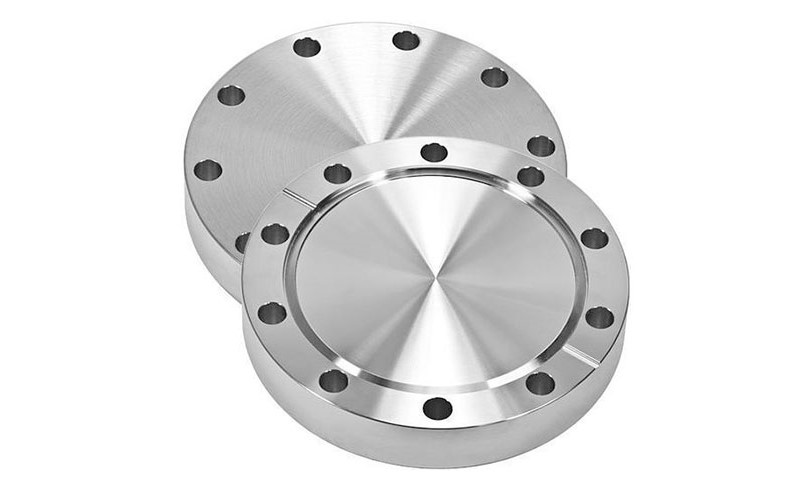
Titanium Grade 2 Weld Neck & Blind Flanges
Tesco Steel & Engineering manufactures Titanium Grade 2 flanges per ASTM B381 and ASME B16.5, in all flange types from weld neck to blind, Class 150 to 2500 — supplied with EN 10204 3.1 / 3.2 certification, PMI and third-party inspection on request. Explore the wider titanium flange range, ASTM B363 Gr 2 titanium fittings, Titanium Grade 1 flanges, and the flange dimension charts.
| Titanium Grade 2 flanges are available in the following specifications: | |
|---|---|
| Material Grade | Titanium Grade 2 (CP Ti) / UNS R50400 / ASTM B381 F-2 / DIN 3.7035 |
| Type | Commercially pure titanium — the standard workhorse CP grade |
| Size | 1/2″ NB to 24″ NB (DN 15 to DN 600); larger to ASME B16.47 |
| Class / Rating | 150#, 300#, 600#, 900#, 1500#, 2500# · 3000#, 6000#, 9000# (socket-weld / threaded) |
| Pressure Ratings | PN 6 – PN 400 (PN6, 10, 16, 25, 40, 64, 100, 160, 250, 320, 400) |
| Schedule / Wall Thickness | STD, XS, XXS, SCH 10, 20, 40, 80 |
| Standards | ASTM B381 (forgings F-2), B348 (bar), B265 (plate); ASME B16.5, B16.47; DIN 3.7035 |
| Flange Types | Weld Neck (WNRF), Slip-On (SORF), Blind, Socket Weld (SWRF), Lap Joint, Threaded / Screwed, Plate, Long Weld Neck, Orifice |
| Flange Faces | Raised Face (RF), Flat Face (FF), Ring Type Joint (RTJ), Tongue & Groove (T&G) |
| Weld Filler | ERTi-2 (AWS A5.16) commercially pure titanium |
| Testing | PMI, hydrostatic, UT, MT/PT, weld-colour inspection per spec; EN 10204 3.1 / 3.2 |
Grade 2 has slightly higher interstitial (oxygen, iron) content than Grade 1, which raises its strength while keeping good ductility and weldability. Its corrosion resistance comes from the titanium-oxide passive film rather than from alloying.
| Element | Titanium Grade 2 (UNS R50400) |
|---|---|
| Titanium (Ti) | Balance (commercially pure) |
| Oxygen (O) | 0.25% max |
| Iron (Fe) | 0.30% max |
| Carbon (C) | 0.08% max |
| Nitrogen (N) | 0.03% max |
| Hydrogen (H) | 0.015% max |
| Mechanical Property | Titanium Grade 2 |
|---|---|
| Tensile Strength (min) | 345 MPa (50 ksi) |
| Yield Strength 0.2% (min) | 275 MPa (40 ksi) |
| Yield Strength (max) | 450 MPa (65 ksi) |
| Elongation (min) | 20% |
| Density | 4.51 g/cm³ (~56% of steel) |
| Modulus of Elasticity | ~103 GPa |
| Max Continuous Service Temp | ~300 °C |
| Standard | Titanium Grade 2 Designation |
|---|---|
| UNS (USA) | R50400 |
| ASTM (forgings / flanges) | B381 F-2 (also B348 Gr 2 bar, B265 Gr 2 plate) |
| EN / DIN (Europe) | 3.7035 / Ti2 |
| Werkstoff | 3.7035 |
| JIS (Japan) | Class 2 (Type 2) |
| Common name | CP Titanium Grade 2 |
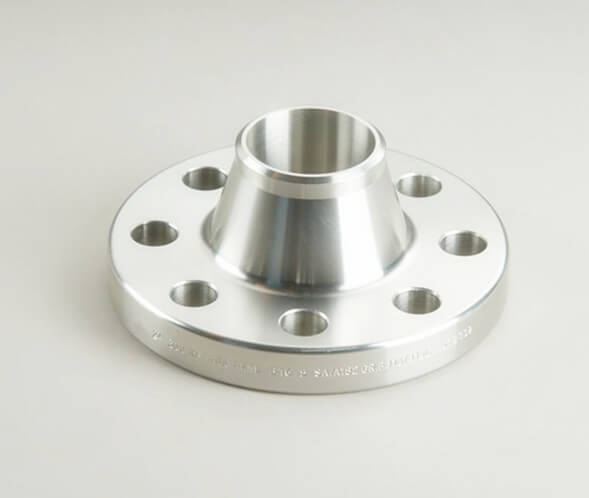
Titanium Gr 2 Weld Neck (WNRF)

Titanium Gr 2 Slip-On (SORF)
Titanium Gr 2 Blind (BFF)
| Flange Type | Description & Titanium-Gr-2-Specific Use |
|---|---|
| Weld Neck (WNRF) | Tapered hub butt-welded to pipe for high-integrity seawater, chemical and wet-chlorine lines; weld with ERTi-2 filler under full inert shielding. |
| Slip-On (SORF) | Fillet-welded over the pipe; the most common titanium connection for marine and chemical secondary piping. |
| Blind (BFF) | Seals pipe ends and vessel nozzles in seawater, chlor-alkali and oxidising-acid service. |
| Socket Weld (SWRF) | Small-bore (1/2″–2″) instrument and chemical-injection connections. |
| Lap Joint (LJRF) | Used with a titanium stub end where frequent dismantling is needed; economises on titanium in the backing ring. |
| Threaded (TRFF) | Internal NPT/BSP threads for non-welded connections in corrosive utility service. |
| Long Weld Neck / Orifice / Plate | Nozzle, flow-metering and plate flanges in Grade 2 for marine and chemical-process duty. |
| Property | Grade 2 (R50400) | Grade 1 (R50250) | Grade 5 / Ti-6Al-4V (R56400) | Grade 7 (R52400) |
|---|---|---|---|---|
| Type | CP Ti (workhorse) | CP Ti (lowest interstitials) | Alpha-beta alloy | CP Ti + Palladium |
| Tensile (min) | 345 MPa | 240 MPa | 895 MPa | 345 MPa |
| Ductility / formability | High | Highest | Lower | High |
| Seawater / chlorides | Excellent | Excellent | Excellent | Excellent |
| Reducing acids (HCl, H₂SO₄) | Limited | Limited | Limited | Good (Pd) |
| Flange spec | ASTM B381 F-2 | ASTM B381 F-1 | ASTM B381 F-5 | ASTM B381 F-7 |
| Best For | General corrosion / marine workhorse | Max ductility, forming, anodes, cladding | High strength, aerospace, fasteners | Reducing acid & chemical service |
Immune to pitting and crevice corrosion in seawater and chloride brines far beyond stainless — ideal for marine, offshore and desalination.
Excellent in wet chlorine, chlorate, hypochlorite and oxidising acids (e.g. nitric) — the standard for chlor-alkali and bleaching.
Density ~4.51 g/cm³ — about half of steel, cutting weight in marine, offshore and aerospace assemblies.
The optimum balance of strength, ductility and weldability — the default titanium grade for piping, flanges and heat exchangers.
| Industry | Typical Application |
|---|---|
| Chemical Processing | Oxidising acids (nitric), organic acids, chloride salt solutions, reactor and column nozzles |
| Chlor-Alkali | Wet chlorine, chlorate and hypochlorite piping; cell connections |
| Desalination & Seawater | Seawater feed, brine and RO piping; heat-exchanger and condenser nozzles |
| Marine & Offshore | Seawater cooling and firewater systems where weight and chloride resistance matter |
| Power Generation | Seawater-cooled surface condensers and feed connections |
| Pulp & Paper | Bleach plant piping (chlorine dioxide / hypochlorite) |
| Oil & Gas | Seawater injection, produced-water and corrosive process connections |
Forged from certified commercially pure titanium with PMI verification — full chemistry and interstitial control on the MTC.
WNRF, SORF, blind, socket-weld, threaded, lap-joint, LWN, orifice and plate — in RF, FF, RTJ and T&G faces.
Welded under full inert-gas shielding with weld-colour inspection to guarantee uncontaminated, ductile joints.
EN 10204 3.1 / 3.2 MTC, heat/lot traceability, hydrostatic and third-party inspection on request.
Titanium Grade 2 flange prices reflect titanium sponge/market rates plus size, pressure class, flange type and quantity — titanium carries a premium over stainless but offers unmatched seawater/chloride life and weight saving. Tesco Steel & Engineering offers competitive ex-works pricing from Mumbai with full export documentation and material traceability. Click Ask for Quote or message us on WhatsApp at +91 92233 66922 with flange type, size (NB), pressure class, quantity and documentation requirements.
Q1. What is a Titanium Grade 2 flange?
A Titanium Grade 2 flange is a pipe flange made from commercially pure (CP) titanium Grade 2 (UNS R50400) — the most widely used of the CP titanium grades and the industry workhorse, offering the best all-round balance of strength, ductility, weldability and corrosion resistance. Forged flanges are supplied to ASTM B381 Grade F-2 and machined to ASME B16.5 / B16.47. Grade 2 is lightweight (about half the density of steel) with outstanding resistance to seawater, chlorides, wet chlorine and oxidising acids.
Q2. What is the difference between Titanium Grade 1 and Grade 2 flanges?
Both are commercially pure titanium with the same excellent corrosion resistance. Grade 1 has lower oxygen/iron, so it is softer, more ductile and more formable but lower in strength (tensile ~240 MPa min). Grade 2 has slightly higher oxygen/iron, giving higher strength (tensile ~345 MPa min) while keeping good ductility and weldability — which is why Grade 2 is the general-purpose workhorse used for most titanium piping and flanges. Grade 1 is chosen only where maximum formability or deep-drawing is needed.
Q3. What standard covers Titanium Grade 2 flanges?
Forged titanium flanges are supplied to ASTM B381 Grade F-2 for Grade 2 (UNS R50400). Related product standards are ASTM B348 (bar/billet) and ASTM B265 (plate/sheet). Flange dimensions follow ASME B16.5 (1/2″–24″ NB) or ASME B16.47 for larger diameters. The European equivalent is DIN 3.7035 / Werkstoff 3.7035.
Q4. What are the mechanical properties of Titanium Grade 2?
Titanium Grade 2 has a minimum tensile strength of 345 MPa (50 ksi), a 0.2% yield strength of 275–450 MPa (40–65 ksi) and minimum elongation of 20%. Its density is about 4.51 g/cm³ — roughly half that of steel — and its modulus of elasticity is about 103 GPa. This strength-to-weight ratio plus corrosion resistance is why Grade 2 is the standard CP titanium grade.
Q5. What is the corrosion resistance of Titanium Grade 2?
Titanium Grade 2 forms a stable, self-healing titanium-oxide passive film that gives outstanding resistance to seawater, brackish water, chlorides, wet chlorine, chlorate and hypochlorite, oxidising acids (such as nitric acid), and most organic acids and chloride salt solutions. It resists pitting and crevice corrosion in seawater far better than stainless steel. It is not suitable for hydrofluoric acid, or hot concentrated hydrochloric/sulphuric acid without inhibitors — for those, Grade 7 (Ti-Pd) or a nickel alloy is used.
Q6. Can Titanium Grade 2 flanges be welded?
Yes — Grade 2 has excellent weldability and is the most commonly welded titanium grade. It is welded by GTAW (TIG) and plasma using matching ERTi-2 commercially pure titanium filler. The weld pool, root and cooling metal must be fully shielded from air with argon/helium (torch shield, trailing shield and back-purge) until below ~260 °C, because oxygen/nitrogen pickup causes embrittlement. A clean weld is bright silver or light straw; blue, grey or white indicates contamination and must be rejected.
Q7. Is titanium lighter than stainless steel?
Yes. Titanium Grade 2 has a density of about 4.51 g/cm³, roughly 56% of carbon or stainless steel (about 7.9–8.0 g/cm³). Combined with its corrosion resistance, this low weight makes titanium flanges attractive for marine, offshore and aerospace applications where both weight saving and chloride resistance matter.
Q8. What is the maximum service temperature of Titanium Grade 2 flanges?
Commercially pure Grade 2 titanium is generally used up to about 300 °C in continuous service; above this its strength falls and oxidation/oxygen pick-up increase. For higher-temperature or higher-strength duty, alpha-beta alloys such as Grade 5 (Ti-6Al-4V) are specified. Titanium also retains good toughness at low temperatures.
Q9. What are the equivalent grades of Titanium Grade 2?
Titanium Grade 2 (CP titanium) equivalents include UNS R50400, ASTM B381 F-2 / B348 Gr 2 / B265 Gr 2, DIN 3.7035 / Werkstoff 3.7035, and JIS Class 2 (Type 2). All denote the standard medium-strength commercially pure titanium.
Q10. What industries use Titanium Grade 2 flanges?
Titanium Grade 2 flanges are used in chemical processing, chlor-alkali (wet chlorine, chlorate, hypochlorite), desalination and seawater piping, marine and offshore systems, power-plant seawater condensers, pulp & paper bleaching, and heat-exchanger and pressure-vessel nozzles — wherever titanium's seawater/chloride corrosion resistance and light weight are required at moderate strength.