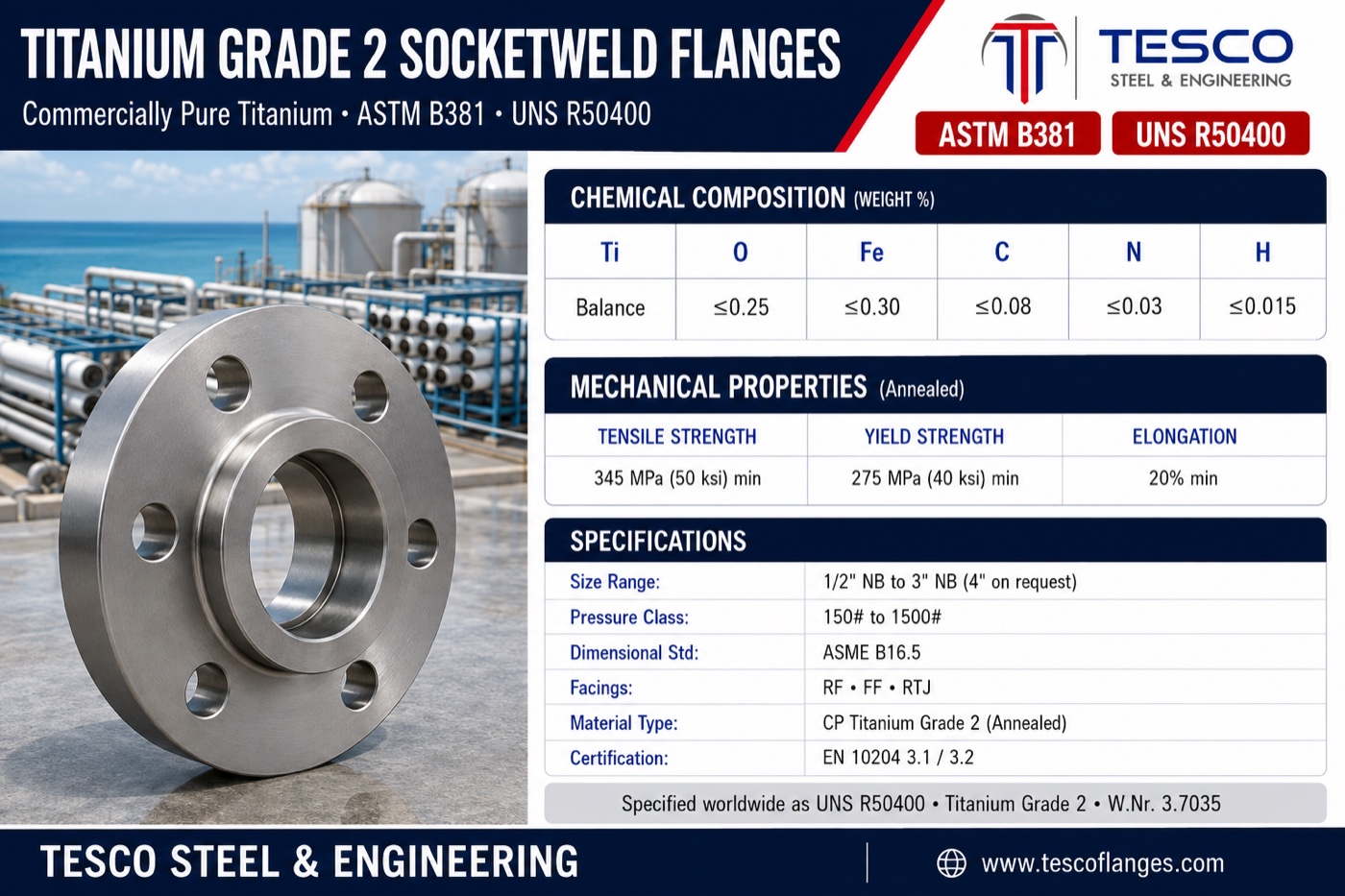
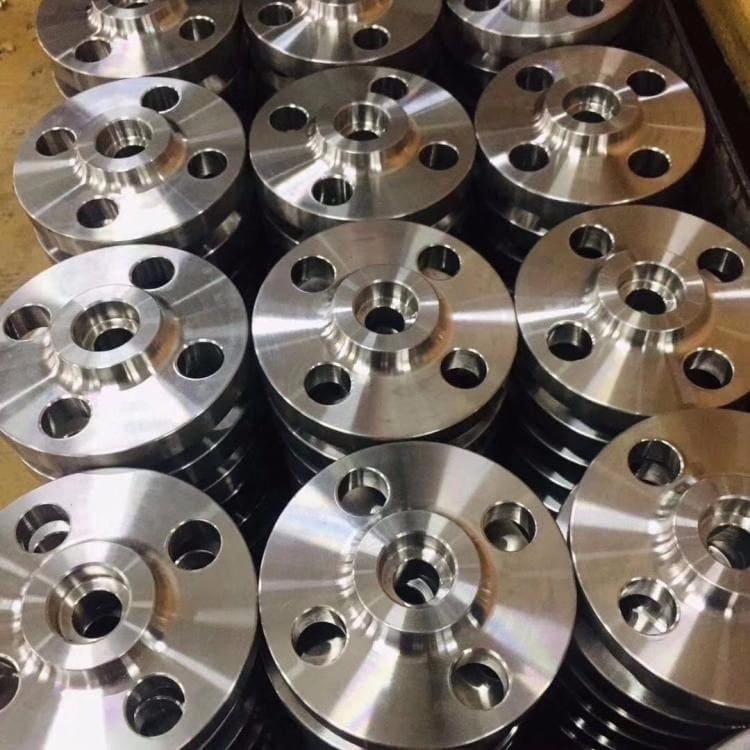
Tesco Steel & Engineering manufactures Titanium Grade 2 socketweld flanges — the immunity strategy: ASTM B381, UNS R50400, W.Nr. 3.7035 — to ASME B16.5 from ½″ to 3″ NB in Classes 150–1500. This page closes the seawater map this site has been drawing: copper-nickel antifouls, Monel is noble, the 6Mo and super duplex grades hold films, 625 adds muscle — and titanium simply does not lose: a TiO2 film that repairs itself instantly in oxygenated chloride water, effectively immune to seawater pitting, crevice-resistant above every conventional CRA, indifferent to biofouling and flow — at half the weight of steel. Grade 2 is the workhorse setting of the oxygen dial (O ≤0.25%): stainless-familiar strength, full weldability, the CP family's shared immunity. The honesty is chemical, not marine: hot reducing acids stay with C-276, dry chlorine is a hazard (wet chlorine is home turf), and the galvanic caution runs in reverse — protect the other metal. Welded under full inert-gas discipline with ERTi-2. Facings: SWRF, SWFF, SWRTJ. Every lot with EN 10204 3.1/3.2 MTC. ISO 9001:2015, made in Mumbai, India — exported to 50+ countries.
Titanium Gr 2 · B381 · R50400 · 3.7035The TiO2 Film — Immunity, Not DefenceSeawater Pitting: Effectively ImmuneHalf the Weight of Steel — 4.51 g/cm³345 / 275 MPa · 20% ElongationDesalination · Condensers · Wet ChlorineASME B16.5 ½″–3″ · Class 150–1500EN 10204 3.1 / 3.2 · ISO 9001:2015
Titanium Grade 2 Socketweld Flanges — Specifications at a Glance
What is a Titanium Grade 2 Socketweld Flange?
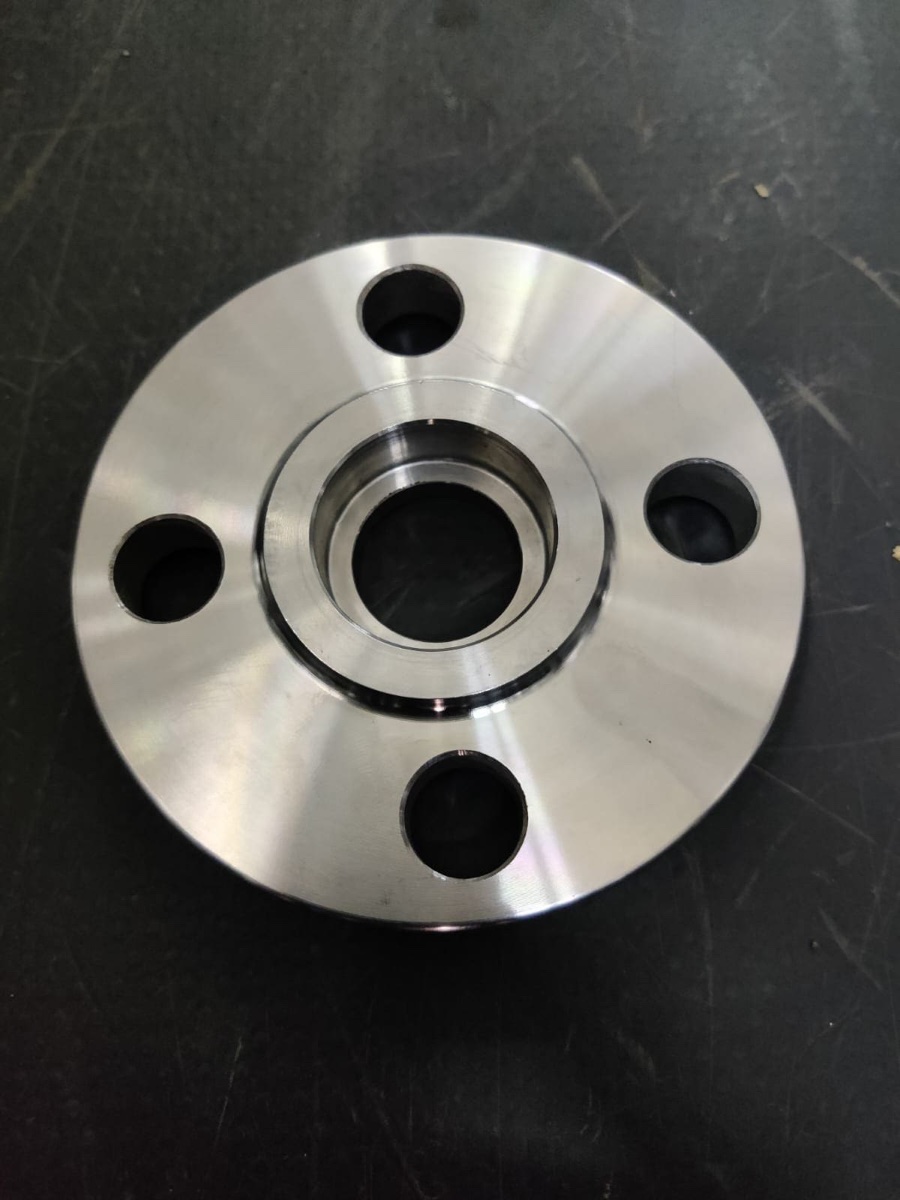
The immunity strategy in the small-bore pattern. A forged CP Titanium Grade 2 flange (ASTM B381 / UNS R50400 / W.Nr. 3.7035) with a machined socket: pipe seated square by geometry, one external fillet weld under full inert-gas discipline, through-bore matched to the pipe schedule. The TiO2 film repairs itself instantly in oxygenated chloride water: effectively immune to seawater pitting, crevice margin above every conventional CRA, indifferent to biofouling and velocity — at 4.51 g/cm³, roughly half the weight of steel. Tensile ≥345 MPa, yield ≥275 MPa, elongation ≥20%, annealed. Sized by ASME B16.5 at ½″–3″ NB, Classes 150–1500; EN 10204 3.1 on every lot.
The final answer — the film that never loses, at half the weight
This page
The rule of the finished map: the cheapest adequate defence wins the order — and when velocity, aeration, fouling and decades-long life all stack, immunity is the honest buy.
What the Film and the Density Buy
The Film That Never Loses
TiO2 forms in any trace of oxygen or moisture and repairs itself essentially instantly — no measurable seawater pitting at ambient temperature, crevice margins above every conventional CRA, no fouling or velocity penalty.
Half the Weight of Steel
4.51 g/cm³ against steel's 7.85 — strength-to-weight beyond anything on this site, and a real line-item on offshore topside and skid weight budgets.
The Oxygen Dial
Grade 2's O ≤0.25% is the workhorse setting — stainless-familiar strength with full weldability; Grade 1 softer, Grades 3 and 4 stronger, corrosion behaviour shared across the CP family.
Honesty About the Chemistry
The weaknesses are chemical, not marine: hot reducing acids stay with C-276, dry chlorine is a hazard (wet chlorine is home turf), and hydrogen wants managing. The sea itself, titanium simply wins.
Titanium Grade 2 Chemical Composition (UNS R50400)
Element
Ti
O
Fe
C
N
H
Weight %
Balance
≤0.25
≤0.30
≤0.08
≤0.03
≤0.015
Six entries — that is the whole table. Commercially pure titanium is specified by what is kept out: the oxygen cap is the grade (Grade 1 caps it at 0.18%), and the tiny hydrogen cap keeps its third decimal because hydride embrittlement is managed at the ppm level. No nickel, no chromium, no molybdenum — the metal itself is the strategy. PMI confirms every piece.
Mechanical Properties (Annealed)
Property
ASTM B381 Grade F-2 Requirement
Tensile Strength
≥ 345 MPa (50 ksi)
Yield Strength (0.2%)
≥ 275 MPa (40 ksi)
Elongation
≥ 20% — tough from cryogenic temperatures up, no ductile-brittle transition
Density
4.51 g/cm³ — roughly 57% the weight of steel: the certificate's quiet second column
Condition
Annealed — furnace records certified; no hardening treatments exist or are needed
Rating
B16.5 titanium tables govern the joint to ~315 °C — gasket-limited before metal-limited; stated per class on our quotations
One Socket, Three Facings — and the Isolation Note
The isolation note: titanium is the noblest metal in almost any joint it enters — where it bolts to steel, CuNi or stainless in seawater, the other metal pays. Isolation gasket kits with sleeved bolting are standard practice at mixed-metal joints; state the mating metallurgy and the kit guidance rides with the quotation.
Titanium Grade 2 Socketweld Flange Specifications
Titanium Grade 2 Socketweld Flanges are available in the following specifications:
Material Grade
Titanium Grade 2, ASTM B381 (UNS R50400), W.Nr. 3.7035 — certificates carry the designations your documentation uses
Heat Treatment
Annealed with furnace records certified
Size
1/2"NB to 3"NB per ASME B16.5; 4″ and larger to order; EN 1092-1 patterns to order
Class
150#, 300#, 600#, 900#, 1500# (900# shares 1500# dimensions in most sizes) — seawater duty lives in 150/300
Facings
Raised Face (SWRF), Flat Face (SWFF), Ring Type Joint (SWRTJ) with groove per B16.20
Bore
Socket bore to pipe OD; through-bore matched to pipe schedule
Welding
Single external fillet with 1/16″ expansion gap; GTAW with ERTi-2 under full inert-gas discipline — trailing shields and back-purge; weld-colour inspection; no preheat, no PWHT
Service Span
Seawater, brines, desalination, wet chlorine and hypochlorite, oxidising chlorides, nitric duty; hot reducing acids to C-276 and Grade 7, hot brines past ~75–80 °C crevice review, dry chlorine excluded — see the notes
Tension & chemistry per heat; PMI on every piece; socket depth and bore gauged
Certification
EN 10204 3.1 with anneal records (standard) / 3.2 witnessed
Specification Notes — Getting Titanium Sockets Right
Four honest notes.The weaknesses are chemical, not marine: hot reducing acids — hydrochloric, sulphuric — attack the film; that bench belongs to C-276, with Grade 7's palladium covering the mild end. Dry chlorine is a hazard, not a duty: titanium burns in dry chlorine gas — wet chlorine is home turf precisely because moisture feeds the film; chlorine service must guarantee its water content. Hydrogen wants managing: over-aggressive cathodic protection and galvanic charging accumulate hydrides over years — a design review, not a service ban. And hot concentrated brines meet the crevice limit near 75–80 °C in severe geometries — state the real brine temperature; Grade 7 exists for what lies beyond.
How Our Titanium Grade 2 Socketweld Flanges Are Manufactured
1
Forging — cut billet of the spectro-verified R50400 heat is hot-forged into the flange blank with full heat traceability and dedicated titanium handling.
2
Annealing — sets the uniform alpha structure; furnace charts retained against the heat number.
3
Machining — faces, OD and drilling to ASME B16.5 on dedicated stations with sharp-tool, low-heat discipline and iron-free handling — no carbon-steel contact, no embedded iron; socket counterbore and depth gauged piece by piece, through-bore matched to the ordered schedule.
4
Facing — RF serrations, flat face or RTJ groove per B16.20; galling-aware finishing on all mating surfaces.
5
Testing & marking — tension and chemistry per heat; PMI on every piece; laser-marked with grade, size, class, schedule and heat number.
6
Certification & packing — EN 10204 3.1 MTC with anneal records (3.2 witnessed on request); inert-gas WPS guidance included; packed sea-worthy with no carbon-steel contact.
Where Titanium Grade 2 Socketweld Flanges Are Used
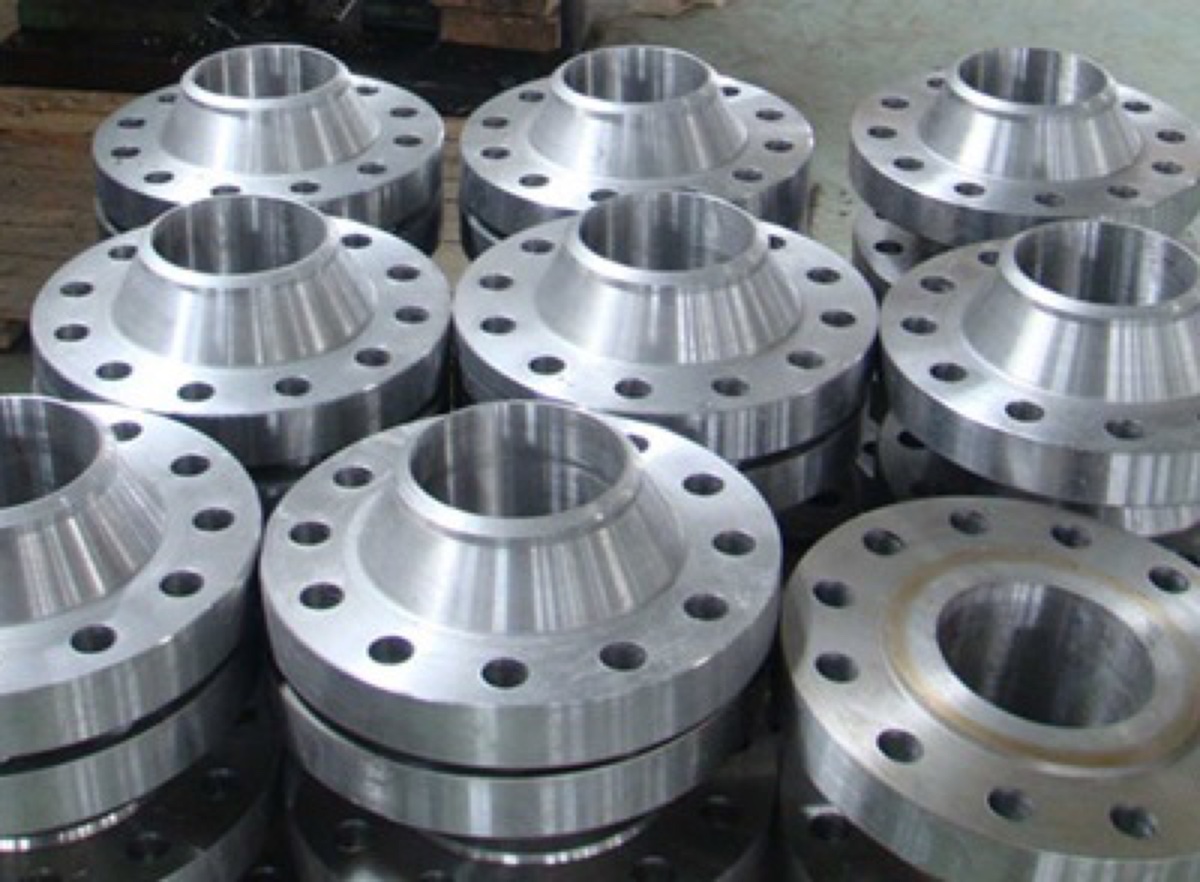
Wherever seawater runs hard and long: desalination plants — MSF, MED and RO trains — coastal and offshore power-plant condenser circuits, offshore seawater and firewater small bore, chlor-alkali wet-chlorine and hypochlorite systems, marine heat-exchanger connections, PTA and nitric-bearing chemical duty, and the mixed-metal joints where its isolation kits and light weight earn their keep. Production below:
Socket weld flange dimensions are class-governed per ASME B16.5 — identical across material grades (pressure-temperature ratings follow the titanium tables). Full charts:
How to Specify & Order a Titanium Grade 2 Socketweld Flange
Six elements — the service and the mating metal matter here:
1
Size & standard — e.g. 1″ NB ASME B16.5, or DN25 EN 1092-1 to order.
2
Pressure class & facing — 150#–1500#; SWRF (the default), SWFF or SWRTJ — with the design temperature: titanium's B16.5 ratings step down with heat faster than the nickel groups.
3
Pipe schedule — the through-bore is matched to the pipe ID.
4
Grade line & service — Titanium Grade 2 / B381 / R50400 / 3.7035; the service stated (seawater, brine temperature, chlorine wet or dry, acids) and the mating metallurgy for isolation-kit guidance — they decide between Grade 2, Grade 5, Grade 7 and the nickel bench.
5
Certification — EN 10204 3.1 with anneal records (our standard) / 3.2 witnessed, PMI as applicable.
A Titanium Grade 2 socketweld flange is a forged commercially pure titanium flange — titanium as the balance with five impurity caps, the defining one being oxygen at ≤0.25%, ASTM B381, UNS R50400, W.Nr. 3.7035 — whose back carries a machined socket: the pipe end seats inside, self-aligned square to the face, and is secured with a single external fillet weld. Grade 2 is titanium's workhorse, and titanium is the seawater map's final answer: a TiO2 film that repairs itself instantly in oxygenated chloride water makes the metal effectively immune to seawater pitting, indifferent to biofouling, and lighter than half the steel it replaces. Dimensioned to ASME B16.5 for ½" to 3" NB in Classes 150 to 1500 — the desalination and coastal-power grade, in the small-bore pattern.
Why is titanium effectively immune in seawater?
Because its film never loses. Every seawater metal on this site defends differently — copper-nickel grows an antifouling film, Monel relies on nobility, the 6Mo and super duplex grades hold high-PREN passive films, 625 adds muscle to the film — and each defence has a failure mode chloride water eventually probes. Titanium's TiO2 film is different in kind: it forms in any trace of oxygen or moisture, repairs itself essentially instantly when scratched, and is thermodynamically at home in oxidising chloride water. The practical result: no measurable seawater pitting at ambient temperatures, crevice resistance above every conventional CRA, indifference to flow rates that strip copper-nickel, and no biofouling penalty — barnacles grow on it and the film does not care. That is why desalination evaporators, coastal condenser circuits and offshore seawater systems made titanium their reference metal — the immunity strategy, completing the map.
What makes Grade 2 the workhorse — and what is the oxygen dial?
Commercially pure titanium is graded by one dial: oxygen. Interstitial oxygen strengthens titanium powerfully — each increment of the cap buys strength and costs a little ductility — so the CP family is a strength ladder built from the same metal: Grade 1 (O ≤0.18%) the softest and most formable, Grade 2 (≤0.25%) the balance point, Grade 3 (≤0.35%) and Grade 4 stronger again. Grade 2 wins the piping world because its 345/275 MPa certificate matches austenitic stainless closely enough to feel familiar, while keeping full weldability and toughness — corrosion behaviour across the CP grades is essentially identical, so nothing is lost. The alloyed grades answer different questions: Grade 5 (Ti-6Al-4V) is the aerospace strength alloy, Grade 7's palladium dose extends titanium into reducing acids. For flanged seawater and chemical service, Grade 2 is the honest default.
What is the chemical composition of Titanium Grade 2 (UNS R50400)?
Titanium the balance, with five caps: oxygen ≤0.25% — the grade-defining interstitial — iron ≤0.30%, carbon ≤0.08%, nitrogen ≤0.03% and hydrogen ≤0.015%, with the usual residual limits beneath. That is the entire table: commercially pure titanium contains no deliberate nickel, chromium, molybdenum or copper, and its specification is an exercise in keeping things out rather than putting things in. The tiny hydrogen cap deserves its third decimal: hydrogen embrittles titanium by hydride formation, so mill practice, pickling and cathodic exposure are all managed against it. Chemistry is verified per heat, confirmed by PMI on every piece — titanium announces itself unmistakably on the analyser — and travels on the EN 10204 3.1 MTC.
What are the mechanical properties of Titanium Grade 2 socketweld flanges?
In the annealed condition ASTM B381 requires tensile strength 345 MPa (50 ksi) minimum and yield strength 275 MPa (40 ksi) minimum with elongation 20% minimum — numbers that read modest until the density joins the calculation: at 4.51 g/cm³, titanium is roughly 57% the weight of steel, so strength-to-weight beats every stainless and nickel alloy on this site, and a titanium flange kit noticeably lightens offshore topside and skid weight budgets. The metal is tough from cryogenic temperatures up with no ductile-brittle transition, and takes no hardening heat treatments — the anneal is the condition. B16.5's titanium pressure-temperature tables govern the flange rating, and the joint keeps the series' two-ceilings honesty: gasket and rating retire the bolted connection long before the metal.
Where does titanium's crevice limit actually sit?
Higher than every conventional CRA, but not at infinity — and honest numbers matter at this altitude. In ambient and warm seawater, Grade 2 crevice corrosion is a non-issue in practice: gasketed joints, deposits and stagnant zones that quietly kill stainless and test the nickel bench leave titanium alone. The limit appears in hot concentrated chloride brines: above roughly 75-80°C in severe crevice geometries, Grade 2 can begin to suffer crevice attack, which is precisely why the palladium-bearing Grade 7 and ruthenium-bearing grades exist — they extend the same metal deep into hot brine and mildly reducing territory. For desalination brine loops running hot, say the actual temperature on the enquiry; for everything at seawater temperatures, Grade 2's crevice margin is the widest on this site.
What is the galvanic caution with titanium flanges?
Titanium sits at the noble end of the seawater galvanic series — in practice the noblest structural metal in the joint, wherever it bolts. That reverses the usual worry: the titanium is never the victim; the other metal is. Couple a titanium flange directly to carbon steel, copper-nickel or even stainless in seawater and the partner corrodes faster for titanium's benefit, with the damage concentrated where areas are unfavourable. Good practice is standard and simple: isolation gasket kits with sleeved bolting where titanium meets less noble metals, matched titanium-to-titanium joints where possible, and attention to bolting metallurgy — the studs should not become the anode. One subtlety worth naming: aggressive cathodic protection can charge titanium with hydrogen over years, so CP settings near titanium hardware deserve review. State the mating metallurgy on the enquiry and the isolation guidance rides with the quotation.
What are titanium's honest weaknesses?
Four, and they are chemical rather than marine. Reducing acids: hot hydrochloric and sulphuric attack titanium's film — that bench belongs to Hastelloy C-276 and the nickel ladder, with titanium Grade 7 covering the mild end. Dry chlorine: a genuine hazard, not a mere weakness — titanium burns in dry chlorine gas; it is superb in wet chlorine precisely because moisture maintains the film, so chlorine service must guarantee its water content. Hydrogen: hydride embrittlement accumulates from over-aggressive cathodic protection, galvanic hydrogen charging or hot hydrogen atmospheres — managed by design, not luck. And anhydrous specials: dry methanol and certain anhydrous media stress-crack it — again, moisture is the ally. Plus a workshop note: titanium galls readily, so threaded work wants proper lubrication. None of these touch the seawater franchise it rules.
Titanium or the CRA bench — 625, C-276, copper-nickel — for seawater?
Per kilogram, titanium looks expensive; per decade of seawater service, it is often the cheapest metal on this site — and the honest comparison needs both numbers. Against copper-nickel: CuNi is cheaper and self-cleaning against fouling, but flow-limited and soft — titanium takes any velocity, any aeration, and half the weight. Against the 6Mo and super duplex film-formers: they serve chlorinated seawater well at lower cost, with crevice margins that need watching as temperature climbs — titanium removes the watching. Against 625 and C-276: in pure seawater duty they are over-bought — their premium pays for acid chemistry and strength that seawater never asks for. The practical map: velocity, aeration, biofouling and long-life seawater — titanium; seawater plus acids or sour gas — the nickel bench; tight budgets at moderate duty — CuNi and the duplexes. Each page of this series says the same from its own corner.
How is a Titanium Grade 2 socketweld flange welded?
Beautifully — under total inert-gas discipline, which is the entire skill. Titanium above roughly 400°C absorbs oxygen and nitrogen greedily, and a contaminated weld is brittle regardless of how it looks, so practice is GTAW with matching ERTi-2 filler under argon everywhere the metal is hot: torch shielding, trailing shields on the cooling bead, and full back-purge of the bore — flux processes are excluded outright. Inspection is built into the metal: the weld's oxide colour tells the story — silver and light straw pass, dark blues and greys mean contamination and the bead comes out. Geometry is the standard socket pattern: pipe bottomed, withdrawn 1/16" (1.6 mm) for the expansion gap, single external fillet. No preheat, no PWHT, and scrupulous cleanliness — dedicated tools, no iron contamination, degreased joints. WPS guidance travels with every supply.
How hot can Titanium Grade 2 actually go?
Its ceilings are lower than the nickel bench's, and honestly so. Structurally, CP titanium's strength falls steadily with temperature and ASME's titanium tables govern pressure duty to roughly 315°C — generous for its actual applications, which are overwhelmingly ambient-to-warm seawater and chemical service. Chemically, the picture is medium-dependent: oxidising and wet-chloride service is comfortable across its pressure range, but hot concentrated brines meet the crevice limit near 75-80°C in severe geometries, and gas-side oxidation and hydrogen pickup become design matters above a few hundred degrees. Titanium is not a fire alloy and never claims to be — the heat ladder belongs to the Inconels and the 800 family. The two-ceilings honesty applies as everywhere: B16.5's titanium tables and the gasket govern the joint, stated per class on our quotations.
What about Grade 5 and Grade 7 — the siblings?
Two different upgrades from the workhorse. Grade 5 — Ti-6Al-4V, UNS R56400 — is the strength sibling: aluminium and vanadium lift the certificate to roughly 895/828 MPa, the aerospace alloy, specified for flanges where titanium's corrosion service meets serious mechanical load; it trades some weldability care and cost for triple the strength, and its own socketweld page sits alongside this one. Grade 7 — R52400 — is the chemistry sibling: a small palladium addition (~0.12-0.25%) catalyses the film's repair in reducing conditions, extending titanium into hot brines and dilute reducing acids that limit Grade 2 — the most corrosion-resistant CP titanium, priced accordingly. The rule: seawater and general chemical duty — Grade 2; strength-driven hardware — Grade 5; hot brine and the reducing margin — Grade 7. Our titanium material pages carry all three.
What sizes and pressure classes do Titanium Grade 2 socketweld flanges come in?
ASME B16.5 standardises socket weld flanges from ½" to 3" NB in Classes 150, 300, 600, 900 and 1500 — Class 900 sharing Class 1500 dimensions in most small-bore sizes — with 4" and Class 2500 made to order. Titanium's order book lives overwhelmingly in Classes 150 and 300: seawater, desalination and chemical small bore runs at modest pressures where the metallurgy, not the rating, is the specification — and B16.5's titanium tables set conservative ratings that step down with temperature faster than the nickel groups. All three facings are available: SWRF the default, SWFF for lined and FRP mates, SWRTJ where specified. Put the pipe schedule on the enquiry — the through-bore is matched to the pipe ID — and the design temperature; our quotations state the governing rating per class.
What details are needed to get an accurate Titanium Grade 2 socketweld flange quotation?
Six elements plus commercial terms: (1) size — ½" to 3" NB; (2) pressure class — 150 to 1500, with the design temperature, which governs titanium's rating strongly; (3) facing — SWRF, SWFF or SWRTJ with ring number; (4) the pipe schedule, so the through-bore matches the pipe ID; (5) the grade line — Titanium Grade 2, ASTM B381, UNS R50400 or W.Nr. 3.7035 all name the same metal — with the service stated (seawater, brine temperature, chlorine wet or dry, acids, mating metallurgy for isolation kits): it decides between Grade 2, Grade 5, Grade 7 and the nickel bench more often than price does; (6) certification — EN 10204 3.1 with anneal records (our standard) or 3.2 witnessed, PMI as applicable. Add quantity and destination; quotations normally within 24 hours.
Who manufactures Titanium Grade 2 socketweld flanges in India?
Tesco Steel & Engineering is an ISO 9001:2015 certified flange manufacturer based in Mumbai, India, producing Titanium Grade 2 (ASTM B381, UNS R50400) socket weld flanges from ½" to 3" NB (larger to order) in Classes 150-1500 — each forged from certified heats, annealed with furnace records against the heat number, machined on dedicated titanium stations with iron-free handling and sharp-tool discipline, gauged socket depth and schedule-matched bore, PMI-checked, and laser-marked with grade, size, class, schedule and heat number. Supplied with EN 10204 3.1/3.2 certification and inert-gas WPS guidance, alongside the Grade 5 and Grade 7 siblings, the full titanium flange range, and the seawater bench this series maps — copper-nickel, Monel, the 6Mo and duplex grades and 625. Exported to more than 50 countries.