Titanium UNS R50400 Weld Neck Flanges — CP Titanium Grade 2 (3.7035)
Tesco Steel & Engineering forges Titanium Grade 2 weld neck flanges — UNS R50400, Werkstoff Nr. 3.7035, the workhorse commercially pure titanium — to ASTM B381 F-2, from 1/2″ NB to 56″ NB in ASME B16.5 Class 150–2500 and European PN patterns. Titanium's self-healing oxide film makes Grade 2 near-immune to seawater, brines, wet chlorine and oxidizing chlorides — the pitting, crevice attack and chloride SCC that limit stainless simply stop being design issues — at a density of 4.51 g/cm³, roughly half the weight of steel. Built for desalination, seawater cooling, chlor-alkali and PTA plants. Mating B861/B862 pipe, welded by GTAW with ERTi-2 under full inert-gas discipline. Supplied with PMI/XRF and EN 10204 3.1/3.2 on request. ISO 9001:2015, made in Mumbai, India — exported worldwide.
Titanium Gr. 2 · UNS R50400 · 3.7035
CP Titanium · Ti 99.2% min
ASTM B381 F-2 / ASME SB-381
Half the Weight of Steel
Seawater · Desalination · Chlor-Alkali
1/2″ – 56″ NB · Class 150–2500
ISO 9001:2015 · Exported Worldwide
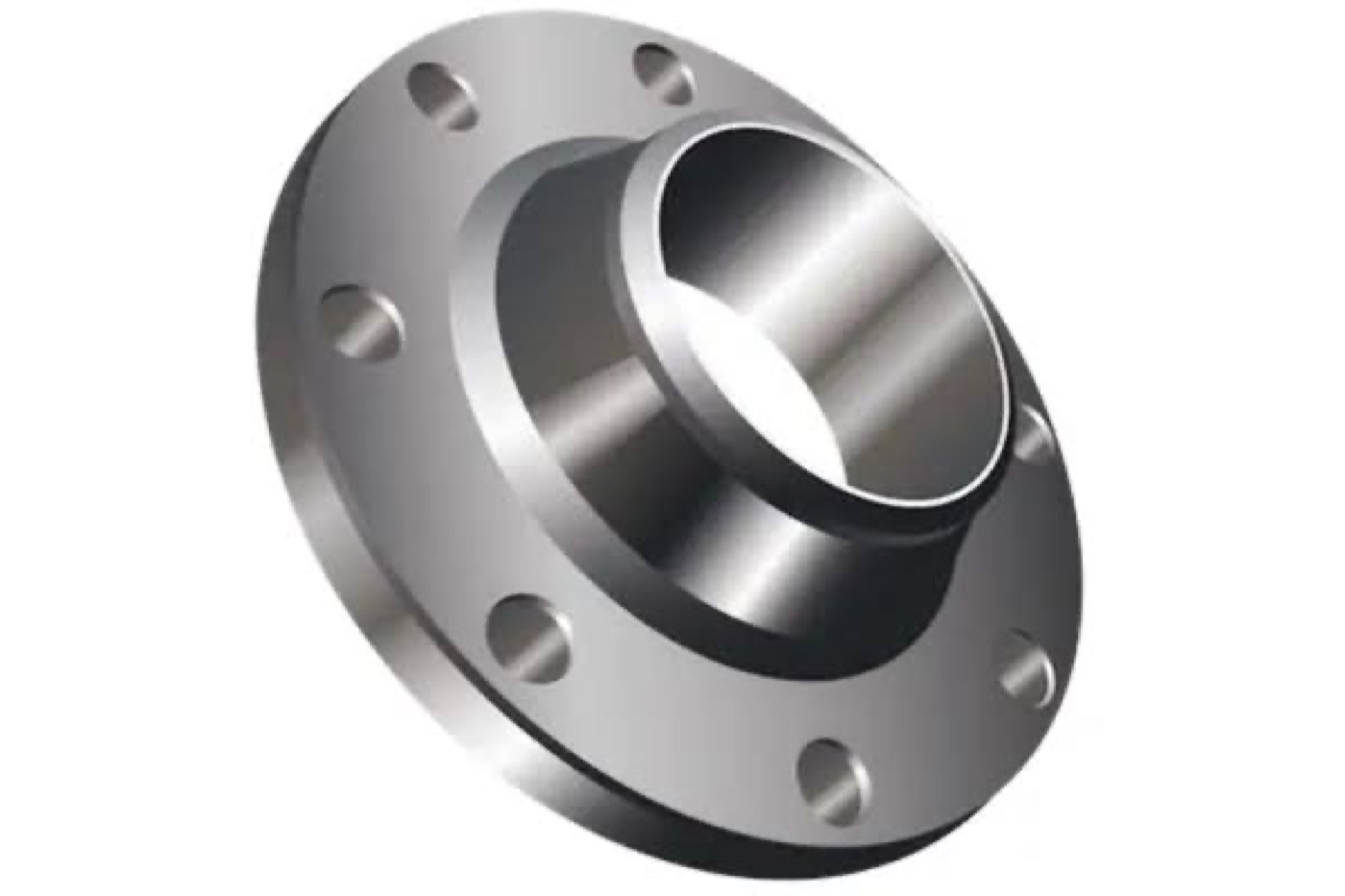
Titanium Grade 2 Weld Neck Flange — UNS R50400 (3.7035), Raised Face
What is a Titanium UNS R50400 Weld Neck Flange?
Titanium Grade 2 (UNS R50400 / 3.7035) is commercially pure titanium — 99.2% Ti minimum, its strength set by a controlled oxygen window rather than alloying. The metal's instantly self-healing TiO₂ film makes it effectively inert in seawater, brines, wet chlorine and oxidizing chlorides, and at 4.51 g/cm³ it weighs about half as much as steel. A Titanium UNS R50400 weld neck flange pairs that metallurgy with a long tapered hub butt-welded to the pipe, forged to ASTM B381 F-2.
The CP ladder: Grade 1 is softer and most formable; Grade 2 is the industrial default; Grade 4 trades ductility for strength; Grade 7 adds palladium for reducing acids; and the aerospace alloy Grade 5 (Ti-6Al-4V) steps in when strength-to-weight rules.
Against the nickel CRAs on this site — 825, 625, C-276 — titanium plays a different game: in oxidizing chloride service it is simply immune rather than resistant, and the weight saving compounds the lifecycle case. Its trade-off is the reducing-acid weak point, covered honestly below.
Also searched as: CP titanium flange, Ti Gr. 2 flange, UNS R50400 flange, 3.7035 flange, ASTM B381 F-2 flange, titanium WNRF flange — all refer to the product on this page.
Chemical Composition of Titanium Grade 2
| Ti | C | Fe | H | N | O |
|---|
| 99.2 min | 0.08 max | 0.3 max | 0.015 max | 0.03 max | 0.25 max |
Values in weight %. No deliberate alloying — the oxygen window (0.25% max) sets the strength and separates Grade 2 from softer Grade 1 and stronger Grades 3/4, while the hydrogen cap (0.015%) guards against embrittlement.
Mechanical Properties of Titanium Grade 2
| Tensile Strength, MPa | Yield Strength, Min, MPa | Elongation % min. |
|---|
| 344 [49900] | 275 [39900] | 20 |
Carbon-steel-like figures — delivered at 56% of steel's density, so a Grade 2 flange gives comparable pressure capability at nearly half the mass, with toughness retained to cryogenic temperatures.
Designations of Titanium Grade 2
| UNS | Werkstoff Nr. | Standard |
|---|
| R50400 | 3.7035 | Titanium Gr. 2 |
System partners: ASTM B861 seamless / B862 welded pipe, B363 butt-weld fittings, B265 plate, B348 bar and B381 F-2 forgings. Family: CP Grades 1–4, Pd-bearing Grade 7, and alloyed Grade 5 / Ti-6Al-4V (R56400).
Titanium UNS R50400 Weld Neck Flange Specifications
| Titanium UNS R50400 Weld Neck Flanges are available in the following specifications: |
|---|
| Size | 1/2"NB to 56"NB |
| Class | 150#, 300#, 400#, 600#, 900#, 1500#, 2500# |
| Sch (Schedule) | XS, XXS, STD & Schedule 20, 40, 80, 160 |
| Pressure Ratings | PN 2.5 - PN 400 |
| Standards | ASTM B381 F-2 / ASME SB-381; ASME B16.5, ASME B16.47, EN 1092-1, DIN 2631–2635, BS 4504 |
| Condition | Annealed; bright machined faces, protected for shipment |
| Other Services | PMI / XRF alloy verification on Titanium UNS R50400 Weld Neck Flanges
Dye-penetrant examination & hydrostatic testing
Degreased, chloride-free cleaning & packing
Project-specific marking, wrapping & export packing |
Why Grade 2 Is the Workhorse Titanium
Immune, Not Just Resistant
In seawater, brines and wet chlorine the self-healing TiO₂ film gives effectively zero corrosion — no pitting, no crevice attack, no chloride SCC, for decades.
Half the Weight of Steel
4.51 g/cm³ means lighter spools, easier handling and lower structural load — a real saving on large-bore seawater headers.
Strength With Formability
The Grade 2 oxygen window buys carbon-steel-class strength while keeping the ductility and weldability that make CP titanium practical to fabricate.
Lifecycle Economics
Higher metal price, near-zero corrosion allowance, no retube cycle — desalination and coastal power plants buy titanium because it is cheaper over the plant's life.
Full Titanium Range In-House
Grades 1, 2, 4, 5 and 7 flanges from one source — the service picks the grade, the certificates arrive matched.
Welding Titanium Grade 2 — Inert-Gas Discipline
Grade 2 welds by GTAW with ERTi-2 filler under total inert-gas coverage — torch shielding plus trailing shields and full back purging — because titanium above ~400 °C absorbs oxygen and nitrogen and embrittles. Cleanliness is absolute: no steel contact, no chlorinated solvents, dedicated tools. Weld colour tells the story: bright silver passes, straw is marginal, blue or grey means contamination. Within that discipline titanium welds routinely — it is a procedure question, not an alloy risk.
Grade-selection note: reducing acids are titanium's weak point — uninhibited hot HCl or H₂SO₂ move the duty to
Grade 7 or the nickel alloys (
C-276), and hydrofluoric acid is excluded outright. Where strength-to-weight governs,
Grade 5 (Ti-6Al-4V) steps up. State the medium, concentration and temperature in the enquiry and the grade follows.
Where Titanium Grade 2 Weld Neck Flanges Are Used
Seawater leads — desalination evaporators, intakes, cooling and firewater systems, coastal and offshore exchangers — then chlor-alkali cells and wet-chlorine headers, PTA plants, pulp-mill bleach washers, nitric acid service, plating lines and pharma equipment where metal-ion pickup must be nil. Weld neck flange production:
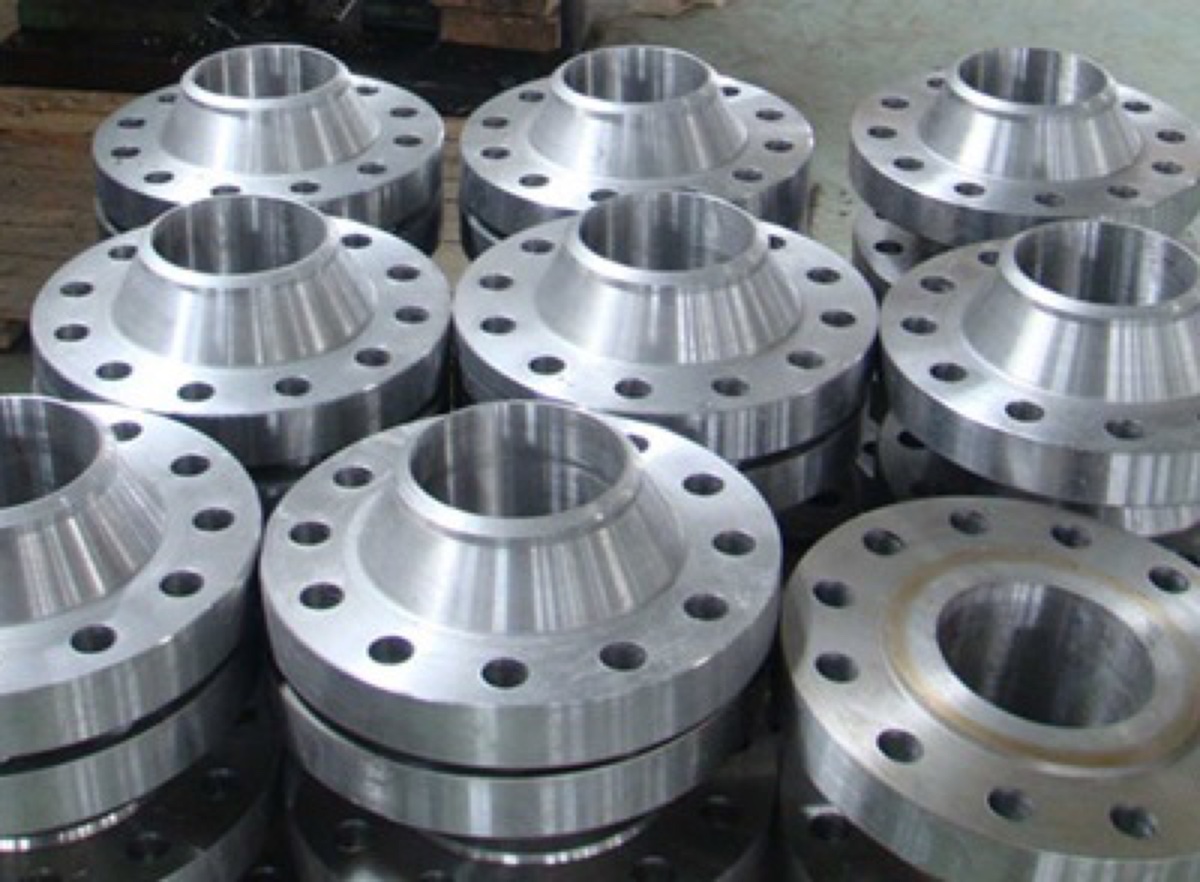
Weld Neck Flanges — Machined & Stacked in Production
Titanium UNS R50400 Weld Neck Flange Dimensions
Titanium Grade 2 weld neck flanges share their dimensions with every other material in the same class — OD, thickness, hub, bore, bolt circle and bolting per the standard tables (at roughly half the weight). Full ASME B16.5 charts:
European PN dimensions are published on the EN 1092-1 Type 11, DIN 2631–2635 and BS 4504 pages.
Price List & How to Order
Titanium pricing tracks sponge and mill markets plus the testing scope, so we quote live with a stated validity rather than publish a static list. To get a firm quotation, usually within 24 hours:
1
List your requirement — size (NB), class or PN, standard (ASME B16.5 / B16.47 / EN / DIN / BS), grade (Gr. 2 — or 1/4/5/7), pipe schedule or bore, and quantity.
2
State the service & testing scope — medium, concentration and temperature, plus 3.2 witness, PMI or project specifications.
Titanium UNS R50400 Weld Neck Flanges — Frequently Asked Questions
What is a Titanium UNS R50400 weld neck flange?
It is a weld neck flange forged from commercially pure Titanium Grade 2 — UNS R50400 / 3.7035, the workhorse CP titanium grade — to ASTM B381 F-2. The long tapered hub is butt-welded to the pipe with the bore matched to the schedule, giving a radiographable joint in a metal that is near-immune to seawater, brines and wet chlorine at roughly half the weight of a steel flange.
Why is titanium so corrosion resistant?
The metal itself is highly reactive — and that is the secret. The instant titanium meets air or water it grows a thin, tenacious titanium-dioxide film, and if the surface is scratched the film re-forms in milliseconds. In oxidizing and neutral chloride environments — seawater, brines, wet chlorine, hypochlorite, nitric acid — that self-healing film is essentially inert, which is why Grade 2 heat exchangers run for decades in seawater with no measurable attack, immune to the pitting, crevice attack and chloride SCC that plague stainless steel.
What is the difference between Titanium Grade 2 and Grade 1?
Both are commercially pure titanium; the difference is oxygen content and therefore strength. Grade 1 is the softest and most formable, with the lowest oxygen; Grade 2 carries slightly more oxygen for a useful strength step — 345 MPa tensile minimum against Grade 1's 240 — while keeping virtually identical corrosion behaviour. That balance makes Grade 2 the default industrial CP grade: strong enough for pressure hardware, ductile enough to fabricate, and the most stocked titanium worldwide.
What is the difference between Titanium Grade 2 and Grade 5 (Ti-6Al-4V)?
Grade 5 is an alloy — 6% aluminium, 4% vanadium — with roughly two and a half times Grade 2's strength, developed for aerospace. It is the choice when strength-to-weight rules: rotating equipment, subsea hardware, high-pressure components. Grade 2 answers with better weldability, formability, lower cost and slightly better corrosion resistance in most chemical media. For static corrosion-driven piping and flanges, Grade 2 is the standard; step to Grade 5 when the stress analysis demands it.
What is the difference between Titanium Grade 2 and Grade 7?
Grade 7 is Grade 2 plus a whisper of palladium (0.12-0.25%), and that trace transforms its behaviour in reducing acids — dilute hydrochloric and sulfuric where Grade 2 corrodes actively, Grade 7 stays passive to meaningfully higher concentrations and temperatures. It costs substantially more, so it is specified only where reducing-acid excursions are real. For seawater, chlorides and oxidizing duty, Grade 2 performs identically at a fraction of the price.
What are the equivalent designations for Titanium Grade 2?
UNS R50400; Werkstoff Nr. 3.7035; ASTM Grade 2 across the product standards — B381 F-2 forgings, B861/B862 pipe, B363 fittings, B265 plate and B348 bar; and the common names CP titanium, commercially pure titanium or Ti Gr. 2. An enquiry in any of these designations is quoted as the same material.
What is the chemical composition of Titanium Grade 2?
Commercially pure: titanium 99.2% minimum, with the interstitials controlled — oxygen 0.25% maximum (the strength-setting element), iron 0.3% maximum, carbon 0.08% maximum, nitrogen 0.03% maximum and hydrogen 0.015% maximum. There are no deliberate alloying additions; the oxygen window is what separates Grade 2 from softer Grade 1 and stronger Grades 3 and 4.
What are the mechanical properties of Titanium Grade 2 flanges?
Tensile strength 344 MPa minimum, yield strength 275 MPa minimum and elongation 20% minimum, demonstrated on every certificate. Those figures resemble carbon steel — but titanium delivers them at a density of 4.51 g/cm3, roughly 56% of steel's weight, so a Grade 2 flange gives comparable pressure capability at nearly half the mass, with full toughness retained at cryogenic temperatures.
Which pipe and fittings do Titanium Grade 2 weld neck flanges mate with?
ASTM B861 seamless or B862 welded Grade 2 pipe are the standard partners, with B363 butt-weld fittings and B265 plate completing the system. The weld neck bore is machined to the pipe schedule you state, so the bore runs flush through the joint and the bevel arrives ready for a matched CP-titanium butt weld.
How are Titanium Grade 2 flanges welded to pipe?
GTAW with ERTi-2 filler and total inert-gas coverage — torch shielding plus trailing shields and full back purging — because titanium above about 400 °C absorbs oxygen and nitrogen and embrittles. Cleanliness is absolute: no steel contact, no chlorinated solvents, dedicated tools. Welds are verified by colour (bright silver passes; straw is marginal; blue or grey means contamination) and bend testing. Within that discipline titanium welds routinely and reliably; it is a procedure question, not an alloy risk.
Where does Titanium Grade 2 outperform stainless steel and nickel alloys?
Anywhere chlorides plus oxidizing conditions rule. In seawater and brines Grade 2 is effectively immune to the pitting, crevice corrosion and chloride SCC that limit even 6-Mo stainless; in wet chlorine, chlorine dioxide and hypochlorite it outlasts the nickel CRAs; in nitric acid it is a reference material. Add the weight saving and titanium frequently beats super-austenitics and Ni-Cr-Mo alloys on lifecycle cost in desalination, coastal power and chlor-alkali plants — despite the higher metal price.
What are the limitations of Titanium Grade 2?
Reducing acids are the weak point: uninhibited hot hydrochloric, sulfuric and any hydrofluoric acid strip the protective film — Grade 7 or nickel alloys take those duties. Dry chlorine gas is hazardous where wet chlorine is safe. Service temperature is generally kept below about 315 °C for pressure duty, galvanic couplings make titanium the protected cathode (check the mating metal, not the titanium), and welding demands strict inert-gas discipline. Inside its envelope, though, the grade is remarkably forgiving.
Why are titanium flanges specified in desalination and chlor-alkali plants?
Both industries live at titanium's sweet spot: hot seawater, concentrated brines and chlorine chemistry. Desalination evaporators and seawater intakes use Grade 2 because it simply does not corrode in the service, eliminating the retube-and-replace cycle; chlor-alkali cells and wet-chlorine headers use it because few other metals survive at all. The flanged connections on those systems specify the same grade as the tube and pipe — CP titanium end to end.
What testing and certification do you supply with Titanium Grade 2 flanges?
Every lot ships with EN 10204 3.1 mill test certificates covering chemical analysis — including the oxygen, iron and hydrogen interstitial limits — mechanical properties and heat treatment, with 3.2 certification witnessed by Lloyd's, DNV, BV or TÜV on request. We also offer PMI/XRF verification, hydrostatic testing and dye-penetrant examination, with full heat-number traceability.
Where are Titanium Grade 2 weld neck flanges used?
Desalination plants, seawater cooling and firewater systems, coastal and offshore heat exchangers and condensers, chlor-alkali and wet-chlorine systems, PTA and terephthalic acid plants, pulp-mill bleach washers, nitric acid service, electroplating and anodizing lines, and pharmaceutical equipment where metal-ion contamination must be nil. Wherever chlorides meet oxidizing chemistry — or weight matters — Grade 2 is the working answer.
What sizes and standards do you manufacture Titanium Grade 2 weld neck flanges in?
From 1/2 inch NB to 56 inch NB: ASME B16.5 Class 150 to 2500 up to 24 inch, ASME B16.47 above, and European PN 2.5 to PN 400 patterns to EN 1092-1, DIN and BS 4504. Raised face is standard, ring joint on request, and every bore is machined to the mating pipe schedule from Sch 10 through XXS.
Do you keep Titanium Grade 2 weld neck flanges in stock? What is the lead time?
Titanium moves in project quantities against desalination, chemical and power specifications, so most orders are forged to order — typically 4 to 6 weeks depending on size, class and testing scope — while common exchanger sizes rotating through production are sometimes available sooner. Titanium sponge and mill prices move with the market, so quotations carry a validity period.
Do you export Titanium Grade 2 flanges outside India?
Yes. Tesco Steel & Engineering is an ISO 9001:2015 certified manufacturer based in Mumbai, and titanium flanges ship to desalination, chemical and power projects across the Middle East, Europe, Africa, Southeast Asia and the Americas. Flanges travel face-protected and seaworthy-packed, with full heat-number and test traceability.

