Tesco Steel & Engineering forges Titanium Grade 2 blind flanges — ASTM B381 Gr. F-2, UNS R50400, W.Nr. 3.7035 — to ASME B16.5 Class 150–2500 from ½″ to 24″ NB and to ASME B16.47 up to 60″. Not a steel, not a nickel alloy: commercially pure titanium, a reactive metal whose self-healing oxide film makes ambient seawater and wet chlorine essentially non-events — unlimited-velocity seawater, no pitting, no crevice attack, no chloride SCC — where the whole ladder from 316L to the C-family fights for every degree. And at 4.51 g/cm³, the blind weighs ~57% of its steel counterpart. The workhorse of desalination, offshore cooling water and chlor-alkali. Two honest limits up front: reducing acids attack it (that duty stays with Alloy 20 and the C-alloys, or moves to Grade 7) and dry chlorine is forbidden — details below. Need aerospace strength? Grade 5 blinds. Facings: BLRF, BLFF or BLRTJ. Every lot with EN 10204 3.1/3.2 MTC. ISO 9001:2015, made in Mumbai, India — exported to 50+ countries.
Titanium Gr. 2 · ASTM B381 F-2 · UNS R50400W.Nr. 3.7035The Seawater MetalSelf-Healing Oxide Film4.51 g/cm³ — 57% of Steel WeightDesalination · Offshore · Chlor-AlkaliWet Chlorine Yes — Dry Chlorine NeverASME B16.5 ½″–24″ · Class 150–2500EN 10204 3.1 / 3.2 · ISO 9001:2015
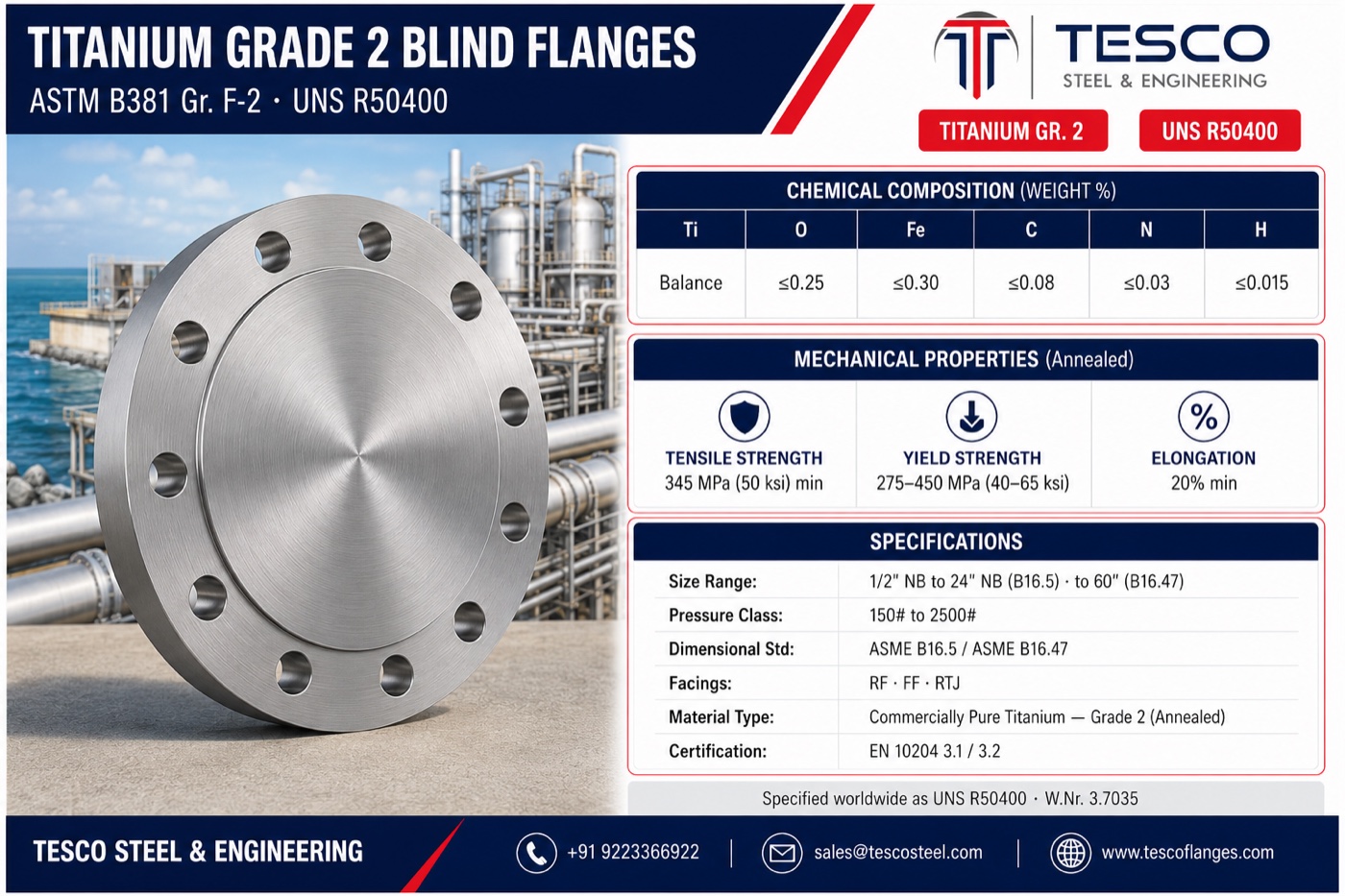
Titanium Grade 2 Blind Flanges — Specifications at a Glance
What is a Titanium Grade 2 Blind Flange?
The seawater metal's closure. A solid forged disc of commercially pure titanium (ASTM B381 Gr. F-2 / UNS R50400 / W.Nr. 3.7035) with no bore. A self-healing oxide film that oxidizing chlorides strengthen rather than attack: unlimited-velocity seawater, no pitting or crevice attack in ambient service, no chloride SCC — plus wet chlorine and hypochlorite command. Density 4.51 g/cm³ — about 57% of a steel blind's weight. Annealed — 345 MPa tensile, 275–450 MPa yield range, 20% elongation. Purity is the spec: six-entry interstitial chemistry, oxygen sets the grade. Dimensions per ASME B16.5 / B16.47 in RF, FF and RTJ; EN 10204 3.1 on every lot.
Also searched as: Ti Gr 2 blind flange, CP titanium blind flange, R50400 blind flange, B381 F2 blind, 3.7035 blind flange, titanium blank flange — all refer to the product on this page. See also the Titanium Grade 5 blind flanges (Ti-6Al-4V strength), the other R50400 types — weld neck, slip-on, socketweld — the titanium hub with Grade 1 / Grade 7, and the facing pages BLRF / BLFF / BLRTJ.
A Different Film Entirely
Chloride Duty
The Alloy Ladder's Answer
Titanium Grade 2's Answer
Ambient seawater — any velocity
CuNi to ~4 m/s; duplex, 6Mo, 625 by severity
Essentially inert — no velocity limit
Pitting & crevice
Bought degree-by-degree with Mo (2% → 16%)
Immune below ~70–80°C — film feeds on oxidizing chlorides
Chloride SCC
Off the map only from 904L / nickel bases up
Off the map, full stop
Wet chlorine / hypochlorite
C-22 / C-276 territory
The standard construction metal
Hot concentrated brine >80°C
C-family holds
Crevice risk — hand to Gr 7/12 or back to the C-family
The ladder this site climbs is one long defence of chromium's film with molybdenum. Titanium steps off the ladder: its film is a different chemistry that oxidizing chlorides renew — at a fraction of nickel-alloy price and weight.
What Purity Buys
Six Entries, No Recipe
CP titanium is graded by ceilings on O, Fe, C, N, H — nothing deliberately alloyed. No precipitates, no sensitisation, no ageing metallurgy: corrosion behaviour you can predict from a purity number, with oxygen (≤0.25%) setting the strength grade.
Half the Weight on the Crane
4.51 g/cm³ against ~7.85 for steel and up to 8.9 for nickel alloys: a Grade 2 blind is ~57% of the steel weight — tens of kilograms on large bores. Offshore weight budgets and maintenance crews both notice.
The Fenced Yield
Yield is specified as a range, 275–450 MPa — fenced from both sides because oxygen moves it so strongly. Strength near carbon steel's; formability and weldability kept; and for real strength, Grade 5 nearly triples it.
Titanium Grade 2 Chemical Composition (UNS R50400)
Element
Ti
O
Fe
C
N
H
Weight %
Balance
≤0.25
≤0.30
≤0.08
≤0.03
≤0.015
Purity is the specification. Oxygen is the strength lever — Grade 1 caps it at 0.18% for maximum formability, Grade 2's 0.25% buys the 345 MPa floor. Hydrogen (≤0.015%) is the watch-item: it forms brittle hydrides, and our certificates report it per heat. Titanium stock is machined and handled fully segregated from steel — no iron contamination of the surface, PMI on every piece.
Mechanical Properties (Annealed)
Property
ASTM B381 Gr. F-2 Requirement
Tensile Strength
≥ 345 MPa (50 ksi)
Yield Strength (0.2%)
275–450 MPa (40–65 ksi) — a min-max band, the Grade 2 signature
High-pressure practice — ring must not out-harden the groove
Titanium Grade 2 Blind Flange Specifications
Titanium Grade 2 / UNS R50400 Blind Flanges are available in the following specifications:
Material Grade
Titanium Grade 2 — ASTM B381 Gr. F-2 (UNS R50400), W.Nr. 3.7035; plate B265 and bar B348 belong on mill paperwork, the flange certificate reads B381
Heat Treatment
Annealed — furnace records certified; hydrogen reported per heat
Size
1/2"NB to 24"NB per ASME B16.5; 26"–60" per ASME B16.47; EN 1092-1 to order
Class
150#, 300#, 400#, 600#, 900#, 1500#, 2500#
Facings
Raised Face (BLRF), Flat Face (BLFF), Ring Type Joint (BLRTJ) with groove per B16.20
Service Span
Seawater at any velocity, desalination brine, wet chlorine, hypochlorite, ClO2, nitric chemistry; reducing acids and dry chlorine excluded — see notes
Surface Finish
Natural machined — no paint, no steel contact; titanium-dedicated handling throughout
Modifications
NPT-tapped test and injection blinds; matching spectacle blinds, spades and bleed rings; isolation gasket guidance for mixed-metal joints
Testing
Tension & full interstitial chemistry per heat including hydrogen; PMI routine on every piece
Certification
EN 10204 3.1 (standard) / 3.2 witnessed
Why Titanium Grade 2 Blind Flanges Are Specified
The Water Never Stops Moving
Velocity limits retire copper-nickel and erode steel; titanium has none in seawater. Intakes, high-flow cooling circuits and firewater systems keep their closures for decades.
The Brine Is the Product
Desalination lives at the exact chemistry — hot aerated brine — that torments the stainless ladder. MSF and MED plants standardised on titanium a generation ago; the blinds should match the vessel.
The Chlorine Is Wet
Chlor-alkali cell rooms, hypochlorite and bleach chemistry are titanium's franchise — the film feeds on exactly what attacks everything else. (Dry chlorine is the opposite story — see the notes below.)
Every Kilogram Is Budgeted
Offshore topsides and naval systems count weight: 57% of steel, roughly half of nickel alloy, same B16.5 envelope.
Four honest notes — two of them safety-critical.Dry chlorine is forbidden: without moisture to sustain the film, titanium can ignite in dry chlorine gas — the industry requires a guaranteed water content (of the order of 1%) before titanium may see chlorine; if your stream can ever run dry, specify another metal, and say so at enquiry. Reducing acids attack CP titanium: hydrochloric and sulphuric beyond dilute strengths dissolve the film — that duty belongs to Alloy 20, 825 and the C-family, or to palladium-bearing Grade 7. Galvanic nobility cuts the other way: in seawater titanium sits near the noble end — bolted straight to carbon steel or CuNi, the cheaper flange becomes the anode; use isolation gasket kits or match the system. And hydrogen is the long game: aggressive cathodic protection can push hydrogen into titanium over years — state the CP regime for subsea service.
How Our Titanium Grade 2 Blind Flanges Are Manufactured
1
Forging — cut billet of the verified R50400 heat — interstitial windows including hydrogen confirmed — is hot-forged into the solid disc blank with full heat traceability and titanium-dedicated tooling.
2
Annealing — the anneal that sets the uniform alpha structure; furnace charts retained against the heat number.
3
Machining & facing — faces, OD, drilling and any NPT taps cut to ASME B16.5 / B16.47 on titanium-segregated stations — no steel contact, no iron pickup; RF serrations, flat face or RTJ groove gauged per B16.20.
4
Testing — tension test and full interstitial chemistry against the heat, hydrogen included; PMI confirms CP titanium — no alloyed disc can masquerade as Grade 2.
5
Finishing — natural machined finish; marked with standard, grade, size, class and heat number.
6
Certification & packing — EN 10204 3.1 MTC (3.2 witnessed on request) with anneal records; faces protected, palletised or crated sea-worthy — segregated from ferrous cargo.
Where Titanium Grade 2 Blind Flanges Are Used
Where the seawater metal earns its keep: desalination plants (MSF/MED evaporators, brine headers, intakes), offshore and coastal cooling-water circuits, naval and commercial marine systems, chlor-alkali cell rooms and wet-chlorine headers, hypochlorite and ClO2 bleach systems, nitric acid and PTA chemistry, and condenser circuits with titanium tubing wanting matching closures. Production below:
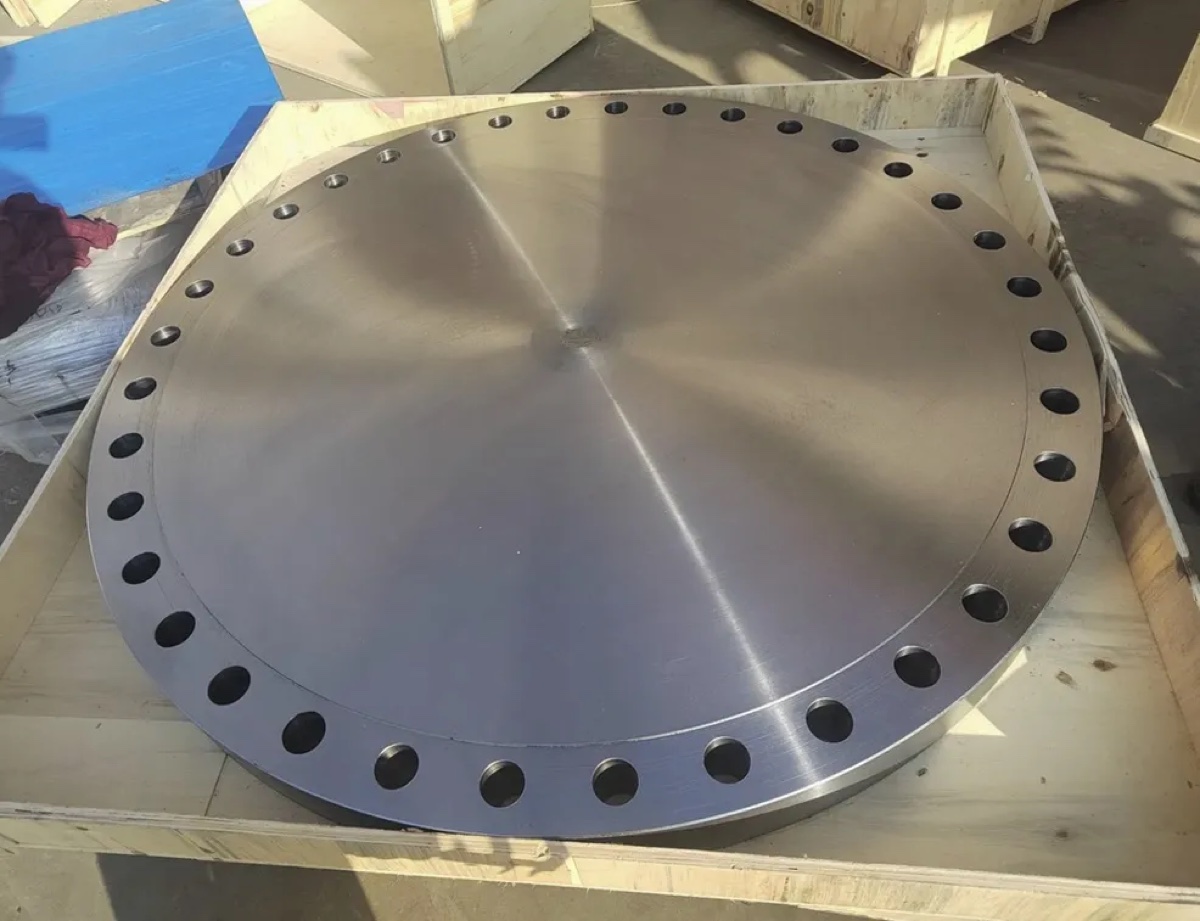
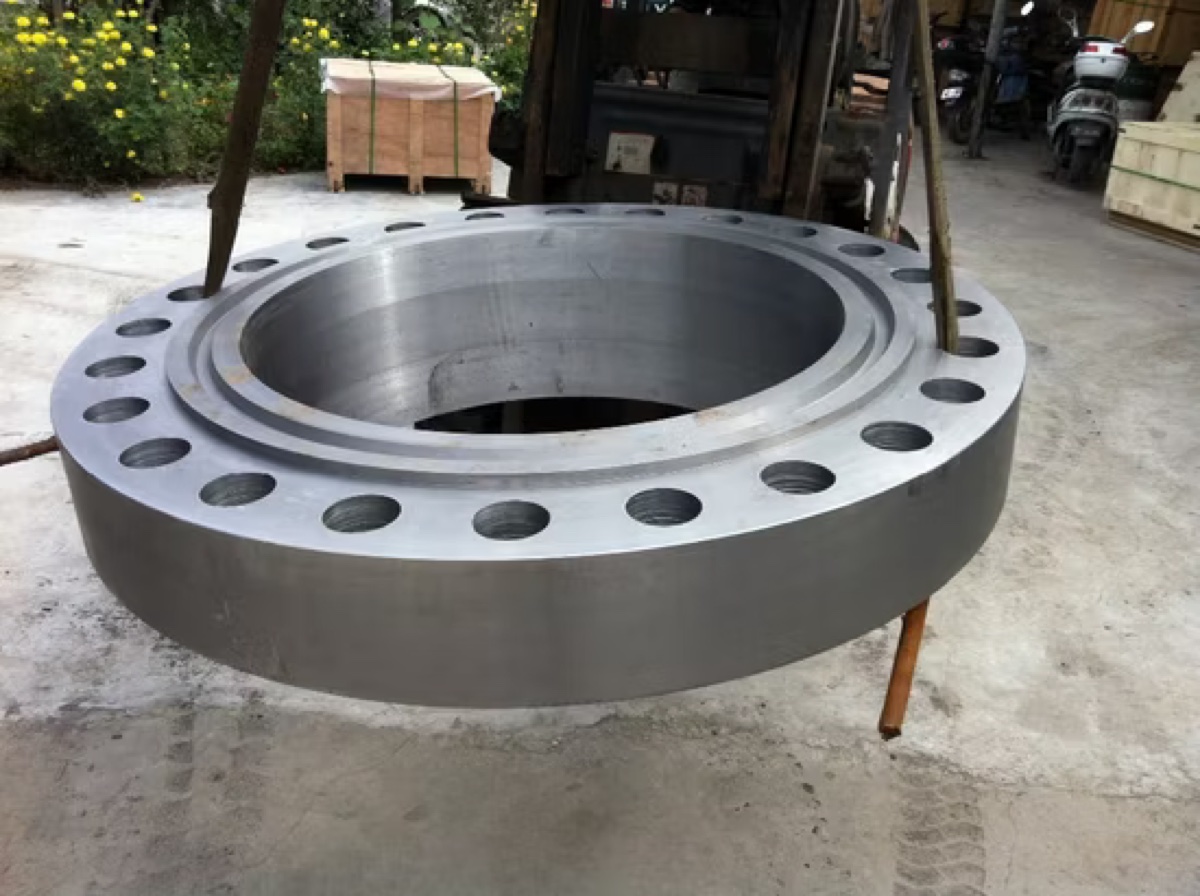
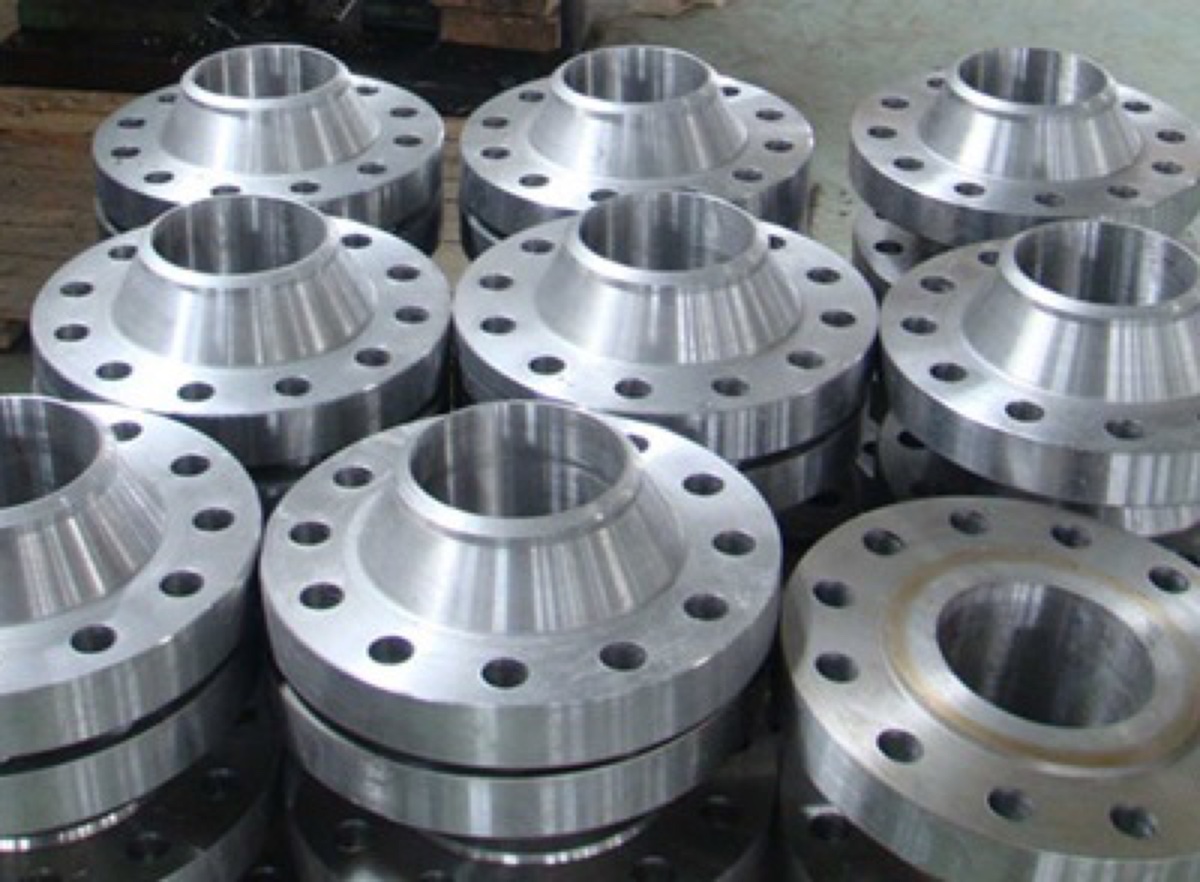
Large Machined Blind — Crated for ExportRTJ Groove Machining — Class 600Titanium Grade 2 — Segregated Stock
Titanium Grade 2 Blind Flange Dimensions
Blind dimensions are class-governed — identical across material grades (the weight, at 57%, is not). Full charts:
How to Specify & Order a Titanium Grade 2 Blind Flange
Five elements — and for chlorine duty, the moisture guarantee is part of the specification:
1
Size & standard — e.g. 8″ NB ASME B16.5, or the B16.47 series for 26″ and above.
2
Pressure class & facing — Class 150–2500; RF, FF or RTJ (with ring number — titanium or soft compatible ring) to match the mating flange.
3
Grade — ASTM B381 Gr. F-2 (UNS R50400), annealed; W.Nr. 3.7035 where the European designation is required. Formability-critical? Grade 1. Strength? Grade 5. Reducing acid or hot brine? Grade 7.
4
Service declarations & certification — chlorine moisture guarantee where applicable; subsea CP regime if cathodically protected; isolation kit needs for mixed-metal joints; NPT tap size if a test blind; PMI or 3.2 witnessing as specified; EN 10204 3.1 — our standard.
A Titanium Grade 2 blind flange is a solid forged disc of commercially pure titanium — ASTM B381 Grade F-2, UNS R50400, W.Nr. 3.7035 — drilled to the standard bolt pattern with no bore, used to close flanged connections in seawater, desalination and wet-chlorine systems. It is not a steel and not a nickel alloy: titanium is a reactive metal protected by a self-healing oxide film that ambient seawater and oxidizing chlorides actually strengthen, which is why the metal shrugs off duties that climb the whole stainless and nickel ladder. Grade 2 is the workhorse purity grade — annealed, 345 MPa tensile minimum — and at 4.51 g/cm³ the finished blind weighs roughly 57% of its steel counterpart. Dimensions follow ASME B16.5 from ½ inch to 24 inch and ASME B16.47 beyond, in raised face, flat face and ring joint facings.
Why is titanium called the seawater metal?
Because in ambient seawater it is, for practical purposes, inert. The oxide film that forms on titanium in oxygen-bearing water is thin, tenacious and self-healing — scratch it and it re-forms in milliseconds — and chlorides do not undermine it the way they undermine the chromium film on stainless steel. The results read like a datasheet misprint: no measurable corrosion in seawater at any practical velocity (erosion-corrosion limits that retire copper-nickel simply do not apply), no pitting, no crevice attack below roughly 70-80°C, no chloride stress corrosion cracking. That is why desalination evaporators, offshore seawater cooling circuits and naval systems that must not fail specify titanium — and why a Grade 2 blind is the natural closure on all of them.
Why does the Grade 2 chemistry table list only trace elements?
Because purity is the specification. Commercially pure titanium is graded not by what is added but by ceilings on four interstitial elements — oxygen, iron, carbon, nitrogen, plus hydrogen — and oxygen is the lever: more oxygen means more strength and less ductility. Grade 1 (O ≤0.18%) is the softest and most formable; Grade 2 (O ≤0.25%) trades a little of that formability for the 345 MPa tensile floor that makes it the industry workhorse; Grades 3 and 4 continue the climb. Nothing else is deliberately alloyed — which is also why Grade 2 welds so forgivingly and why its corrosion behaviour is so predictable: there are no precipitates, no sensitisation, no ageing metallurgy to manage. One number to watch on any certificate: hydrogen, capped at 0.015%, because hydrogen forms brittle hydrides.
What is the chemical composition of Titanium Grade 2 (UNS R50400)?
Titanium balance, with ceilings: oxygen ≤0.25%, iron ≤0.30%, carbon ≤0.08%, nitrogen ≤0.03%, hydrogen ≤0.015%. That is the entire table — six entries. Read it as a purity ladder rather than an alloy recipe: oxygen sets the strength grade, iron is a melt-cleanliness marker, and hydrogen is the embrittlement watch-item. Our PMI confirms the absence of alloying signatures on every piece — a Grade 5 disc (6% aluminium, 4% vanadium) or a stainless disc cannot masquerade as CP titanium on our shelves — and titanium stock is handled fully segregated from steel to prevent iron contamination of the surface.
What are the mechanical properties of Titanium Grade 2 blind flanges?
In the annealed condition ASTM B381 Grade F-2 requires tensile strength 345 MPa (50 ksi) minimum, yield strength within the range 275-450 MPa (40-65 ksi), and elongation 20% minimum. The min-max yield band is a Grade 2 signature — most flange materials specify only a floor, but CP titanium's yield is so sensitive to oxygen content that the standard fences it from both sides, keeping the grade formable as well as strong. In use the numbers sit near carbon steel's, at 57% of the weight — but strength is not why titanium is bought: where a design needs real yield in a titanium certificate, Grade 5 (Ti-6Al-4V, UNS R56400) nearly triples it, and that grade has its own blind flange page here.
How much lighter is a titanium blind flange than a steel one?
Titanium's density is 4.51 g/cm³ against roughly 7.85 for carbon steel and 7.9-8.9 for stainless and nickel alloys — so a Grade 2 blind weighs about 57% of the same steel blind and nearly half of a nickel-alloy one. On a DN600 Class 150 blind that difference is measured in tens of kilograms: rigging gets lighter, offshore topside weight budgets breathe easier, and maintenance crews swinging a spade or turning a spectacle blind feel it directly. Combined with corrosion life measured in decades of seawater service, the weight advantage is why offshore and naval designers treat titanium's price per kilogram as misleading — per year of service per kilogram carried, it is often the cheapest metal on the platform.
How does titanium relate to the stainless and nickel chloride ladder?
It steps off it. The ladder this site climbs — 316L, 317L, duplex, 904L, super duplex, 254 SMO, 625, the C-family — is one long campaign to defend chromium's oxide film against chloride attack with ever more molybdenum. Titanium's film is a different chemistry altogether: oxidizing chlorides feed it rather than fight it, so ambient seawater and hypochlorite duties that require 6Mo or C-alloy performance are simply routine for Grade 2 at a fraction of the nickel-alloy price and weight. The honest boundary: hot concentrated brines above roughly 75-80°C can crevice-attack Grade 2 under gaskets — there the palladium-bearing Grade 7 or Grade 12 continues the titanium story, or the duty returns to the C-family. Ambient-temperature chloride service, however, belongs to titanium almost by default.
Why is titanium excellent in wet chlorine but forbidden in dry chlorine?
The most important sentence on this page. Wet chlorine — chlorine gas carrying even a fraction of a percent of moisture — continuously renews titanium's oxide film, and Grade 2 is the standard construction metal of wet-chlorine headers, chlorine dioxide and hypochlorite systems across the chlor-alkali and bleach industries. Dry chlorine is the opposite: with no water to sustain the film, titanium can ignite spontaneously in dry chlorine gas — a genuine metal fire, one of the famous hazards of chemical engineering. The industry rule of thumb requires a minimum water content (of the order of 1%) before titanium may see chlorine. If your chlorine can ever run dry — upset, start-up, instrument air ingress — the closure must be another material, and our quotation will say so. State the moisture guarantee when enquiring for chlorine duty.
Which acids attack Titanium Grade 2?
The reducing ones. Hydrochloric and sulphuric acid beyond dilute concentrations, hot oxalic and formic — these dissolve the oxide film faster than it can re-form, and CP titanium corrodes rapidly where a C-276 would soldier on. Oxidizing acids are the opposite story: nitric acid across a wide range is classic titanium territory, and wet-chlorine chemistry as above. Two rescues exist inside the titanium family before you leave it: small palladium additions (Grade 7, and leaner Grade 16) extend resistance meaningfully into reducing-acid and hot-brine territory, and Grade 12 adds Mo-Ni for crevice performance — see our titanium Grade 7 page. Beyond those, reducing-acid duty belongs to the nickel world: Alloy 20, 825 or the C-family, each with its own blind flange page here.
Will a titanium flange cause galvanic corrosion of my steel piping?
It can — and the current flows the wrong way for the steel. In seawater titanium sits at the noble end of the galvanic series, near graphite and well above stainless, copper-nickel and carbon steel; bolt a titanium blind directly to a carbon-steel or CuNi flange in an electrolyte and the cheaper metal becomes the sacrificial anode of the couple. Practice is straightforward: isolate the joint — isolation gasket kits with sleeved bolts and insulating washers are standard offshore hardware — or match the system and close titanium piping with a titanium blind, which is the cleaner answer and the reason this page exists. Titanium itself is essentially immune in the couple; hydrogen pickup under aggressive cathodic protection is the one caveat, worth stating at enquiry for CP-protected subsea systems.
Titanium Grade 2 or Grade 5 — which blind flange should I order?
Grade 2 unless strength says otherwise. Grade 2 is commercially pure: the best corrosion behaviour, the forgiving weldability, the industry's default for seawater, desalination and chemical duty — at 345 MPa tensile. Grade 5 (Ti-6Al-4V, UNS R56400) is the aerospace alloy: 895 MPa tensile and 828 MPa yield from its aluminium-vanadium chemistry, bought for pressure-driven wall-thickness savings, high-cycle fatigue and weight-critical structures, at some cost in corrosion margin (its crevice threshold sits lower) and in welding care. For a bolted closure, where the flange thickness is set by ASME B16.5 tables rather than by yield, Grade 2 is almost always the right buy — the Grade 5 blind page on this site exists for the systems already built in Ti-6Al-4V that want matching hardware.
What facings are Titanium Grade 2 blind flanges made with?
All three: raised face (BLRF) — the default — flat face (BLFF) for mating the FRP, rubber-lined and glass-lined equipment common in chlorine and desalination plants, and ring type joint (BLRTJ) where high-pressure practice demands it, noting that RTJ rings for titanium systems should themselves be titanium or a soft compatible metal so the groove is not damaged by a harder ring. Gaskets in seawater service double as galvanic management — isolation kits where the mating flange is steel or copper-nickel, plain PTFE or elastomer-faced gaskets between titanium faces. NPT-tapped test and injection blinds are machined and certified at the works.
Where are Titanium Grade 2 blind flanges used?
Desalination plants — MSF and MED evaporator bodies, brine headers and seawater intakes; offshore and coastal power-station cooling-water circuits; naval and commercial marine seawater systems; chlor-alkali cell rooms and wet-chlorine headers; hypochlorite and chlorine dioxide bleach systems in pulp and water treatment; PTA and nitric-acid chemistry; and heat-exchanger and condenser circuits where tube-side titanium wants matching closures. Grade 2 blinds close those systems as isolations, spare-nozzle blanks, spectacle-blind companions and tapped test points — matching the vessel metal so the joint has neither a corrosion weak point nor a galvanic couple.
Which standards cover Titanium Grade 2 blind flanges?
The forging standard is ASTM B381, Grade F-2 (UNS R50400) — titanium has its own forging specification, separate from the steels' A182 and the nickel alloys' B564; plate is B265 and bar is B348, which belong on mill paperwork rather than the flange certificate. The European designation is W.Nr. 3.7035 (Ti Grade 2 per EN standards). Dimensions follow ASME B16.5 for ½"-24" and ASME B16.47 for 26"-60". A complete specification reads: 'Blind Flange, RF, 8", ASME B16.5 Class 150, ASTM B381 Gr. F-2 (UNS R50400), annealed' — and our EN 10204 certificates state it exactly that way, with interstitial chemistry including hydrogen reported per heat.
Who manufactures Titanium Grade 2 blind flanges in India?
Tesco Steel & Engineering is an ISO 9001:2015 certified flange manufacturer based in Mumbai, India, forging Titanium Grade 2 / ASTM B381 Gr. F-2 / UNS R50400 blind flanges from ½" to 24" NB per ASME B16.5 in Classes 150-2500 and to 60" per ASME B16.47 — annealed with furnace records certified, machined with titanium-dedicated handling fully segregated from steel, PMI-verified on every piece, certified to EN 10204 3.1/3.2 with full interstitial chemistry including hydrogen — in raised face, flat face and ring joint facings, alongside titanium Grades 1, 5 and 7 and the complete stainless, duplex and nickel-alloy blind range. Exported to more than 50 countries.