Nickel 201 Blind Flanges — UNS N02201 Low-Carbon Pure Nickel Blind Manufacturer
Tesco Steel & Engineering forges Nickel 201 blind flanges — ASTM B564, UNS N02201, EN 2.4068 — to ASME B16.5 Class 150–2500 from ½″ to 24″ NB and to ASME B16.47 up to 60″. A grade that exists because of one deleted impurity: cap carbon at 0.02% and pure nickel's graphitization clock stops ticking — so the caustic and dry-halogen franchises of Nickel 200 extend from the 315°C line to roughly 600°C: the world of caustic evaporators, concentrators and anhydrous fusion, and the hot ends of chlorination and HCl trains. The honest trade: carbon was a strengthener, so 201 is the softest grade on this site — and it doesn't matter, because nothing else survives its service. Below the line: Nickel 200, or dual-certified 200/201 material. Beyond 600°C or into wet chlorine: Inconel / Hastelloy. Facings: BLRF, BLFF or BLRTJ. Every lot with EN 10204 3.1/3.2 MTC. ISO 9001:2015, made in Mumbai, India — exported to 50+ countries.
Nickel 201 · ASTM B564 · UNS N02201EN 2.4068 · LC-Ni 99C ≤0.02% — Nothing to GraphitizeHot Caustic to ~600°CEvaporators · Fusion · Hot Dry Cl₂/HClDual-Cert 200/201 AvailableASME B16.5 ½″–24″ · Class 150–2500EN 10204 3.1 / 3.2 · ISO 9001:2015
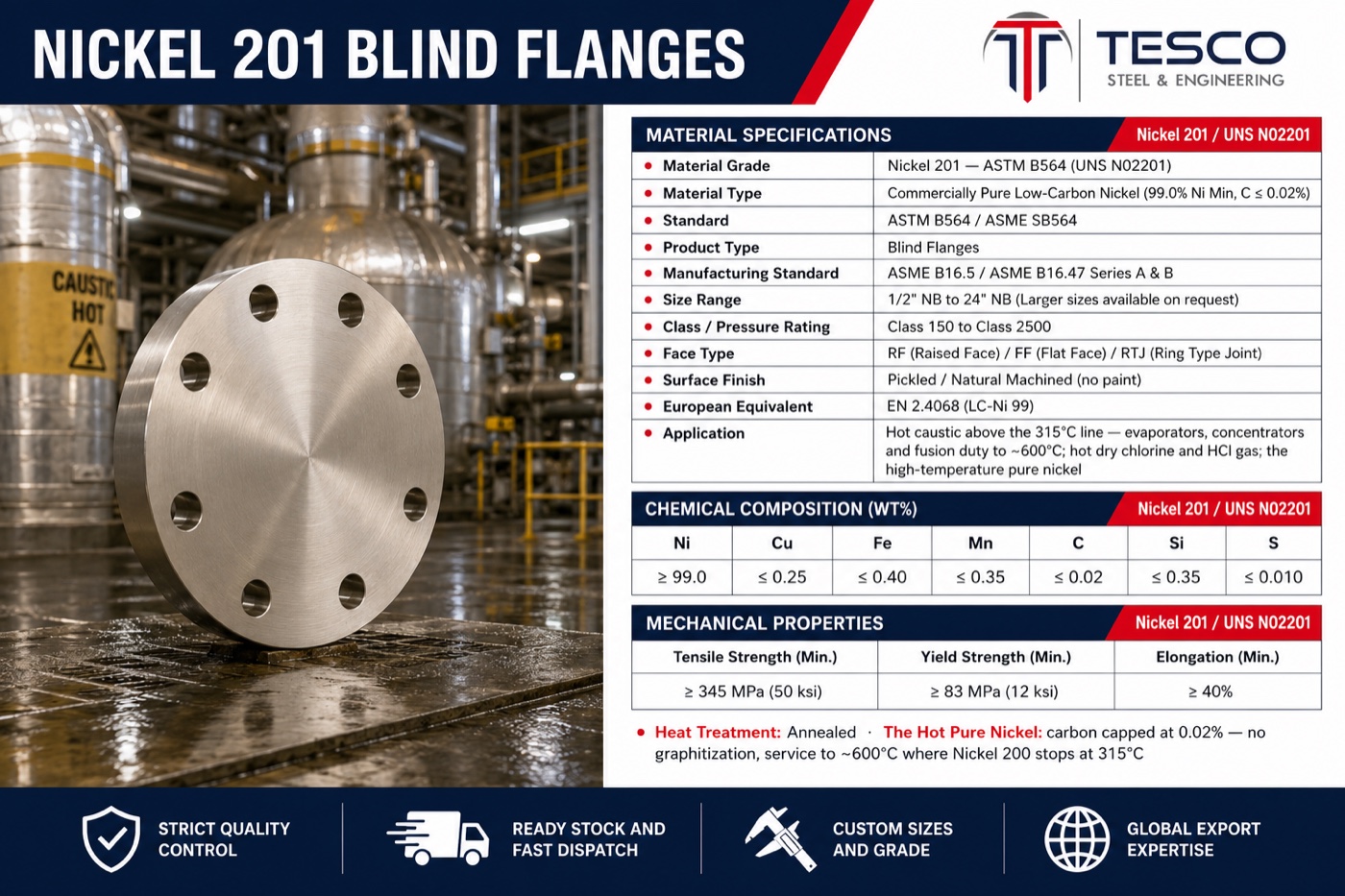
Nickel 201 Blind Flanges — Specifications at a Glance
What is a Nickel 201 Blind Flange?
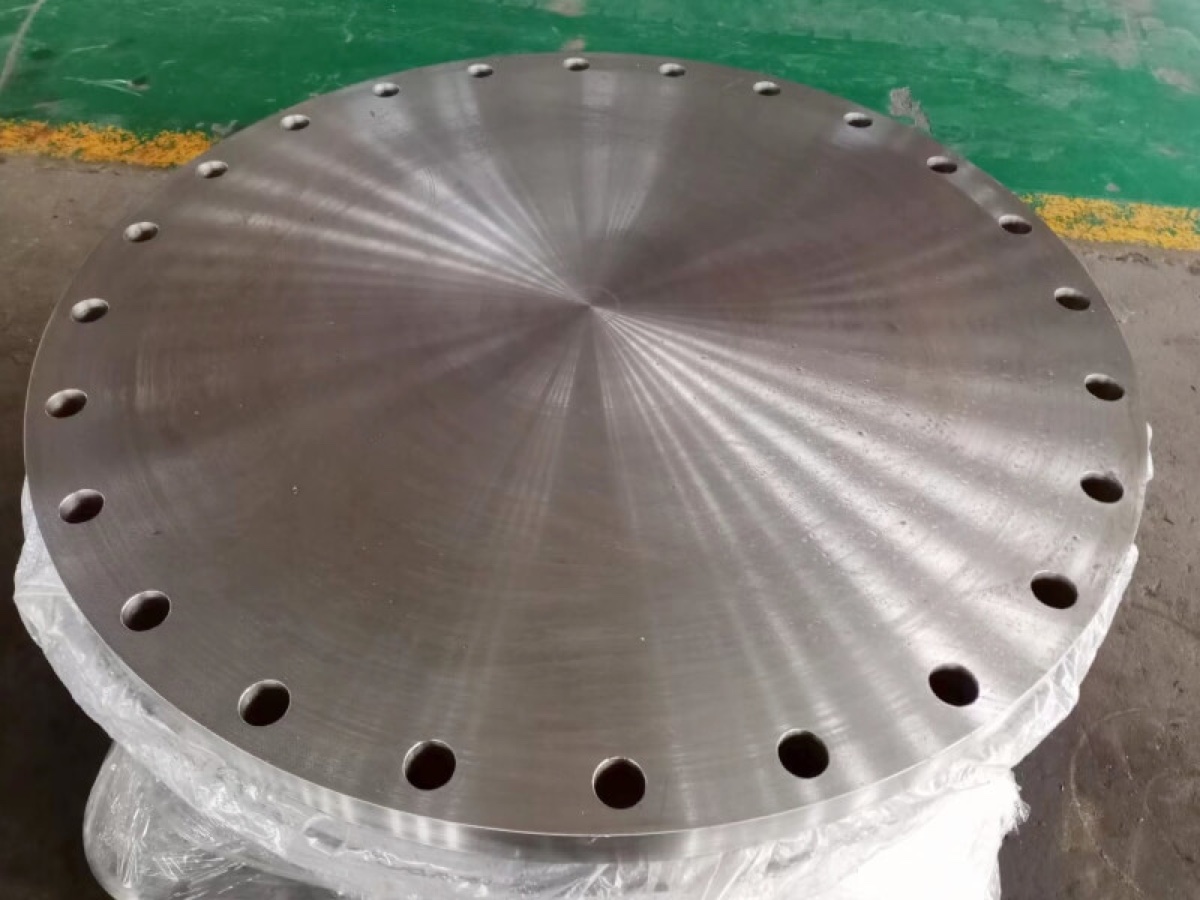
The hot pure nickel. A solid forged disc of commercially pure low-carbon nickel — 99.0% minimum, C ≤0.02% (ASTM B564 / UNS N02201 / EN 2.4068) — with no bore, closing pipes, valves and nozzles in the hot end of pure nickel's territory: caustic evaporators, concentrators and fusion duty to ~600°C, hot dry chlorine and HCl gas. The deleted carbon is the whole specification: nothing to graphitize where Nickel 200 must stop at 315°C. Mechanicals 345/83 MPa annealed — the softest on this site, specified for chemistry, never strength. Dimensions per ASME B16.5 / B16.47 in RF, FF and RTJ facings; EN 10204 3.1 certified.
Also searched as: Ni 201 blind flange, low-carbon nickel blind flange, N02201 blind, 2.4068 blind flange, LC-Ni 99 blind, SB564 nickel 201 blind, caustic evaporator blind flange — all covered on this page. See also its standard-carbon twin Nickel 200 blind flanges, the alkali middle-rung Monel 400, the hotter handoffs Inconel / Hastelloy, and the facing pages BLRF / BLFF / BLRTJ.
One Deleted Impurity, 285 Extra Degrees
The Graphitization Clock
Nickel dissolves almost no carbon. Above 315°C, the excess in standard 200 slowly precipitates as graphite films along grain boundaries — embrittlement that arrives years into service, not at commissioning. No alloying fix exists in a metal defined by purity; the fix is subtraction.
C ≤0.02% — the Whole Specification
Cap the carbon and the mechanism starves. The service ceiling moves from 315°C to roughly 600°C — opening caustic evaporator, concentrator and anhydrous fusion duty that no other pure metal or alloy holds on the same terms.
The Honest Trade
Carbon was also a strengthener: 201's minimums drop to 345/83 MPa, the softest on this site. It never costs a specification — between 315°C and 600°C in hot caustic, it is quite simply the only pure nickel that belongs.
When heat outruns pure nickel, or strength joins the brief
Nickel 201 Chemical Composition (UNS N02201)
Element
Ni
Cu
Fe
Mn
C
Si
S
Weight %
≥99.0
≤0.25
≤0.40
≤0.35
≤0.02
≤0.35
≤0.010
Beside the Nickel 200 sheet, exactly one number changes: carbon, 0.15 → 0.02 — and that number is the specification. Our certificates report it to the third decimal, verified on every heat, because everything this grade promises depends on it.
Mechanical Properties & The Service Span
Property
ASTM B564 N02201 Requirement
Tensile Strength
≥ 345 MPa (50 ksi)
Yield Strength (0.2%)
≥ 83 MPa (12 ksi) — the softest on this site; the deleted carbon was a strengthener
Elongation
≥ 40%
Hardness
No B564 limit — soft as annealed; work-hardens in machining
Condition
Annealed — stated on certificate
Service Span
Cryogenic upward to ~600°C sustained — the 315–600°C window is its reason to exist; beyond it, Inconel
Ring selection careful — annealed pure nickel is itself soft
Nickel 201 Blind Flange Specifications
Nickel 201 / UNS N02201 Blind Flanges are available in the following specifications:
Material Grade
Nickel 201 — ASTM B564 / ASME SB564 (UNS N02201); EN 2.4068 / LC-Ni 99; dual-certified 200/201 material on request
Heat Treatment
Annealed — stated on certificate
Size
1/2"NB to 24"NB per ASME B16.5; 26"–60" per ASME B16.47; EN 1092-1 to order
Class
150#, 300#, 400#, 600#, 900#, 1500#, 2500# — rated on the grade's own nickel B16.5 lines
Facings
Raised Face (BLRF), Flat Face (BLFF), Ring Type Joint (BLRTJ) with groove per B16.20
Service Span
Hot caustic & alkalis 315–600°C, hot dry Cl₂/HCl; sulphur-bearing hot gas, oxidising acids and wet halogens excluded — state the chemistry at enquiry
Surface Finish
Pickled or natural machined — no paint; segregated alloy handling throughout
Modifications
NPT-tapped centre (test / dosing / vent), lifting provisions — machined & certified at the works
Testing
Tension & chemistry per heat — 99% purity and the 0.02% carbon cap verified; PMI routine
Certification
EN 10204 3.1 (standard) / 3.2 witnessed — measured carbon on every MTC
Why Nickel 201 Blind Flanges Are Specified
The Evaporator Wrote the Line Class
Concentrating caustic means hot metal — walls above the 315°C line as the liquor approaches anhydrous — and only low-carbon pure nickel holds that duty for years without graphitizing. The closure carries the same certified carbon as the shell.
Purity, Kept Hot
The 99% purity franchise of the 200 page — no shed alloying ions, chlor-alkali and food-grade pedigree — carried into the temperature range where the plant actually concentrates its product.
Weld Zones With Nothing to Lose
Even the heat-affected zones of future welds carry ≤0.02% carbon — the graphitization immunity travels with the certificate, spool after spool.
One Inventory, Both Sides of the Line
Dual-certified 200/201 material meets both specifications at once — a single stock and a single MTC covering every temperature in the plant.
Three details buyers miss.The carbon must be on the certificate: "Nickel 201" on a PO means nothing without the measured ≤0.02% on the MTC — we report it to the third decimal on every heat, and dual-certified 200/201 paperwork carries both UNS numbers plus the number that earns them. Sulphur discipline tightens with temperature: at 201's working range, nickel's oldest enemy works faster — sulphur-bearing streams are excluded and weld-prep cleanliness (marker ink, oils, greases) is policed to full nickel practice. Dry still means dry: the hot-halogen franchise holds only without moisture — wet chlorine at any temperature is Hastelloy territory, and the water content of the stream is the first question on any halogen enquiry.
How Our Nickel 201 Blind Flanges Are Manufactured
1
Forging — cut billet of the spectro-verified N02201 heat — 99% purity and the 0.02% carbon cap confirmed — is hot-forged into the solid disc blank with full heat traceability and segregated handling.
2
Annealing — restoring the soft, fully ductile matrix; furnace charts retained against the heat number.
3
Machining & facing — faces, OD and drilling to ASME B16.5 / B16.47 with tooling set for pure nickel's gummy, work-hardening behaviour; RF serrations, flat face or RTJ groove gauged per B16.20; NPT taps machined where ordered.
4
Testing — tension test and chemistry against the heat; carbon verified to the third decimal; PMI on every piece confirms the purity.
5
Pickling — the clean bare-metal surface the hot caustic or halogen service will meet, with marking of standard, grade, size, class and heat number.
6
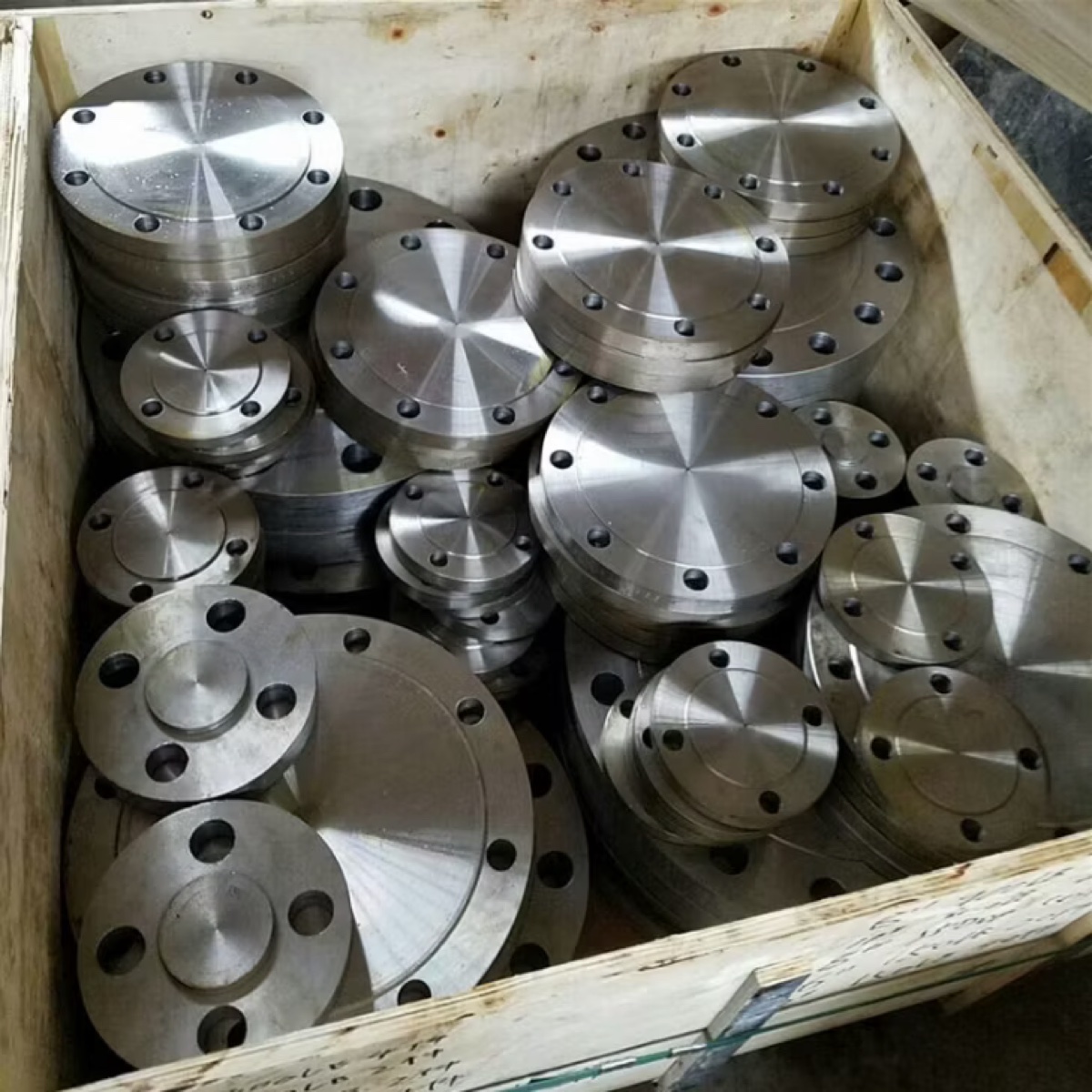
Certification & packing — EN 10204 3.1 MTC (3.2 witnessed on request) with the measured carbon stated; faces protected, palletised or crated sea-worthy — no carbon-steel contact in transit.
Where Nickel 201 Blind Flanges Are Used
The hot end of pure nickel's territory: caustic evaporators, concentrators and anhydrous fusion equipment; high-temperature chlor-alkali sections; hot dry chlorine and HCl synthesis trains; fluorine chemistry at temperature; food and fine-chemical caustic circuits crossing the 315°C line. Production below:
Five elements — the carbon declaration is the 201-specific one:
1
Size & standard — e.g. 4″ NB ASME B16.5, or the B16.47 series for 26″ and above.
2
Pressure class & facing — Class 150–2500; RF, FF or RTJ (with ring number) to match the mating flange.
3
Grade — ASTM B564 UNS N02201 (Nickel 201), or dual-certified 200/201 where one stock must serve both sides of the 315°C line; EN 2.4068 designation where required.
4
Service & certification — state the medium, concentration, design temperature and (for halogens) moisture; NPT tap size if a test blind; PMI or 3.2 witnessing as specified; EN 10204 3.1 standard with measured carbon.
Example: “Blind Flange, RF, 4″ NB, ASME B16.5 Class 150, ASTM B564 UNS N02201 (Nickel 201), EN 10204 3.1 — 4 pcs, caustic evaporator body nozzle, 380°C.” Quotations normally within 24 hours with price, unit weight and delivery.
A Nickel 201 blind flange is a solid forged disc of commercially pure low-carbon nickel — 99.0% minimum with carbon capped at 0.02%, certified to ASTM B564 as UNS N02201, EN 2.4068 — drilled to the standard bolt pattern with no bore. It is the high-temperature version of pure nickel: with almost no carbon there is nothing to graphitize, so the caustic and dry-halogen franchises of Nickel 200 extend to around 600°C, the territory of caustic evaporators, concentrators and fusion equipment. Dimensions follow ASME B16.5 from ½ inch to 24 inch and ASME B16.47 beyond, in raised face, flat face and ring joint facings.
Why does deleting carbon create a whole new grade?
Because in pure nickel, carbon is a slow-acting time bomb above 315°C. Nickel dissolves very little carbon, and at sustained temperature the excess precipitates as graphite films along the grain boundaries — intergranular embrittlement that shows up years into service, not at commissioning. There is no alloying fix in a metal defined by its purity, so the fix is subtraction: cap carbon at 0.02% and the mechanism has nothing to work with. That single deleted impurity moves the service ceiling from 315°C to roughly 600°C — the entire reason N02201 exists as a separate UNS number.
Nickel 201 or Nickel 200 — how does the split work?
One rule, written into every design code: 200 up to 315°C, 201 above it. Below the line the grades are interchangeable in chemistry-resistance terms and 200 is marginally stronger and more available; above it, standard 200's carbon graphitizes over time and 201 is the only pure nickel that belongs. The choice is made once, at specification, by the design temperature — a caustic transfer line at 90°C orders 200; the evaporator body at 380°C orders 201. Both carry the same 99% purity franchise; we forge both and certify the carbon either way.
What is the chemical composition of Nickel 201 (UNS N02201)?
Nickel 99.0% minimum, carbon ≤0.02% — the defining pair — with the remaining entries residual caps: copper ≤0.25%, iron ≤0.40%, manganese ≤0.35%, silicon ≤0.35%, sulphur ≤0.010%. Beside the Nickel 200 sheet the only change is the carbon line dropping from 0.15% to 0.02%, and that one number is the specification: our certificates report it to the third decimal and we verify it on every heat, because everything the grade promises depends on it.
What are the mechanical properties of Nickel 201 blind flanges?
Per ASTM B564 in the annealed condition: tensile strength 345 MPa (50 ksi) minimum, yield strength 83 MPa (12 ksi) minimum, elongation 40% minimum — the softest grade on this site, softer even than Nickel 200, because the deleted carbon was also a strengthener. The honest framing: it does not matter. Nothing else survives 201's service, ratings run on the grade's own B16.5 lines, and at its working temperatures the low-carbon structure is actually the more stable of the two. Strength was never the brief; surviving 600°C caustic was.
Can material be dual-certified as Nickel 200 and 201?
Yes — and it is common mill practice. A heat melted to carbon ≤0.02% satisfies both specifications simultaneously: N02201's cap by definition, and N02200's ≤0.15% with room to spare, with the mechanical minimums of both met in the annealed condition. Dual-certified 200/201 material lets stockists and fabricators carry one inventory for both duties, and lets a project standardise below and above the 315°C line on a single certificate. We supply dual-certified forgings on request — the MTC then carries both UNS numbers and the measured carbon that earns them.
What temperature range does a Nickel 201 blind flange cover?
Cryogenic toughness at the cold end — it is still pure nickel — and roughly 600°C at the top for sustained service, the window the grade was created to open. Oxidation in clean air is not the limit; the practical ceilings are set by the chemistry it serves: caustic concentration curves, halogen moisture, and beyond 600°C the general handoff to the chromium-bearing Inconels. Between 315°C and 600°C it is, quite simply, the only pure nickel that belongs — the reason its slightly softer numbers never cost it a specification.
Why is Nickel 201 the caustic evaporator grade?
Because evaporator duty combines everything the grade was built for. Concentrating caustic soda means hot metal — evaporator and concentrator walls run well above the 315°C line as the liquor approaches anhydrous — and only pure nickel holds concentrated NaOH at those temperatures, but only the low-carbon version holds it for years without graphitizing. Fusion equipment handling molten caustic is the extreme case of the same logic. The 201 closure on an evaporator nozzle carries the identical guarantee as the shell: 99% purity, nothing to embrittle, certified carbon.
How does Nickel 201 handle hot chlorine and HCl gas?
It extends the pure-nickel dry-halogen franchise to its hottest useful range. Dry chlorine and dry hydrogen chloride form a protective nickel-chloride film on the metal, and with graphitization removed, 201 carries that service through temperatures standard 200's carbon rule would forbid — the hot ends of chlorination trains and HCl synthesis. The standing rule carries over unchanged and matters even more when hot: dry means dry. Moisture converts the duty to aggressive wet-halogen chemistry, which belongs to Hastelloy — state the water content of the stream before any other parameter.
What service conditions does Nickel 201 dislike?
The pure-nickel list, sharpened by its hotter duty. Sulphur remains the oldest enemy — and at 201's working temperatures the embrittlement mechanism runs faster, so sulphur-bearing gases, deposits and even weld-prep contamination (marker ink, oils, greases) are policed with full nickel-practice discipline. Strongly oxidising acids attack it as they attack all film-free nickel. Wet halogens are Hastelloy territory. And above roughly 600°C, or where hot strength genuinely matters, the chromium-bearing Inconels take over. Inside its own windows — hot caustic and hot dry halogens — it remains the reference metal.
Is Nickel 201 easy to fabricate and weld?
As friendly as its twin, with one extra virtue. Pure nickel welds readily with matching filler (ERNi-1 / Filler Metal 61), has no embrittlement windows or post-weld heat-treatment demands, and the low-carbon version adds security: even the weld zones carry nothing to graphitize in hot service. The practical notes carry over — it machines gummy and work-hardens quickly, so tooling is set accordingly, and sulphur-source cleanliness on weld preps is mandatory. A blind flange asks none of this until it becomes a welded spool; when it does, the 201 certificate travels with it.
What facings are Nickel 201 blind flanges made with?
All three: raised face (BLRF) — the default — flat face (BLFF) for lined and non-metallic mating equipment, and ring type joint (BLRTJ) where high-pressure practice calls for it, the ring chosen softer than the groove and selected with care, since annealed pure nickel is itself the softest metal in our range. Each facing has its own page on this site. Gasket systems follow the service temperature as much as the chemistry — hot caustic duty runs on nickel-compatible and graphite-free selections. NPT-tapped test and dosing blinds are machined and certified at the works.
Where are Nickel 201 blind flanges used?
The hot end of pure nickel's territory: caustic evaporators, concentrators and anhydrous fusion equipment; the high-temperature sections of chlor-alkali plants; hot dry chlorine and hydrogen chloride synthesis and distribution; fluorine chemistry at temperature; and the food, soap and fine-chemical caustic circuits whose process temperatures cross the 315°C line. Nickel 201 blinds close those systems as isolations, spare-nozzle blanks and tapped test points — with the certified 0.02% carbon that lets them stay there for the life of the plant.
Which standards cover Nickel 201 blind flanges?
The material standard is ASTM B564 (UNS N02201) with ASME SB564 as the boiler-code twin — the nickel-alloy forging standard — alongside B160 for bar, B161 for pipe and B162 for plate in the same metal, and EN 2.4068 (LC-Ni 99) as the European designation; its standard-carbon twin certifies as N02200 / EN 2.4066, with dual certification available. Dimensions follow ASME B16.5 for ½"-24" and ASME B16.47 for 26"-60". A complete specification reads: 'Blind Flange, RF, 4", ASME B16.5 Class 150, ASTM B564 UNS N02201 (Nickel 201)' — and our EN 10204 certificates state it exactly that way, measured carbon included.
Who manufactures Nickel 201 blind flanges in India?
Tesco Steel & Engineering is an ISO 9001:2015 certified flange manufacturer based in Mumbai, India, forging Nickel 201 / ASTM B564 / UNS N02201 / EN 2.4068 blind flanges — with Nickel 200 and dual-certified 200/201 material alongside — from ½" to 24" NB per ASME B16.5 in Classes 150-2500 and to 60" per ASME B16.47, annealed, pickled, PMI-verified with the 99% purity read on every piece and the 0.02% carbon cap verified on every heat, certified to EN 10204 3.1/3.2 on every lot, in raised face, flat face and ring joint facings — alongside Monel 400 and K-500, Alloy 20, Hastelloy, Inconel and copper-nickel blinds. Exported to more than 50 countries.