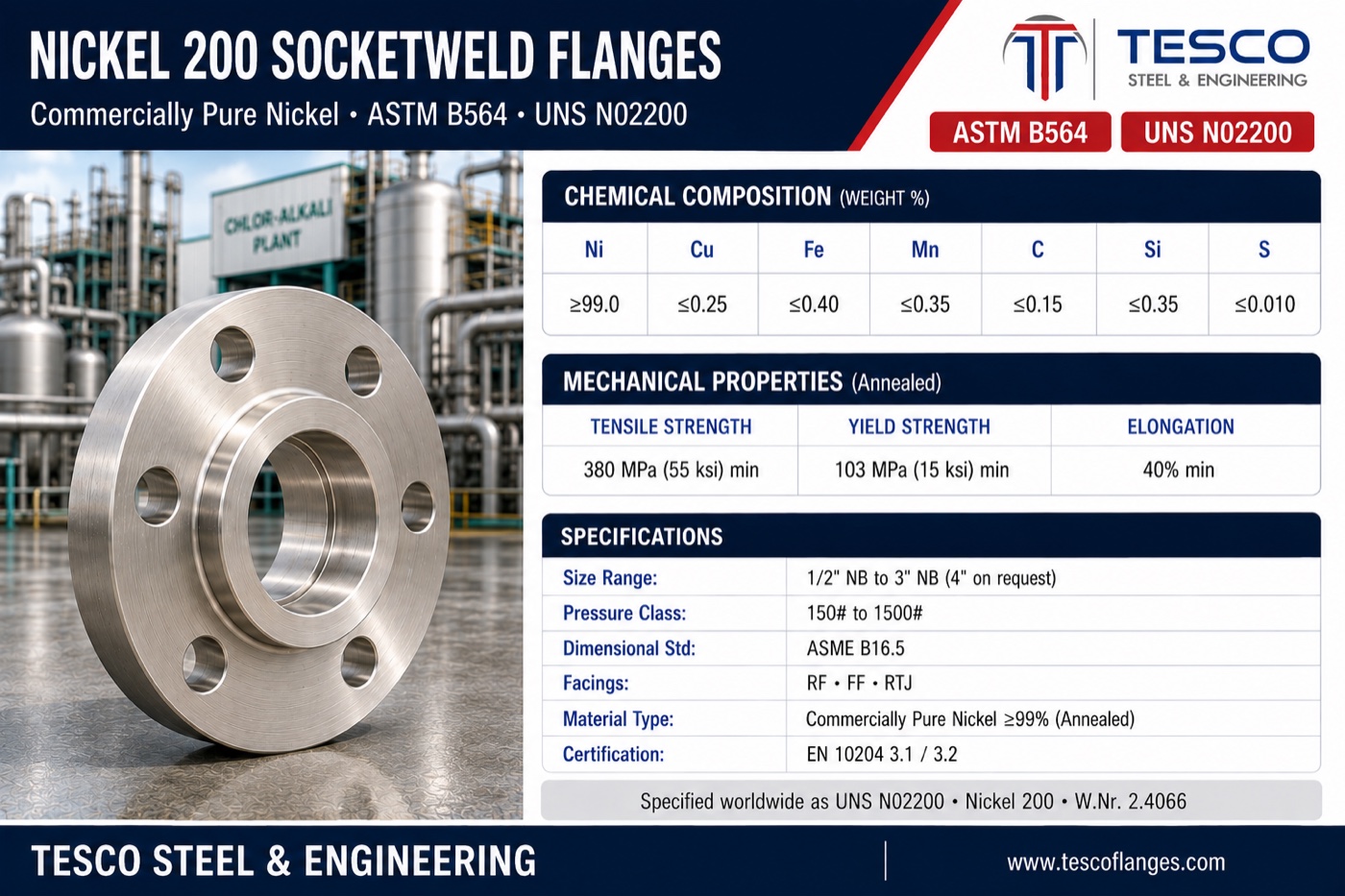
Tesco Steel & Engineering manufactures Nickel 200 socketweld flanges — commercially pure nickel: ASTM B564, UNS N02200, W.Nr. 2.4066 — to ASME B16.5 from ½″ to 3″ NB in Classes 150–1500. Every other metal in this series is nickel plus something — copper for Monel, molybdenum for Hastelloy — but this one is the element itself, ≥99% pure, because its crown duty rewards purity: hot concentrated caustic soda — the top of the ladder the whole nickel family climbs, where evaporators take 50% caustic to solid and nothing else keeps up. The one decision the grade demands is stated plainly below: above 315 °C, carbon graphitises — specify Nickel 201 by name. Also on the honest list: the series' gentlest certificate (103 MPa yield), the reducing-only chemistry, and the party trick — pure nickel is magnetic. Welded with ERNi-1 filler — no preheat, no PWHT. Facings: SWRF, SWFF, SWRTJ. Every lot with EN 10204 3.1/3.2 MTC. ISO 9001:2015, made in Mumbai, India — exported to 50+ countries.
Nickel 200 · B564 · N02200 · 2.4066The Element Itself — Ni ≥99%The Hot Caustic CrownDry Cl2 / HCl Gas · Fluorine · Food PurityAbove 315 °C → Nickel 201380 / 103 MPa · 40% ElongationASME B16.5 ½″–3″ · Class 150–1500EN 10204 3.1 / 3.2 · ISO 9001:2015
Nickel 200 Socketweld Flanges — Specifications at a Glance
What is a Nickel 200 Socketweld Flange?
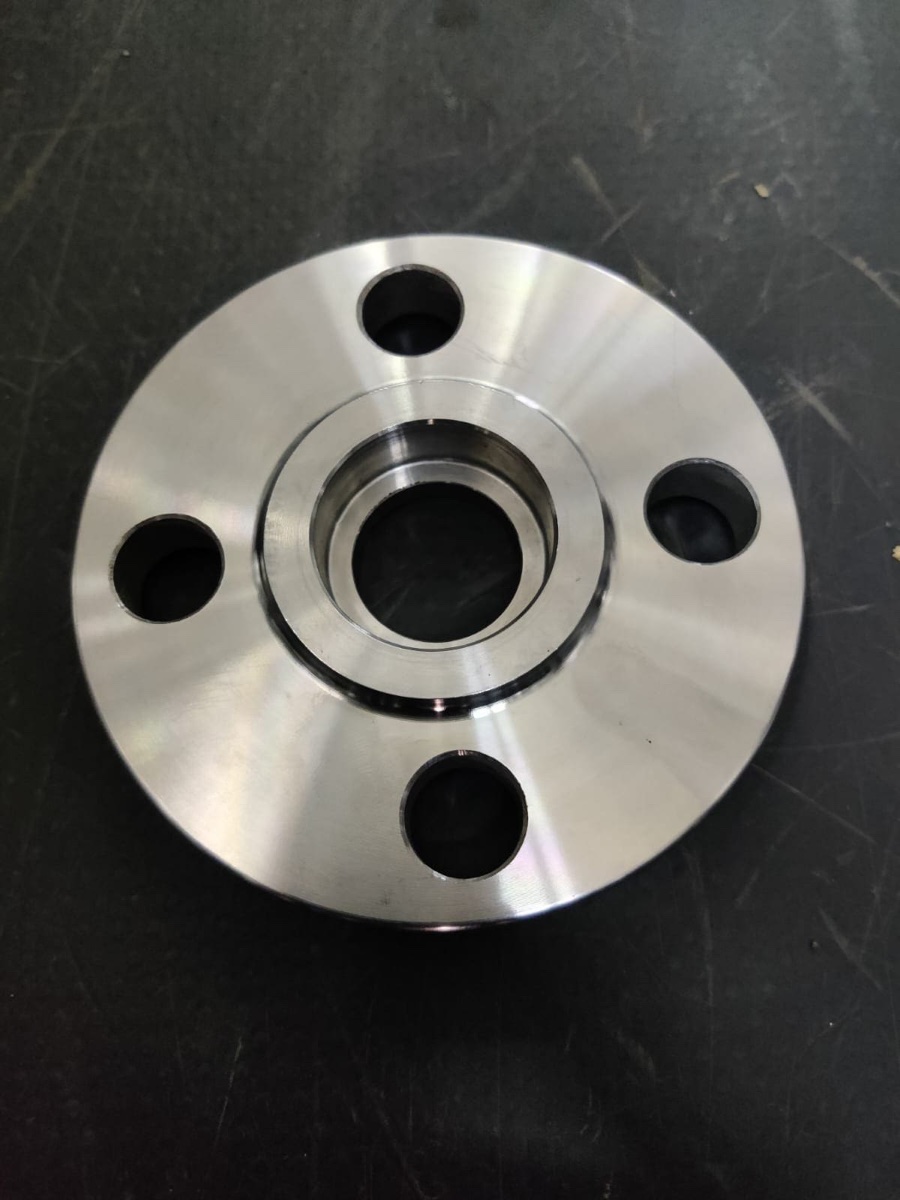
The family patriarch in the small-bore pattern. A forged commercially pure nickel flange (ASTM B564 / UNS N02200 / W.Nr. 2.4066) with a machined socket: pipe seated square by geometry, one external fillet weld with ERNi-1 filler — no preheat, no PWHT — through-bore matched to the pipe schedule. Ni ≥99.0%; everything else a trace ceiling. The crown duty: hot concentrated caustic — plus dry chlorine and HCl gas, fluorine, and food-and-rayon purity service. Tensile ≥380 MPa, yield ≥103 MPa, elongation ≥40%, annealed — the series' gentlest, most ductile certificate. Above 315 °C, specify Nickel 201. Sized by ASME B16.5 at ½″–3″ NB, Classes 150–1500; EN 10204 3.1 on every lot.
The ladder the Monel page pointed up ends here: at the molten-anhydrous extreme of caustic fusion, commercially pure nickel remains the standard engineering answer.
What Purity Buys
The Caustic Crown
In hot concentrated NaOH/KOH nickel itself is the resistant species — additions only dilute it. Evaporators to solid, fusion vessels, and the small-bore trim around them.
Colourless Chemistry
Nickel's corrosion products are colourless and non-staining — the reason rayon, food and pharma caustic is evaporated in pure nickel: the product's purity is the specification.
The Dry-Gas Franchise
Dry chlorine and dry HCl gas to several hundred degrees, and fluorine beside Monel — the protective halide films few metals can grow.
Honesty Built In
103 MPa yield, reducing-only chemistry, 315 °C carbon rule — the grade's three caveats are stated on this page as plainly as its crown.
Nickel 200 Chemical Composition (UNS N02200)
Element
Ni
Cu
Fe
Mn
C
Si
S
Weight %
≥99.0
≤0.25
≤0.40
≤0.35
≤0.15
≤0.35
≤0.010
One floor, six ceilings, no ranges: nothing is added on purpose — the certificate proves absence. The carbon ceiling of 0.15% is the consequential line: it separates 200 from low-carbon 201 (≤0.02%) and drives the 315 °C rule. PMI confirms the purity on every piece.
Mechanical Properties (Annealed)
Property
ASTM B564 N02200 Requirement
Tensile Strength
≥ 380 MPa (55 ksi)
Yield Strength (0.2%)
≥ 103 MPa (15 ksi) — the series' gentlest certificate, honestly stated: pure metals are soft, and this one is bought for chemistry
Elongation
≥ 40% — the series' most ductile; an asset in thermally cycled caustic duty
Condition
Annealed — furnace records certified
Temperature Span
Cryogenic upward; 200 to 315 °C (graphitisation), 201 to ~600 °C; hot sulphur excluded as for all nickel
Rating
B16.5 nickel-group tables — already reflecting the gentle strength; stated per class on our quotations
Tension & chemistry per heat; PMI on every piece — ≥99% Ni confirmed; socket depth and bore gauged
Certification
EN 10204 3.1 with anneal records (standard) / 3.2 witnessed
Specification Notes — Getting Nickel 200 Sockets Right
Four honest notes.The 315 °C rule is the decision: above it, 200's carbon graphitises at the grain boundaries over years — hot caustic duty often lives exactly there, so specify Nickel 201 by name and we will ask if the temperature is unstated. The chemistry runs reducing or dry: nitric acid, ferric and cupric salts and aerated acids attack the bare metal — the film-formers own that territory. Hot sulphur embrittles: the oldest rule in nickel metallurgy — sulphur-bearing gas above ~315–350 °C is excluded, and our shop keeps sulphur off the metal down to the marking crayons. And it is magnetic: pure nickel is ferromagnetic — a magnetic delivery is the metal behaving correctly, not a mix-up; PMI settles identity, not a fridge magnet.
How Our Nickel 200 Socketweld Flanges Are Manufactured
1
Forging — cut billet of the spectro-verified N02200 heat is hot-forged into the flange blank with full heat traceability and segregated nickel handling.
2
Annealing — sets the soft, fully ductile structure; furnace charts retained against the heat number.
3
Machining — faces, OD and drilling to ASME B16.5 on dedicated stations with sulphur-free lubricants — pure nickel is gummy and work-hardens: sharp tooling, positive feeds; socket counterbore and depth gauged piece by piece, through-bore matched to the ordered schedule.
4
Facing — RF serrations, flat face or RTJ groove per B16.20.
5
Testing & marking — tension and chemistry per heat; PMI on every piece with the purity confirmed; laser-marked with grade, size, class, schedule and heat number.
6
Certification & packing — EN 10204 3.1 MTC with anneal records, dual 200/201 stated where the heat qualifies (3.2 witnessed on request); ERNi-1 WPS guidance included; packed sea-worthy with no carbon-steel contact.
Where Nickel 200 Socketweld Flanges Are Used
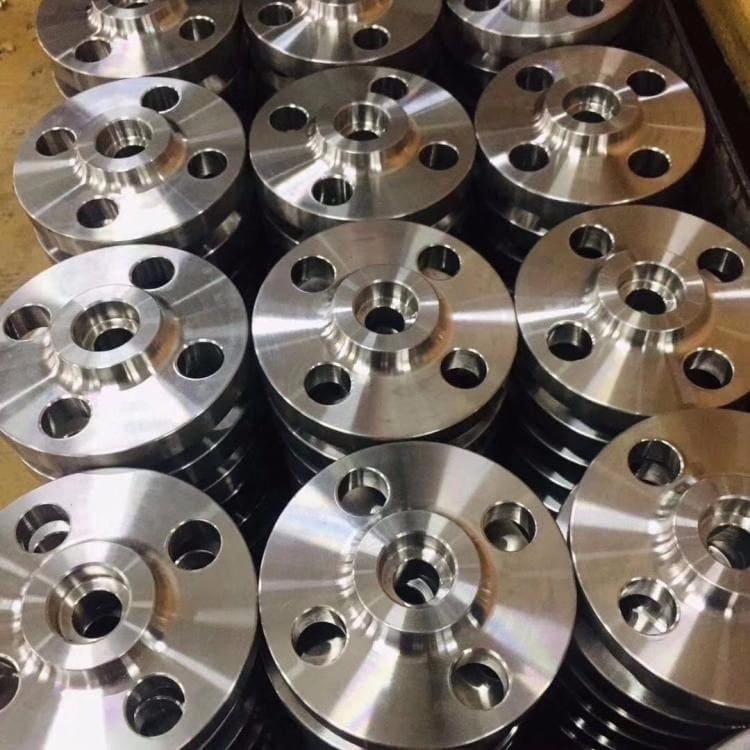
Where the caustic is hottest and the purity strictest: chlor-alkali plants (caustic evaporation trains and the dry-chlorine gas side), viscose rayon works, alumina refinery caustic circuits, caustic fusion and anhydrous handling, fluorine and fluorochemical service, and food, pharma and electronics chemistry where colourless corrosion products protect the product. Production below:
How to Specify & Order a Nickel 200 Socketweld Flange
Six elements — and the service temperature decides the grade:
1
Size & standard — e.g. 1″ NB ASME B16.5, or DN25 EN 1092-1 to order.
2
Pressure class & facing — 150#–1500#; SWRF (the default), SWFF or SWRTJ — with the caustic concentration and temperature, so gasket guidance rides with the quote.
3
Pipe schedule — the through-bore is matched to the pipe ID.
4
Grade line — decided by temperature: Nickel 200 at or below 315 °C; Nickel 201 by name above it; dual 200/201 where the heat qualifies.
5
Certification — EN 10204 3.1 with anneal records (our standard) / 3.2 witnessed, PMI as applicable.
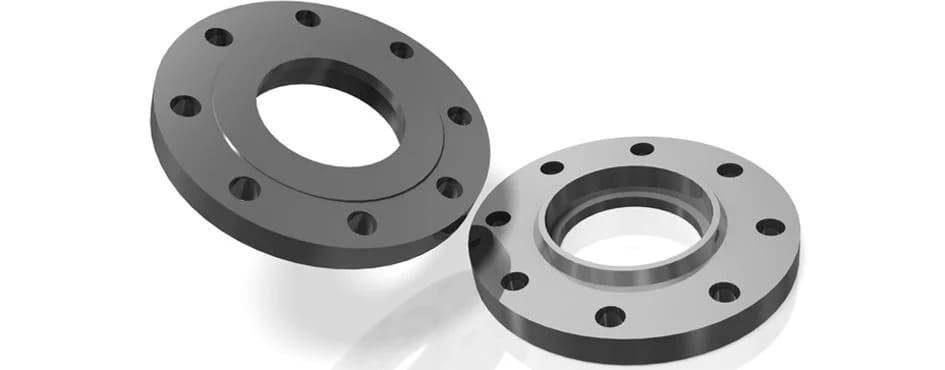
A Nickel 200 socketweld flange is a forged commercially pure nickel flange — at least 99% nickel, with every other element a trace, ASTM B564, UNS N02200, W.Nr. 2.4066 — whose back carries a machined socket: the pipe end seats inside, self-aligned square to the face, and is secured with a single external fillet weld. Where every other metal in this series is nickel plus something — copper for Monel, chromium for Inconel, molybdenum for Hastelloy — Nickel 200 is the element itself, kept pure because its crown duty rewards purity: hot concentrated caustic soda, the one service the whole nickel family serves and pure nickel serves best. Dimensioned to ASME B16.5 for ½" to 3" NB in Classes 150 to 1500 — the family patriarch, in the small-bore pattern.
Why use the pure element instead of an alloy?
Because in nickel's home territory, additions only dilute the virtue. Every alloying element exists to fix a weakness somewhere — copper for reducing acids, chromium for oxidising media, molybdenum for chlorides — but each addition also brings its own vulnerabilities: Monel's copper is what ammonia and stagnant seawater attack; chromium is what caustic slowly leaches. In hot concentrated caustic, nickel itself is the resistant species, and the purer the metal, the cleaner its behaviour — which is why the caustic ladder ends at 99% purity rather than at some cleverer chemistry. The same purity logic serves product-quality duties: nickel's corrosion products are colourless and non-staining, which is why caustic for rayon, food and pharmaceutical use is evaporated in pure nickel rather than anything stronger or cheaper.
What is the chemical composition of Nickel 200 (UNS N02200)?
Nickel 99.0% minimum — and that is the specification. Everything else is a ceiling on impurities: copper ≤0.25%, iron ≤0.40%, manganese ≤0.35%, carbon ≤0.15%, silicon ≤0.35%, sulphur ≤0.010%. Note there are no ranges anywhere except the nickel floor: nothing is added on purpose, and the certificate's job is to prove absence rather than presence. Two ceilings deserve attention: the sulphur limit of 0.010% guards the weldability and hot workability that sulphur destroys in nickel, and the carbon ceiling of 0.15% is the number that separates 200 from its low-carbon sibling 201 — the single most consequential line on this page, covered in the 315°C FAQ below. Chemistry is verified per heat and travels on the EN 10204 3.1 MTC.
Why is Nickel 200 the crown metal of hot caustic?
Because at the top of the caustic map, nothing else keeps up. Sodium and potassium hydroxide grow harsher with concentration and temperature: carbon steel cracks, stainless suffers caustic stress cracking and chromium leaching, and even the nickel alloys give ground as their alloying additions find trouble — until, at the molten-anhydrous extreme of caustic fusion, commercially pure nickel remains the standard engineering answer. The practical map: Monel 400 serves the broad middle economically; Nickel 200/201 owns the hot, strong end — evaporators taking 50% caustic to solid, fusion vessels, and the piping and small-bore trim around them. This is the ladder our Monel 400 page pointed up, and this page is its top. Chlor-alkali plants, viscose rayon works and alumina refineries are the resident industries.
Nickel 200 or 201 — the 315°C rule?
The one specification decision this grade demands, and it is beautifully simple. Nickel 200's carbon ceiling of 0.15% is harmless at ordinary temperatures — but above roughly 315°C, that carbon slowly precipitates as graphite at the grain boundaries, embrittling the metal over years of service; the classic failure is a caustic evaporator coil gone brittle. Nickel 201 is the identical metal with carbon capped at 0.02%: nothing left to graphitise, serviceable to roughly 600°C. So the rule reads: at or below 315°C, either grade serves and 200 is the routine supply; above 315°C, specify 201 by name — and since hot caustic duty often lives exactly there, the question belongs on every enquiry. Our Nickel 201 socketweld page carries the sibling's story; dual-certified 200/201 material, where offered, satisfies both lines.
What are the mechanical properties of Nickel 200 socketweld flanges?
In the annealed condition ASTM B564 requires tensile strength 380 MPa (55 ksi) minimum, yield strength 103 MPa (15 ksi) minimum and elongation 40% minimum — the gentlest, most ductile certificate in this entire socketweld series, and honestly so: pure metals are soft, and nickel is bought here for its chemistry, not its muscle. The engineering consequences are managed by the system: B16.5's pressure-temperature tables for the nickel group already reflect the modest strength, so a properly classed Nickel 200 flange carries its rated duty with the same margins as any other — and the enormous ductility is itself an asset in thermally cycled caustic service. Where a nickel-family duty genuinely needs strength, the conversation moves to Monel 400 or K-500; the caustic crown rarely asks.
Is Nickel 200 magnetic — the party trick?
Yes — and it surprises people holding what they assume is another non-magnetic corrosion alloy. Pure nickel is one of the three ferromagnetic elements (with iron and cobalt), so a Nickel 200 flange sticks to a magnet at room temperature, losing its magnetism only above the Curie point around 355°C. This has practical uses and one warning. Uses: a magnet crudely distinguishes pure nickel from the non-magnetic austenitic stainlesses and most nickel alloys in a mixed store — handy, though PMI remains the real identification. The warning runs the other way: do not reject a Nickel 200 delivery because it is magnetic — that is the metal behaving correctly, and we field the question often enough to give it a FAQ. Magnetically sensitive assemblies, of course, should look to K-500 or the austenitics instead.
Beyond caustic — what else does Nickel 200 serve?
A short, distinguished list, all sharing the reducing-or-dry theme. Dry chlorine and dry hydrogen chloride gas: nickel forms a protective chloride layer and serves to several hundred degrees — a chlor-alkali plant's gas side, to go with its caustic side. Fluorine and fluorides: nickel's fluoride film is among the few that survive, putting the metal alongside Monel in fluorochemical service. High-purity and food-grade process: colourless, non-staining corrosion products protect product quality in food, rayon and electronics chemistry. And the classics of the nobility principle it shares with Monel: de-aerated brine and reducing salt chemistry. The mirror-image limits also carry over: oxidising acids attack it, and hot sulphur-bearing atmospheres embrittle it — stated plainly in the notes on this page.
What are Nickel 200's honest weaknesses?
Four, none of them secrets. Oxidising media: like Monel, pure nickel has no chromium film — nitric acid, ferric and cupric salts and strongly aerated acids attack the bare metal; the chemistry must run reducing or dry. Hot sulphur: above roughly 315-350°C, sulphur-bearing gases and deposits embrittle nickel along its grain boundaries — the oldest rule in nickel metallurgy, and why sulphur-free handling matters right down to marking crayons. Graphitisation: 200's own carbon turns against it above 315°C — the sibling FAQ's whole subject. And strength: 103 MPa yield is the series' gentlest, managed by B16.5's tables but worth remembering where mechanical abuse is possible. None of these touch the caustic crown; all of them belong in the specification conversation.
How is a Nickel 200 socketweld flange welded?
Straightforwardly, with the nickel family's cleanliness religion. Geometry is standard: pipe bottomed in the socket, withdrawn 1/16" (1.6 mm) to leave the expansion gap, single external fillet weld — with ERNi-1, the matching pure-nickel filler. No preheat, no PWHT. The discipline is contamination control: sulphur, lead and zinc embrittle hot nickel, so joints are degreased, marking materials checked, and tooling dedicated; weld metal is sluggish and does not wet like steel, so slightly wider bevels and unhurried technique are normal practice. For 201-grade weldments the same filler serves. Our flanges arrive annealed with records, and WPS guidance naming ERNi-1 travels with every supply.
What facings are Nickel 200 socketweld flanges made with?
All three, each with its own page on this site: raised face (SWRF) — the default, with PTFE or graphite spiral wound gaskets by service — flat face (SWFF) for GRP, lined and cast equipment mates, and ring type joint (SWRTJ) for the rare high-pressure case, with soft iron or nickel rings per the duty. The caustic-service note: gasket selection follows the concentration and temperature — PTFE retires early in hot caustic, graphite and specialised systems carry the top of the map, and the recommendation rides with our quotation when the duty is stated. In caustic plants, bolting and flange faces also appreciate the same clean, chloride-free handling the process demands. NPT-tapped variants are machined and certified at the works.
What sizes and pressure classes do Nickel 200 socketweld flanges come in?
ASME B16.5 standardises socket weld flanges from ½" to 3" NB in Classes 150, 300, 600, 900 and 1500 — Class 900 sharing Class 1500 dimensions in most small-bore sizes — with 4" and Class 2500 made to order. Caustic and chlor-alkali small bore lives almost entirely in Classes 150 and 300: evaporator trim, dosing lines, sample points and gas-side connections run at modest pressures where the chemistry, not the rating, drives the specification. Put the pipe schedule on the enquiry — the through-bore is matched to the pipe ID — and B16.5's nickel-group tables, which already reflect the metal's gentle strength, govern the rating; our quotations state it per class.
What details are needed to get an accurate Nickel 200 socketweld flange quotation?
Six elements plus one temperature question: (1) size — ½" to 3" NB; (2) pressure class — 150 to 1500; (3) facing — SWRF, SWFF or SWRTJ with ring number; (4) the pipe schedule, so the through-bore matches the pipe ID; (5) the grade line — Nickel 200, ASTM B564, UNS N02200 or W.Nr. 2.4066 all name the same metal — and here the temperature question: if service exceeds 315°C, the enquiry should read Nickel 201 (UNS N02201) instead, and we will ask if it is unstated; (6) certification — EN 10204 3.1 with anneal records (our standard) or 3.2 witnessed, PMI as applicable. Add the caustic concentration and temperature for gasket guidance, plus quantity and destination. Quotations normally within 24 hours.
Is Nickel 200 stocked or made to order?
A steady specialist item. Chlor-alkali, viscose and alumina plants generate continuous maintenance demand for pure-nickel small bore, so common sizes in Classes 150 and 300 turn over regularly — often available quickly — while larger sizes and higher classes are forged to order from certified N02200 heats held with our nickel-alloy stock. Typical to-order lead times run days to a few weeks by quantity; caustic-plant shutdown windows are a duty we know — say so on the enquiry and small lots can usually be expedited. The EN 10204 3.1 certificate carries the 2.4066 designation where European documentation expects it, and dual 200/201 certification is stated where the heat qualifies.
Who manufactures Nickel 200 socketweld flanges in India?
Tesco Steel & Engineering is an ISO 9001:2015 certified flange manufacturer based in Mumbai, India, producing Nickel 200 (ASTM B564, UNS N02200) socket weld flanges from ½" to 3" NB (larger to order) in Classes 150-1500 — each forged from certified heats, annealed with furnace records against the heat number, machined on dedicated nickel-alloy stations with sulphur-free lubricants, gauged socket depth and schedule-matched bore, PMI-checked — the ≥99% nickel confirmed on every piece — and laser-marked with grade, size, class, schedule and heat number. Supplied with EN 10204 3.1/3.2 certification and ERNi-1 WPS guidance, alongside the Nickel 201 sibling, the Monel family and the full nickel-alloy socketweld range this series covers. Exported to more than 50 countries.