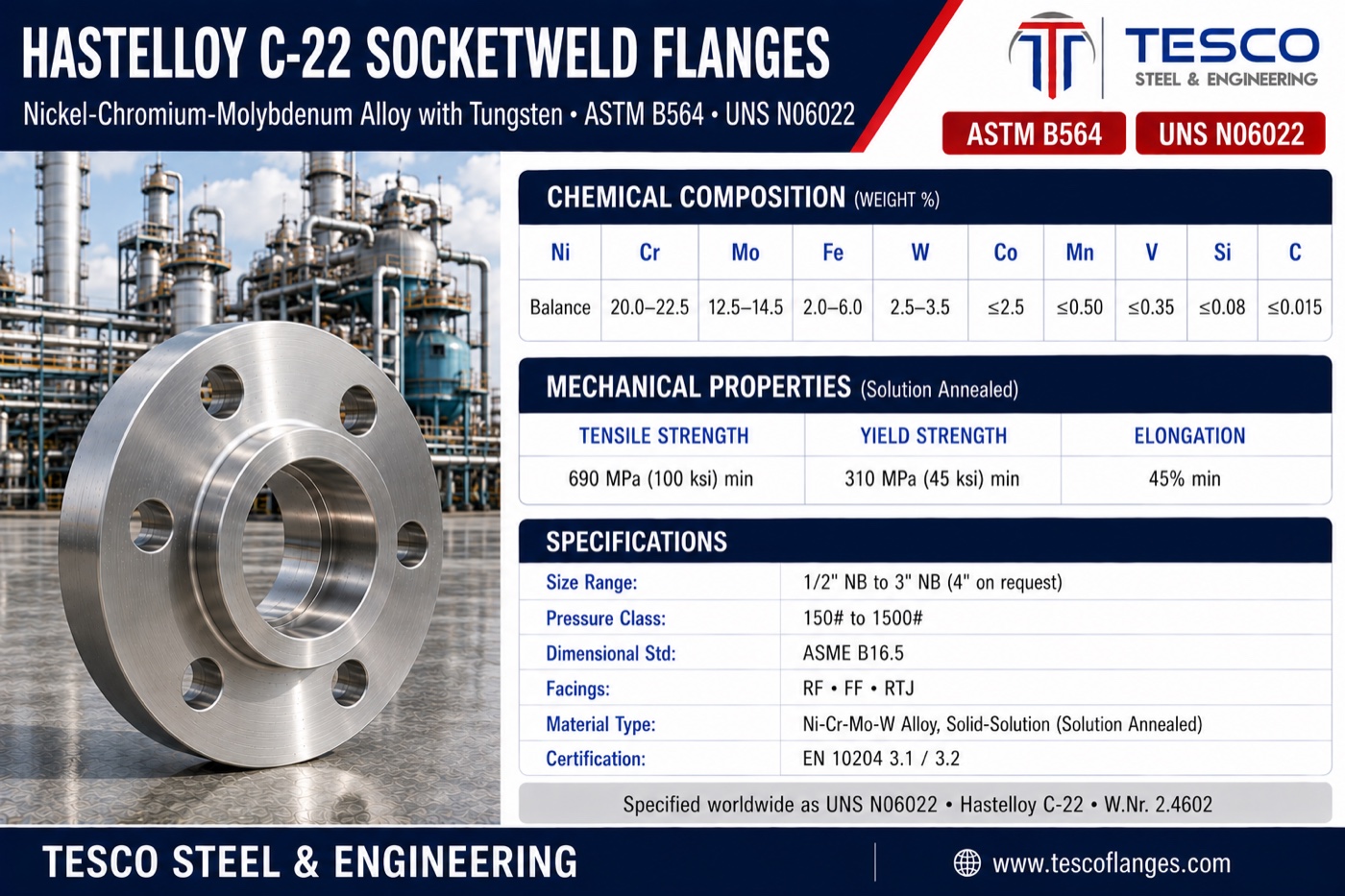
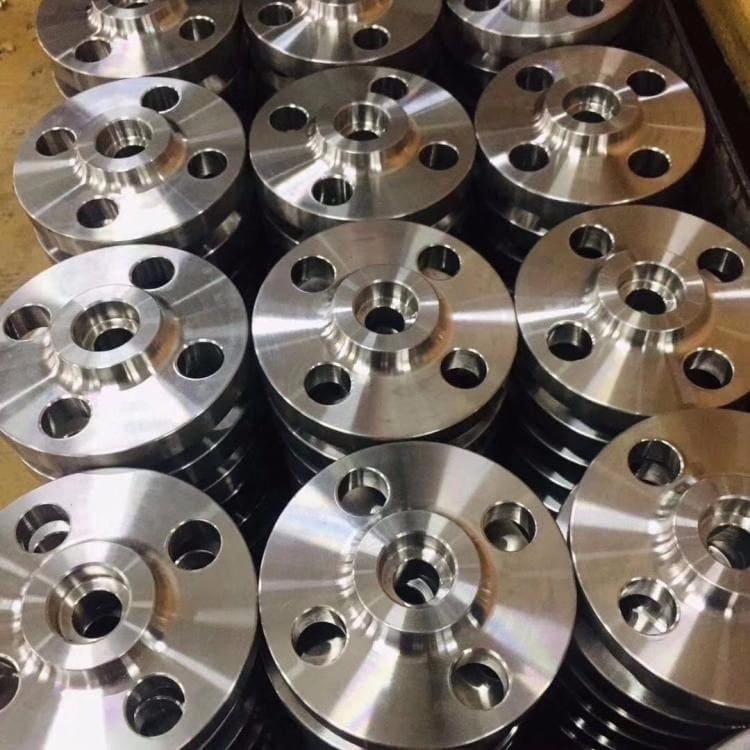
Tesco Steel & Engineering manufactures Hastelloy C-22 socketweld flanges — the balanced sibling: ASTM B564, UNS N06022, W.Nr. 2.4602 — to ASME B16.5 from ½″ to 3″ NB in Classes 150–1500. Where C-276 spends everything on the reducing frontier, C-22 rebalances the budget: chromium raised to 20–22.5% — a real second front against oxidising acids, ferric chlorides and wet oxidising chlorine — while 12.5–14.5% molybdenum with 2.5–3.5% tungsten keeps most of the reducing defence. The result is the widest single-alloy coverage on this site, built for the plants whose chemistry changes with the batch: multi-product works, pharma campaigns, waste streams, incinerator scrubbers — plus the family's best pitting and crevice numbers, a genuinely relevant credential for a gasketed, crevice-rich thing like a flange joint. The C-family weldability carries over: C ≤0.015%, as-welded service, no preheat, no PWHT, with matching ERNiCrMo-10. The honest splits are below: known steady reducing service keeps C-276; offshore strength stays with 625; nameable chemistry may belong down the ladder. Facings: SWRF, SWFF, SWRTJ. Every lot with EN 10204 3.1/3.2 MTC. ISO 9001:2015, made in Mumbai, India — exported to 50+ countries.
Hastelloy C-22 · B564 · N06022 · 2.4602Cr 20–22.5% + Mo 12.5–14.5% + WTwo Fronts — Oxidising and ReducingThe Grade for Unknown ChemistryPitting & Crevice — Best in the Family690 / 310 MPa · 45% ElongationASME B16.5 ½″–3″ · Class 150–1500EN 10204 3.1 / 3.2 · ISO 9001:2015
Hastelloy C-22 Socketweld Flanges — Specifications at a Glance
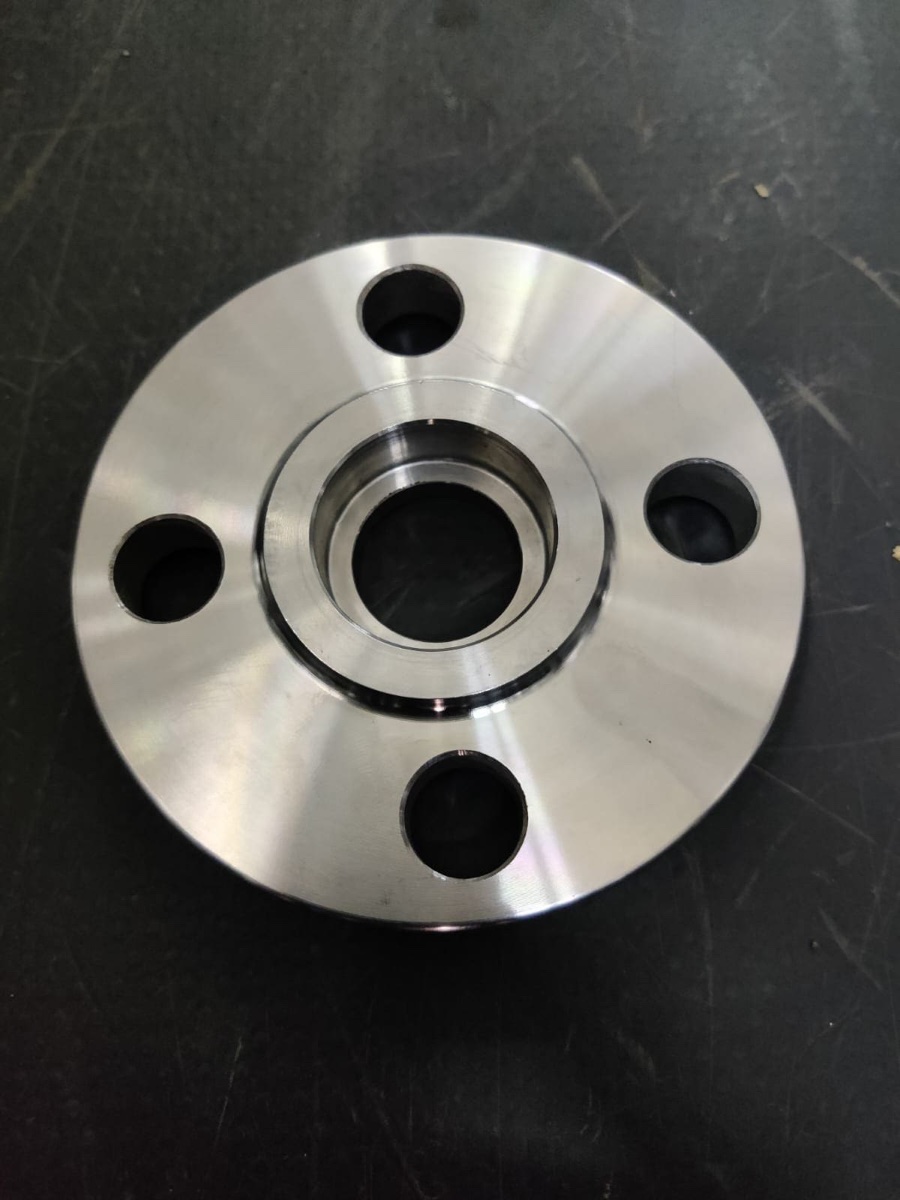
What is a Hastelloy C-22 Socketweld Flange?
The balanced sibling in the small-bore pattern. A forged Hastelloy C-22 flange (ASTM B564 / UNS N06022 / W.Nr. 2.4602) with a machined socket: pipe seated square by geometry, one external fillet weld — no preheat, no PWHT, as-welded corrosion service — through-bore matched to the pipe schedule. Cr 20–22.5% covers the oxidising front; Mo 12.5–14.5% + W 2.5–3.5% guard the reducing front — the widest single-alloy coverage on this site, with the family's best pitting and crevice numbers. C ≤0.015%, Si ≤0.08% keep the HAZ clean. Tensile ≥690 MPa, yield ≥310 MPa, elongation ≥45% — the series' most ductile certificate. Sized by ASME B16.5 at ½″–3″ NB, Classes 150–1500; EN 10204 3.1 on every lot.
Two fronts — the grade for chemistry you cannot name
This page
The rule of the siblings: can you name the medium? Named, steady, reducing — C-276. Swinging, oxidising-leaning, or unknown — C-22. Prices sit close; let the chemistry decide.
What the Rebalanced Budget Buys
The Second Front
Cr 20–22.5% is real armour against oxidising acids, ferric and cupric chlorides and wet oxidising chlorine — the flank its sibling deliberately leaves thin.
The Reducing Defence, Kept
Mo 12.5–14.5% with W 2.5–3.5% is still a massive dose — hot sulphuric, phosphoric and HCl duty short of the sibling's deepest territory remain on the menu.
The Localised-Corrosion Crown
Cr + Mo + W together give the family's best pitting and crevice temperatures — for a bolted, gasketed, crevice-rich flange joint, the most relevant credential there is.
Honesty About the Known
When the medium can be named, a named alloy usually wins — C-276 for steady reducing service, the cheaper rungs for nameable duties. C-22's premium is for the routing sheet that says various.
Hastelloy C-22 Chemical Composition (UNS N06022)
Element
Ni
Cr
Mo
Fe
W
Co
Mn
V
Si
C
Weight %
Balance
20.0–22.5
12.5–14.5
2.0–6.0
2.5–3.5
≤2.5
≤0.50
≤0.35
≤0.08
≤0.015
Read it against the sibling: chromium up six points, molybdenum down two and a half, tungsten trimmed half a point, manganese halved — every change funds the second front. The crushed carbon and silicon carry over: the C-family's as-welded service is a shared inheritance. PMI confirms the Cr-Mo-W signature on every piece.
Mechanical Properties (Solution Annealed)
Property
ASTM B564 N06022 Requirement
Tensile Strength
≥ 690 MPa (100 ksi)
Yield Strength (0.2%)
≥ 310 MPa (45 ksi) — a step above its sibling's floor
Elongation
≥ 45% — the most ductile certificate in this entire series
Condition
Solution Annealed (~1120 °C, rapid quench) — furnace records certified
Temperature Span
Cryogenic to a few hundred degrees in practice — an aqueous alloy by design; 600–800 °C dwell ages the Mo-W solution; the fire belongs to other families
Rating
B16.5 nickel-alloy tables govern the joint — gasket-limited before metal-limited; stated per class on our quotations
One Socket, Three Facings — Campaign-Plant Practice
A note the crevice numbers earn: under-gasket crevices are where chloride service quietly kills lesser flanges — C-22's crown credential works precisely there. State the mate and medium (or its range); gasket guidance rides with the quotation.
Hastelloy C-22 Socketweld Flange Specifications
Hastelloy C-22 Socketweld Flanges are available in the following specifications:
Material Grade
Hastelloy C-22, ASTM B564 (UNS N06022), W.Nr. 2.4602 — certificates carry the designations your documentation uses
Heat Treatment
Solution annealed (~1120 °C, rapid quench) with furnace records certified
Size
1/2"NB to 3"NB per ASME B16.5; 4″ and larger to order; EN 1092-1 patterns to order
Class
150#, 300#, 600#, 900#, 1500# (900# shares 1500# dimensions in most sizes) — chemistry duty lives in 150/300
Facings
Raised Face (SWRF), Flat Face (SWFF), Ring Type Joint (SWRTJ) with groove per B16.20
Bore
Socket bore to pipe OD; through-bore matched to pipe schedule
Welding
Single external fillet with 1/16″ expansion gap; matching ERNiCrMo-10 filler; as-welded corrosion service — no preheat, no PWHT; sulphur-clean practice
Service Span
Swinging and unknown aggressive chemistry — multi-product plants, campaigns, waste streams, incinerator scrubbers; oxidising chlorides and wet chlorine; named reducing duty to C-276, offshore strength to 625, nameable media down the ladder — see the notes
Tension & chemistry per heat; PMI on every piece — the Cr-Mo-W signature confirmed; socket depth and bore gauged
Certification
EN 10204 3.1 with solution-anneal records (standard) / 3.2 witnessed
Specification Notes — Getting Alloy C-22 Sockets Right
Four honest notes.Known steady reducing service keeps the sibling: in hot and boiling HCl and the deepest reducing sulphuric, C-276's extra molybdenum is the better spend — its page says so from the other side. Nameable chemistry may belong down the ladder:825 for sour breadth, Alloy 20 for named sulphuric, 904L on price — our quotation names the lowest rung that honestly serves. Pure hot nitric still favours plain chromium grades — even the balanced budget is not that front's specialist. And keep it wet: 600–800 °C dwell ages the Mo-W solution — the fire belongs to the Inconels and the 800 family.
How Our Hastelloy C-22 Socketweld Flanges Are Manufactured
1
Forging — cut billet of the spectro-verified N06022 heat is hot-forged into the flange blank with full heat traceability and segregated nickel-alloy handling.
2
Solution annealing — ~1120 °C with rapid quench keeps the Cr-Mo-W solution clean and both fronts at full strength; furnace charts retained against the heat number.
3
Machining — faces, OD and drilling to ASME B16.5 on dedicated stations with sulphur-free lubricants; the tough matrix machined with rigid carbide discipline; socket counterbore and depth gauged piece by piece, through-bore matched to the ordered schedule.
4
Facing — RF serrations, flat face or RTJ groove per B16.20.
5
Testing & marking — tension and chemistry per heat; PMI on every piece; laser-marked with grade, size, class, schedule and heat number.
6
Certification & packing — EN 10204 3.1 MTC with solution-anneal records (3.2 witnessed on request); WPS guidance included; packed sea-worthy with no carbon-steel contact.
Where Hastelloy C-22 Socketweld Flanges Are Used
Wherever the routing sheet says “various”: multi-product chemical works and campaign reactors, pharmaceutical and fine-chemical plants, waste-treatment headers and incinerator scrubber systems, FGD and bleach-plant duty shared with its sibling, oxidising-chloride process liquor, and the crevice-critical chloride services where its localised-corrosion crown pays. Production below:
Socket weld flange dimensions are class-governed per ASME B16.5 — identical across material grades (pressure-temperature ratings follow the nickel-alloy group). Full charts:
How to Specify & Order a Hastelloy C-22 Socketweld Flange
Six elements — and “it varies” is a valid answer here:
1
Size & standard — e.g. 1″ NB ASME B16.5, or DN25 EN 1092-1 to order.
2
Pressure class & facing — 150#–1500#; SWRF (the default), SWFF (lined and FRP mates) or SWRTJ — with the design temperature.
3
Pipe schedule — the through-bore is matched to the pipe ID.
4
Grade line & the medium — or its range — Hastelloy C-22 / B564 / N06022 / 2.4602; state the chemistry, or state honestly that it swings — swinging is C-22's case; a nameable medium may belong to C-276, 625 or a cheaper rung, and our quotation says which.
5
Certification — EN 10204 3.1 with solution-anneal records (our standard) / 3.2 witnessed, PMI as applicable.
A Hastelloy C-22 socketweld flange is a forged nickel-chromium-molybdenum alloy flange — a nickel balance carrying 20-22.5% chromium, 12.5-14.5% molybdenum and 2.5-3.5% tungsten, with carbon held at ≤0.015%, ASTM B564, UNS N06022, W.Nr. 2.4602 — whose back carries a machined socket: the pipe end seats inside, self-aligned square to the face, and is secured with a single external fillet weld. C-22 is the balanced sibling of the C-family: chromium raised to cover the oxidising chemistry its sibling C-276 concedes, the molybdenum-tungsten pair kept massive enough to guard the reducing side — the widest single-alloy coverage on this site, built for the plants whose chemistry changes with the batch. Dimensioned to ASME B16.5 for ½" to 3" NB in Classes 150 to 1500.
What makes C-22 the balanced sibling of C-276?
One trade, deliberately struck. C-276 spends everything on the reducing frontier: 15-17% molybdenum, chromium held to a modest 14.5-16.5% — unbeatable in boiling HCl, thin against hot oxidisers. C-22 rebalances the same budget: chromium raised to 20-22.5% — real armour against oxidising acids, ferric and cupric chlorides, wet oxidising chlorine chemistry — while molybdenum is trimmed to a still-massive 12.5-14.5% with 2.5-3.5% tungsten, keeping most of the reducing defence. The result gives up a little of C-276's deepest territory and gains an entire second front. Both carry the crushed carbon and silicon that make the C-family weldable as-welded. Two siblings, one budget, two different bets — and the right one depends entirely on whether you can name the medium.
Why is C-22 the grade for unknown and swinging chemistry?
Because balance beats depth when the enemy keeps changing. A multi-product chemical plant runs acid campaigns one month and oxidising liquor the next; a waste stream carries whatever the upstream units discard; an incinerator scrubber sees oxidising chlorides, reducing condensates and everything between, sometimes in the same hour. A specialist alloy optimised for one direction can be attacked from the other — C-276's modest chromium is its known flank. C-22's raised chromium plus retained Mo-W means there is no easy flank: oxidising swings meet the chromia film, reducing swings meet the noble Mo-W matrix, and chloride excursions meet the family's best localised-corrosion numbers. That is why multi-product plants, pharma campaign reactors, waste-treatment and incinerator systems standardise on it: one certificate that does not need to know next month's chemistry.
What is the chemical composition of Hastelloy C-22 (UNS N06022)?
Nickel the balance (roughly 56%), chromium 20.0-22.5%, molybdenum 12.5-14.5%, tungsten 2.5-3.5%, iron 2.0-6.0% — a deliberate range — cobalt ≤2.5%, manganese ≤0.50%, vanadium ≤0.35%, silicon ≤0.08% and carbon ≤0.015% — the C-family's crushed impurities, buying as-welded service. Read it against the sibling: chromium up six points, molybdenum down two-and-a-half, tungsten trimmed half a point, manganese halved — every change funds the second front. Nothing is spent on hardening or stabilising; the impurity control does that job. Chemistry is verified per heat, PMI-confirmed on every piece, and travels on the EN 10204 3.1 MTC.
What are the mechanical properties of Hastelloy C-22 socketweld flanges?
In the solution-annealed condition ASTM B564 requires tensile strength 690 MPa (100 ksi) minimum, yield strength 310 MPa (45 ksi) minimum and elongation 45% minimum — the most ductile certificate in this entire socketweld series, a step past even C-276's 40%, with a slightly higher yield floor as well. The character matches: gummy, tough, forgiving from cryogenic temperatures up, no hardening treatments, nothing for fabrication to disturb. The solution anneal (around 1120°C with rapid quench) is certified with furnace records. B16.5's nickel-alloy pressure-temperature tables govern the flange rating, and the joint keeps the series' two-ceilings honesty — gasket and rating retire the bolted connection long before the metal.
What can C-22 actually take — in both directions?
Reading both halves of the ledger: on the oxidising side — ferric and cupric chloride solutions (the classic C-22 credential, brutal to most alloys), wet chlorine and hypochlorite, chlorine dioxide bleach chemistry, nitric-bearing mixed acids and oxidising process liquor that would strip its sibling's thinner chromia. On the reducing side — hot sulphuric and phosphoric across wide ranges, hydrochloric duty short of C-276's deepest hot-and-boiling territory, organic acids, and the acidic chloride condensates of scrubber service. Across both — seawater, brines and hot chloride solutions with critical pitting and crevice temperatures at the top of the family. The one honest exclusion stands: pure hot concentrated nitric still favours plain high-chromium grades. As at the C-276 rung: state medium, concentration and temperature — at this altitude, data decides.
Is C-22 really the pitting and crevice champion?
Among this site's grades, yes — that is the arithmetic of its design. Pitting resistance rises with chromium, molybdenum and tungsten together, and C-22 is the only alloy here that carries all three in quantity: 20-22.5% chromium plus 12.5-14.5% molybdenum plus tungsten gives it critical pitting and crevice temperatures beyond even C-276 in standard oxidising-chloride tests, and far beyond the 6Mo and super duplex bench. In practice that means crevices under gaskets and deposits, stagnant chloride liquor, oxidising chloride mixtures — the localised attacks that quietly kill lesser flanges — need service conditions more severe than almost any plant produces. It is also why C-22 became a reference alloy for the most conservative long-term containment engineering in the world. For a bolted, gasketed, crevice-rich thing like a flange joint, that is a genuinely relevant credential.
Hastelloy C-22 or C-276 — how do the siblings split?
By one question: can you name the medium? If the service is known, steady and reducing — hot HCl, reducing sulphuric, the classic FGD condensate — C-276 is the deeper specialist and takes the order, as its page says from the other side. If the chemistry swings, oxidises, or simply is not fully known — multi-product plants, batch campaigns, waste streams, oxidising chloride liquor — C-22's second front earns its place, and its best-in-class localised-corrosion numbers add margin everywhere. Prices sit close enough that the chemistry, not the budget, should decide. The two share the crushed-carbon weldability, the same facings and the same small-bore practice, and plenty of plants stock both — 276 on the named reducing lines, 22 everywhere the routing sheet says ‘various’.
Hastelloy C-22 or Inconel 625?
A real overlap, honestly divided. Both carry high nickel, high chromium and serious molybdenum; both weld beautifully with their own wires. 625's case: the 827 MPa niobium certificate, the offshore and sour-service pedigree, NACE fame and the strength-driven order book — where mechanics and chlorides stack, 625 is the complete package. C-22's case: four to five more points of molybdenum plus tungsten, visibly deeper reducing-acid coverage, and the family's best pitting and crevice numbers — where the duty is aggressive chemistry rather than strength, C-22 out-armours it. The practical split mirrors the plants themselves: offshore platforms and wellheads — 625; chemical works, scrubbers and campaign reactors — C-22. Between them sits price and availability, which fairly settle the borderline cases.
When do the cheaper rungs suffice instead of C-22?
Whenever the chemistry can be named and a named alloy covers it — the same ladder honesty as everywhere on this site. Known sulphuric plant: Alloy 20 and 904L carry their classic ranges at far friendlier prices. Sour gas with chlorides: 825 built its career there. Chlorinated seawater and film-only duty: 254 SMO and the super duplexes serve at stainless-adjacent cost. Known steady reducing service: C-276, the deeper sibling. C-22's premium is earned precisely where naming fails — the multi-product routing sheet, the waste header, the campaign reactor, the scrubber that sees everything — or where localised corrosion margins must be maximal. Send the medium, or the honest admission that it varies, with the enquiry: our quotation names the lowest rung that truly serves, and ‘it varies’ is exactly when this page is the answer.
How is a Hastelloy C-22 socketweld flange welded?
With the C-family's easy conscience and its own wire. Geometry is standard: pipe bottomed in the socket, withdrawn 1/16" (1.6 mm) to leave the expansion gap, single external fillet weld — no preheat, no PWHT, and thanks to the crushed carbon and silicon the joint goes into corrosion service as-welded. Filler is matching ERNiCrMo-10 — and C-22 wire has a second career of its own: it is a favourite over-alloyed consumable and overlay chemistry across the C-family and beyond, valued for keeping weld-metal pitting resistance above the plates it joins. The puddle is sluggish nickel-family standard — let placement do the work — and cleanliness is absolute: sulphur-free lubricants, dedicated brushes, no carbon-steel contact, low-oxide shielding. WPS guidance travels with every supply.
How hot can Hastelloy C-22 actually go?
The same honest envelope as its sibling: hot enough for any wet duty it will meet, and it should stay wet. The code recognises C-22 into the 600°C region, but long dwell between roughly 600 and 800°C precipitates the same family of intermetallic phases that trouble all heavy Mo-W solutions, costing ductility and corrosion edge — this is an aqueous alloy, and the fire belongs to the Inconels and the 800 family. Its actual applications never ask for more: scrubbers, reactors, bleach plants and waste systems live from ambient to low hundreds. The two-ceilings honesty applies as everywhere — B16.5's nickel-alloy tables and the gasket system govern the bolted joint — and the practical rule is simple: if the enquiry reads hot and dry, it belongs to a different bench than the C-family.
What sizes and pressure classes do Hastelloy C-22 socketweld flanges come in?
ASME B16.5 standardises socket weld flanges from ½" to 3" NB in Classes 150, 300, 600, 900 and 1500 — Class 900 sharing Class 1500 dimensions in most small-bore sizes — with 4" and Class 2500 made to order. C-22's order book mirrors its sibling's: overwhelmingly Classes 150 and 300, because scrubber, reactor and waste-system small bore runs at modest pressures where the chemistry is the entire specification — with upper classes for high-pressure chemical duty. All three facings are available: SWRF the default, SWFF for the lined, glass-lined and FRP equipment that campaign chemistry lives with, SWRTJ for the rare high-pressure case. Put the pipe schedule on the enquiry — the through-bore is matched to the pipe ID — and B16.5's nickel-alloy tables set the rating; our quotations state it per class.
What details are needed to get an accurate Hastelloy C-22 socketweld flange quotation?
Six elements plus commercial terms: (1) size — ½" to 3" NB; (2) pressure class — 150 to 1500, with the design temperature; (3) facing — SWRF, SWFF or SWRTJ with ring number; (4) the pipe schedule, so the through-bore matches the pipe ID; (5) the grade line — Hastelloy C-22, ASTM B564, UNS N06022 or W.Nr. 2.4602 all name the same metal — with the medium stated, or the honest note that it varies: swinging and unnamed chemistry is precisely C-22's case, while a nameable medium may belong to C-276, 625 or a cheaper rung, and our quotation says which; (6) certification — EN 10204 3.1 with solution-anneal records (our standard) or 3.2 witnessed, PMI as applicable. Add quantity and destination; quotations normally within 24 hours.
Who manufactures Hastelloy C-22 socketweld flanges in India?
Tesco Steel & Engineering is an ISO 9001:2015 certified flange manufacturer based in Mumbai, India, producing Hastelloy C-22 (ASTM B564, UNS N06022) socket weld flanges from ½" to 3" NB (larger to order) in Classes 150-1500 — each forged from certified heats, solution-annealed with furnace records against the heat number, machined on dedicated nickel-alloy stations with sulphur-free lubricants, gauged socket depth and schedule-matched bore, PMI-checked — the Cr-Mo-W signature confirmed on every piece — and laser-marked with grade, size, class, schedule and heat number. Supplied with EN 10204 3.1/3.2 certification and WPS guidance, alongside the C-276 sibling, the full acid ladder from 904L through Alloy 20 and 825, and the complete nickel-alloy socketweld range this series covers. Exported to more than 50 countries.