UNS N02201 Weld Neck Flanges — Low-Carbon Nickel 201 (2.4068)
Tesco Steel & Engineering forges UNS N02201 weld neck flanges in Nickel 201 — Werkstoff Nr. 2.4068, commercially pure nickel with carbon capped at 0.02% — to ASTM B564, from 1/2″ NB to 56″ NB in ASME B16.5 Class 150–2500 and European PN patterns. The low carbon removes the graphitization ceiling that stops Nickel 200 at 315 °C, carrying pure nickel's caustic-soda supremacy — through evaporation into molten anhydrous NaOH — and its dry chlorine and fluorine capability to around 600 °C. Mating B161 pipe, welded with ERNi-1; dual-certified 200/201 heats cover both callouts. Supplied with PMI and EN 10204 3.1/3.2 on request. ISO 9001:2015, made in Mumbai, India — exported worldwide.
Nickel 201 · UNS N02201 · 2.4068
C 0.02% Max · No Graphitization
ASTM B564 / ASME SB-564
Molten Caustic · To ~600 °C
Dry Halogens · Food Grade
1/2″ – 56″ NB · Class 150–2500
ISO 9001:2015 · Exported Worldwide
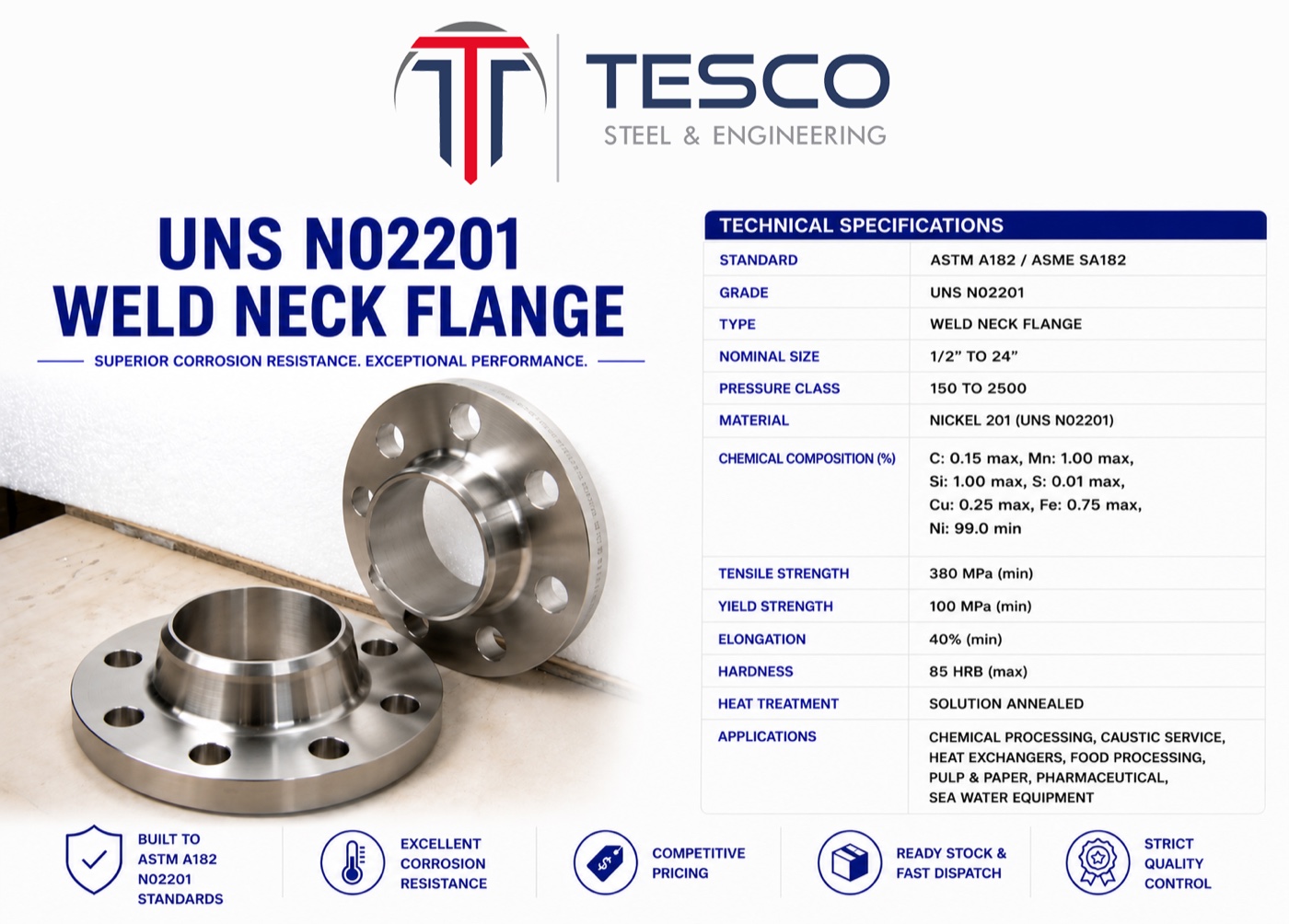
UNS N02201 Weld Neck Flange — Nickel 201 (2.4068), Technical Specifications
What is a UNS N02201 (Nickel 201) Weld Neck Flange?
Nickel 201 (UNS N02201 / 2.4068) is commercially pure nickel with one deliberate change from grade 200: carbon capped at 0.02%. That cap removes the graphitization mechanism that embrittles standard nickel above 315 °C — so 201 carries pure nickel's caustic supremacy and dry-halogen capability to ~600 °C, including molten anhydrous NaOH. A N02201 weld neck flange pairs that chemistry with a long tapered hub butt-welded to the pipe, forged to ASTM B564.
The logic mirrors L-grade stainless applied to a different failure mode: leave too little carbon to precipitate, and the damage mechanism never starts. Below 315 °C the grades behave identically — which is why modern melts are often dual-certified 200/201, answering the temperature question before it is asked. For the full pure-nickel story — caustic, purity, halogens — see our Nickel 200 weld neck flanges page.
Its home duty is caustic fusion: anhydrous NaOH runs molten at 320–480 °C, above 200's ceiling and beyond anything stainless survives — fusion pots, transfer lines and their flanged joints specify 201 by name.
Also searched as: Nickel 201 flange, low carbon nickel flange, N02201 flange, 2.4068 flange, LC-Ni 99 flange, ASTM B564 nickel 201 flange — all refer to the product on this page.
Chemical Composition of UNS N02201
| C | Mn | Si | S | Cu | Fe | Ni |
|---|
| 0.02 max | 0.35 max | 0.35 max | 0.01 max | 0.25 max | 0.40 max | 99.00 min |
Values in weight %. The 0.02% carbon ceiling is the grade's entire identity — everything else matches standard Nickel 200. Every certificate demonstrates it, because the high-temperature rating depends on it.
Mechanical Properties of UNS N02201
| Tensile Strength, MPa | Yield Strength, Min, MPa | Elongation % min. |
|---|
| 403 | 103 | 45 |
Typical annealed values per our supply practice; the governing ASTM B564 minimums are 345 MPa (50 ksi) tensile, 80 MPa (12 ksi) yield and 40% elongation, demonstrated on every certificate. The low carbon makes 201 slightly softer than 200 — the deliberate price of the temperature capability, already reflected in the pressure-temperature ratings.
Equivalent Grades of UNS N02201
| Standard | Werkstoff Nr. | UNS | JIS | BS | GOST | EN |
|---|
| Nickel 201 | 2.4068 | N02201 | NW 2201 | NA 12 | НП-2 | LC-Ni 99 |
The standard-carbon parent is Nickel 200 / N02200 / 2.4066. System partners: ASTM B161 seamless pipe, B366 butt-weld fittings, B162 plate and B564 forgings.
UNS N02201 Weld Neck Flange Specifications
| Nickel 201 Weld Neck Flanges are available in the following specifications: |
|---|
| Size | 1/2"NB to 56"NB |
| Class | 150#, 300#, 400#, 600#, 900#, 1500#, 2500# |
| Sch (Schedule) | XS, XXS, STD & Schedule 20, 40, 80, 160 |
| Pressure Ratings | PN 2.5 - PN 400 |
| Standards | ASTM B564 / ASME SB-564; ASME B16.5, ASME B16.47, EN 1092-1, DIN 2631–2635, BS 4504 |
| Condition | Annealed; dual-certifiable Nickel 200/201 |
| Other Services | Sand Blasting on Nickel 201 Weld Neck Flanges
Shot Peening on Nickel 201 Weld Neck Flanges
Fine surface finishes for food & high-purity duty
PMI testing & dye-penetrant examination
Project-specific marking, wrapping & export packing |
Why Nickel 201 Owns the Hot End of Pure Nickel
Molten Caustic Capability
Anhydrous NaOH fusion at 320–480 °C — above 200's ceiling, beyond stainless entirely — is the duty the grade was made for.
No Graphitization, Ever
0.02% carbon leaves nothing to precipitate — the embrittlement mechanism that limits standard nickel simply never starts.
Hot Halogens
Dry chlorine, HCl, fluorine and HF gas to several hundred degrees with ductility intact — fluorine generation systems specify 201 by name.
Purity Preserved
Same elemental cleanliness as Nickel 200 — no Cu, Cr or Mo to leach — for hot high-purity and food chemistry.
Dual-Certified 200/201
One heat, both grades on the certificate — inventory consolidates and the 315 °C question answers itself.
Welding Nickel 201 — Same Discipline, Rating Preserved
Nickel 201 welds with ERNi-1 / ENi-1 filler and the strictest nickel cleanliness — sulphur from markers, oils or shop grime embrittles hot pure nickel, so joints are degreased and handled clean end to end. Low heat input, no preheat, no PWHT — and because ERNi-1 weld metal is itself low-carbon, the joint keeps the 201 temperature rating straight through the weld.
Grade-selection note: below 315 °C,
Nickel 200 serves identically — specify 201 (or dual-certified stock) whenever the design temperature crosses that line. The universal caution on hot sulphur-bearing atmospheres applies to all nickel grades.
Where UNS N02201 Weld Neck Flanges Are Used
Caustic fusion leads: molten-NaOH pots, high-concentration evaporators and their transfer lines — the grade's defining service. Hot halogen chemistry follows in chlor-alkali and fluorine plants, then high-temperature food and fibre processing and hot high-purity chemical duty. Our nickel production below:
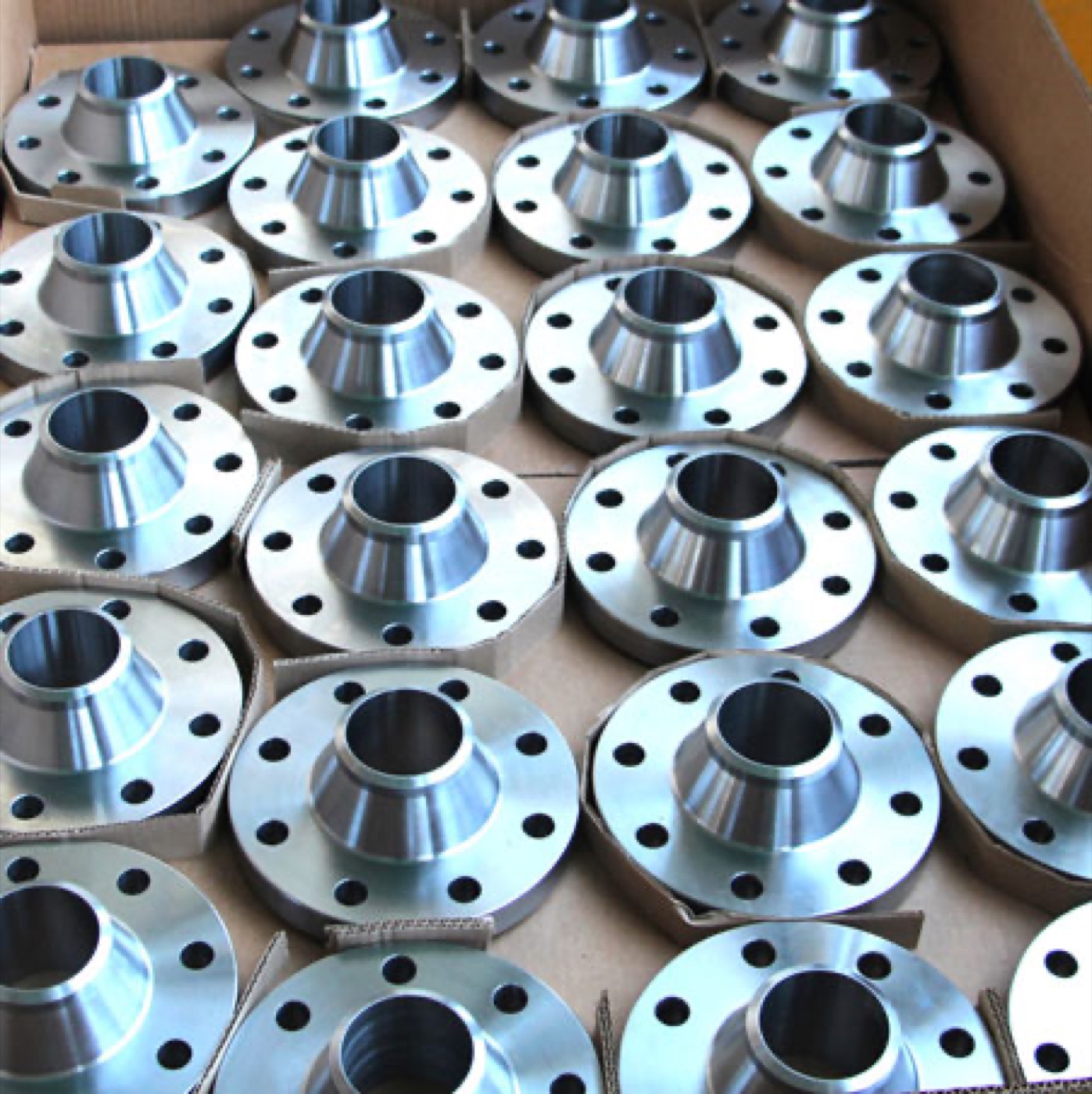
Weld Neck Flanges — Machined & Packed Production
UNS N02201 Weld Neck Flange Dimensions
Nickel 201 weld neck flanges share their dimensions with every other material in the same class — OD, thickness, hub, bore, bolt circle and bolting per the standard tables. Full ASME B16.5 charts:
European PN dimensions are published on the EN 1092-1 Type 11, DIN 2631–2635 and BS 4504 pages.
Price List & How to Order
Pure nickel pricing tracks the nickel market directly plus the testing scope, so we quote live with a stated validity rather than publish a static list. To get a firm quotation, usually within 24 hours:
1
List your requirement — size (NB), class or PN, standard (ASME B16.5 / B16.47 / EN / DIN / BS), grade (Nickel 201 / N02201, or dual-certified 200/201), pipe schedule or bore, and quantity.
2
State the service & testing scope — design temperature, caustic concentration or halogen duty, plus 3.2 witness, PMI or project specifications.
UNS N02201 Weld Neck Flanges — Frequently Asked Questions
What is a UNS N02201 (Nickel 201) weld neck flange?
It is a weld neck flange forged from Nickel 201 — commercially pure wrought nickel with carbon deliberately capped at 0.02%, UNS N02201 / 2.4068 — to ASTM B564. The long tapered hub is butt-welded to the pipe with the bore matched to the pipe schedule. Nickel 201 is the grade that carries pure nickel's chemistry above 315 °C: molten caustic, hot dry halogens and high-temperature purity duty to around 600 °C.
What is the difference between Nickel 201 and Nickel 200?
Carbon, and the temperature ceiling it sets. Nickel 200 allows carbon to 0.15%; in sustained service above about 315 °C that carbon precipitates as grain-boundary graphite and embrittles the metal. Nickel 201 caps carbon at 0.02%, removing the mechanism entirely, and serves to around 600 °C. Corrosion behaviour is otherwise identical — the same caustic supremacy, halogen films and purity. Below 315 °C either grade works, and dual-certified 200/201 heats cover both callouts on one certificate.
Why does low carbon prevent graphitization?
Graphitization needs carbon to precipitate — pure nickel holds very little carbon in solution at service temperatures, so whatever the melt carries eventually migrates to grain boundaries as graphite flakes, which act as built-in cracks. Cutting carbon to 0.02% leaves too little to form a damaging network no matter how long the exposure. It is the same logic as L-grade stainless applied to a different failure mode.
What is molten caustic service and why does it demand Nickel 201?
Caustic soda plants concentrate NaOH by evaporation until, in anhydrous fusion processes, the product is molten salt at 320 to 480 °C — squarely above Nickel 200's graphitization limit and far beyond anything stainless or most nickel alloys survive. Nickel 201 handles both attacks at once: pure nickel's unmatched caustic resistance and the low-carbon immunity to embrittlement. Fusion pots, transfer lines and their flanged joints specify it by name.
What are the equivalent designations for Nickel 201?
UNS N02201; Werkstoff Nr. 2.4068; EN LC-Ni 99; JIS NW 2201; BS NA 12; and GOST НП-2. Its system partners share the chemistry: ASTM B161 seamless pipe, B366 butt-weld fittings, B162 plate and B564 forgings. An enquiry in any of these designations is quoted as the same material.
What is the chemical composition of UNS N02201?
Per ASTM B564: nickel 99.00% minimum with carbon capped at 0.02% — the grade's defining limit — and residuals held to manganese 0.35%, silicon 0.35%, copper 0.25%, iron 0.40% and sulphur 0.01%. Apart from the carbon ceiling, it is the same commercially pure nickel as grade 200.
What are the mechanical properties of N02201 flanges?
Typical annealed properties run 403 MPa tensile, 103 MPa yield and 45% elongation; the governing ASTM B564 minimums are 345 MPa (50 ksi) tensile, 80 MPa (12 ksi) yield and 40% elongation, demonstrated on every certificate. The low carbon makes 201 slightly softer than 200 — the deliberate price of the high-temperature capability, already reflected in the flange pressure-temperature ratings.
Which pipe and fittings do N02201 weld neck flanges mate with?
ASTM B161 seamless Nickel 201 pipe is the standard partner, with B366 butt-weld fittings and B162 plate completing the system. The weld neck bore is machined to the pipe schedule you state, so the bore runs flush through the joint and the bevel arrives ready for a matched-chemistry butt weld.
How are Nickel 201 flanges welded to pipe?
With ERNi-1 / ENi-1 filler and the strictest nickel cleanliness: sulphur from markers, oils or shop grime embrittles hot pure nickel, so joints are degreased and handled clean end to end. Low heat input, no preheat, no PWHT — and because ERNi-1 weld metal is itself low-carbon, the joint keeps the 201 temperature rating through the weld.
What temperature range can Nickel 201 flanges be used in?
From cryogenic to about 600 °C — the low-carbon chemistry removes the 315 °C graphitization ceiling that limits Nickel 200, and in caustic and dry-halogen environments the metal serves to the top of that range. The universal nickel caution applies: hot sulphur-bearing atmospheres attack all nickel grades above roughly 315 °C, so combustion-gas exposure needs review.
Can Nickel 201 handle hot chlorine and fluorine?
Yes — dry halogens are its second home. Pure nickel's stable halide films carry chlorine, hydrogen chloride, fluorine and HF gas service to several hundred degrees, and the low-carbon grade holds its ductility there where 200 would slowly embrittle. Fluorine generation and hot chlorination systems specify 201 for exactly this combination. Wet halogens remain aggressive acids — moisture control defines the design.
What does dual-certified Nickel 200/201 mean?
A heat melted with carbon at or below 0.02% while meeting Nickel 200's strength minimums satisfies both specifications on one mill certificate. That is common modern melt practice, and it consolidates inventory: one flange covers a purchase order written around either grade, and the temperature question is answered before it is asked.
Is Nickel 201 suitable for food and high-purity service?
Yes — it shares Nickel 200's elemental purity, with no copper, chromium or molybdenum to leach. Where a high-purity process also runs hot — synthetic fibre spinning, hot food-chemistry evaporators — the 201 grade covers both the contamination budget and the temperature. Fine surface finishes and full traceability support validation paperwork on request.
What testing and certification do you supply with N02201 flanges?
Every lot ships with EN 10204 3.1 mill test certificates covering chemical analysis — demonstrating the 99% nickel minimum and, decisively, the 0.02% carbon ceiling — mechanical properties and the anneal record, with 3.2 certification witnessed by Lloyd's, DNV, BV or TÜV on request. We also offer PMI verification, hydrostatic testing and dye-penetrant examination, with full heat-number traceability.
Where are UNS N02201 weld neck flanges used?
Caustic fusion and high-concentration evaporation above all — the service that defines the grade — plus hot dry-halogen systems in chlor-alkali and fluorine chemistry, high-temperature food and fibre processing, and any pure-nickel duty whose design temperature crosses 315 °C. Where the process sheet pairs NaOH with heat, 201 is the named answer.
What sizes and standards do you manufacture N02201 weld neck flanges in?
From 1/2 inch NB to 56 inch NB: ASME B16.5 Class 150 to 2500 up to 24 inch, ASME B16.47 above, and European PN 2.5 to PN 400 patterns to EN 1092-1, DIN and BS 4504. Raised face is standard, flat face and ring joint on request, and every bore is machined to the mating pipe schedule from Sch 10 through XXS.
Do you keep Nickel 201 weld neck flanges in stock? What is the lead time?
Nickel 201 moves in project quantities — often alongside dual-certified 200/201 stock in the common Class 150 and 300 sizes — while larger diameters, higher classes and witness-tested lots are forged to order, typically in 4 to 6 weeks. Prices track the nickel market directly, so quotations carry a validity period.
Do you export UNS N02201 flanges outside India?
Yes. Tesco Steel & Engineering is an ISO 9001:2015 certified manufacturer based in Mumbai, and Nickel 201 flanges ship to chlor-alkali, fluorochemical and process projects across the Middle East, Europe, Africa, Southeast Asia and the Americas. Flanges travel face-protected and seaworthy-packed, with full heat-number and test traceability.

