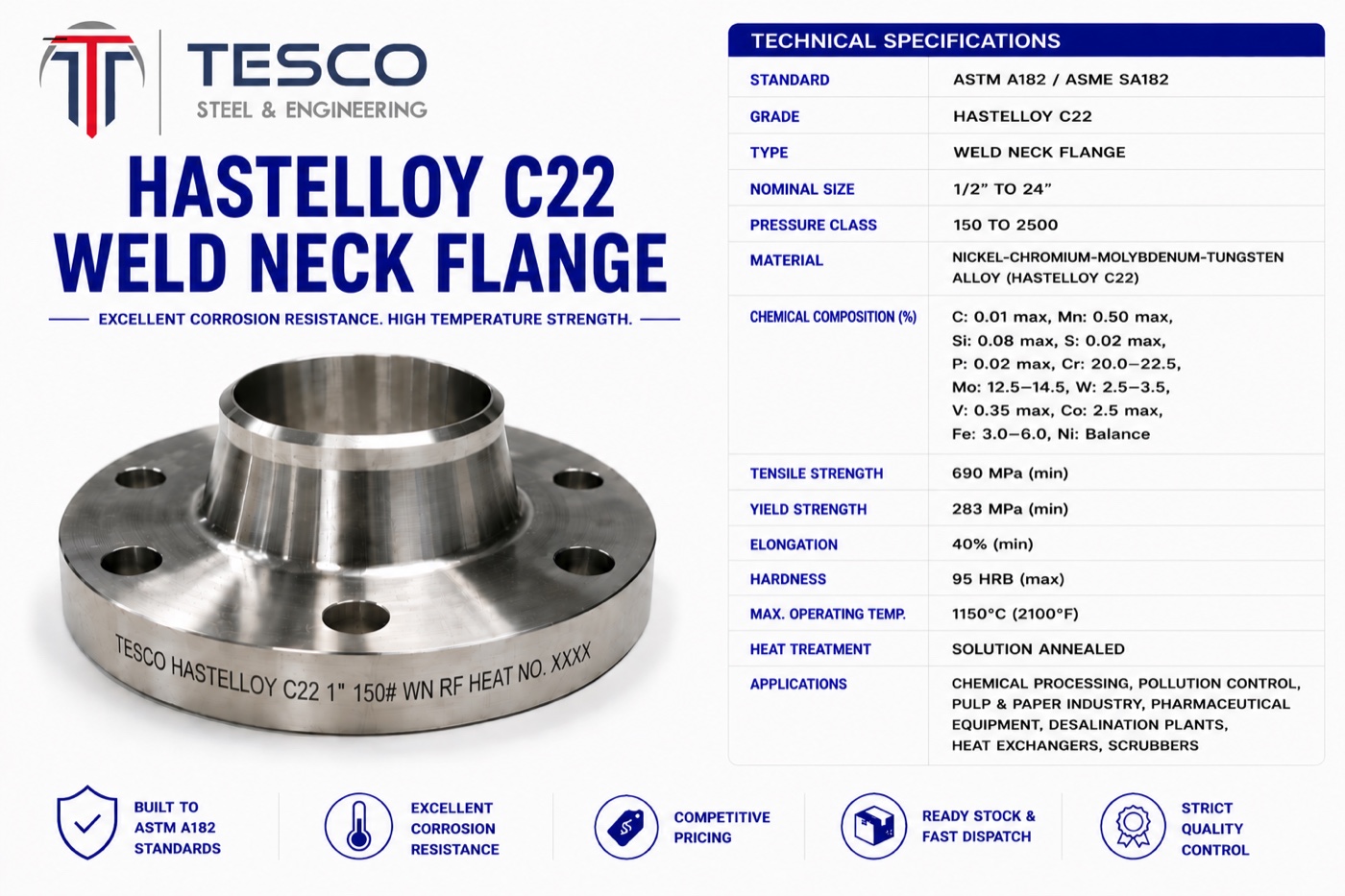
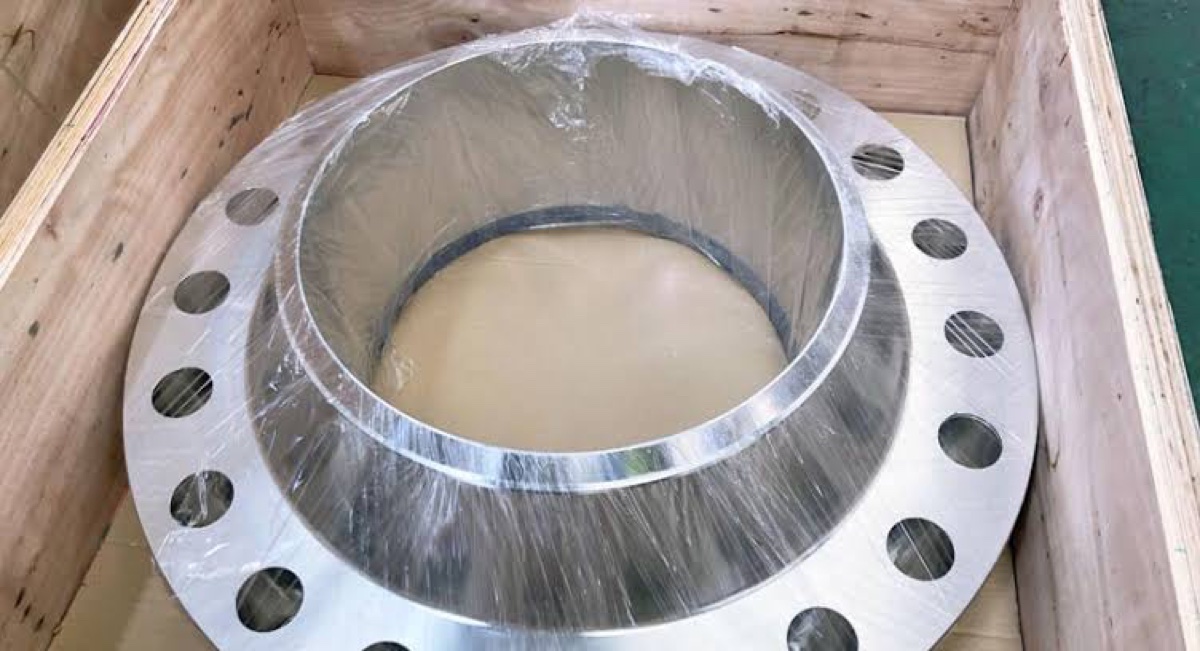
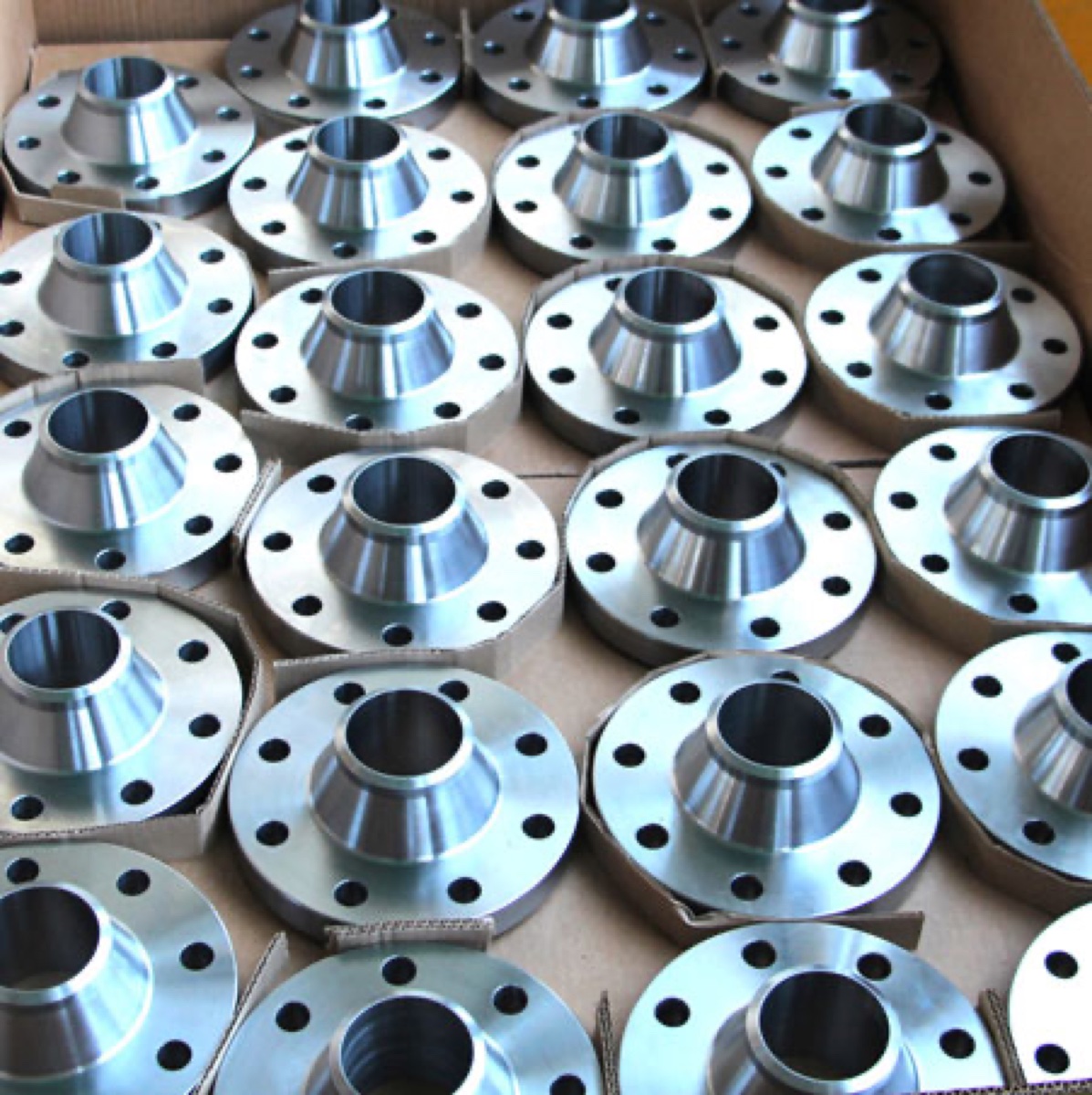
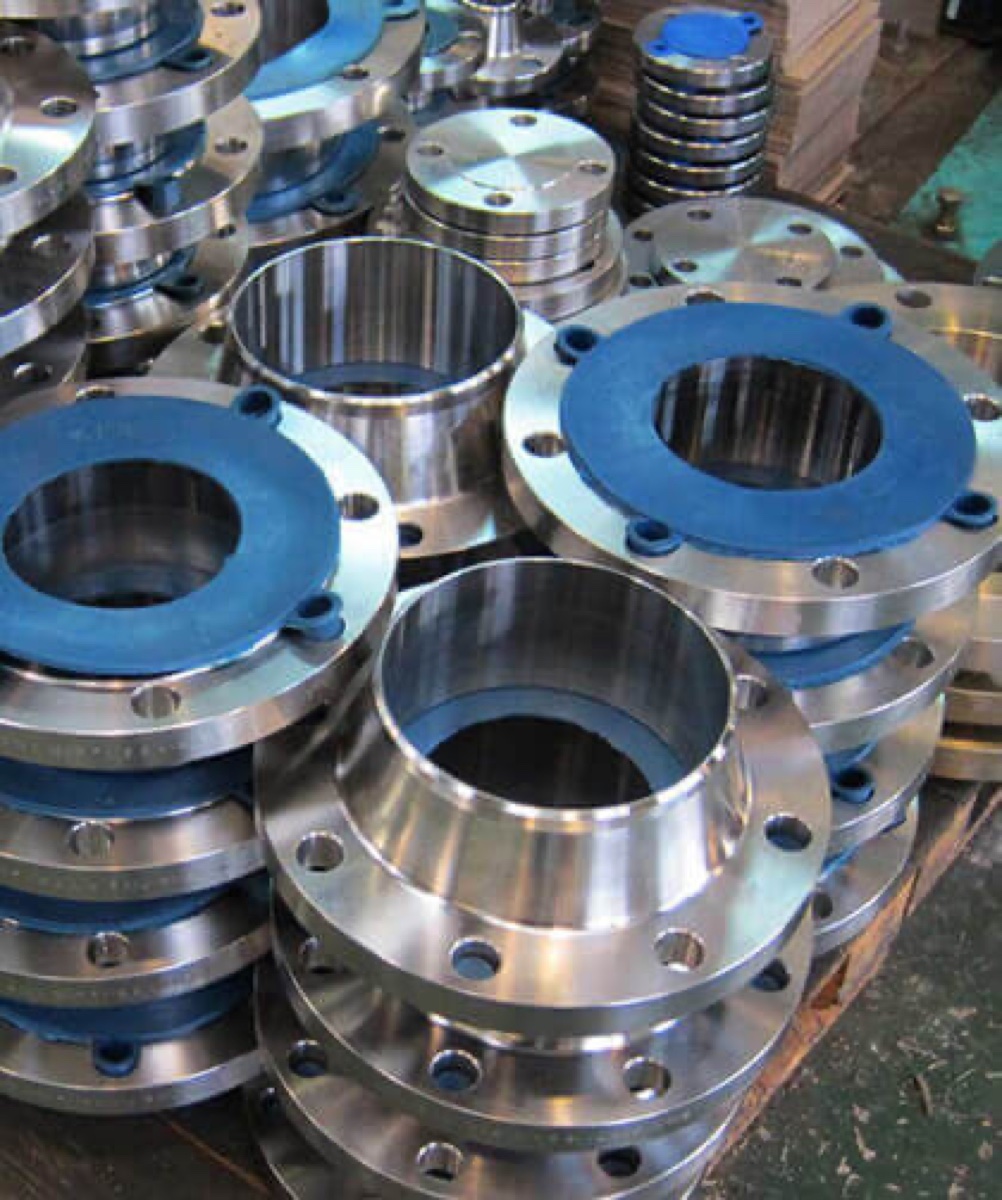
Tesco Steel & Engineering forges Hastelloy C-22 weld neck flanges — UNS N06022, Werkstoff Nr. 2.4602 — to ASTM B564, from 1/2″ NB to 56″ NB in ASME B16.5 Class 150–2500 and European PN patterns. C-22 rebalances the C-family toward the oxidizing side: the family's highest chromium at 20–22.5% covers oxidizing acids, ferric chlorides and wet chlorine, while 12.5–14.5% molybdenum + tungsten keep pitting and crevice attack crushed — and its weld heat-affected zone performs so well the alloy doubles as the industry's overlay and filler. The pick for multipurpose pharma reactors, FGD systems and chlorination plants, alongside C-276. Mating B622 pipe, welded with ERNiCrMo-10. Supplied with PMI, ASTM G28 and EN 10204 3.1/3.2 on request. ISO 9001:2015, made in Mumbai, India — exported worldwide.
Hastelloy C-22 · UNS N06022 · 2.4602Cr 20–22.5% · Mo 12.5–14.5% · W 2.5–3.5%ASTM B564 / ASME SB-564Best-in-Family Weld HAZPharma Reactors · FGD · Chlorine1/2″ – 56″ NB · Class 150–2500ISO 9001:2015 · Exported Worldwide
Hastelloy C-22 (UNS N06022 / 2.4602) is the C-family's all-rounder: the highest chromium in the family (20–22.5%) for oxidizing acids and chlorine chemistry, 12.5–14.5% molybdenum + 2.5–3.5% tungsten against pitting and crevice attack, and refined carbon/silicon so joints stay resistant as-welded — with HAZ performance good enough that C-22 wire (ERNiCrMo-10) overlays and joins other CRAs. A Hastelloy C22 weld neck flange pairs that chemistry with a long tapered hub butt-welded to the pipe, forged to ASTM B564.
Against C-276: C-22 trades a few points of molybdenum for chromium — better in oxidizing media, slightly behind in hot reducing acids. Copper-bearing C-2000 and the HCl-specialist B-2/B-3 complete the family; Inconel 625 sits a molybdenum class below at a friendlier price.
The commercial niche: multipurpose plants. When a batch reactor runs acid this campaign and oxidizing chlorides the next, C-22's balanced chemistry holds across the swing — which is why pharmaceutical and fine-chemical sites standardize on it.
Also searched as: Alloy C-22 flange, UNS N06022 flange, 2.4602 flange, NiCr21Mo14W flange, C22 WNRF flange, pharma reactor flange — all refer to the product on this page.
Chemical Composition of Hastelloy C22
C
Mn
Si
S
Co
Ni
Cr
Fe
Mo
W
P
0.010 max
0.50 max
0.08 max
0.02 max
2.50 max
50.015 min
20.00-22.50
2.00-6.00
12.50-14.50
2.50-3.50
0.02 max
Values in weight %; nickel is the balance. The signature is the chromium–molybdenum balance: enough Cr to own the oxidizing side of the corrosion map, enough Mo+W to keep localized attack crushed — with C and Si refined for as-welded resistance.
Mechanical Properties of Hastelloy C22
Tensile Strength, MPa [psi]
Yield Strength, Min, MPa [psi]
Elongation % min.
690 [100000]
310 [45000]
45
Minimums per ASTM B564 in the solution-annealed condition, demonstrated on every certificate. The 45% elongation floor speaks to the alloy's ductility — forgiving in fabrication, tough from cryogenic temperatures upward.
Equivalent Grades of Hastelloy C22
Standard
Werkstoff Nr.
UNS
JIS
EN
Hastelloy C22
2.4602
N06022
NW 6022
NiCr21Mo14W
System partners: ASTM B622 seamless pipe, B366 butt-weld fittings, B575 plate, B574 bar and B564 forgings. Family: C-276 (N10276), C-2000 (N06200), B-2/B-3 and heat-service Hastelloy X.
Hastelloy C22 Weld Neck Flange Specifications
Hastelloy C22 Weld Neck Flanges are available in the following specifications:
Size
1/2"NB to 56"NB
Class
150#, 300#, 400#, 600#, 900#, 1500#, 2500#
Sch (Schedule)
XS, XXS, STD & Schedule 20, 40, 80, 160
Pressure Ratings
PN 2.5 - PN 400
Standards
ASTM B564 / ASME SB-564; ASME B16.5, ASME B16.47, EN 1092-1, DIN 2631–2635, BS 4504
Condition
Solution annealed; NACE MR0175 / ISO 15156 compliant supply on request
20–22.5% Cr owns the oxidizing half of the corrosion map — nitric-bearing streams, ferric chloride, wet chlorine at high oxidizing potential.
Pitting Still Crushed
12.5–14.5% Mo plus tungsten keep localized-corrosion resistance in the top class — hot brines and crevices stay design non-issues.
The Weld-Zone Reference
C-22's as-welded HAZ performs so well that ERNiCrMo-10 is the industry's overlay and joining filler for other CRAs — fabricated vessels qualify easier.
Built for Swinging Chemistry
Multipurpose reactors that change campaigns keep one alloy for every batch — C-22's balance is why pharma standardizes on it.
Full C-Family In-House
C-22, C-276, C-2000 and the B-series from one forge — the medium picks the member, the certificates arrive matched.
Welding Hastelloy C22 — ERNiCrMo-10, As-Welded
C-22 welds with matching ERNiCrMo-10 wire or ENiCrMo-10 electrodes and nickel-alloy discipline: sulphur-free cleanliness, moderate heat input, interpass control, no preheat and no PWHT. Its heat-affected zone keeps corrosion resistance as-welded better than any other C-family member — the same property that makes C-22 wire the favoured overlay and dissimilar-CRA filler across the industry.
Grade-selection note: hot concentrated reducing acids favour C-276; clean hydrochloric favours B-2/B-3; moderate duty may be covered economically by 625 or 825. State the medium, concentration and temperature in the enquiry and the grade follows.
Where Hastelloy C22 Weld Neck Flanges Are Used
Multipurpose pharma & fine-chemical reactors lead, then FGD outlet ducts and absorbers, chlorination and bleach plants, waste incineration, nuclear waste processing, acid regeneration, sour gas systems and seawater duty. Our nickel-alloy production below:
Hastelloy C22 weld neck flanges share their dimensions with every other material in the same class — OD, thickness, hub, bore, bolt circle and bolting per the standard tables. Full ASME B16.5 charts:
C-22 pricing tracks nickel and molybdenum plus the testing scope, so we quote live with a stated validity rather than publish a static list. To get a firm quotation, usually within 24 hours:
1
List your requirement — size (NB), class or PN, standard (ASME B16.5 / B16.47 / EN / DIN / BS), pipe schedule or bore, and quantity.
2
State the service & testing scope — medium, concentration and temperature; NACE MR0175 requirement; plus 3.2 witness, PMI, G28 or project specifications.
3
Send it across — via the inquiry form, WhatsApp, or email to sales@tescosteel.com — and we reply with price, delivery and stock position.
It is a weld neck flange forged from Hastelloy C-22 — the most versatile member of the C-family, UNS N06022 / 2.4602, a nickel base carrying the family's highest chromium (20-22.5%) plus 12.5-14.5% molybdenum and 2.5-3.5% tungsten — to ASTM B564. The long tapered hub is butt-welded to the pipe with the bore matched to the schedule, giving a radiographable joint in the alloy chosen for oxidizing acids, wet chlorine and multipurpose chemical reactors.
What is the idea behind the Hastelloy C-22 chemistry?
Rebalance C-276 toward the oxidizing side. C-22 trades a few points of molybdenum for the family's highest chromium — 20-22.5% — so oxidizing acids, ferric and cupric chlorides and wet chlorine sit squarely inside its comfort zone while the 13% molybdenum plus tungsten still crush pitting and crevice attack. Carbon and silicon stay refined for as-welded corrosion resistance, and C-22's weld heat-affected zone performs so well the alloy doubles as the weld filler for other CRAs.
What is the difference between Hastelloy C-22 and C-276?
The Cr/Mo balance. C-276 carries more molybdenum (15-17% vs 12.5-14.5%) — the edge in strongly reducing media like hot hydrochloric and sour brines. C-22 carries more chromium (20-22.5% vs 14.5-16.5%) — the edge in oxidizing acids, wet-oxidation duty and chlorine chemistry, plus better weld-HAZ corrosion performance. C-276 is the benchmark incumbent; C-22 the versatile all-rounder that handles swings between reducing and oxidizing without flinching. We forge both; the medium decides.
Why is Hastelloy C-22 the multipurpose-reactor alloy?
Because batch and campaign plants change chemistry week to week — acid today, oxidizing chlorides tomorrow, solvent wash between. A specialist alloy optimized for one medium gets caught out by the next campaign; C-22's balanced chromium-plus-molybdenum chemistry holds low corrosion rates across the widest span of media in the family. That is why pharmaceutical and fine-chemical multipurpose reactors, and the flanges on them, standardize on C-22.
What is the difference between Hastelloy C-22 and Inconel 625?
Both are Ni-Cr-Mo alloys, but C-22 carries roughly half again more molybdenum (12.5-14.5% vs 8-10%) plus tungsten, putting its pitting and crevice resistance a clear class above. 625 answers with higher strength and a lower price, which wins seawater and moderate chemical duty. When the service turns to hot oxidizing acids, wet chlorine or aggressive mixed streams, C-22 is the upgrade path — and it is frequently specified as weld overlay for exactly those environments.
What are the equivalent designations for Hastelloy C22?
UNS N06022; Werkstoff Nr. 2.4602; EN NiCr21Mo14W; JIS NW 6022; and the trade names Hastelloy C-22 or Alloy C-22. System partners: ASTM B622 seamless pipe, B366 butt-weld fittings, B575 plate, B574 bar and B564 forgings. An enquiry in any of these designations is quoted as the same material.
What is the chemical composition of Hastelloy C22?
Per ASTM B564: nickel balance (50.015% minimum), chromium 20.00 to 22.50% — the family's highest — molybdenum 12.50 to 14.50%, tungsten 2.50 to 3.50%, iron 2.00 to 6.00%, cobalt 2.50% maximum, with carbon held at 0.010% and silicon at 0.08% for as-welded corrosion resistance, plus manganese 0.50% max, phosphorus 0.02% max and sulphur 0.02% max.
What are the mechanical properties of Hastelloy C22 flanges?
Per ASTM B564 in the solution-annealed condition: tensile strength 690 MPa (100 ksi) minimum, yield strength 310 MPa (45 ksi) minimum and elongation 45% minimum, demonstrated on every certificate. The alloy is tough from cryogenic temperatures upward, work-hardens strongly in machining, and its ductility makes it forgiving in fabrication.
Which pipe and fittings do Hastelloy C22 weld neck flanges mate with?
ASTM B622 seamless C-22 pipe is the standard partner, with B366 butt-weld fittings, B575 plate and B574 bar completing the system. The weld neck bore is machined to the pipe schedule you state, so the bore runs flush through the joint and the bevel arrives ready for a matched-chemistry butt weld.
How are Hastelloy C22 flanges welded to pipe?
With matching ERNiCrMo-10 wire or ENiCrMo-10 electrodes and nickel-alloy discipline: sulphur-free cleanliness, moderate heat input, interpass control, no preheat and no PWHT. C-22's heat-affected zone keeps its corrosion resistance as-welded better than any other C-family member — the same property that makes ERNiCrMo-10 a favoured filler and overlay for other corrosion-resistant alloys.
Is Hastelloy C-22 better than C-276?
Neither dominates — they bracket the corrosion map from opposite sides. In oxidizing media (nitric-bearing streams, ferric chloride, wet chlorine at high oxidizing potential) and in weld-zone performance, C-22 measures better. In strongly reducing media (hot concentrated hydrochloric, sour brines) C-276's extra molybdenum keeps the edge. For mixed or swinging chemistry C-22 is often the safer single choice; for known reducing severity C-276 remains the benchmark. State the medium and we quote the right member.
Is Hastelloy C22 suitable for FGD and chlorine service?
Yes — flue-gas desulfurization outlet ducts, dampers and absorber internals are standing C-22 duties, since scrubber condensates are simultaneously acidic, chloride-laden and oxidizing. In chlorination systems, hypochlorite and chlorine-dioxide bleach service, C-22's high chromium gives it an accepted track record alongside C-276, and its superior as-welded HAZ makes fabricated ducting and vessels simpler to qualify.
Is Hastelloy C22 suitable for sour service under NACE MR0175?
Yes — C-22 is listed in NACE MR0175 / ISO 15156 among the top-tier nickel-base CRAs, highly resistant to sulphide stress cracking, chloride SCC and pitting in H2S-CO2-chloride environments. It serves severe sour wells and surface equipment in the solution-annealed condition; state the NACE requirement in the enquiry and certification follows.
What temperature range can Hastelloy C22 flanges be used in?
In wet-corrosion duty — its real job — C-22 serves from cryogenic temperatures to roughly 400 °C with ASME code coverage beyond; long exposures above about 650 °C can precipitate intermetallic phases that dent ductility and corrosion resistance, so it is not a furnace alloy. For genuinely hot oxidation service the heat-resistant grades (Hastelloy X, Inconel 600/601) take over — C-22's territory is chemistry, not flame.
What testing and certification do you supply with Hastelloy C22 flanges?
Every lot ships with EN 10204 3.1 mill test certificates covering chemical analysis — demonstrating the chromium, molybdenum, tungsten and ultra-low carbon/silicon windows — mechanical properties and the solution-anneal record, with 3.2 certification witnessed by Lloyd's, DNV, BV or TÜV on request. We also offer PMI verification, intergranular-corrosion testing to ASTM G28, hydrostatic testing and dye-penetrant examination, with full heat-number traceability.
Where are Hastelloy C22 weld neck flanges used?
Multipurpose pharmaceutical and fine-chemical reactors, flue-gas desulfurization systems, chlorination and bleach plants, waste incineration and scrubbers, nuclear waste processing, pickling and acid-regeneration plants, sour gas systems and seawater duty. Wherever the chemistry swings between reducing and oxidizing — or simply is not known in advance — C-22 is the single alloy that covers the span.
What sizes and standards do you manufacture Hastelloy C22 weld neck flanges in?
From 1/2 inch NB to 56 inch NB: ASME B16.5 Class 150 to 2500 up to 24 inch, ASME B16.47 above, and European PN 2.5 to PN 400 patterns to EN 1092-1, DIN and BS 4504. Raised face is standard, ring joint on request, and every bore is machined to the mating pipe schedule from Sch 10 through XXS.
Do you keep Hastelloy C22 weld neck flanges in stock? What is the lead time?
C-22 moves steadily in pharmaceutical, FGD and chemical-plant projects, so common sizes in Class 150 and 300 rotate through production with popular items often available, while larger diameters, higher classes and witness-tested lots are forged to order — typically 4 to 6 weeks. Prices track nickel and molybdenum, so quotations carry a validity period.
Do you export Hastelloy C22 flanges outside India?
Yes. Tesco Steel & Engineering is an ISO 9001:2015 certified manufacturer based in Mumbai, and Hastelloy C22 flanges ship to pharmaceutical, chemical, power and oil and gas projects across the Middle East, Europe, Africa, Southeast Asia and the Americas. Flanges travel face-protected and seaworthy-packed, with full heat-number and test traceability.