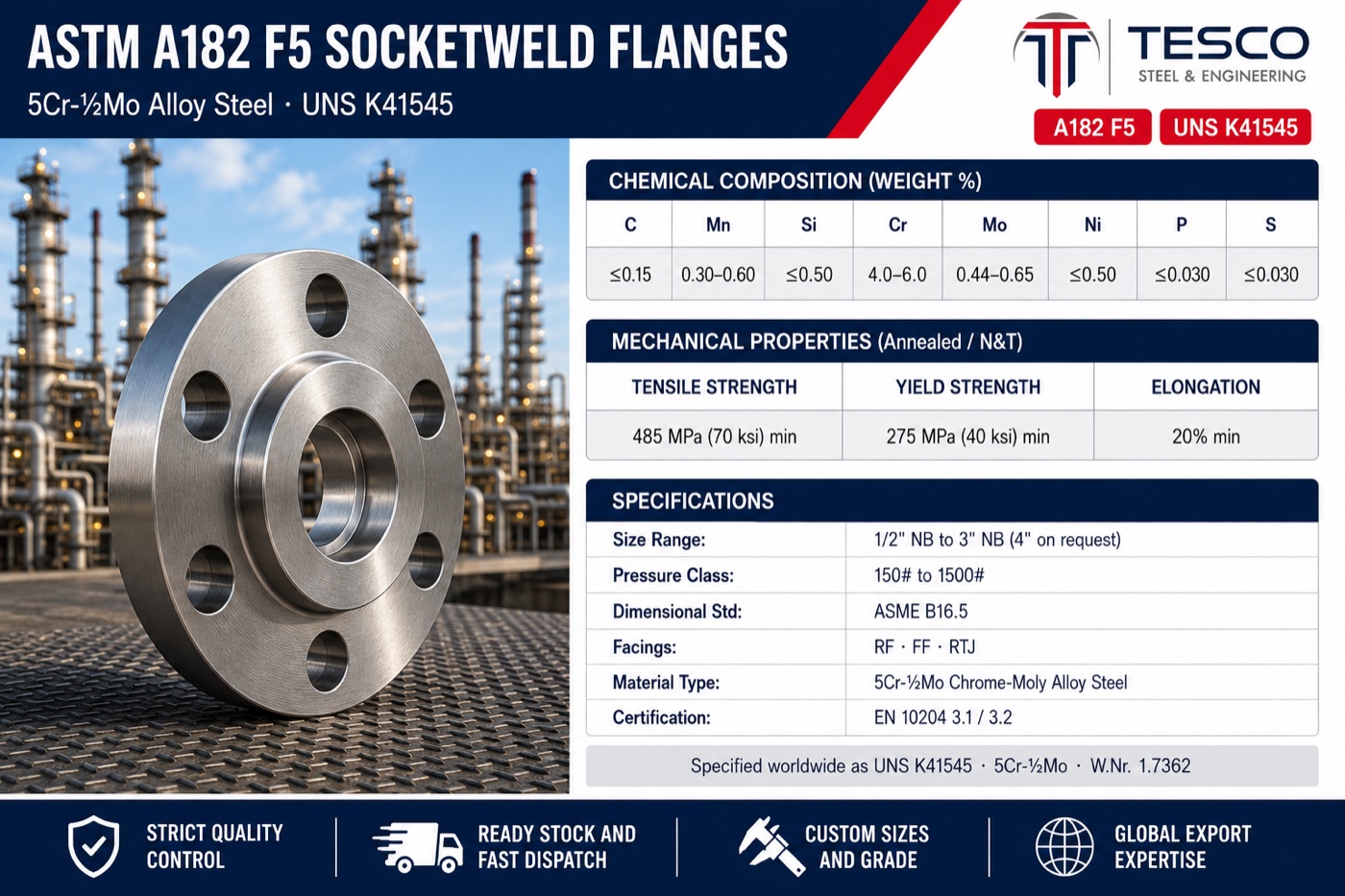
Tesco Steel & Engineering manufactures ASTM A182 F5 socketweld flanges — 5Cr-½Mo alloy steel, UNS K41545, W.Nr. 1.7362 — to ASME B16.5 from ½″ to 3″ NB in Classes 150–1500 (2500 and 4″ to order). On the chrome-moly ladder, F5 is where chromium becomes a corrosion purchase: 5% Cr defends against the high-temperature sulphidation of crude, vacuum, coker and FCC streams and widens the hydrogen-service window per the Nelson curves — exactly the duty of hot refinery small bore: drains, vents, instrument taps and injection points. Socket seated, one external fillet weld — with honest preheat/PWHT guidance below, because 5Cr steel air-hardens. All three facings — SWRF, SWFF, SWRTJ. Creep-led steam duty? F11 / F22 do it cheaper. Hotter and sourer? F9. Every lot with EN 10204 3.1/3.2 MTC. ISO 9001:2015, made in Mumbai, India — exported to 50+ countries.
A182 F5 · UNS K41545 · W.Nr. 1.73625Cr-½Mo Chrome-MolySulphidation & H2 Service GradeASME B16.5 ½″–3″ · Class 150–1500485 / 275 MPa · 143–217 HBSWRF · SWFF · SWRTJPreheat / PWHT Guidance IncludedEN 10204 3.1 / 3.2 · ISO 9001:2015
ASTM A182 F5 Socketweld Flanges — Specifications at a Glance
What is an ASTM A182 F5 Socketweld Flange?
The refinery's hot small-bore flange. A forged 5Cr-½Mo alloy steel flange (ASTM A182 F5 / UNS K41545) with a machined socket: pipe seated square by geometry, one external fillet weld, through-bore matched to the pipe schedule. The 5% chromium is a corrosion purchase — sulphidation resistance on hot sour hydrocarbon circuits and hydrogen service per the Nelson curves — with molybdenum holding strength where carbon steel fades. Tensile ≥485 MPa, yield ≥275 MPa, 143–217 HB, annealed or N&T. Sized by ASME B16.5 at ½″–3″ NB, Classes 150–1500; welded with chrome-moly preheat/PWHT discipline; EN 10204 3.1 on every lot.
Also searched as: A182 F5 socket weld flange, F5 SWRF flange, 5Cr socket weld flange, chrome moly SW flange, K41545 flange — all the same product family. Related pages: the facings — SWRF / SWFF / SWRTJ — the socketweld hub, the other F5 types — blind, weld neck, slip-on, F5 grade hub — the ladder neighbours F11 / F22 / F9, and the alloy steel hub.
Below F5 the ladder climbs for strength at temperature; from F5 upward the chromium is increasingly armour against hot sulphur and hydrogen. That turn is why F5 lives in refineries while F22 lives in power stations.
What 5% Chromium Buys
Sulphidation Armour
Above ~260 °C, sulphur compounds in crude fractions eat steel at rates that fall steeply with chromium (the McConomy curves). 5% Cr cuts hot sour corrosion severalfold against carbon steel and meaningfully against F11/F22 — the classic economic answer for hot sour circuits.
A Wider Hydrogen Window
The Nelson curves push carbon steel out of hot hydrogen service; F5's Cr-Mo carbides resist hydrogen attack across a much larger temperature/pressure envelope — hydroprocessing auxiliaries live here.
Strength Where Carbon Steel Fades
Molybdenum-stabilised carbides hold useful strength at 400–600 °C and resist the graphitization that retires A105 above 425 °C.
ASTM A182 F5 Chemical Composition (UNS K41545)
Element
C
Mn
Si
Cr
Mo
Ni
P
S
Weight %
≤0.15
0.30–0.60
≤0.50
4.0–6.0
0.44–0.65
≤0.50
≤0.030
≤0.030
The 4–6% chromium band is the identity — corrosion armour while staying a ferritic, weldable-with-care steel. Note C ≤0.15%: the higher-carbon F5a variant (to 0.25%) is a separate, stronger, harder-to-weld grade — see the FAQ. PMI reads the Cr-Mo signature on every piece.
Mechanical Properties (Annealed / N&T)
Property
ASTM A182 F5 Requirement
Tensile Strength
≥ 485 MPa (70 ksi)
Yield Strength (0.2%)
≥ 275 MPa (40 ksi)
Elongation
≥ 20%
Hardness
143–217 HB — the mill's proof of proper tempering, and your PWHT baseline
Condition
Annealed or normalized-and-tempered — furnace records certified
Why It's Bought
Not ambient numbers — what it keeps at 400–600 °C in sour, hydrogen-bearing service
ASTM A182 F5 Socketweld Flanges are available in the following specifications:
Material Grade
ASTM A182 F5 (UNS K41545), W.Nr. 1.7362 — 5Cr-½Mo; F5a (higher carbon, 620/345 MPa) quoted separately where a specification names it
Heat Treatment
Annealed or normalized-and-tempered; hardness verified 143–217 HB; furnace records certified
Size
1/2"NB to 3"NB per ASME B16.5; 4″ and larger to order
Class
150#, 300#, 600#, 900#, 1500# (900# shares 1500# dimensions in most sizes); 2500# on request — refinery duty clusters in 300–900
Facings
Raised Face (SWRF), Flat Face (SWFF), Ring Type Joint (SWRTJ) with groove per B16.20
Bore
Socket bore to pipe OD; through-bore matched to pipe schedule (Sch 40/80/160 — 80/160 dominate hot small bore)
Welding
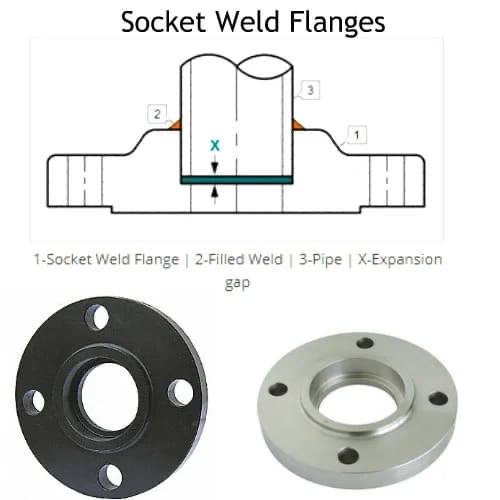
Single external fillet per B16.5/B31.3 with 1/16″ expansion gap; preheat and PWHT per chrome-moly practice — see the FAQ
Service Span
Hot sour hydrocarbon and hydrogen circuits per McConomy/Nelson practice; creep-led steam duty directed to F11/F22
Testing
Tension, chemistry and hardness per heat; PMI on every piece; socket depth and bore gauged
Certification
EN 10204 3.1 with heat-treatment records (standard) / 3.2 witnessed
Specification Notes — Getting F5 Sockets Right
Four honest notes.5Cr steel air-hardens: weld it cold and the heat-affected zone forms crack-prone martensite — preheat (typically ~175–230 °C) and, for most services, PWHT are not optional, and small-bore sockets are exactly where field crews are tempted to skip both. The 1/16″ gap still applies — thermal expansion against a bottomed socket cracks weld roots, chrome-moly or not. Don't buy F5 for clean steam: if sulphur isn't attacking the line, F11/F22 carry the creep duty cheaper — and our quote will say so. And hot cyclic small bore often butt-welds: decoking and steam-out circuits concentrate alternating stress at the fillet root — where the line class demands it, the F5 weld neck is the right escalation.
How Our A182 F5 Socketweld Flanges Are Manufactured
1
Forging — cut billet of the spectro-verified F5 heat — the Cr and Mo windows confirmed — is hot-forged into the flange blank with full heat traceability.
2
Heat treatment — annealed or normalized-and-tempered per the specification; furnace charts retained against the heat number.
3
Hardness & testing — hardness verified in the 143–217 HB band; tension and chemistry per heat; PMI reads the Cr-Mo signature on every piece.
4
Machining — faces, OD and drilling to ASME B16.5; socket counterbore and depth gauged piece by piece, through-bore matched to the ordered schedule; RF serrations, flat face or RTJ groove per B16.20.
5
Marking — laser-marked with grade, size, class, schedule and heat number.
6
Certification & packing — EN 10204 3.1 MTC with heat-treatment records (3.2 witnessed on request); packed sea-worthy.
Where ASTM A182 F5 Socketweld Flanges Are Used
Hot, sour, small-bore: crude and vacuum distillation unit auxiliaries, coker and visbreaker circuits, FCC and hydroprocessing small bore, hot oil and transfer lines, furnace and heater connections — the drains, vents, instrument taps and injection points of refinery services running 300–600 °C with sulphur or hydrogen in the stream. Production below:
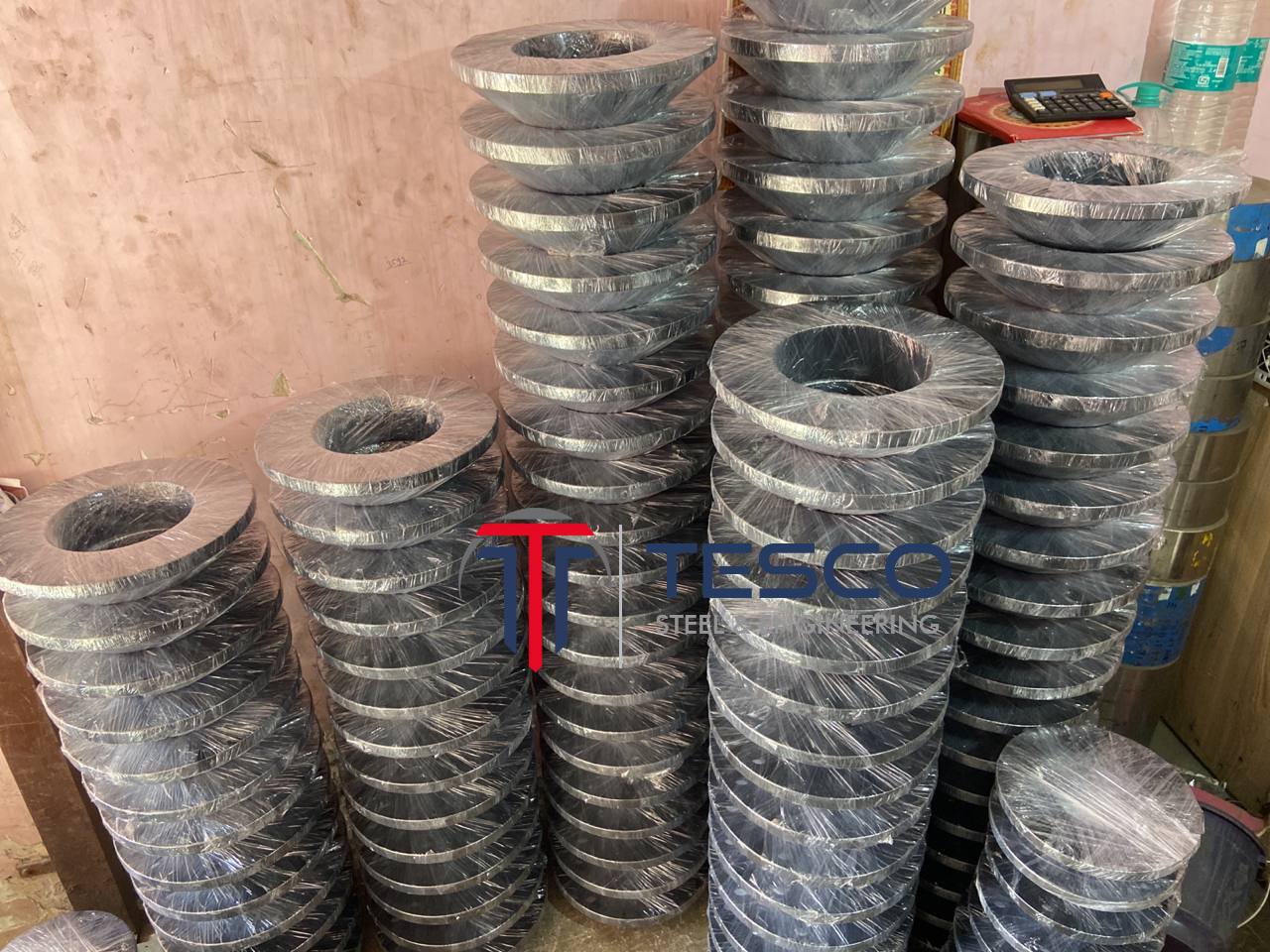
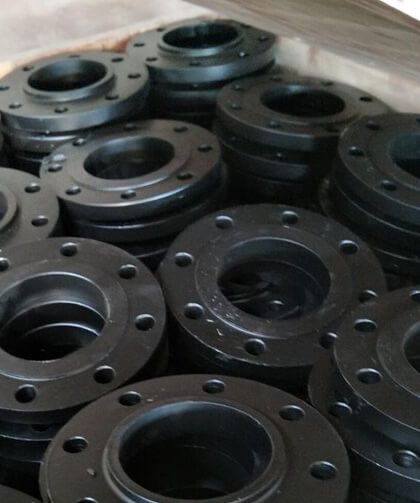
A182 Alloy Steel Flanges — Stacked for DispatchThe Socket Weld Joint — Note the Expansion Gap (X)Steel Flanges — Black-Coated, Crated at Our Works
A182 F5 Socketweld Flange Dimensions
Socket weld flange dimensions are class-governed per ASME B16.5 — identical across material grades (pressure-temperature ratings follow the material group). Full charts:
An ASTM A182 F5 socketweld flange is a forged 5Cr-½Mo alloy steel flange — 5% chromium, ½% molybdenum, UNS K41545 — whose back carries a machined socket: the pipe end seats inside, self-aligned square to the face, and is secured with a single external fillet weld. F5 is the chrome-moly grade bought as much for corrosion as for heat: its chromium resists the high-temperature sulphidation of refinery hydrocarbon streams, and its molybdenum holds strength at temperatures where carbon steel fades. Dimensioned to ASME B16.5 for ½" to 3" NB in Classes 150 to 1500, in raised face, flat face and ring joint facings — the small-bore flange of hot refinery circuits.
Where does F5 sit on the chrome-moly ladder?
The ladder climbs by chromium: F1 (½Mo, no Cr), F11 (1¼Cr-½Mo), F22 (2¼Cr-1Mo), F5 (5Cr-½Mo), F9 (9Cr-1Mo) and F91 (9Cr-1Mo-V, the creep-strength-enhanced grade). The lower rungs — F11 and F22 — are bought mainly for creep strength in steam and boiler service; from F5 upward the chromium is increasingly a corrosion purchase: 5% Cr roughly triples the sulphidation resistance of the 2¼% grades in hot sour hydrocarbon streams. That is why F5 clusters in refineries rather than power stations — crude and vacuum columns, cokers, FCC circuits — while F22 dominates steam. Each rung has its own pages on this site; this page is the F5 socket weld.
What does 5% chromium actually buy?
Two defences that carbon steel lacks. Sulphidation resistance: above roughly 260°C, the sulphur compounds in crude fractions attack steel at rates that scale steeply downward with chromium content — the industry's McConomy curves — and 5% Cr is the classic economic answer for hot sour circuits, cutting corrosion rates several-fold against carbon steel and meaningfully against F11/F22. Hydrogen resistance: at refinery temperatures and hydrogen partial pressures, the Nelson curves push carbon steel out of service; F5's chromium and molybdenum tie up carbides and resist hydrogen attack across a much wider operating window. Both mechanisms live exactly where hot small-bore connections do — hence this flange.
What is the chemical composition of ASTM A182 F5?
Carbon ≤0.15%, manganese 0.30-0.60%, silicon ≤0.50%, chromium 4.0-6.0%, molybdenum 0.44-0.65%, nickel ≤0.50%, phosphorus ≤0.030%, sulphur ≤0.030%. The 4-6% chromium band is the identity — enough for sulphidation and hydrogen duty, low enough to remain a ferritic, weldable-with-care steel rather than a stainless. Note the carbon ceiling of 0.15%: the related grade F5a allows up to 0.25% carbon for higher strength, and the two are not interchangeable on a certificate — see the F5a FAQ below. Chemistry is verified per heat and travels on the EN 10204 3.1 MTC.
What are the mechanical properties of A182 F5 socketweld flanges?
In the annealed or normalized-and-tempered condition A182 requires tensile strength 485 MPa (70 ksi) minimum, yield strength 275 MPa (40 ksi) minimum, elongation 20% minimum, with hardness controlled in the 143-217 HB band. The numbers read close to carbon steel's at room temperature — F5 is not bought for ambient strength but for what it keeps at 400-600°C, where its molybdenum-stabilised carbides hold strength and resist the graphitization that retires carbon steel. The hardness band matters doubly on a welded product: it is the mill's evidence of proper tempering, and the baseline your site PWHT should return the weld zone to.
How is an F5 socketweld flange welded — preheat, PWHT and the gap?
With chrome-moly discipline. The joint geometry is standard socket weld practice — pipe bottomed, withdrawn 1/16" (1.6 mm) per ASME B31.3 so expansion cannot crack the weld root, single external fillet. But 5Cr steel is air-hardening: an F5 weld cooled freely from welding heat forms hard, crack-prone martensite in the heat-affected zone. Codes therefore require preheat (typically around 175-230°C for this class) and, for most wall thicknesses and service classes, post-weld heat treatment to temper the zone back toward the 143-217 HB band. Small-bore sockets are where this discipline gets skipped in the field — and where cracked F5 welds come from. Our flanges arrive properly heat treated; the joint's pedigree is the fabricator's half of the contract.
F5 or F11/F22 — how do I choose?
By what is attacking the line. If the duty is clean steam or hot hydrogen-free hydrocarbon and the question is strength at temperature, the lower rungs answer it cheaper: F11 and F22 carry better creep ratings per rupee and dominate boiler and steam-header work. If the stream carries sulphur at temperature — crude fractions, vacuum gas oils, coker feeds — corrosion sets the agenda and chromium is the currency: F5's 5% outlasts F22's 2¼% severalfold in sulphidation, and that is what you are paying for. Mixed cases follow the corrosion engineer's curves rather than the stress tables. All three grades ship as socket welds from our works, each with its own page.
When does the duty move up to F9 or F91?
When either the sulphur or the steam gets more aggressive. F9 (9Cr-1Mo) continues the corrosion logic: twice F5's chromium buys another step of sulphidation and hydrogen resistance for the hottest, sourest refinery circuits. F91 (9Cr-1Mo-V) is a different mission — a creep-strength-enhanced ferritic developed for modern high-energy steam, with vanadium-niobium microalloying and a strict normalize-and-temper window; it appears in power piping far more than refineries, and its welding rules are stricter still. The practical refinery ladder for small bore is F5 → F9 by corrosion severity; the power-plant ladder is F22 → F91 by steam conditions. Both continuations have pages on this site.
What facings are A182 F5 socketweld flanges made with?
All three, each with its own page on this site: raised face (SWRF) — the default for steel-to-steel refinery joints, with spiral wound gaskets (graphite-filled for the hot services F5 lives in) — flat face (SWFF) for the rare lined or brittle mate, and ring type joint (SWRTJ) for high-pressure hot circuits, common in Classes 900-1500 refinery small bore. The socket, the welding discipline and the schedule-matched bore are identical across the three; only the gasket face changes, and the piping class decides which you order.
What sizes and pressure classes do F5 socketweld flanges come in?
ASME B16.5 standardises socket weld flanges from ½" to 3" NB in Classes 150, 300, 600, 900 and 1500 — Class 900 sharing Class 1500 dimensions in most small-bore sizes — with 4" and Class 2500 made to order. Refinery duty concentrates F5 sockets in Classes 300-900. As with every socket flange, put the pipe schedule on the enquiry — Sch 80 and 160 dominate hot high-pressure small bore — so the through-bore matches the pipe ID and the flow path stays smooth. Note B16.5 ratings for Group 1.9 materials govern the pressure-temperature limits; our quotations state them per class.
When should I not use a socket weld flange?
The standard socket weld limits apply, plus one that bites harder in F5's world. As always: the socket gap is a crevice (corrosion-sensitive stagnant services prefer butt welds), fillet welds cannot be radiographed (mandatory-RT and lethal-service classes escalate to weld necks), and hygienic duty excludes sockets. The F5-specific caution is thermal cycling: hot refinery small bore that cycles hard — decoking circuits, steam-out services — concentrates alternating stress at the fillet root exactly where chrome-moly's hardening tendency lives, and many refinery specifications therefore butt-weld their hot cyclic small bore. Where your line class says so, our F5 weld neck page has the matching flange.
What is F5a and how does it differ from F5?
F5a is the higher-carbon, higher-strength variant of the same 5Cr-½Mo chemistry: carbon up to 0.25% against F5's 0.15%, buying tensile 620 MPa and yield 345 MPa minimums against F5's 485/275. The price is weldability — more carbon in an air-hardening steel means more preheat sensitivity and harder heat-affected zones — which is why F5 remains the default for welded constructions like socket flanges and F5a appears where a designer specifically wants the strength. The two are separate grades on a certificate and are not interchangeable: if your specification says F5a, order F5a and we quote it; an unqualified 'F5' order is supplied and certified as F5.
What details are needed to get an accurate F5 socketweld flange quotation?
Six elements plus commercial terms: (1) size — ½" to 3" NB; (2) pressure class — 150 to 1500; (3) facing — SWRF, SWFF or SWRTJ with ring number; (4) the pipe schedule — Sch 40, 80 or 160, so the through-bore matches the pipe ID; (5) grade detail — F5 (default) or F5a if the specification names it, with any hardness or PWHT-simulation requirements; (6) certification — EN 10204 3.1 with heat-treatment records (our standard) or 3.2 witnessed, PMI as applicable. Add quantity and destination and we return price, weight and delivery — normally within 24 hours.
Who manufactures ASTM A182 F5 socketweld flanges in India?
Tesco Steel & Engineering is an ISO 9001:2015 certified flange manufacturer based in Mumbai, India, producing ASTM A182 F5 socket weld flanges from ½" to 3" NB (larger to order) in Classes 150-1500 — each forged from certified heats, annealed or normalized-and-tempered with furnace records, hardness-verified in the 143-217 HB band, machined with gauged socket depth and schedule-matched bore, PMI-checked and laser-marked with grade, size, class and heat number. Supplied with EN 10204 3.1/3.2 certification, alongside the full chrome-moly ladder — F1, F11, F22, F9 and F91 — and the complete socket weld range in carbon, stainless and nickel alloys. Exported to more than 50 countries.