ASTM A182 F22 Weld Neck Flanges — 2.25Cr-1Mo Alloy Steel
Tesco Steel & Engineering forges ASTM A182 F22 weld neck flanges in 2.25% chromium, 1% molybdenum alloy steel — UNS K21590, Werkstoff Nr. 1.7380 (10CrMo910), supplied as Class 3 — from 1/2″ NB to 56″ NB, in ASME B16.5 Class 150–2500 and European PN patterns. Two industries standardise on this grade: power plants for reheat and main steam headers to ~580 °C, and hydroprocessing for its resistance to high-temperature hydrogen attack per the API 941 Nelson curves — mating A335 P22 pipe in both. Normalized & tempered, hardness-controlled 156–207 HB, with IBR, NACE MR0175, PMI and EN 10204 3.1/3.2 on request. ISO 9001:2015, made in Mumbai, India — exported worldwide.
A182 F22 Cl3 · UNS K21590 · 1.7380
2.25Cr – 1Mo
1/2″ – 56″ NB
Class 150 – 2500 · PN 2.5 – 400
Steam to ~580 °C · Hydrogen Service
IBR · NACE · PMI · 3.1/3.2
ISO 9001:2015 · Exported Worldwide
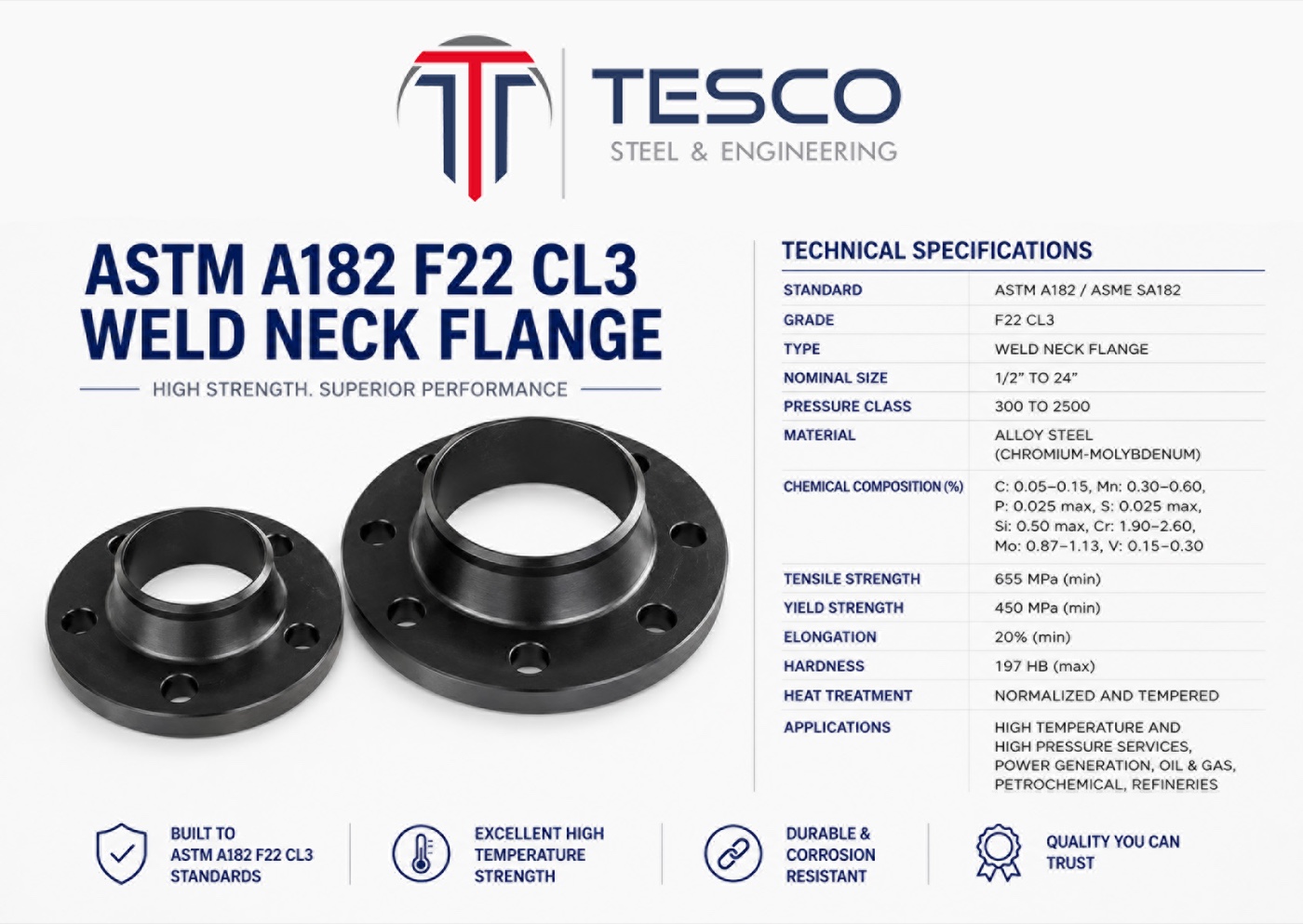
ASTM A182 F22 CL3 Weld Neck Flange — 2.25Cr-1Mo Alloy Steel, Technical Specifications
What is an ASTM A182 F22 Weld Neck Flange?
ASTM A182 F22 is the 2.25Cr-1Mo alloy steel forging grade (UNS K21590), supplied as Class 3 unless a spec says otherwise. An F22 weld neck flange pairs that chemistry with the strongest flange design: a long tapered hub butt-welded to the pipe, bore matched to the pipe schedule, joint fully radiographable — built for power-plant steam to ~580 °C and for high-pressure hydrogen service, where its Nelson-curve position makes it the industry default.
The chemistry earns its keep twice over. In steam service, the full percent of molybdenum delivers creep strength a clear step above F11, carrying reheat headers and hot boiler connections for decades. In hydrogen service, the 2.25% chromium ties up carbon against high-temperature hydrogen attack — the internal methane blistering mapped by the API 941 Nelson curves — which is why hydrotreaters, hydrocrackers and ammonia loops specify F22 flanges with A335 P22 pipe as a matched system.
Above F22 the ladder continues to F91 (modified 9Cr-1Mo-V) for supercritical creep duty; on the sulphur-driven refinery path, F5 and F9 take over. We forge every rung in-house.
Also searched as: A182 F22 Cl3 WNRF flange, SA182 F22 weld neck flange, 2.25Cr-1Mo flange, 10CrMo910 flange, UNS K21590 flange, alloy steel F22 flange — all refer to the product on this page.
Chemical Composition of ASTM A182 F22 CL3
| C | Mn | P | S | Si | Cr | Mo |
|---|
| 0.05-0.15 | 0.30-0.60 | 0.040 max | 0.040 max | 0.50 max | 2.00-2.50 | 0.87-1.13 |
Values in weight %. The low, windowed carbon keeps this air-hardening grade weldable; the full percent of molybdenum powers the creep strength; and the 2.25% chromium is what positions F22 so favourably on the API 941 Nelson curves for hydrogen service.
Mechanical Properties of ASTM A182 F22 CL3
| Tensile Strength, MPa [ksi] | Yield Strength, Min, MPa [ksi] | Elongation % min. | Reduction of Area % min. | Hardness HB |
|---|
| 515 [75] | 310 [45] | 20 | 30 | 156-207 |
Class 3 (normalized & tempered) minimums — the industry default; the softer annealed Class 1 (415/205 MPa) is supplied against specification. The hardness band certifies the heat treatment, keeps welds sound, and holds the flange under NACE limits where sour service applies.
Equivalent Grades of ASTM A182 F22
| Standard | Werkstoff Nr. | UNS | DIN |
|---|
| Alloy F22 | 1.7380 | UNS K21590 | 10CrMo910 |
The same 2.25Cr-1Mo chemistry runs through the whole piping system: A335 P22 seamless pipe, A234 WP22 butt-weld fittings and A217 WC9 castings. An enquiry in any of these designations is quoted as the same material.
ASTM A182 F22 Weld Neck Flange Specifications
| ASTM A182 F22 Weld Neck Flanges are available in the following specifications: |
|---|
| Size | 1/2"NB to 56"NB |
| Class | 150#, 300#, 400#, 600#, 900#, 1500#, 2500# |
| Sch (Schedule) | XS, XXS, STD & Schedule 20, 40, 80, 160 |
| Pressure Ratings | PN 2.5 - PN 400 |
| Standards | ASME B16.5, ASME B16.47, EN 1092-1 Type 11, DIN 2631–2635, BS 4504 |
| Grade / Strength Class | A182 F22 Class 3 (normalized & tempered) standard; Class 1 on request |
| Other Services | Hot Dip Galvanized (GI) ASTM A182 F22 Weld Neck Flanges
Sand Blasting on ASTM A182 F22 Weld Neck Flanges
Shot Peening on ASTM A182 F22 Weld Neck Flanges
Epoxy Coating on ASTM A182 F22 Weld Neck Flanges
FBE Coating on ASTM A182 F22 Weld Neck Flanges |
Why F22 for Steam & Hydrogen Flanged Joints
Hydrogen-Attack Resistant
2.25% chromium ties up the carbon that high-temperature hydrogen would otherwise turn to methane inside the steel — the Nelson-curve position that makes F22 the hydroprocessing default.
Creep Strength Beyond F11
A full percent of molybdenum carries reheat headers and hot steam leads to ~580 °C — the workhorse of the hotter half of conventional power plants.
Hardness Under Control
The specified 156–207 HB band certifies the normalize-and-temper treatment, keeps welds sound, and holds the flange inside NACE MR0175 limits.
One Chemistry, Whole System
F22 flanges, A335 P22 pipe, WP22 fittings — matched chemistry and matched procedures from boiler to reactor loop.
IBR & Code Ready
IBR Form III-C for Indian boiler work, EN 10204 3.1/3.2, PMI and hardness surveys — the paperwork arrives as complete as the flange.
Welding F22 — What the Grade Demands
F22 is genuinely air-hardening: the heat-affected zone quenches itself hard in still air. Sound joints follow three rules — preheat around 200 °C, matching 2.25Cr-1Mo consumables (E9018-B3 / ER90S-B3), and mandatory PWHT at roughly 675–750 °C to temper the HAZ and relieve stress before the joint enters decades of creep or hydrogen duty.
Do not skip PWHT. ASME B31.1, B31.3 and the boiler codes mandate post-weld heat treatment for the 2.25Cr class in essentially all practical thicknesses — plan it into the construction schedule from day one.
Where ASTM A182 F22 Weld Neck Flanges Are Used
Power generation: reheat and main steam headers, hot boiler connections, HRSG high-temperature modules and turbine leads — the hotter half of conventional steam plants. Hydroprocessing and synthesis: hydrotreater and hydrocracker reactor loops, ammonia and methanol synthesis circuits — anywhere hydrogen partial pressure and temperature climb together. Below F22's range, F11 saves money; for supercritical steam, F91 continues the ladder; for sulphur-driven refinery corrosion, F5 and F9 take the other path.
Production & Packing
Certified 2.25Cr-1Mo blanks are forged, normalized and tempered, hardness-surveyed and PMI-verified, then CNC-turned: hub profiled, bore matched to your pipe schedule, weld end bevelled to 37.5°, faces serrated, and each flange marked with grade, size, rating and heat number. The photograph below is our alloy weld neck production, stretch-wrapped and stacked for dispatch:
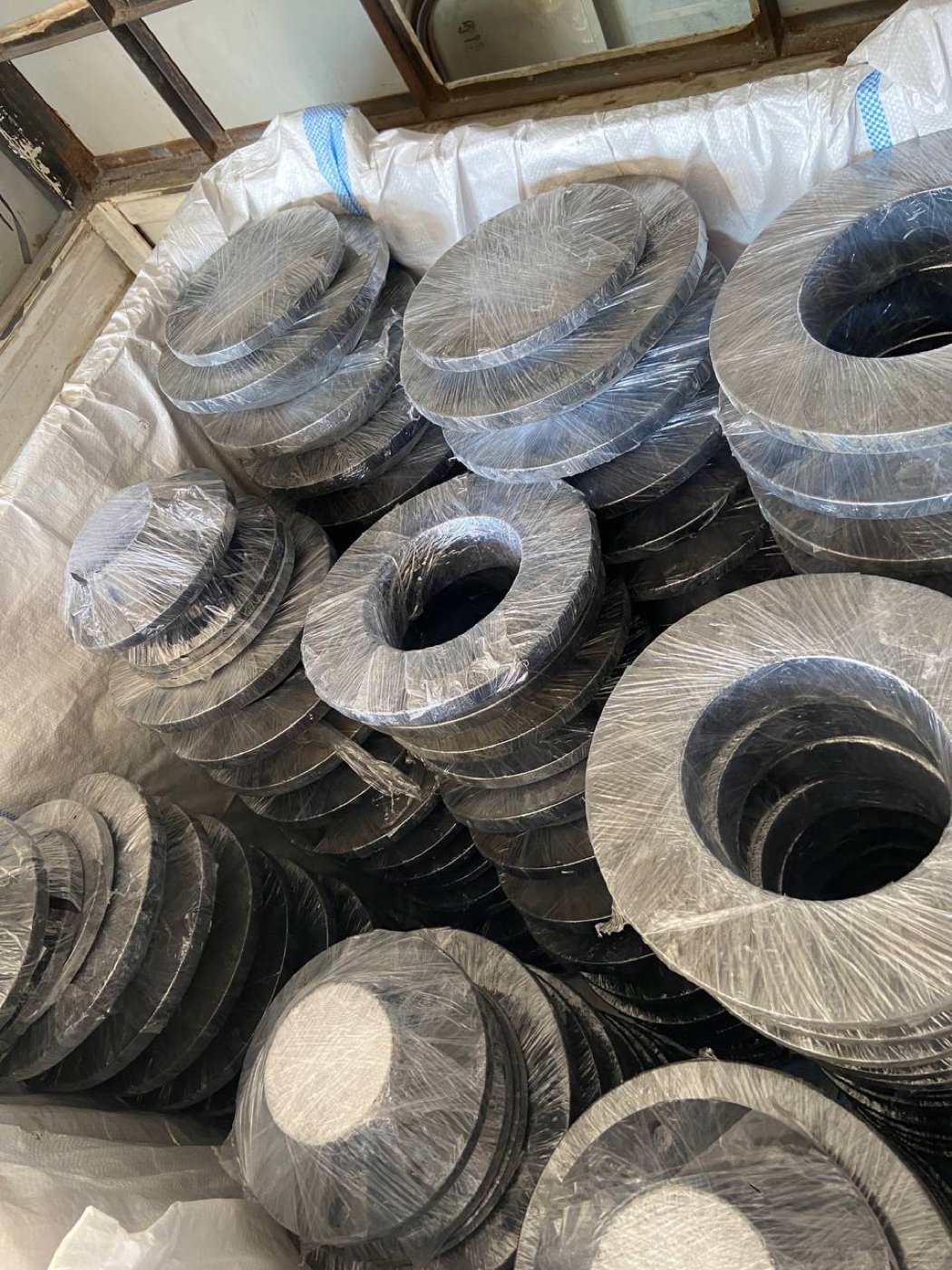
A182 F22 Alloy Steel Weld Neck Flanges — Wrapped in Lined Packing, Ready for Dispatch
ASTM A182 F22 Weld Neck Flange Dimensions
F22 weld neck flanges share their dimensions with every other material in the same class — OD, thickness, hub, bore, bolt circle and bolting per the standard tables. Full ASME B16.5 charts:
European PN dimensions are published on the EN 1092-1 Type 11, DIN 2631–2635 and BS 4504 pages.
Price List & How to Order
F22 pricing follows the alloy steel market plus heat-treatment and certification scope, so we quote live rather than publish a static list. To get a firm quotation, usually within 24 hours:
1
List your requirement — size (NB), class or PN, standard (ASME B16.5 / B16.47 / EN / DIN / BS), grade and class (F22 Cl1 or Cl3), pipe schedule or bore, and quantity.
2
Add any extras — IBR documentation, NACE MR0175, PMI, 3.2 certification, RTJ facing.
ASTM A182 F22 Weld Neck Flanges — Frequently Asked Questions
What is an ASTM A182 F22 weld neck flange?
It is a weld neck flange forged from ASTM A182 grade F22 — the 2.25% chromium, 1% molybdenum alloy steel (UNS K21590), supplied as Class 3 unless specified otherwise. The long tapered hub is butt-welded to the pipe with the bore matched to the pipe schedule, giving a radiographable, fatigue-resistant joint in the grade power plants choose for their hotter steam headers and hydroprocessing units choose for high-pressure hydrogen service.
What is the difference between F22 Class 1 and Class 3?
Heat treatment and the strength it buys. Class 1 is the annealed, softer condition — 415 MPa tensile / 205 MPa yield minimums — occasionally specified for its lower hardness. Class 3, the industry default and what we supply unless told otherwise, is normalized and tempered to 515 / 310 MPa minimums. Chemistry is the same 2.25Cr-1Mo in both. State the class in your enquiry and the certificate documents it.
What temperature can F22 flanges handle?
F22 serves creep-range steam duty to around 580 °C, with design stresses per the ASME rating tables — a useful step above F11's comfort zone. Where main-steam conditions push into supercritical territory, the modified 9Cr grade F91 takes over with roughly double the creep strength. Between those bounds, F22 is the standard grade for reheat headers, hot steam leads and heavy-wall boiler connections.
Why is F22 the grade for hydrogen service?
At high temperature and hydrogen partial pressure, hydrogen diffuses into steel and reacts with carbides to form methane, blistering and fissuring the metal from within — high-temperature hydrogen attack. Resistance is set by chromium and molybdenum content, mapped for designers by the API 941 Nelson curves, and 2.25Cr-1Mo sits far above carbon steel and F11 on those curves. That is why hydrotreaters, hydrocrackers and ammonia and methanol synthesis loops standardise on F22 flanges and A335 P22 pipe.
How does F22 compare with F11 and F91?
F11 (1.25Cr-0.5Mo) is the value grade for the broad middle of steam temperatures; F22 roughly doubles its chromium and molybdenum for higher creep strength and decisively better hydrogen-attack resistance; F91 (modified 9Cr-1Mo-V) then roughly doubles F22's creep strength again for supercritical steam, at the price of the strictest welding rules in the family. We forge weld neck flanges in all three, plus F5 and F9 for sulphur-driven refinery duty.
What are the equivalent designations for A182 F22?
UNS K21590; Werkstoff Nr. 1.7380; and the DIN designation 10CrMo910 (10CrMo9-10 in current EN numbering). Its system partners share the chemistry: A335 P22 seamless pipe, A234 WP22 butt-weld fittings and A217 WC9 castings. An enquiry in any of these designations is quoted as the same material.
What is the chemical composition of ASTM A182 F22?
Carbon 0.05 to 0.15%, manganese 0.30 to 0.60%, phosphorus 0.040% max, sulphur 0.040% max, silicon 0.50% max, chromium 2.00 to 2.50% and molybdenum 0.87 to 1.13%. The low, windowed carbon keeps this air-hardening grade weldable, while the full percent of molybdenum is what powers its creep strength.
What are the mechanical properties of A182 F22 flanges?
For Class 3: minimum tensile strength 515 MPa (75 ksi), minimum yield strength 310 MPa (45 ksi), minimum elongation 20%, minimum reduction of area 30%, and hardness controlled within 156 to 207 HB. The hardness band — floor and ceiling — confirms the normalize-and-temper heat treatment, keeps the flange weldable, and holds it under sour-service limits where NACE applies.
Which pipe grade do F22 weld neck flanges mate with?
ASTM A335 P22 — the 2.25Cr-1Mo seamless alloy pipe that shares F22's chemistry — with A234 WP22 fittings completing the system. The weld neck bore is machined to the pipe schedule you state, so the bore runs flush through the joint and the bevel arrives ready for a matched-chemistry butt weld.
How are F22 flanges welded to pipe?
With matching 2.25Cr-1Mo consumables — E9018-B3 electrodes or ER90S-B3 wire — preheat around 200 °C, controlled interpass temperature, and mandatory post-weld heat treatment at roughly 675 to 750 °C. F22 is genuinely air-hardening: the heat-affected zone quenches itself hard in still air, so the thermal rules are not optional. The 37.5 degree bevel comes machined ready for a radiographable butt weld.
Is PWHT required for F22 flange welds?
Effectively always. ASME B31.1, B31.3 and the boiler codes mandate post-weld heat treatment for the 2.25Cr class in essentially all practical thicknesses. PWHT tempers the hardened heat-affected zone, relieves residual stress, and restores the toughness a creep-service or hydrogen-service joint will rely on for decades. Plan the furnace or field-PWHT time into the construction schedule from day one.
Do you supply F22 flanges with IBR certification?
Yes. For Indian boiler and power plant work we supply F22 weld neck flanges with IBR Form III-C documentation under the Indian Boiler Regulations, alongside the EN 10204 3.1 or 3.2 material certificate. State the IBR requirement in your enquiry so inspection and countersigning are scheduled into production.
Where are ASTM A182 F22 weld neck flanges used?
Two worlds share the grade. Power generation runs F22 on reheat and main steam headers, hot boiler connections and HRSG high-temperature modules. Hydroprocessing runs it wherever hydrogen partial pressure and temperature climb — hydrotreater and hydrocracker reactor loops, ammonia and methanol synthesis circuits. Both exploit the same chemistry: chromium and molybdenum enough for creep and hydrogen resistance at a workable price.
What sizes and standards do you manufacture F22 weld neck flanges in?
From 1/2 inch NB to 56 inch NB: ASME B16.5 Class 150 to 2500 up to 24 inch, ASME B16.47 above, and European PN 2.5 to PN 400 patterns to EN 1092-1 Type 11, DIN and BS 4504. Raised face is standard, ring joint for high-class hydrogen and steam service on request, and every bore is machined to the mating pipe schedule from Sch 20 through XXS.
What testing and certification do you supply with F22 flanges?
Every lot ships with EN 10204 3.1 mill test certificates covering chemical analysis, mechanical properties, heat treatment condition and hardness, with 3.2 certification witnessed by Lloyd's, DNV, BV or TÜV on request. PMI verifies the chromium and molybdenum on the actual flange, hardness surveys support NACE MR0175 compliance, and IBR documentation is available for boiler work — with full heat-number traceability throughout.
Do you keep A182 F22 weld neck flanges in stock? What is the lead time?
Common power-plant and hydroprocessing sizes in Class 300, 600, 900 and 1500 rotate through regular production runs, with popular items often available from stock — the wrapped weld neck stacks photographed on this page are real alloy production. Larger diameters, Class 2500 and IBR-witnessed lots are forged to order, typically in 3 to 5 weeks. Send your list for a firm delivery commitment.
What information should I include in an F22 flange enquiry?
Six things: size (NB), pressure class or PN rating, dimensional standard (ASME B16.5, B16.47 or EN/DIN/BS), grade and class (F22 Cl1 or Cl3), pipe schedule or bore, and quantity. Add any extras — IBR, NACE, PMI, 3.2 certification, RTJ facing. With these details we return a firm quotation, usually within 24 hours.
Do you export ASTM A182 F22 flanges outside India?
Yes. Tesco Steel & Engineering is an ISO 9001:2015 certified manufacturer based in Mumbai, and F22 weld neck flanges ship steadily to power projects, refineries, fertiliser plants and EPC contractors across the Middle East, Europe, Africa, Southeast Asia and the Americas. Flanges travel face-protected in lined packing with full heat-number and heat-treatment traceability.

