ASTM A182 F12 Weld Neck Flanges — 1Cr-0.5Mo Alloy Steel
Tesco Steel & Engineering forges ASTM A182 F12 weld neck flanges in 1% chromium, 0.5% molybdenum alloy steel — UNS K11562, supplied as Class 2 — from 1/2″ NB to 56″ NB, in ASME B16.5 Class 150–2500 and European PN patterns. The quiet sibling of F11 with leaner silicon and chromium, F12 serves boiler steam circuits and power plant piping to ~550 °C, mating A335 P12 pipe wherever the specification calls out the P12/F12 system. Normalized & tempered, with IBR, NACE MR0175, PMI and EN 10204 3.1/3.2 on request. ISO 9001:2015, made in Mumbai, India — exported worldwide.
A182 F12 Cl2 · UNS K11562
1Cr – 0.5Mo Boiler Grade
1/2″ – 56″ NB
Class 150 – 2500 · PN 2.5 – 400
Steam Service to ~550 °C
IBR · NACE · PMI · 3.1/3.2
ISO 9001:2015 · Exported Worldwide
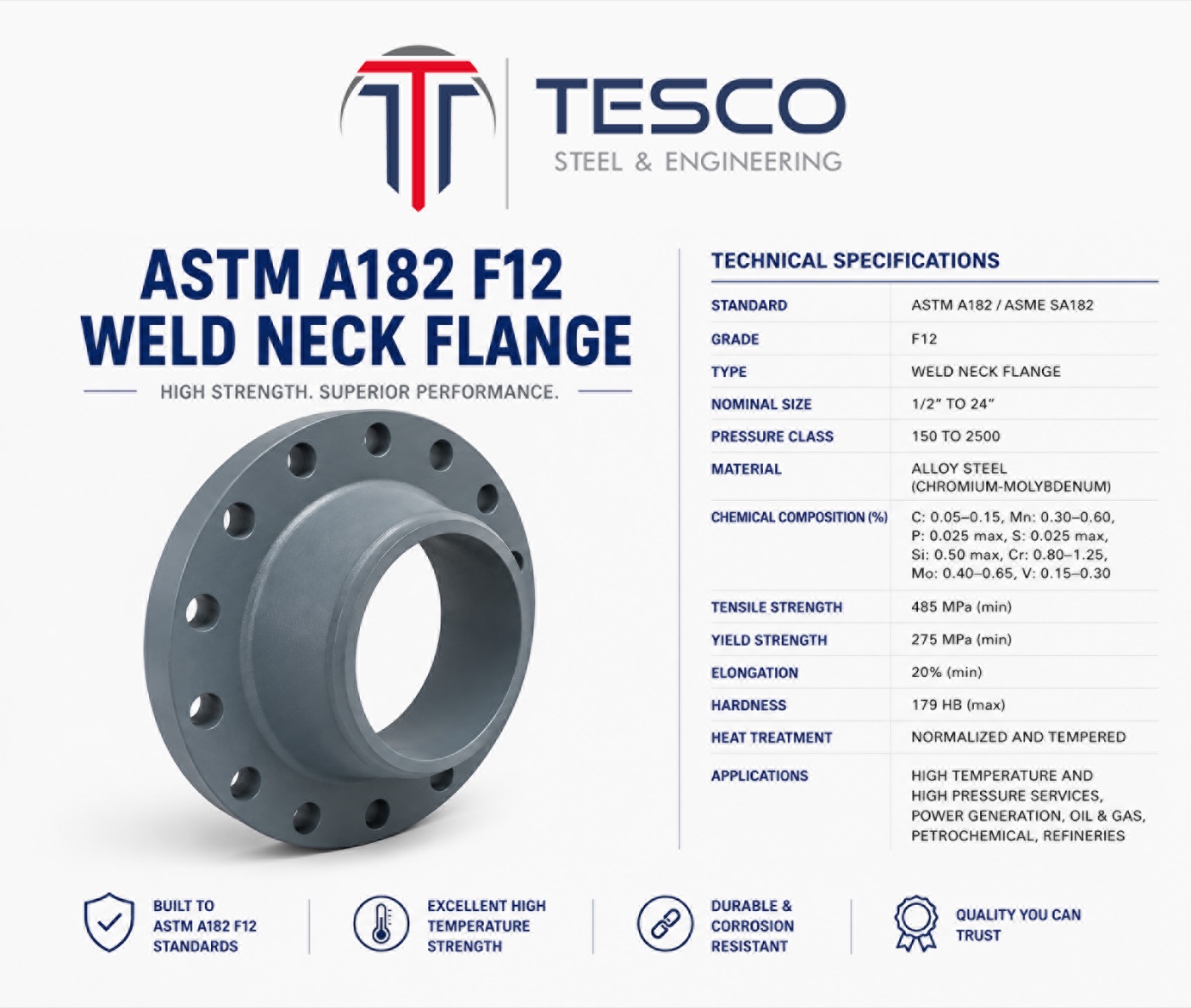
ASTM A182 F12 Weld Neck Flange — 1Cr-0.5Mo Alloy Steel, Technical Specifications
What is an ASTM A182 F12 Weld Neck Flange?
ASTM A182 F12 is the 1Cr-0.5Mo alloy steel forging grade (UNS K11562), supplied as Class 2 unless a spec says otherwise. An F12 weld neck flange pairs that chemistry with the strongest flange design: a long tapered hub butt-welded to the pipe, bore matched to the pipe schedule, joint fully radiographable — a boiler-grade chrome-moly for steam circuits to ~550 °C, running the P12/F12 system with A335 P12 pipe.
F12 and F11 are close siblings — identical Class 2 strength minimums, near-identical service envelopes — distinguished mainly by chemistry details: F12 runs slightly leaner chromium (0.80–1.25%) and markedly less silicon. In practice the project specification decides: P12 pipe systems take F12 flanges, P11 systems take F11, and the certificates document the difference. The molybdenum does the creep work either way, carrying boiler joints for decades past carbon steel's limit.
Up the ladder, F22 takes the hotter headers and hydrogen service, and F91 the supercritical creep duty; on the sulphur path, F5 and F9 serve the refineries. We forge every rung in-house.
Also searched as: A182 F12 Cl2 WNRF flange, SA182 F12 weld neck flange, 1Cr-0.5Mo flange, UNS K11562 flange, alloy steel F12 flange — all refer to the product on this page.
Chemical Composition of ASTM A182 F12 CL2
| C | Mn | P | S | Si | Cr | Mo |
|---|
| 0.10-0.20 | 0.30-0.80 | 0.040 max | 0.040 max | 0.10-0.60 | 0.80-1.25 | 0.44-0.65 |
Values in weight %, per ASTM A182 for grade F12 Class 2. The nominal 1% chromium and half-percent molybdenum define the grade; the restrained silicon (0.10–0.60%) is the tell that separates F12 from F11 on a certificate.
Mechanical Properties of ASTM A182 F12 CL2
| Tensile Strength, MPa [ksi] | Yield Strength, Min, MPa [ksi] | Elongation % min. |
|---|
| 485 [70] | 275 [40] | 20 |
Class 2 minimums — identical to F11 Class 2, so the two grades rate the same in the ASME pressure-temperature tables. Class 1 (415/220 MPa, lower carbon) is supplied against specification, and each flange's heat treatment and hardness are reported on the certificate.
Designations & System Partners
| Product Form | Specification |
|---|
| Forged flanges | ASTM A182 F12 (UNS K11562) |
| Seamless pipe | ASTM A335 P12 |
| Butt-weld fittings | ASTM A234 WP12 |
| European family | 13CrMo4-5 / W.Nr 1.7335 composition range |
One 1Cr-0.5Mo chemistry across the whole piping system — an enquiry in any of these designations is quoted as the same material.
ASTM A182 F12 Weld Neck Flange Specifications
| ASTM A182 F12 Weld Neck Flanges are available in the following specifications: |
|---|
| Size | 1/2"NB to 56"NB |
| Class | 150#, 300#, 400#, 600#, 900#, 1500#, 2500# |
| Sch (Schedule) | XS, XXS, STD & Schedule 20, 40, 80, 160 |
| Pressure Ratings | PN 2.5 - PN 400 |
| Standards | ASME B16.5, ASME B16.47, EN 1092-1 Type 11, DIN 2631–2635, BS 4504 |
| Grade / Strength Class | A182 F12 Class 2 standard; Class 1 on request |
| Other Services | Hot Dip Galvanized (GI) ASTM A182 F12 Weld Neck Flanges
Sand Blasting on ASTM A182 F12 Weld Neck Flanges
Shot Peening on ASTM A182 F12 Weld Neck Flanges
Epoxy Coating on ASTM A182 F12 Weld Neck Flanges
FBE Coating on ASTM A182 F12 Weld Neck Flanges |
Why F12 for Boiler Flanged Joints
The P12 System Match
Where the specification runs A335 P12 pipe, F12 flanges complete the system — matched chemistry, matched welding procedures, matched certificates.
Creep Strength Past Carbon Steel
Half a percent of molybdenum carries boiler steam joints to ~550 °C for decades — at a cost and weldability close to carbon steel practice.
Mild Welding Rules
E8018-B2 consumables, moderate preheat, standard PWHT — among the friendliest of the chrome-moly family, proven across thousands of boiler joints.
IBR & Code Ready
IBR Form III-C for Indian boiler work, EN 10204 3.1/3.2, PMI and hardness surveys — the paperwork arrives as complete as the flange.
A Weld You Can Prove
The full-penetration butt weld radiographs cleanly — the inspection backbone every boiler code expects of its creep-service joints.
Welding F12 — What the Grade Demands
F12 welds like its sibling F11: matching 1Cr-0.5Mo consumables (E8018-B2 / ER80S-B2), preheat around 150–200 °C, and PWHT at roughly 620–720 °C where the governing code requires it — which, above thin-wall exemption limits, is most of the time in boiler work. The heat-affected zone hardens if the thermal rules are ignored, mild grade or not.
Plan the PWHT. ASME B31.1/B31.3 and the boiler codes invoke post-weld heat treatment for the 1Cr class beyond modest thicknesses — cheap insurance on joints that will spend decades in creep service.
Where ASTM A182 F12 Weld Neck Flanges Are Used
Boilers and power plants: steam circuits, headers and distribution piping, turbine auxiliaries and feedwater systems — every P12-specified joint running hotter than carbon steel's comfort zone. Refinery and petrochemical services at moderate creep-range temperatures use the grade for the same economics. Below ~425 °C, A105 saves money; for hotter or hydrogen service, F22 continues the ladder.
Production & Packing
Certified 1Cr-0.5Mo blanks are forged, normalized and tempered, PMI-verified, then CNC-turned: hub profiled, bore matched to your pipe schedule, weld end bevelled to 37.5°, faces serrated, and each flange marked with grade, size, rating and heat number. The photograph below is our alloy weld neck production, black-coated and wrapped:
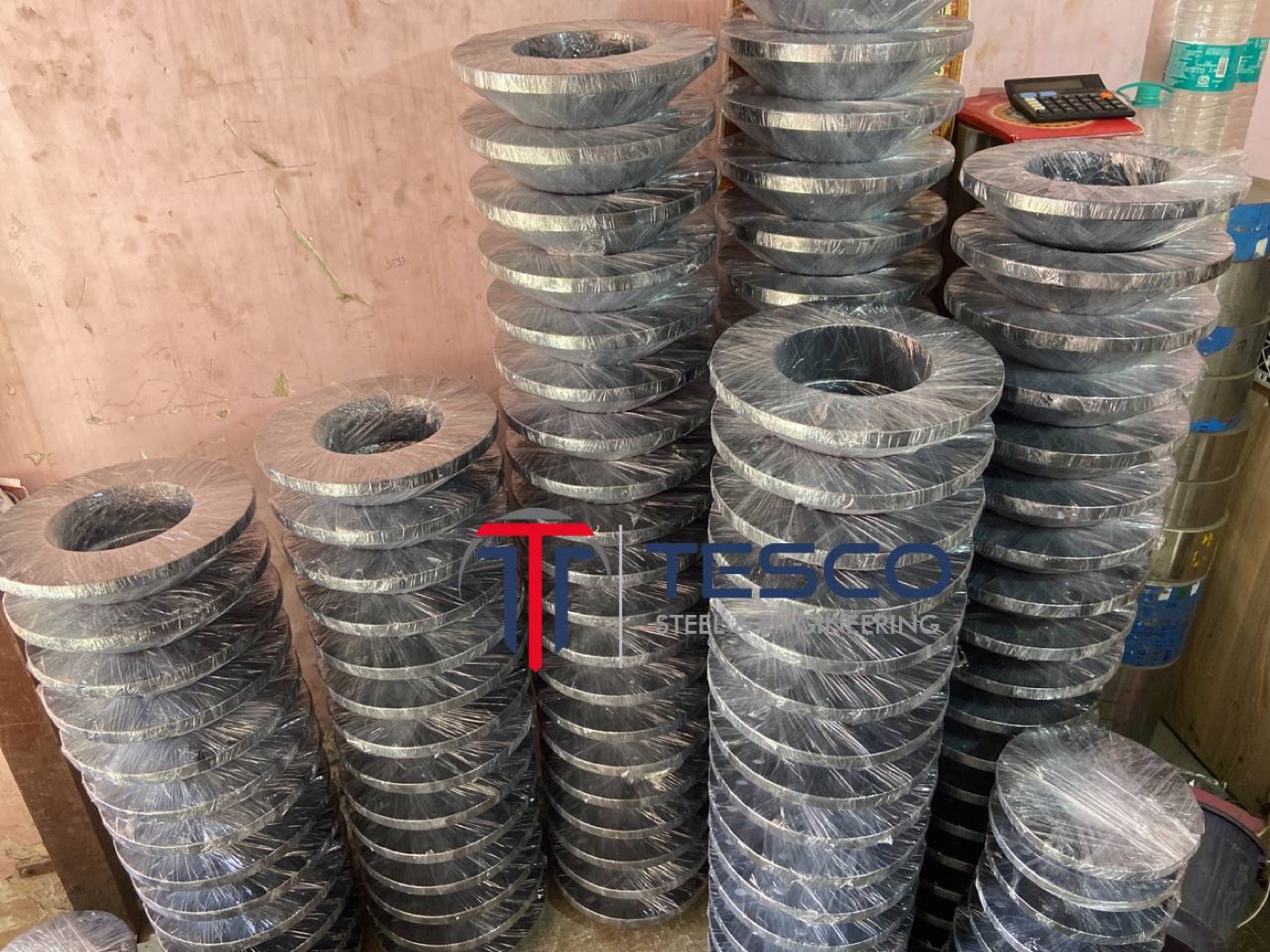
A182 F12 Alloy Steel Weld Neck Flanges — Wrapped & Stacked in Production
ASTM A182 F12 Weld Neck Flange Dimensions
F12 weld neck flanges share their dimensions with every other material in the same class — OD, thickness, hub, bore, bolt circle and bolting per the standard tables. Full ASME B16.5 charts:
European PN dimensions are published on the EN 1092-1 Type 11, DIN 2631–2635 and BS 4504 pages.
Price List & How to Order
F12 pricing follows the alloy steel market plus heat-treatment and certification scope, so we quote live rather than publish a static list. To get a firm quotation, usually within 24 hours:
1
List your requirement — size (NB), class or PN, standard (ASME B16.5 / B16.47 / EN / DIN / BS), grade and class (F12 Cl1 or Cl2), pipe schedule or bore, and quantity.
2
Add any extras — IBR documentation, NACE MR0175, PMI, 3.2 certification, RTJ facing.
ASTM A182 F12 Weld Neck Flanges — Frequently Asked Questions
What is an ASTM A182 F12 weld neck flange?
It is a weld neck flange forged from ASTM A182 grade F12 — the 1% chromium, 0.5% molybdenum alloy steel (UNS K11562), supplied as Class 2 unless specified otherwise. The long tapered hub is butt-welded to the pipe with the bore matched to the pipe schedule, giving a radiographable, fatigue-resistant joint in a boiler-grade chrome-moly that serves steam circuits running hotter than carbon steel's comfort zone.
What is the difference between F12 and F11 flanges?
They are close siblings — both nominally low-chromium, half-molybdenum boiler steels with identical Class 2 strength minimums. The differences are subtle: F12 carries slightly less chromium (0.80-1.25% versus F11's 1.00-1.50%) and, distinctively, much less silicon (0.10-0.60% versus F11's 0.50-1.00%). In practice the choice is made by the project specification and the pipe grade it pairs with — P12 systems take F12 flanges, P11 systems take F11. We forge both, so either callout is covered.
What is the difference between F12 Class 1 and Class 2?
Carbon content and strength. Class 1 runs 0.05 to 0.15% carbon with 415 MPa tensile / 220 MPa yield minimums; Class 2 — the industry default and what we supply unless told otherwise — runs 0.10 to 0.20% carbon with 485 / 275 MPa minimums. State the class in your enquiry and the certificate documents it.
What temperature can F12 flanges handle?
F12 serves creep-range steam duty to around 550 °C, with design stresses per the ASME rating tables — essentially the same envelope as F11. Below about 425 °C, carbon steel A105 is usually the economical choice; for hotter headers and hydrogen service, F22 steps up; for supercritical steam, F91 tops the ladder. The molybdenum resists creep and the chromium adds oxidation margin at boiler conditions.
What are the equivalent designations for A182 F12?
UNS K11562 for the Class 2 grade, running alongside its system partners: A335 P12 seamless pipe and A234 WP12 butt-weld fittings — the same 1Cr-0.5Mo chemistry across every product form. In European practice the closely related 13CrMo4-5 (1.7335) family covers this composition range. An enquiry in any of these designations is quoted as the same material.
What is the chemical composition of ASTM A182 F12?
For Class 2: carbon 0.10 to 0.20%, manganese 0.30 to 0.80%, phosphorus 0.040% max, sulphur 0.040% max, silicon 0.10 to 0.60%, chromium 0.80 to 1.25% and molybdenum 0.44 to 0.65%. The nominal 1% chromium and half-percent molybdenum define the grade; the restrained silicon is what visibly separates it from F11 on a certificate.
What are the mechanical properties of A182 F12 flanges?
For Class 2: minimum tensile strength 485 MPa (70 ksi), minimum yield strength 275 MPa (40 ksi) and minimum elongation 20% — identical strength minimums to F11 Class 2, so the two grades rate the same in the ASME pressure-temperature tables. Hardness is controlled through the normalize-and-temper heat treatment and reported on the certificate.
Which pipe grade do F12 weld neck flanges mate with?
ASTM A335 P12 — the 1Cr-0.5Mo seamless alloy pipe that shares F12's chemistry — with A234 WP12 fittings completing the system. The weld neck bore is machined to the pipe schedule you state, so the bore runs flush through the joint and the bevel arrives ready for a matched-chemistry butt weld.
How are F12 flanges welded to pipe?
With 1Cr-0.5Mo-class consumables — E8018-B2 electrodes or ER80S-B2 wire — preheat around 150 to 200 °C, controlled interpass temperature, and post-weld heat treatment at roughly 620 to 720 °C as the governing code requires. Like all the chrome-molys, F12 hardens in the heat-affected zone if the thermal rules are ignored, though it is among the milder grades to weld.
Is PWHT required for F12 flange welds?
In most practical cases, yes. ASME B31.1 and B31.3 require post-weld heat treatment for the 1Cr class above thin-wall exemption limits, and boiler codes almost always invoke it. PWHT tempers the hardened heat-affected zone and relieves residual stress — cheap insurance on joints that will spend decades in creep service.
Do you supply F12 flanges with IBR certification?
Yes. For Indian boiler and power plant work we supply F12 weld neck flanges with IBR Form III-C documentation under the Indian Boiler Regulations, alongside the EN 10204 3.1 or 3.2 material certificate. State the IBR requirement in your enquiry so inspection and countersigning are scheduled into production.
Where are ASTM A182 F12 weld neck flanges used?
Boiler steam circuits, steam headers and distribution piping, power plant auxiliaries, and refinery or petrochemical services at moderate creep-range temperatures — the same territory as F11, chosen wherever the project specification and pipe grade call out the P12/F12 system. Its molybdenum extends life beyond carbon steel while keeping welding and cost close to carbon steel practice.
What sizes and standards do you manufacture F12 weld neck flanges in?
From 1/2 inch NB to 56 inch NB: ASME B16.5 Class 150 to 2500 up to 24 inch, ASME B16.47 above, and European PN 2.5 to PN 400 patterns to EN 1092-1 Type 11, DIN and BS 4504. Raised face is standard, ring joint on request, and every bore is machined to the mating pipe schedule from Sch 20 through XXS.
What testing and certification do you supply with F12 flanges?
Every lot ships with EN 10204 3.1 mill test certificates covering chemical analysis, mechanical properties and heat treatment condition, with 3.2 certification witnessed by Lloyd's, DNV, BV or TÜV on request. PMI verifies the chromium and molybdenum on the actual flange, hardness surveys support NACE MR0175 compliance, and IBR documentation is available for boiler work — with full heat-number traceability throughout.
Do you keep A182 F12 weld neck flanges in stock? What is the lead time?
F12 is a specification-driven grade that rotates through production runs alongside our high-volume F11 line — the wrapped weld neck stacks photographed on this page are real alloy production. Common boiler sizes are often available quickly; other sizes, higher classes and IBR-witnessed lots are forged to order, typically in 3 to 5 weeks. Send your list for a firm delivery commitment.
What information should I include in an F12 flange enquiry?
Six things: size (NB), pressure class or PN rating, dimensional standard (ASME B16.5, B16.47 or EN/DIN/BS), grade and class (F12 Cl1 or Cl2), pipe schedule or bore, and quantity. Add any extras — IBR, NACE, PMI, 3.2 certification, RTJ facing. With these details we return a firm quotation, usually within 24 hours.
Do you export ASTM A182 F12 flanges outside India?
Yes. Tesco Steel & Engineering is an ISO 9001:2015 certified manufacturer based in Mumbai, and F12 weld neck flanges ship to power projects, boiler makers and EPC contractors across the Middle East, Europe, Africa, Southeast Asia and the Americas. Flanges travel face-protected in lined packing with full heat-number and heat-treatment traceability.

