Inconel 600 Weld Neck Flanges — Nickel-Chromium Alloy (UNS N06600)
Tesco Steel & Engineering forges Inconel 600 weld neck flanges — UNS N06600, Werkstoff Nr. 2.4816, the foundational 72% nickel, 15% chromium alloy — to ASTM B564, from 1/2″ NB to 56″ NB in ASME B16.5 Class 150–2500 and European PN patterns. The chromium adds oxidation resistance to ~1093 °C onto a nickel base that owns caustic service, handles dry chlorine and HCl hot, and is immune to chloride stress corrosion cracking — the alloy of furnace components, heat-treatment equipment, nuclear steam systems and hot chemical duty, mating B167 pipe, welded with ERNiCr-3 (Inconel 82). Supplied with PMI and EN 10204 3.1/3.2 on request. ISO 9001:2015, made in Mumbai, India — exported worldwide.
Inconel 600 · UNS N06600 · 2.4816
Ni 72% Min · Cr 14–17% · NiCr15Fe
ASTM B564 / ASME SB-564
Heat to 1093 °C · Caustic · Halogens
Chloride SCC Immune
1/2″ – 56″ NB · Class 150–2500
ISO 9001:2015 · Exported Worldwide
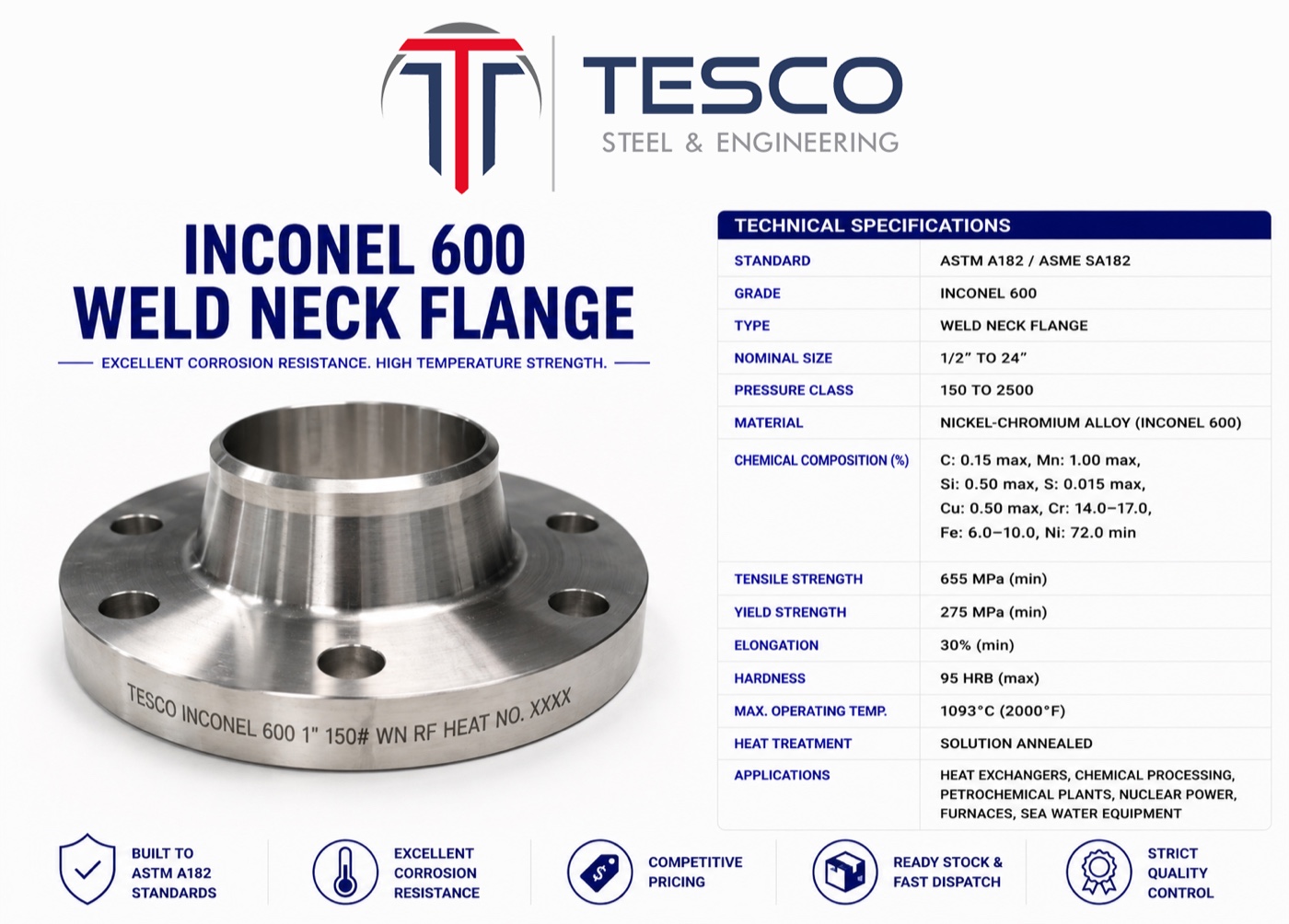
Inconel 600 Weld Neck Flange — UNS N06600 (2.4816), Technical Specifications
What is an Inconel 600 Weld Neck Flange?
Inconel 600 (UNS N06600 / 2.4816) is the foundational nickel-chromium alloy: 72% nickel minimum carrying nickel's chemistry — caustic tolerance, dry-halogen capability, chloride-SCC immunity — with 14–17% chromium building the oxide shield that takes it to ~1093 °C in air. An Inconel 600 weld neck flange pairs that dual pedigree with a long tapered hub butt-welded to the pipe, bore matched to schedule, forged to ASTM B564.
Alloy 600 is the bridge between the corrosion alloys and the heat-resisting ones — where pure nickel and Monel scale away in hot oxidizing atmospheres, 600's chromia holds. The family continues by enemy: 601 adds aluminium for furnace duty above 1100 °C; 625 adds molybdenum and niobium for wet corrosion and strength.
Decades of furnace retorts, radiant tubes, chlorination units, caustic evaporators and nuclear steam systems built the alloy's pedigree — flanged joints on hot-gas and hot-chemistry loops specify it so the connection is never the weak point.
Also searched as: Alloy 600 flange, UNS N06600 flange, 2.4816 flange, NiCr15Fe flange, nickel chromium flange, ASTM B564 Inconel flange — all refer to the product on this page; see also our
Inconel 600 flanges overview.
Chemical Composition of Inconel 600
| C | Mn | Si | S | Cu | Fe | Ni | Cr |
|---|
| 0.15 max | 1.00 max | 0.50 max | 0.015 max | 0.50 max | 6.00-10.00 | 72.00 min | 14.00-17.00 |
Values in weight %. The chromium is the heat shield — its oxide carries the alloy to red heat — while the 72% nickel minimum keeps the corrosion chemistry of the family; the deliberate iron improves economy without costing either.
Mechanical Properties of Inconel 600
| Tensile Strength, MPa | Yield Strength, Min, MPa | Elongation % min. |
|---|
| 655 | 310 | 40 |
Typical annealed values per our supply practice; the governing ASTM B564 minimums are 550 MPa (80 ksi) tensile, 240 MPa (35 ksi) yield and 30% elongation, demonstrated on every certificate. Useful strength persists to red heat — the property that keeps furnace connections serviceable where steels have long yielded.
Equivalent Grades of Inconel 600
| Standard | Werkstoff Nr. | UNS | JIS | BS | GOST | AFNOR | EN |
|---|
| Inconel 600 | 2.4816 | N06600 | NCF 600 | NA 13 | ХН78Т | NC15FE11M | NiCr15Fe |
System partners: ASTM B167 seamless pipe, B366 butt-weld fittings, B168 plate and B564 forgings. Family siblings: Inconel 601 (Al-bearing furnace grade) and Inconel 625 (Mo-Nb corrosion heavyweight).
Inconel 600 Weld Neck Flange Specifications
| Inconel 600 Weld Neck Flanges are available in the following specifications: |
|---|
| Size | 1/2"NB to 56"NB |
| Class | 150#, 300#, 400#, 600#, 900#, 1500#, 2500# |
| Sch (Schedule) | XS, XXS, STD & Schedule 20, 40, 80, 160 |
| Pressure Ratings | PN 2.5 - PN 400 |
| Standards | ASTM B564 / ASME SB-564; ASME B16.5, ASME B16.47, EN 1092-1, DIN 2631–2635, BS 4504 |
| Condition | Annealed |
| Other Services | Sand Blasting on Inconel 600 Weld Neck Flanges
Shot Peening on Inconel 600 Weld Neck Flanges
Pickling & degreased supply
PMI testing & dye-penetrant examination
Project-specific marking, wrapping & export packing |
Why Alloy 600 is the Heat-and-Chemistry Workhorse
Red Heat Without Scaling
The chromia film carries the alloy to ~1093 °C in air — furnace retorts, radiant tubes and hot-gas flanges run for years.
Nickel's Chemistry Intact
Caustic tolerance second only to pure nickel, dry chlorine and HCl capability at temperature, and total chloride-SCC immunity.
Cryogenic to Furnace
One austenitic alloy covers liquefied-gas toughness and red-heat strength — few materials span that range.
Nuclear-Grade Pedigree
Steam-generator and reactor-auxiliary history means the metallurgy, welding and paperwork of alloy 600 are understood everywhere.
600, 601 & 625 From One Forge
The full Inconel flange family in production — whichever member the service picks, the bevels and certificates arrive matched.
Welding Inconel 600 — 82/182 and Clean Discipline
Alloy 600 welds with ERNiCr-3 (Inconel 82) wire or ENiCrFe-3 (182) electrodes and classic nickel-alloy discipline: sulphur-free cleanliness, low heat input, no preheat, no PWHT. The solid-solution alloy has no sensitization to manage in normal fabrication, and the 82/182 consumables carry the joint's rating to the same temperatures as the base metal.
Hot-end cautions: sulphur-bearing atmospheres attack all high-nickel alloys above ~315 °C, and carburizing service above ~1000 °C favours the aluminium-bearing
Inconel 601. For wet, acidic or seawater duty, step across to
625.
Where Inconel 600 Weld Neck Flanges Are Used
Furnace and heat-treatment plants lead: retorts, muffles, radiant tube and hot-gas ducting connections. Chemical hot sections follow — chlorination and vinyl chloride units, caustic evaporators — then nuclear and conventional steam systems, thermocouple and heater wells, and gas-turbine auxiliaries. Our nickel-alloy production below:
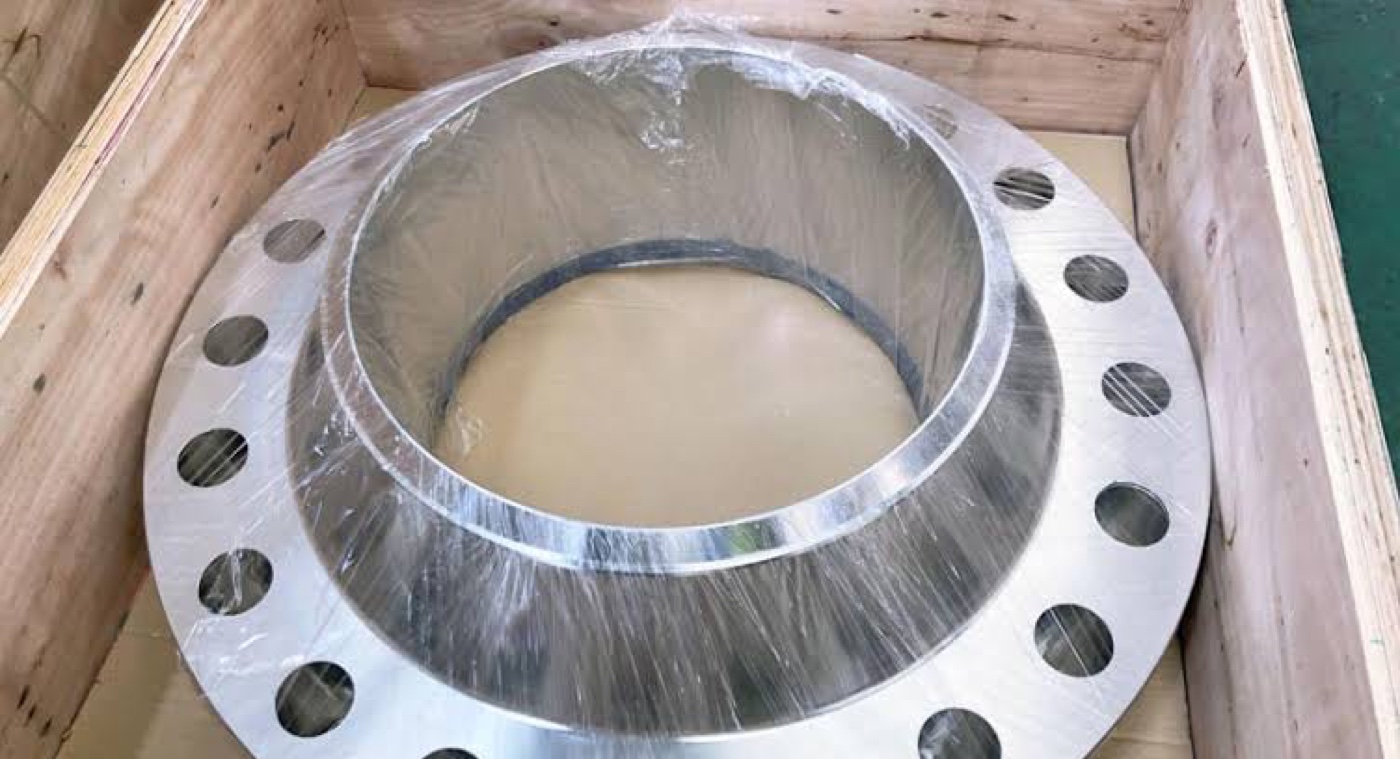
Weld Neck Flanges — Machined & Packed Production
Inconel 600 Weld Neck Flange Dimensions
Inconel 600 weld neck flanges share their dimensions with every other material in the same class — OD, thickness, hub, bore, bolt circle and bolting per the standard tables. Full ASME B16.5 charts:
European PN dimensions are published on the EN 1092-1 Type 11, DIN 2631–2635 and BS 4504 pages.
Price List & How to Order
Inconel pricing tracks nickel closely plus the testing scope, so we quote live with a stated validity rather than publish a static list. To get a firm quotation, usually within 24 hours:
1
List your requirement — size (NB), class or PN, standard (ASME B16.5 / B16.47 / EN / DIN / BS), grade (Inconel 600 / N06600 — or 601/625 if the service demands), pipe schedule or bore, and quantity.
2
State the service & testing scope — temperature and atmosphere (it picks the family member), plus 3.2 witness, PMI or project specifications.
Inconel 600 Weld Neck Flanges — Frequently Asked Questions
What is an Inconel 600 weld neck flange?
It is a weld neck flange forged from Inconel 600 — the foundational nickel-chromium alloy of 72% nickel minimum and 15% chromium, UNS N06600 / 2.4816 — to ASTM B564. The long tapered hub is butt-welded to the pipe with the bore matched to the pipe schedule, giving a radiographable, fatigue-resistant joint in the alloy that pairs nickel's corrosion chemistry with chromium's heat resistance: furnace, heat-treatment and hot chemical duty to about 1093 °C.
What makes Inconel 600 different from pure nickel and Monel?
The 15% chromium. Pure nickel and Monel excel in caustic, HF and seawater but scale away in hot oxidizing atmospheres; alloy 600's chromium builds a protective oxide that carries it to about 1093 °C in air while the nickel base keeps the family virtues — caustic tolerance, dry-halogen capability and complete chloride-SCC immunity. It is the bridge between the corrosion alloys and the heat-resisting ones, which is why it became the workhorse of both worlds.
When should I choose Inconel 601 or 625 instead of 600?
By enemy. 601 adds aluminium for still better oxidation and carburization resistance — the furnace specialist above 1100 °C. 625 adds 9% molybdenum and niobium for wet corrosion and strength — the marine and chemical heavyweight. Alloy 600 remains the balanced generalist: hot air, steam, caustic and halogens at the best price of the three. We forge all of them, so the enquiry can name the service and we confirm the economic grade.
What are the equivalent designations for Inconel 600?
UNS N06600; Werkstoff Nr. 2.4816; EN NiCr15Fe; JIS NCF 600; BS NA 13; GOST ХН78Т; AFNOR NC15FE11M; and the trade names Inconel 600 or Alloy 600. System partners: ASTM B167 seamless pipe, B366 butt-weld fittings, B168 plate and B564 forgings. An enquiry in any of these designations is quoted as the same material.
What is the chemical composition of Inconel 600?
Per ASTM B564: nickel 72.00% minimum, chromium 14.00 to 17.00%, iron 6.00 to 10.00%, with residuals capped at carbon 0.15%, manganese 1.00%, silicon 0.50%, copper 0.50% and sulphur 0.015%. The chromium is the heat shield; the deliberate iron improves economy without costing the nickel base its chemistry.
What are the mechanical properties of Inconel 600 flanges?
Typical annealed properties run 655 MPa tensile, 310 MPa yield and 40% elongation; the governing ASTM B564 minimums are 550 MPa (80 ksi) tensile, 240 MPa (35 ksi) yield and 30% elongation, demonstrated on every certificate. Useful strength persists to red heat — the property that keeps flanged furnace connections serviceable where steels have long yielded.
Which pipe and fittings do Inconel 600 weld neck flanges mate with?
ASTM B167 seamless Inconel 600 pipe is the standard partner, with B366 butt-weld fittings and B168 plate completing the system. The weld neck bore is machined to the pipe schedule you state, so the bore runs flush through the joint and the bevel arrives ready for a matched-chemistry butt weld.
How are Inconel 600 flanges welded to pipe?
With ERNiCr-3 (Inconel 82) wire or ENiCrFe-3 (182) electrodes and nickel-alloy discipline: scrupulous sulphur-free cleanliness, low heat input, no preheat, no PWHT. The solid-solution alloy has no sensitization to manage in normal fabrication, and the 82/182 consumables carry the joint's rating to the same temperatures as the base metal.
What temperature range can Inconel 600 flanges be used in?
From cryogenic — the austenitic nickel base keeps full toughness — to about 1093 °C in oxidizing atmospheres, where the chromia scale protects. Two cautions steer the hot end: sulphur-bearing atmospheres attack all high-nickel alloys above roughly 315 °C, and carburizing service above 1000 °C favours the aluminium-bearing 601. Within those lines, few alloys cover so wide a span.
Is Inconel 600 resistant to chloride stress corrosion cracking?
Yes — at over 70% nickel the alloy sits far beyond the SCC threshold, and alloy 600 has long been specified for hot chloride and steam duties precisely because austenitic stainless cracks there. Its one documented aqueous weakness is high-temperature pure water with caustic concentration (the historic nuclear steam-generator lesson), which alloy 690's higher chromium addresses — a niche far from ordinary flange duty.
Can Inconel 600 handle caustic and halogens?
Yes on both counts — the nickel base gives excellent caustic soda resistance second only to pure nickel, and the alloy serves dry chlorine and hydrogen chloride at elevated temperatures where it is a standard materials choice. That chemistry, plus the heat capability, is why chlorination units and caustic evaporator hot sections flange in alloy 600.
Why is Inconel 600 used in furnace and heat-treatment equipment?
Because it keeps both strength and surface integrity through thermal cycling to very high temperatures: retorts, muffles, radiant tubes, rollers and fixture hardware run for years in alloy 600. Flanged connections on hot-gas ducting, burner trains and furnace atmosphere systems specify the same alloy so the joint is never the weak point of the loop.
What testing and certification do you supply with Inconel 600 flanges?
Every lot ships with EN 10204 3.1 mill test certificates covering chemical analysis — demonstrating the 72% nickel minimum and chromium window — mechanical properties and the anneal record, with 3.2 certification witnessed by Lloyd's, DNV, BV or TÜV on request. We also offer PMI verification, hydrostatic testing and dye-penetrant examination, with full heat-number traceability.
Where are Inconel 600 weld neck flanges used?
Furnace and heat-treatment plants — retorts, radiant tube and hot-gas connections — plus chemical and petrochemical hot sections, chlorination and vinyl chloride units, caustic evaporators, nuclear and conventional steam systems, thermocouple and heater wells, and gas-turbine auxiliaries. Wherever heat and aggressive chemistry arrive together, alloy 600 is the historic first answer.
What sizes and standards do you manufacture Inconel 600 weld neck flanges in?
From 1/2 inch NB to 56 inch NB: ASME B16.5 Class 150 to 2500 up to 24 inch, ASME B16.47 above, and European PN 2.5 to PN 400 patterns to EN 1092-1, DIN and BS 4504. Raised face is standard, ring joint on request, and every bore is machined to the mating pipe schedule from Sch 10 through XXS.
Do you keep Inconel 600 weld neck flanges in stock? What is the lead time?
Inconel moves in project quantities, so common furnace and chemical-plant sizes in Class 150 and 300 rotate through production with popular items often available, while larger diameters, higher classes and witness-tested lots are forged to order — typically 4 to 6 weeks. Prices track nickel closely, so quotations carry a validity period.
Do you export Inconel 600 flanges outside India?
Yes. Tesco Steel & Engineering is an ISO 9001:2015 certified manufacturer based in Mumbai, and Inconel 600 flanges ship to furnace, chemical and power projects across the Middle East, Europe, Africa, Southeast Asia and the Americas. Flanges travel face-protected and seaworthy-packed, with full heat-number and test traceability.

