ASTM A182 F91 Weld Neck Flanges — Modified 9Cr-1Mo-V (Grade 91)
Tesco Steel & Engineering forges ASTM A182 F91 weld neck flanges in modified 9Cr-1Mo-V — Grade 91, UNS K90901, Werkstoff Nr. 1.4903 — from 1/2″ NB to 56″ NB, in ASME B16.5 Class 150–2500 and European PN patterns. Vanadium, niobium and nitrogen micro-alloying gives Grade 91 roughly double the creep strength of conventional 9Cr steel, making it the flange of supercritical and ultra-supercritical steam piping — main steam, hot reheat, headers and turbine leads — mating A335 P91 pipe. Normalized & tempered under tight control, hardness-surveyed, with IBR, PMI and EN 10204 3.1/3.2 certification. ISO 9001:2015, made in Mumbai, India — exported worldwide.
A182 F91 · Grade 91 · UNS K90901
Modified 9Cr – 1Mo – V
1/2″ – 56″ NB
Class 150 – 2500 · PN 2.5 – 400
Supercritical Steam to ~620 °C
IBR · PMI · Hardness Surveys
ISO 9001:2015 · Exported Worldwide
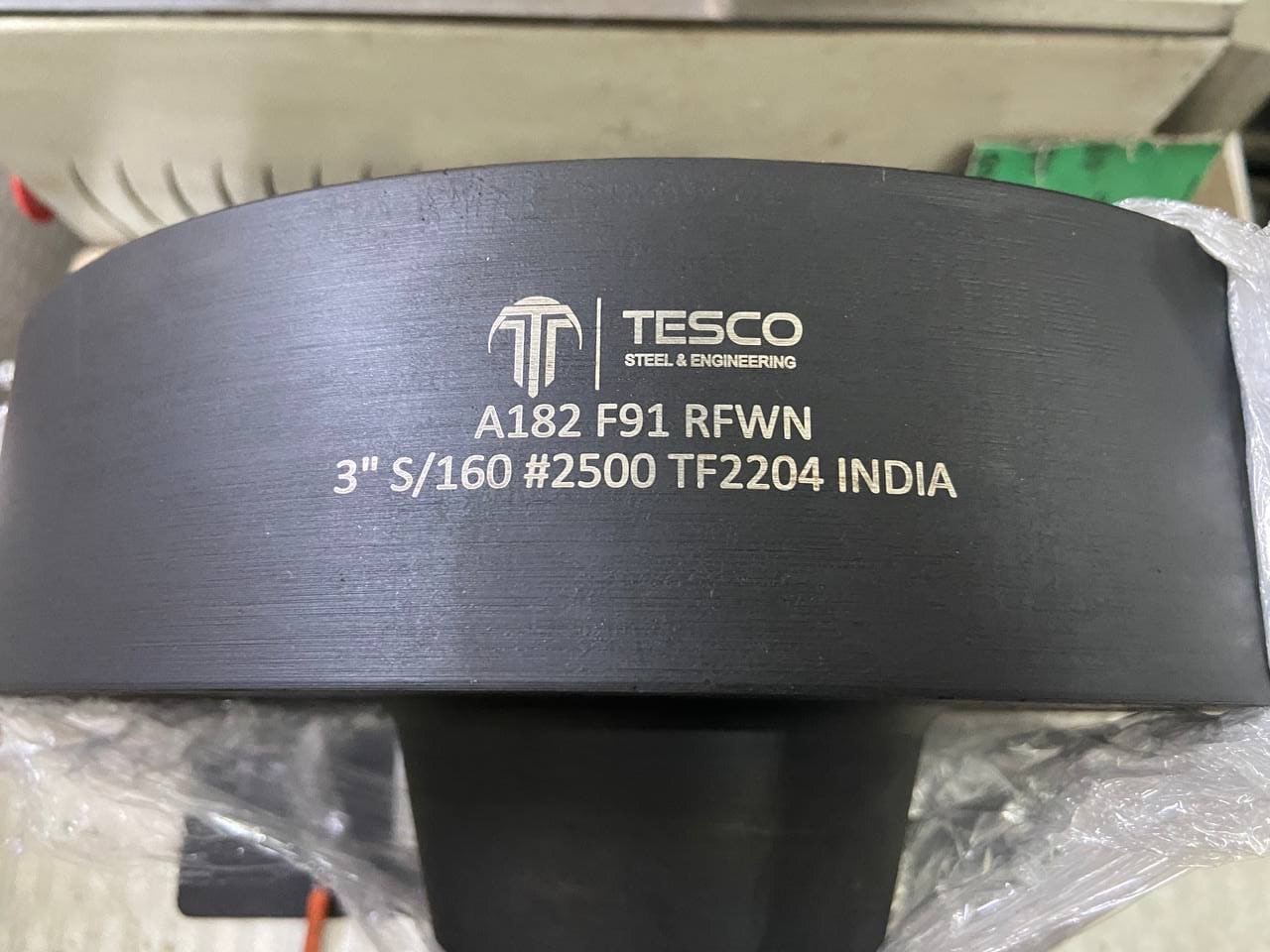
ASTM A182 F91 Weld Neck Flange — 3″ Sch 160, Class 2500 RFWN, Laser-Marked, From Production
What is an ASTM A182 F91 Weld Neck Flange?
ASTM A182 F91 is the forged-flange form of Grade 91 — modified 9Cr-1Mo-V, the creep-strength-enhanced ferritic (CSEF) steel that carries the world's supercritical and ultra-supercritical steam piping. An F91 weld neck flange pairs that metallurgy with the strongest flange design: a long tapered hub butt-welded to the pipe, bore matched to the pipe schedule, joint fully radiographable — rated for steam to ~620 °C with the highest allowable stresses of any ferritic flange grade.
The "modified" is the whole story: tiny, tightly controlled additions of vanadium, niobium and nitrogen form fine carbo-nitrides that pin the microstructure at temperature, roughly doubling the creep strength of conventional 9Cr steel like F9. At supercritical conditions that strength buys thinner walls, lighter headers and fewer welds than F22 could manage — which is why Grade 91 became the backbone of modern power plants, with A335 P91 pipe as its system partner.
The price of that performance is discipline: Grade 91's properties live in its normalized-and-tempered microstructure, so heat treatment, welding, PWHT and hardness control are the strictest in the chrome-moly family. Our F91 flanges ship with that discipline documented — heat-treatment records and hardness surveys on every certificate.
Also searched as: Grade 91 flange, P91 flange, SA182 F91 weld neck flange, modified 9Cr-1Mo flange, UNS K90901 flange, 1.4903 flange, X10CrMoVNb9-1 flange, CSEF flange — all refer to the product on this page.
Chemical Composition of ASTM A182 F91
| C | Mn | P | S | Si | Cr | Mo |
|---|
| 0.08 - 0.12 | 0.30-0.60 | 0.020 max | 0.010 max | 0.50 max | 8.50-9.50 | 0.85-1.05 |
The "modified" micro-alloys: per ASTM A182, F91 additionally contains vanadium 0.18–0.25%, niobium (columbium) 0.06–0.10% and nitrogen 0.030–0.070%, with nickel 0.40% max and aluminium 0.02% max. These fine carbo-nitride formers are what double the creep strength over plain 9Cr-1Mo — and the unusually tight phosphorus and sulphur limits keep the grade tough despite its strength. Full analysis of every heat, including the micro-alloys, appears on the certificate.
Mechanical Properties of ASTM A182 F91
| Tensile Strength, MPa | Yield Strength, Min, MPa | Elongation % min. |
|---|
| 585 | 415 | 20 |
The highest strength minimums of the chrome-moly flange family — 585 MPa (85 ksi) tensile, 415 MPa (60 ksi) yield. Hardness is watched at both ends (typical acceptance ~190–250 HB): too hard warns of untempered martensite, too soft warns of over-tempering that sacrifices creep strength. Every lot's hardness survey is certified.
Equivalent Grades of ASTM A182 F91
| Standard | Werkstoff Nr. | DIN |
|---|
| Alloy F91 | 1.4903 | X10CrMoVNb91 |
Also designated UNS K90901 and known universally as Grade 91. The same chemistry runs through the whole system: A335 P91 seamless pipe, A234 WP91 butt-weld fittings and A217 C12A castings. An enquiry in any of these designations is quoted as the same material.
ASTM A182 F91 Weld Neck Flange Specifications
| ASTM A182 F91 Weld Neck Flanges are available in the following specifications: |
|---|
| Size | 1/2"NB to 56"NB |
| Class | 150#, 300#, 400#, 600#, 900#, 1500#, 2500# |
| Sch (Schedule) | XS, XXS, STD & Schedule 20, 40, 80, 160 |
| Pressure Ratings | PN 2.5 - PN 400 |
| Standards | ASME B16.5, ASME B16.47, EN 1092-1 Type 11, DIN 2631–2635, BS 4504 |
| Heat Treatment | Normalized (1040–1080 °C) & Tempered (730 °C min), hardness-surveyed |
| Other Services | Hot Dip Galvanized (GI) ASTM A182 F91 Weld Neck Flanges
Sand Blasting on ASTM A182 F91 Weld Neck Flanges
Shot Peening on ASTM A182 F91 Weld Neck Flanges
Epoxy Coating on ASTM A182 F91 Weld Neck Flanges
FBE Coating on ASTM A182 F91 Weld Neck Flanges |
Why F91 for Supercritical Steam Joints
Double the Creep Strength
V/Nb/N carbo-nitrides pin the microstructure at temperature — roughly twice the creep strength of conventional 9Cr, and the highest allowable stresses of any ferritic flange grade.
Thinner, Lighter, Fewer Welds
At supercritical conditions F91's stresses permit wall thicknesses F22 cannot match — lighter headers, smaller bolting, fewer field welds per line.
Discipline, Documented
Normalize-and-temper records and hardness surveys ship on every certificate — the paperwork Grade 91 quality systems are built on.
One Chemistry, Whole System
F91 flanges, A335 P91 pipe, WP91 fittings — matched chemistry and matched procedures from boiler outlet to turbine stop valve.
IBR & Project Ready
IBR Form III-C for Indian supercritical plants, EN 10204 3.1/3.2, PMI including micro-alloys, witness points on request.
Welding F91 — The Strictest Rules in the Family
Grade 91's properties live in its microstructure, and welding is where they are most easily destroyed. Sound joints demand matching B9 consumables (E9015-B9 / ER90S-B9), preheat around 200–250 °C, controlled interpass, and PWHT in a tight window around 745–775 °C — too low leaves brittle martensite, too high wrecks the creep resistance. Hardness checks on both sides of every weld verify the result, and designs keep welds away from peak-stress locations to manage Type IV cracking, the recognised long-term damage mode of Grade 91 systems.
Grade 91 is unforgiving of shortcuts. Qualified procedures, calibrated furnaces and post-PWHT hardness verification are not optional — and they start with flanges whose heat treatment and hardness are certified, as ours are.
Where ASTM A182 F91 Weld Neck Flanges Are Used
Supercritical and ultra-supercritical power plants are Grade 91's home: main steam and hot reheat piping, boiler outlet headers, turbine leads and bypass systems — including the fleet of Indian supercritical units built on IBR-certified P91/F91 systems. HRSG high-temperature sections in large combined-cycle plants follow, along with refinery and petrochemical services needing maximum ferritic creep strength. Below Grade 91 territory, F22 and F11 serve the conventional steam range; for sulphur-driven refinery duty, F5 and F9 take the other path.
Production & Packing
F91 is produced in controlled batches: certified Grade 91 blanks are forged, normalized at 1040–1080 °C and tempered above 730 °C, hardness-surveyed and PMI-verified including the micro-alloys, then CNC-turned with the bore matched to your pipe schedule and the weld end bevelled to 37.5°. Each flange is laser-marked with grade, size, schedule, class and heat number — like the Class 2500 example photographed above — and travels face-protected in lined crates:
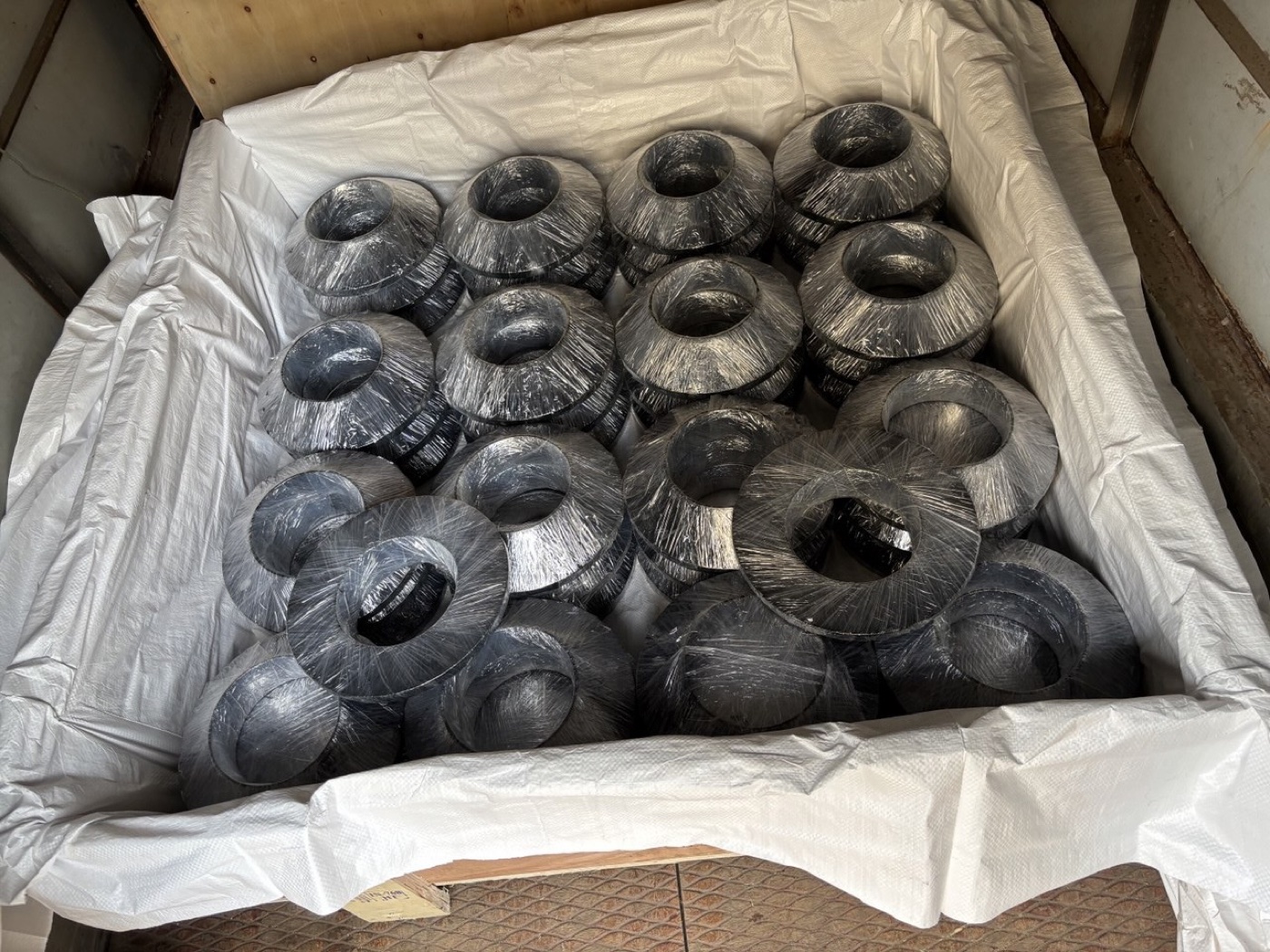
A182 F91 Weld Neck Flanges — Wrapped in Lined Export Crate, Ready for Dispatch
ASTM A182 F91 Weld Neck Flange Dimensions
F91 weld neck flanges share their dimensions with every other material in the same class — OD, thickness, hub, bore, bolt circle and bolting per the standard tables. Full ASME B16.5 charts:
European PN dimensions are published on the EN 1092-1 Type 11, DIN 2631–2635 and BS 4504 pages.
Price List & How to Order
F91 pricing follows the alloy market plus the heat-treatment, testing and witness scope that Grade 91 projects specify, so we quote live rather than publish a static list. To get a firm quotation, usually within 24 hours:
1
List your requirement — size (NB), class or PN, standard (ASME B16.5 / B16.47 / EN / DIN / BS), facing (RF or RTJ), pipe schedule or bore, and quantity.
2
Add the certification scope — IBR, 3.2, witness points, hardness mapping, PMI — Grade 91 paperwork is usually project-specified, so the more detail the firmer the quote.
ASTM A182 F91 Weld Neck Flanges — Frequently Asked Questions
What is an ASTM A182 F91 weld neck flange?
It is a weld neck flange forged from ASTM A182 grade F91 — modified 9Cr-1Mo-V, the Grade 91 creep-strength-enhanced ferritic steel (UNS K90901). The long tapered hub is butt-welded to the pipe with the bore matched to the pipe schedule, giving a radiographable, fatigue-resistant joint in the strongest creep-service grade of the chrome-moly family — the flange of supercritical and ultra-supercritical steam piping worldwide.
What does the 'modified' in modified 9Cr-1Mo mean?
Micro-alloying. F91 takes the 9Cr-1Mo base of F9 and adds small, tightly controlled amounts of vanadium (0.18-0.25%), niobium (0.06-0.10%) and nitrogen (0.030-0.070%). Those elements form fine, stable carbo-nitrides that pin the microstructure at temperature, roughly doubling the creep strength of conventional 9Cr steel. That is the entire point of Grade 91 — and why its heat treatment and welding rules are the strictest in the family.
How does F91 compare with F9 and F22?
F9 shares the 9% chromium but not the micro-alloying — it is the sulphidation-resistance grade for refineries, not a creep champion. F22 (2.25Cr-1Mo) is the conventional power grade that F91 typically replaces: at supercritical steam conditions, F91's higher allowable stresses permit thinner walls, lighter headers and fewer welds. The trade is discipline — F91 demands tighter heat treatment, welding and hardness control than either. We forge all three.
What temperature can F91 flanges handle?
F91 serves creep-range steam duty to around 600-620 °C — supercritical and ultra-supercritical territory — with design stresses per the ASME rating tables far above F22 at those temperatures. Its performance depends on the correct normalized-and-tempered microstructure, which is why heat treatment condition and hardness are certified on every lot and should be preserved through fabrication.
What are the equivalent designations for A182 F91?
Grade 91 in general usage; UNS K90901; Werkstoff Nr. 1.4903; and the European designation X10CrMoVNb9-1. Its system partners share the chemistry: A335 P91 seamless pipe, A234 WP91 butt-weld fittings and A217 C12A castings. An enquiry in any of these designations is quoted as the same material.
What is the chemical composition of ASTM A182 F91?
Carbon 0.08 to 0.12%, manganese 0.30 to 0.60%, phosphorus 0.020% max, sulphur 0.010% max, silicon up to 0.50%, chromium 8.50 to 9.50% and molybdenum 0.85 to 1.05% — plus the defining micro-alloys: vanadium 0.18 to 0.25%, niobium 0.06 to 0.10% and nitrogen 0.030 to 0.070%. Note the unusually tight phosphorus and sulphur limits, part of what keeps the grade tough despite its strength.
What are the mechanical properties of A182 F91 flanges?
Minimum tensile strength 585 MPa (85 ksi), minimum yield strength 415 MPa (60 ksi) and minimum elongation 20% — the highest strength minimums of the chrome-moly flange family. Hardness is watched at both ends: too hard indicates an untempered structure, too soft indicates over-tempering that sacrifices creep strength. Typical acceptance practice runs around 190 to 250 HB, and every lot's values are certified.
Which pipe grade do F91 weld neck flanges mate with?
ASTM A335 P91 — the modified 9Cr-1Mo-V seamless pipe that carries supercritical main steam and hot reheat lines — with A234 WP91 fittings completing the system. The weld neck bore is machined to the pipe schedule you state, so the bore runs flush through the joint and the bevel arrives ready for a matched-chemistry butt weld.
How are F91 flanges welded to pipe?
With matching Grade 91 consumables — E9015-B9 electrodes or ER90S-B9 wire — preheat around 200 to 250 °C, controlled interpass temperature, and post-weld heat treatment in a tight window around 745 to 775 °C. The PWHT temperature matters more than on any other grade: too low leaves brittle martensite, too high destroys the creep-resistant microstructure. Qualified procedures and calibrated furnaces are not optional on Grade 91 work.
What is Type IV cracking, and how is it managed?
Type IV cracking is creep failure in the fine-grained outer edge of a weld's heat-affected zone — the recognised long-term damage mode of Grade 91 systems. It is managed, not eliminated: correct PWHT, hardness verification on both sides of every weld, designs that keep welds out of the highest-stress locations, and in-service monitoring. Buying flanges with certified heat treatment and hardness — as ours ship — is the first link in that chain.
Why does hardness matter so much on F91?
Because hardness is the field-measurable proxy for the microstructure that gives Grade 91 its creep strength. A soft reading (below roughly 190 HB) warns of over-tempering or a missed normalize — material that will creep decades early; a hard reading (above roughly 250 HB) warns of untempered martensite that can crack. That is why our F91 flanges ship with hardness surveys on the certificate, and why site QA re-checks hardness after every PWHT.
Do you supply F91 flanges with IBR certification?
Yes. Grade 91 is the backbone of modern Indian supercritical power plants, and we supply F91 weld neck flanges with IBR Form III-C documentation under the Indian Boiler Regulations, alongside the EN 10204 3.1 or 3.2 material certificate with full heat-treatment and hardness records. State the IBR requirement in your enquiry so inspection and countersigning are scheduled into production.
Where are ASTM A182 F91 weld neck flanges used?
Supercritical and ultra-supercritical power plants above all: main steam and hot reheat piping, boiler outlet headers, turbine leads and bypass systems. HRSG high-temperature sections in large combined-cycle plants follow, along with refinery and petrochemical services that need maximum creep strength in a ferritic grade. Wherever A335 P91 pipe runs, F91 flanges complete the system.
What sizes and standards do you manufacture F91 weld neck flanges in?
From 1/2 inch NB to 56 inch NB: ASME B16.5 Class 150 to 2500 up to 24 inch, ASME B16.47 above, and European PN 2.5 to PN 400 patterns to EN 1092-1 Type 11, DIN and BS 4504. Raised face is standard, ring joint for the highest classes on request — the 3 inch Schedule 160 Class 2500 flange photographed on this page is a production example — and every bore is machined to the mating pipe schedule.
What testing and certification do you supply with F91 flanges?
Every lot ships with EN 10204 3.1 mill test certificates covering chemical analysis including the V/Nb/N micro-alloys, mechanical properties, normalize-and-temper records and hardness surveys, with 3.2 certification witnessed by Lloyd's, DNV, BV or TÜV on request. PMI verifies the chemistry on the actual flange, and IBR documentation is available for boiler work — with full heat-number traceability throughout.
Do you keep A182 F91 weld neck flanges in stock? What is the lead time?
F91 is a project-driven grade produced in controlled batches rather than held as commodity stock — the heat-treatment discipline is the product. Common power-plant sizes rotate through production runs, and manufacture typically takes 3 to 6 weeks depending on size, class, quantity and witness requirements. The laser-marked Class 2500 flange photographed on this page is from such a run. Send your list for a firm delivery commitment.
What information should I include in an F91 flange enquiry?
Six things: size (NB), pressure class or PN rating, dimensional standard (ASME B16.5, B16.47 or EN/DIN/BS), facing (RF or RTJ), pipe schedule or bore, and quantity. Add certification scope — IBR, 3.2, witness points, hardness mapping — since Grade 91 paperwork is often project-specified. With these details we return a firm quotation, usually within 24 hours.
Do you export ASTM A182 F91 flanges outside India?
Yes. Tesco Steel & Engineering is an ISO 9001:2015 certified manufacturer based in Mumbai, and F91 weld neck flanges ship to supercritical power projects, boiler makers and EPC contractors across the Middle East, Europe, Africa, Southeast Asia and the Americas. Flanges travel face-protected in lined crates — as photographed on this page — with complete heat-treatment and hardness traceability.

