

TES-LOK instrumentation thread fittings — high-pressure threaded (NPT / BSP / BSPT) pipe fittings for instrument and process connections: hex nipples, couplings, reducers, street elbows, tees, plugs, and caps. The all-threaded counterpart to twin-ferrule tube fittings, machined from bar for high integrity. SS 316, SS 304, Brass, Monel, Inconel, Hastelloy. Up to 10000 PSI (689 bar). −196°C to 537°C. ISO 9001:2015 certified. Made in India.
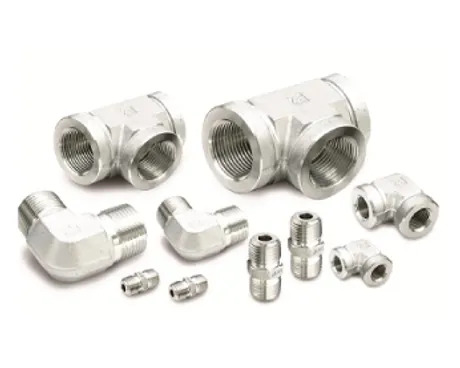
TES-LOK Instrumentation Thread Fittings
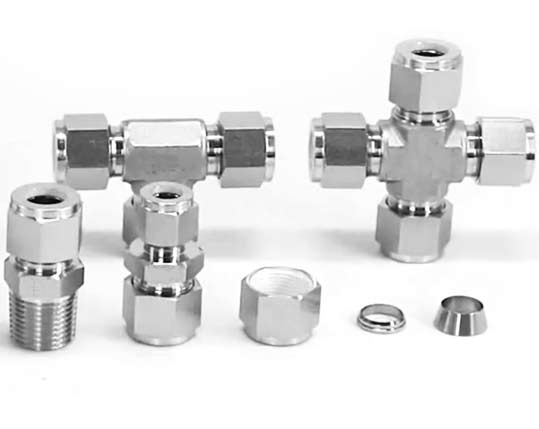
Tube Fittings (Twin-Ferrule)
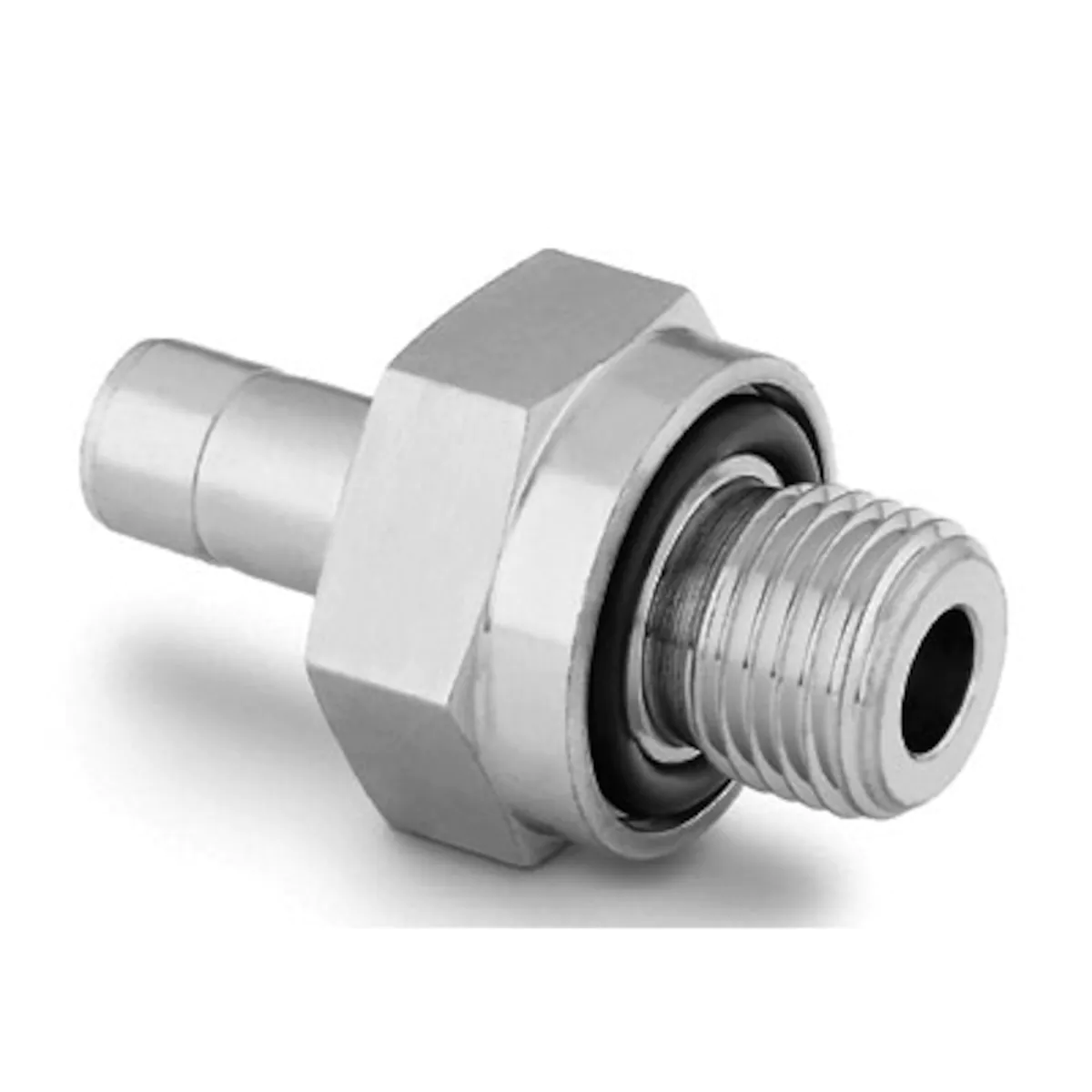
Male Adapter (Thread to Tube)
Thread fittings are the threaded backbone of an instrument hook-up — connecting gauges, transmitters, manifolds, valves, and impulse lines together and adapting between thread sizes and forms. They work alongside twin-ferrule tube fittings (which connect tube) and are often combined with them via male and female adapters to build complete instrument tubing and piping assemblies.
| Criterion | Instrumentation Thread Fitting | Instrumentation Tube Fitting |
|---|---|---|
| Connection | Pipe thread both ends (NPT / BSPT / BSPP) | Twin-ferrule compression on tube; thread on other end |
| Joins | Threaded ports, instruments, valves, manifolds | Instrument / process tube to instruments & ports |
| Pressure | Up to 10000 PSI (689 bar) — no tube joint to limit | Up to 6000 PSI (tube-joint limited) |
| Sealing | Thread interference (tapered) + PTFE tape / sealant | Ferrule seal on tube OD |
| Examples | Hex nipple, coupling, reducer, street elbow, plug | Male connector, union, elbow, tee, bulkhead |
| Used together? | Yes — male / female adapters bridge thread fittings and tube fittings to build complete hook-ups | |
TES-LOK manufactures the complete range of threaded instrument pipe fittings. Explore each product:
| Category | Fittings |
|---|---|
| Nipples | Hex Nipple • Reducing Hex Nipple |
| Couplings | Hex Coupling • Reducing Hex Coupling |
| Elbows & Tees | Street Elbow • Reducing Street Elbow • Street Tee |
| Plugs & Caps | Hex Plug • Female Cap |
| Thread / Tube Adapters | Male Adapter • Female Adapter • Male Connector (Bonded Seal) |
| Thread | Type | Sealing | Standard |
|---|---|---|---|
| NPT | Tapered 60° | Thread interference + PTFE tape / sealant | ASME B1.20.1 |
| BSPT (Rc) | Tapered 55° | Thread interference + PTFE tape | BS 21 / ISO 7-1 |
| BSPP (G) | Parallel 55° | Bonded seal / O-ring on face (not tape) | BS 2779 / ISO 228 |
| UNF | Unified fine 60° | Thread + washer / O-ring | ASME B1.1 |
| Metric | Parallel 60° | O-ring face / bonded seal | ISO 261 / DIN 13 |
| Parameter | Details |
|---|---|
| Brand | TES-LOK (Tesco Steel & Engineering) |
| Type | Threaded instrument / process pipe fittings (bar-stock machined) |
| Size Range | 1/16" to 2" | 2 mm to 50 mm (thread / port size) |
| Working Pressure | Up to 10000 PSI (689 bar) @ 38°C (100°F) — size and material dependent |
| Working Temperature | −196°C to 537°C (−320°F to 1000°F) — material dependent |
| Thread Options | NPT, BSP (BSPP), BSPT, UNF, ISO metric, SAE |
| Body Material | SS 316 / 316L, SS 304, Brass, Monel, Inconel, Hastelloy, special alloys |
| Configurations | Hex nipple, reducing nipple, hex coupling, reducing coupling, street elbow, street tee, hex plug, cap, adapters |
| Standards | Thread forms per ASME B1.20.1 (NPT), BS 21 / ISO 7-1 (BSPT), ISO 228 (BSPP); ASTM material specs |
| Certifications | ISO 9001:2015 | EN 10204 3.1 MTC on request |
| Material | Max Temp | Corrosion Resistance | Typical Service |
|---|---|---|---|
| SS 316 / 316L | 537°C | Excellent — chloride resistant | General instrumentation, offshore, chemical, marine |
| SS 304 / 304L | 537°C | Good — general service | Food, pharma, water, mild process |
| Brass | 150°C | Moderate — no ammonia/acids | Pneumatics, compressed air, low-pressure water |
| Monel 400 | 480°C | Excellent — HF, seawater | HF service, desalination, marine |
| Inconel 625 | 537°C+ | Outstanding — high-temp & sour | Furnace, sour gas, high-temperature lines |
| Hastelloy C-276 | 500°C | Superior — strong acids | Chemical reactors, acid & halogen service |
With no tube/ferrule joint to limit them, threaded instrument fittings carry very high working pressures — up to 10000 PSI (689 bar) — making them ideal for high-pressure gauge and instrument hook-ups.
Bodies are CNC-machined from solid bar stock with clean, accurate thread forms — no porosity, consistent thread gauging, and reliable sealing on tapered NPT/BSPT and parallel BSPP threads.
SS 304 and Brass for general service; SS 316 for corrosion; Monel, Inconel, and Hastelloy for HF, sour, high-temperature, and strong-acid media — one threaded-fitting range across the full material spectrum.
Used with male and female adapters, the thread-fitting range connects seamlessly to TES-LOK twin-ferrule tube fittings — so a complete instrument hook-up (threads + tube) comes from a single source.
Hex nipples and couplings (straight and reducing), street elbows and tees, hex plugs and caps, and adapters — the full set of threaded shapes to extend, reduce, branch, blank, and adapt any instrument connection.
Manufactured under ISO 9001:2015 with EN 10204 3.1 material test certificates available on request — full traceability for instrumentation, offshore, and process-plant QA.
| Industry | Typical Use Point | Why Thread Fittings Used |
|---|---|---|
| Oil & Gas / Offshore | Gauge and transmitter hook-ups, impulse line connections, manifold porting | High-pressure threaded connections; SS 316 corrosion resistance |
| Refinery & Petrochemical | Instrument hook-ups, analyser plumbing, process taps | Adapt and extend threaded instrument connections; high integrity |
| Power Generation | Boiler and turbine instrument connections, gauge nipples | 10000 PSI capability; wide temperature range |
| Chemical Processing | Corrosive-service instrument and sample connections | Hastelloy / Monel threaded fittings for aggressive media |
| Pharmaceutical | Instrument and utility threaded connections on skids | SS 316L bar-stock machined; clean, traceable |
| Hydraulics & Pneumatics | Threaded port adapters, nipples, and reducers | High-pressure threaded porting; many shapes from one source |
| Water & Utilities | Gauge and instrument threaded connections | Brass and SS options; reliable threaded seals |
| Shipbuilding & Marine | Engine and control instrument threaded hook-ups | SS 316 salt resistance; high-pressure threaded joints |
Q1. What is an instrumentation thread fitting?
It is a threaded (pipe-thread) instrument and process fitting — both connections are pipe threads (NPT, BSPT, or BSPP) rather than tube/ferrule ends. The family includes hex nipples, couplings, reducers, street elbows, tees, plugs, and caps, used to extend, reduce, branch, blank, and adapt threaded instrument connections. Because there is no tube joint to limit it, the threaded fitting carries very high pressure — up to 10000 PSI.
Q2. How is a thread fitting different from a tube fitting?
A thread fitting connects to threaded ports, instruments, and valves with pipe threads on both ends. A tube fitting connects instrument tube using a twin-ferrule compression end. Thread fittings handle higher pressure (no tube joint to limit), while tube fittings provide the removable tube connection. They are used together — male and female adapters bridge the two systems to build complete instrument hook-ups.
Q3. What is the difference between NPT, BSPT, and BSPP threads?
NPT is a 60° tapered thread (US standard) that seals on thread interference with PTFE tape. BSPT (Rc) is a 55° tapered thread (UK/European) that also seals on interference with tape. BSPP (G) is a 55° parallel thread that does NOT seal on the threads — it needs a bonded seal or O-ring on the face. NPT and BSPT are not interchangeable (different angles), and tape must not be relied upon to seal BSPP.
Q4. Why can thread fittings handle higher pressure than tube fittings?
A tube fitting's working pressure is limited by the tube-to-ferrule joint and the tube itself. A threaded fitting has no tube joint — it is a solid, bar-stock-machined body with pipe threads, so its pressure rating is governed only by the material and wall, allowing ratings up to 10000 PSI (689 bar) for high-pressure instrument and gauge hook-ups.
Q5. What sealant should I use on threaded instrument fittings?
For tapered NPT and BSPT threads, use PTFE (Teflon) tape — 2 to 3 wraps from the second thread — or a compatible liquid/paste thread sealant. For parallel BSPP, UNF, or metric threads, use a bonded seal or O-ring on the sealing face; PTFE tape will not reliably seal a parallel thread. Always match the sealing method to the thread type.
Q6. How do I avoid galling stainless steel threaded fittings?
Stainless-on-stainless threads can gall (cold-weld) if tightened dry or too quickly. Use a service-compatible anti-seize compound, engage the threads slowly and squarely by hand first, avoid cross-threading, and do not over-torque. These steps prevent the thread surfaces from seizing during make-up.
Q7. What materials are available?
SS 316/316L and SS 304 for general and corrosive service; Brass for pneumatics and low-pressure water; and Monel, Inconel, and Hastelloy for HF, sour, high-temperature, and strong-acid media. All threaded shapes are offered across the material range, with EN 10204 3.1 MTC available on request.
Q8. Do you supply the full range of threaded shapes?
Yes. TES-LOK manufactures hex nipples and reducing nipples, hex couplings and reducing couplings, street elbows and reducing street elbows, street tees, hex plugs, caps, and male/female adapters that bridge to the tube-fitting range. See the range table above and the sidebar for links to each product, plus the twin-ferrule tube fitting range.