

TES-LOK Reducing Hex Nipple Tube Fittings — male external threads on both ends of different sizes, short precision-machined hex body. Compact inline size reducer for all-threaded instrument and process assemblies. SS 316 · Brass · Monel · Inconel · NPT · BSP · BSPT · BSPP · 1/8"–2" · Up to 6,000 PSI · ISO 9001:2015 certified.
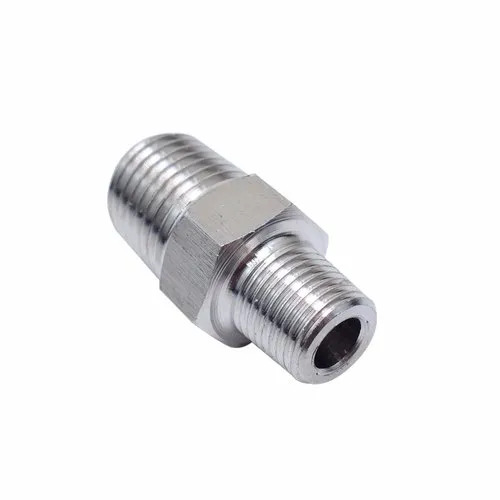
Reducing Hex Nipple
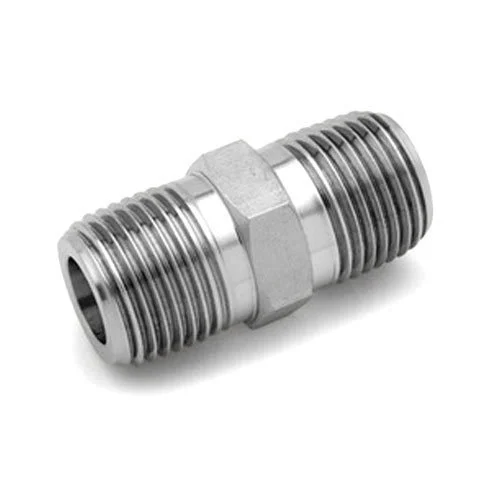
Equal Hex Nipple (same-size variant)
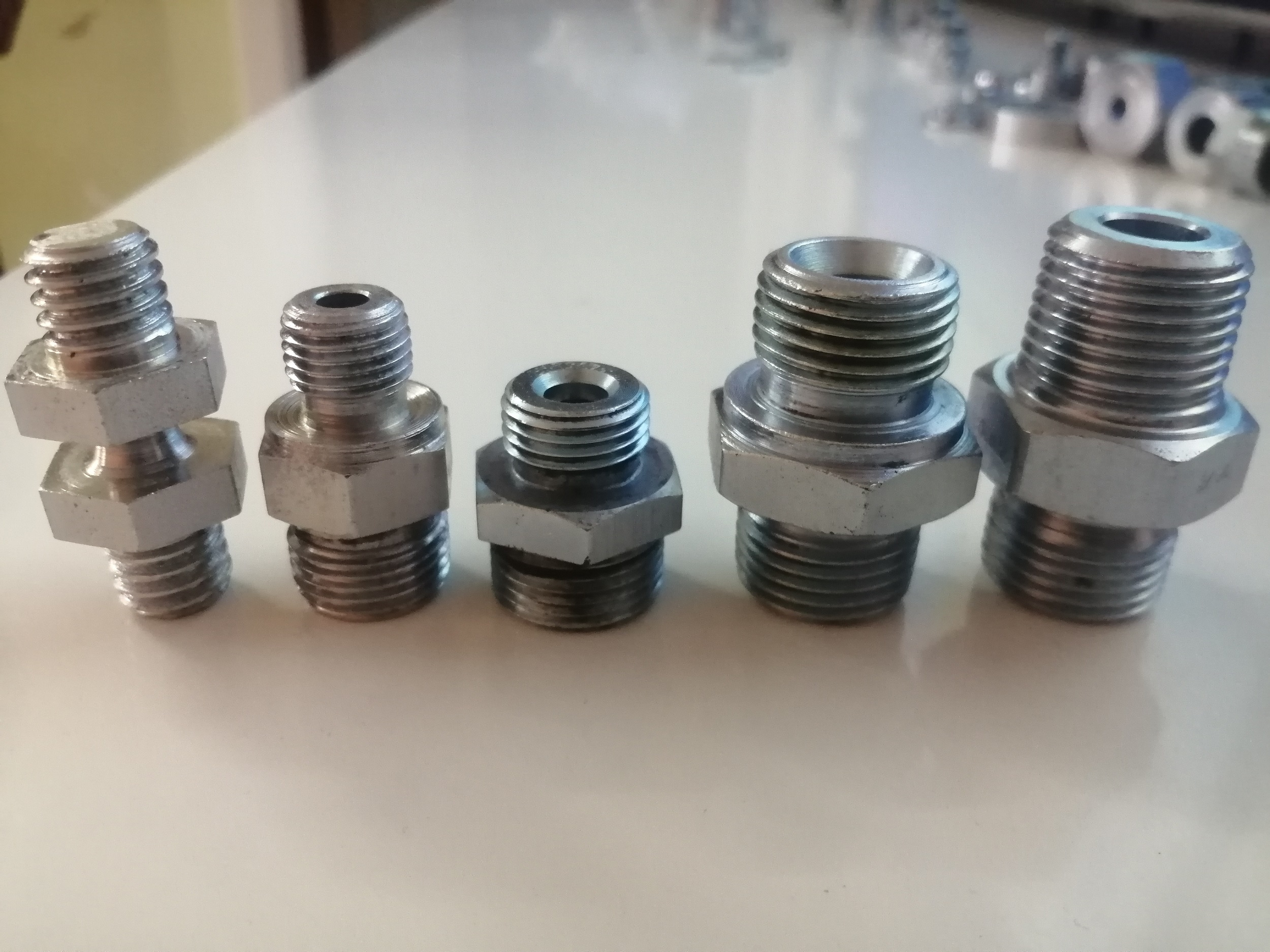
Hex Body & Thread Detail
A reducing hex nipple is a short, solid male-to-male pipe fitting machined with external threads on both ends at different sizes. The body is hexagonal in cross-section, providing wrench flats so the fitting can be tightened without slipping or damaging adjacent components. It serves as a compact inline size reducer, connecting two female-threaded ports of different pipe sizes — such as a 1/2" NPT valve outlet to a 1/4" NPT instrument inlet — without any additional adapter fittings.
In instrument and process tubing systems, reducing hex nipples are the standard method for bridging thread size mismatches directly at the connection point. Because the hex body is machined from solid bar stock, there are no internal steps or flow-disrupting bores — the internal bore reduces smoothly from the larger end to the smaller end, maintaining clean flow characteristics. TES-LOK reducing hex nipples are precision-machined to ASME B1.20.1 (NPT), BS EN 10226 (BSPT), and BS EN ISO 228-1 (BSPP) thread standards.
| Variant | Large End Thread | Small End Thread | Common Use |
|---|---|---|---|
| NPT × NPT Reducing | NPT (tapered) | NPT (tapered) | All-NPT instrument assemblies, US-standard equipment, oil & gas process lines |
| BSPT × BSPT Reducing | BSPT (tapered) | BSPT (tapered) | UK/European equipment with tapered BSP ports, hydraulic panels |
| BSPP × BSPP Reducing | BSPP (parallel) | BSPP (parallel) | Hydraulic and pneumatic systems where parallel BSP threads are standard |
| NPT × BSPT Mixed | NPT (tapered) | BSPT (tapered) | Cross-standard assemblies — US equipment connected to European valves/manifolds |
| BSPP × NPT Mixed | BSPP (parallel) | NPT (tapered) | Hydraulic equipment with BSPP ports connected to NPT instrument components |
| Fitting | End 1 | End 2 | When to Use |
|---|---|---|---|
| Reducing Hex Nipple | Male thread (large) | Male thread (small) | Connecting two female-threaded ports of different sizes inline; compact, no extra length |
| Equal Hex Nipple | Male thread (same size) | Male thread (same size) | Connecting two female-threaded ports of the same size; extends or closes gaps in threaded assemblies |
| Reducing Hex Coupling | Female thread (large) | Female thread (small) | Connecting two male-threaded pipes or nipples of different sizes; female sockets on both ends |
| Male Adapter | Compression tube | Male thread | Transitioning from compression tube to a female-threaded port — not a pure thread-to-thread reducer |
| Reducing Union | Compression tube (large OD) | Compression tube (small OD) | Inline OD size change within a tube run — no threads involved |
| Thread Standards | NPT per ASME B1.20.1; BSPT per BS EN 10226; BSPP per BS EN ISO 228-1 |
| Thread Size Range | 1/8" to 2" (large end); 1/16" to 1-1/2" (small end); custom combinations on request |
| Body Form | Hexagonal (hex) — uniform hex across full body length for full-length wrench engagement |
| Working Pressure | Up to 6,000 PSI (SS 316, ambient); 3,000 PSI (Brass); consult de-rating table for elevated temperature |
| Standard Material | SS 316 (ASTM A276 / A479) |
| Optional Materials | SS 316L, SS 304, Brass (CW617N), Monel 400, Inconel 600, Hastelloy C-276 |
| Surface Finish | Bright annealed or passivated (SS); natural (Brass); electroless nickel plating available on request |
| Temperature Range | -196°C to +450°C (SS 316); -10°C to +120°C (Brass) |
| Quality Certification | ISO 9001:2015; EN 10204 3.1 MTCs available; PMI testing on request |
| Compatibility | Compatible with Swagelok, Parker A-LOK, Ham-Let, and all standard NPT/BSP fittings and ports |
Specify as Large End Thread × Small End Thread. For example: 1/2" NPT × 1/4" NPT means the large-end male thread is 1/2" NPT and the small-end male thread is 1/4" NPT.
| Large End | Small End | Thread Form | Typical Application |
|---|---|---|---|
| 1/4" | 1/8" | NPT or BSPT | Instrument port to small gauge or transducer inlet |
| 3/8" | 1/4" | NPT or BSPT | Valve outlet to instrument manifold inlet |
| 1/2" | 1/4" | NPT or BSPT | Process line to instrument impulse connection |
| 1/2" | 3/8" | NPT or BSPT | Pump connection to smaller pipeline branch |
| 3/4" | 1/2" | NPT or BSPT | Manifold block to valve inlet; heat exchanger port to instrument |
| 1" | 1/2" | NPT or BSPT | Main line to branch instrument connection |
| 1" | 3/4" | NPT, BSPT, or BSPP | Large-bore connection to medium-bore instrument or valve |
| 1-1/4" | 1" | NPT or BSPP | Hydraulic system size reduction; industrial pipeline branch |
| 1-1/2" | 1" | NPT or BSPP | Large industrial valve to medium-bore instrument; tank outlet to instrument |
| 2" | 1-1/2" | NPT or BSPP | Main process pipe to control valve body; large-bore instrument connections |
Correct thread sealant selection is critical for leak-free installation. The sealant requirement differs by thread form — using the wrong sealant can cause false sealing, assembly failures, or contamination.
| Thread Form | Sealant Required | Application Method | Notes |
|---|---|---|---|
| NPT (Tapered) | PTFE tape or anaerobic thread sealant | 2–3 wraps PTFE tape clockwise on male thread; or apply anaerobic sealant to male threads only | Seal achieved by taper — thread deforms as it tightens into female socket. Do not over-tighten. |
| BSPT (Tapered) | PTFE tape or anaerobic thread sealant | 2–3 wraps PTFE tape clockwise on male thread | Same taper-seal principle as NPT. Thread pitch and angle differ from NPT — do not cross-mix NPT and BSPT. |
| BSPP (Parallel) | Dowty bonded seal (bonded washer) | Fit bonded seal onto male thread shoulder before threading into female port | Parallel threads do not taper-seal. The bonded washer compresses between the male shoulder and the female port face to create the seal. PTFE tape must NOT be used. |
| Mixed NPT × BSPT | PTFE tape on both ends | Apply PTFE tape to each end independently before installation | Both are tapered threads — PTFE tape is appropriate on each end, but torque requirements differ. |
| Mixed BSPP × NPT | Dowty seal on BSPP end; PTFE tape on NPT end | Apply appropriate sealant to each end before threading in | Each end is sealed independently — do not use a single sealant type across both ends. |
A reducing hex nipple eliminates the need for two separate fittings (an adapter plus a nipple) to achieve a thread size change. One precision-machined piece handles the size transition inline, saving space, weight, and assembly time — critical in dense instrument panels and tight manifold configurations.
The hex body runs the full length of the fitting, providing maximum wrench engagement area. This prevents rounding off during high-torque installation, allows a backup wrench on one end while tightening the other, and makes future disassembly straightforward without fitting damage.
Standard SS 316 construction provides resistance to chloride-bearing environments, process chemicals, and offshore atmospheric corrosion. Suitable for sour gas (H2S), seawater service, and aggressive chemical process streams without special coatings or treatment.
Available in NPT, BSPT, BSPP, and mixed-standard combinations, TES-LOK reducing hex nipples bridge cross-standard assemblies that arise when US-specification equipment is interfaced with European or Asian instruments. Custom thread combinations are manufactured on request.
Each nipple is precision-machined and thread-gauged to ASME B1.20.1, BS EN 10226, and BS EN ISO 228-1. Dimensional consistency across the production batch ensures that thread engagement, torque behaviour, and sealing performance are repeatable on every fitting — critical for in-line replacement during maintenance shutdowns.
EN 10204 3.1 material test certificates (MTCs) are available on request for all SS 316 and exotic alloy reducing hex nipples. PMI (positive material identification) testing is also available. Full traceability supports documentation requirements for oil & gas, petrochemical, and pharmaceutical installations.
TES-LOK Reducing Hex Nipples are specified across a broad range of instrument and process installations wherever a thread size change is required at a connection point:
▶ What is a reducing hex nipple tube fitting?
A reducing hex nipple is a short male-to-male pipe fitting with external threads on both ends machined to different sizes. The hex body in the centre provides wrench flats for installation. It is used to connect two female-threaded components — such as a valve, manifold port, or pipe coupling — of different thread sizes without additional adapters. In instrument and process tubing systems, reducing hex nipples serve as compact inline size reducers in all-threaded assemblies.
▶ What is the difference between a reducing hex nipple and a standard hex nipple?
A standard (equal) hex nipple has the same thread size on both ends — it simply extends or reconnects two ports of the same size. A reducing hex nipple has different thread sizes on each end — for example, 1/2" NPT on one end and 1/4" NPT on the other — allowing an inline size change between two female-threaded components. Both share the same short hex body and wrench-flat design.
▶ What thread forms are available for reducing hex nipples?
TES-LOK Reducing Hex Nipples are available in NPT (ASME B1.20.1), BSPT (BS EN 10226), and BSPP (BS EN ISO 228-1). Mixed-standard combinations — such as NPT large end with BSPT small end — are available on request for cross-standard assemblies.
▶ Can I use PTFE tape on a BSPP reducing hex nipple?
No. PTFE tape must never be applied to BSPP (parallel BSP) threads. Parallel threads do not seal by thread engagement — they require a Dowty bonded seal (bonded washer) on the male thread shoulder against the female port face. PTFE tape on BSPP creates a false torque sensation without sealing. Only apply PTFE tape to NPT and BSPT (tapered) thread ends.
▶ How do I install a reducing hex nipple correctly?
Apply appropriate thread sealant to both male ends (PTFE tape for NPT/BSPT, Dowty seal for BSPP). Thread the smaller end into its female port first, then tighten using an open-end wrench on the hex body flats. Thread the larger end into its second port and tighten similarly. Never use a pipe wrench on hex flats — it will round off the flats and make future removal impossible. Do not over-torque. Pressure-test after assembly.
▶ What size combinations are available?
Common combinations include: 1/4" × 1/8", 3/8" × 1/4", 1/2" × 1/4", 1/2" × 3/8", 3/4" × 1/2", 1" × 1/2", 1" × 3/4", 1-1/4" × 1", 1-1/2" × 1", and 2" × 1-1/2". Non-standard size combinations are manufactured on request. Specify large-end thread × small-end thread when ordering.
▶ What materials are available?
SS 316 (standard), SS 316L, SS 304, Brass, Monel 400, Inconel 600, and Hastelloy C-276. SS 316 is the preferred material for instrument and process tubing systems in oil & gas, chemical, and offshore environments. EN 10204 3.1 MTCs and PMI available on request.
▶ What is the pressure rating of a reducing hex nipple?
Up to 6,000 PSI in SS 316 at ambient temperature. Brass versions are rated to 3,000 PSI. The pressure rating is governed by the smaller thread end — always verify the rating of the smallest thread size in the assembly. Working pressure also depends on operating temperature; consult the de-rating curve for elevated-temperature applications.
SS 316 · Brass · Monel · Inconel · NPT · BSP · BSPT · BSPP · 1/8"–2" · Custom size combinations · ISO 9001:2015 · EN 10204 3.1 MTCs available
✉ Email Quote 📞 WhatsApp