

TES-LOK Street Tee Tube Fittings — male thread on one run end (the street end), female thread on the opposite run end and branch. Thread directly into a female socket without a nipple. SS 304 · SS 316 · Brass · Alloy 400 · Equal and Reducing · 6,000 PSI · ISO 9001:2015 certified.
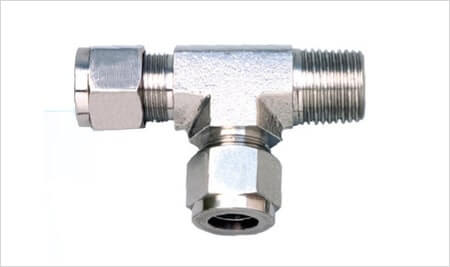
A street tee tube fitting — also called a service tee or male-female tee — is a T-shaped three-port fitting with a mixed-gender thread arrangement: one inline run end carries a male external thread (the "street end"), while the opposite run end and the perpendicular branch port each carry a female internal thread.
The defining feature is the street end. Because it presents an external male thread, the street tee can thread directly into the female socket of an adjacent fitting, valve body, or manifold entry — eliminating the close nipple that would otherwise be required to bridge two back-to-back female sockets. The result is a more compact assembly with one fewer fitting and one fewer potential leak joint.
The term "street" originates from 19th-century pipe-trade usage: a "street fitting" had one male end for direct insertion into a service socket, as if connecting straight off the street main. Today the convention is standardised across NPT and BSP fitting ranges and applies to street elbows, street crosses, and street tees. TES-LOK Street Tees are machined from certified bar stock, rated to 6,000 PSI, and available in SS 304, SS 316, Brass, and all major special alloys.
| Port | Connection Type | Function |
|---|---|---|
| Run End 1 — Street End (inline) | Male thread (NPT / BSP) | Threads directly into female socket of adjacent fitting, valve, or manifold — no nipple required |
| Run End 2 — Opposite (inline) | Female thread (NPT / BSP) | Receives male-threaded nipple, stud, or pipe end for the continuing run |
| Branch Port (perpendicular) | Female thread (NPT / BSP) | Receives male-threaded nipple, instrument body stud, or pipe end for the branch |
The street end (male run) and opposite run end are coaxial; the branch is perpendicular at 90°. Compare with the Male Tee (all three ports male) or the Female Tee (all three ports female).
| Parameter | Details |
|---|---|
| Product name | Street Tee Tube Fitting (Service Tee / Male-Female Tee) |
| Brand | TES-LOK (Tesco Steel & Engineering) |
| Street end (Run 1) | Male external thread — NPT, BSPT, BSPP, UNF, ISO metric |
| Opposite run end (Run 2) | Female internal thread — same standard as street end |
| Branch port | Female internal thread — same standard as street end |
| Configuration | Equal (same thread size all ports) · Reducing (branch one size smaller) |
| Thread size range | 1/8" to 1" (NPT / BSP) · ISO metric M10 to M42 |
| Max working pressure | Up to 6,000 PSI (SS 316, ambient temperature) |
| Materials | SS 304, SS 316, SS 316L, Brass, Alloy 400 (Monel), Alloy 600 (Inconel), Alloy C-276 (Hastelloy), Duplex 2205, Super Duplex 2507 |
| Temperature range | −65 °F to +1200 °F (material dependent) |
| Thread standard | ANSI/ASME B1.20.1 (NPT) · BS EN 10226 / ISO 7 (BSPT) · ISO 228 (BSPP) |
| Quality certification | ISO 9001:2015 · Material test certificates · 3.1 / 3.2 MTCs on request |
| Industries | Oil & Gas · Petrochemical · Power · Hydraulics · Marine · HVAC |
| Street End (Male) | Opposite Run (Female) | Branch (Female) | Typical Application |
|---|---|---|---|
| 1/8" NPT(M) | 1/8" NPT(F) | 1/8" NPT(F) | Miniature manifold entries, gauge socket connections |
| 1/4" NPT(M) | 1/4" NPT(F) | 1/4" NPT(F) | Instrument panel T-junctions, transmitter headers |
| 1/4" NPT(M) | 1/4" NPT(F) | 1/8" NPT(F) | 1/4" run with smaller 1/8" instrument branch |
| 3/8" NPT(M) | 3/8" NPT(F) | 3/8" NPT(F) | Process skid headers, hydraulic loop T-points |
| 3/8" NPT(M) | 3/8" NPT(F) | 1/4" NPT(F) | 3/8" process run with 1/4" instrument branch |
| 1/2" NPT(M) | 1/2" NPT(F) | 1/2" NPT(F) | High-flow process headers, steam distribution |
| 1/4" BSP(M) | 1/4" BSP(F) | 1/4" BSP(F) | Offshore metric loops, European OEM instrument panels |
| 1/2" BSP(M) | 1/2" BSP(F) | 1/4" BSP(F) | Marine hydraulic headers with metric instrument tap |
Wherever two female sockets face each other — a valve outlet and a tee body, for instance — a standard arrangement requires a close nipple between them. The street tee removes that nipple entirely: the male street end threads straight into one female socket, reducing fitting count by one and eliminating one potential leak path per T-junction.
By removing the nipple, the street tee shortens the overall assembly by the nipple length — typically 25 mm to 50 mm per joint. Over a manifold with multiple T-points, this saving compounds. Compact assemblies are especially valuable in offshore module skids, analysers, and instrument cabinets where footprint is constrained.
One fewer fitting means one fewer threaded joint to prepare, seal, and torque. For high-volume instrument skid assembly or offshore hook-up work, the reduction in joint count across hundreds of street tees translates into measurable time savings and fewer opportunities for incorrect sealant application.
TES-LOK Street Tees are available in equal configuration (same thread size on all three ports) and reducing configuration (branch one size smaller than run). A reducing street tee at a branch point further eliminates a separate threaded reducer, cutting another fitting and another joint from the assembly.
Machined from certified bar stock to the same dimensional and pressure standards as all TES-LOK threaded fittings, the street tee achieves up to 6,000 PSI working pressure. The all-metal body with no elastomeric components handles cryogenic through high-temperature service without degradation.
Available in SS 304, SS 316, SS 316L, Brass, Monel 400, Inconel 600, Hastelloy C-276, Duplex 2205, and Super Duplex 2507. All materials are supplied with EN 10204 3.1 MTCs; 3.2 third-party MTCs are available on request for critical or nuclear-class service.
| Fitting | Run End 1 | Run End 2 | Branch | When to Choose |
|---|---|---|---|---|
| Street Tee | Male thread | Female thread | Female thread | One run end plugs into a female socket; other two ports receive male nipples |
| Male Tee | Male thread | Male thread | Male thread | All three mating parts are female-threaded sockets |
| Female Tee | Female thread | Female thread | Female thread | All three mating parts are male-threaded nipples or studs |
| Male Run Tee | Male thread | Compression tube | Compression tube | One threaded run end; remaining ports are compression tube |
| Female Run Tee | Female thread | Compression tube | Compression tube | One female run end; remaining ports are compression tube |
Both fittings use the same "street end" concept — a male thread that plugs directly into an adjacent female socket. The difference is geometry:
Use a street elbow when you only need a direction change; use a street tee when you also need a branch tap at the same connection point. See also the Street Elbow product page for specifications.
Step 1 — Plan the assembly. Identify which port is the street end (male thread) and which are the female ports. Orient the tee so the male street end faces the female socket it will thread into, and the two female ports face the male nipples or studs they will receive.
Step 2 — Apply sealant to the male threads. Apply PTFE tape (2–3 wraps, clockwise from the first complete thread) to the male street end of the tee. Do the same for any male nipples that will thread into the two female ports. Do not apply PTFE to parallel BSPP female sockets — use a bonded seal or O-ring on the male thread end instead.
Step 3 — Thread the street end first. Thread the male street end into the female socket of the adjacent fitting or valve body. Hold the body hex immediately behind the street end and tighten 1½ to 2 full turns past hand-tight. Using a back-up wrench here is critical — torquing from the wrong flat can cross-load the female ports and crack the body.
Step 4 — Thread the female ports. Apply PTFE to the male nipples and thread them into the two female ports (opposite run and branch). Tighten each using the nearest body flat, one at a time, with a back-up wrench on the body. Tighten to hand-tight + 1½–2 turns for NPT/BSPT.
Step 5 — Leak test. Pressurise to working pressure and inspect all three joints with a gas sniffer or bubble solution. Depressurise before any retightening — do not torque a live joint.
| Industry | Typical Application |
|---|---|
| Oil & Gas | Wellhead instrument manifold compact T-junctions, chemical injection skid headers |
| Refinery / Petrochemical | Analyser sample conditioning headers, process T-points on congested skids |
| Power Generation | Steam header T-junctions, boiler gauge manifolds, lube oil distribution |
| Hydraulics & Pneumatics | Compact hydraulic power unit T-points, pneumatic panel manifold entries |
| Marine & Offshore | Deck piping manifolds, ballast header T-joints, HVAC instrument loops |
| Chemical & Pharma | Chemical dosing manifold T-points, CIP distribution, sterile utility piping |
▶ What is a street tee tube fitting?
▶ Why is it called a "street" tee?
▶ How does a street tee differ from a male tee or female tee?
▶ What thread standards are available?
▶ What sizes are available?
▶ What is the maximum pressure rating?
▶ How do I install a street tee?
▶ Which industries use street tee tube fittings?
ISO 9001:2015 certified manufacturer. SS 304 · SS 316 · Brass · Special Alloys. 1/8"–1" NPT / BSP / BSPT. Equal and Reducing. Short lead times. Mill test certificates included.
✉ Email Quote 📞 WhatsApp 📞 Call Us