

TES-LOK Female Tee Tube Fittings — female NPT/BSP internal thread on all three ports. Mount three male-threaded nipples, studs, or pipe ends in a T-configuration. SS 304 · SS 316 · Brass · Alloy 400 · Equal and Reducing · 6,000 PSI · ISO 9001:2015 certified.
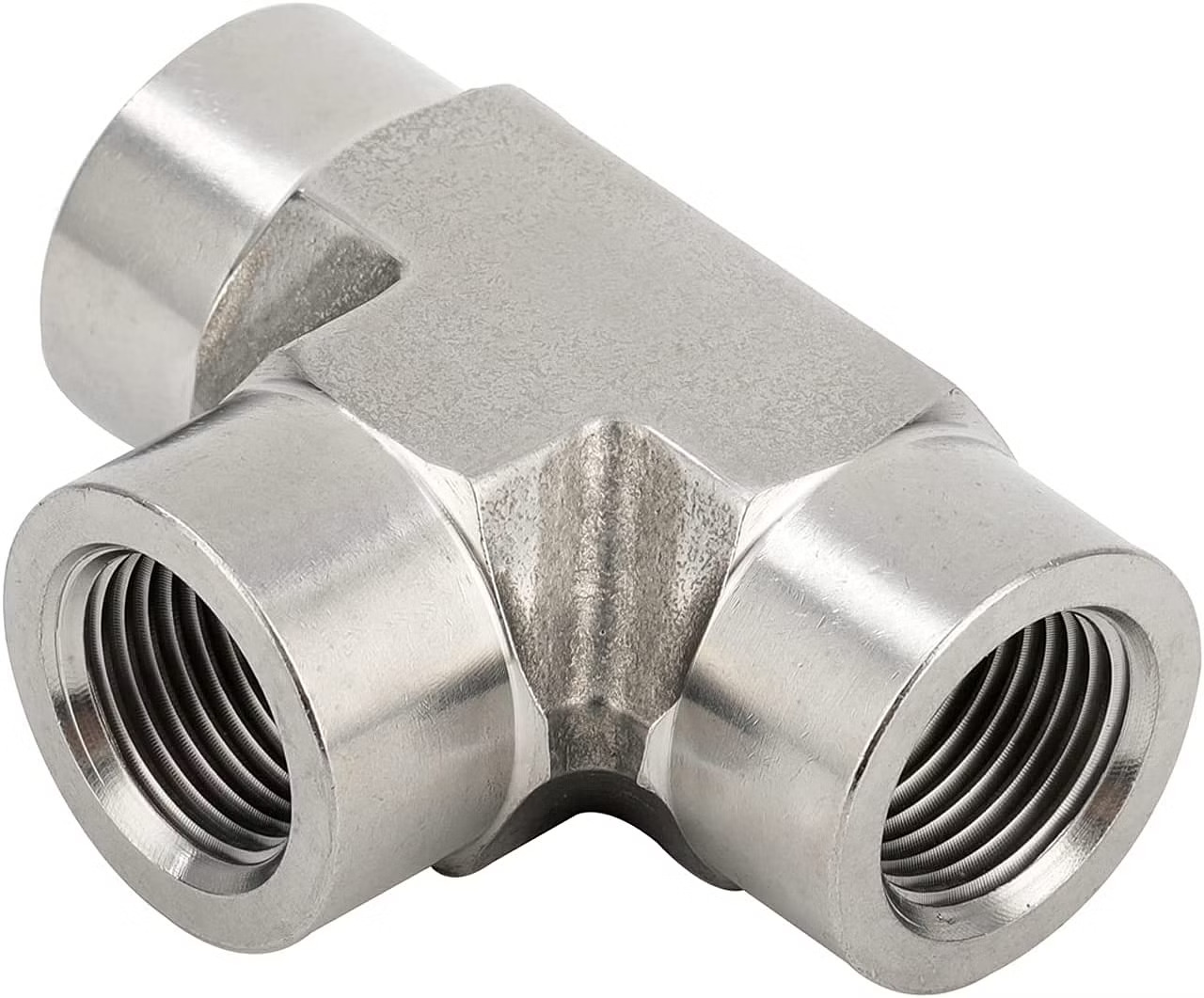
A female tee tube fitting is a T-shaped three-port fitting with female internal threads on all three ports — two inline run ports and one perpendicular branch port. All three ports receive male-threaded components: nipples, hex nipples, studs, pipe ends, or male connectors. It is the direct counterpart of the male tee and is chosen when every mating component presents an external male thread.
Unlike hybrid tee fittings such as the female branch tee or female run tee — which combine tube compression ends with a single female-threaded port — the TES-LOK Female Tee has no compression ends at all. Installation requires only thread sealant and a wrench. There are no tube stubs to cut, no ferrule shoulders to deburr around, and no ferrule make-up sequence to follow, making this the fastest all-threaded T-junction to assemble on any instrument skid or process header.
Machined from bar stock or drop-forged blanks, TES-LOK Female Tees are available in equal configuration (same thread size on all three ports) and reducing configuration (branch one size smaller than the run). Maximum working pressure is 6,000 PSI in SS 316 at ambient temperature. All materials are supplied with full Mill Test Certificates; EN 10204 3.1/3.2 MTCs are available on request.
| Port | Connection Type | Function |
|---|---|---|
| Run Port 1 (inline) | Female thread (NPT / BSP) | Receives male-threaded nipple, stud, or pipe end |
| Run Port 2 (opposite inline) | Female thread (NPT / BSP) | Receives male-threaded nipple, stud, or pipe end |
| Branch Port (perpendicular) | Female thread (NPT / BSP) | Receives male-threaded nipple, instrument body stud, or pipe end |
All three ports are interchangeable in the equal configuration. For reducing female tees, the branch port has a smaller thread size than the two run ports. Compare with the Male Tee (male thread on all three ports) or the Female Branch Tee (female thread only on branch; compression tube on run ends).
| Parameter | Details |
|---|---|
| Product name | Female Tee Tube Fitting |
| Brand | TES-LOK (Tesco Steel & Engineering) |
| Connection type — all ports | Female internal thread — NPT, BSP tapered (BSPT), BSP parallel (BSPP/G), UNF, ISO metric, SAE/JIC |
| Configuration | Equal (all three ports same size) · Reducing (branch one size smaller than run) |
| Thread size range | 1/8" to 1" (NPT / BSP) · ISO metric M10 to M42 |
| Max working pressure | Up to 6,000 PSI (SS 316, ambient temperature) |
| Materials | SS 304, SS 316, SS 316L, Brass, Alloy 400 (Monel), Alloy 600 (Inconel), Alloy C-276 (Hastelloy), Duplex 2205, Super Duplex 2507 |
| Temperature range | −65 °F to +1200 °F (material dependent) |
| Thread standard | ANSI/ASME B1.20.1 (NPT) · BS EN 10226 / ISO 7 (BSP tapered) · ISO 228 (BSPP) |
| Quality certification | ISO 9001:2015 · Material test certificates · 3.1 / 3.2 MTCs on request |
| Finish | Bright machined (SS) · Electropolished on request · Nickel-plated (Brass) |
| Industries | Oil & Gas · Petrochemical · Power · Hydraulics · Marine · Pharma |
| Run Thread Size | Branch Thread Size | Configuration | Common Application |
|---|---|---|---|
| 1/8" NPT(F) | 1/8" NPT(F) | Equal | Miniature instrument manifolds, gauge headers |
| 1/4" NPT(F) | 1/4" NPT(F) | Equal | Pressure gauge T-junctions, transmitter manifolds |
| 1/4" NPT(F) | 1/8" NPT(F) | Reducing branch | Main line 1/4"; branch to smaller instrument nipple |
| 3/8" NPT(F) | 3/8" NPT(F) | Equal | Process skid hydraulic headers, pneumatic loops |
| 3/8" NPT(F) | 1/4" NPT(F) | Reducing branch | 3/8" run with 1/4" instrument tap on branch |
| 1/2" NPT(F) | 1/2" NPT(F) | Equal | High-flow process headers, steam distribution |
| 1/4" BSP(F) | 1/4" BSP(F) | Equal | Offshore metric instrument loops, European OEM panels |
| 1/2" BSP(F) | 1/4" BSP(F) | Reducing branch | Marine hydraulic headers with instrument nipple tap |
With female threads on all three ports, the fitting accepts hex nipples, close nipples, stud ends, instrument process connections, and male pipe ends on every port simultaneously — no adapters, no additional fittings, no extra leak joints. Three male-threaded components join in a single T-body.
Unlike compression-type tee fittings, the female tee has no tube stubs or ferrule seats. Installation requires only thread sealant and two wrenches — no tube cutting, deburring, or ferrule make-up sequence. This is the fastest tee variant to install and reduces the risk of installation errors entirely.
Without ferrule shoulders, tube stubs, or compression nut clearances, the female tee body is significantly more compact than any hybrid tee variant of equivalent port size. This makes it ideal for tight panel spaces, densely packed skids, and in-line manifold assemblies where envelope size is constrained.
TES-LOK Female Tees are available in equal configuration (identical thread size on all three ports) and reducing configuration (branch one or two sizes smaller than the run ports). A reducing female tee eliminates a separate threaded reducer at the branch junction, cutting component count and potential leak paths by one fitting per T-point.
Machined from the same certified bar stock as TES-LOK's compression-type fittings, the female tee achieves up to 6,000 PSI working pressure. The all-metal construction has no elastomers to degrade at temperature extremes, making it equally suitable for cryogenic, ambient, and elevated-temperature process services.
Available in SS 304, SS 316, SS 316L, Brass, Monel 400, Inconel 600, Hastelloy C-276, Duplex 2205, and Super Duplex 2507. All materials are supplied with EN 10204 3.1 Mill Test Certificates; 3.2 third-party witnessed MTCs are available on request for critical, nuclear, or subsea applications.
| Fitting | Run Port 1 | Run Port 2 | Branch Port | When to Choose |
|---|---|---|---|---|
| Female Tee | Female thread | Female thread | Female thread | All three mating parts are male-threaded |
| Male Tee | Male thread | Male thread | Male thread | All three mating parts are female-threaded |
| Female Branch Tee | Compression tube | Compression tube | Female thread | Tube run passes through; branch receives male nipple/stud |
| Female Run Tee | Female thread | Compression tube | Compression tube | Female thread on one run end; other ports are compression tube |
| Union Tee | Compression tube | Compression tube | Compression tube | All-compression T-junction; no threaded ports at all |
Step 1 — Inspect threads. Check the female threads inside the tee and the male threads on all mating nipples or studs for damage, burrs, or contamination. Clean with a lint-free cloth. Replace any component with a damaged or crossed thread — do not attempt to force-thread past resistance.
Step 2 — Apply thread sealant to the male mating threads. For NPT and BSPT (tapered) male threads: apply 2–3 wraps of PTFE tape clockwise (viewed from the thread end), starting from the first complete thread. Alternatively, use an approved anaerobic pipe sealant per the manufacturer's instructions. For BSPP/G (parallel) male threads: do not use PTFE tape — use a bonded seal washer or O-ring face seal on the male thread end.
Step 3 — Thread the first port. Hand-thread one male component into the corresponding female port of the tee until snug. Using a wrench on the nearest body flat, tighten 1½ to 2 full turns past hand-tight for NPT/BSPT. Hold the body hex immediately adjacent to the port being tightened with a back-up wrench — never torque across the tee body, as this can stress the perpendicular female thread and initiate a crack.
Step 4 — Thread the remaining ports. Repeat Step 3 for each of the other two ports. Check all three connections for correct alignment before applying final torque. Misaligned threads must be backed off and re-started — never force an off-axis thread.
Step 5 — Leak test. Pressurise the assembly to working pressure and check all three joints with a calibrated gas sniffer or soap bubble solution. Any weeping joint should be depressurised, the mating thread cleaned and re-sealed with fresh PTFE tape, and retightened — do not attempt to stop a leak by over-torquing a live joint.
| Industry | Typical Application |
|---|---|
| Oil & Gas | Wellhead instrument manifold T-junctions, chemical injection headers, subsea module piping |
| Refinery / Petrochemical | Process header T-points, analyser sample distribution, reactor instrument branching |
| Power Generation | Steam impulse pipe T-junctions, boiler gauge headers, lube oil distribution headers |
| Hydraulics & Pneumatics | T-junction points in hydraulic power units, pneumatic panel distribution, accumulator piping |
| Marine & Offshore | Deck piping T-points, HVAC distribution manifolds, bilge and ballast headers |
| Chemical & Pharma | Dosing manifold T-points, CIP/SIP distribution, sterile utility piping headers |
▶ What is a female tee tube fitting?
▶ How does a female tee differ from a male tee?
▶ How does a female tee differ from a female branch tee or female run tee?
▶ What thread standards are available?
▶ What thread sizes are available?
▶ What is the maximum pressure rating?
▶ How do I install a female tee tube fitting?
▶ Which industries use female tee tube fittings?
ISO 9001:2015 certified manufacturer. SS 304 · SS 316 · Brass · Special Alloys. 1/8"–1" female thread. NPT / BSP / BSPT. Equal and Reducing. Short lead times. Mill test certificates included.
✉ Email Quote 📞 WhatsApp 📞 Call Us